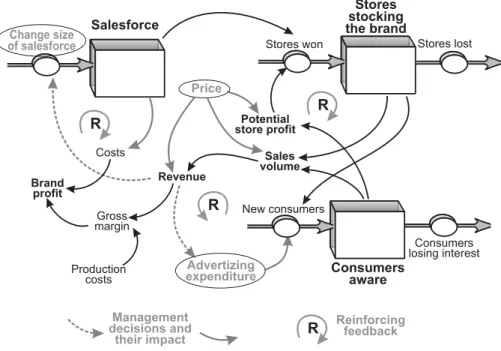
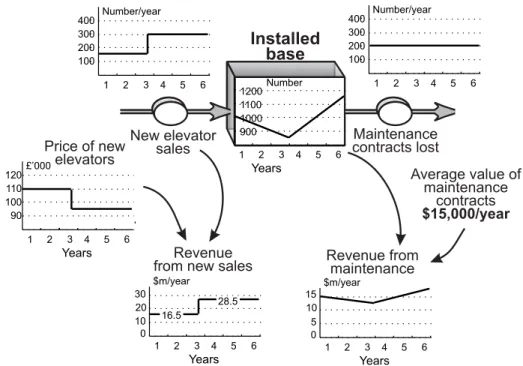
Case C – The BBC has one of the best libraries of high quality television programs in the world and wants to build a strong market for this material. Representing this in the stock and flow framework still requires the basic rules to be met - the stock of resources can only be increased via an input.

Identify the time-path of performance
Identify those few resources at the heart of the business
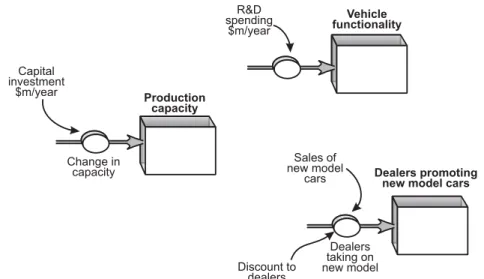
Don't confuse this with purchase rate: since the product is a durable item, revenue comes from initial sales, not frequent repurchases of consumables. The main resource on the supply side is production capacity, which limits the speed at which potentially interested customers can be supplied. This is not to say that cash is unlimited or irrelevant, but the cash situation is an important outcome rather than a fundamental limitation.
Finally, the car's reputation is also left to one side in the first instance, as the question is about how effectively the new market can be developed. Get quantitative – identify the inflows and outflows that cause core resources to grow, develop or decline.
Get quantitative—identify the inflows and outflows causing the core resources to grow, develop, or decline
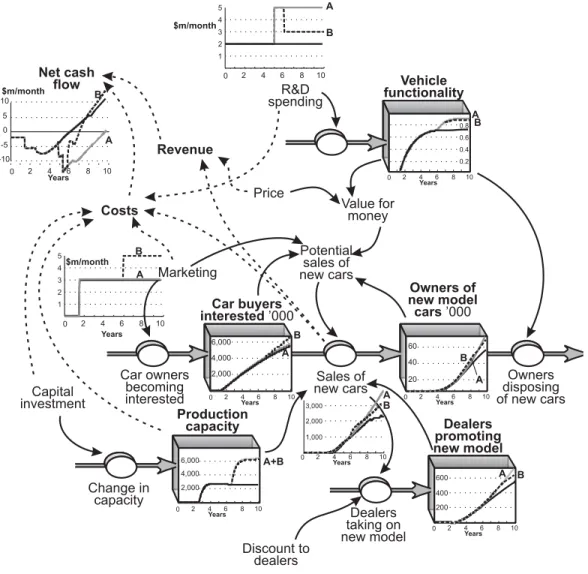
Make sure these time charts are consistent and accurate (it's a shame if inflows and outflows indicate growth, when the arithmetic actually implies decline!). At first, awareness rises sharply as the novelty of the vehicles grabs attention, but this early excitement is difficult to sustain, and consumer interest grows less rapidly. Despite the vehicles' good qualities, buyers just don't choose to buy them, so the population of people who own the new vehicles has barely budged by Year 4.
First, although it is often an important discipline to track stocks and their related flows simultaneously, it is unnecessary for production capacity. Identify how flows of each resource depend on existing resource levels and other drivers.
Identify how flows of each resource depend upon existing levels of resources and other drivers
They are therefore interested both in the speed of sales and in the profit they will make, determined by the discount between the retail price and the price at which they are supplied by the manufacturer. In addition, car owners may be persuaded to consider this product for their next purchase by the company's marketing efforts and by recommendations from existing owners - a word-of-mouth effect. Buyer interest is driven by the company's marketing efforts, and how long owners will keep their vehicles reflects the functionality they experience while owning them.
Some form of functionality will also drive flows, such as the services offered by the telecom provider, the user features of the consumer electronics product, and the actual services offered by the professional service firm. In this case, the comparison between price and functionality of the new vehicles is a strong driver of the potential sales rate (Figure 6.5):.
Combine the resource dependencies from Step 4 into a strategic architecture of the business
Finally – focus on how people actually choose to “run” – don't assume they behave the way you think they should or according to rational judgments or standard models. Do telecommunications customers look at their monthly bill, calculate what they expect from a competing supplier, then rationally compare the difference to what they think is the cost of moving, or simply respond to competitors' claims that they are cheaper. . This is likely to be especially true if the product is significantly new compared to anything the industry has offered before.
Also, the power of any word-of-mouth feedback from first-time buyers of vehicles to persuade others to consider purchasing them needs to be discovered, rather than assumed. The impact of vehicle availability on sales will need to be carefully considered: do enthusiastic buyers simply give up when they can't find cars at their nearest dealer, or do they keep looking until they do.
Get quantitative—again—to see how the strategic architecture explains performance to date and into the future
Customer research can provide some insight into the relative balance of factors that, for example, in practice cause customers to be gained or lost. It is now possible to trace possible explanations for the new vehicle launch problem (Figure 6.9), and foresee how the business may develop in the future. This could either be due to unattractive discounts or the vehicles' slow sales rate itself.
If auto sales are slow, even deep discounts won't provide dealers with significant cash flow, so the problem seems to be the sales rate—we've slowed STRATEGIC ARCHITECTURE o 101. Number of people interested for vehicles it seems to be healthy, over two million.

Revising policy to uprate performance
It is quite possible that this evaluation of the changed strategy will give an answer that is unacceptable (eg, the cumulative cash outflow would not be tolerated). Realizing that R&D improvements will take some time, the price of the cars is immediately reduced, from $40,000 to $32,000. Note that some variables do not seem to differ significantly between the three scenarios (proceed as it is, Case A and Case B)—interested car buyers 104 o DYNAMICS OF COMPETITIVE STRATEGY.
The process described above should make it possible to get a good picture of the firm's strategic architecture. To help diagnose performance problems, a search process can be followed to lead the team to a clear understanding of the causes of their current performance.
Minimize any ‘‘leaks’’ in the system—resource loss rates that are higher than they could be
Minimize any "leaks" in the system - resource loss rates that are higher than they could be. To ensure that such a spread of precious resources is reduced to a minimum, examine the time charts for all outflows in the system. Identify why the leaks are occurring in the system, either due to inadequacies among other resources or inappropriate policies.
There is usually also no direct link from the results of such interviews to redesigned processes or policies that may act to reduce attrition in the future. Identify whether the necessary drivers of resource inflows are all in place and operating effectively.
Identify whether the necessary drivers of resource inflows are all in place and operating effectively
Identify and eliminate any balancing mechanisms that may be preventing progress at present, or may do so in future
Ensure reinforcing processes that should be driving growth are doing so, and seek to add new mechanisms
Make sure the reinforcing processes that should drive growth are doing so, and try to add new mechanisms. Such paths to further growth are clearly already commonplace, but DRSV makes it possible to assess, in detail and at scale, the organization-wide consequences, over time, of such initiatives. Finally, a vital precaution must be taken - examine the new structure of the resource system and look for any opportunities that negative reinforcement may arise.
Ensure that balancing mechanisms are in place to act against such a collapse quickly enough to protect against disaster. It is essential to ensure that any loss of customers or traders does not risk further stimulating such losses.
If necessary, use stepwise solutions to remove resource limits and imbalances
This is clearly unlikely, as the defined limit will soon be reached - the highest level of skill imaginable for the task. Finally, remember why achieving this understanding is important—the level of each intangible resource has a direct and powerful impact on your ability to win and retain other resources. In many cases, the product mix includes negative profit contributors – the right end of the curve again slopes down, indicating that the positive profitability of the profitable products is partially offset by the unprofitable products on the right.
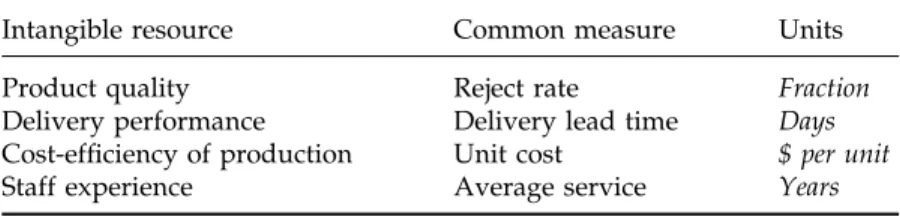
To handle the change in customer quality, it is necessary to capture each customer's revenue contribution (ie, the number of units to be maintained multiplied by the unit price of each contract). The first intangible we can add is a common example of a characteristic of ``co-flow'' - the experience that the professionals themselves carry with them. Technical expertise and process skills such as management of THE HARD FACE OF SOFT FACTORS o 151 .
Finally, two indirect resources may be important—the morale of the staff and the firm's reputation in the market in which it operates.
This first scenario reflects some strong simplifying assumptions – for example, that network capacity and coverage can be provided quickly enough to serve this IN FIGHT - THE DYNAMICS OF RIVALRY o 159. Since the stock of resources (customers) determines performance, this stock can affect which only the rate of flow from the prospect pool, competitive outcomes depend on relative win rates—the share of leads each competitor wins in each time period. Nevertheless, it is useful to think in these terms to focus on key flow rates [i.e. the number of people per period of time who change their behavior from one mode to another]).
Demographic changes such as lower birth rates and longer life expectancies will bring new people into the stock and remove them in BATTLE - THE DYNAMICS OF RIVALRY o 161. Finally, depending on regulatory conditions, service providers are free to design their own network retail—in which V STRUGGLE—RIVALRY DYNAMICS o Example 171 Type 1 rivalry reappears, but now as a competition for the most attractive trade locations.

However, the critical role of the frameworks was to provide focus for information gathering after the service launch. Once trading began, children's flow rates through the system kicked in, the impact of the various factors influencing these flow rates could be assessed, and appropriate changes in marketing and operational policies could be made. This all happened extremely quickly, in the space of just a few weeks, but the clarity of the structure allowed the strategy to be adjusted at the same speed.
One-time sales of refrigerators, televisions, and so on create an installed base that can recommend the product to others. Perhaps more importantly, however, these sales motivate dealers to allocate more space to the supplier of the most popular models (type 3 rivalry).
That's enough to capture a few more of the original supplier's consumers, but note that Rival 2 isn't gaining any business from Rival 1 - the savings pales in comparison to if the average player stays an active handheld user for 10 years, then every year 10 % of the new market. The box in Figure 8.13 thus provides insight into the scope and timing of the unique opportunity offered by sudden shifts.
However, this future cash flow depends on the likely switching of customers, which, as we have seen, will be a dynamic process IN THE BATTLE – THE DYNAMICS OF WEEDING o 179. The incumbent's retention of customers is so great that it more than making up for the cost of the price cut.

First, the major switching rates of concern tend to occur in relation to one or two particularly strong or aggressive competitors. Any existing competing retail chain will be predominantly affected by the customer switching to this new competitor and can safely handle customer switching to and from local independent stores as a group. We will discuss the use of solid groups to simplify rivalries later in this chapter.