Corporate Actions – A Concise Guide
An introduction to securities events
by Francis Groves
HARRIMAN HOUSE LTD 3A Penns Road
Petersfield Hampshire GU32 2EW GREAT BRITAIN Tel: +44 (0)1730 233870 Fax: +44 (0)1730 233880 Email: [email protected]
Website: www.harriman-house.com
First published in Great Britain in 2008 Copyright © Harriman House Ltd
The right of Francis Groves to be identified as the author has been asserted in accordance with the Copyright, Design and Patents Act 1988.
978-1-905641-67-3
British Library Cataloguing in Publication Data
A CIP catalogue record for this book can be obtained from the British Library.
All rights reserved; no part of this publication may be reproduced, stored in a retrieval system, or transmitted in any form or by any means, electronic, mechanical, photocopying, recording, or otherwise without the prior written permission of the Publisher. This book may not be lent, resold, hired out or otherwise disposed of by way of trade in any form of binding or cover other than that in which it is published
without the prior written consent of the Publisher.
Printed and bound in Great Britain by Athenaeum Press Limited, Tyne & Wear.
No responsibility for loss occasioned to any person or corporate body acting or refraining to act as a result of reading material in this book can be accepted by
the Publisher, by the Author, or by the employer of the Author.
iii
Contents
About the Author vii
Preface ix
Introduction xi
Quick Guide to Locating Information on
Specific Corporate Actions xv
1. Defining Corporate Actions 1
The characteristics of a share and its issuer – definitions of corporate actions – how the action is decided upon: articles of association, AGMs & EGMs – the board of directors – chief financial officers and treasury departments – legislation underpinning the system.
2. The Main Corporate Actions 9
How many types of corporate action are there? – definitions/descriptions of main types of corporate actions (dividends, scrip dividends, scrip issues, return of capital, consolidation, rights issues, takeover bids, agreed takeovers, de-mergers) – benefits or otherwise for shareholders and share prices.
3. The Corporate Actions Process 31
From the investor’s point of view – announcement dates – record dates – ex-dates – effective dates – steps along the way to a takeover – corporate actions information from the share prices pages – typical timetables for returns of capital and rights issues.
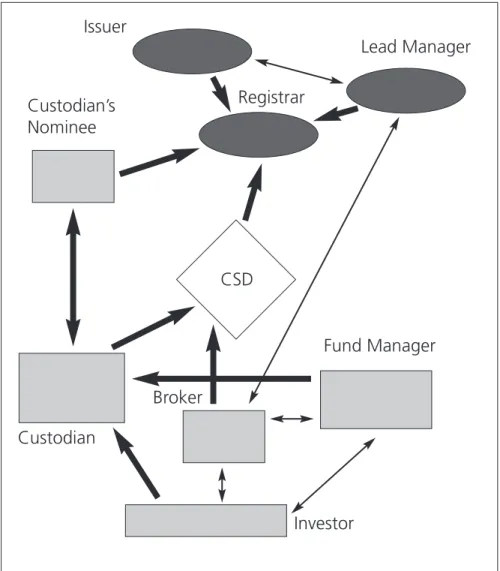
4. The Corporate Actions Industry 43 What goes on behind the scenes – chart of the corporate action flow of information – the connections between the main players – the legislative framework.
5. How Well is the Corporate Actions System Working? 59 The volume of actions and cost of corporate actions administration; staff, data and investment – risk and the cost of mistakes in processing – where do the problems arise? – who loses out when mistakes are made?
6. Corporate Actions; Technology and the Future 73 The importance of automation in corporate actions – ISO 15022 and SWIFT – Straight Through Processing (STP) – ISO 20022 – solution providers in corporate actions automation – how likely is it that full standardisation will ever be achieved?
7. Corporate Actions Wreaking Change on Shares 87 Corporate actions, a winding path – a concrete example – how much does the investor need to know? – how important is corporate action information (or the lack of it) as a factor in selecting a sharedealing/investment service? – different routes for information to reach the investor.
Corporate Actions – A Concise Guide
iv
8. Shareholder Voting 97 How important is it to vote? – voting by investment funds – differences between the UK & the USA – the Myners Report – the state of affairs for the retail/small investor – voting terminology.
9. Corporate Actions and Taxation 109
Stamp taxes and withholding taxes – illustrations of how different corporate actions can affect income tax and CGT liabilities with some specific shares as examples – treatment of corporate actions for ISA holders – investment funds and corporate actions
10. Corporate Actions in Different Jurisdictions 121 National differences in corporate actions – Japanese dividends – depository receipts – restrictions on foreign share ownership – different rules for shareholder general meetings – bearer certificates – the removal of corporate actions barriers in the EU?
11. Corporate Actions for Debt Securities 135 The volume of corporate actions relating to bonds – fundamental difference from equity corporate actions – interest and redemption, the basic corporate actions – optional redemption, callable and puttable bonds – variable coupon bonds and floating rate notes – conversions and warrants.
Contents
v
12. Corporate Action Effects Across the Investing Spectrum 147 How corporate actions affect the calculation of stock exchange indices – how charts handle corporate actions – the effects of corporate actions on futures, options, CFDs and ETFs – corporate actions for CDOs – corporate actions and securities lending – hedge funds and corporate actions – corporate actions and the pension fund trustee – corporate actions and crime.
13. Conclusion 161
Glossary 165
Appendices 191
List of Central Securities Depositories 193 Capital Gains Tax Example – Biffa/Severn Trent 197
Non-rights Issues of Shares 199
Suggested Reading 201
Index 205
About the Author
Francis Groves studied modern history at the London School of Economics and has many years of experience working for legal and financial publishers including, Reuters, the Financial Times and Butterworths. He has written on overseas property investment and created financial literacy training materials. The interaction of politics and finance is a particular interest for him.
vii
Preface
What the book covers
Corporate actions are normally considered as incidental to the business of investing and marketing investments, but the aim of this concise guide is to look at the subject of corporate actions in the round, defining what corporate actions are, listing and describing the main corporate actions and showing how individual corporate actions are applied to investors’ holdings of securities. This will give an overview of the way in which the corporate actions processing function works both in the UK and other important global markets. Detailing all the differences between jurisdictions is beyond the scope of this guide, though the UK is taken as a starting point to help describe and explain significant national distinctions, particularly for the United States and the rest of the European Union.
Who the book is for
The guide is designed to be an introduction to corporate actions for investment industry practitioners in general. Those starting out in corporate actions processing will find it a helpful outline, but it is also designed to be useful for all who encounter corporate actions tangentially in disciplines such as fund management or financial advice provision. Different industry participants have differing interests in corporate actions, and for the sake of consistency the guide is (mainly) written from the point of view of the beneficial owners of securities.
ix
x
Corporate Actions – A Concise Guide
How the book is structured
Those who simply require a handy and straightforward introduction to specific corporate actions will find the quick guide to the content and the glossary of corporate actions terms especially useful.
The first three chapters deal exclusively with equity corporate actions.
These chapters cover definitions of a corporate action and the legal framework(s) underpinning corporate actions, followed by a look at the most significant actions one by one, and then a detailed examination of the staging of some of these. The corporate actions of debt securities are given separate treatment in Chapter 11.
In Chapters 4, 5 and 6 the focus moves from the corporate actions themselves to the industry that has grown up to process them. These three chapters cover respectively the corporate actions industry, its efficiency and its progress (recent and future).
Chapter 7 looks at the impact of successive corporate actions on one particular share (Encore Oil) and shareholdings in it. This is followed by a look at the scope investors have for influencing such events through shareholder voting.
The final chapter looks at how corporate actions are treated in the context of stock indices, stock charts and a number of more complex investments.
Although change in the corporate actions industry is sometimes slow (it has been described as glacial) the process is always evolving, and so this guide can only aim to be a snapshot of the state of affairs at the time of writing, together with an outline of some of the forces for change that are at work. The aim has been to provide sufficient detail to give the reader a working model that is practically helpful in navigating the corporate actions universe.
1For the 12 months from March 2003 there were estimated to be 935,000 equity corporate actions (‘Corporate Action Processing, What Are The Risks’, a study carried out by the consultancy Oxera on behalf of the Depository Trust and Clearing Corporation. Figures on the volume of complex actions and those with the potential to cause share price movements are from the same report.
xi
Introduction
Corporate actions have been sidelined for too long and deserve to be treated with more respect. No type of investment security can be fully understood without knowledge of its corporate actions. All corporate actions have implications for the sustainability of an investment’s performance, but more beguiling investment preoccupations put them into the shade.
The corporate actions processing industry is in deeper shadow than even the actions themselves. Together with bank clearing and exchange settlement systems, the administration of corporate actions is one of the key co-operative functions tying our highly competitive global finance industry together. In the financial markets of the developed world the efficiency and “risklessness” of corporate actions processing is entirely taken for granted. Yet the volume of complex corporate actions and a common sense estimate of the likelihood of mistakes occurring suggest that industry practitioners and investing clients may be deluding themselves.
Figures for the annual number of equity and debt security corporate actions stand at approximately one million and three million respectively.1For equities it is estimated that corporate actions that can be classed as complex comprise 10-15% of the total. It has also been estimated that every year 18,000 corporate actions have the potential to cause significant share price movements in the world’s 25 most
2‘Transforming Structured Securities Processing’, (Depository Trust & Clearing Corporation white paper, September 2007).
xii
Corporate Actions – A Concise Guide
important stock markets. Although this represents just a small percentage of the total number of corporate actions, it nevertheless equates to several dozen price moving corporate events each trading day. In the realm of debt securities the payment events of structured debt caused a huge increase in the volume and complexity of corporate actions in the 2003-07 period.2 Corporate actions processing faces challenges in delivering entitlements to investors accurately and in good time and meeting these challenges is important to the securities industry.
Despite this corporate action practitioners have been left to themselves, carrying on their craft quietly behind a high wall.
If knowledge of corporate actions brings us to fully understand the securities they relate to, some familiarity with corporate actions processing is important in gaining an insight into the workings of the securities industry as a system. With the exceptions of accountancy and financial regulation, no other activity involves as many kinds of investment industry participant as corporate actions processing.
The current state of corporate actions underscores the incompleteness of the globalisation of financial markets. The corporate actions industry is global in the sense that the corporate actions for any tradable security, from wherever it originates will, in some cases, only be processed after a fashion. The relegation of corporate action processing to obscurity is one factor in disguising the host of cultural, ethical and regulatory differences that distinguish securities markets from one another. These differences in the detail are woven into much cross-border corporate actions processing. Although we may be on the brink of an unparalleled extension of the world’s developed economies, understanding of the entitlements of shareholders (domestic and overseas) in the newly developed countries is a long way behind other features of globalisation.
xiii Introduction
A look at corporate actions at this time will give food for thought in several directions. As the financial institutions take stock, re-examining their points of reference, it will be interesting to see whether corporate action entitlements receive more of the limelight than they have up until now.
The corporate actions industry needs to improve its efficiency; what needs to change to affect this, and will the major players be able or willing to put up the investment necessary? As the balance of economic power shifts eastwards, what kind of corporate actions environment will investors meet with when they invest outside their own region? In sum, a better acquaintance with the current state of corporate actions will allow a greater understanding of changes in the securities industry.
Quick Guide to Locating Information on Specific
Corporate Actions
Corporate Action Where to look Related Topics Bonus Issue (Scrip Issue,
Capitalisation Issue, Stock split)
Chs.2,3 Share Consolidation Ch.2
Consolidation Chs. 2,7
Conversion Ch.11
Dividends Chs.2,3,10
Dividend Yield Ch.2 Dividend Cover Ch.2 Scrip Dividend Ch.2
Interest Payments Ch.11 Accrued Interest Ch.11
Redemption Ch.11 Partial Redemption Ch.11
Drawing Ch.11
Return of Capital
(Capital Distribution) Chs.2,3 Capital Gains Tax Ch.9
Rights Issue
(Share Placing) Chs.2,3
Other types of share placing Ch.7, Appendix llll Dilution Ch.7
Capital Gains Tax Ch.9 Pre-emption Rights Ch.2, Appendix lll
Scrip Dividends Ch.2
Share Buyback Ch.2
Takeover Bid Chs.2,3,5,8,
Agreed Takeover Ch.2 De-merger/Divestment /Spin off Chs.2,8,9 Reverse Takeover Chs.7,8 Capital Gains Tax Ch.9
Voting Chs.8,10
Warrant Ch.11
xvii Quick Guide to Locating Information on Specific Corporate Actions
1.
Defining Corporate Actions
I
nvestors may focus mainly on the purchase of securities and their re- sale but equities and debt securities are more than passive tokens of investment value. By means of corporate actions they acquire a life of their own, an ability to transform themselves and to make investors change their minds. Individual corporate actions for equities such as takeover bids or rights issues can have a significant effect on share prices. Over just a few years, the cumulative effect of a number of corporate actions can cause a share to undergo a complete metamorphosis.The starting point of all corporate actions is the ownership of individual units of investment; shares, bonds or variations. For shares ofcommon stock, the type of security on which we shall be concentrating chiefly, the overarching right is that of ownership of the company in question (the issuer) and from ownership spring the following specific rights:
1. To elect the board of directors
2. To vote for corporate actions that require shareholder approval 3. To share in corporate earnings in the form of dividends
4. To maintain the same proportion of the company’s common stock in the event of additional shares being issued
And, finally,
5. To receive a share of theresidual assetsof the company in the event of liquidation (which could be called the saddest corporate action of them all)
So, along with ownership come shared control, shared benefits and rules to protect the rights attached to each share. The shared control tends not to translate into power for the small investor or even large
3
3The shareholder’s lack of control over events affecting their investment will be looked at in more detail in Chapter 7.
4
Corporate Actions – A Concise Guide
minority shareholdings and rules protecting the rights attached to each of a company’s shares do not necessarily protect the financial interests of the share’s owner.3
Further definitions
Definitions of “corporate action” vary depending upon whether the point of view is that of the issuer:
‘an event initiated by a company that affects its share,’ (Frances Maguire, The Banker 1st June 2007)
‘A corporate action occurs when changes are made to the capital structure or financial position of an issuer of a security that affect any of the securities it has issued.’ (‘Transforming Corporate Action Processing’, Depository Trust & Clearing Corporation, 2003)
or the shareholder:
…where the owner of a security is given the opportunity to receive a benefit or participate in a reorganisation of the company.
A complete definition covering all types of corporate action may not be possible. The important point is that corporate actions all have their genesis in the entitlements that accompany owning the shares (no matter how few of them). It follows from this that, in order to put corporate actions into effect, comprehensive information about the ownership of all the shares concerned is required. This information is held in the company’sshare register.
4The significance of the 75% hurdle for special resolutions was demonstrated at the Northern Rock EGM in January 2008 when a number of rebel resolutions received the support of the simple majorities of shareholders represented, but failed because support fell short of the 75% level. As a rule, reporting on shareholder meetings in the press is strong on comment and short on detail.
The most detailed source of information is likely to be the website of the company in question.
5 Defining Corporate Actions
How are corporate actions decided?
For each company the workings of corporate actions will be set out in the articles of association. If one thought of a company as a country, the memorandum and articles of association would be the country’s constitution, the shares would be the voters and the place of Congress or Parliament would be taken by the shareholder meetings (annual or extraordinary general meetings). Although this looks like a “winner takes all” system of government, some proposals, known as “special resolutions”, require 75% support.4 Proposals to change the memorandum and articles of association would be treated as special resolutions.
Chapter 8 will take another look at voting in shareholder meetings;
how it works, how effective it is and moves afoot to improve the system.
Decisions on corporate actions or changes to the articles of association are not the only purpose of shareholder meetings; they also (for example) vote to approve the remuneration of directors, to elect directors, or re-elect them when their terms of office expire.
In the analogy of a country the directors are, of course, the government.
In almost all circumstances it is they who make proposals on various corporate actions for the shareholder meetings to decide on.
Generally speaking, ensuring that a company has sufficient capital and cash to carry on its business successfully will be the responsibility of the company’s Chief Financial Officer (CFO) and its treasury department. Recommendations about items such as the dividend, share or bond issues and share buybacks will originate from this quarter.
5This is available on the web at: http://delcode.delaware.gov/title8/c001/sc01/ . The general distinction between corporate governance, a state matter, and securities trading, a federal one, has become less clear cut since the passing of the Sarbanes Oxley-Act in 2002, the biggest incursion of federal power into corporate law since the 1930s. These variations between the states are more than cosmetic. For example, states like North Carolina would allow creditors to make claims against shareholders who had received ‘excessive dividends’, limited liability notwithstanding.
6These include Florida, Georgia, Indiana, Virginia and Washington.
6
Corporate Actions – A Concise Guide
Patterns of organisation and chains of command vary from one company to the next, but a company’s annual report should explain how the treasury function is carried out.
Who writes the rules?
The picture of the sovereignty of shareholder meetings over the affairs of the company distorts reality by ignoring the importance of national (and international) legislation in regulating companies’ affairs. In the United Kingdom legislation in the form of Statutory Instruments (SIs) taking one or other of the various companies acts or other statutes as their authority have an all important effect on companies’ responsibility for corporate governance generally and corporate actions in particular.
Companies also have to comply with regulation emanating from the Financial Services Authority (FSA), such as the Combined Code on Corporate Governance. Increasingly, this legislation and regulation is itself subject to Europe-wide policies in the form of EU directives.
In the United States, corporation law is mainly a state matter so there can be variations from one US state to the next. However, the situation is made simpler by the fact that a large proportion of American companies are incorporated in the State of Delaware (the state allows out of state incorporations and does not tax trading activities that take place outside the state), so Delaware’s General Corporation Law applies to a lot of US companies.5In addition, some 16 of the states conform to the Revised Model Business Corporation Act (1984) either wholly or substantially.6
7Although company borrowing does not fall under the heading of corporate actions, technically speaking, and does not affect shareholders directly, as an alternative to share issues as a method of raising capital it merits the same kind of consideration by shareholders as real corporate actions.
This area will be considered in more depth in the following chapter.
7 Defining Corporate Actions
Shaftesbury PLC, an AGM in practice
A look at Shaftesbury PLC, a property investment company in London’s West End, gives a flavour of how one particular company’s 2005 AGM altered the company’s articles of association.
Among the changes to the company’s articles of association proposed to the AGM in January 2005 were a proposal relating to uncertificated (ie, non-hard copy) shares, another allowing for electronic communication with shareholders, a third adjusting the rules for announcing changes to the time or place of a general meeting and a fourth altering (downwards) the amount of borrowing the directors could authorise without the specific authority of a general meeting of shareholders.
The explanatory notes make clear that the first two items comply with specific pieces of legislation.7
How big is the corporate action universe?
Before looking at particular types of corporate action, it is worth pausing for a moment to consider the sheer numbers of corporate actions taking place every year.
8‘Corporate Action Processing, What Are the Risks?’, (Oxera, 2004) estimated that there were 935,200 corporate actions relating to equities that year, of which approximately two-thirds were North American and one-fifth European.
9Society for Worldwide Interbank Financial Telecommunication. Part of the increase is due to the recovery of stock markets from the bursting of the dotcom bubble. The volume of corporate actions normally peaks in May, reflecting the large number of corporate actions that take place in the Spring results season.
8
Corporate Actions – A Concise Guide
In 2004 the number of corporate actions taking place worldwide was estimated to be close to one million.8Given that each corporate action affects thousands of shareholders and that processing every corporate action involves several organisations in communicating and checking information, it will be clear that corporate actions administration requires huge effort and constitutes a complex industry. This industry is carried on away from the attention of the media, and the investor, for the most part. According to SWIFT the volume of corporate actions message traffic was 45 million in 2005, double the amount of 2002.9 Completing corporate actions takes a lot of work and represents a substantial hidden cost for investors.
2.
The Main Corporate Actions
A teeming universe of corporate actions
E
stimates of the number of kinds of corporate action vary, partly because there are different definitions of what constitutes a discrete event and partly because new corporate actions are invented.10 A conservative estimate of the number of types of corporate action would be around 70,11but others have put the total at over 150.12Thankfully, there are a small number of types of corporate action that are a long way out in front in terms of their importance, and this chapter will look at these in more detail.Dividends
This must be the most familiar (and easily understood) corporate action of them all. It is also the most common type of corporate action – accounting for slightly less than 30% of all actions. A dividend is a distribution of cash to shareholders in proportion to their equity holding. No company is compelled to declare a dividend and those that do may vary the amount. Typically, a company will pay an interim dividend and a final dividend. The dividend is normally contingent on the approval of the AGM.
11
10For example, a rights issue is usually thought of as a single corporate action in terms of its import for the investor, but corporate action practitioners may see it as two separate actions;
firstly, the distribution of the rights (nil-paid) and, secondly, the (call) payment for the new shares.
11‘Lost in Transcription’ (The Banker, 1st June 2007).
12Infosys white paper (Ramamurthy, Arora & Ghosh, November 2005).
Some historical background on dividends
The modern use of the word dividend in English, as the share of the profit of a joint stock company, goes back to the early seventeenth century. The first companies paying dividends were the overseas trading companies such as the Dutch East India Company (the Vereinigte Oostindische Compagnie or VOC), which paid dividends varying between 12 and 75% a year in the seventeenth century. However, VOC shareholders did not always receive their dividends in cash; payments with VOC bonds or in kind (spices) also occurred, explaining why the shareholders were called the “pepper sacks of Amsterdam”.13
The importance of dividends naturally varies from one company to another and there are also cultural differences in attitudes to dividends from one country to another. Generally speaking, dividends are more significant for shareholders in the UK than in other parts of the world, but the sad truth is that the long-term trend for dividends has been downwards, with the most marked decline occurring in the United States. The importance of dividends is always going to be relative to other factors. For instance, at a time when low rates of interest prevail, like the beginning of the current decade, company dividends will seem comparatively attractive. By contrast, when share prices are rising steeply the attractiveness of the dividend is likely to be overshadowed.
Corporate Actions – A Concise Guide
12
13These VOC dividend percentages are not true dividend yields based on the price the shares were trading at when the dividend was paid – in the early years of the 17th century there was no official quoted price with which to calculate a true dividend yield. Instead, the VOC dividend is expressed as a percentage of the price of the shares at issue (ie, their face value).
This, too, has been the state of affairs in the ten years to 2006 when dividends contributed just 8% of the total return to shareholders from their shareholdings. Changes to the tax regime of the shareholder may make it more advantageous for them to receive entitlements such as return of capital rather than dividends. However, in the UK share dividends are treated more favourably than income derived from other kinds of savings.14
Dividend yields
The size of the dividend is the key component of the dividend yield, one of the basic ratios used for evaluating shares and their price.
Dividend yield = total dividend share price
& dividend cover
A tool for checking how affordable a dividend is by calculating how many times over the company could afford to pay the dividend out of its after-tax profits.
Dividend cover = net profit dividend
The Main Corporate Actions
13
14Chapter 9 looks at the tax implications of different kinds of corporate action in more detail.
Of course, in the long term every company must be able to afford its dividend and there are no guarantees that a company that has been paying high dividends might not to have to cut the dividend in the face of a drop in profits. Faced with this uncertainty, some investors rely on a company’s dividend history as an indication of management skill and commitment to maintaining or (better still) consistently raising the dividend.15
Along with high rate deposit accounts, shares with a high dividend yield are a favourite among those (known as “income investors”) who need to derive an income from their investments.
Corporate Actions – A Concise Guide
14
15Money Observer features its ‘ten per cent club’ annually. The UK companies listed have increased their dividends by 10% over 10 successive years.
Dividends – how they work in practice
Normally the announcements of the interim dividend and the final dividend will accompany the publication of half-year results and final results respectively. The following announcement would be typical:
Friday 14th March 2008
“The Board remains confident in the Group’s earnings outlook and has decided to increase the final dividend by 5% to 25p per share. This brings the full year dividend to 39.9p per share, an increase of 5% on that paid for 2006. Going forward, the Board expects to grow the dividend gradually, while continuing to achieve greater dividend cover.”
This would be followed by a timetable for the dividend payment:
Shares quoted ex-dividend16 28th March 2008
Record date 30th March
Final Dividend paid 21st May
The AGM 22nd May
The Main Corporate Actions
15
16The ex-dividend date is the first day on which purchasing the shares wouldnot entitle the investor to the dividend in question. The record date is the date on which the registrar would compile the list of shareholders due to be paid (these important dates are dealt with in more detail in the next chapter). Note that the approval of the final dividend payment would normally be the subject of a shareholder vote at the AGM, so the shareholders’ approval is retrospective. If a company operates a dividend re-investment scheme they will normally make clear to shareholders the latest date for joining or exiting the scheme. In the above example a shareholder would know that they had to opt into the dividend re-investment plan by, say, 23rd April to be sure of having their final dividend re-invested.
Scrip dividends (paper instead of cash)
Whether the word scrip is derived from a scrap of paper or an abbreviation of subscription, the meaning is memorable enough; scrip dividends are an alternative of taking further shares in the company in place of a cash dividend.17 A client will often be asked to decide as a matter of policy if they wish to receive scrip dividends (if offered) rather than the cash dividend when they first sign up with a stockbroker.
However, ongoing arrangements like this are really a time saving convenience for the stock broking service and its clients; as far as the issuing company is concerned the shareholder normally has a choice between taking the scrip shares or the cash dividend. In the language of corporate actions they make an “election”.
Scrip dividends are fairly common but by no means universal. For UK shareholders, receiving a scrip dividend has income tax implications.
Scrip dividends should not be confused with DRIPs (Dividend Reinvestment Plans) – arrangements for shareholders to have their dividend spent on the purchase of more shares in the company. The difference is that shares for a DRIP are bought on the stock market and the (small) charges are deducted to cover stamp duty and dealing costs.
Using a DRIP facility is not a corporate action in itself, merely a service provided by some issuers once the dividend payment has been made.
Corporate Actions – A Concise Guide
16
17This description of ‘scrip’ is true in UK parlance. In the United States, the term ‘scrip dividend’
seems to be ambiguous and is sometimes used to describe a promissory note in lieu of an actual cash dividend. The term ‘stock dividend’ meaning a dividend paid in shares is also current in the US.
Scrip dividends in practice
Information about an issuer’s policy on scrip dividends is generally available on the issuer’s investor relations website. The issuer will require an instruction from the shareholder to confirm that they wish to receive their dividend in paper form. This could either be in the form of notification from the broker that this shareholder always opts for scrip dividends where they are available or a signed mandate from the investor that they wish this issuer’s dividends in particular to be paid as a scrip dividend.
The ex-dividend date, record date and payment date for the scrip dividend will normally be the same as for the cash dividend.
The scrip dividend is normally calculated by means of a scrip dividend reference price, a divisor applied to the cash dividend entitlement to work out how many shares the cash dividend equates to. The scrip dividend reference price is calculated according to a formula such as the average of the middle market quotations for the issuer’s shares on the five trading days commencing on the ex-dividend date.
Re-invested dividends
Over long time periods investors who can afford to re-invest dividends reap an enormous reward. For example, £100 invested in equities in 1945 would by 2007 have grown to £8511.
However, with dividends reinvested, this figure would have been
£131,369 – more than 15 times greater.
Performance figures for managed funds are normally on a dividends re-invested basis.18
The Main Corporate Actions
17
18Barclays Capital Equity Gilt Study, 2005.
Scrip issues
Otherwise known as abonus issueor acapitalisation issue, this is the issue of more shares to the shareholders in proportion to their existing shareholdings at no charge. The purpose of a bonus issue is normally to reduce a company’s retained earnings (reserves) in proportion to its share capital.19
The effect of a bonus issue on the issuer’s market capitalisation is to leave it (and the value of each shareholders’ holdings) unchanged. The number of shares in issue goes up but the value of each share goes down. Normally, the dividend will be adjusted downwards to give the shares the same dividend yield as before.
For some markets (including the UK) the effect of reducing the price of individual shares can be advantageous as a very high price for shares is thought to put off investors.
In the US a scrip or bonus issue is known as ashare split.
Scrip (bonus) issues in practice
A scrip issue will normally be put to the vote at a shareholder meeting before being put into effect. Practically, there is little a shareholder needs to worry about except to make a note of the date when the scrip issue is due to take place; otherwise the steep drop in the share price on the day in question may give them an unnecessary shock!
Corporate Actions – A Concise Guide
18
19Not to be confused with bonus share plans in Australia (which are covered in the glossary).
Normally, holders of physical share certificates will be issued with new certificates showing the new number of shares they hold, but shareholders should continue to keep the old certificate because proof of their shareholding is normally based on the old and new certificates together.
Return of capital
Ashare capital reductionis another name for this exercise. The effect of a return of capital is to leave the shareholder with cash compensation for ending up with fewer shares than they started with.
It is quite common for issuers to achieve a return of capital by replacing existing shares with a new share issue but, for example, only issuing four shares for every five held before. The shareholder will then receive a fifth ‘B’ share that can be cashed in at a future date.
Returns of capital accounts for 2% of all corporate actions.20
Share buyback – a non-event
Achieving a similar result as return of capital, a share buyback occurs when an issuer buys back its own shares on the open market.
The Main Corporate Actions
19
20‘Corporate Actions Processing, What are the Risks?’ (Oxera, 2004).
Normally a company would require the approval of a shareholder meeting for such a move but a share buyback is not a true corporate action. This is because the transaction takes place in the stock exchange rather than through formal contact with the shareholders about an entitlement that is proportional to their shareholding.
Both returns of capital and share buybacks have been fairly common in recent years as companies have tended to build up substantial reserves. Shareholders benefit directly from a return of capital while buybacks have an indirect benefit through the support to the share price of an issuer buying its own shares in significant amounts. Share commentators will often contrast actions like these with the launching of takeover bids, an alternative use for piles of cash.
However, share buybacks can be used by a company as a means of a (favoured) major shareholder increasing its holding. The share buyback by Arcelor in 2006 was controversial because the Severstal stake in the company would have risen from 32% to 38% of the shares.
Generally speaking, share buybacks usually result in a small initial increase in the share price. They can eat into a company’s reserves of cash so there may not be funds for increased dividends straight away. Managements can be accused of trying to distract shareholders from poor performance with buybacks.
Shareholders with some capital gains tax allowance to spare mayprefer an issuer to spend its cash on share buybacks rather than on a higher dividend (which will be subject to income tax).
Corporate Actions – A Concise Guide
20
Consolidation
A share consolidation is the opposite to a share split or bonus issue, consisting of the replacement of the shares with a smaller number of shares with a higher face value.
There is no change to the issuer’s market capitalisation, so in a one-for- two consolidation a shareholder would receive half the number of shares but the share price (as well as the face value) would be twice as great.
Rights Issues
One of the most important species of corporate action, rights issues are a method of raising more capital by issuing more shares to existing shareholders in proportion to their shareholdings. As with other share issues, rights issues have to be conducted according to the Listing Rules of the UK Listing Authority. The right to buy new shares in proportion to one’s existing shareholding is known as a pre-emption right or subscription right and, in the UK, it normally requires a resolution to waive the right to be supported by 75% of shareholders.21
Clearly, only companies that need more cash will undertake such an exercise and rights issues are often interpreted as an important signal in the stock market. A rights issue confers an extra degree of influence to the shareholders as collectively they have power over the success or failure of the event. In the context of a rights issue, failure would be a widespread disinclination on the part of the shareholders to ‘take up their rights’ (pay for more shares in the company).22This not only sends
The Main Corporate Actions
21
21However, there is an informal arrangement whereby the trade associations of the UK’s institutional investors allow small issues of shares to be made that don’t take account of shareholders’ pre-emptive rights. Appendix lll looks at the subject of pre-emptive rights and non- rights issues in more detail.
22This does not have to be an ‘all or nothing’ decision; shareholders are perfectly entitled to take up some of their rights but not all of them.
an important negative signal to the market about how shareholders feel about their company, but also means that the issuing company has to look to the open market for buyers of the newly issued shares. Big sale of shares naturally tend to have the effect of forcing the share price downwards.
Companies will normally offer the rights issue of shares to the shareholders at a discount to the current share price in order to encourage the level of take-up. A deeply discounted rights issue was at one time taken as an indicator of the management’s lack of confidence and often heralded a decline of the company’s share price. In recent years deeply discounted rights issues have become more frequent and investors tend to see them as no more than a strategy for ensuring that the rights are all taken up.
Shareholders and analysts will look beyond the corporate action to the
‘narrative’ coming from the issuing company. A rights issue to pay for a convincingly explained acquisition, for example, will find more favour than one launched by an insurance company that has just announced its reserves are insufficient to cover recent claims for hurricane damage.
For companies with solvency problems a rights issue may be the only alternative to takeover or liquidation. In these circumstances the shareholders collectively hold the power to decide whether the company survives or not.
As with a company being listed on the stock exchange for the first time, an issuer launching a rights issue would normally use the services of an investment bank in a lead manager role. One of the tasks of a lead manager may be to underwrite the issue or arrange for it to be underwritten by other financial institutions, which means that they will buy the new shares of those shareholders who do not wish to take up their rights. Normally substantial fees are charged for underwriting,
Corporate Actions – A Concise Guide
22
which accounts for the significant expenses of a rights issue (see the example below). [The role of the lead manager will be looked at in more detail in Chapter 4.]
FIBERNET GROUP PLC
4 FOR 15 RIGHTS ISSUE TO RAISE APPROXIMATELY
£77.0 MILLION INTRODUCTION
The Board announces a 4 for 15 Rights Issue of 12,826,325 New Ordinary Shares to raise approximately £75.7 million, net of expenses.
The Rights Issue has been fully underwritten by Old Mutual Securities.
The Rights Issue is conditional upon, inter alia, Shareholders' approval which will be sought at the Extraordinary General Meeting.
The Rights Issue Price represents a 54.8%.
discount to the closing middle market quotation of 1328 per Ordinary Share on 22nd November 2000, the last business day before this announcement.
The Main Corporate Actions
23
Rights; tricky terminology
The key defining privilege for the existing shareholders in a rights issue is the opportunity to trade in the new rights issue shares when they arenil-paid, that is before having to pay for them.
Where there are no nil-paid rights to trade the issue is called an open offer but the existing shareholders still have subscription rights. Open offers are the norm in the United States. Sometimes the more helpful termentitlement offeris used.
The US and the UK also differ in a small but important variation in phraseology when it comes to these types of share issue. A US open offer might be expressed as a five for four issue, signifying that shareholders will have an entitlement of one extra share for every four already owned, so ending up with five shares. In the UK a rights issue in the same proportions would be expressed as a one for four issue of nil-paid rights.23
In some countries (including the UK) shareholders electing not to exercise their rights will receive a cash premium when the rights lapse.
An arrangement like this is at the issuer’s discretion. European practice is for the issuer (or lead manager) to tender lapsed rights automatically with the proceeds going to the initial holder of the right. Sometimes shareholders will use the money raised from the selling on of some of the rights to pay for the take up of the remainder.
Corporate Actions – A Concise Guide
24
23See Appendix lll for more detail on pre-emption and alternatives for issuers. See also the phrase
“excess application” in the Glossary of terms.
Takeover bids
Potentially, a takeover bid for a company in which you have a shareholding is the most significant corporate action of all. It can also be one of the most complicated and drawn out of corporate events, especially in instances where the bid is unwelcome to the directors of the prey or where a takeover battle develops with two (or more) predators fighting over the target company.
In the UK the regulating body is the Panel on Takeovers and Mergers, normally referred to as “The Takeover Panel”, and takeovers have to abide by “The City Code on Takeovers and Mergers” (The Code).
‘Triggers’ along the way to a takeover
• The first hint of a takeover bid could be a stock exchange regulatory announcement that shares in the target company had been acquired by a rival or a private equity firm.
• Once the predator company (or companies acting ‘in concert’) have acquired 30% or more of the shares of the target company, the code requires them to make a ‘conditional offer’
for all of its shares. This offer is conditional upon enough other shareholders agreeing to sell their shareholdings for the predator to gain a controlling interest. Note that the offer must value the target company’s shares at no less than the price paid by the predator in its most recent purchase of those shares.
• Once the predator has more than 50% of the shares, they have the power to out-vote any other shareholder. This is the point when, object achieved, their offer can become unconditional.
However, the acquirer may postpone making the offer unconditional until they have agreements to sell that would
The Main Corporate Actions
25
bring their interest to as much as 75% of the voting shares or more. The predator company has a deadline of 60 days after the offer was announced for it to be made unconditional.
• Once the predator has 90% of the shares the predator can buy up the remaining shareholdings compulsorily. At this point the target company’s stock exchange listing ends.
While takeovers are often an opportunity for investors to make a profit on their investment, there are a number of potential drawbacks. A successful takeover could mean saying goodbye to a company with an excellent record for dividends. Indeed directors sometimes play on just that fact to foster shareholder loyalty, or they may decide to pay a special dividendin an effort to thwart a takeover (as happened in the takeover bid by MAN of Germany for the Swedish truck maker, Scania). If an acquiring company pays for the takeover by offering its own stock to the target company’s shareholders, they may lose out if the merged companies fare badly after the takeover and the share price declines.
Where the shareholder may see pros and cons for the takeover bid, for the directors of the target company the situation is bound to be clear- cut and unwelcome. A hostile takeover bid can be an explicit or implicit claim that management of the predator company would make a better job of managing the target company than its current directors, who will, if the bid is successful, almost certainly be voted off the board.24
Corporate Actions – A Concise Guide
26
24Of course, there may be other arguments in favour of a takeover that don’t reflect badly on the current management, such as, for example, economies of scale or the desire of the acquiring company to gain access to the distribution channels of the target company. The subject of the long-term outcomes for mergers has been much researched and the view that only a minority are truly successful seems on the way to becoming orthodox.
A takeover bid presents the shareholder with three basic choices:25 1. Accept the offer
2. Reject the offer
3. Sell their shares on the open market in the course of the bid. This option may be attractive in a situation where the shareholder is doubtful that the bid will be successful but wishes to take advantage of the (temporarily) increased share price that the bid has brought about. Alternatively, the offer may consist wholly or chiefly of shares in the acquiring company and the shareholder prefers to have cash straight away.
Takeover bids tend to be preceded by a period when rumours of bids abound and a subsequent stage when the intention to bid may be clear but the terms have not yet been announced.26 Speculation about the price the predator may put on the target company’s shares will be reflected in a higher (and possibly more volatile) share price at this time.
The Main Corporate Actions
27
25Once a takeover has been successful a shareholder who did not accept the offer at the time has
‘sell out’ rights, the right to have their stake bought out by the new parent company. However, the acquirer will have “squeeze out” rights if their shareholding rises above a certain proportion (normally around 90% - EU law stipulates 90-95% but devolves the precise level to the decision of individual member states).
26See Chapter 3.
Poison pills
In some countries, it is common practice for companies to have
“poison pills”, which are designed to make hostile takeovers more difficult. Typically, this might mean that once a shareholder acquires as much as 15% of the voting shares in a company, all the other shareholders are able to buy new shares at a big discount to the stock market price. Poison pills have been upheld by the Supreme Court of Delaware until recently but this may be beginning to change. They also occur in Japan.
In recent years the idea of “chewable pills” has grown in favour.
These are poison pills with features to make them more acceptable to shareholders, such as shorter lifespans or a triennial review of poison pills by independent directors.
Reverse Takeovers
A reverse takeover can mean the acquisition of a larger company by a smaller one, or the acquisition of a listed company by an unlisted one.27
Agreed takeovers
This kind of takeover (or merger) accounts for some of the most important takeovers, such as the acquisition of mobile phone operator O2by Telefonica of Spain.
Corporate Actions – A Concise Guide
28
27See Chapter 7.
Although an agreed takeover has a good chance of success, the shareholders should consider the reasons the target company’s directors have for recommending the offer. For example, an agreed offer may arise where several predators are interested in the target but there is one that the directors of the target company prefer. Also, the acquiring company may have gained the support of (some of) the target’s directors through offers of directorships in the merged company.
De-mergers
A de-merger occurs when a company spins off a business it owns into a completely separate company. This result is often achieved through an issue of shares in the de-merged entity to the shareholders of the original group (in proportion to their shareholdings).28The rationale for a de- merger may be that it permits each of the businesses to focus on their core activities or that the market capitalisations of the separate companies will become more than the market capitalisation of the original group, thus increasing shareholder value. To put it another way, it becomes clear that the original group is less than the sum of its parts.
For companies that are active in more than one kind of business, de- merger rumours can be a staple of comment by analysts and the financial press. This has been the case with Pearson, for example, which has divested itself of Royal Doulton, Madame Tussauds and its stake in Lazard Brothers and whose Financial Times subsidiary is a perennial favourite of de-merger speculation.
The Main Corporate Actions
29
28Another form of de-merger would be a management buyout.
30
Corporate Actions – A Concise Guide
Severn Trent/Biffa, an example of how the sums worked out Severn Trent’s de-merger of its waste services subsidiary, Biffa, in the second half of 2006 was recommended to shareholders on the grounds that the two companies had few ‘operational synergies’ and that the de-merger would be an opportunity to return value to Severn Trent shareholders (who benefited from a return of capital and the receipt of shares in Biffa).
On 1st October 2006 a shareholding of 375 Severn Trent shares would have been worth £5,010. They would have received:
£618.75 as a special dividend (the return of capital)
375 new shares in Biffa (one for each Severn Trent share held) 250 new shares in Severn Trent (two for each three shares formerly held)
A year later (1st October 2007) the 375 Biffa shares were worth
£833 and the 250 Severn Trent shares were worth £3,525, making a total of £4,408. If one adds back the special dividend the shareholder is slightly ahead.
But…!
For a higher rate taxpayer there would be some £155 in extra tax to pay on the special dividend.
3.
The Corporate Actions Process
H
aving looked at the main types of corporate action, this chapter will be dealing with how the processing of corporate actions appears from the point of view of the shareholder. Essentially, every corporate action comprises a few stages and the normal sequence is as follows:1. Announcement date of the corporate action.
2. The ex-date – the first date on which shares are purchased without the entitlement of the corporate action in question.
3. Record date – the date at which the registrar extracts the list of holders of a particular stock from theregisterin order to process a corporate action.
4. Effective date of the corporate action.
In an ideal world, where all processes were instant, the ex-date and the record date would be the same. Although the processing of trades is a fraction of what it was 15 years ago, a time lag remains between share trades and share ownership information being passed to the custodian and the registrar/share register. Without some time elapsing between the two stages the anomaly of ex-shareholders appearing on the list of stockholders entitled to the corporate action would occur.29 The key date for the investor is the ex-date. The investor may be unaware of the record date but it is pivotally important to those responsible for processing a corporate action, not least in investigating why a mistake has occurred in processing an event.
33
29This means that the opposite anomaly of actual stockholders missing out from a corporate action can happen instead. However, in the case of dividends, at least, the way it works seems fair.
Typically, in the UK the gap between the ex-date and the record date will only be a couple of days. However, there will normally be a much longer period between the record date and the effective date. A wait of seven or eight weeks from the record date is not uncommon and normally the intervening period will be at least a month.30
Corporate action processes vary in two main ways as far as the shareholder is concerned. Firstly, the kind of corporate action will affect the announcement date. Typically a dividend announcement, for example, will accompany the half-year (interim dividend) or final results (final dividend) but other corporate actions, such as a takeover bid, can be less predictable. Other corporate actions, such as a stock split, might be flagged as an intention when notice of the AGM is given but could just as well be the subject of an EGM. The formal announcement date for such a corporate action would be contingent on the shareholders approving the proposal at the meeting.
The second distinction from the point of view of the shareholder will be between those corporate actions requiring some kind of response from the shareholder (say, on whether they intend to take up their rights in a rights issue) and those that take effect automatically (such as a straightforward cash dividend).31 In the latter case the sequence of stages listed above is adequate.
Corporate Actions – A Concise Guide
34
30Anyone who uses an online stockbroking service should be able to see an example of the delay in the gap between ex-dividend dates and payment dates. Ex-dividend dates normally fall on Wednesdays but dividend payment days vary.
31The corporate actions community tends to make a three-way distinction between compulsory (mandatory) actions, compulsory actions with options for the shareholders (such as scrip dividends) and voluntary actions (such as takeover offers).
Steps on the way to a takeover
Some of the customary developments in a takeover bid form a typical sequence. The list is by no means exhaustive and the chronological order can vary enormously:
• Statement of possible interest on the part of the (possible) predator
• Announcement by target company that an approach has been made to it
• Shareholder letter from the target company to its shareholder (normally letters of this kind include a clear warning to the recipient that “This document is important and requires your immediate attention”)
• Announcement of the predator’s definite intention to make a public offer for the target company’s shares
• Statement that the target company has agreed to allow the predator a period for carrying out due diligence checks (normal in the case of agreed bids but not where the bid is hostile)
• Publication of the terms of the offer (including the closing date, which has to be at least 3 weeks after the publication – Day 21)
• Statement that the predator and the trustees of the target company’s pension fund have agreed to exchange information
• Announcement by the predator on progress in gaining approval from regulatory bodies for the takeover
The Corporate Actions Process
35
• Announcement of the proportion of the target company’s voting shares that the predator has acquired (such announcements can appear on numerous occasions as the bid progresses)
• Publication of offer documentation and commencement of offer period (normally accompanied by the ‘Form of Acceptance’ for the shareholder to complete and instructions on effecting ‘Electronic Acceptance’ for those who hold their shares in Crest, and giving a first close date)
• Announcements by the predator company on its intentions relating to staffing levels, plant closures, head office closure or replacing the CEO in the target company in the event of the bid being successful
• Announcement of revised takeover terms with a second close date(this may occur no later than Day 46 of the bid under the City Code on Takeovers and Mergers)
• Announcement that the Minimum Acceptance Condition has been waived or altered (for example, a company might have set this at 75% of voting shares originally but later announce that it only requires 51% of the voting shares for its offer to go ahead)
• Announcement by the predator that its offer has been declared “wholly unconditional” (this normally comes with figures on the number of shares and what percentage of the voting shares it has “acceptances” for)
• Announcements of the start (and end) of compulsory purchase of shares
Corporate Actions – A Concise Guide
36
• Most of these announcements will be made by the announcements service of the stock exchange(s) where the target company’s shares are listed. Items in bold would be formally notified to the holders of shares in the target company.
• Up until 39 days after the announcement (Day 39) the parties involved may release new information relevant to the takeover (eg, trading results).32
For actions that involve the shareholder in making a decision (an election) there may be many intervening stages between the announcement date for the event and its ex-date. The path of developments in a takeover bid, especially in a situation where the target company does not welcome the offer, or where there is more than one predator, is highly unpredictable. To take one recent example, The Royal Bank of Scotland/Banco Santander/Fortis takeover battle with Barclays Bank for ABN AMRO took over six months and included dozens of announcements from the contenders and the target before the RBS consortium offer becameunconditional.
The Corporate Actions Process
37
32A takeover bid is cumulative by nature so there is no single record date. The ex-date could be said to be the day after the offer closes. In the case of a failed bid there will be no effective date but where the bid is successful the effective date would be when the acquiring company fulfils the terms of its offer to the shareholders of the target company.
Spotting corporate actions data in the London Share Service
The London share prices in the Financial Times provide some essential facts for the benefit of the prospective investor.
The following symbols appear in the ‘Notes’ column:
s Merger, bid or reorganisation in progress
† Interim dividend since increase or resumed
‡ Interim since reduced, passed or deferred
P Dividend adjusted for consolidation or share split q Earnings based on preliminary figures
These abbreviations can appear to the right of the share price:
xd ex dividend xc ex scrip issue xr ex rights
xa ex all (ie, without entitlement to current dividends, scrip issues or rights issues)
xR ex capital distribution
Other corporate actions may be less complex than a takeover battle but still involve some interesting twists that distinguish them from the norm.
Corporate Actions – A Concise Guide
38