Since 1987, dozens of people have made important contributions to the creation and maintenance of the FMEC community. This paper is an integrative essay on the activities and intellectual concerns of the FMEC community.
1 Introduction
In addition, the paper introduces each of the chapters in this book and places them within the general FMEC framework.
2 Formalisms
Nearly half of the FMEC articles appearing in this volume or in the ten previous special issues of journals (see §A.2 below) use a logical formalism. There are no equations in The Origin of Species and the theory is not successfully axiomatized.
3 Themes
4 Topics
FMEC researchers have studied the logics of adversarial reasoning, action, deontic reasoning, modal reasoning, epistemic reasoning, temporal reasoning, institutional power, and speech act reasoning—all applicable to e-commerce. In strategy formulation, FMEC researchers explored how computations can uncover effective strategies.
5 A Brief Guide to the Volume
In terms of our FMEC framework, the article focuses on procedures (reinforcement learning) because of its formalism. In terms of our FMEC framework, the paper focuses on procedures (replicator dynamics) because of its formalism.
6 Upwards and Onwards
The existing literature reports mixed findings on the effects of working memory amount on agent effectiveness in strategic contexts. The article finds that the relationship between working memory and drug effectiveness has an inverted U-shape, that is, there appears to be an optimal memory size.
Embodied Research
An excellent start has been made with COIN (www.coin-or.org), which is perhaps the closest existing embodiment of the embodied research concept we are trying to explore here. Also, the management of an incorporated research project (e.g. the editorial board) could do a lot to provide opportunities for refereed publication.
7 Acknowledgements
A FMEC Bibliographic History
FMEC Ph.D. Theses
A Schematic Evaluation of Internal Accounting Control Systems Kuo-Tay Chen, University of Texas at Austin, USA, 1992, [Che92]. Formal Representation of Normative Systems: A Defeasible Deontic Reasoning Approach Young Ryu, University of Texas at Austin, USA, 1992, [Ryu92].
FMEC Special Issues Bibliography
Cross-Organization Workflow Integration Using Contracts” by Hans Weigand and Willem-Jan van den Heuvel. A software implementation of Kimbrough's discotation theory for the representation and enforcement of electronic commerce contracts" by Alan S.
DS02] Aspassia Daskalopulu and Marek Sergot, Computational aspects of the FLBC framework, Decision Support Systems33(2002), no. TT02], Formal aspects of a generic trust model for electronic commerce, Decision Support Systems33(2002), no.
Enforcement for Business Process Automation
Our approach to presenting rights and duties is informed by the extensive literature on deontic logic, particularly Kimbrough's theory of disquotation. Kimbrough's disquotation theory [Kim01] is an emerging formal theory that can be used to represent and reason about sentences containing propositional content, such as those commonly found in e-commerce contracts.
2 Contributions
We propose a significant effort to advance the state of the art in capturing user requirements and their mapping to computer system functions such as access control, provisioning, and auditing. The new development style described can have a significant impact on the automation of activities in commercial organizations and will be an important contribution to workflow management in e-business.
3 Application Scenario
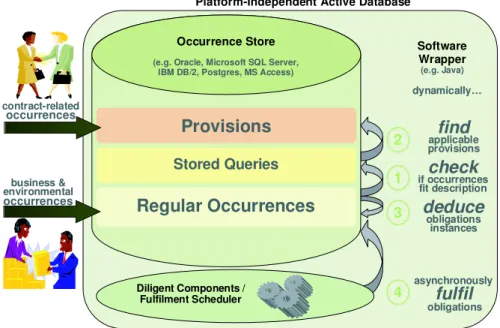
After the successful initiation of the aforementioned procedure for seeking compensation, compensation for the breach of an obligation must be paid by the responsible party to the party entitled to compensation. SkyHi wishes to store the provisions of their contracts and internal business policies, in addition to the legal regulations to which they are subject, in a database, so that the provisions can be used to guide their behavior (computer and human activity) systems.
4 Overview
SkyHi would like the human and software components in their system to consult the database to determine what to do next in the face of a dynamically changing set of features. They must use the facilities to determine the current state of affairs.
Provisions
Regular Occurrences
Avoiding such conflicts altogether is not our intention, as we believe, in a world of multiple norm-givers, conflicts and resulting exchanges are inevitable. Hansson and Makinson's view is that, since conflict cannot exist, one of these norms must be blocked (restricted from the output set of norms) to eliminate the conflict.
5 Occurrences
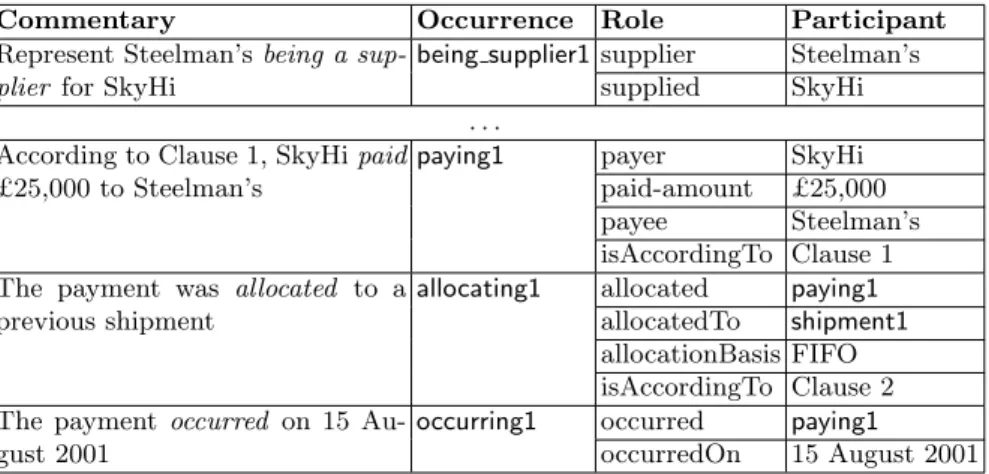
Furthermore, we do not wish to imply that our notion has any philosophical subtlety to the various uses of the term 'event' in the literature. This means that parsing the sentence 'SkyHi Builders paid £25,000 to Steelman's Warehouse' should not lead to a direct presentation of the objective fact that.
6 Kimbrough’s Disquotation Theory
More specifically, we would read this as "no violation is caused by permitted occurrences." Breach (e4, c)↔ ¬φ) (5) This says that SkyHi Builders' obligation to pay Steelman's Warehouse is breached, in terms of clause c, if, and only if, SkyHi Builders has not actually paid the £25,000 Steelman's Warehouse.
7 An Implementation of Kimbrough’s Disquotation Theory
- Assertions
- Prohibitions
- Permissions
- Powers and Liabilities
- Obligations
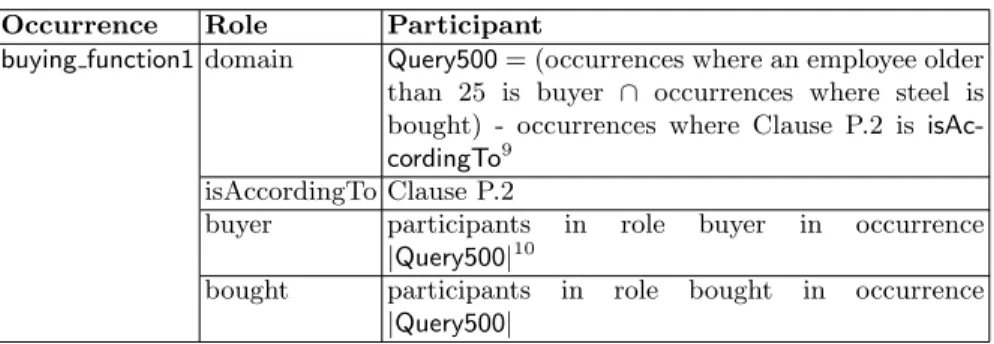
Clearly, the only means of making a purchase in terms of clause P.2 is to insert an occurrence into the domain (Query500) of the function. Completion of the aforementioned question that brings, in the sense of point L.1, the fulfillment of the obligation (an occurrence of the fulfillment of the obligation).
8 Contract Provision Monitoring
Immediate Detection
And in the event that none do so, we are equally able to judge that the group's obligation has been breached, since no event fitting the question described in the obligation has occurred within the time limit. The incremental nature of the algorithm is important as tens of thousands of occurrences can be stored in the database.
Delayed Detection
Our incremental coverage checker determines which queries relate to an item newly added to the database. With batch checks, unique identifiers added to the database within an interval are entered into the coverage checker after a batch of events, rather than after a single event.
9 Contract Performance and Enforcement
Intervention
The database stores both the application specification—that is, the provisions that define what can, must, and cannot happen under various circumstances—and the operational workflow events. Another option is to allow accelerator components (eg, the fulfillment scheduler) to perform consultation and invoke implementation components.
Prevention by Refusal
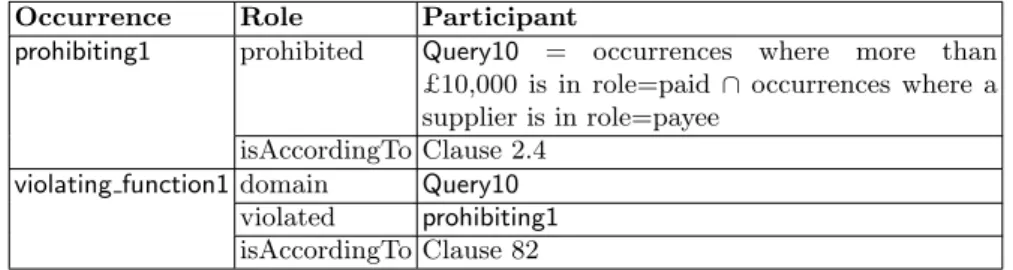
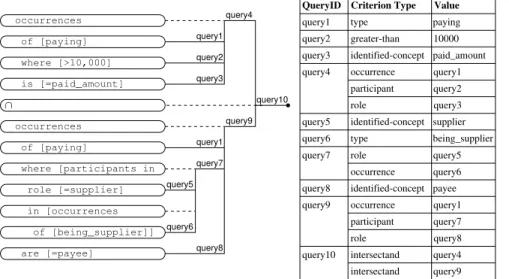
As illustrated in §7.2, this is represented by storing an occurrence of stop, stop1, referring to Query10 in that occurrence's stop role, where Query10 is the stored query:. occurrences where [role participants [=provider]. in [occurrence of [being a supplier]]]. Query19= first occurrence of SkyHi paying Steelman £25,000 for delivery where payment is before 1 September 2001 or, more formally:. occurrences where [=SkyHi] is [=payer]. is [=allocationBasis]]] ∩ [role participant [=occurred].
Prevention by Construal
Our analytical mechanism for determining the overlap of specification-time queries can be compared to the empirical approach used in Damianou et al [D+01], which requires that there be actual runtime data in order to determine whether an item is covered. with two queries (or what they call . 'domain scope expressions'). The purpose of our 'prevention by refusal' mechanism is merely to illustrate that enforcement decisions can be made by determining whether an intended (mandatory) action is covered by the prohibition.
10 Software Implementation
- Storing Operational Data
- Storing Provisions of Contracts and Policies
- Storing Queries
- Finding Overlapping and Inconsistent Provisions
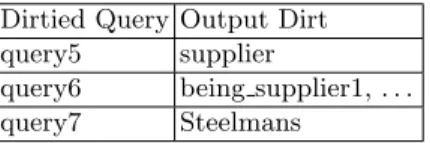
Substituting input dirt for dirty criteria (shown underlined) yields a partial re-evaluation query: [participants in role [=supplier] in [=being supplier1]]. This fact is stored in the last line of the “dirty queries and dirt” cache shown in Table 8.
11 Related Work
In standard deontic logic (SDL), the mutual definition of obligation, prohibition, and permission excludes the possibility of conflicting norms; an assumption that we find too strong in practice, where conflicts are inevitable. Individual obligations can therefore be identified, conflicts can be expressed and each instance of an obligation can then have a life cycle that extends from creation to fulfillment, breach or annulment.
12 Conclusions
We believe that this makes conflict resolution untenable for practical applications, as there is insufficient information about facilities to allow choices between them. We discussed the data storage and query techniques used by the Edee system, and showed through worked examples how our approach efficiently determined conflicts that dynamically emerged between business contracts and organizational policies.
13 Acknowledgements
An important innovation was the use of an incremental continuous query evaluation mechanism for monitoring events against contractual terms stored in tabular data stores, using pervasive industrial technology (Java and relational databases). Although much remains to be done before we have an industrial strength application, we believe that our changes to the formal logic framework and our new software prototype implementation provide the advanced state-of-the-art in executable specification for e- promote trading applications.
A Coverage Checking Rules
AB01c] , Representation and enforcement of e-commerce contracts using events, Proceedings of the 4th International Conference on Electronic Commerce Research, Edwin L. Bicarregui, Towards a framework for trust management in e-services, Proceedings of the Fourth International Conference on Electronic Commerce Research, IFIP INFORMS, 2001, pp.
Workflow Design
The resulting dynamics in organizational requirements, structures and behaviors greatly increase the complexity of workflow analysis. In Section 4, we present workflow loop diagrams as a concise way to represent workflow situations.
2 The Extended Workflow Loop
In the various sections we illustrate the ideas with a typical case. evaluation) and the agent for the operational (execution part). From a control perspective, the agent's performance can consist of these executive tasks that make up the service, but also of the conversations with the beneficiary (so its total performance in the service loop is what counts as X in the control loop).
The control loop is very similar to the service loop, which makes it possible to consider them as two types of communication loops. Note that the agent has two executor roles, but there is a slight difference between the X role of the agent in the service loop and the X role of the agent in the control loop.
3 Extended Workflow Loop Norms
- Norms for Organizational Communication
- Workflow Loop Norms Implicit in LAP
- The Extended Workflow Loop Ontology
- Formal Extended Workflow Loop Norms
Based on our extended workflow cycle model and principles from internal control theory, we then generalized and refined those implicit LAP rates. Having introduced the concepts underlying the extended workflow cycle, we are now ready to begin our formalization.
4 Workflow Loop Schemas
The Schema Structure
However, as our analysis of workflow cycle rates has shown, such constraints often need to be relaxed in the complexity of real work situations. The fourth line captures the complexity presented in the extended workflow cycle: a role can act as a customer, beneficiary, provider, principal, or agent.
Modelling Workflow Loop Situations
Note that there is now a control loop and a service loop that together form the extended workflow loop. The workflow loop roles in the service loop schema are also distributed between customer, provider and agent.

5 A Method for Legitimacy Checking
Conceptual Graph Theory
In general, relations can be read, in the direction of the arrows, as "the source concept has a relation to the destination concept". If more than one relationship is associated with a concept, the hyphen symbol '-' can be used to separate the shared concept from the rest of these relationships.
Outline of the Method
The init task is performed by a domain role, a conversation role, a workflow loop role, and topic. Each workflow loop norm can be translated into one or more required and prohibited patterns.
6 Conclusions
Exactly how this interpretation process will occur depends on (1) the type of workflow circuit definitions that cause the violation, (2) the type of norm that is violated, and (3) the meta-norms that govern what to do in the event violation. MMWFF93] Raul Medina-Mora, Terry Winograd, Rofrigo Flores, and Fernando Flores, The Action Workflow Approach to Workflow Management Technology, The Information Society 9 (1993), no.
Financial Contracts: A Formal Semantics Approach to Knowledge Representation, Part
General Notational Conventions
Object Language – Constants In the object language, constant names will be strings of uppercase or lowercase Roman letters or numbers or hyphens, starting with an uppercase letter. Object Language – Variables Variables will be denoted as one or more lowercase letters, with an optional subscript, eg, x, y, z1, z2.
2 The Language L 1
Semantics of L 1
It can never be true with respect to M for some value assignments, and false with respect to M for other value assignments. But if Φ has one or more free variables, then it can be true with respect to some assignments and false with respect to others.
3 Re-Interpretation of Predicates
However, it will provide more flexibility later if we consider a two-place predicate not as a function of two arguments corresponding to truth values, but as a function of one argument associated with another function of one argument associated with a truth value. Thus, a predicate with any number of places is considered to denote a function of only one argument whose result is either another function or a truth value.
4 Many-Sorted, Type-Theoretic Languages
As mentioned above, these references remain first-order, that is, only individuals and their properties and relations (indicated by predicates) are represented in the language. So far, the elementary types we have discussed are individuals in the domain, denoted as type 'e' (for "entity".
5 λ Abstraction
The device for referring to this in the object language is the so-called lambda operator, λ. Note that the lambda abstraction takes the role of set definition and the functional implementation takes the role of set membership in the object languages we are developing, while traditional set concepts are used in metalanguage definitions.
6 Operations, Definite Reference
Comment: For comparison, ιµΦµ denotes the set (or rather its characteristic function) of individuals satisfying Φ. If Φ is a formula and µ is a variable, then DenM,g(∃µΦ) = T rue if and only if there is a value assignment, g', such that g' is exactly the same as g, except possibly the value that is assigned to µby g' and DenM,g(Φ) =True.
8 Character Strings, Labels
If Φ is a formula and µ is a variable, then DenM,g(∀µΦ) =True if and only if for every value assignment g' such that g' is exactly equal to g, except possibly for the individual assignment of µby g',DenM ,g(Φ) =T rue. As these examples probably show, a label is an association of a string with an individual for identification purposes only.
9 Numbers and Measurement
These predicates are all of type
10 Time, Realization, Change
The choice of measurement standards is somewhat problematic in the case of time ranges. The existential quantifier refers to the inclusion of some individual in the model (domain of individuals).
11 Possible Worlds, Intensions
Since then, we added additional sets C (character strings), N (numbers), and T (times) to the model. Aspects of the model that differ between different possible worlds are also constrained to the
12 Summary of the Language IL
Semantics of IL
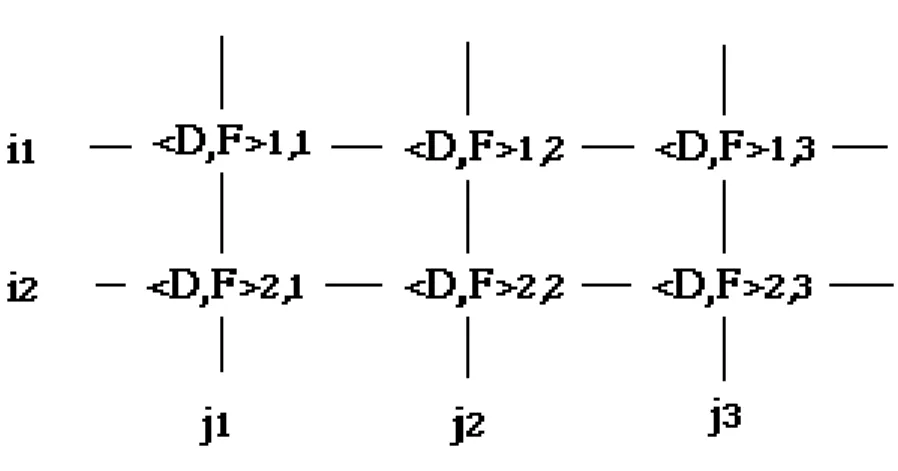
Amodel for IL is an ordered tupleM =
Semantic Rules
13 Action
CLOSED(Window) T (OPEN(Window) I(John) CLOSED(Window)) that is, the window was closed and then it was open instead of staying closed due to John's interference.
14 Modals, Deontic Operators
Note on Contingent Obligations, Permissions
In case b, if Ψ is true at the current index, then Φ must be true at all indices involving allowed worlds. So if Ψ were not true at the current index, but were true at another index that includes an allowable world, Φ would not necessarily hold at this other index.
Contractual Obligation and Permission
We will denote such penalty clauses by adding an extra place in the operators of contractual obligations and permissions, separated by a. While express penalty clauses are quite common in the case of contractual obligations, they are rare in the case of contractual permission.
15 Summary of the Language CANDID
- Syntax of CANDID
- Semantics of CANDID
- Legal Framework
- Ownership and Possession
- Some Further Definitions and Notation
The objects of economic activity, that is, the things that are traded, present analogous problems for formal description. However, to the extent that the legal system generally reflects a long evolution compared to the shorter time frame of a government's transactions (i.e., the government generally cannot change the law from one transaction to the next), we give the prefer to separate the legal code from the government as an economic actor, and consider the government and its agencies as regulated by law, just like other economic actors.
2 Economic Actors
Persons, Proprietorships
Joint Ownership, Partnerships
Private Corporations
If the company will engage in interstate commerce, the prospectus must also be approved by the Securities and Exchange Commission (SEC). Changes in things owned by the company and its commitments to other parties are made by officers of the company and their employees acting as agents.
3 Economic Objects
- Physical Objects
- Promissory Objects
- Monetary Objects
- Information Objects
Thus, copyright law for textual material prescribes the "copyrights" of the author and publisher.). By acquiring an information object, we acquire a physical representation of the information object and certain rights of limited reproduction.
4 Summary
Therefore, in owning such an information object, one certainly owns the medium of physical representation, but more importantly, one owns the rights that control the reproduction of the object. Also, an information object has both physical and deontic aspects - the physical representation of the original and limited reproduction rights.
Concepts
Financial contracts: a formal semantic approach to knowledge representation, part approach to knowledge representation, part III: CANDID specification of financial.
2 Additional Definitions, Notational Conventions
3 Elementary Financial Concepts
- Loans
- Loans of Money
- Simple versus Compound Interest
- Present Value of a Debt
- Partial Payments
It is more common for the second amount of money to be set as a multiple of the first. Regarding partial payments, it is important to distinguish between the loan requirements and the options available to the borrower.
4 Financial Instruments
- Leases
- Options
- Insurance
- Easements and Licenses
- Debt Instruments
- Equity Instruments
- Convertibles
Given that many people could claim to own the promise on date t1, how can the company determine which one is the real one? In the case of coupon bonds (or any bonds for that matter), the issuer generally does not keep a record of the promises.
5 Concluding Remarks
Not a Drop of Ink
1 Performative Aspects of Commerce and Public Administration
- Performatives as Social Action
- Doing Things With Words
- Written Performatives
- Legal Performatives
- Deontic States Created by Legal Speech Acts
- Legal Processes as Formal Conversations
- Legal Conversations as Documentary Procedures
- Performative Networks, Established by Umbrella Contract Given the above framework, we can now describe a performative network
With written performatives, the assumption is naturally that the signature provides a unique identification of the author. However, the authenticity of the signature is rarely questioned (handwriting analysts are rarely required in court).
2 Issues for Open Electronic Commerce
Open versus Closed Trading
In contrast, a performative network actually supports the performance of actions that change the status of the participants. The main goal of our research is to contribute to lowering the barriers to the use of EDI in these open trade relationships.
Automation of Documentary Procedures
As a result, the most successful EDI implementations have been realized in what could be called 'closed trading relationships', i.e. long-term trading relationships, involving a large number of transactions, between parties that have a high level of trust and possibly a close coordination of the parties' business processes (Table 1). However, in electronic commerce, when the performance of the documentary procedure is controlled by automated systems, documentary procedures should be laid down in a common formal, calculable and executable language.
Soft Coding of Documentary Procedures
Even if a party manages to create such an agreement with one specific trading partner, if it then wants to establish EDI links with more partners, this can lead to the existence of several slightly different documentary procedures.
3 From Ink to Bits: Original, Signed Writings
Performative Electronic Documents
If the message was actually sent, the sender cannot deny it because the recipient has the message encrypted with the sender's secret key. All messages are assumed to be encrypted using the receiver's public key (security) and the sender's secret key (authentication or digital signature).
Negotiable Electronic Documents
First, it provides the issuer of the right with the knowledge to verify whether a party may claim that right. If the negotiable instrument is a key requirement in the execution of the trade transaction, one of the other solutions must be taken.
4 Computational Modeling of Documentary Procedures
Representation: Documentary Petri Nets
On the other hand, smart card technology places limitations on the accessibility of the parties involved and introduces additional administrative overhead within the organizations to track the smart cards in relation to the transactions to which these smart cards belong.