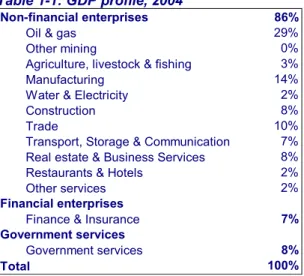
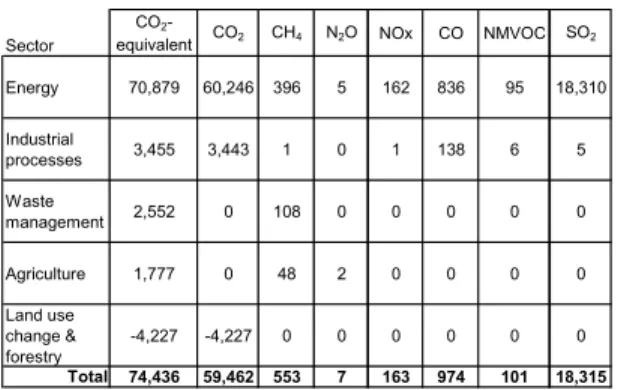
The UAE's total estimated oil reserves are around 98 billion barrels, or nearly 10 percent of the world's proven oil reserves. The results of the UAE National Greenhouse Gas Inventory, discussed in detail in Chapter 2, are summarized in the table below.
Geography
Climate
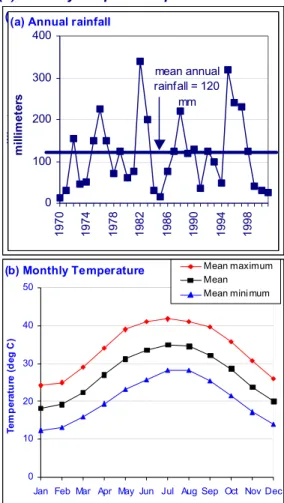
These rainfall levels, while showing a large range across the Emirates in the winter months (especially the month of March), are uniformly very low across the UAE during the summer months between July and October. The range in maximum observed monthly temperatures is highest in the summer months, reaching almost 6 degrees Celsius across the UAE.
Demography …………………………………………………………….. 15-16
Much of the country is subject to violent dust storms with infrequent and irregular rainfall. At the executive level of government, the Federal Supreme Council (FSC) is the highest federal authority in the United Arab Emirates and consists of the seven Emirati rulers who elect a president and vice president every five years.
Economy ………………………………………………………………. 17-18
The UAE ranks fifth in the world in terms of the size of its reserves, after Russia, Iran, Saudi Arabia and Qatar. Of the seven emirates in the UAE federation, the Emirate of Abu Dhabi possesses the largest hydrocarbon resources.
Public Health ………………………………………………………….. 23-24
Maritime trade has been a feature of the UAE economy for many centuries and continues to bring trade to the region. The United Arab Emirates is strategically located on the Arabian Gulf, on the important trade route between Europe and Southeast Asia. In addition to the 15 commercial ports (including oil terminals), there are also several smaller fishing ports along the UAE's coastline.
By the year 2004, the UAE has achieved much progress in the field of preventive and curative health services that emulate in contemporary international standards.
Introduction
According to the IPCC, human activities in pursuit of development, such as the burning of fossil fuels, industrial processing, intensive agriculture, land use change and forest exploitation, as well as waste management have caused the release of greenhouse gas (GHG) emissions. in the atmosphere. GHG emissions consist of carbon dioxide (CO2), the main greenhouse gas, as well as a number of other gases known to contribute to the greenhouse effect. These other gases include methane (CH4), nitrous oxide (N2O), nitrogen oxides (NOx), non-methane volatile organic compounds (NMVOCs) and carbon monoxide (CO).
Among other commitments, each party to the UNFCCC has the obligation to regularly submit a national inventory of greenhouse gas emissions by sources and sinks.
Methodology
Default values obtained on site were used in the land use change and forestry, waste management, agriculture and industry sectors. A major objective of the IPCC methodology is to assist national experts in reducing uncertainties to a reasonable minimum. However, uncertainties are inherent in any national emissions estimate and may arise from different interpretations of source/net categories, the use of average values (especially default emission factors) and incomplete scientific understanding of the underlying emission processes. and sequestration of GS.
In applying the IPCC methodology and standard emission factors to the UAE context, a number of assumptions have been made.
Energy Sector Inventory
Data were often available in formats that suited the government's planning purposes, but did not necessarily address all the information required when using the IPCC methodology. Sector-specific uncertainties encountered by the national inventory team are discussed in the subsections in this chapter. The electricity sector relies on natural gas for more than 96% of its fuel supply, with the balance provided by diesel (3%), residual oil and crude oil (both less than 0.5%).
The manufacturing and construction industries are also heavily dependent on natural gas, with around 85% of total energy consumption coming from this energy source, with the remainder mainly coming from residual fuel oil.
Industrial Processes Inventory
Other major sources of carbon dioxide from industrial processes are the production of ammonia and aluminum, accounting for 25%.
Waste Management Inventory
Out of a total of 108.3 Gg CH4 emitted, about 95 Gg are from solid waste disposal and the balance 13 from wastewater treatment.
Agricultural Sector Inventory
Land Use Change and Forestry Inventory …………………..…………. 31-32
The approximately 63 million trees planted in the UAE contributed to the sequestration of 4,227 Gg of carbon dioxide in 1994. It is important to note that this level exceeds all of the carbon dioxide emitted by industrial processes in the UAE. It is important to develop a program to increase the accuracy of the national inventory of GHG emissions of the United Arab Emirates.
Develop a centralized, comprehensive, systematic and regularly maintained tree planting database for the UAE.
Vulnerability and Adaptation
Projected Climate Change …………………………………..…………. 36-37
Water resources in the UAE are currently vulnerable in a number of ways. In the face of climate change, the UAE's vulnerability will only worsen if effective adaptation strategies are not implemented. Climate change could affect population centers in the UAE in two primary ways.
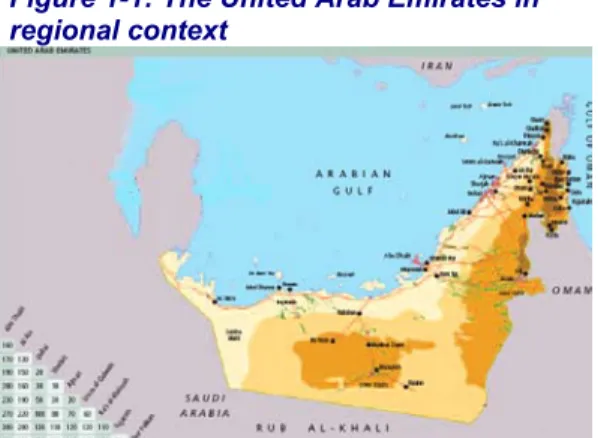
More than 80% of the oil produced in the UAE is exported, compared to around 20% for natural gas. Coastal areas of the UAE consist of two distinct sections, separated in the northeast by the Musandam Peninsula in Oman. Eight of the nine major cities in the UAE are located along these coastal areas, representing around 85% of the population.
Introduction
This chapter provides an overview of some initiatives that would be attractive in the UAE to reduce or sequester greenhouse gas emissions. Given the importance for the UAE to continue pursuing its economic development priorities, greenhouse gas emissions are expected to increase despite continued efforts at both the emirate and federal levels to promote sustainable development, such as environmental education/awareness, wildlife protection and water management. The measures discussed in this chapter focus on the potential of certain technologies and practices to not only reduce greenhouse gas emissions, but also contribute to the economic development of the country by improving the lives of all its inhabitants .
Clearly, implementing the measures outlined in this chapter would require significant new coordination around a number of institutional, regulatory, legislative and financial initiatives.
Buildings Sector
In recent years, the UAE has begun to consider the implementation of a district cooling system in the emirate of Dubai. The abundant sunshine in the UAE, as well as the increasing competitiveness of solar energy systems - photovoltaics and solar hot water systems - suggest that this technology could be poised to take off in the UAE. In the process, they can save hundreds of millions of dirhams annually in electricity costs while reducing GHG emissions.
Currently, a large residential building in Bur Dubai is the first building in the Middle East to use solar energy for daily cooling of the building, significantly reducing electricity bills.
Transport Sector
While the time and complexity of developing piping networks, particularly in Dubai's multi-user scheme, makes district cooling a capital-intensive option for reducing greenhouse gas emissions, these systems offer an opportunity to dramatically reduce space cooling loads by capturing efficiency. about the co-production process. With improved fuel efficiency, significant reductions in energy and greenhouse gas emissions can be achieved. Depending on the strength of the standard, increasing vehicle fuel economy could save significant amounts of gasoline and diesel over time, leading directly to reduced greenhouse gas emissions.
The number of car and light truck trips in the UAE continues to increase due to the growing population and economic development.
Industrial Sector
Such a standard would require all car and light truck imports to meet a minimum level of fuel economy that is cost-effective and technically feasible. Between 1994 and 2004, the annual growth in registered cars and light trucks increased significantly. One such investment is a subway system that can simultaneously alleviate city traffic and reduce greenhouse gas emissions from cars.
The Dubai Urban Rail Transit, or Metro, will be the first of its kind in the Arabian Peninsula.
Electric Supply
Forestry
Waste Sector
One possible measure that could be considered in the United Arab Emirates to reduce greenhouse emissions in this sector is landfill methane capture for electricity generation (EPA, 1998). Under this option, no degradable organic matter would be removed from the waste stream reaching a landfill, thus increasing the economic incentive to install CH4 gas recovery systems since the total amount of methane that could be produced would be available for energy recovery and production. Another possible measure that could be considered in the United Arab Emirates to reduce greenhouse emissions in this sector is the introduction of an integrated waste management system that includes recycling, composting, landfilling (EPA, 1998) .
This option would remove a large portion of the degradable organic materials from the waste stream used for composting, thus reducing the economic incentive for installing gas recovery systems as the amount of methane that could be produced would be reduced and the costs would not can cover. of gas extraction.
Challenges & Follow-Up
Reducing emissions by capturing landfill methane and using it as an energy source could bring significant energy, economic and environmental benefits to the UAE. The feasibility of this option in the UAE depends on the amount of gas captured, gas treatment equipment and the expected rate and period of electricity generation. This would be an interim approach until landfill gas recovery systems are in place. To this day, this is a popular option from the site.
It would build on the strong technological and institutional foundation in the UAE and help drive innovation, while positioning the UAE as a responsible regional leader in addressing the global challenge of climate change.
List of References
While implementing this set of initiatives would be an ambitious undertaking, it represents an important component being considered in the National Climate Change Strategy.
National Action Plan
The UAE and Climate Change
Challenges and Opportunities