Our narrative specifically captures the unique characteristics of complex conversation within the US context. Pragmatism, according to Henry Steele Commager (1950), "adjusted itself admirably to the temperament of average America."
An Historical Convergence
And this commodity, learning, must be packaged and delivered in uniform ways to allow market openness and competition. Accountability, a word that plays on the sensibilities of the general public, is actually a way for corporations to sell software, data tools and testing materials to over 13,500 US school districts.
The Way Forward: A Tentative USA Framework
It rests on a more polyphonic perspective of curriculum, primarily rooted in the holistic development of the student as a person. Of particular concern is the impact of the current system on historically underserved students in the US.
Curriculum Options for Democracy, Multiculturalism, and Social Justice
Conclusions for Complicated Conversations That Must Result in Action
The dialogue we seek, following Freire, must begin in the context of local manifestations of injustice. Leadership, in the context of dialogue, involves active listening, evoking the voices of those who are not heard and facilitating collective critical consciousness and empowerment for action.
Government of Errors: The Deceit of the Privatization Movement and the Danger to America's Public Schools. Open Access This chapter is licensed under the terms of the Creative Commons Attribution 4.0 International License (http://creativecommons.org/licenses/by/4.0/), which permits use, sharing, modification, distribution, and reproduction in any medium or format , as long as you credit the original author(s) and source appropriately, provide a link to the Creative Commons license and indicate if changes have been made.
Curriculum and School Leadership –
Adjusting School Leadership to Curriculum
Introduction
Despite these differences, the governance of each state is organized according to a fairly traditional bureaucratic governance model. The minister of a state usually represents the top of the governing structure (macro-level) with a number of subordinate institutions (meso-level), with the schools themselves acting as the lowest units (micro-level).
School Leadership in Germany
In recent years, all principals have really become better than the staff and have taken over human resource management duties from the local or regional authority, such as carrying out the official assessments of teachers. Mostly, however, the state examinations and in particular the official assessments of teaching competences by superiors are taken into account as the deciding factors.
Curriculum in Germany
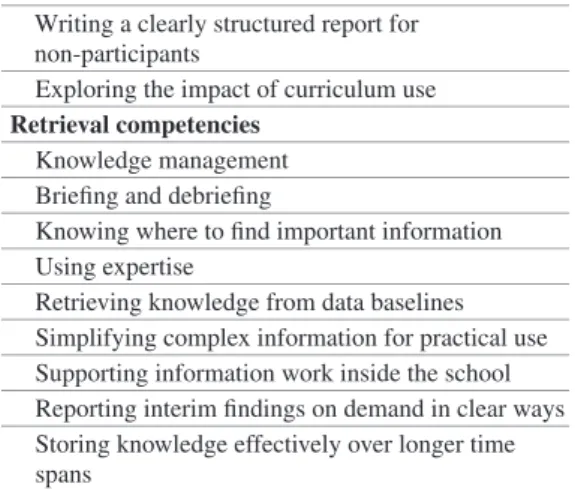
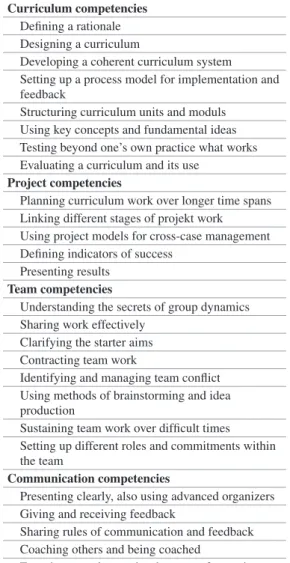
This is also reflected in the growing number of documents relevant to the development and implementation of a curriculum. Leadership, especially shared leadership oriented toward improving student learning opportunities, can be seen as the lever that activates productive work in the curriculum area.
Empirical Insights: Preferences and Strains in School Leadership Practices and the Importance of Curriculum
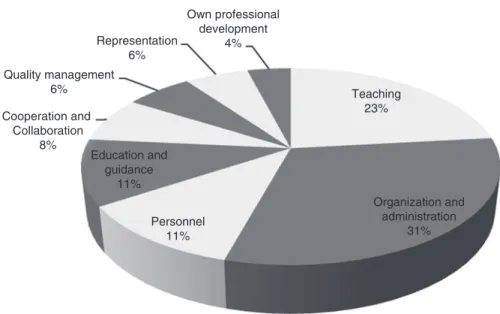
To summarize, the data suggest that school leaders in Germany (as well as in other German-speaking countries) can be associated with the concept of primus inter pares. Still, school leaders mostly carry out activities they do not prefer and they mostly experience as a burden.
Instructional Leadership
Instructional leadership and curriculum matters as well as curriculum research were linked on several occasions. Data from the OECD PISA studies show that instructional leadership is practiced by German principals. The 2014 OECD Policy Outlook for Germany saw increasing autonomy and an above OECD average use of instructional leadership in Germany by German school leaders (Klumpp et al. 2014).
Organizational Education
Leadership action should also be a model for what the school wants to teach and preach, that is, it should form a model-like social space of experience for all stakeholders by realizing educational goals for the benefit of the organization and the individual. The core principle of leadership action is therefore to promote the learning of all members of the organization, and in a democratic society to promote 'democracy', both as a goal and as a method. Regarding “cooperation,” Wunderer and Grunwald (1980) and Liebel (1992) define “cooperative leadership” as (1) the exercise of purposeful social influence to accomplish shared tasks or duties (aspect of goal achievement) (2). ) in/with a structured work environment (organizational aspect) (3) in the context of mutual, symmetrical exercise of influence (participatory aspect) and (4) designing the work and social relationships in a way that allows for a general consensus (pro-social aspect).
Conclusion
In the views of organizational education, we can argue that the delegation of decision-making power should not happen, however, in order to 'bribe' the interested parties to show motivation, but for the sake of a real democratization of the school. Looking ahead to possible developments in Germany, the difficulties are due to the state autonomy of the German Länder. From PISA to educational standards – the impact of large-scale assessments on science education in Germany.
Teachers and Administrators as Lead Professionals for Democratic Ethics
From Course Design to Collaborative Journeys of Becoming
Over the years, I have experimented with introducing the concept of curriculum liberalization in a number of ways. The focus of our chapter on collaboration now turns to a discussion of the interrelated concepts of teacher and administrative leadership that emerge from this approach to understanding curriculum fundamentals. Curriculum-based teacher leadership is troubled by the event of critical awareness that “one of the most salient features of our culture is that there is so much bullshit” (Frankfurt 2005, p. 1).
The Interplay of Administrative and Teacher Leadership
Currently, we have embarked on a journey to support administrators on their eclectic path of creating a culture that supports their own journey and that of teacher leaders. Administrators will be asked to define teacher leadership, brainstorm how teacher leaders can support the district's goals and objectives, and create a culture of support in the buildings. Watkins (Eds.), The assault on public education: Confronting the politics of corporate school reform (pp. 189-192).
Codification of Present Swedish Curriculum Processes: Linking Educational Activities over
Since the establishment of the comprehensive school system in the 1950s and beyond, the interaction between educational research, policy and practice has been emphasized and elaborated in various forms. In the remainder of the chapter we first present the changes in the Swedish education system. This is followed by a brief overview of some key features of research issues in the development of the Swedish comprehensive school system.
Changes in the Swedish Educational System
During a period of expansion of modern welfare systems in the 1950s, political management and administration of reforms was relatively straightforward. These can be seen as expressions of changes in the relationship between the state, society and the individual. Changes on both the vertical and the horizontal axes have together contributed to an increase of players involved in the management of education;.
Two Waves of Reforms
During the late 1990s and the first decade of the twentieth century, Sweden experienced a second wave of reforms. The curriculum and the assessment system also became more aligned and internationally benchmarked tests were incorporated into the national system and discourse on assessment and evaluation (Pettersson 2008). This is particularly important when local actors are expected to take action and the state monitors performance within an open discourse of quality and equity in a control regime.
From Frame Factor Theory to Code, Context and Curriculum Processes
Therefore, Swedish researchers began to engage in the activity of providing politicians with empirically based knowledge for political decisions. The main question was whether and how disjointed groups of students in the mainstream school system affected classroom processes and school outcomes. He raised questions about how frameworks were constructed and identified historically developed curriculum codes that manifest themselves in the selection and organization of school knowledge (eg Lundgren 1977).
Curriculum as a Political Problem and the Linguistic Turn
All these leading positions are important for the connection between different levels in the governance system, where the curriculum is used, among other things, as a governance tool (Nihlfors 2003). Scientists from various research areas have shown interest in the black box of education, in which management and leadership are an important phenomenon. First, political scientists have shown interest in schools as political organizations (Pierre 2007) or in the ownership of municipalities (Jarl 2012).
Key Actors for Leading
A Shifting National Assessment Culture
These features are not new to the education system, but they have been emphasized from the curriculum in recent decades. Today, the international assessments are an integral part of the national education evaluation system and are emerging in the debate as an unavoidable part of it. From the mid-1940s to the mid-1990s, national tests were based on a system of standardized grades.
Curriculum Leadership in a Changing Educational Landscape
The responsibility for adopting these laws and regulations rests with the boards of local school owners – the municipalities or independent schools. School managers (principals and pre-school managers) very rarely meet politicians to discuss e.g. the result of their systematic quality work, and it is also rare that this type of document ends up in board meeting minutes. As a result, the national level "bypasses" the school owner level, making the multi-level management of the local school more complex than it needs to be.
The Comparative Curriculum Code
The distribution of resources is primarily a matter for the boards of the municipalities and the independent schools. Considering our two cases, the findings regarding assessment culture align closely with the overall changes in the educational landscape and messaging system of education. The system of pedagogy and transmission is also affected, with diagnosis, record-keeping and documentation becoming a more prominent aspect of the transmission process in recent years.
Looking into the Future: Research to Come
Key elements of the comparison code are legitimacy, standardization and formalization, also three of the main concepts in comparative education that again hold a strong position in the field of educational research, policy and practice today. Educational management and social integration and exclusion: Studies in the powers of reason and the reasons of power. The images or other third-party materials in this chapter are included in the chapter's Creative Commons license, unless otherwise indicated in a credit line for the material.
Rethinking Authority in Educational Leadership
Educational leadership involves (though not reducible to) the exercise of authority (often institutionally conferred) to enlist faculty and students to realize educational goals, often institutionally conceived and now almost universally quantified. Ted Aoki's3 insight that an example of an educational leader - "principal" - once meant principal reminds us that authority could be exercised personally and educationally. That is my motive here: to engage colleagues in a complicated conversation about educational leadership by detaching the concept from its purely institutional affiliation and associating it with personal relationships rooted in early, often imprinted experiences, thereby invoking traditions of study and understanding associated with psychoanalysis,4 with its emphasis on infancy, during and after which dependence is renegotiated over time into (relative) relations of reciprocity.
Relationships
With reference to psychoanalysis - in which intimacy is encouraged by the authority of the analyst and the dependence of the patient - Luxon is interested in how in the "repeated repetition" of "break" and "repair" within the "transference" relationship15 persons "prepare Luxon specifically points to the “culturally salient figures of psychoanalyst and truth-teller” – I would add teachers and other educational leaders – as the “nodes” that bind “self and political governance. ” These scales of government are not opposite ends of a spectrum, but subjectively intertwined, as Foucault notes: “There is no first or final point of resistance to political power other than in the relationship one has to oneself " (quoted in Koopman) 2013, 173). Ethical self-formation26 may not predictably relate to specified structures of pedagogical relationships, but even the suggestion of a reciprocal relationship resonates with traditions of liberal learning in the US, as Michael Roth makes clear.
Parrhesia
37 Of course, they can be intertwined and distinct, as Luxon points out: "The stages of parresia and thus testify to the relationship of an individual with the truth and the political field that enables or limits this relationship." The great public educator and anti-lynching activist Ida B. 41 'The parrhesian promise,' Luxon explains, 'is that through a relationship with a truth-teller, students of parrhesia develop their authorial capacities' that 'take care' of 'themselves'. . 43 Psychic material – the realm of the personal – includes sexual content, as Gilbert (2014, x) asserts: “There can be no education without the charge of sexuality; love, curiosity and aggressiveness fuel our engagements with knowledge.”