Plou Immobilization of the β-fructofuranosidase from Xanthophyllomyces dendrorhous by entrapment in polyvinyl alcohol and its application to neo-fructooligosaccharide production. The first one is an overview of the industrial application of (immobilized) biocatalysts in areas such as the pharmaceutical, food and beverage industries, as well as the energy sector (biofuel production and natural gas conversion).
Immobilized Biocatalysts
Definitions, Historical Aspects, and Perspectives
This Special Issue
47] gave an overview of the industrial application of (immobilized) biocatalysts in areas such as the pharmaceutical, food and beverage industries as well as the energy sector (biofuel production and natural gas conversion). Immobilization of β-fructofuranosidase from Xanthophyllomyces dendrorhous by entrapment in polyvinyl alcohol and its use for the production of neo-fructooligosaccharides. Catalysts.
Industrial Applications of Enzymes
Recent Advances, Techniques, and Outlooks
Introduction
Enzyme Implementation: A Societal Need
Enzyme Immobilization for Expanded Scope of Implementation
The immobilization technique also led to improved catalytic activity with only slightly hindered catalytic efficiency in n-hexane, probably due to the preservation of the tertiary structure in the organic medium as a result of covalent immobilization [77]. In this study, PEL-CLEAs were found to be less catalytically active than free PEL, probably due to mass transfer limitations of the large substrate molecules.
![Figure 2. Schematic of different enzyme immobilization techniques. The crystal structure of Glucose Oxidase (GOx) isolated from Aspergillus Niger was used as a model enzyme (PDB ID: 3QVP) [67].](https://thumb-ap.123doks.com/thumbv2/1libvncom/9201500.0/22.723.125.594.317.653/schematic-different-immobilization-techniques-structure-glucose-oxidase-aspergillus.webp)
Intensified Approach for Designing Improved Biocatalysts
An understanding of atomistic level interactions has led to the development of efficient and optimized biodevices. The success of immobilized GI is rooted in the biochemical properties of the enzyme as well as the technological developments that allowed the commercialization of the process catalyzed by immobilized enzymes.
Environmental Impact Assessment and Economic Approaches for Enzyme Implementation in Industrial Catalysis
At higher temperatures, the equilibrium of isomerization is shifted to favor higher yields of fructose, so the use of thermostable immobilized enzyme provided improved yields of HFCS. In addition, the production costs of GI were significant at the time of development, as the immobilization of GI reduced the total amount required for HFCS production by enabling enzyme reuse [5].
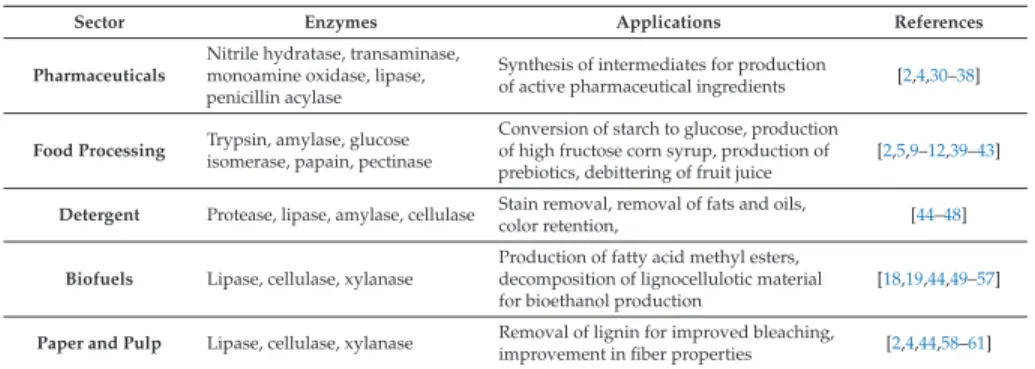
Pertinent Examples of Enzymes Application in Industrial Catalysis 1. Pharmaceuticals Industry
The use of the methane monooxygenase (MMO) biocatalyst, for the conversion of methane to methanol, has recently gained interest in the expanding wave of natural gas extraction. An emerging trend is the use of enzyme catalysis for the commercial-scale production of probiotics, artificial sweeteners and rare sugars [2].
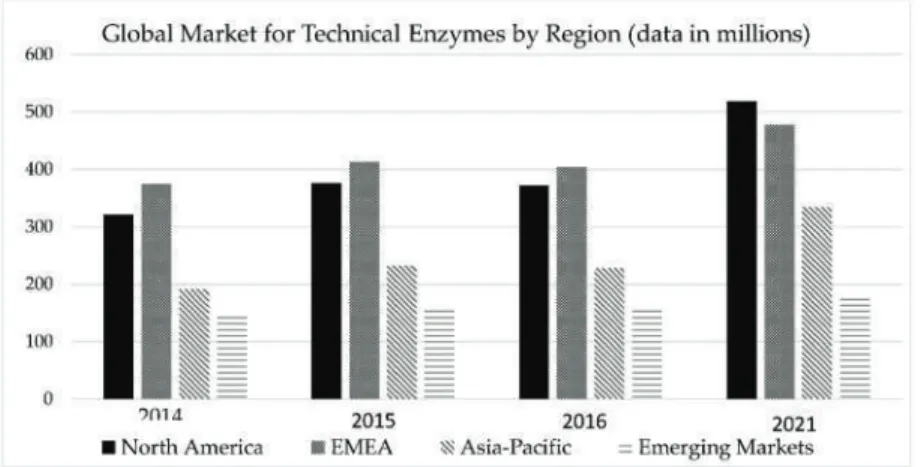
Projections of Economic Growth and Implementation Potential
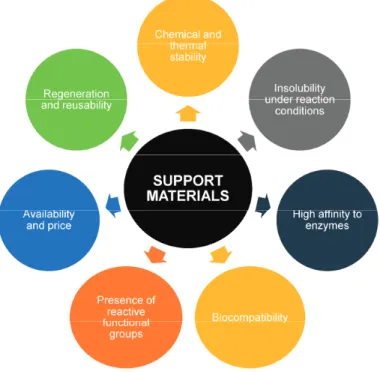
In the example of the detergent industry, it should be noted that enzymes are a product and not a specific catalyst for a chemical process. The application of biocatalysts in industrial technologies will have to consider not only the optimization of the enzyme functionality, but further, lead to the increase of the operational stability of the enzyme at the interface with the supports used for immobilization.
Conclusions
Crosslinked Enzyme Aggregates: A Simple and Efficient Method for Immobilization of Penicillin Acylase.Org. Combined cross-linked enzyme aggregates of horseradish peroxidase and glucose oxidase to catalyze cascade chemical reactions.Enzym Microb.
A General Overview of Support Materials for Enzyme Immobilization: Characteristics, Properties,
Practical Utility
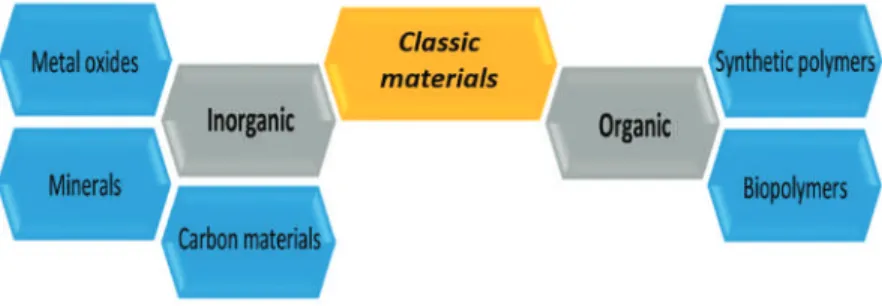
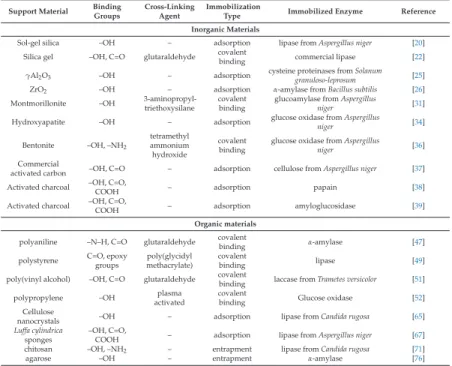
Classic Support Materials for Enzyme Immobilization
Various polymer materials can be used as effective supports and improve properties of the immobilized enzyme such as thermal stability and reusability. The products showed good catalytic activity retention, but their reusability was poor due to leaching of the enzyme from the matrix.
New Support Materials for Enzyme Immobilization
A possible solution is binding the enzyme molecules to magnetic iron oxide nanoparticles (MNPs) and simple disassembly of the biocatalytic system using an external magnetic field [80]. Selected cases of use of New materials of organic origin for enzyme immobilization are discussed below.

Summary
Preparation and application of poly(N,N-dimethylacrylamide-co-acrylamide) and poly(N-isopropylacrylamide-co-acrylamide)/K-Carrageenan hydrogels for immobilization of lipase.Int. Immobilization of glucoamylase on triazine-functionalized Fe3O4/graphene oxide nanocomposite: Improved stability and reusability.Int. Preparation and characterization of sol-gel hybrid coating films for covalent immobilization of lipase enzyme.
Applications of Immobilized Bio-Catalyst in Metal-Organic Frameworks
Applications of Enzyme@MOFs Materials in Catalysis, Sensing, and Detection
Evidenced by the bathochromic shift of the immobilized MP-11 in Tb-mesoMOF compared to free MP-11. the hydrophobic interactions between the hydrophobic nanocage of Tb-mesoMOF and MP-11 were attributed to the better performance of MP-11@Tb-mesoMOF over free MP-11. Thus, trypsin is normally attached to the surface of MOFs rather than encapsulated in the pores to allow for better substrate accessibility. This requires the enzymes of the biosensors to be stable and functional in an unnatural environment.
![Figure 1. Schematic representation of the bioconjugation of the 1D-polymer, [(Et 2 NH 2 )(In(pda) 2 )] n , with EGFP](https://thumb-ap.123doks.com/thumbv2/1libvncom/9201500.0/73.723.121.606.542.635/figure-schematic-representation-bioconjugation-polymer-et-nh-egfp.webp)
Conclusions
Design and synthesis of metal-organic frameworks using metal-organic polyhedra as supermolecular building blocks.Chem. Modulated synthesis of metal-organic frameworks by tuning the initial oxidation state of the metal.Eur. High efficiency and long-lasting intracellular activity of an enzymatic nanofactory based on metal-organic frameworks.Nat.
In-Situ Self-Assembly of Zinc/Adenine Hybrid Nanomaterials for Enzyme Immobilization
Results and Discussion
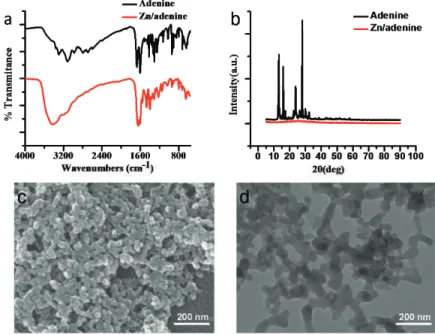
Next, we used glucose oxidase (GOx) and horseradish peroxidase (HRP) as guest molecules to test the enzyme immobilization property of the Zn/adenine complexes. The stability of the GOx-Zn/adenine complexes was investigated at different pH values (from 3 to 10, Figure 4b) and temperatures (from 30 to 90◦C, Figure 4c) and compared with that of the free GOx in solution. The activity of the GOx-Zn/adenine complexes was more stable compared to that of the free enzymes with respect to pH.
Materials and Methods 1. Materials
To test the recovery of the GOx-Zn/adenine complexes, the reaction was carried out for 5 minutes, and the immobilized enzyme was separated by centrifugation. Different concentrations of glucose (750μL) and 1 mM ABTS (750μL) were added to 500μL of the suspension of GOx–HRP–Zn/adenine complexes. The reaction solution was centrifuged at 10,000 rpm for 3 min, and the absorbance of the supernatants at 414 nm was measured using a UV-1100 spectrophotometer.
Conclusions
Then new substrate and other solution were added to start the new cycle of the reaction for 5 min. The selectivity was determined by the absorbance of the supernatants using 100μM glucose as the substrate, compared to 100μM xylose, fructose, mannose or galactose, or 1 mg/mL BSA. This article is an open access article distributed under the terms and conditions of the Creative Commons Attribution (CC BY) license (http://creativecommons.org/licenses/by/4.0/).
Controlling Redox Enzyme Orientation at Planar Electrodes
Introduction: Interest in and Limitation of Bioelectrocatalysis Based on Immobilized Redox Enzymes
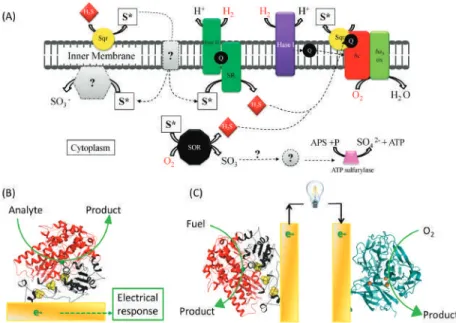
In the environmental field, bioremediation is a process that uses redox enzymes for cleanup [15]. Here again the mandatory step would be the functional immobilization of the enzyme on the electrode surface. Therefore, the aim will be to orient the enzyme with the active site as close as possible to the solid surface.
Interfacial Electron Transfer: Why Is Orientation a Key Issue?
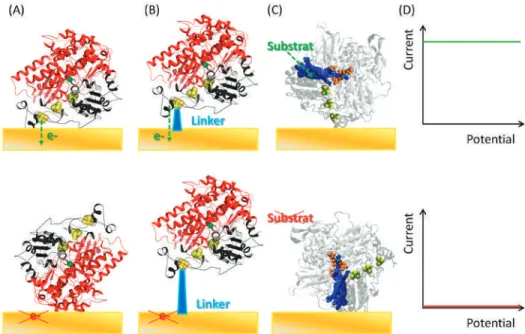
For example, it is expected that non-redox enzymes to achieve high catalysis efficiency must be oriented such that the active site faces the opposite side of the solid surface to facilitate access to the substrate. Since the interfacial electron transfer constant k0 between the enzyme and the electrode surface depends on the electron tunneling distance, the distribution in enzyme orientations creates a dispersion of this constant, which can lie in the range between kmin and kmax = k0. The βd0 parameter governs the shape of the electrochemical signals as modeled by Armstrong's group [29] and reported in recent articles for ET analysis of immobilized enzymes [30].
The Key Components 1. Properties of Redox Proteins
In addition, knowing the pKa of the terminal moieties allows chemical control on the electrode surface. In the presence of pinhole defects within the SAM, another ET pathway may be effective due to the diffusion of redox species through the defect sites on the electrode. Direct enzyme binding was achieved and explained by the proximity of the C-terminal end to Cu T1 in the LAC under study.
![Figure 4. Representation of (A) self-assembled monolayer [83] and (B) scheme for electrografting of diazonium salts on electrode surfaces (Au, C or Indium Tin Oxide (ITO)) with alterable terminal chemical functionality.](https://thumb-ap.123doks.com/thumbv2/1libvncom/9201500.0/103.723.109.615.360.501/representation-assembled-monolayer-electrografting-diazonium-electrode-alterable-functionality.webp)
How to Probe Enzyme Orientation on an Electrode 1. Electrochemistry
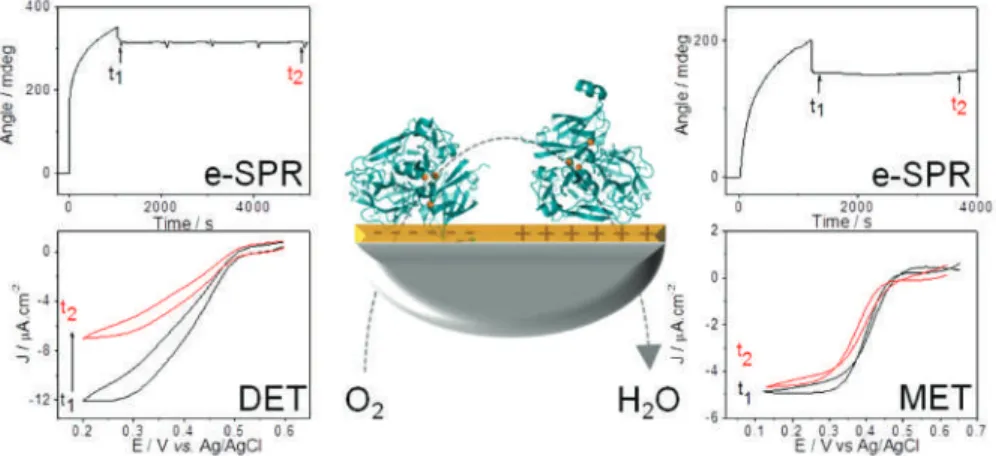
On positive (right) or negative (left) SAM-modified gold electrodes, surface adsorption of the enzyme is successful. Indeed, depending on the physicochemical properties of the SAM-modified gold electrode (hydrophilic or hydrophobic), the intensity of the ratio of amide I to amide II varied, reflecting different orientations of the enzyme. Similarly, PM-IRRAS was used to study the orientation of LAC at SAM-modified gold electrodes depending on the charges of the SAM headgroup [107].
Factors Driving the Oriented Immobilization at an Electrode
The same group also investigated the effect of the degree of protonation of the SAM surface on the immobilization of a [NiFe]-Hase [171]. The strength of the enzyme/surface interaction is proportional to the SAM degree of protonation. This effect would be due to the change in the polarization of the enzyme environment, where much less polarizable protein replaces water.
![Figure 10. The fluctuating dipole moment of the [NiFe]-Hase from A. aeolicus enables it to adsorb efficiently on both positively and negatively charged surfaces (panels (A) and (B), respectively) [172].](https://thumb-ap.123doks.com/thumbv2/1libvncom/9201500.0/114.723.183.540.247.618/figure-fluctuating-aeolicus-efficiently-positively-negatively-surfaces-respectively.webp)
Future Directions: Towards Rational Bioelectrode Design
Spectroscopic identification of the Au-C bond formation upon electroreduction of an aryldiazonium salt on gold. Langmuir. Combined ATR-SEIRAS and EC-STM investigation of the immobilization of Laccase on chemically modified Au electrodes.J. Effect of the degree of protonation of a self-assembled monolayer on the immobilization dynamics of a [NiFe] hydrogenase. Langmuir.
Co-Detection of Dopamine and Glucose with High Temporal Resolution
Results and Discussion 1. Preparation of the Biosensor
The modification of the carbon surface with AuNPs fulfills two functions in this sensor design. Using a microinjector pump, 500 ms puffs of the solution mixture are injected against the sensor surface placed in the buffer solution creating a rapid controlled oscillation of the two analytes towards the electrode. The electrode response to dopamine was used to evaluate the ability of the sensor to co-detect glucose and dopamine, as well as to compare the kinetic response for two analytes.

Materials and Methods 1. Chemical Reagents
Simultaneous measurement of cholinergic tone and neuronal network dynamics in vivo in the rat brain using a novel choline oxidase-based electrochemical biosensor.Biosens. Contrasting regulation of catecholamine neurotransmission in the behaving brain: pharmacological insights from an electrochemical perspective. Simultaneous Voltammetric Measurements of Glucose and Dopamine Demonstrate the Coupling of Glucose Availability with Increased Metabolic Demand in the Rat Striatum.ACS Chem.
Polyelectrolyte Complex Beads by Novel Two-Step Process for Improved Performance of Viable
Whole-Cell Baeyer-Villiger Monoxygenase by Immobilization
Materials and Methods 1. Characterisation Polymers
The internal structure of the PEC beads was characterized using confocal laser scanning microscopy (CLSM). Further studies using environmental scanning electron microscopy confirmed the dimensional stability and sphericity of the PEC beads. In addition, both the surface morphology and the mechanical resistance of the PEC beads remained unchanged before and after the biotransformations.
Immobilization of Planococcus sp. S5 Strain on the Loofah Sponge and Its Application in
Naproxen Removal
Materials and Methods 1. Bacterial Cultures Cultivation
The first step in preparing the loofa sponges (York, Bolechowo, Poland) for immobilization was to dry them in a drying machine to determine constant weight and to cut out fragments weighing 0.15 g. The values of the efficiency of naproxen biodegradation and enzyme activities were analyzed by STATISTICA 12 PL software package. Analysis of the effect of immobilization on the activity of enzymes associated with naproxen biodegradation showed that it caused a significant increase in the activity of all investigated enzymes.
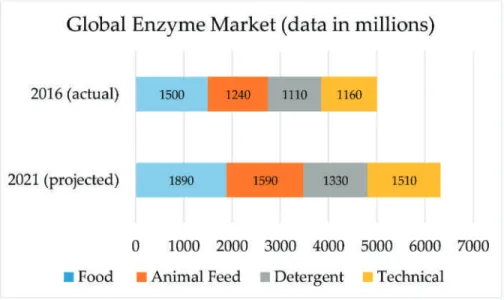
![Figure adapted from data included in Ref. [44].](https://thumb-ap.123doks.com/thumbv2/1libvncom/9201500.0/21.723.107.618.707.851/figure-adapted-from-data-included-in-ref.webp)