Multinational
Finance
Multinational Finance
Evaluating Opportunities, Costs, and Risks of Operations
Fifth Edition
KIRT C. BUTLER
Michigan State University
John Wiley & Sons, Inc.
First, Second, and Third Editions published by South-Western Pub in 1996, 1999, 2003. Fourth Edition published by Wiley-Blackwell in 2008.
Published simultaneously in Canada.
No part of this publication may be reproduced, stored in a retrieval system, or transmitted in any form or by any means, electronic, mechanical, photocopying, recording, scanning, or otherwise, except as permitted under Section 107 or 108 of the 1976 United States Copyright Act, without either the prior written permission of the Publisher, or authorization through payment of the appropriate per-copy fee to the Copyright Clearance Center, Inc., 222 Rosewood Drive, Danvers, MA 01923, (978) 750-8400, fax (978) 646-8600, or on the Web at www.copyright.com. Requests to the Publisher for permission should be addressed to the Permissions Department, John Wiley & Sons, Inc., 111 River Street, Hoboken, NJ 07030, (201) 748-6011, fax (201) 748-6008, or online at www.wiley.com/go/permissions.
Limit of Liability/Disclaimer of Warranty: While the publisher and author have used their best efforts in preparing this book, they make no representations or warranties with respect to the accuracy or completeness of the contents of this book and specifically disclaim any implied warranties of merchantability or fitness for a particular purpose. No warranty may be created or extended by sales representatives or written sales materials. The advice and strategies contained herein may not be suitable for your situation. You should consult with a professional where appropriate. Neither the publisher nor author shall be liable for any loss of profit or any other commercial damages, including but not limited to special, incidental, consequential, or other damages.
For general information on our other products and services or for technical support, please contact our Customer Care Department within the United States at (800) 762-2974, outside the United States at (317) 572-3993 or fax (317) 572-4002.
Wiley also publishes its books in a variety of electronic formats. Some content that appears in print may not be available in electronic books. For more information about Wiley products, visit our web site at www.wiley.com
Library of Congress Cataloging-in-Publication Data Butler, Kirt Charles.
Multinational finance : evaluating opportunities, costs, and risks of operations / Kirt C. Butler. — 5th ed.
p. cm.
Includes index.
ISBN 978-1-118-27012-7 (pbk.); ISBN 978-1-118-28276-2 (ebk); ISBN 978-1-118-28486-5 (ebk);
ISBN 978-1-118-28516-9 (ebk)
1. International business enterprises – Finance. 2. Foreign exchange. 3. International finance. I. Title.
HG4027.5.B88 2012 658.15′99 — dc23
2012008106 Printed in the United States of America
10 9 8 7 6 5 4 3 2 1
Preface xv
Acknowledgments xix
PART ONE
The International Financial Environment CHAPTER 1
An Introduction to Multinational Finance 3
Executive Summary 3
1.1 The Goals of the Multinational Corporation 3
1.2 The Challenges of Multinational Operations 6
1.3 The Opportunities of Multinational Operations 9 1.4 Financial Management of the Multinational Corporation 15
1.5 Summary 16
Key Terms 17
Conceptual Questions 17
CHAPTER 2
World Trade and the International Monetary System 19
Executive Summary 19
2.1 Integration of the World’s Markets 19
2.2 Balance-of-Payments Statistics 22
2.3 Exchange Rate Systems 25
2.4 A Brief History of the International Monetary System 28
2.5 The Global Financial Crisis of 2008 40
2.6 Summary 41
Key Terms 42
Conceptual Questions 42
Problems 43
Suggested Readings 43
CHAPTER 3
Foreign Exchange and Eurocurrency Markets 45
Executive Summary 45
3.1 Characteristics of Financial Markets 45
3.2 The Eurocurrency Market 46
3.3 The Foreign Exchange Market 51
3.4 Foreign Exchange Rates and Quotations 57
vii
3.5 The Empirical Behavior of Exchange Rates 64
3.6 Summary 67
Key Terms 68
Conceptual Questions 69
Problems 69
Suggested Readings 71
CHAPTER 4
The International Parity Conditions and Their Consequences 73
Executive Summary 73
4.1 The Law of One Price 73
4.2 Exchange Rate Equilibrium 76
4.3 Interest Rate Parity and Covered Interest Arbitrage 80 4.4 Less Reliable International Parity Conditions 83
4.5 The Real Exchange Rate 88
4.6 Exchange Rate Forecasting 94
4.7 Summary 96
Key Terms 97
Conceptual Questions 98
Problems 98
Suggested Readings 102
Appendix 4A: Continuous Compounding 102
Problems 106
PART TWO
Derivative Securities for Financial Risk Management CHAPTER 5
Currency Futures and Futures Markets 109
Executive Summary 109
5.1 Financial Futures Exchanges 109
5.2 The Operation of Futures Markets 111
5.3 Futures Contracts 112
5.4 Forward versus Futures Market Hedges 115
5.5 Futures Hedges Using Cross-Exchange Rates 119
5.6 Hedging with Currency Futures 120
5.7 Summary 129
Key Terms 131
Conceptual Questions 131
Problems 132
Suggested Readings 133
CHAPTER 6
Currency Options and Options Markets 135
Executive Summary 135
6.1 What Is an Option? 135
6.2 Option Payoff Profiles 138
6.3 Currency Option Values Prior to Expiration 143
6.4 Hedging with Currency Options 147 6.5 Exchange Rate Volatility Revisited (Advanced) 152
6.6 Summary 158
Key Terms 159
Conceptual Questions 159
Problems 159
Suggested Readings 161
Appendix 6A: Currency Option Valuation 161
Key Terms 168
Problems 168
Suggested Readings 170
CHAPTER 7
Currency Swaps and Swaps Markets 171
Executive Summary 171
7.1 The Growth of the Swaps Market 171
7.2 Swaps as Portfolios of Forward Contracts 172
7.3 Currency Swaps 176
7.4 Interest Rate Swaps 183
7.5 Other Types of Swaps 187
7.6 Hedging the Swap Bank’s Exposure to Financial Price Risk 189
7.7 Summary 190
Key Terms 190
Conceptual Questions 191
Problems 191
Suggested Readings 193
PART THREE
Managing the Risks of Multinational Operations CHAPTER 8
Multinational Treasury Management 197
Executive Summary 197
8.1 Determining Financial Goals and Strategies 197
8.2 Managing the Corporation’s International Trade 199 8.3 Financing the Corporation’s International Trade 205 8.4 Managing the Multinational Corporation’s Cash Flows 209 8.5 Currency Risk Management in the Multinational Corporation 211
8.6 Summary 224
Key Terms 224
Conceptual Questions 225
Problems 225
Suggested Readings 226
Appendix 8A: The Rationale for Hedging Currency Risk 227
Key Terms 237
Conceptual Questions 237
Problems 237
Suggested Readings 238
CHAPTER 9
Managing Transaction Exposure to Currency Risk 239
Executive Summary 239
9.1 An Example of Transaction Exposure to Currency Risk 239
9.2 Managing Transaction Exposures Internally 240
9.3 Managing Transaction Exposure in Financial Markets 247
9.4 Treasury Management in Practice 255
9.5 Summary 260
Key Terms 261
Conceptual Questions 261
Problems 261
Suggested Readings 263
CHAPTER 10
Managing Operating Exposure to Currency Risk 265
Executive Summary 265
10.1 Operating Exposures to Currency Risk 265
10.2 The Exposure of Shareholders’ Equity 269
10.3 Managing Operating Exposure in the Financial Markets 274 10.4 Managing Operating Exposure through Operations 279 10.5 Pricing Strategy and the Firm’s Competitive Environment 281
10.6 Summary 285
Key Terms 286
Conceptual Questions 286
Problems 286
Suggested Readings 288
CHAPTER 11
Managing Translation Exposure and Accounting for Financial Transactions 291
Executive Summary 291
11.1 The Current Rate Method of Financial Accounting
Standard No. 52 291
11.2 Corporate Hedging of Translation Exposure 294
11.3 Accounting for Financial Market Transactions 298 11.4 Accounting, Disclosure, and Corporate Hedging Activities 304
11.5 Summary 307
Key Terms 308
Conceptual Questions 308
Problems 309
Suggested Readings 311
PART FOUR
Valuation and the Structure of Multinational Operations CHAPTER 12
Foreign Market Entry and Country Risk Management 315
Executive Summary 315
12.1 Strategic Entry into International Markets 316
12.2 Country Risk Assessment 322
12.3 Strategies for Managing Country Risk 331 12.4 Protecting the Multinational’s Competitive Advantages 338
12.5 Summary 342
Key Terms 343
Conceptual Questions 343
Problems 344
Suggested Readings 345
CHAPTER 13
Multinational Capital Budgeting 347
Executive Summary 347
13.1 The Algebra of Multinational Capital Budgeting 347 13.2 An Example: Wendy’s Restaurant in Neverland 350
13.3 International Parity Disequilibria 354
13.4 Special Circumstances in Cross-Border Investments 360
13.5 Summary 367
Key Terms 368
Conceptual Questions 368
Problems 368
Suggested Readings 373
CHAPTER 14
Multinational Capital Structure and Cost of Capital 375
Executive Summary 375
14.1 Capital Structure and the Cost of Capital 375
14.2 Project Valuation and the Cost of Capital 380
14.3 The Cost of Capital on Multinational Operations 390 14.4 Sources of Funds for Multinational Operations 394 14.5 The International Evidence on Capital Structure 401
14.6 Summary 402
Key Terms 403
Conceptual Questions 404
Problems 405
Suggested Readings 408
CHAPTER 15
Taxes and Multinational Corporate Strategy 411
Executive Summary 411
15.1 The Objectives of National Tax Policy 411
15.2 Types of Taxation 413
15.3 U.S. Taxation of Foreign-Source Income 417
15.4 Taxes and Organizational Form 423
15.5 Transfer Pricing and Tax Planning 425
15.6 Taxes and the Location of Foreign Assets and Liabilities 428
15.7 Summary 432
Key Terms 433
Conceptual Questions 433
Problems 434
Suggested Readings 435
CHAPTER 16
Real Options and Cross-Border Investment Strategy 437
Executive Summary 437
16.1 Real Options and the Theory and Practice of Investment 437
16.2 Market Entry as a Simple Real Option 439
16.3 Uncertainty and the Value of the Option to Invest 447
16.4 Market Entry as a Compound Real Option 451
16.5 The Real Option Approach as a Complement to
Net Present Value 454
16.6 Summary 457
Key Terms 458
Conceptual Questions 458
Problems 458
Suggested Readings 462
CHAPTER 17
Corporate Governance and the International Market for Corporate Control 465
Executive Summary 465
17.1 Corporate Governance 466
17.2 The International Market for Corporate Control 478 17.3 The International Evidence on Mergers and Acquisitions 484
17.4 Summary 488
Key Terms 489
Conceptual Questions 489
Problems 490
Suggested Readings 491
PART FIVE
International Portfolio Investment and Asset Pricing CHAPTER 18
International Capital Markets 495
Executive Summary 495
18.1 Domestic and International Bond Markets 495
18.2 Domestic and International Stock Markets 502
18.3 International Investment Vehicles 510
18.4 Share Prices in International Markets 515
18.5 Asset Allocation Policy and Investment Style 519
18.6 Cross-Border Financial Statement Analysis 521
18.7 Summary 524
Key Terms 526
Conceptual Questions 526
Problems 527
Suggested Readings 528
CHAPTER 19
International Portfolio Diversification 531
Executive Summary 531
19.1 The Algebra of Portfolio Diversification 531
19.2 Returns on Foreign Investments 541 19.3 The Benefits of International Portfolio Diversification 548
19.4 Home Bias 551
19.5 Summary 557
Key Terms 558
Conceptual Questions 558
Problems 559
Suggested Readings 560
CHAPTER 20
International Asset Pricing 563
Executive Summary 563
20.1 The International Capital Asset Pricing Model 563 20.2 Factor Models and Arbitrage Pricing Theory 568
20.3 Factor Models for International Assets 571
20.4 Momentum Strategies 580
20.5 Contemporary Asset Pricing Models 582
20.6 Summary 583
Key Terms 584
Conceptual Questions 584
Problems 585
Suggested Readings 588
Notes 591
Solutions to Even-Numbered Problems 607
Symbols and Acronyms 635
Useful Rules and Formulas 637
Useful Websites 641
Glossary 643
Index 663
Everything should be made as simple as possible, but not simpler.
— Albert Einstein
M
ultinational Finance assumes the viewpoint of the financial manager of a multinational enterprise with investment or financial operations in more than one country. The enterprise could be a multinational corporation, but also could be a large financial institution or a small partnership or proprietorship. The book provides a framework for evaluating the many opportunities, costs, and risks of multinational operations in a manner that allows readers to see beyond the algebra and terminology to general principles.Einstein’s statement, ‘‘Everything should be made as simple as possible, but not simpler,’’ is a perfect introduction to a text in multinational finance, because it captures the tension between simplicity and substance that is inherent in presenting a difficult subject in an accessible way.
Dealing with foreign cultures and currencies can be a dizzying experience, and it is essential to strive for a simple and intuitive approach to multinational finance. Yet some areas of multinational finance are inherently complex. Too much simplification in these areas would be a disservice to practitioners in the field, while too much detail can overwhelm the reader and obscure the forest for the trees. The goal of this text is thus to impart ‘‘just enough’’ knowledge in each of the most critical areas of multinational finance.
MEETING YOUR OBJECTIVES
The text is organized into five Parts.
■ Part I: The International Financial Environment.The text presents an in-depth treatment of the international financial environment, including international
xv
trade and the balance of payments, currency and Eurocurrency markets, and the international parity conditions. Chapters 3 and 4 on currency and Eurocurrency markets are a necessary prerequisite for most of the chapters that follow.
■ Part II: Derivative Securities for Financial Risk Management. Chapters 5 – 7 contain detailed treatments of currency futures, options, and swaps because of the importance of these derivative instruments in financial risk management.
The swaps chapter contains updated treatments of interest rate swaps, currency swaps, commodity swaps, and credit default swaps.
■ Part III: Managing the Risks of Multinational Operations. Part III covers the rationale for hedging currency risks, operation of the multinational treasury, and the multinational corporation’s management of transaction, operating, and translation exposures to currency risk.
■ Part IV: Valuation and the Structure of Multinational Operations. Valuing and structuring the corporation’s international assets is the heart of the text.
Part IV begins with a discussion of country risk and its management. The cross-border capital budgeting chapter has far more depth than competing texts, covering the international parity case as well as disequilibrium situations in which the international parity conditions do not hold. Additional chapters cover multinational financing, taxation, real option valuation, and corporate governance.
■ Part V: International Portfolio Investment and Asset Pricing. Multinational Finance takes a market-oriented view of the multinational corporation, with separate chapters on international capital markets, portfolio diversification, and asset pricing.
Most readers of Multinational Financehave a professional interest in interna- tional corporate finance. These readers will find that Part I, Part III, and Part IV provide a comprehensive coverage of key international corporate finance topics, with a managerial focus throughout.
Readers with an interest in international financial markets also will find a wealth of content in Multinational Finance. Part II provides a thorough and up- to-date coverage of currency futures, options, and swaps, and their use in financial risk management. These detailed and technical chapters provide a useful supplement to the risk management chapters in Part III of the text. Chapter 9, ‘‘Managing Transaction Exposure to Currency Risk,’’ in Part III provides a simplified overview and comparison of the various financial derivatives.
Part V will prove useful to anyone with an interest in international investments, including students of corporate finance who want a deeper insight into investors’
required returns, and the corporation’s cost of capital, as well as readers with an interest in the international aspects of traditional investments.
KEY FEATURES
This edition ofMultinational Financeretains the classic features developed in earlier editions, as well as a wealth of new material on current and future topics of interest to practitioners of multinational finance.
■ Comprehensive and up-to-date coverage of traditional topics in multinational financial management.Intended for advanced undergraduate and MBA classes,
the text requires only a single preparatory course in finance. Chapters that extend material from the first course begin with a brief review of the fundamentals.
Numerous graphs and figures assist the reader in understanding key financial concepts and techniques. Real-world updates, applications, and examples are used to illustrate how the financial concepts and techniques are used in practice.
Advanced material is placed in chapter appendices, so that study can be tailored to each individual’s objectives.
■ Distinctive chapters on key topics.Distinctive chapters are devoted to topics of special interest to practitioners of multinational finance.
■ Chapters 5 – 7 provide detailed treatments of futures, options, and swaps.
These specialized chapters are appropriate for students desiring a deep under- standing of the financial tools available for currency risk management.
■ An optional Appendix 8A develops the rationale for hedging currency risk for those readers that desire a deeper understanding of the motives of the firm’s stakeholders for managing currency risk, and the valuation consequences of currency risk management for the firm’s stakeholders.
■ Chapter 16 takes a real options approach to valuing the flexibility in cross- border investments.
■ Chapter 17 describes differences in national corporate governance systems and their implications for the international market for corporate control. The chapter provides a survey of the rich and ongoing academic research into corporate governance and corporate control.
■ Chapter 20 on international asset pricing provides an up-to-date treatment of this interesting and important topic, including state-of-the-art international asset pricing models.
■ Exciting new material on topics of contemporary interest. The text includes information on the best practices of multinational corporations, as well as the current thinking of top scholars in the field.
■ Concepts: Project valuation under equilibrium and disequilibrium conditions, time-varying expected returns and volatilities, hedge funds and private equity, agency costs, moral hazard, behavioral finance, home bias, the legal environ- ment and investor protections, the diversification discount, asset allocation styles, the success of politically connected CEOs, and the impact of the 2008 financial crisis on the theory and practice of multinational finance.
■ Tools: All-in costs, the ‘‘Greeks’’ (deltas, gammas, vegas, and thetas), price elasticities, conditional and implied volatilities, exchange-traded funds (ETFs), hedge funds and private equity, credit derivatives, project finance, assets-in- place and growth options, and the no-arbitrage condition.
■ Models: Exchange rate forecasting, value-at-risk, conditional asset pricing models, currency option pricing models, factor models (e.g., currency; country vs. industry), the international value premium, and international momentum strategies.
LEARNING AIDS
Several learning aids are used to highlight the main points in each chapter and assist the student in learning the material.
■ Callouts in the text highlight key concepts and definitions.
■ Market UpdatesandApplicationsappearing as boxed essays provide real-world examples and practical applications of the conceptual material.
■ Websitesappearing in the text link the chapter topics to the real world.
■ Key Termsappear in boldface the first time they are used. Key terms are listed at the end of each chapter and defined in a comprehensive Glossary.
■ An annotated list ofSuggested Readingsat the end of each chapter provides a gateway to the academic and practitioner literature in the area.
■ More than 200 end-of-chapterConceptual Questionssummarize the key ideas in each chapter and allow readers to test their understanding of the material.
■ More than 150 end-of-chapterProblemsprovide practice in applying the finan- cial concepts, techniques, and strategies. Solutions to even-numbered problems are provided at the end of the text.
SUPPLEMENTS FOR THE INSTRUCTOR
A comprehensive Instructor’s Manual is available to instructors adopting the text for classroom use.
■ More than 600 PowerPointslides review the key elements in each chapter and illustrate how to apply the material. The accompanying Notes Pagesprovide additional anecdotes, insights, and examples for classroom use.
■ ASolutions Manualprovides answers to all of the end-of-chapter questions and problems.
■ A comprehensive Test Bank includes more than one thousand test questions and solutions, including true-false and multiple-choice questions, numerical problems, and short essays.
Great care is taken in providing these supplements in order to reduce instructors’
burden of preparation and allow them to spend their time where it is most needed — in teaching the students.
Kirt C. Butler April 2012 East Lansing, Michigan
A
t my ‘‘hombu’’ karate dojo in Lansing, Michigan, we begin and end each class session with the Japanese phrase ‘‘onegai shimasu,’’ which means ‘‘please teach me.’’ This is appropriate for both students and teachers. Although I have learned a great deal from my own teachers and colleagues, I have learned at least as much from my students. Their varied backgrounds and approaches to learning have enriched my life and made me a better teacher, scholar, and student.I am particularly grateful to the following scholars, whose thoughtful comments and suggestions have helped make the writing ofMultinational Financean interesting and enjoyable journey:
Richard Ajayi, University of Central Florida Anne Allerston, Bournemouth University Richard Baillie, Michigan State University
Arindam Bandopadhyaya, University of Massachusetts – Boston Jeffrey Bergstrand, University of Notre Dame
Shyam Bhati, University of Wollongong Rita Biswas, SUNY – Albany
Gordon Bodnar, Johns Hopkins University Donald J.S. Brean, University of Toronto Rajesh Chakrabarti, Indian School of Business Louis K.C. Chan, University of Illinois
David B. Cox, University of Denver Adri de Ridder, G ¨oteborg University
Miranda Detzler, University of Massachusetts – Boston Mark Eaker, University of Virginia
Joseph E. Finnerty, University of Illinois Julian Gaspar, Texas A&M
Thomas Gjerde, Butler University
Thomas Grennes, North Carolina State University Dora Hancock, Leeds Metropolitan University Roger D. Huang, University of Notre Dame Kwang Nam Jee, Korea Development Bank Kurt Jesswein, Sam Houston State University
xix
Jun-Koo Kang, Nanyang Technological University Andrew Karolyi, Ohio State University
Aditya Kaul, University of Alberta
Yong-Cheol Kim, University of Wisconsin – Milwaukee Gerhard Kling, University of Southampton
Paul Koch, University of Kansas
Theodor Kohers, Mississippi State University C.R. Krishnaswamy, Western Michigan University Chuck Kwok, University of South Carolina Christian Lundblad, University of North Carolina Peter MacKay, Southern Methodist University Thomas J. O’Brien, University of Connecticut Barbara Ostdiek, Rice University
Ed Outslay, Michigan State University Terry Pope, Abilene Christian University Mitchell Ratner, Rider College
Jonathan Reeves, University of New South Wales Ashok Robin, Rochester Institute of Technology Antonio Rodriguez, Texas A&M International Mehdi Salehizadeh, San Diego State University Hakan Saraoglu, Bryant College
Vijay Singal, Virginia Tech Jacky C. So, University of Macao Michael Solt, San Jose State University Wei-Ling Song, Louisiana State University Richard Stehle, Humboldt University Chris Stivers, University of Louisville Philip Swicegood, Wofford College Lawrence Tai, Zayed University Tilan Tang, Clemson University
Dean Taylor, University of Colorado, Denver Antoinette Tessmer, Michigan State University Dosse Toulaboe, Fort Hays State University Gwinyai Utete, Louisiana State University Masahiro Watanabe, Rice University Rohan Williamson, Georgetown University Jiawen Yang, George Washington University Ellen Yun Zhu, Oakland University
The Finance team at Wiley proved their mettle in bringing this project to fruition.
My special thanks go to Executive Editor Bill Falloon, Developmental Editor Meg Freeborn, and Senior Production Editor Natasha Andrews-Noel for their support, encouragement, and conscientious attention to detail.
Ongoing inspiration and direction are provided by my parents, Bruce and Jean Butler, my children, Rosemarie and Vincent, and my Sensei, Seikichi Iha.
Finally, and most importantly, I wish to thank my wife, Erika, who travels the world in search of international business anecdotes, while I stay at home and work on yet another edition ofMultinational Finance.
One
The International Financial Environment
Even if you’re on the right track, you’ll get run over if you just sit there.
— Will Rogers
1
1
An Introduction to Multinational Finance
The more we learn of the possibilities of our world, and the possibilities of ourselves, the richer, we learn, is our inheritance.
— H.G. Wells
T
his book assumes the viewpoint of the financial manager of a multinational corporation (MNC) with investment or financial operations in more than one country. Managers encounter new opportunities as they extend their operations into international markets, as well as new costs and risks. The challenge facing the multinational financial manager is to successfully develop and execute business and financial strategies in more than one culture or national business environment.1.1 THE GOALS OF THE MULTINATIONAL CORPORATION
Figure 1.1 presents the ownership and control structure that is typical of companies in market economies. In these countries, the primary goal of the firm is to maximize shareholder wealth. However, shareholder wealth maximization is far from the only objective of the MNC. Many other stakeholdershave an interest in the firm, including suppliers, customers, debtholders, managers, business partners, employees, and society at large. The objectives of these other stakeholders often are in conflict with shareholder wealth maximization, especially during periods of financial distress.
Stakeholders include those with a stake in the firm.
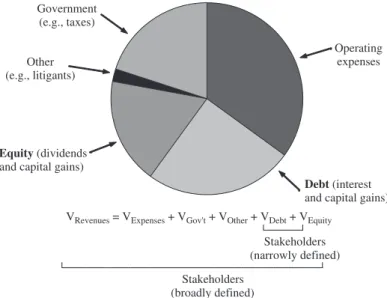
Figure 1.2 represents the value of the various claimants on the corporation’s future revenues. In this view of the firm, the value of revenues can be allocated to operating expenses (labor and materials), the government (taxes), suppliers of debt and equity capital, and other potential claimants (e.g., litigants through local or foreign legal systems). Stakeholders sometimes are narrowly defined as the owners of the firm’s debt and equity. These claims are paid out of operating income and are
3
Board of Directors
Management
Debt Equity Assets
Shareholders
FIGURE 1.1 Corporate Governance
represented by VDebtand VEquity in Figure 1.2. The values of these claims depend on the laws and conventions of the nations within which the MNC operates.
A broader definition of stakeholder includes anyone with an interest in the company, such as the firm’s customers, suppliers, employees, host government(s), and anyone else with an actual or potential claim on the firm. The firm’s customers help determine the value of revenues, VRevenues. Suppliers and employees determine the value of operating expenses, VExpenses. Governmental claims, VGovt, represent the claims of society at large and include taxes, tariffs, and the costs of compliance with local laws and regulations (e.g., environmental and corporate governance rules).
The objectives of these other stakeholders are seldom the same as those of debt or equity. Labor is more concerned with wages and job security than with shareholder wealth. Customers and suppliers likewise are concerned with their own well-being. The objective of ‘‘maximize shareholder wealth’’ also can be in conflict with host countries’ cultural, economic, political, environmental, or religious goals.
Managers have their own objectives, which are not the same as those of equity shareholders or other stakeholders. Agency costs refer to any loss in value from conflicts of interest between managers and other stakeholders, particularly
Stakeholders (narrowly defined) Stakeholders
(broadly defined) Government
(e.g., taxes)
Other (e.g., litigants)
Equity (dividends and capital gains)
Operating expenses
Debt (interest and capital gains) VRevenues = VExpenses + VGov't + VOther + VDebt + VEquity
FIGURE 1.2 Stakeholders and Their Claims on the Revenues of the Firm
equity shareholders. These costs include the costs of contracting and monitoring between the various stakeholders to reduce potential conflicts of interest. A good example of an agency cost from everyday life is the physician who recommends a costly procedure that may or may not be good for the patient — but is certainly good for the physician’s pocketbook. The presence of agency costs does not mean that management will not act in the best interests of shareholders, only that it is costly to encourage managers to do so. As the residual owners of the firm, it is the shareholders who ultimately bear these agency costs.
Agency costs arise from conflicts of interest.
Not all of the firm’s activities appear in the financial statements. Some of these activities can and do affect other stakeholders. For example, if the firm violates the laws of a host country, it may be liable for civil or criminal penalties. Union Carbide’s disaster at its plant in Bhopal, India (see box ahead), resulted in huge claims that adversely affected all stakeholders.
Countries differ in the extent to which they protect each of these stakeholders.
Countries with strong socialist movements place an emphasis on employee welfare.
Some countries emphasize environmental concerns, while others actively promote their local economy to the detriment of the local — and global — environment. Most countries protect or subsidize key industries deemed to be of vital importance to the nation’s economy or national identity. Protected industries often include products related to agriculture, such as rice in Japan, beer in Germany, and wine in France.
In the United States, as in other countries, various agricultural products that are vulnerable to foreign competition are protected through price supports and tariffs.
Sovereign nations determine the nature of the playing field on which MNCs operate. Company representatives must work within the rules and respect the sensitivities of the societies in which they operate.1 Businesses ignoring the local rules of the game do so at their own peril.
MARKET UPDATE Union Carbide’s Bhopal Disaster
Union Carbide (www.unioncarbide.com) is a diversified U.S. company with worldwide operations in a variety of industry segments. Union Carbide’s 51%- owned subsidiary in India operated a chemical plant in Bhopal, India. In 1984, poisonous gases were inadvertently released from the plant, causing the death of more than 2,000 people and injuries to nearly a quarter of a million people.
This disaster resulted in losses for nearly all of Union Carbide’s stakeholders (broadly defined). Debt and equity lost value in anticipation of a class action suit that eventually was settled in India’s courts. The careers and self-esteem of managers and employees involved in the Bhopal operation also suffered. The biggest losses were suffered by the Indian government (Union Carbide’s equity partner) and the local population.
1.2 THE CHALLENGES OF MULTINATIONAL OPERATIONS Recognizing and Overcoming Cultural Differences
An English aristocrat once said, ‘‘The only trouble with going abroad is that you have to leave home to do it.’’ True enough. People and their cultural norms vary widely. Managers and employees of the MNC must deal with unfamiliar business and popular cultures as they seek to extend the firm’s competitive advantages into new and unfamiliar markets. Being able to understand, adapt to, and manage cultural differences can make the difference between a successful and an unsuccessful international venture.
Cultural differences can be a source of risk.
Language is one of the more obvious differences between cultures. Literal translations of common words or phrases can create some amusing situations. If you’ve traveled, you’ll no doubt have your own favorite anecdote. (I once announced to a class in Germany that ‘‘Ich bin warm’’ — only to discover that ‘‘I am warm’’ is German slang for ‘‘I am gay.’’) A little language can go a long way, but only if you are able to laugh about your lack of fluency with your hosts.
As if verbal language weren’t enough of a barrier to communication, body language differs across cultures as well. In many settings, what we do with our bodies is even more important than what we say. (Voltaire wrote, ‘‘Words were given to man to enable him to conceal his true feelings.’’) Although some body language is universal, much of it is a reflection of our culture.
Eye contact is a good example. In the Western world, direct eye contact conveys confidence. Avoiding eye contact is taken as a sign of weakness and may even convey untrustworthiness. In Western countries, subordinates show respect by meeting the eyes of their superiors. In some Asian countries, subordinates show their respect by avoiding eye contact. In some Arab countries, excessive eye contact between a man and woman is thought to be disrespectful to the woman. The eyes are the windows to the soul, but be careful which windows you look through.
Another way to categorize differences in national business environments is along the functional areas of business. The following list characterizes some of the differences that MNCs encounter in their cross-border operations:
■ Differences in legal, accounting, and tax systems. Successful multinational managers must learn unfamiliar tax laws, accounting and legal conventions, and business procedures. As an example, governments in developing countries sometimes offer tax benefits in the form of tax holidays as an investment incentive. Negotiating these benefits and ensuring that they are not revoked subsequent to investment can be a delicate and time-consuming task.
■ Differences in personnel management. MNCs must adapt their human resource practices and organizational structures to accommodate the labor conditions
and conventions in foreign markets. Human resource policies developed at home often do not translate into other cultures.
■ Differences in marketing. Cross-cultural differences in marketing extend well beyond differences in language. For example, Walt Disney owns and operates some of the world’s most successful theme parks. At the heart of Disney’s U.S.
success is its family appeal. When it opened its EuroDisney theme park near Paris in the late 1980s, Disney tried to retain this family orientation and refused to sell alcoholic beverages. This unfortunately ensured that no self-respecting Frenchman would visit the park. EuroDisney was beset by other difficulties as well, including overly optimistic forecasts, labor strife, and popular opposition.
Fortunately for Disney, its equity stake was kept to a minimum by bringing in other investors in a project finance arrangement. Disney’s reputation did take a beating, along with several classes of foreign investors and the reputation of the French government of Franc¸ois Mitterrand.
■ Differences in distribution. A prolonged stay in another country inevitably means shopping for groceries. Observant shoppers can detect many national differences in the ways in which foods are distributed. U.S. residents are accustomed to large grocery chains that offer wide selections of food and nonfood items. These large chains keep expenses low through efficient supply chain management. In many other parts of the world, groceries are sold in local mom-and-pop stores.
Large discount stores are seen as impersonal and are not trusted by shoppers.
The source of the local owners’ advantage lies in their close relationships with their customers.
■ Differences in financial markets. Financial market operations vary across coun- tries. Although the most obvious differences are in the liquidity and volume of trade, other differences can be profound. For example, banking practices in many Islamic countries are conducted according to the teachings of the prophet Mohammed as found in the Koran and other Islamic holy scriptures. According to these Islamic banking customs, depositors do not receive a set rate of interest but instead share in the profits and losses of the bank. Western banks opening branch banks in Islamic countries must be cognizant of these local religious norms.
■ Differences in corporate governance. Another difference between national busi- ness cultures lies in corporate governance— the mechanisms by which major stakeholders exert control over the firm (and discussed at length in Chapter 17).
The corporation is defined by a legal framework of contracts between cus- tomers, suppliers, labor, debt, equity, and management. Because each of these contracts is executed within the laws of the societies in which the firm operates, society itself helps determine the forms of these contracts and the rights and responsibilities of the various parties.
A foreign venture that does not respect local cultural sensibilities is destined for trouble. Multinational managers must learn new business systems and social behaviors, including what types of corporate behaviors are punished, what types are merely tolerated, and what types can lead to fruitful partnerships with foreign residents and their governments.
APPLICATION ¿Que Hora Es?
Mexico City, September 12, 11:50 A.M.: You are a New Yorker working for AT&T on a satellite communications deal with the Mexican telecom giant Telmex. You have scheduled lunch with Aldo Martinez of Telmex at a fashionable restaurant in Mexico City. Conscious of the importance of the proposed deal, you arrive early and secure a private table in a secluded area of the restaurant.
12:20P.M.: Thirty minutes have passed since your arrival and still no sign of Aldo. Could he have been caught in one of Mexico City’s infamous traffic jams? Should you try to contact him on your cell phone? The waiter doesn’t seem concerned that you haven’t begun to order. Should you order food for the two of you? Oh, dear.
12:35P.M.: It has been over half an hour! Now you are really concerned.
Your imagination starts to run away with you. Perhaps the deal has fallen through? No, you’re just panicky. Perhaps he was overcome by smog? The delay is beginning to irritate you. You resolve to contact Aldo by phone — and just at that moment Aldo strolls calmly into the restaurant. Greeting you as if nothing is out of the ordinary, he takes a seat and inquires how you have been. Doesn’t he realize the anxiety and inconvenience that he has caused?
Attitudes toward time vary across cultures, particularly in the precision with which time is measured. You are merely experiencing the difference between a New York minute and la hora Mexicana (Mexican time).
Managing the Costs and Risks of Multinational Operations
Cross-border operations create additional costs. They also increase the MNC’s risk exposures.Riskexists whenever actual outcomes can differ from expectations. The MNC has exposure to risk when its assets or liabilities can change in value with unexpected changes in business conditions. As individuals and businesses pursue cross-border opportunities, they expose themselves to a wide variety of new risks.
Risk exists when outcomes can differ from the expected.
An important new risk exposure arising from cross-border operations iscountry risk— the risk that the business environment in a host country or the host country’s relationship with another country will unexpectedly change. Important sources of country risk to which the MNC is exposed include political risks and financial risks.
Political risk is the risk that the business environment in a host country will unexpectedly change due to political events. Political risk usually is determined
within a country as local political forces influence the business environment. Sources of political risk include unexpected changes in the business environment arising from repatriation restrictions, taxes, local content and employment regulations, restrictions on foreign ownership, business and bankruptcy laws, foreign exchange controls, and expropriation.
Country risks include political and financial risks.
Financial riskrefers to the risk of unexpected change in the financial or economic environment of a host country. Financial risk is influenced by political factors, but also by a myriad of financial and economic factors that are outside the control of local political forces. A particularly important financial risk exposure for MNCs with operations in more than one country is currency risk. The MNC is exposed to currency risk— also calledforeign exchange riskorforex (FX) risk— if unexpected changes in currency values affect the value of the firm. Volatility in the world’s currency markets can cause the value of the MNC to fluctuate in unexpected ways.
Profits can be wiped out quickly by changes in currency values. For this reason, financial risk management is essential for both large and small firms competing in today’s global marketplace.
1.3 THE OPPORTUNITIES OF MULTINATIONAL OPERATIONS
According to thediscounted cash flowapproach to valuation, asset value is equal to the present value of expected future cash flows discounted at an appropriate risk-adjusted discount rate.
V= t[E[CFt]/(1+i)t] (1.1) This valuation equation has an important implication for the firm. If a corporate decision has no impact on the firm’s expected future cash flows or discount rate, then the decision also has no impact on the value of the firm. Conversely, if a decision is to add value, then the decision must either increase expected cash flows or decrease the cost of capital.
Multinational Investment Opportunities
The set of investments available to the corporation is called itsinvestment oppor- tunity set. The corporation’s investment objective is to identify, invest, and then manage the set of assets that maximizes the value of the firm to its key stakeholders.
In terms of Equation 1.1, the objective is to choose the set of investments that maximizes the present value of expected future operating cash flows. This means accepting projects with expected returns that exceed investors’ required return, and rejecting projects that do not meet this hurdle.
Multinational corporations have many opportunities that are not available to local firms for increasing operating cash flows.
Enhancing Revenues Multinational corporations enjoy higher revenues than local firms by providing goods or services that are not readily available in local markets.
Here are a few examples of revenue-enhancing advantages that MNCs enjoy over domestic firms.
■ Global branding. A global brand can provide an advantage over local competi- tors. For example, McDonald’s and Coca-Cola have leveraged their internation- ally recognized brand names into marketing efficiencies that are unavailable to local competitors.
■ Marketing flexibility. MNCs have more marketing flexibility than domestic firms, in that they can more easily shift sales efforts toward markets willing to pay higher prices for their products. For example, if Ford’s Focus is in high demand in Europe, then Ford can shift its marketing efforts toward Europe and away from regions of lower demand or profitability.
■ Advantages of scale and scope. Because of their size and the breadth of their operations, MNCs can exploit their competitive advantages on a larger scale and across a broader range of markets and products than domestic competitors. For example, Nike promotes its corporate brand — the Nike swoosh — in multiple international markets and across its product line.
Reducing Operating Costs Multinational operations can reduce operating expenses in a number of ways that are not available to domestic firms.
■ Low-cost raw materials. MNCs seek low-cost raw materials to reduce costs and ensure supplies. The lure of low-cost resources can be powerful. In 1997, the French company Total secured a $2 billion deal to develop Iran’s South Pars gas field. Political opposition from Tehran — as well as from other governments — had prevented foreign investment in Iran since its 1979 revolu- tion. When Iran sought outside investment to increase production and overcome a budget deficit, MNCs such as Total were quick to respond, and economic necessity overcame two decades of political opposition.
■ Low-cost labor. Labor costs vary widely around the world, and manufacturers have an incentive to buy their goods and services from low-cost sources. Rapid industrialization in Japan and Korea during the 1960s and 1970s was driven by their low labor costs and educated workforces. These countries rose to the first rank of international economies as they acquired technological expertise.
In more recent years, the ascendance of China and India similarly has been fueled by low labor costs. The threat of low-cost foreign labor is a major fear of organized labor in industrialized countries. Indeed, labor unions are vocal opponents of efforts to promote international trade through organizations such as the European Union (EU), the North American Free Trade Agreement (NAFTA), and the World Trade Organization (WTO).
■ Flexibility in global site selection. MNCs have greater flexibility than domestic firms in the location and timing of their investments. Competition between local, regional, and national governments for capital investment allows MNCs to ‘‘shop around’’ for the most attractive deal. For example, automobile manu- facturers such as Toyota and General Motors routinely shop for tax incentives
before investing in new plants or product lines. Because of their size and inter- national presence, multinational corporations are in a better position than local firms to manage their international site location decisions.
■ Flexibility in sourcing and production. By having a diversified manufacturing base, MNCs can shift production to low-cost locations in response to currency movements or other factors. If changes in currency values make components less expensive from some countries than from others, then MNCs can use their global manufacturing network to increase production in the low-cost countries and decrease production in the high-cost countries. Local competitors typically do not enjoy this flexibility.
■ Economies of scale and scope. Companies possesseconomies of scalewhen size itself results in lower average or per-unit production costs. Economies of scale arise as fixed development or production costs are spread over a larger output.
For example, manufacturing integrated circuits entails high development costs and large fixed investment costs. Once a manufacturing plant is set up, variable production costs can be quite low. High start-up costs serve to insulate large MNCs from local competition. Economies of scope are similar, but refer to efficiencies that arise across product lines, such as when joint production results in lower per-unit costs.
■ Economies of vertical integration. Firms possesseconomies of vertical integra- tionwhen they enjoy lower costs through their control of a vertically integrated supply chain. Firms vertically integrate when it is more efficient to arrange the steps of a production process through internal rather than external markets.
Vertical integration is popular in industries that need to protect their produc- tion processes or technologies from competitors. Mature MNCs often integrate their supply chains from labor and raw material inputs right through the final marketing, distribution, and after-sale service of their products.
Multinational Business Strategy Here are a few classic strategies for preserving or enhancing operating cash flows through multinational operations. Note these strategies are often influenced by local (foreign or domestic) factors.
■ Following the customer. Service firms, such as banks and accounting firms, often follow their customers into foreign markets. Parts suppliers in industries such as automobile manufacturing also follow this strategy. As the nuances of operating in a foreign country are mastered, these firms can begin to pursue foreign clients as well.
■ Leading the customer. Many firms try to attract foreign companies into their domestic market. This lead-the-customer strategy is a way of solidifying rela- tions with foreign companies before they establish relations with other local competitors.
■ Following the leader. When competitors are actively acquiring foreign assets, a common response is to similarly acquire foreign assets to reduce the threat of falling behind in global market share or production costs. This bandwagon phenomenon is especially common in industries enjoying high profitability.
■ Going local. MNCs often build capacity directly in foreign markets to avoid quotas or tariffs on imported goods. This reduces the risk of protectionism, as
the MNC is seen as less of an outsider if it employs local workers. It also may increase sales, as customers are more receptive to locally produced goods.
Multinational Financial Opportunities
The objective of financial policy is to maximize the value of the firm through its financing choices, given the firm’s investment decisions. Financial policy includes decisions regarding the mix of debt and equity, the maturity structure of debt, the markets in which capital is raised and its currency of denomination, the method of financing domestic and foreign operations, and financial risk management.
Many financial opportunities arise from financial market imperfections, so it is sensible to first define a perfect financial market.
The Perfect Market Assumptions and Concepts of Market Efficiency Theperfect finan- cial market assumptionswill prove useful at several points in the text.
In a perfect financial market, rational investors have equal access to market prices and information in a frictionless market.
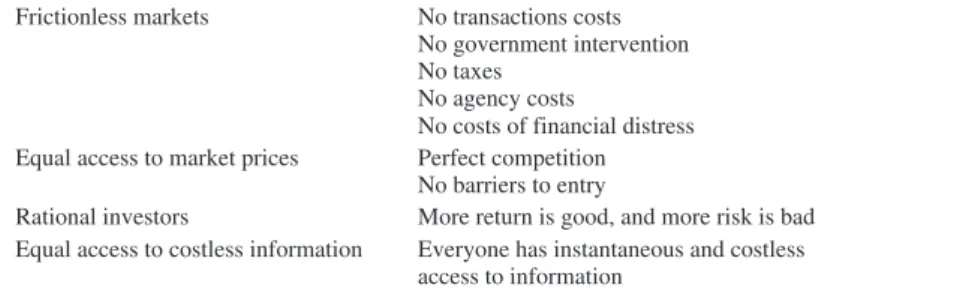
This definition has several components, summarized in Figure 1.3.
■ Frictionless markets. A frictionless market has no transaction costs, taxes, government intervention, agency costs, or costs of financial distress. Some market frictions such as transaction costs are a function of market volume and liquidity. Other frictions such as taxes are externally imposed and independent of volume and liquidity.
■ Equal access to market prices. If all market participants have equal access to market prices, then no single party can influence prices. Although this is a con- venient assumption, it does not always hold. Many domestic and international actors can influence prices. Governments influence asset and currency values through their fiscal and monetary policies, cartels such as the Organization of
Rational investors have equal access to market prices and information in a frictionless market.
1. Frictionless markets No transactions costs No government intervention No taxes
No agency costs 2. Equal access to market prices Perfect competition
No barriers to entry
access to information
3. Rational investors More return is good, and more risk is bad 4. Equal access to costless information Everyone has instantaneous and costless
No costs of financial distress
FIGURE 1.3 The Perfect Market Assumptions
Petroleum Exporting Countries (OPEC) influence commodity prices through their control of production, and hedge funds such as George Soros’s Quantum Fund affect market prices through the sheer size of their trades.
■ Rational investors. Rational investors price assets with a dispassionate eye toward expected returns and risks. Although this sounds great in theory, investors are not always rational, and there are significant cross-border differ- ences in investors’ behaviors. The study of the impact of psychological factors on behaviors and asset prices is referred to as behavioral finance, and is an active area of financial research.
■ Equal access to costless information. Equal access to costless information puts market participants on an equal footing with one another. This assumption belies the fact that language serves as a very real barrier to the flow of information across (and sometimes within) national boundaries. Even with a common lan- guage, information is difficult to convey and can change in the telling. There are also wide differences in accounting measurement and disclosure require- ments, and managers and other insiders benefit from their privileged access to information in both developed and developing markets.
The assumption of frictionless markets is an assumption ofoperational efficiency such that there are no drains on funds as they are transferred from one use to another. The last three assumptions are sufficient to ensure an informationally efficient market in which prices fully reflect all relevant information. Informational efficiency does not require frictionless markets, as prices can fully reflect information despite the existence of transaction costs. For example, a bid-ask spread on currency transaction would preclude costless arbitrage, although currencies could still be correctly priced within the bounds of transaction costs.2 Similarly, stock and bond markets can be informationally efficient despite relatively high transaction costs.
Operational efficiency and informational efficiency together promote alloca- tional efficiency; that is, an efficient allocation of capital toward its most productive uses. Allocational efficiency — the basic objective of any financial market — is great- est when there is high liquidity and transaction volume in freely traded assets. Less liquid financial markets do not allocate capital between savers and borrowers as efficiently as more liquid markets.
In a perfect financial market, there is no need for government regulators, bank auditors, or attorneys. With no taxes, there is no need for tax collectors or tax accountants. With equal access to market prices and no transaction costs, there is no need for financial intermediaries such as banks and brokers, nor any market for finance graduates. And, with costless information, there is no need for finance professors or this text. The net result is that the price of a particular asset is the same all over the world. Although this is strictly true only in a perfect world, it has important implications for real-world financial policies.
Implications of Perfect Financial Markets for Multinational Financial Policy The per- fect market assumptions provide a convenient starting point for investigating many difficult issues in finance. In particular, the corporation’s financial policy is irrele- vant in a perfect financial market because — with equal access to market prices and information in a frictionless market — individual investors can replicate or reverse
any action that the firm can take.3 In such a world, financial policy cannot affect firm value.
The converse of this irrelevance proposition also must be true.
If financial policy is to increase firm value, then it must increase the firm’s expected cash flows or decrease the discount rate in a way that cannot be replicated by individual investors.
Financial market imperfections are more prominent in international than in domestic markets, so MNCs have more opportunities than comparable domestic firms to create value through their financial policies. Here are a few examples.
■ Financial market arbitrage. Chapter 4 shows how market participants can take advantage of cross-border differences in asset prices, such as disequilibria in currencies and interest rates.
■ Hedging policy. Chapter 8 shows how financial managers can create value by reducing drains on operating cash flows (e.g., by reducing expected bankruptcy costs) through the firm’s hedging policy.
■ MNC cost of capital when there are capital flow barriers. Chapter 14 discusses how MNCs can lower their cost of capital by selling debt or equity securities to foreign investors that are willing to pay higher prices than domestic investors.
■ Reducing taxes through multinational operations. Chapter 15 shows how MNCs can reduce their tax burden through multinational tax planning. In particular, MNCs have an incentive to recognize income in low-tax countries and expenses in high-tax countries.
■ Barriers to the free flow of capital across international markets. Chapter 18 surveys the world’s debt and equity markets, and describes some of the barriers that impede the free flow of capital across national borders. Chapter 18 also discusses vehicles for diversifying across national boundaries in the presence of these capital flow barriers.
■ Currency risk and the cost of capital. Chapter 20 discusses the multinational corporation’s exposure to currency risk and the impact of this exposure on investors’ required returns and the MNC’s cost of capital.
Violations of any of the perfect financial market assumptions can lead to financial opportunities, particularly for multinational corporations with access to interna- tional financial markets.
Multinational Opportunities and Firm Value
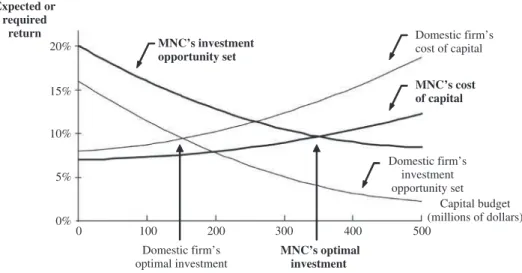
Figure 1.4 illustrates the potential increase in firm value provided by multinational opportunities. The downward-sloping lines represent the investment opportunity set of a domestic corporation and of a comparable multinational corporation. Each firm accepts its most lucrative projects first, so expected returns fall as more capital is invested. The expected return on the domestic firm’s first dollar of investment
Expected or required
return
MNC’s investment opportunity set
Domestic firm’s cost of capital MNC’s cost of capital
Domestic firm’s investment opportunity set
Capital budget (millions of dollars) MNC’s optimal
investment Domestic firm’s
optimal investment 0%0
5%
10%
15%
20%
100 200 300 400 500
Key: Investment opportunities reflect expected returns on an incremental dollar of investment.
Capital costs reflect investors’ required returns on a given dollar used to fund that investment.
FIGURE 1.4 The Potential Benefits of Multinationality
is 16 percent along the y-axis. With more attractive investment alternatives, the MNC’s initial investments are displayed with an expected return of 20 percent.
The upward-sloping lines represent the required return or cost of capital on investment. Firms draw upon their lowest cost sources of funds first, so cost of capital is an increasing function of the capital budget. The domestic firm in Figure 1.4 has a cost of capital of 8 percent on the first dollar that it invests. With access to lower cost funds from international sources, the MNC in Figure 1.4 faces a required return of only 7 percent on its initial investment.
The MNC in Figure 1.4 earns an expected return of 20 percent at a required return of only 7 percent along the y-axis, so its first dollar of investment increases shareholder wealth by 13 cents. The MNC in Figure 1.4 will continue to invest until its expected return falls below its required return at a capital budget of approximately
$350 million. With a larger and richer set of investments, this MNC will have a higher value than a comparable domestic firm.
The market value of a multinational corporation should reflect these expanded investment and financing opportunities. However, these opportunities come with additional costs and risks as well. Although an MNC’s international experience places it in a better position than its domestic rivals to evaluate and manage these opportunities, costs, and risks, it is an open question whether multinational operations per se can increase the value of the firm.4
1.4 FINANCIAL MANAGEMENT OF THE MULTINATIONAL CORPORATION
At the heart of the opportunities, costs, and risks of multinational operations are the differences among the countries and peoples of the world. Local culture
influences the conduct of business in profound and subtle ways, creating important cross-border differences in financial, economic, political, regulatory, accounting, and tax environments. The multinational financial manager must be sensitive to these differences in the conduct of both professional and personal life. Failing to accommodate cultural patterns and expectations can obstruct negotiations and result in hostility and mistrust even if both counterparties have the best of intentions.
MNCs have operations in more than one country
Because of the far-reaching influence of local business environments on multina- tional operations, the multinational financial manager must be well versed in each of the traditional fields of business, including marketing, management of physical and human resources, law, regulation, taxation, accounting, and finance. Successful operation in each of these areas depends on knowing local cultures and their written and unwritten conventions. Business problems are rarely the province of a single discipline, and the challenges facing multinational corporations are especially prone to be multidisciplinary.
To be able to recognize and develop business opportunities in foreign markets, the multinational financial manager also must be an expert in several fields within finance. Multinational financial managers must understand the capabilities and limitations of traditional investment analysis, have a plan of attack for entry into and exit from foreign markets, and value the flexibilities and real options presented by investment opportunities in foreign markets. The financial opportunities of the MNC also are richer than those of the domestic corporation, because of cross-border differences in investors’ expectations, risk tolerances, and required returns. Multinational financial management requires a thorough knowledge of the international financial markets for equity securities, interest rate contracts, currencies, commodities, and derivatives (futures, options, and swaps). Today’s multinational financial manager must be a jack-of-all-trades, as well as a master of finance.
1.5 SUMMARY
An understanding of multinational financial management is crucial to success in today’s, and inevitably in tomorrow’s, marketplace. This is unquestionably true for firms competing directly with foreign firms, such as domestic automakers in competition with foreign automakers. It is also true for domestic firms whose suppliers, customers, and competitors are increasingly likely to be from foreign countries.
In today’s business environment, the success of a multinational corporation depends on its manager’s abilities to recognize and exploit imperfections in national markets for products and factors of production, and to work effectively within the political and economic constraints imposed by host governments.
This book develops a framework for evaluating the opportunities, costs, and risks presented by the world’s marketplaces. Although we usually take the perspective
of the financial manager of a large multinational corporation, this framework works just as well for government entities, small businesses, and even individuals. Along the way, we provide a tour of business environments in many countries around the world. Bon voyage.
KEY TERMS
agency costs
allocational, informational, and opera- tional efficiency
arbitrage
corporate governance country risk
currency (foreign exchange) risk discounted cash flow
economies of scale and scope
economies of vertical integration financial risk
investment opportunity set multinational corporation (MNC) perfect financial market assumptions political risk
risk versus risk exposure stakeholders
CONCEPTUAL QUESTIONS
1.1 List the MNC’s key stakeholders. How does each have a stake in the MNC?
1.2 In what ways do cultural differences affect the conduct of international business?
1.3 What is country risk? Describe several types of country risk one might face when conducting business in another country.
1.4 What is political risk?
1.5 What is foreign exchange risk?
1.6 What investment opportunities might MNCs enjoy that are not available to local firms?
1.7 How can MNCs reduce operating expenses relative to domestic firms?
1.8 What are the perfect financial market assumptions? What is their implication for multinational financial management?
1.9 Describe the ways in which multinational financial management is different from domestic financial management.