The center of gravity in Roman studies has shifted far from the upper echelons of government and administration in Rome or the Emperor’s court to the provinces and the individual. The multidisciplinary stud- ies presented in this volume reflect the turn in Roman history to the identities of ethnic groups and even single individuals who lived in Rome’s vast multinational empire. The purpose is less to discover another element in the Roman Empire’s “success” in governance than to illuminate the variety of individual experience in its own terms. The chapters here, reflecting a wide spectrum of professional expertise, range across the many cultures, languages, religions and literatures of the Roman Empire, with a special focus on the Jews as a test case for the larger issues. This title is also available as Open Access on Cambridge Core.
j o n a t h a n j . p r i c e is the Fred and Helen Lessing Professor of Ancient History at Tel Aviv University and the author of many studies on Greek and Roman historiography, and Jewish history and epigraphy of the Roman period. His publications includeJerusalem under Siege: The Collapse of the Jewish State, 66–70 C.E.(1992),Thucydides and Internal War(Cambridge, 2001), and editions of about 3,000 Jewish inscriptions inCorpus Inscriptionum Iudaeae/Palaestinae, Volumes I–V (2010–21).
m a r g a l i t f i n k e l b e r g is Professor of Classics (emeritus) at Tel Aviv University and a member of the Israel Academy of Sciences and Humanities. She has authoredThe Birth of Literary Fiction in Ancient Greece (1998), Greeks and Pre-Greeks: Aegean Prehistory and Greek Heroic Tradition (2005), Homer (2014; Hebrew), The Gatekeeper:
Narrative Voice in Plato’s Dialogues(2019),Homer and Early Greek Epic: Collected Essays(2020), and numerous scholarly articles. She is the editor ofThe Homer Encyclopedia(3 vols.; 2011).
y u v a l s h a h a r is Senior Lecturer in Jewish History at Tel Aviv University. His published studies on the history, historiography and historical geography of Palestine in the Hellenistic, Roman and Byzantine periods include Josephus Geographicus: The Classical Context of Geography in Josephus(2004).
History Emeritus at Tel Aviv University, as well as, inter alia, an Israel Prize laureate, and a member of the Israel Academy of Sciences and Humanities and of the American Philosophical Society. Some but not all of the articles were first presented in May 2015 in a conference at Tel Aviv University on the occasion of his retirement and seventieth birthday. We wish him many more fruitful years of scholarship.
Jonathan Price, Yuval Shahar, Margalit Finkelberg
New Perspectives on Ethnic Diversity and Cultural Identity
Edited by
j o n a t h a n j . p r i c e
Tel Aviv University
m a r g a l i t f i n k e l b e r g
Tel Aviv University
y u v a l s h a h a r
Tel Aviv University
477 Williamstown Road, Port Melbourne, VIC 3207, Australia 314–321, 3rd Floor, Plot 3, Splendor Forum, Jasola District Centre, New Delhi–110025, India
79 Anson Road, #06–04/06, Singapore 079906
Cambridge University Press is part of the University of Cambridge.
It furthers the University’s mission by disseminating knowledge in the pursuit of education, learning, and research at the highest international levels of excellence.
www.cambridge.org
Information on this title:www.cambridge.org/9781009256223 DOI:10.1017/9781009256193
© Cambridge University Press 2021 Reissued as Open Access, 2022
This work is in copyright. It is subject to statutory exceptions and to the provisions of relevant licensing agreements; with the exception of the Creative Commons version the link for which is provided below, no reproduction of any part of this work may take place without the written
permission of Cambridge University Press.
An online version of this work is published atdoi.org/10.1017/9781009256193under a Creative Commons Open Access license CC-BY-NC-ND 4.0 which permits re-use, distribution and reproduction in any medium for non-commercial purposes providing appropriate credit to the original work is given. You may not distribute derivative works without permission. To view a copy of this license, visithttps://creativecommons .org/licenses/by-nc-nd/4.0
All versions of this work may contain content reproduced under license from third parties. Permission to reproduce this third-party content must be obtained from these third-parties directly.
When citing this work, please include a reference to the DOI10.1017/9781009256193 First published 2021
Printed in Singapore by Markono Print Media Pte Ltd
A catalogue record for this publication is available from the British Library.
Library of Congress Cataloging-in-Publication Data
Names: Price, Jonathan J., editor. | Finkelberg, Margalit, editor. | Shahar, Yuval, 1953̣ –editor.
Title: Rome : an empire of many nations : new perspectives on ethnic diversity and cultural identity / edited by Jonathan J. Price, Margalit Finkelberg, Yuval Shahar.
Other titles: Rome, an empire of many nations : new perspectives on ethnic diversity and cultural identity Description: Cambridge, United Kingdom : New York, NY : Cambridge University Press, 2021. | Includes bibliographical references and index.
Identifiers: LCCN 2020057804 (print) | LCCN 2020057805 (ebook) | ISBN 9781108479455 (hardback) | ISBN 9781108785563 (ebook)
Subjects: LCSH: National characteristics, Roman. | Romans–Ethnic identity. | Ethnicity–Rome. | Jews– Rome–History. | Religious pluralism–Rome. | Group identity–Rome.
Classification: LCC DG78 .R5838 2021 (print) | LCC DG78 (ebook) | DDC 937/.06–dc23 LC record available athttps://lccn.loc.gov/2020057804
LC ebook record available athttps://lccn.loc.gov/2020057805 ISBN 978-1-009-25622-3 Paperback
Cambridge University Press has no responsibility for the persistence or accuracy of URLs for external or third-party internet websites referred to in this publication
The center of gravity in Roman studies has shifted far from the upper echelons of government and administration in Rome or the Emperor’s court to the provinces and the individual. The multidisciplinary stud- ies presented in this volume reflect the turn in Roman history to the identities of ethnic groups and even single individuals who lived in Rome’s vast multinational empire. The purpose is less to discover another element in the Roman Empire’s “success” in governance than to illuminate the variety of individual experience in its own terms. The chapters here, reflecting a wide spectrum of professional expertise, range across the many cultures, languages, religions and literatures of the Roman Empire, with a special focus on the Jews as a test case for the larger issues. This title is also available as Open Access on Cambridge Core.
j o n a t h a n j . p r i c e is the Fred and Helen Lessing Professor of Ancient History at Tel Aviv University and the author of many studies on Greek and Roman historiography, and Jewish history and epigraphy of the Roman period. His publications includeJerusalem under Siege: The Collapse of the Jewish State, 66–70 C.E.(1992),Thucydides and Internal War(Cambridge, 2001), and editions of about 3,000 Jewish inscriptions inCorpus Inscriptionum Iudaeae/Palaestinae, Volumes I–V (2010–21).
m a r g a l i t f i n k e l b e r g is Professor of Classics (emeritus) at Tel Aviv University and a member of the Israel Academy of Sciences and Humanities. She has authoredThe Birth of Literary Fiction in Ancient Greece (1998), Greeks and Pre-Greeks: Aegean Prehistory and Greek Heroic Tradition (2005), Homer (2014; Hebrew), The Gatekeeper:
Narrative Voice in Plato’s Dialogues(2019),Homer and Early Greek Epic: Collected Essays(2020), and numerous scholarly articles. She is the editor ofThe Homer Encyclopedia(3 vols.; 2011).
y u v a l s h a h a r is Senior Lecturer in Jewish History at Tel Aviv University. His published studies on the history, historiography and historical geography of Palestine in the Hellenistic, Roman and Byzantine periods include Josephus Geographicus: The Classical Context of Geography in Josephus(2004).
History Emeritus at Tel Aviv University, as well as, inter alia, an Israel Prize laureate, and a member of the Israel Academy of Sciences and Humanities and of the American Philosophical Society. Some but not all of the articles were first presented in May 2015 in a conference at Tel Aviv University on the occasion of his retirement and seventieth birthday. We wish him many more fruitful years of scholarship.
Jonathan Price, Yuval Shahar, Margalit Finkelberg
New Perspectives on Ethnic Diversity and Cultural Identity
Edited by
j o n a t h a n j . p r i c e
Tel Aviv University
m a r g a l i t f i n k e l b e r g
Tel Aviv University
y u v a l s h a h a r
Tel Aviv University
477 Williamstown Road, Port Melbourne, VIC 3207, Australia 314–321, 3rd Floor, Plot 3, Splendor Forum, Jasola District Centre, New Delhi–110025, India
79 Anson Road, #06–04/06, Singapore 079906
Cambridge University Press is part of the University of Cambridge.
It furthers the University’s mission by disseminating knowledge in the pursuit of education, learning, and research at the highest international levels of excellence.
www.cambridge.org
Information on this title:www.cambridge.org/9781009256223 DOI:10.1017/9781009256193
© Cambridge University Press 2021 Reissued as Open Access, 2022
This work is in copyright. It is subject to statutory exceptions and to the provisions of relevant licensing agreements; with the exception of the Creative Commons version the link for which is provided below, no reproduction of any part of this work may take place without the written
permission of Cambridge University Press.
An online version of this work is published atdoi.org/10.1017/9781009256193under a Creative Commons Open Access license CC-BY-NC-ND 4.0 which permits re-use, distribution and reproduction in any medium for non-commercial purposes providing appropriate credit to the original work is given. You may not distribute derivative works without permission. To view a copy of this license, visithttps://creativecommons .org/licenses/by-nc-nd/4.0
All versions of this work may contain content reproduced under license from third parties. Permission to reproduce this third-party content must be obtained from these third-parties directly.
When citing this work, please include a reference to the DOI10.1017/9781009256193 First published 2021
Printed in Singapore by Markono Print Media Pte Ltd
A catalogue record for this publication is available from the British Library.
Library of Congress Cataloging-in-Publication Data
Names: Price, Jonathan J., editor. | Finkelberg, Margalit, editor. | Shahar, Yuval, 1953̣ –editor.
Title: Rome : an empire of many nations : new perspectives on ethnic diversity and cultural identity / edited by Jonathan J. Price, Margalit Finkelberg, Yuval Shahar.
Other titles: Rome, an empire of many nations : new perspectives on ethnic diversity and cultural identity Description: Cambridge, United Kingdom : New York, NY : Cambridge University Press, 2021. | Includes bibliographical references and index.
Identifiers: LCCN 2020057804 (print) | LCCN 2020057805 (ebook) | ISBN 9781108479455 (hardback) | ISBN 9781108785563 (ebook)
Subjects: LCSH: National characteristics, Roman. | Romans–Ethnic identity. | Ethnicity–Rome. | Jews– Rome–History. | Religious pluralism–Rome. | Group identity–Rome.
Classification: LCC DG78 .R5838 2021 (print) | LCC DG78 (ebook) | DDC 937/.06–dc23 LC record available athttps://lccn.loc.gov/2020057804
LC ebook record available athttps://lccn.loc.gov/2020057805 ISBN 978-1-009-25622-3 Paperback
Cambridge University Press has no responsibility for the persistence or accuracy of URLs for external or third-party internet websites referred to in this publication
The center of gravity in Roman studies has shifted far from the upper echelons of government and administration in Rome or the Emperor’s court to the provinces and the individual. The multidisciplinary stud- ies presented in this volume reflect the turn in Roman history to the identities of ethnic groups and even single individuals who lived in Rome’s vast multinational empire. The purpose is less to discover another element in the Roman Empire’s “success” in governance than to illuminate the variety of individual experience in its own terms. The chapters here, reflecting a wide spectrum of professional expertise, range across the many cultures, languages, religions and literatures of the Roman Empire, with a special focus on the Jews as a test case for the larger issues. This title is also available as Open Access on Cambridge Core.
j o n a t h a n j . p r i c e is the Fred and Helen Lessing Professor of Ancient History at Tel Aviv University and the author of many studies on Greek and Roman historiography, and Jewish history and epigraphy of the Roman period. His publications includeJerusalem under Siege: The Collapse of the Jewish State, 66–70 C.E.(1992),Thucydides and Internal War(Cambridge, 2001), and editions of about 3,000 Jewish inscriptions inCorpus Inscriptionum Iudaeae/Palaestinae, Volumes I–V (2010–21).
m a r g a l i t f i n k e l b e r g is Professor of Classics (emeritus) at Tel Aviv University and a member of the Israel Academy of Sciences and Humanities. She has authoredThe Birth of Literary Fiction in Ancient Greece (1998), Greeks and Pre-Greeks: Aegean Prehistory and Greek Heroic Tradition (2005), Homer (2014; Hebrew), The Gatekeeper:
Narrative Voice in Plato’s Dialogues(2019),Homer and Early Greek Epic: Collected Essays(2020), and numerous scholarly articles. She is the editor ofThe Homer Encyclopedia(3 vols.; 2011).
y u v a l s h a h a r is Senior Lecturer in Jewish History at Tel Aviv University. His published studies on the history, historiography and historical geography of Palestine in the Hellenistic, Roman and Byzantine periods include Josephus Geographicus: The Classical Context of Geography in Josephus(2004).
History Emeritus at Tel Aviv University, as well as, inter alia, an Israel Prize laureate, and a member of the Israel Academy of Sciences and Humanities and of the American Philosophical Society. Some but not all of the articles were first presented in May 2015 in a conference at Tel Aviv University on the occasion of his retirement and seventieth birthday. We wish him many more fruitful years of scholarship.
Jonathan Price, Yuval Shahar, Margalit Finkelberg
New Perspectives on Ethnic Diversity and Cultural Identity
Edited by
j o n a t h a n j . p r i c e
Tel Aviv University
m a r g a l i t f i n k e l b e r g
Tel Aviv University
y u v a l s h a h a r
Tel Aviv University
477 Williamstown Road, Port Melbourne, VIC 3207, Australia 314–321, 3rd Floor, Plot 3, Splendor Forum, Jasola District Centre, New Delhi–110025, India
79 Anson Road, #06–04/06, Singapore 079906
Cambridge University Press is part of the University of Cambridge.
It furthers the University’s mission by disseminating knowledge in the pursuit of education, learning, and research at the highest international levels of excellence.
www.cambridge.org
Information on this title:www.cambridge.org/9781009256223 DOI:10.1017/9781009256193
© Cambridge University Press 2021 Reissued as Open Access, 2022
This work is in copyright. It is subject to statutory exceptions and to the provisions of relevant licensing agreements; with the exception of the Creative Commons version the link for which is provided below, no reproduction of any part of this work may take place without the written
permission of Cambridge University Press.
An online version of this work is published atdoi.org/10.1017/9781009256193under a Creative Commons Open Access license CC-BY-NC-ND 4.0 which permits re-use, distribution and reproduction in any medium for non-commercial purposes providing appropriate credit to the original work is given. You may not distribute derivative works without permission. To view a copy of this license, visithttps://creativecommons .org/licenses/by-nc-nd/4.0
All versions of this work may contain content reproduced under license from third parties. Permission to reproduce this third-party content must be obtained from these third-parties directly.
When citing this work, please include a reference to the DOI10.1017/9781009256193 First published 2021
Printed in Singapore by Markono Print Media Pte Ltd
A catalogue record for this publication is available from the British Library.
Library of Congress Cataloging-in-Publication Data
Names: Price, Jonathan J., editor. | Finkelberg, Margalit, editor. | Shahar, Yuval, 1953̣ –editor.
Title: Rome : an empire of many nations : new perspectives on ethnic diversity and cultural identity / edited by Jonathan J. Price, Margalit Finkelberg, Yuval Shahar.
Other titles: Rome, an empire of many nations : new perspectives on ethnic diversity and cultural identity Description: Cambridge, United Kingdom : New York, NY : Cambridge University Press, 2021. | Includes bibliographical references and index.
Identifiers: LCCN 2020057804 (print) | LCCN 2020057805 (ebook) | ISBN 9781108479455 (hardback) | ISBN 9781108785563 (ebook)
Subjects: LCSH: National characteristics, Roman. | Romans–Ethnic identity. | Ethnicity–Rome. | Jews– Rome–History. | Religious pluralism–Rome. | Group identity–Rome.
Classification: LCC DG78 .R5838 2021 (print) | LCC DG78 (ebook) | DDC 937/.06–dc23 LC record available athttps://lccn.loc.gov/2020057804
LC ebook record available athttps://lccn.loc.gov/2020057805 ISBN 978-1-009-25622-3 Paperback
Cambridge University Press has no responsibility for the persistence or accuracy of URLs for external or third-party internet websites referred to in this publication
The center of gravity in Roman studies has shifted far from the upper echelons of government and administration in Rome or the Emperor’s court to the provinces and the individual. The multidisciplinary stud- ies presented in this volume reflect the turn in Roman history to the identities of ethnic groups and even single individuals who lived in Rome’s vast multinational empire. The purpose is less to discover another element in the Roman Empire’s “success” in governance than to illuminate the variety of individual experience in its own terms. The chapters here, reflecting a wide spectrum of professional expertise, range across the many cultures, languages, religions and literatures of the Roman Empire, with a special focus on the Jews as a test case for the larger issues. This title is also available as Open Access on Cambridge Core.
j o n a t h a n j . p r i c e is the Fred and Helen Lessing Professor of Ancient History at Tel Aviv University and the author of many studies on Greek and Roman historiography, and Jewish history and epigraphy of the Roman period. His publications includeJerusalem under Siege: The Collapse of the Jewish State, 66–70 C.E.(1992),Thucydides and Internal War(Cambridge, 2001), and editions of about 3,000 Jewish inscriptions inCorpus Inscriptionum Iudaeae/Palaestinae, Volumes I–V (2010–21).
m a r g a l i t f i n k e l b e r g is Professor of Classics (emeritus) at Tel Aviv University and a member of the Israel Academy of Sciences and Humanities. She has authoredThe Birth of Literary Fiction in Ancient Greece (1998), Greeks and Pre-Greeks: Aegean Prehistory and Greek Heroic Tradition (2005), Homer (2014; Hebrew), The Gatekeeper:
Narrative Voice in Plato’s Dialogues(2019),Homer and Early Greek Epic: Collected Essays(2020), and numerous scholarly articles. She is the editor ofThe Homer Encyclopedia(3 vols.; 2011).
y u v a l s h a h a r is Senior Lecturer in Jewish History at Tel Aviv University. His published studies on the history, historiography and historical geography of Palestine in the Hellenistic, Roman and Byzantine periods include Josephus Geographicus: The Classical Context of Geography in Josephus(2004).
History Emeritus at Tel Aviv University, as well as, inter alia, an Israel Prize laureate, and a member of the Israel Academy of Sciences and Humanities and of the American Philosophical Society. Some but not all of the articles were first presented in May 2015 in a conference at Tel Aviv University on the occasion of his retirement and seventieth birthday. We wish him many more fruitful years of scholarship.
Jonathan Price, Yuval Shahar, Margalit Finkelberg
New Perspectives on Ethnic Diversity and Cultural Identity
Edited by
j o n a t h a n j . p r i c e
Tel Aviv University
m a r g a l i t f i n k e l b e r g
Tel Aviv University
y u v a l s h a h a r
Tel Aviv University
477 Williamstown Road, Port Melbourne, VIC 3207, Australia 314–321, 3rd Floor, Plot 3, Splendor Forum, Jasola District Centre, New Delhi–110025, India
79 Anson Road, #06–04/06, Singapore 079906
Cambridge University Press is part of the University of Cambridge.
It furthers the University’s mission by disseminating knowledge in the pursuit of education, learning, and research at the highest international levels of excellence.
www.cambridge.org
Information on this title:www.cambridge.org/9781009256223 DOI:10.1017/9781009256193
© Cambridge University Press 2021 Reissued as Open Access, 2022
This work is in copyright. It is subject to statutory exceptions and to the provisions of relevant licensing agreements; with the exception of the Creative Commons version the link for which is provided below, no reproduction of any part of this work may take place without the written
permission of Cambridge University Press.
An online version of this work is published atdoi.org/10.1017/9781009256193under a Creative Commons Open Access license CC-BY-NC-ND 4.0 which permits re-use, distribution and reproduction in any medium for non-commercial purposes providing appropriate credit to the original work is given. You may not distribute derivative works without permission. To view a copy of this license, visithttps://creativecommons .org/licenses/by-nc-nd/4.0
All versions of this work may contain content reproduced under license from third parties. Permission to reproduce this third-party content must be obtained from these third-parties directly.
When citing this work, please include a reference to the DOI10.1017/9781009256193 First published 2021
Printed in Singapore by Markono Print Media Pte Ltd
A catalogue record for this publication is available from the British Library.
Library of Congress Cataloging-in-Publication Data
Names: Price, Jonathan J., editor. | Finkelberg, Margalit, editor. | Shahar, Yuval, 1953̣ –editor.
Title: Rome : an empire of many nations : new perspectives on ethnic diversity and cultural identity / edited by Jonathan J. Price, Margalit Finkelberg, Yuval Shahar.
Other titles: Rome, an empire of many nations : new perspectives on ethnic diversity and cultural identity Description: Cambridge, United Kingdom : New York, NY : Cambridge University Press, 2021. | Includes bibliographical references and index.
Identifiers: LCCN 2020057804 (print) | LCCN 2020057805 (ebook) | ISBN 9781108479455 (hardback) | ISBN 9781108785563 (ebook)
Subjects: LCSH: National characteristics, Roman. | Romans–Ethnic identity. | Ethnicity–Rome. | Jews– Rome–History. | Religious pluralism–Rome. | Group identity–Rome.
Classification: LCC DG78 .R5838 2021 (print) | LCC DG78 (ebook) | DDC 937/.06–dc23 LC record available athttps://lccn.loc.gov/2020057804
LC ebook record available athttps://lccn.loc.gov/2020057805 ISBN 978-1-009-25622-3 Paperback
Cambridge University Press has no responsibility for the persistence or accuracy of URLs for external or third-party internet websites referred to in this publication
List of Figures [pagevii]
List of Contributors [ix]
Acknowledgments [xi]
List of Abbreviations [xii]
Introduction [1]
p a r t i e t h n i c i t y a n d i d e n t i t y i n t h e r o m a n e m p i r e [15]
1 From Rome to Constantinople [17]
b e n j a m i n i s a a c
2 The Imperial Senate: Center of a Multinational Imperium [29]
w e r n e r e c k
3 Ethnic Types and Stereotypes in Ancient Latin Idioms [42]
d a n i e l a d u e c k
4 Keti, Son of Maswalat: Ethnicity and Empire [58]
b r e n t d . s h a w
p a r t i i c u l t u r e a n d i d e n t i t y i n t h e r o m a n e m p i r e [85]
5 Roman Reception of the Trojan War [87]
m a r g a l i t f i n k e l b e r g
6 Claiming Roman Origins: Greek Cities and the Roman Colonial Pattern [100]
c e´d r i c b r e´l a z
7 Roman Theologies in the Roman Cities of Italy and the Provinces [116]
j o h n s c h e i d
v
8 The Involvement of Provincial Cities in the Administration of School Teaching [135]
i d o i s r a e l o w i c h
9 Many Nations, One Night? Historical Aspects of the Night in the Roman Empire [146]
a n g e l o s c h a n i o t i s
p a r t i i i e t h n i c i t y a n d i d e n t i t y i n t h e r o m a n e m p i r e : t h e c a s e o f t h e j e w s [167]
10 Religious Pluralism in the Roman Empire: Did Judaism Test the Limits of Roman Tolerance? [169]
e r i c h s . g r u e n
11 Rome’s Attitude to Jews after the Great Rebellion–Beyond Raison d’état? [186]
a l e x a n d e r y a k o b s o n
12 Betweenethnosandpopulus: The Boundaries of Being a Jew [203]
y o u v a l r o t m a n
13 Local Identities of Synagogue Communities in the Roman Empire [223]
j o n a t h a n j . p r i c e
14 The Good, the Bad and the Middling: Roman Emperors in Talmudic Literature [239]
y u v a l s h a h a r
15 The Severans and Rabbi Judah ha-Nasi [260]
a h a r o n o p p e n h e i m e r
p a r t i v i u d a e a / p a l a e s t i n a [273]
16 The Roman Legionary Base in Legio-Kefar‘Othnay–The Evidence from the Small Finds [275]
y o t a m t e p p e r
17 The Camp of the Legion X Fretensis and the Starting Point of Aelia Capitolina [300]
s h l o m i t w e k s l e r - b d o l a h
Bibliography [332]
General Index [386]
Index Locorum [396]
4.1 Tombstone of Gaius Julius Gaetulus / Keti son of Maswalat. [page61]
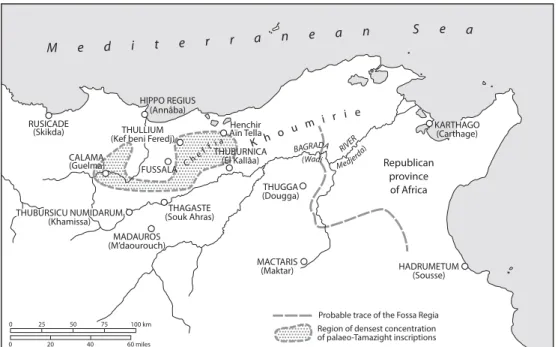
4.2 The Hippo Regius Region: Hippo Regius and Thullium. [66]
4.3 Proconsular Africa: The‘Cheffia’Region in Context. [67]
16.1 Legio-Kefar‘Othnay and the sites in Palestine that mention Roman military presence, Roman roads and the activities of the soldiers of Legio II Traiana and Legio VI Ferrata. [276]
16.2 Peutinger Map–Capercotani (Legio) along the Roman road between Caesarea and Bet She‘an-Scythopolis. [281]
16.3 Sites in the Jezreel Valley and its environs showing connections to Legio, according to Eusebius. [283]
16.4 Schumacher map (1908), probes and archaeological excavations at Legio. [286]
16.5 Tile bearing the stamp of Legio II Traiana, from Legio-Kefar
‘Othnay. [290]
16.6 Stamps of Legio VI Ferrata from Legio-Kefar
‘Othnay. [291]
16.7 Legio, Coin with two countermarks, the first of Legio VI Ferrata, the second of a head facing right. [293]
16.8 Legio, Roman military equipment. [295]
16.9 Kefar‘Othnay–the northern panel of the mosaic in the Christian Prayer Hall. [298]
17.1 The camp of the X Fretensis, the Temple Mount, and the bridge connecting them in the early second century CE. [305]
17.2 The city of Aelia Capitolina and the military camp in the second and third centuries CE. [306]
17.3 Jerusalem/Aelia in the mid fourth century. [307]
17.4 Jerusalem/Aelia around 450 CE. [308]
17.5 Café Bashourah. [310]
vii
17.6 Eastern Cardo in the Western Wall Plaza, looking northeast. [317]
17.7 Eastern Cardo in the Western Wall Plaza, looking southwest. [318]
17.8 Bread stamp from the Roman dump. [319]
17.9 Finds from the Roman dump along the Eastern Cardo. [320]
17.10 Proposed reconstruction of the military camp, the ruins of the Temple Mount and the bridge connecting them in the early second century CE. [321]
17.11 Flagstones of the Western Cardo. [324]
17.12 Great Causeway–Eastern Cardo. [325]
17.13 Great Causeway. [326]
Cédric Brélaz
Professor of Ancient History, University of Fribourg, Switzerland Angelos Chaniotis
Professor of Ancient History and Classics, School of Historical Studies, Institute for Advanced Study, Princeton
Daniela Dueck
Associate Professor of Ancient History, Bar Ilan University Werner Eck
Professor of Ancient History (emeritus), University of Cologne Margalit Finkelberg
Professor of Classics (emeritus), Tel Aviv University Erich S. Gruen
Gladys Rehard Wood Professor of History and Classics (emeritus), University of California, Berkeley
Benjamin Isaac
Fred and Helen Lessing Professor of Ancient History (emeritus), Tel Aviv University
Ido Israelowich
Senior Lecturer in Classics, Tel Aviv University Aharon Oppenheimer
Sir Isaac Wolfson Professor of Jewish Studies (emeritus), Tel Aviv University
Jonathan J. Price
Fred and Helen Lessing Professor of Ancient History, Tel Aviv University Youval Rotman
Associate Professor of History, Tel Aviv University John Scheid
Professor of Religion, Institutions and Society of Rome (emeritus), Collège de France
Yuval Shahar
Senior Lecturer in Jewish History, Tel Aviv University
ix
Brent D. Shaw
Andrew Fleming West Professor in Classics (emeritus), Princeton University
Dr. Yotam Tepper
Archaeologist, Israel Antiquities Authority Dr. Shlomit Weksler-Bdolah
Archaeologist, Israel Antiquities Authority Alexander Yakobson
Associate Professor of Ancient History, Hebrew University of Jerusalem
The editors would like to thank those who provided the funding for the conference in honor of Benjamin Isaac, held in Tel Aviv in May 2015, that gave rise to the present volume: first of all, Joan C. Lessing, whose continu- ing, generous support is invaluable to historical research and advanced study of history in Tel Aviv University. Within Tel Aviv University, we are grateful to the Rector’s office, the Dean of Humanities, the Zvi Yavetz School of Historical Studies, the Shirley and Leslie Porter School of Cultural Studies and the Goldstein-Goren Diaspora Research Center.
Our talented graduate student in ancient history, Noam Rytwo (Ritbo), prepared the bibliography and the indices; we thank him, as well as the Zvi Yavetz School of Historical Studies for underwriting his work.
xi
AE L’Année Épigraphique(see Cagnat et al. 1888–)
BCTH Bulletin archéologique du Comité des Travaux historiques et scientifiques(see Cagnat et al. 1892)
BMC British Museum Catalogue(see Hill)
BMCRE British Museum Catalogue of Coins of the Roman Empire(see Poole et al.)
BRGK Bericht der römisch-germanischen Kommission des deutschen archäologischen Instituts(see Deutsches Archäologisches Institut)
CCL see CCSL
CCSL Corpus Christianorum, series Latina(see Dekkers et al.) CIIP Corpus Inscriptionum Iudaeae/Palaestinae(see Ameling et al.) CIL Corpus Inscriptionum Latinarum(see Mommsen et al.) CJ Classical Journal
CPG Corpus Paroemiographorum Graecorum(see Leutsch and Scheidewin)
CPJ Corpus Papyrorum JudaicarumI–III (see Tcherikover et al.) CSEL Corpus Scriptorum Ecclesiasticorum Latinorum(see Vahlen
et al.)
FHG Fragmenta Historicorum Graecorum(see Müller et al.) GV Griechische Vers-Inschriften1: Grab-Epigramme (see Peek) IAM Inscriptions antiques du Maroc(see Galand et al.)
IG Inscriptiones Graecae(see Deutsche Akademie der Wissenschaften zu Berlin)
IGBulg Inscriptiones Graecae in Bulgaria repertae(see Mihailov) IGLS Inscriptions grecques et latines de la Syrie(see Jalabert et al.) IGR Inscriptiones Graecae ad res Romanas pertinentes(see Cagnat
et al. 1906–)
IJO Inscriptiones Judaicae Orientis(see Noy et al.) ILAlg Inscriptions latines de l’Algérie(see Gsell et al.) ILB Les inscriptions latines de Belgique(see Deman et al.) ILS Inscriptiones Latinae Selectae(see Dessau)
ILTun Inscriptions latines de la Tunisie(see Merlin) xii
IvO Die Inschriften von Olympia(see Dittenberg and Purgold) LSAM Lois sacrées de l’Asie Mineure(see Sokolowski)
MAMA Monumenta Asiae Minoris Antiquae(see Calder et al.) P. Lond Greek Papyri in the British Museum(see Kenyon and Bell) PIR Prosopographia Imperii Romani SaeculiI, II, III (see Klebs
et al.)
PLRE Prosopography of the Later Roman Empire(Jones et al.) RGZM Jahrbuch des Römisch-Germanisches Zentralmuseum RIB The Roman Inscriptions of Britain(see Collingwood et al.) RIL Recueil des inscriptions Libyques(see Chabot)
RMD Roman Military Diplomas(see Roxan and Holder) RPC Roman Provincial Coinage(see Burnett et al.)
SEG Supplementum epigraphicum Graecum(see Chaniotis et al.) SNG München Sylloge Nummorum Graecorum München
SNG von Aulock Sylloge Nummorum Graecorum von Aulock TAD Textbook of Aramaic documents from Ancient Egypt(see
Porten and Yardeni)
TAM Tituli Asiae Minoris(see Kalinka et al.)
TAPA Transactions of the American Philological Association
Open Access book through the program.
Flip it Open sells books through regular channels, treating them at the outset in the same way as any other book; they are part of our library collections for Cambridge Core, and sell as hardbacks and ebooks. The one crucial difference is that we make an upfront commitment that when each of these books meets a set revenue threshold we make them available to everyone Open Access via Cambridge Core.
This paperback edition has been released as part of our Open Access commitment and we would like to use this as an opportunity to thank the libraries and other buyers who have helped us flip this and the other titles in the program to Open Access.
To see the full list of libraries that we know have contributed toFlip it Open, as well as the other titles in the program please visit https://www .cambridge.org/core/services/open-research/open-access/oa-book-pilot-flip- it-open/flip-it-open-acknowledgements
xv
When Greek historians turned their attention to the Roman Empire, the main question they sought to answer, which they displayed prominently in their introductions, was the reason for the success of the Empire. Success was defined in terms of acquisition, extent, stability and duration of conquest. Polybius, although not the first Greek historian of Rome, was perhaps the first to formulate the question, which he stated like a banner in the introduction to his complex work: his purpose was to explain‘by what means and under what system of government the Romans succeeded in less than fifty-three years in bringing under their rule almost the whole of the inhabited world, an achievement which is without parallel in human history’.1 A century later, Dionysius of Halicarnassus did Polybius one better by adding duration of rule to Rome’s achievement:‘the supremacy of the Romans has far surpassed all those that are recorded from earlier times, not only in the extent of its dominion and in the splendor of its achievements–which no account has as yet worthily celebrated–but also in the length of time during which it has endured down to our day’;2and his long preface is filled with other such proclamations. In the second century CE, Appian of Alexandria wrote the same idea in less florid prose: ‘No ruling power up to the present time ever achieved such size and duration’,3 after stating that he embarked on a long proof. These three historians are representative of a prevailing trend.4
Polybius introduced the notion, which was maintained and developed with necessary adjustments for centuries, that the Roman Empire was contiguous, or nearly so, with the entire habitable world. Rome’s universal rule was widely (but, of course, not unanimously) accepted as stable and lasting. This was also the official, well-propagated view, as can be seen abundantly in official Roman art, especially from the establishment of the Principate (e.g. the breastplate of the statue of Augustus at Prima Porta), many coin series and literature. As Ovid wrote in Fasti 2.683–4:
Gentibus est aliis tellus data limite certo: / Romanae spatium est urbis et
1 Polyb. 1.1.5, trans. I. Scott-Kilvert. 2 Dion. Hal. AR 1.2.1, trans. E. Cary.
3 Appian,Praef. 29.
4 See the discussion of these three historians and other authors, including Aelius Aristides, in Price
2020 inThe Future of Rome. 1
orbis idem.5 This was a perceived fact to which conquered peoples, both disgruntled subjects and enthusiastic converts, learned to adjust, as several chapters in the present collection demonstrate. If any defects in Roman rule were perceived, the analysis focused on causes of instability; the main dichot- omy in these analyses was between internal and external causes, with Roman writing in Latin especially keen about internal decay, a theme carried over from the Republic. It is true that there were principled objections to Roman rule throughout the history of the Empire, especially from Greek intellectuals;
historians such as Polybius (at first), Dionysius, Appian, Josephus (mutatis mutandisfor a Jewish audience) and others wrote to answer them.6
It could be said that the modern study of the Roman Empire has generally followed, openly or implicitly, and in modern fashion, the main question driving – or prefacing – the Greek panoramic histories of the Empire.
Naturally, modern explanations for the Roman Empire’s wide extent and unusual longevity employ different methods, theories and even evidence from those of the ancients. An obvious example is the voluminous contem- porary knowledge and refined analytical tools for studying economy and demography, which were not available in antiquity and therefore only crudely enlisted or omitted by ancient authors, who focused on more accessible factors like morals and ethics, methods of government and army.7
It should also be emphasized that analysis of thereasonsfor success does not presuppose the same attitudes toward empire, which certainly have shifted considerably not only from antiquity to the present but from the late nineteenth to the early twenty-first century. An interesting intellectual history of the last 150 years could be written by following the vicissitudes of the attitudes towards the Roman Empire in Western scholarship. The modernwissenschaftlichestudy of Rome, employing a wide range of liter- ary and epigraphic sources, may be said to have begun with Mommsen,8for
5 Further insight is afforded by the honorand of this volume, Benjamin Isaac, in a classic essay,
‘Roma Aeterna’, now republished in his collected papers, Isaac 2017a.
6 Other responses are discussed in various chapters here; see esp. Shaw, Finkelberg, Brélaz and Scheid.
7 Economic explanations of the Roman Empire range from Marxist to Capitalist, but trends change fast; see Dmitriev 2009.
8 Gibbon’s methods and style were substantially different, cf. James Rives:‘Just as Edward Gibbon was in many ways the first modern historian of the Roman Empire, so too was he one of the last who framed his work almost entirely in terms of the literary sources’, Rives 2006, 100. What follows is not a systematic survey but opportunistic use of certain (but far from all) key works in historical scholarship on the Roman Empire, for the sake of illustrating a process. A brilliant survey of trends in Roman scholarship, covering issues beyond the‘success’of the Empire, is provided by David Potter (2006), projecting in 2006 that the‘thrust of work for the future seems to me to be the interaction between different groups’in the Roman world.
whom the Roman Empire had been acquired through‘defensive imperial- ism’ and was governed well and securely by virtue of a broad and fairly uniform‘Romanization’of the provinces, based on constitution and law, so stable that it was able to endure unstable emperors in Rome. The idea of Romanization as defining and securing the entire Empire was adopted to varying degrees by British historians of the nineteenth century, whose main modification was to add archaeological evidence as a support. To us, from the distance of more than a century, it seems clear, almost too clear, why British historians then tended to view the Roman Empire as a single and unified civilizing force, although this view persisted well into the twentieth century.9
It may also seem clear to us, again almost too obvious, why during the twentieth century seminal works questioned not only the nineteenth- century understanding of Rome’s motives in acquiring and maintaining empire but also the very nature of imperial rule and the reasons for the Empire’s ‘success’ in ancient terms. In the gloom of crumbling empires, two world wars and seemingly endless proxy wars, assessments of Rome’s achievement and the very nature of its government and empire turned darker, both on the European continent and in North America. We may omit here a decade-by-decade review of the twentieth century and skip to William Harris’epochal work of 1979,War and Imperialism in Republican Rome, 327–70 BC, arguing vigorously (if not really for the first time) that Roman territorial expansion was aggressive and motivated by social, polit- ical and economic ambitions of the Roman élite, as well as certain non-élite sectors, for whom continuous war and expansion was singularly profitable.
This book may have been a decade late in the American context in which it was written. Most of the voluminous work on Roman power written in the twenty to thirty years that followed was a reaction to Harris’thesis, even if he did not address the problems of empire during the Principate, when Rome is conventionally viewed as trying to maintain and administer its conquests with relatively little further expansion.10Yet the ancient question persisted in that and subsequent studies. Even Harris’ latest book on Roman power, Roman Power: A Thousand Years of Empire (2016), sets out inter alia to determine,‘Why in the first place did Roman power spread so widely and last so long?’(p. 2); the book asks how Rome managed the
9 See Freeman 1997. On Classicists in the British civil service, see Murray 2000. The textbooks of H. H. Scullard may be mentioned as persisting in nineteenth-century attitudes, although they linger even in E. Badian’s criticalRoman Imperialism in the Late Republic(1968).
10 This conventional construction is critiqued by Isaac 1990 already on his first page.
Empire during the Principate and Late Antiquity, and the reasons for disruptions and eventual collapse.
In that same decade, Edward Luttwak, in a derivative work that both excited and annoyed Classicists, opened a parallel stream of research and debate by proposing that Rome had a‘grand strategy’, much like twentieth- century empires about which he was an expert;11 this was yet another approach to Rome’s‘success’. The most effective answer to this thesis was Benjamin Isaac’s thorough demonstration of the lack of such a strategy or even of the ability and tools to formulate one, the undefined nature of extreme boundaries (limes) and the importance of motives for expansion such as emperors’greed for glory.12Isaac’s book, deemed 'heretical' by one of his Israeli colleagues,13is situated withinlimesstudies, but in its minute analysis of places, local inscriptions and individuals, it anticipated, in a way, Isaac’s nextmagnum opus, a pioneering study of racism in antiquity, which itself was part of a significant turn in the study of the Roman Empire.14
This is a turn which we are currently living through, and the link between scholarly interests and contemporary issues is fully acknowledged, at the risk of crude determinism. In a recent, controversial book reflecting the latest intellectual and academic trends, David Mattingly openly embraces the notion that each generation should interpret the Roman Empire self-reflectively, according to its own concerns.15In totally reject- ing Romanization as a useful or accurate concept for explaining Rome’s influence and long rule in the provinces, he adopts post-colonialism as a workable model, focusing on the relations between ruler and ruled: the historian must be particularly sensitive to the feelings and thoughts of the ruled and their diverse experiences as subjects; in this way, Rome’s rule is interpreted as‘a manifestation of elite negotiation and native agency’, even if that ‘negotiation’ was regularly delineated by violence. Naturally, the term‘post-colonialism’can be used only as a mode of thought and inquiry:
it should not be suggested that the multi-ethnic continental Roman Empire was similar in structure and function to modern colonial empires.16
The demolition of the prevailing idea of Romanization (although still defended as a useful concept by Harris in his 2016 book) began earlier,
11Luttwak 1976/2016. 12Isaac 1990.
13Shatzman 1994; he agreed, however, with many of Isaac’s central points. 14Isaac 2004.
15Mattingly 2011, 3:‘It is generally agreed that the Roman Empire was one of the most successful and enduring empires in world history’(p. 3). On the same page, he quotes J. S. Wacher,‘The endurance of the Roman Empire is one of the success stories of history. That it survived so long is a sign of its principal achievement, whereby a heterogeneous mixture of races and creeds were induced to settle down together in a more or less peaceful way under the Pax Romana.’
16Cf. again Isaac 1990.
particularly in France, where studies of Rome’s rule in Africa and elsewhere starkly pointed out the violence and coerciveness of Roman rule, and different forms of resistance. Romanization was rejected as an imperialist perspective, and serious attention was given to the native experience.17This shift in focus to Rome’s human subjects continued during the following decades, proceeding through models and theories from the social sciences (e.g. World Systems Theory, acculturation theory and the very popular core-periphery model),18 leading to post-colonialism in different guises, with detailed attention given to local cultures and priority to other kinds of evidence than canonical texts.19 The nineteenth-century notion of Romanization has dwindled to a faint evanescence.20In the present book, among the seventeen chapters, the word‘Romanization’appears only once (Cédric Brélaz referring to an attitude of Apollonius of Tyana).
Other twenty-first-century interpretations of the Roman Empire seem almost like late-breaking news, for example globalization,21 micro- ecology,22comparative imperialisms,23creolization24and cultural plunder and appropriation.25 This overview of scholarship could be extended in many ways; the literature is broad, ever-expanding, if not always deep.
Whatever one may think of post-colonialism, its early forerunners and current advocates, its impact as stated has been to encourage attention to the individual (i.e. the identity and inner lives of persons and groups), and in doing so, shake the main impetus of understanding the Roman Empire from the ancient question of‘success’in terms of extent and longevity to the human experience of the Empire, and of empire in general. In this, it may prove to be one of the more productive turns in Roman history. The present generation has produced a plethora of studies of identity, ethnicity, multi-cultural structures in the Roman Empire, asking not primarily Why and How but What and Who. The conference that gave rise to this volume– held in Tel Aviv University in honor of Benjamin Isaac on
17 See, e.g., the seminal Bénabou 1976. Ronald Syme had attacked Romanization as‘ugly and vulgar’on other grounds; see Mattingly 2011, 22.
18 This last idea, put forward by I. Wallerstein, and its application to the Roman Empire have been astutely critiqued by B. Isaac 2017b.
19 For an efficient survey, see Rothe 2012.
20 Although a recent, forceful defense of the concept is offered by Ando 2000, who avers that‘The stability of the Roman empire requires substantial and specific explanation’, and argues for ideology, i.e.,‘on a slowly realized consensus regarding Rome’s right to maintain social order and to establish a normative political culture’.
21 Hingley 2005 and Sweetman 2007.
22 See Horden and Purcell 2000 with Isaac 2017b, 117–21.
23 Scheidel 2009; Morris-Scheidel 2009; Mutschler/Mittag 2008; Alcock et al. 2001.
24 J. Webster 2001. 25 Loar et al. 2018.
26–27 May 2015–is just one of many such academic gatherings in recent years; this volume as a whole is dedicated to Ben Isaac, in celebration of a distinguished life of scholarship and his seminal contributions to the multiple topics and disciplines in Roman history represented here. The center of gravity in Roman studies has shifted far from the upper echelons of government and administration in Rome or the Emperor’s court to the provinces and the individual. As Veyne noted,‘in a multinational empire whose makeup was multiple, heterogeneous, unequal, and sometimes hostile and badly integrated, the identity of each individual was inherently complex’.26 And Greg Woolf, whose work in this area has been both originary and instrumental, notes that the focus of‘identity politics’ has been‘not on the emergence of vast imperial identities, but rather on how imperial regimes have shaped local experiences; on the emergence of newly self-conscious peoples and nations; on diasporas and displacements; and on how the experience of migration has impacted on the lives of countless individuals’.27Indeed, from the perspective of our own time, this turn in Roman studies reflects the sharpened focus in contemporary politics, education, social relations and legislation on individual identity, ethnicity and the problems of a multi-cultural society. Future generations will decide whether this has in fact added to our knowledge and understanding of the Roman Empire.
Naturally, the turn in Roman studies was preceded by developments in other academic fields, such as the study of ethnic groups and boundaries in anthropology and the dynamics of individual identity against the larger collective, in psychology. Such developments set the stage for Youval Rotman’s chapter in this volume, ‘The Boundaries of Being a Jew’. The investigation of the variety of identities–multiple identities could overlap in one individual, as in Paul, or as Brent Shaw shows in his study here, of a certain individual in Africa–and the products of ethnic expression and suppression have not usually aimed to illuminate Roman policy or methods of control. While it is true that some of these studies have continued the old agenda of explaining the extent and longevity of Rome’s dominance, this does not seem to be the prevailing reason of most, and certainly not of the present collection.
The study of ethnicity and identity in the Roman Empire is more often than not collaborative, given the wide range of languages, territories and specialties required for such a many-faceted topic. The turn toward identity
26Veyne 2005, 237.
27From the chapter titled‘Imperial Identities’in Woolf 2012, 227. His path-breaking work in this direction was Woolf 1998.
and ethnicity has been the result of both new investigations of the old materials and the greater emphasis placed on other sources: private and local epigraphy, letters and private documents on papyri, local narratives, non-Roman literatures including those in languages other than Greek, regional art.28 These non-canonical materials play a large role in the chapters in this volume, as well.
The chapters here are organized under four rubrics. The first includes studies on ethnicity and identity. One matter that set Rome apart as imperialists was their extensive granting of citizenship. This practice not only turned the possible incorporation as a Roman into an incentive for peaceful acceptance of Rome’s dominance but also created interesting cases of multiple identity.29This was as true at the pinnacle of Roman society and government as it was in the army and provincial societies. As Werner Eck shows in his chapter, ‘The Imperial Senate: Center of a Multinational Empire’, the Senate in the first to third centuries CE was composed of individuals from thirty provinces. The provincial senators were considered Roman in every respect, but they did not shed their former identity completely. That is, while they lost theirorigo, they were allowed to keep the dignitas, their reputation and rank, from their homeland. The many different patriae represented in the Senate made it a working symbol of a multi-national empire. Senators enjoyed the rights and privileges as citizens of their places of origin and as Roman citizens. As Eck writes,‘it is hard to doubt the fundamental awareness of their [the senators’] diverse origins among most members of the Senate’. This does not mean that ethnic stereotypes and prejudices did not affect even senators; it was what the Emperor Claudius, in his famous speech, railed against, and what Daniela Dueck, in her chapter,‘Ethnic Types and Stereotypes in Ancient Latin Idioms’, shows persisted stubbornly in patterns of language and thought. Once a prejudice is formulated in a proverb, it is nearly impossible to uproot, even when the proverb transmits demonstrably false concep- tions and information.
Outside the Senate, multiple identities could reside more easily in the same person. Brent Shaw, ‘Keti Son of Maswalat: Ethnicity and Empire’, presents a fascinating example of this: a certain Gaius Iulius Gaetulus, a high-ranking Roman citizen and soldier in the Roman army, who was
28 Some of the original, foundational work was done in epigraphy, pioneered by Louis Robert.
‘Robert’s ability to integrate realia of all sorts to recreate the social imagination of residents of Roman Asia Minor has done more than anything to lay the foundation for contemporary work on Rome’s relationship with its subjects’, Potter 2006.
29 See now the papers in Berthelot-Price 2019.
at the same time Keti son of Maswalat from the tribe of the Misiciri, from the subtribe of the S’RMMi. After explaining the individual case in detail, Shaw gets to the main point, relevant to the purpose of this collection, videlicet,‘to see this divided composite of identity as potentially running internally through individual subjects all the way down to the ground level of any given locale. There is every reason to believe that the empire was filled with persons of such divided identity.’The empire can thus be seen as a kind of composite of composite identities, since the cases of multiple identities similar to that of Keti were widespread throughout the various provinces and persistent through generations: not only complex personal identities but parallel civic apparatuses continued to exist across gener- ations. Or in Shaw’s memorable formulation, it was an ‘ever-changing, every-adapting social schizophrenia that was maintained over many gen- erations in not a few of the provincial families in the empire’.
In the third part of this volume, the specific test-case of the Jews is explored in six chapters which reflect not only the venue of the conference but also the particularly plentiful, if troublesome, evidence for this one small people living in practically every province of the empire, and beyond it. The Jews are perhaps the most extensively self-documented ethnic minority in the Empire (‘the Greeks’are ill-defined as a single group), but their literature is notoriously difficult to use as historical evidence, and the Jews themselves were unusual as an ethnic minority who could be considered both a religion and a nation or ethnos and maintained their strong identity as both while living in transplanted communities throughout the provinces for many generations. As a religion, Erich Gruen, in ‘Religious Pluralism in the Roman Empire: Did Judaism Test the Limits of Roman Tolerance?’, finds that the Jews (at least before 70 CE) enjoyed unexceptional Roman accept- ance as a foreign cult, this general acceptance being‘a longstanding ingredi- ent of Roman identity’. Judaism as a religion was comfortably incorporated into Rome’s‘pluralistic religious universe’.
The kind of natural Roman religious‘pluralism’ that Gruen sees does not, of course, contradict Dueck’s finding of prejudice implanted deep in the Latin language, nor does it illuminate the Romans’attitude toward the Jews as a political problem. This question is taken up by Alexander Yakobson, ‘Rome’s attitude to Jews after the Great Rebellion – beyond Raison d’état’, who sets out to demolish the widely held idea of an especially harsh Roman policy against the Jews after 70 CE. The Flavians presented their suppression of the Jewish rebellion not as conquest over a foreign god or demonic enemy but as the restoration of peace in a divided empire. The special Jewish tax (soon alleviated) answered financial needs; leaving the
Jewish temple in ruins was a political and military decision. Thus the treatment of the Jews after the rebellion did not depart from the Romans’
ecumenical treatment of non-Roman religions in their vast empire.
Yet defining the Jews still defied paradigms. After treatments of Jews as a religion and as a nation (one capable of rebelling), Youval Rotman explores the question of Jewish identity further in ‘Between Ethnosand Populus: the Boundaries of Being a Jew’. Rotman’s innovation is to focus on how the Jews defined themselves within their Graeco-Roman context, since their self-definition as ‘sons of Israel’did not exactly fit any of the other terms available: ethnos, genos, laos, dēmos, populus, natio, polis, civitas.
Rotman’s main conclusion is that markers that we would consider ethnic and religious were viewed and used by the Jews themselves, especially in the context of rabbinic conversion, as delineating political, social and civic boundaries.‘At the basis of all cases we find a political objective: a group of people who insists on defining themselves as a civic entity in order to become one, and to portray themselves as active agents, no matter what the circumstances are.’This general idea is borne out by Price’s study of Jewish micro-communities (i.e. synagogal communities) in ‘Local Identities of Synagogue Communities in the Roman Empire: The Evidence from Inscriptions’. In a manner that was more internally self-assertive than defiant of Rome’s power and integrative tendencies, the inscriptions from synagogues across the Empire connect each community to the general Jewish, self-defining story, rather than to the local non-Jewish community, much less the Empire as a global enterprise.
The last two case studies of the Jews delve even further into‘rabbinic literature’. One impediment to investigating ethnic or religious communi- ties within the Roman Empire is the lack of internal literatures. Papyri and inscriptions shed some light on the inner workings of cults and even the thoughts of their members, but in most cases there is no creative literary product. The biggest exceptions to this are, of course, the Jews and the Christians. Their literatures are very different in nature and purpose.
Rabbinic literature, consisting of the two Talmuds, midrashim and other works, is the most difficult for the historian to penetrate. The task Yuval Shahar sets in‘The Good, the Bad, and the Middling: Roman Emperors in Talmudic Literature’ is not to extract empirical data about Roman emperors from rabbinic texts –the old standard approach –but to read rabbinic stories sensitively, against parallels in classical literature, for how the rabbinic authors processed the memory of emperors who impinged closely on their own history. There is no single blanket judgment about the Roman leaders, but attitudes differed according to the state of relations
between the Jews and the Roman authorities, so that, for example, the contrasting positive portraits of Caracalla (‘Antoninus’) in rabbinic texts and the negative portraits of him in classical sources, which stress his violent hostility toward Roman senators, bring home that the historical memory of emperors depended on who was remembering. Similarly, Aharon Oppenheimer,‘The Severans and Rabbi Judah haNasi’, examining the life of the most famous Jewish patriarch in the period that Shahar defines as the most positive in Jewish memory, examines the Talmudic stories of the friendship between Caracalla and Rabbi Judah. The historicity of these stories is not important (and in some cases is impossible, such as the tradition that the emperor used a secret tunnel between Rome and Palestine to travel every day to consult Rabbi Judah); what is important is the historical memory of good relations during that small period of time.
Oppenheimer proposes that this is not something that the rabbinic mem- ory would have recorded and perpetuated vainly, without reason.
Accordingly, he links the Severans’ policy of urbanization with Rabbi Judah’s various favorable halakhic rulings in relation to the cities.
Identity involves not just ethnicity or individual or group definition in legal, civic and social frameworks but also a formative historical narrative, as well as religious beliefs and practices, education, and personal experi- ences such as dreams. All of these elements of identity are addressed in the second group of papers onculture and identityin the Roman Empire.
As Margalit Finkelberg shows in‘Roman Reception of the Trojan War’, the foundational story identifying Romans as Trojan refugees underwent a fundamental change in the Augustan era, when Troy and the Romans’ Trojan antecedents were lionized to the detriment of the reputation of the Greeks. This was revisionist history to suit imperial needs, and it had a remarkably strong and long afterlife. Dio of Prusa even claimed that the Greeks lost the war (!). The idea of Troy’s superiority, promoted most importantly by Vergil,‘was the one that suited best the new geopolitical reality and the imperial ambitions of Rome’.
What was a proud Greek to do under Roman domination? As Dio observed, ‘the situation has changed . . . for Greece is subject to others and so is Asia’. One successful strategy, which had profound if paradoxical effects on identity, was to promote Roman–Greek kinship or, even more radically, embrace Roman pretensions entirely and, in defiance of previous historical traditions, invent a Roman origin for Greeks to promote imagined Roman origins for themselves. This is the subject treated in some detail by Cédric Brélaz in‘Claiming Roman Origins: Greek Cities and the Roman Colonial Pattern’. The changes in the narrative were not
imposed by Rome. Naturally, not all or even most Greek cities participated or approved, but those cities that incorporated the imperial cult wor- shipped Roma, even adopted Roman colonial symbols and became‘honor- ary colonies’, reaped the awards in privileges and status. One might claim that these strategies were devised insincerely for diplomatic and political advantage, but they were‘an aspect of cultural interaction’and could have long-term effects in ideology, personal and collective identity.
From history and myth to religion. John Scheid,‘Roman Theologies in the Roman Cities of Italy and the Provinces’, looks at something purely Roman, Roman deities and rites, with solely Roman connotations and watches how they spread and were adapted to other regions after Roman conquest. The adoption of Roman gods and rites was not total. Nuances in theology and mythology elude, but close examination of the specific cases of Trier, Cologne, and the Batavi and the Tungri reveals that public religion developed differently in each place, according to local culture and history.
Roman deities with strictly local origins and context were transplanted in far-flung, foreign places as those places became part of the Roman collect- ive identity. As Scheid observes, the mechanism of this transplantation, mutatis mutandis,‘made it possible to extend the domain of the gods of a Roman city. Somewhat like the provincial government extended, without too much distortion, the jurisdiction of the magistrates of the city of Rome.
As the law, which was intended only to regulate relations between citizens in Rome, theology and sacred law were extended by a sort of legal fiction to divinities that were not Roman, but henceforth had a vocation to act in a Roman context.’
As with history and religion, so with education and even the inner private lives of imperial subjects. Ido Israelowich, ‘The Involvement of Provincial Cities in the Administration of School Teaching’, points out that, since the expanding Roman imperial government required literate bureaucrats at the local level throughout the provinces, the demand for teachers rose accordingly, which led provincial cities to grant teachers immunity from certain civic obligations in order to encourage the profes- sion. But teachers’ skill was needed for practical reasons; they weren’t elevated to cultural icons. The teacher remained an artisan, whose inglori- ous profession, like that of the archivist, the shorthand writer, the account- ant or the ledger-keeper, was much required throughout the cities of the High Roman Empire. ‘Cities endowed schoolteachers with privileges because they needed to pay for their practical skills, not as a token of appreciation for the culture they represented.’