With the outbreak of World War I in 1914, the impact of Haber's research on warfare became increasingly apparent. The battlefields of the First World War constitute a space extended to all three dimensions (Trischler 1996).
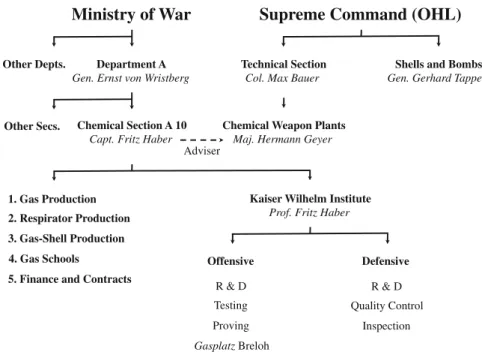
Ministry of War Supreme Command (OHL)
Restrictions on the Means and Methods of Warfare
The legal basis for restrictions on chemical weapons, the validity of which was debated in the context of the use of poison gas at Ypres and beyond, can be precisely identified. That the only legitimate aim which States should seek to achieve during war is to weaken the military forces of the enemy;. The declaration therefore not only regulated and formulated the special, explicit prohibition of certain weapons, but also general principles of the law of war.
Lawrence, who was for many years a lecturer at the Royal Naval College at Greenwich and the Royal Naval War College at Portsmouth, saw it as "the application of the true principle, which measures the illegality of arms, not by their destructiveness, but by the amount of unnecessary suffering they cause" (Lawrence 1923, 529). Petersburg November 29 (December 11) 1868." The appropriate statement is as brief as possible: "The Contracting Powers agree to refrain from the use of projectiles the sole object of which is the diffusion of asphyxiating or noxious gases." (Carnegie Endowment for International Peace1915b, V) It goes back to Article 13 of the draft declaration of the Brussels Conference of 1874. The wording of the Brussels Declaration on War on Land thus became part of the appendix of the Second Hague Convention of 1899 and of Fourth Hague Convention.
The final act of the Second Hague Conference of 1907 contained in Article 22 of the Fourth Convention (with identical wording) and in 23 a, b, e of the Regulation the almost identical definitions of the Hague Convention on Land Warfare of 1899.
No Notion of What Lay Ahead: The Intense Legal Discourse on the Hague Convention
The German professor of international law Karl Strupp wrote an account of international law on land warfare that was published in 1914, already during the First World War. In the third volume of his textbook on the law of war, French international law scholar Alexandre G. In the years since the poison ban was enacted, modern technology had not yet presented a challenge to international law and its protective regulations .
They took on new weight and in turn became not only arguments, but also potential sources of international law (Vec2017). 3 Militarization and circumvention of the law: debates on international law during the continental gas war. This impression of the brevity, and even inadequacy, of international law scholars' interpretations of the ban on poison, combined with the not very politicized tone of legal scholars' interpretations, would change after April 22, 1915, with a small delay but a lasting effect. .
As suggested in the introduction, whether this change seems surprising depends on one's expectations of historical international law, and specifically in wartime.
International Law: Alive, but not Kicking
Monographs on international law also do not seem to mention gas wars at all, or at most very rarely. The connection between the German decision in favor of the use of poison gas and international law also remained unclear. Nevertheless, the argument that the use of poison gas would constitute reprisal under international law shows that the Germans judged its use on the basis of the continued validity of the standard, thereby claiming that its use was a sanction for injustice committed by the other. side.
This makes it clear that they assumed, at least ex post, that the use of poison gas violated international law. The striking absence of assessments based on international law or any other normative consideration raises questions. The Hull decision is even harsher from a comparative international perspective: Germany is said to have expressed particular contempt for international law (see also Partridge 1917, 6).
There are at least a few sources that state the position of other states on poison gas attacks and international law.
The Law Comes Later: The Weak Normative Discourse on Gas Warfare After the German Attack
One first point concerns the question of the extent to which political voices and official reports articulated protest over the German poison gas attack. French protest could be found.4 Hull notes that there were no significant discussions in France about the legality of poison gas weapons. In the end, official protest did not follow until near the end of the First World War - although not by the countries involved, but by the International Committee of the Red Cross (ICRC).
The only official objection in the case of poison gas, on the other hand, came not from a state and not from one of the powers involved in the First World War, but from the International Committee of the Red Cross. 5Protest by the International Committee of the Red Cross, published in "Papers Relating to the Foreign Relations of the United States Appendix II: The World War. Those circumstances also explain why, above all, the possibly illegal action in the form of the use of poison gas by own country is generally reflected via the detour of the enemy country's journalism.
Often, however, the reader learned about the use of gas only from the biased official reports of the General Staff of the German Reich.
Possible Interpretations: Raison de Guerre as Its Own Form of Normativity?
In this view, the traditions of rejecting and denying international law were particularly strong in Germany. The second factor that can be identified is a particular rejection of international law of war that took the form of the German military circumventing the law. The text was cited critically by international law scholars (Westlake 1907, 91; Garner and was translated into several languages (German General Staff 1914; Grand État-Major Allemand 1916).
It is not surprising that in the continuation of the war, the aspect of political applicability of international law was more strongly emphasized (Koellreutter. The third and last approach to explaining the absence of discourse on the use of gas as a weapon and its admissibility within the framework of international law). the law is an uneasiness in the ethos of broad groups of the military for poison gas. After the end of the war in 1918, there followed a third phase in the discourse on international law regarding the use of poison gas weapons.
It was an intense, retrospective debate about the legality of its use under international law.
Crime and Argument: The Intense Discourse After the End of World War I
In Die letzten Tage der Menschheit (translated as The Last Days of Mankind), Karl Kraus also left no doubt about the ethical skepticism of poison gas. How much fame in battle can be attributed to a 'chlorian' offensive without being drowned in shame by its own poison gas." (Kraus2015, 262). On the other hand, revealingly, there is no mention or description of poison gas in art and literature that glorifies or affirms war.
All this shows that poison was the subject mainly of non-affirmative, anti-war and critical accounts of the war. The colored books of the enemy were in turn accused of distortions and omissions in the descriptions of historical events (Zala 2001, 27). What began with the outbreak of war continued throughout the war with the aim of depicting the enemy's war crimes (Dampierre 1917; Niedner 1915).
The major international scholarly works on international law published between the wars frequently mention gas warfare.
Self-justi fi cations: The Nationalist Polarization of International Law
Compared to that of the war years, this discourse on international law was intense and remarkably detailed. They argued that the Hague Declaration of 1899 did not apply to the “blue and yellow cross shells of the World War” or to artillery gas shells because “the diffusion of poisonous gases is not their only purpose; rather, their main purpose was to render the enemy harmless” (Kunz 1927, 26; Strupp 1922, 201). It was a "state of emergency as recognized by international law" (Deutsches Kriegsministerium und Oberste Heeresleitung 1919).
Bans on asphyxiating gas were said to have been overturned in the world war after both sides had used the gas, international law scholar Josef Kohler claimed in 1918; so that gas warfare had been legal (Kohler. German professors of international law Julius Hatschek and Arthur von Kirchenheim claimed between the wars that the use of poison gas was in accordance with international law (Hatschek1923, 316; Kirchenheim. Positions of academics in international law from the Allied Countries, by contrast, cannot be so simply characterized.
For example, there are French assessments saying that poison gas as such violates international law (but could be justified as reprisal) (Rolin.
Politicized Scholarship: No Mediation Possible
The Archbishop of Canterbury and the Bishop of London (in May, on the other hand, appealed to their government not to use poison gas and to descend to the level of the enemy (Garner1920, 273, footnote 1). Finally, there were positions which was not formulated by any of the countries involved in the world war. In the polarized climate of politics and international law between the wars it was all the more tempting for one side or the other to use these somewhat neutral authors to co-opt.
The latter published her book on behalf of the Women's International League for Peace and Freedom. Both authors emphasized not only that Germany's use of poison gas violated international law, but also the continuing threat and worrisome role of a transnationally active arms industry (Endres. Woker openly attacked Haber's argumentation, arguing against the "magnificent militaristic logic"). in the arguments she saw that the gas was effective and in accordance with international law.
Reforms as Af fi rmation of the Prohibition of Poison in International Law
The story of the struggle for international legal rules on the prohibition of the use of chemical weapons is thus far from over. On the contrary, countless violations of legal norms are etched into the history of the twentieth century. The Convention on the Prohibition of the Development, Production, Stockpiling and Use of Chemical Weapons and on Their Destruction.
An Exposition of the Laws and Usages of War on Land for the Direction of the Officers of His Majesty's Army. On the occasion of the 117th anniversary of the granting of the College's charter. Thus, the basic structure of the system was already established in 1914, especially in the German context.
Instead, chemical weapons became the bridge away from peacetime production patterns to the "weaponization" of the dye chemical industry.