THE POLITICAL ECONOMY OF THE MIDDLE EAST
SERIES EDITOR: ASHRAF MISHRIF
Edited by
Giacomo Luciani · Tom Moerenhout
When Can Oil Economies
Be Deemed Sustainable?
The Political Economy of the Middle East
Series Editor Ashraf Mishrif
Centre for Middle East & Mediterranean Studies King’s College London
London, UK
This series explores the nature of Middle Eastern political regimes and their approaches to economic development. In light of the region’s dis- tinctive political, social and economic structures and the dramatic changes that took place in the wake of the Arab spring, this series puts forward a critical body of high-quality, research-based scholarship that reflects cur- rent political and economic transitions across the Middle East. It offers original research and new insights on the causes and consequences of the Arab uprisings; economic reforms and liberalization; political institutions and governance; regional and sub-regional integration arrangements; for- eign trade and investment; political economy of energy, water and food security; finance and Islamic finance; and the politics of welfare, labor mar- ket and human development. Other themes of interest include the role of the private sector in economic development, economic diversification, entrepreneurship and innovation; state-business relationships; and the capacity of regimes and public institutions to lead the development process.
More information about this series at http://www.palgrave.com/gp/series/14415
Giacomo Luciani • Tom Moerenhout
Editors
When Can Oil Economies Be
Deemed Sustainable?
ISSN 2522-8854 ISSN 2522-8862 (electronic) The Political Economy of the Middle East
ISBN 978-981-15-5727-9 ISBN 978-981-15-5728-6 (eBook) https://doi.org/10.1007/978-981-15-5728-6
© Gulf Research Centre Cambridge 2021. This book is an open access publication.
Open Access This book is licensed under the terms of the Creative Commons Attribution- NonCommercial-NoDerivatives 4.0 International License (http://creativecommons.org/
licenses/by-nc-nd/4.0/), which permits any noncommercial use, sharing, distribution and reproduction in any medium or format, as long as you give appropriate credit to the original author(s) and the source, provide a link to the Creative Commons licence and indicate if you modified the licensed material. You do not have permission under this license to share adapted material derived from this book or parts of it.
The images or other third party material in this book are included in the book’s Creative Commons licence, unless indicated otherwise in a credit line to the material. If material is not included in the book’s Creative Commons licence and your intended use is not permitted by statutory regulation or exceeds the permitted use, you will need to obtain permission directly from the copyright holder.
This work is subject to copyright. All commercial rights are reserved by the author(s), whether the whole or part of the material is concerned, specifically the rights of translation, reprinting, reuse of illustrations, recitation, broadcasting, reproduction on microfilms or in any other physical way, and transmission or information storage and retrieval, electronic adaptation, computer software, or by similar or dissimilar methodology now known or hereafter developed. Regarding these commercial rights a non-exclusive license has been granted to the publisher.
The use of general descriptive names, registered names, trademarks, service marks, etc. in this publication does not imply, even in the absence of a specific statement, that such names are exempt from the relevant protective laws and regulations and therefore free for general use.
The publisher, the authors and the editors are safe to assume that the advice and information in this book are believed to be true and accurate at the date of publication. Neither the publisher nor the authors or the editors give a warranty, expressed or implied, with respect to the material contained herein or for any errors or omissions that may have been made. The publisher remains neutral with regard to jurisdictional claims in published maps and institutional affiliations.
Cover illustration: © Nick Gibson / Getty Images
This Palgrave Macmillan imprint is published by the registered company Springer Nature Singapore Pte Ltd.
The registered company address is: 152 Beach Road, #21- 01/04 Gateway East, Singapore 189721, Singapore
Editors
Giacomo Luciani
Graduate Institute of International and Development Studies
Geneva, Switzerland
Paris School of International Affairs Sciences Po
Paris, France
Tom Moerenhout Columbia University School of International and Public Affairs
New York, NY, USA
v This book originates from discussion in a workshop held in the context of the Gulf Research Meeting of August 2018 at Cambridge University (UK), supported by the Gulf Research Center Cambridge. We are grateful to GRC Cambridge and its Chairman, Dr. Abdulaziz Sager, for the gener- ous support of the annual Gulf Research Meeting, that has allowed us to convene the seminar and, more broadly, has given extraordinary impulse to scholarship on the Gulf in multiple disciplines. Thanks also to the GRC team, notably Dr. Christian Koch, Dr. Oskar Ziemelis and Ms. Sanya Kapasi, who validly supported us as well as all other workshop conveners.
We are also grateful to Prof. Ashraf Mishrif for inviting us to publish in Palgrave’s “Political Economy of the Middle East” series that he is the editor of.
We are indebted to Prof. Robert Springborg for many useful comments that allowed us to improve the manuscript and for his support to open access publication.
Finally, we are very grateful to the Swiss National Foundation for the generous grant that has made publication of this volume in Gold Open Access possible. Tom Moerenhout also expresses his gratitude to the Swiss National Foundation for funding his research
At a moment in history when the world is entering a global recession widely seen as the worst in a century, the issue of sustainability of the oil economies is more urgent than ever: we hope a wide public will find our reflections of use.
April 2020 Giacomo Luciani & Tom Moerenhout
A
cknowledgementsvii 1 Introduction: Economic Sustainability of Oil Economies 1
Giacomo Luciani and Tom Moerenhout
2 Framing the Economic Sustainability of Oil Economies 9 Giacomo Luciani
3 Fiscal Sustainability, the Labor Market, and Growth in
Saudi Arabia 31
Ishac Diwan
4 Outlook for Producer Economies 55
Ali Al-Saffar
5 Economic Diversification in Arab Oil- Exporting Countries in the Context of Peak Oil and the Energy
Transition 73
Bassam Fattouh and Anupama Sen
6 Economic Diversification and Sustainable Development of
GCC Countries 99
Joerg Beutel
c
ontentsviii CONTENTS
7 Redefining Economic Sustainability in Resource-rich
States: Comparative Lessons 153 Manal Shehabi
8 Fuel and Electricity Reform for Economic Sustainability in the Gulf 191 Tom Moerenhout
9 Fiscal Sustainability and Hydrocarbon Endowment Per
Capita in the GCC 215 Monica Malik and Thirumalai Nagesh
10 GCC Fiscal Reforms and Labor Market Policies 255 Monica Malik and Thirumalai Nagesh
11 Economic Diversification and Job Creation in the Arab
Gulf Countries: Applying a Value Chain Perspective 281 Martin Hvidt
12 Climate Strategy for Producer Countries: The Case of
Saudi Arabia 301 Jim Krane
13 The Sustainability of GCC Development Under the New Global Oil Order 329 Ibrahim A. Elbadawi and Samir Makdisi
14 When Can Oil Economies be Deemed Sustainable? 349 Giacomo Luciani and Tom Moerenhout
ix Ali Al-Saffar is the Middle East and North Africa programme manager at the International Energy Agency (IEA), leading the IEA’s engagement with the region and acting as a key advisor to the executive manage- ment. Prior to this role, he was an energy analyst at the Directorate for Sustainability, Technology and Outlooks, where he co-authored seven editions of the IEA’s flagship long-term forecast, the World Energy Outlook. He was the lead author of the Outlook for Producer Economies report, which focused on the issue of how the changing global energy landscape could impact oil-dependent economies. Prior to joining the IEA in 2012, he was a Middle East economist and chief automotive analyst at the Economist Intelligence Unit in London.
He holds degrees in Economics and Development Studies.
Joerg Beutel is Professor of Economics and Environmental Sciences at Konstanz University of Applied Sciences in Konstanz, Germany. He served as Dean of the Department of Economics and Social Sciences from 1991 to 1998 and retired in 2008 from the university. He is still active in research and as economic advisor. He conducted major projects for the European Commission, Eurostat, United Nations Statistics Division (UNSD) of the United Nations, the Ministry of Economy and Planning (MOEP) of Saudi Arabia, the Prime Minister’s Office of Brunei Darussalam (JPKE) and the Kuwait Institute for Scientific Research (KISR). He was the editor of the Eurostat Manual of Supply, Use and Input-Output Tables (2008) and became a member of the edi- torial board for the Handbook of Supply, Use and Input-Output Tables
n
otes onc
ontributorsx NOTES ON CONTRIBUTORS
with Extensions and Applications (2018) of the United Nations. Main activities in research are development planning, macroeconomics, national accounts, and input-output analysis. He was engaged in applied economics throughout his professional career.
Ishac Diwan is Professor of Economics at Paris Sciences et Lettres (a consortium of Parisian universities) where he holds the chair of the Economy of the Arab World. He currently teaches at the Ecole Normale Superieure in Paris, and has held in recent years teaching positions at Columbia University, School for International Public Affairs, and at the Harvard Kennedy School. His research focuses on the political econ- omy of the Middle East. His recent (co-authored) books include A Political Economy of the Middle East (2015); and Crony Capitalism in the Middle East (2019). He is also widely published on issues of global finance, macroeconomic and development strategies.
Ibrahim A. Elbadawi was the Minister of Finance and Economic Planning, Sudan, from September 2019 to July 2020; Managing Director, The Economic Research Forum for the Arab World, Iran and Turkey (since January 2017, currently on leave since September 2019); before that he was Director at the Economic Policy and Research Center, the Dubai Economic Council (2009–2016); Lead Economist at the Development Research Group of the World Bank, which he joined in 1989; and Professor of Economics at the University of Gezira in Sudan.
He holds a Ph.D. in economics and statistics from North Carolina State and Northwestern universities in the USA. Elbadawi is the editor of Understanding and Avoiding the Oil Curse in Resource-rich Arab Economies (2016, with Hoda Selim) and Democratic Transitions in the Arab World (2016, with Samir Makdisi).
Bassam Fattouh is Director of the Oxford Institute for Energy Studies and a professor at the School of Oriental and African Studies, University of London. He specialises in international oil pricing systems, OPEC pric- ing power, security of Middle Eastern oil supplies, and the dynamics of oil prices and oil price differentials. He has published a variety of articles on oil and gas topics and his publications have appeared in academic and pro- fessional journals. Fattouh served as a member of an independent expert group established to provide recommendations to the 12th International Energy Forum (IEF) Ministerial Meeting for strengthening the architec- ture of the producer-consumer dialogue through the IEF. He also acts as
xi
NOTES ON CONTRIBUTORS
an adviser to governments and industry, and is a regular speaker at inter- national conferences. Fattouh focuses his research on aspects of the inter- national oil pricing system such as the relationship between the futures market and spot market, the relationship between OPEC and the market, the causes of oil price volatility and the dynamics of oil price differentials.
He also focuses his research on the IOC-NOC relationship and its implications for investment behaviour. He has a strong background in the economic environment of the Middle East.
Martin Hvidt is an associate professor at the Center for Contemporary Middle East Studies, University of Southern Denmark. He received his Ph.D. degree from Odense University and Colorado State University, Fort Collins, in 1995 and was in 2019 bestowed the prestigious Dr. phil degree by University of Southern Denmark based on a higher doctoral dissertation titled “Social and Economic Development in the Contemporary Arab Gulf States”. For the past 25 years, his research has been related to these four broad topics/projects: (1) Irrigation Management in Egypt; (2) The Middle East and North Africa Region in a Globalized World; (3) Dubai: A Middle Eastern Developmental State; and (4) Gulf Rising. Developmental Patterns in the Resource Rich Economies of the Arab Gulf Region. Hvidt is the author of several books and a long range of articles and book chapters.
Jim Krane is the Wallace S. Wilson Fellow for Energy Studies at Rice University’s Baker Institute for Public Policy in Houston. He specializes in energy geopolitics, with a focus on oil-exporting countries and the chal- lenges they face from energy subsidies, internal demand, and climate change. His scholarly articles have been published in Nature Energy, Energy Policy, Energy Journal, MRS Energy and Sustainability, and the Bulletin of the Atomic Scientists. Krane spent nearly 20 years as a journalist, six of them in the Middle East. He is the author of two books. His acclaimed 2009 volume City of Gold: Dubai and the Dream of Capitalism is widely recognized as the seminal work on the iconic city-state, while his award-winning 2019 book Energy Kingdoms: Oil and Political Survival in the Persian Gulf is the definitive study of energy demand in the Gulf region. Krane was a long-time correspondent for the Associated Press and has written for myriad other publications including the Washington Post, Wall Street Journal and Financial Times. He is the winner of several jour- nalism awards. He holds his Ph.D. from Cambridge University.
xii NOTES ON CONTRIBUTORS
Giacomo Luciani teaches at the Paris School of International Affairs, Sciences Po, and at the Graduate Institute of International and Development Studies in Geneva. During 2010–2013 he was Princeton Global Scholar at the Woodrow Wilson School of Public and International Affairs and the Department of Near Eastern Studies.
His work has focused on the political economy of MENA. With Hazem Beblawi, he edited the book The Rentier State (1987), which is frequently cited as one of the origins of the concept. His latest edited book, Combining Economic and Political Development (2017), discusses economic policies to support democratic transitions.
Samir Makdisi is Professor Emeritus of Economics and Founding Director of the Institute of Financial Economics, 1984–2007 and Senior Fellow since 2008, the American University of Beirut (AUB). He is a for- mer Minister of Economy and Trade, Republic of Lebanon, 1992; Deputy President of AUB, 1992–1998; and Chair of the Board of Trustees, Economic Research Forum, 1993–2001; and since 2012 an elected member of the Board. He has served as advisor to the Lebanese and other national governments and to various regional and international economic and financial organizations and has given lectures at major universities in the US, Europe, Asia and the Middle East. Recipient of several honors including the AUB medal (1998), he is widely pub- lished in academic journals and books in the areas of financial poli- cies, civil conflicts and democratic transitions, among others, with special reference to the Arab World. He is the author of The Lessons of Lebanon: The Economics of War and Development (2004) and co-editor (with Ibrahim Elbadawi) of Democracy in the Arab World: Explaining the Deficit (2011) and Democratic Transitions in the Arab World (2017).
He holds his Ph.D. in Economics from Columbia University, New York.
Monica Malik has over 25 years of experience as an economist specialis- ing in the MENA region. Malik holds the position of Chief Economist at Abu Dhabi Commercial Bank, where she established and manages the Economic research team. Previously, she was the Chief Economist at EFG Hermes and was the lead person in the Economics team. Before this, she was the Senior Economist for the MENA region at Standard Chartered, Dubai, and at Dun & Bradstreet, London.
Malik has authored a number of academic books and articles on eco- nomic development in the GCC. She has presented at a number of high
xiii
NOTES ON CONTRIBUTORS
profile conferences and participated in policy round table discussions, as well as appearing regularly in the international media. She holds a Ph.D. in Economic Development in the Middle East focusing on private sector development in Saudi Arabia from the University of Durham.
Tom Moerenhout is Professor of International and Public Affairs at Columbia University and a resident scholar at the Center for Global Energy Policy. He also works with the World Bank’s Energy and Extractives team and the International Institute for Sustainable Development. In recent years, Moerenhout has provided practical, in-country support to energy and development policy reforms in Lebanon, India, Nigeria, Egypt, Iraq and Iraqi Kurdistan. His research focuses on the sustain- ability dimension of economic globalization and energy sector reforms in developing countries. His work on energy subsidies and taxation and the social contract in oil and gas producing countries has been published extensively. He recently helped set up a COVID-19 stimulus tracker to verify energy policy decision in economic recovery packages.
Thirumalai Nagesh has been a member of the ADCB Economics team for the last three years. Prior to ADCB, he worked with research teams at RBS and Deutsche Bank in India. Nagesh has a total of ten years of experi- ence in macro research, covering emerging market economies (India, GCC, Turkey) and oil.
Anupama Sen joined the Oxford Institute for Energy Studies in November 2009. She is Executive Director of the Electricity Programme and Senior Research Fellow. Her research interests lie in the applied eco- nomics of energy in developing countries and her research has spanned the oil, gas and electricity sectors, focusing largely on non-OECD Asia. In addition to OIES papers, her work has appeared in peer-reviewed aca- demic journals and professional publications, as well as in several book chapters and Op-Eds. Sen is a Fellow of the Cambridge Commonwealth Society and has been a Visiting Fellow at Wolfson College, Cambridge.
She holds a B.A. (Hons) from the University of Mumbai, M.Sc. from the London School of Economics and Ph.D. from the University of Cambridge.
Manal Shehabi is the OIES-KFAS Supernumerary Research Fellow at the Oxford Institute for Energy Studies. She is also an SCR Member of St.
Antony’s College, University of Oxford. An applied economist, she
xiv NOTES ON CONTRIBUTORS
has expertise in economic modeling, energy, policy assessment and design, and resource and economic sustainability in resource-rich economies, with a focus on the Middle East and North Africa. Her research made important contributions to the analysis of economic adjustments and policy alternatives in resource economies facing vol- atility and energy transitions, specifically policy reform in economic diversification, labor reform, energy subsidy, alternative energy sources, and impacts of response measures to climate change.
Combining evidence-based policy assessment with local political economy analysis, her research contributed to key policy debates at national levels and at the international level (such as the WTO and the UNFCCC). She also taught university-level courses in economics and conducted capacity building for policy makers in various coun- tries. Shehabi is the author of various academic publications and pol- icy reports, including being the co-author of Kuwait Energy Outlook and a contributing author to the Intergovernmental Panel on Climate Change (IPCC) Special Report on the Ocean and Cryosphere in a Changing Climate. A polyglot, her professional experience beyond academia spans economic research, consulting, energy multinationals, and pub- lic policy in the US, the Middle East, Europe, and Australia.
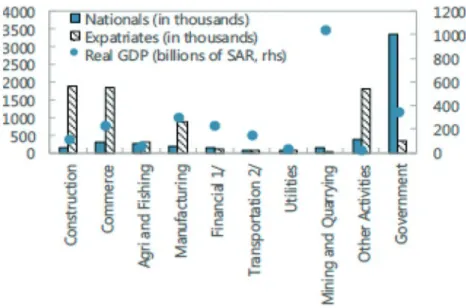
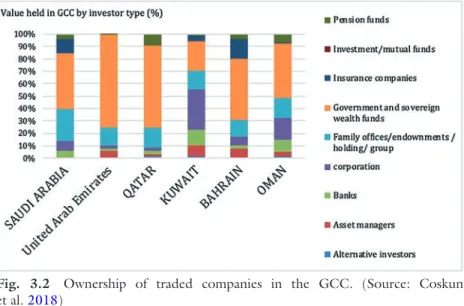
xv Fig. 3.1 Employment and Real GDP by sector (2016) 36 Fig. 3.2 Ownership of traded companies in the GCC 37
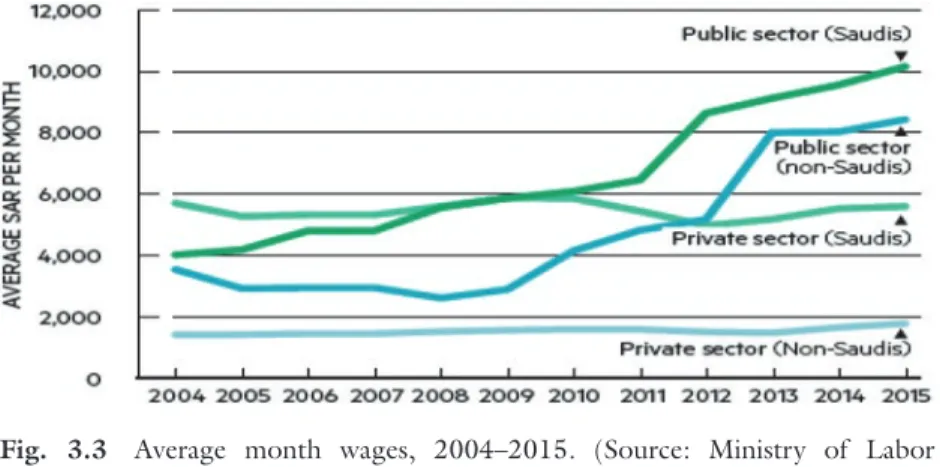
Fig. 3.3 Average month wages, 2004–2015 44
Fig. 3.4 Nationals and Expats employment in the non-oil sectors in
relation to educational levels, 2010 47
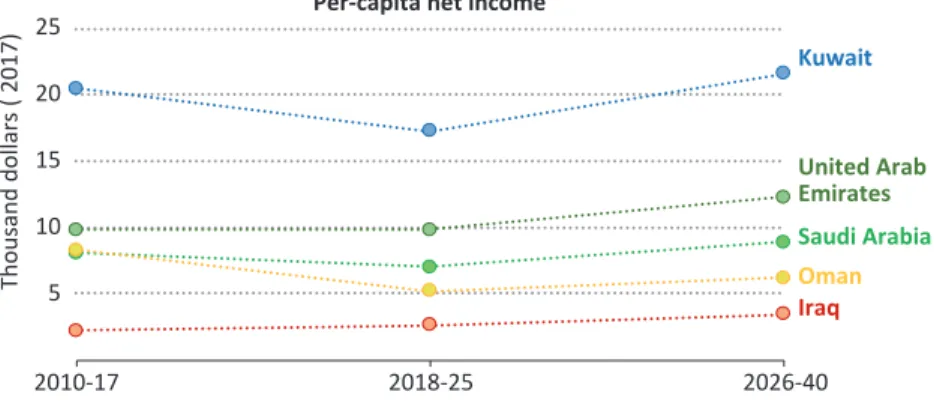
Fig. 4.1 Average annual net income from oil and gas in Middle East
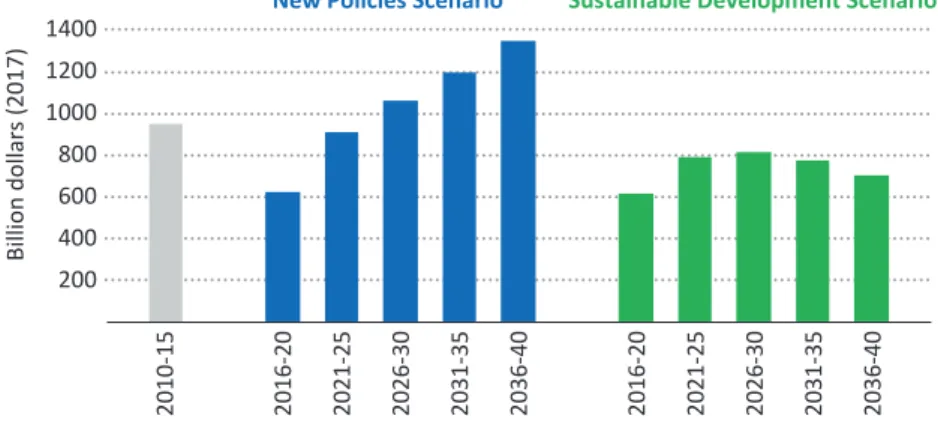
producers 57 Fig. 4.2 Total net income from oil and gas in the New Policies Scenario 58 Fig. 4.3 Total net income from oil and gas in the Sustainable
Development Scenario 59
Fig. 4.4 Levelised cost for solar PV compared with existing oil-fired
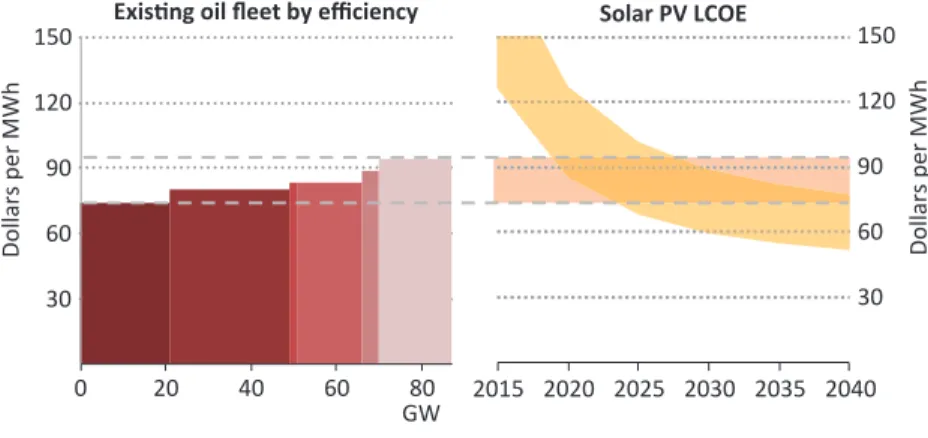
generation at $40 per barrel oil price 64 Fig. 4.5 Estimated value of fossil fuel subsidies in selected producer
economies, 2017 65
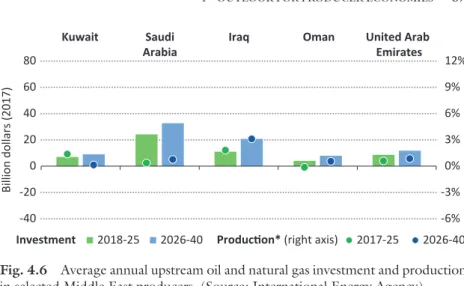
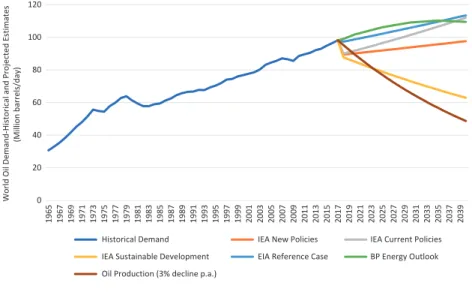
Fig. 4.6 Average annual upstream oil and natural gas investment and production in selected Middle East producers 67 Fig. 5.1 Projections of world oil demand (million barrels/day) 77 Fig. 5.2 Projected rising share of renewables in total primary energy
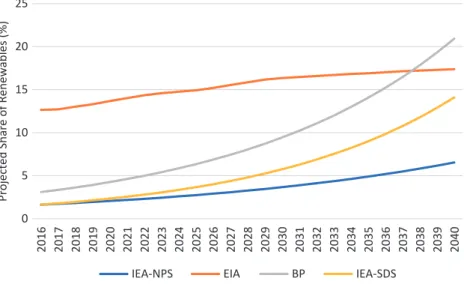
demand (%) 85
Fig. 6.1 Product concentration and diversification of exports and
imports for GCC 113
Fig. 6.2 Industry concentration index for the GCC countries 115 Fig. 6.3 Industry concentration index in international comparison 116 Fig. 7.1 Rapid GDP growth rate at the start of the recovery 165 Fig. 7.2 Simulated Kuwait recovery reaching a new steady state due to
shocks in capital-to-labor ratio, savings rates, and productivity 167
l
ist off
iguresxvi LIST OF FIGURES
Fig. 7.3 Relationship between resource use and growth 168 Fig. 7.4 SWF accumulations in select Latin American economies 172 Fig. 7.5 Steady-state growth and transition following a capital shock in
the Solow model 183
Fig. 7.6 Transition in capital per effective worker and growth rate following a shock to capital stock in the augmented Solow
model 185 Fig. 8.1 Oil price movements and energy price reforms 192 Fig. 8.2 Current account balance (% of GDP, 2011–2018) 195 Fig. 8.3 Transport fuel prices (USD/L, July 2018) 202 Fig. 8.4 Price changes (%) before and after reforms (July 2018) 203 Fig. 8.5 Residential electricity block tariffs in the GCC (July 2018) 206 Fig. 8.6 Industrial electricity tariffs in the GCC 207 Fig. 9.1 GCC: Hydrocarbon endowment per capita (reserves) based on
national population 218
Fig. 9.2 GCC: Hydrocarbon endowment per capita (production) based
on national population 219
Fig. 9.3 GCC: Hydrocarbon endowment per capita reflected in current
account and fiscal balances 220
Fig. 9.4 GCC: Hydrocarbon endowment also reflected in regional FX
reserve positions 222
Fig. 9.5 GCC: Hydrocarbon poorer per capita countries have largely seen a faster rise in government debt 222 Fig. 9.6 GCC: gross government debt has risen sharply since 2014,
limited fiscal space for some countries 223 Fig. 9.7 GCC: Government spending growth was strong between
2003 and 2014 226
Fig. 9.8 GCC: Drivers of total GCC spending growth, by capital and
current expenditure 227
Fig. 9.9 GCC: Government sharply pulled back spending in 2015 and 2016 in response to the lower oil price 228 Fig. 9.10 GCC: Change in government spending from 2014 to 2018 229 Fig. 9.11 GCC: Phases of fiscal reforms relative to oil price
developments and policy 231
Fig. 9.12 Global: GCC countries more reliant on hydrocarbon revenues
than other commodity producers 233
Fig. 9.13 GCC: Hydrocarbon earnings still dominate revenues; Kuwait
and Bahrain see smallest reduction 233
Fig. 9.14 GCC: Gradual recovery in real non-oil GDP growth from 2017 with modest pickup in government spending and more
limited fiscal reforms 236
xvii
LIST OF FIGURES
Fig. 10.1 GCC: Total population growth reflects economic cycles and
the flexibility of foreign labor 256
Fig. 10.2 Saudi Arabia: Employment dynamics in the public sector 257 Fig. 10.3 Saudi Arabia and Kuwait: Significant variations in composition
of public and private sector labor force 258 Fig. 10.4 GCC: Large youth population requires strong job creation 258 Fig. 10.5 GCC: Demographic profile of GCC population dominated by
young and working age population 260
Fig. 10.6 GCC: UAE and Qatar have higher GDP per capita among the
GCC countries 260
Fig. 10.7 GCC: Government spending on wages high in the region,
though lower in the UAE and Qatar 264
Fig. 10.8 GCC: Hydrocarbon richer per capita countries tend to have larger expatriate population in relative share 265 Fig. 10.9 Saudi Arabia; Higher wages and benefits in the public sector
support demand for government jobs 267
Fig. 10.10 Saudi Arabia: Unemployment rate amongst Saudi nationals
remains high, especially females 268
Fig. 10.11 Saudi: Public sector employment seen rising though civil
services hiring remains broadly steady 270 Fig. 10.12 Saudi: Unemployment rate amongst Saudi youth
(20–24 years) high at 36.3% in 1Q2019 271 Fig. 10.13 Saudi Arabia: Saudi nationals largely not replacing expatriate
jobs lost 273
Fig. 10.14 Oman: Expatriate labor force contracted in 2018 with visa ban
on a number of sectors 274
Fig. 11.1 Porter’s value chain 287
Fig. 11.2 The smiley model 288
Fig. 11.3 Transition to the smiley curve 289
Fig. 12.1 Saudi Arabia GHG emissions by gas type 305 Fig. 12.2 GHG and CO2 emissions in selected countries 307 Fig. 12.3 GHG and CO2 emissions per capita in GCC 307
Fig. 12.4 Top 30 flaring countries 313
Fig. 12.5 Comparison of cost paths with varying levels of spending on
mitigation, adaptation, and damage 320
Fig. 12.6 US 2017 billion-dollar weather and climate disasters 321 Fig. 12.7 Examples of potential economic effects from climate change
by 2100 322
Fig. 13.1 Average rent per capita (2000 to 2016) 334 Fig. 13.2 Real average economic growth rate per capita (1985 to 2016) 334 Fig. 13.3 Median average polity and political constrains in resource-rich
economies 335 Fig. 13.4 Real GDP per working-age person (2000 = 100) 342
xix Table 2.1 Ranking of Gulf countries and selected comparator countries
by Economic Complexity Index 16
Table 3.1 Central Government Budget 2014–2022 (SAR, billions) 34 Table 6.1 GDP and foreign trade at current prices of the world’s 10
largest economies 101
Table 6.2 GDP and foreign trade at current prices of GCC countries 104 Table 6.3 Intermediates, value added and output of the world’s ten
largest economies 106
Table 6.4 Intermediates, value added and output at current prices of
GCC countries 107
Table 6.5 Value added by industries 2016 at current prices in
international comparison 109
Table 6.6 GDP by type of expenditure 2016 at current prices in
international comparison 111
Table 6.7 Extended input-output table with satellite systems for Saudi Arabia 118 Table 6.8 Input-output data of Saudi Arabia and Norway 122 Table 6.9 Input-output data of Kuwait and Norway 125
Table 6.10 Input-output diversity index 130
Table 6.11 Test for sustainable development of GCC countries in 2014 135 Table 6.12 Test for sustainable development of Bahrain 137 Table 6.13 Test for sustainable development of Kuwait 139 Table 6.14 Test for sustainable development of Oman 141 Table 6.15 Test for sustainable development of Qatar 143 Table 6.16 Test for sustainable development of Saudi Arabia 145 Table 6.17 Test for sustainable development of United Arab Emirates 147
Table 7.1 GCC energy sectors, 2014 158
l
ist oft
Ablesxx LIST OF TABLES
Table 8.1 Fuel Prices in the UAE (July 2018) 197 Table 8.2 Fuel Prices in Oman (continuously adjusted since January
2016) 197 Table 8.3 Qatar fuel prices (adjusted continuously since June 2016) 198 Table 8.4 Energy pricing reforms in Saudi Arabia (January 2016) 199 Table 8.5 Fuel pricing reforms in Saudi Arabia (percentage changes
between brackets) 200
Table 8.6 Fuel prices in Bahrain (percentage changes between brackets) 201
Table 8.7 Fuel prices in Kuwait 201
Table 8.8 Transition process from allocation state to productive
economy 209 Table 9.1 GCC: Fiscal budget breakeven oil price (USD per barrel) 221 Table 9.2 GCC: Sovereign rating changes by the main rating agencies
since 2015–2018 224
Table 9.3 Components of allowance package, announced on
6 January 2018 239
Table 9.4 GCC: Summary of fiscal reform measures until mid-2019 242 Table 9.5 UAE: Key policies announced in 2018 248 Table 10.1 Abu Dhabi: Water and electricity tariffs for households 262 Table 10.2 GCC: Summary of key labor market nationalization policies 266 Table 10.3 Schedule of fees and levies on expatriates 270 Table 12.1 Saudi Arabia benchmarked against selected countries in
terms of GHGs, population, and economy 306 Table 12.2 Carbon taxes on Saudi and Venezuelan crudes at
$70 per barrel 314
Table 12.3 Power generation by source in KSA 317 Table 13.1 Typology of resource rents per capita (average: 2000–2013) 333 Table 13.2 Armed civil conflicts, 1970–2010 335 Table 13.3 Political regimes types and years in power 336
xxi
l
ist ofb
oxesBox 6.1 Product Concentration and Diversification Indices of Exports
and Imports 114
Box 6.2 UN Handbook of Supply, Use and Input-Output Tables 120 Box 6.3 Input-Output-Based Primary Diversity Index 128
1
© The Author(s) 2021
G. Luciani, T. Moerenhout (eds.), When Can Oil Economies Be Deemed Sustainable?, The Political Economy of the Middle East, https://doi.org/10.1007/978-981-15-5728-6_1
CHAPTER 1
Introduction: Economic Sustainability of Oil Economies
Giacomo Luciani and Tom Moerenhout
1 W
hatI
ss
ustaInable?
When can oil economies be deemed sustainable? This complex question has been profusely debated in the last 5 years. The timing of this debate is no coincidence. On the one hand, the pace of environmental degradation has aggravated, in terms of air pollution, carbon emissions and the impacts of the planet’s warming. On the other hand, volatile international oil mar- kets and the acceleration of the energy transition have challenged the notion that oil revenues are sufficient to sustain oil economies in the near to medium term. With current challenges predicted to pursue in the near future, a more in-depth discussion about sustainability is warranted.
G. Luciani
Graduate Institute of International and Development Studies, Geneva, Switzerland
Paris School of International Affairs, Sciences Po, Paris, France e-mail: [email protected]
T. Moerenhout (*)
Columbia University, School of International and Public Affairs, New York, NY, USA e-mail: [email protected]
2
The debate on sustainability in general, and on economic sustainability in particular, suffers from lack of conceptual clarity. What is the meaning of economic sustainability? As technology and the availability of goods and services constantly evolve, no economy is sustainable in a stationary state.
Every economy, enterprise and individual needs to constantly evolve and adapt to changing circumstances. What is sustainable today may not be sustainable tomorrow: in the debate about sustainability, a concept of adaptability is implicit. As we cannot predict the future, and economies are constantly subjected to unforeseen shocks, we do not know what will be sustainable tomorrow, or for how long. Oil economies are confronted with this exact challenge. The current reform drive begs the question:
What reforms should really be driven?
Adaptability is a function of many things. It is often considered as a function of diversification. Per se, economic logic rather favors specializa- tion in one’s comparative advantage than diversification. The increasing importance of global value chains for development emphasizes this eco- nomic logic, by moving competition from entire sectors to single stages of production, and even individual jobs. However, changing circumstances (movements in terms of trade) can be unfavorable for the given specializa- tion. Economic history provides several examples of the rapid demise of specific industries due to technological progress or exhaustion of natural resources. In some cases, economic actors whose specialization has been challenged have successfully reinvented themselves, adapting more or less radically to a new specialization; in other cases, this has not succeeded, and economic actors have decayed and disappeared.
The pressure on many Gulf countries is high, but it is not equal as Gulf Cooperation Council (GCC) countries are heterogeneous. Some coun- tries still hold a very strong comparative advantage in oil and gas produc- tion, so why should their governments not tailor their economies to this sector and approach their own diversification in the context of the value chain of petroleum products? One might argue that countries with large resource reserves and small populations could then simply accept, for the time being, that price shocks will happen periodically. Other GCC states, however, are faced with declining reserves and sizeable populations. It is in this context, with the additional drivers of technological advancements and environmental unsustainability, that it is more urgent to discuss diver- sification. As they accelerate diversification of value added and revenue, the pressure is on to invest in those sectors and stages of production that can yield results for some time to come.
G. LUCIANI AND T. MOERENHOUT
3
2 W
hatI
su
nsustaInable?
More than understanding what is sustainable, we may more easily know what is not sustainable. Adaptability, after all, is also a function of the abil- ity to identify unsustainable trends early on, and correct them before very large costs are incurred. Current trends may be clearly unsustainable if extrapolated into the future: this is especially the case with respect to envi- ronmental impact and some socioeconomic trends such as rising inequali- ties and poverty. Thus, one way to discuss sustainability is to point to aspects, which are clearly unsustainable. All economies display such traits that are unsustainable; the question is whether they can be corrected on time before they cause excessive costs. It is very likely that some costs will need to be borne anyhow, before issues are corrected; the question is:
what type of costs and how large can they be, before they become acutely
“unsustainable”?
The lack of economic sustainability and the lack of diversification in oil economies in the Gulf have been discussed for decades and have often been equated. They have also featured in many previous development visions. In recent years, however, and in part due to the oil price collapse and a changing international energy landscape, diversification has become a more pronounced objective. But it appears that the debate on diversifica- tion suffers from path dependency, lacks specificity and still insufficiently takes into account the particular political economy constraints of GCC countries.
The first challenge, for example, lies in its definition: diversification of what? Of value added? Of exports? Of revenue? Quite clearly, it is the latter that lies at the basis of the post-2014 obsession with diversification, but a sole focus on revenue can undermine a fruitful discussion about what is possible in terms of policy-making on the medium term. A focus on what is acutely unsustainable would be a significant contribution to this debate on economic sustainability.
3 t
hIsb
ookThe chapters in this edited volume document discussions held in the con- text of the 2018 Gulf Research Meeting held by the Gulf Research Center at the University of Cambridge (UK). It starts from the acknowledgment that there is no widely accepted definition and measure of sustainability.
All authors however try to capture not only political and economic factors,
1 INTRODUCTION: ECONOMIC SUSTAINABILITY OF OIL ECONOMIES
4
but also social and cultural influences on economic reform in GCC countries.
While authors have argued in total autonomy from each other and some divergent opinions remain, the thrust of the book is to conclude that some GCC economies have made significant progress toward diversifica- tion, reducing exclusive reliance on oil with respect to both composition of GDP and exports. This book also investigates a number of pronounced economic sustainability challenges in the Gulf’s oil producers, in terms of not only the threats to fiscal balances, but also the nationalization and privatization of labor markets, environmental pressures on GCC countries and soaring income inequalities within Gulf countries.
This edited volume has four parts, discussing various facets of economic sustainability. In a first part, authors provide a holistic discussion of cur- rent trends in, and projections about, the sustainability of oil economies in the Gulf. The second part of this edited volume discusses trends in fiscal sustainability, given the quest, and need, of governments in the Gulf to diversify not just the economy, but especially their revenue base. These chapters also tie in fiscal reforms to the goal of Gulf economies to diversify and to adjust labor market structures. The third part addresses labor mar- ket policies and labor market reforms. The fourth part discusses strategies of oil economies toward international climate action. This fourth part misses an assessment of environmental consequences of climate change that can threaten Gulf economies. The editors consider it essential that the content of this volume is complemented by such assessments.
4 a h
olIstIc,
andR
ealIstIc, P
IctuReIn Chap. 2, Giacomo Luciani frames the debate on economic sustainabil- ity of oil economies. He questions the popular notion that Gulf economies are not sustainable by discussing the progress on diversification as well as the continued relevance of hydrocarbons. Highlighting that the oil rent is likely to shrink over time, he points out the core challenge of developing taxation and fostering the development of an independent and competi- tive private sector. He also emphasizes the need for further labor sector reform and the challenges of income inequality.
In Chap. 3, Ishac Diwan argues that the current focus in Saudi Arabia of replacing a rentier economic model with economic diversification in tradables is unrealistically ambitious. Rather, he proposes a Norway-like
G. LUCIANI AND T. MOERENHOUT
5 model where public sector jobs are complemented with private sector employment in middle productivity and high-wage jobs. He discusses the challenges in labor market reform and the trade-off between slow adjust- ment and large-scale financing of new investment to support this transition.
In Chap. 4, Ali Al-Saffar explores the outlook for producer economies.
He discusses current risks and emerging pressures to producer economies, arguing that uncertainties in oil demand and supply have strengthened the need for further diversification. He reviews the results of two scenarios toward 2040, one in which oil demand continues to grow and another where oil demand tapers off. He concludes by pressing the role of a more efficient and productive energy sector in the Gulf’s economic reform initiatives.
In Chap. 5, Bassam Fattouh and Anupama Sen argue that the broader characteristics of the current energy transition toward low carbon energy sources will be more important than when oil demand will eventually peak. They expect that the diversification strategy of exporters will be con- ditioned by the speed of that transition, and that during the transition, the oil sector will continue to play a key strategic role. In reverse, also the pace of the global transition will be influenced by the speed and success of eco- nomic diversification in oil economies.
In Chap. 6, Joerg Beutel reveals the usefulness of an input-output approach to better understand the growing importance of intermediates when discussing economic diversification. He compares the performance on economic diversification and sustainable development of GCC econo- mies with a reference case (Norway). He concludes that GCC countries have performed well on diversification, but less so on sustainable develop- ment, which includes, among others, the depletion of natural resources and environmental pollution.
In Chap. 7, Manal Shehabi redefines economic sustainability in resource-dependent states by offering a new definition that accounts for the economic challenges of resource dependence. She elaborates on the changing and elusive definition of economic sustainability, and then sug- gests an alternative definition that centers around volatility and depletion.
She discusses the specific policies that successful growth-sustaining poli- cies would imply, such as the regulation of oligopolies and human capital development.
1 INTRODUCTION: ECONOMIC SUSTAINABILITY OF OIL ECONOMIES
6
5 F
Iscals
ustaInabIlItyIn Chap. 8, Tom Moerenhout discusses fuel and electricity pricing reform as core tenets of Gulf reform programs. He argues that pricing reforms were successfully used post-2014 to avoid an even more menacing collapse of state budgets. While future reforms will still be needed, he warns for a potential double-edged sword. If the extent and pace of pricing reforms is too ambitious, then it might erode the comparative advantage of indus- trial consumers and as such complicate efforts to achieve (within sector) diversification.
In Chap. 9, Monica Malik and Thirumalai Nagesh look at fiscal sustain- ability and the types of fiscal reforms (including the introduction of value- added tax) that have been implemented following the oil price collapse in 2014. They argue that those reforms have been deeper than earlier cycles, but that it remains difficult for many GCC governments to implement a multi-year fiscal reform process given the pressure that his would cause on the private sector and the population.
6 l
aboRM
aRketR
eFoRMIn Chap. 10, Monica Malik and Thirumalai Nagesh discuss the relevance of population dynamics and labor markets to fiscal capacity. They elabo- rate on the opposition between the existing social contract and fiscal labor market needs in the area of reducing public sector employment. While noting that the greater burden of fiscal reforms has fallen on the expatriate population, they argue that an evolution in the social contract remains essential as governments seek to create private sector jobs for the youth population and downsize the public sector.
In Chap. 11, Martin Hvidt applies a value chain perspective to the question of economic diversification and job creation in oil-producing countries in the Gulf. He suggests that such a value chain perspective can provide more clarity on whether newly created jobs are in the lower or higher value-added segment. He suggests that Gulf countries should aim at creating jobs in the high-value segment, as this will create a virtuous process including the upskilling of the labor force. It will also require a readjustment of the current reliance on expatriate labor.
G. LUCIANI AND T. MOERENHOUT
7
7 e
nvIRonMentals
ustaInabIlItyIn Chap. 12, Jim Krane analyzes how oil export-dependent states have adopted three near-term strategies to protect oil rents and revenue. A “dig in” strategy aimed at insulating the oil industry from climate risk and undermining global action on climate change. A “join in” strategy aimed at rational domestic energy policies and with greenhouse gas reduction benefits. And a “throw in” strategy seeks to frame mitigation efforts as more expensive than climate change damages. He provides a case study on Saudi Arabia’s response to global climate action.
8 s
ustaInabIlIty oFGcc
develoPMentIn Chap. 13, Ibrahim Elbadawi and Samir Makdisi review the develop- ment experiences of the six countries of the Gulf Cooperation Council, starting from the observation that they have been able to avoid the most explicit consequences of the resource curse. They highlight that the unusual high rents per capita have resulted in a developmental and politi- cal equilibrium. The authors conclude that the dependence of GCC coun- tries on such high rents casts a shadow over the future sustainability of this equilibrium, especially under a new emerging global oil order, which will likely be characterized by lower oil prices.
In Chap. 14, Giacomo Luciani and Tom Moerenhout conclude. They underline that no unequivocal and final answer to what determines the sustainability of oil economies exists, but that, equally, not all oil econo- mies should be stereotyped as unsustainable.
If one overall message can be distilled from this book, it is that we should move on from the simplistic branding of the Gulf economies as unsustainable, and tackle the details of which adaptations they might need to undertake. In this approach, developing fiscal tools to greatly reduce reliance of recurrent expenditure on the oil rent, and moving away from a model of low-cost, low-productivity expatriate labor to a model of higher wages and productivity emerge as the two decisive challenges. Both have direct implications for political institutions, which consequently will also need to adapt.
1 INTRODUCTION: ECONOMIC SUSTAINABILITY OF OIL ECONOMIES
8
Open Access This chapter is licensed under the terms of the Creative Commons Attribution-NonCommercial- NoDerivatives 4.0 International License (http://
creativecommons.org/licenses/by-nc-nd/4.0/), which permits any noncommer- cial use, sharing, distribution and reproduction in any medium or format, as long as you give appropriate credit to the original author(s) and the source, provide a link to the Creative Commons licence and indicate if you modified the licensed material. You do not have permission under this license to share adapted material derived from this chapter or parts of it.
The images or other third party material in this chapter are included in the chapter’s Creative Commons licence, unless indicated otherwise in a credit line to the material. If material is not included in the chapter’s Creative Commons licence and your intended use is not permitted by statutory regulation or exceeds the permitted use, you will need to obtain permission directly from the copy- right holder.
G. LUCIANI AND T. MOERENHOUT
9
© The Author(s) 2021
G. Luciani, T. Moerenhout (eds.), When Can Oil Economies Be Deemed Sustainable?, The Political Economy of the Middle East, https://doi.org/10.1007/978-981-15-5728-6_2
CHAPTER 2
Framing the Economic Sustainability of Oil Economies
Giacomo Luciani
1 I
ntroductIon: M
yF
IrstV
IsIttoA
bud
hAbII first visited Abu Dhabi in the early 1980s, traveling with an economist colleague and friend. As we were driving into town, I was pleasantly sur- prised at the greenery along the streets (which was a priority for Sheikh Zayed, the Amir) and the well laid-out urban environment (which has become more chaotic in the intervening decades), and positively com- mented on it. Yet my friend objected: “But you see, Giacomo, this will all revert to dust as soon as oil is finished”. That was also the time when The Economist was advising Kuwait not to invest in the country, as it would be futile anyhow, and the prevailing opinion was that Saudi Arabia would never succeed in establishing a petrochemical industry.
The stereotype according to which Gulf oil economies are not sustain- able continues to be widely maintained. The original fear that “oil at some
G. Luciani (*)
Graduate Institute of International and Development Studies, Geneva, Switzerland
Paris School of International Affairs, Sciences Po, Paris, France e-mail: [email protected]
10
point will run out” has lately been replaced by the expectation that oil will lose all economic value because of global warming and “unburnable car- bon”, but the essence of the narrative has not changed.
The unsustainability mantra is rooted in the poor understanding of eco- nomics and the way markets work. There has never been in contemporary history a country that has reverted to dust. Economies are constantly adapting to changing circumstances, and no economy is sustainable in its steady state if no change is allowed. The same is true for political systems:
some systems are more flexible and capable of adapting gradually, while others are rigid and may cause forfeiting potential growth for a period of time—but eventually change comes about. In some (too numerous) cases, resistance to change, or the inability to agree on the governance of it, has led to violent conflict entailing extensive losses of capital and human life.
In some such cases, however, the economic recovery process has been swift and has opened the door to phases of relative prosperity.
This chapter elaborates on what sustainability actually entails. I devote the second section to the simple but frequently forgotten truth that no economy is sustainable without change, thus putting the case of the Gulf oil economies in a broader global perspective; the third section is devoted to the importance of identifying the needed change in order to be able to discuss the appropriate development strategies. While the standard line is that the Gulf oil economies have not diversified and “remain too depen- dent on oil”, I argue in the fourth section that measurable and significant diversification has taken place. While further diversification in the compo- sition of GDP and exports is certainly needed, an ongoing process is underway in this direction.
The fifth section discusses the standard economic threat that resource- rich countries must cope with, that is, the so-called Dutch disease. The Gulf oil countries have quite successfully dealt with it through a strategy of investment in infrastructure and almost unlimited importation of expa- triate labor. The latter has caused its own problems, social and economic—
notably a pattern of declining productivity, which is discussed in Sect. 6.
This pattern must be reversed because, in the longer run, it is incompati- ble with a growing GDP per capita. This, I argue, is by far the most impor- tant challenge that these economies must now face.
In the seventh section, I discuss excessive dependence on hydrocarbons in the generation of aggregate value added, and argue that it is not an intractable problem. The Gulf economies have abundant opportunities to decarbonize domestic energy consumption as well as the production and transformation of hydrocarbons. Systematically embracing the capture of
G. LUCIANI
11 CO2 to avoid emissions in the atmosphere, and using captured CO2 in enhanced oil recovery (EOR), possibly including also the use of imported CO2 captured elsewhere in the world, makes the production of negative- emissions hydrocarbons technically possible (albeit expensive and cur- rently uneconomic). The progressive transformation of crude oil and gas into non-fuel products or hydrogen, and the possible advent of a hydro- gen economy, may eventually eliminate emissions from burning hydrocar- bons directly.
It is therefore quite possible that hydrocarbons will retain economic value for decades to come, while their use evolves in ways that make it compatible with maintaining global warming within the limits mandated by the Paris Agreement and supported by climate science. This, however, would certainly entail an increase in the cost of production and corre- spondingly a reduction of the net rent accruing to the treasury of the major producing countries. In the eighth section, I argue that, combined with growing population, gradually declining access to rent implies that states whose financial wherewithal continues to be highly dependent on the oil rent must urgently develop fiscal tools to extract revenue from the domestic economy. This entails the progressive reversal of the rentier state paradigm, whereby the state economically supports society, to a more common situation of society paying for the state. This reversal is unlikely to happen without concomitant evolution of the political order away from patrimonial absolute monarchies to a situation in which, while monarchies may well remain in place, some form of accountability will need to be enforced. Hence, if one assumes that no political evolution is possible, then surely the Gulf oil states are fiscally unsustainable—but no political order can endure unchanged in the face of changing circumstances.
The need to raise taxes mandates a degree of separation between the State and its taxed subjects. Taxes cannot be raised exclusively or primarily on government employees and state-owned enterprises: a genuinely inde- pendent and competitive private sector must develop, which is capable of walking on its own legs and not depend solely on government procure- ment. As discussed in the ninth section, government policies toward the private sector have so far allowed for the accumulation of large fortunes but have fallen significantly short of truly empowering the private sector.
Priority for state control of strategic assets has hindered privatization of all but marginal activities, and obsession for control and loyalty to the regime prevents the emergence of a truly entrepreneurial bourgeoisie.
Finally, social and political cohesion requires that greater attention be paid to income distribution. In the absence of any income or wealth
2 FRAMING THE ECONOMIC SUSTAINABILITY OF OIL ECONOMIES
12
taxation, oil-fueled economic growth has disproportionately favored a minority of citizens, and, after an early period characterized by significant social mobility, all opportunities now seem reserved for the elite. In the last section, I thus discuss the aspect of social sustainability, meaning that the development path must be such that some opportunities for upward mobility are offered also to the many that have been left behind.
2 n
oE
conoMyI
ss
ustAInAblEW
Ithoutc
hAngEEconomic life is a process of continuous creative destruction, and no economy is sustainable if it does not continuously adapt. Changing con- sumer demand—and especially evolving technology and the constant introduction of new products—imposes continuous adaptation on all economies. No economy is sustainable unless it adapts continuously to changing circumstances.
Sustainability is therefore closely related to adaptability. Existing com- parative advantage may be lost and new comparative advantage acquired:
it all depends on investment decisions, based on starting circumstances.
Protecting existing competitive advantages or acquiring new ones is more of an art than a science, and it is normal that some competitors will lose ground while others will gain. The losers may eventually disappear, if we are talking about individual companies; but countries do not disappear.
Countries whose economy loses competitiveness will experience a worsening of their trade balance. If not compensated by an inflow of for- eign capital or other transfers, their currency will eventually depreciate relative to other currencies. In recent times, many countries have experi- enced dramatic devaluations until they found a new equilibrium in exter- nal accounts.
It should be noted that the Gulf countries enjoy trade surpluses in most years, and their imports include non-essential and non-productive items such as notably weapons systems. They also host large numbers of expatri- ate workers who generate large flows of remittances, which burden the respective balance of payments (and contribute to inflating imports). That said, the possibility of allowing a devaluation of the respective national currencies has repeatedly been considered (and rejected) in the Gulf Cooperation Council (GCC) countries. Devaluation would discourage imports and improve the competitiveness of some local products.
Devaluations restore competitiveness but damage the purchasing power of all wages paid in the local currency. Hence, countries that lose ground
G. LUCIANI
13 in competitiveness generally experience lower growth in income per cap- ita, while countries whose competitiveness is improving experience higher growth in income per capita. Differential growth in income per capita is a common experience, and major changes have taken place since the end of World War II in the relative position of individual countries—generally in the sense that countries that had lower income per capita have been able to reduce the gap separating them from countries with the highest income per capita. Thus, it may be said that the latter have lost competitiveness, but no one would conclude that they are not sustainable.
The question of sustainability for the GCC economies therefore means being able to adapt to changing circumstances, preserving past gains in income per capita for their citizens, and possibly further closing the gap with the richest countries.
3 I
dEntIFyIngn
EEdEdc
hAngEIn this discussion, it is important to exactly identify the nature of the prob- lem in order to suggest the right policy decisions. The economies of the GCC countries are certainly not sustainable if the assumption is that no change will take place—all economies must continuously adapt. Thus, the mantra that GCC economies are not sustainable has limited use in guiding expectations and policies unless the exact nature of the required change is identified.
The literature oscillates between different definitions of non- sustainability, and these do not necessarily converge in a reasonably clear policy agenda. Is the problem linked to the high share of GDP that is generated by the oil and gas sector? Or to the dominant share of oil and gas in total exports? If we conclude so, we should say that sustainability is linked to improved economic diversification. Or is it linked to the belief that oil and gas may lose economic value in a world that needs to rapidly decarbonize? In this case, sustainability may rather be linked to investment to preserve the economic value of hydrocarbons in a decarbonizing world.
Is non-sustainability linked to excessive dependence on expatriate labor combined with unemployment among the nations’ youth? Is it related to the phenomenon of declining productivity of labor, which is closely related to dependence on expatriates? In this case, the issue should primarily be viewed as one of reforming labor policies.
Or is non-sustainability primarily linked to government finance—the fact that governments have not developed a system of taxation that may
2 FRAMING THE ECONOMIC SUSTAINABILITY OF OIL ECONOMIES
14
progressively wean them from excessive dependence of a possibly declin- ing source of revenue, that is, hydrocarbon rents? In this case, the ques- tion should be primarily one of making sure that a taxation base is created and the required imposition system established. It is perfectly possible for the economy to remain competitive and for the state to be unable to extract sufficient revenue from it with appropriate taxes.
4 d
IVErsIFIcAtIonh
Ast
AkEnP
lAcEContrary to the frequent assertion that the Gulf economies have not diversified as evidenced by their continuing high reliance on oil and gas as shares of both GDP and exports, statistics tell us that significant value- added diversification has taken place. This is hardly surprising for any observer that is aware of the impoverished and extremely simple status of the economies in question before the advent of the oil era.
The discussion of diversification in oil economies is complicated by the impact of variable oil prices. Whenever prices are high, value added from oil and gas upstream is also increased, more so than value added in the rest of the economy, and it will appear that the economy is losing diversity.
Whenever prices are decreasing, the opposite will be the case, and it will show that the economy is now more diversified. Higher oil prices are a good thing for oil-producing countries, notwithstanding the fact that they will appear to be less diversified. In fact, it is not just appearance: the higher prices are a reality and reduced diversification an inevitable conse- quence. That said, it does not make sense to discuss diversification trends unless price variations are also taken into account. There are no other commodities as important as oil whose price is as volatile as that of oil, otherwise this would be a common problem for many countries.
We therefore need to resort to more complex measures of diversifica- tion, as extensively discussed in the chapter by Joerg Beutel in this volume.
Although even the more sophisticated indices aimed at measuring the structural interrelations of an economy, such as those based on input- output tables, are not immune from reflecting changes in relative prices, their behavior tends to be more stable. Beutel shows that several diversifi- cation indices do not tell us that the economies of the GCC countries, in particular Saudi Arabia, are much less diversified than the comparator country Norway.
A converging conclusion is arrived at if we use the Economic Complexity Index (ECI) developed by Ricardo Hausmann and César Hidalgo at
G. LUCIANI