Managing Relationships, Learning and Demands in Protected Areas
A Social Systems Analysis
Bimo Abraham Nkhata
Submitted in fulfillment of the requirements for the degree of Doctor of Philosophy (Environment and Development)
Centre for Environment, Agriculture and Development Faculty of Science and Agriculture
University of KwaZulu-Natal PIETERMARITZBURG
2007
ABSTRACT
This thesis seeks to contribute to the improved understanding of social systems analysis in management effectiveness research on protected areas. It develops and applies propositions for incorporating the analysis of social systems into management effectiveness research. The propositions are designed as theoretical constructs which represent some aspects of social reality in protected area management. They signify an organized way of thinking about the social domain of protected area management. It is argued that an analysis of management effectiveness must recognize the need to take into account the inherent interactive nature of the connections among three variables, relationships, learning and demands. It is suggested that the three variables do not exist in isolation, but are interconnected and exert influence on each other. The interactions among the variables provide this study with a conceptual structure for analyzing the social domain of protected area management.
The thesis conceives the management of relationships as a behavioral process in which protected area management agencies influence the decisions and actions of other parties, and vice versa, over a period of time in order to advance shared interests. The effectiveness of relationship management depends on integrated learning, a collective process of managing information in a timely manner so as to enhance the responsiveness of social actors involved with protected areas. Demand management is viewed as a social process in which protected area management agencies develop timely and defensible responses to current and emerging demands from stakeholders. The management of demands is expressed through relationship management and integrated learning.
Important in this context is the capability of social actors to cope with complexity, change and surprises.
The thesis should be seen as a theoretical premise that focuses on the learning competence of social actors by aligning and fostering their ability to respond timely to the ever-changing demands on protected areas through the effective management of relationships. It should be viewed as making a contribution to the move in protected area
management towards developing learning organizations and institutions through a systems approach. This should be interpreted as enhancing learning about the human dimensions of protected area management. And more specifically, effective learning generates timely responses in the management of demands and relationships. The implications of failure to respond quickly enough are epitomized in a number of South African examples such as rivers that stop flowing and conflicts over resource use.
The thesis makes a contribution to management effectiveness research by examining in some important ways why research should not be determined solely by biophysical components, but should be extended to the broader social issues that define the nature and quality of management. It is argued that a deep appreciation of management effectiveness requires an understanding of relationships, learning and demands to provide a foundation for systemic social analyses. The thesis illustrates why a behavioral approach to relationships theory provides a foundation for resilient social relationships in collaborative processes. It shows why the establishment and maintenance of an integrated learning system take place in a complex context which links elements of governance learning and management learning. It also evinces why protected area management agencies have to incorporate mental models into adaptive management of demands.
These insights imply that the opportunities for effective protected area management are largely contingent on systemic insights into the underlying social structures and processes responsible for emergent problems. By exposing the insights, research on management effectiveness is poised to take new direction.
DECLARATION
The work described in this thesis was carried out in the Centre for Environment, Agriculture and Development, University of KwaZulu-Natal, Pietermaritzburg from August 2004 to November 2007 under the supervision of Professors Charles Breen and Rob Fincham. The thesis consists of a series of chapters that have been published in, or prepared for submission to, a range of scientific journals. As a result, formatting styles differ and overlap may occur to secure publishable entities.
I hereby declare that this is an authentic record of work and has not in its entirety nor in part, previously formed the basis for the award of any degree of this or any other University. Wherever use is made of other’s work, it is duly acknowledged in the text.
30TH MARCH 2008
………... ………
Signed Date
BIMO ABRAHAM NKHATA
TABLE OF CONTENTS
Abstract………..………..………. i
Declaration...…….……….………... iii
List of Contents………..……….. iv
List of Figures……….………. iv
Acknowledgements………..……… vi LIST OF CONTENTS
Chapter 1: Social Systems Analysis and Management Effectiveness Research on Protected Areas: Research Propositions
1
Chapter 2: Resilient Social Relationships and Collaboration in the Management of Social-Ecological Systems
24
Chapter 3: Integrated Learning Systems for the Governance and Management of Protected Areas
45
Chapter 4: Mental Models and Adaptive Management of Demands on Protected Areas
66
Chapter 5: Collaborative Arrangements in Fire and Water Management in Kruger National Park
81
Chapter 6: Synthesizing the Research Propositions 106 LIST OF FIGURES
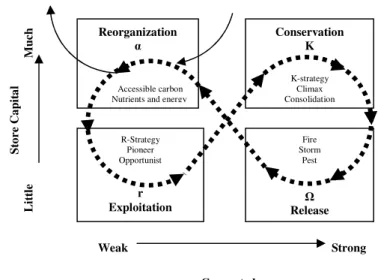
Figure 2.1: A model for viewing different types of inter-organizational relationships using a matrix comprising dependency and certainty dimensions
29
Figure 2.2: The four ecosystem functions and the flow of events between them
30
Figure 2.3: A framework based on relational capital and relational connectedness for analyzing change in long-term social relationships
34
Figure 3.1: A framework for analyzing an integrated learning system for the governance and management of protected areas
52
Figure 3.2: The creation of shared knowledge in an integrated learning system
55
Figure 4.1: An illustration of the search for fundamental solutions in adaptive management of demands on protected areas
70
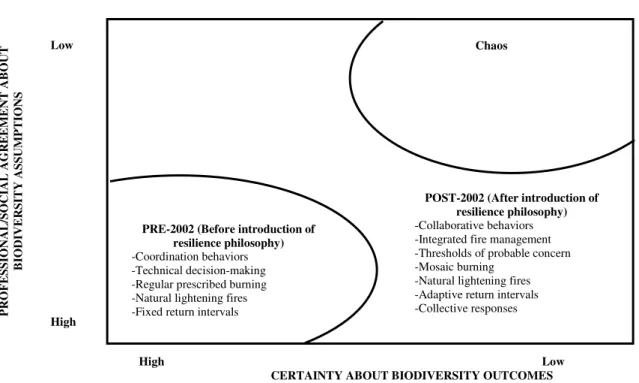
Figure 4.2: A decision-making model based on the levels of agreement on assumption and levels of certainty about outcomes
72
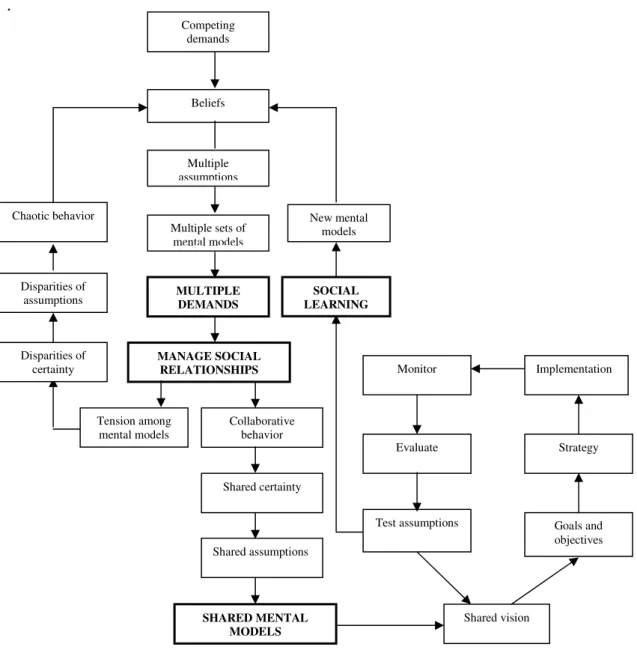
Figure 4.3: A conceptual framework for integrating mental models in adaptive management of demands on protected areas
73
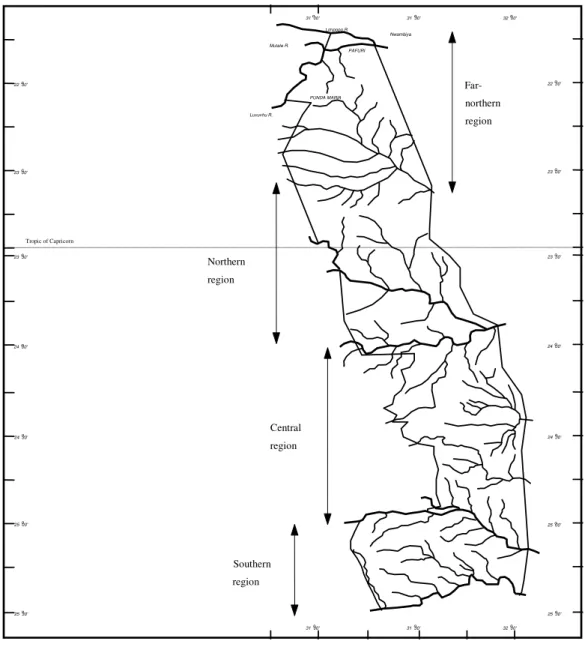
Figure 5.1: Map of the Kruger National Park 87
Figure 5.2: Social relationships and the evolution of fire management decisions in Kruger National Park
89
Figure 4.3: Social relationships and the evolution of water management decisions in Kruger National Park
93
Figure 5.4: Diagram illustrating evolutionary changes and increasing relational capital and relational connectedness in water management in Kruger National Park
98
APPENDICES
Appendix 1: Interview schedule 120
ACKNOWLEDGEMENTS
I would like to express my appreciation and gratitude to the following people and organizations for their contribution to this study:
The Ford Foundation, for generously awarding me a bursary to enable me complete this degree; The University of Montana for providing me an opportunity to attend a non- graduate degree program at the university; My supervisor and co-supervisor, Professors Charles Breen and Rob Fincham respectively, for their support, guidance and time they provided me during the production of this thesis; Professors Wayne Freimund and Steve McCool, for their interesting insights during my stint at The University of Montana.
All the members of staff at the Centre for Environment, Agriculture and Development, for making all the necessary logistics that made my stay and studies in South Africa a success; members of the Treehouse Research Program for People and Conservation, for the support and encouragement through out my academic career; and staff at the South African National Parks and Kruger National Park for the opportunity to conduct field research.
Finally, I am most grateful to my wife, Justina Ndhlovu, and children, Gift, Peter, Bernadette, Augustine, and Bimo for their patience and understanding over many years of study.
1
Social Systems Analysis and Management Effectiveness Research on Protected Areas: Research Propositions
INTRODUCTION
In this thesis I seek to contribute to the improved understanding of social systems analysis in management effectiveness research on protected areas. I intend to develop and apply propositions for incorporating the analysis of social systems into management effectiveness research, with special reference to adaptive management. For over two decades, there has been interest in research on the management effectiveness of protected areas (Bell 1984, MacKinnon et al. 1986, Hocking et al. 2000, Pomeroy et al. 2004).
Although the philosophy of management effectiveness is not new (Deshler 1982), research has been confined to issues strongly related to the management effectiveness of biophysical systems. Notwithstanding a few exceptions, such as the works of Lee (1993), Berkes and Folke (1998), Gunderson and Holling (2002) and Manfredo et al. (2004), the social dimension has received little attention. In savannah protected areas, for example, the focus has been largely on large mammals and their concomitant habitats (see Bell 1984, du Toit et al. 2003, Wilshusen et al. 2003). Despite years of concern with the management effectiveness of protected areas (Deshler 1982), we have little solid understanding of the associated underlying social systems. The concern here is not with stable-state social systems but with the analysis of processes located in the changing structures and functions of social systems over time (Pettigrew 1973, 1990). The acknowledgement of complex dynamic variability in social systems leaves the way open for a systemic analysis of management effectiveness. This understanding suggests that management effectiveness theories should not be determined solely by biophysical attributes, but should be extended to broader social issues and concerns through a more holistic systems approach.
This introductory chapter serves as a context by providing an overview of the research background as well as the main theoretical frameworks on which this thesis is premised, namely relationships, learning, and demand management. The first section provides a definition of management effectiveness in general as well as its connection to protected areas. The second section describes the nature of the social environments of protected areas and its implications for management effectiveness. The third section discusses the role of a behavioral approach to relationships theory in analyzing collaborative processes.
This is followed by a section on integrated learning systems. The fifth section examines adaptive management theory as a management effectiveness approach for understanding and managing the demands on protected areas. The sixth section discusses social systems analysis as the main research methodology used in this study. Finally, the chapter presents the research propositions, objectives, and thesis structure.
DEFINING MANAGEMENT EFFECTIVENESS
To begin with, it is important that I provide some definition of management effectiveness. There are, of course, as many definitions as there are researchers. One common approach, however, is to view management effectiveness as a concept that connotes a process of producing an intended result (Checkland 1985, Hocking et al.
2000). Smit and de Cronje (1997), using the basic principles of management, argue that in simple terms the concept implies a desire for the right thing to be done. They contend that this definition distinguished the concept from the related notion of management efficiency, which implies doing something right. Deshler (1982: 8) provides a definition that attempts to bring the two concepts together. He states that management effectiveness involves the “efficient and orderly use of human and material resources on a planned basis directed to achieve management objectives.” Thus, in the context of protected areas, a typical assessment of management effectiveness would include design issues relating to protected area systems, appropriateness of management systems and processes, and delivery of protected area objectives (Hockings et al. 2000, Salafsky et al. 2001, Biggs and Rogers 2003, Hockings 2003).
It is important to recognize that the debates surrounding the concept of management effectiveness go to as far back as the 1950s, particularly in management science (Checkland 1985). These debates have largely centered on the concept’s core characteristic, that of goal seeking. Opponents have accused the notion of goal seeking of being too idealistic to be applied to real-world problems (Checkland 1985, Walker et al.
2002). They argue that in real life goals change all the time, and as such, have no real value when applied to messy, ill-structured, real-world problems. On the other hand, proponents have argued that, since the essence of management is to produce results, it is only reasonable to use goals as a measure of those results (Coleman 1990). Whilst acknowledging that goals change from time to time, proponents contend that the notion of goal seeking is still useful particularly for analytical purposes (Smit and de Cronje 1997). In sum, I contend that the two perspectives illustrate the multi-dimensional character of management, an attribute that is inevitable given the complex nature of reality. Also, the two perspectives suggest that the concept is inherently ambivalent.
In this thesis I adopt a more holistic and pragmatic approach by transcending the implicit dichotomy in the two perspectives. I proceed by searching for a unifying framework in which one perspective incorporates the most important insights of both arguments. In that regard, I use a two-dimensional definition as used by Walker et al. (2002) and Anderies et al. (2004). Accordingly, I conceive effectiveness from two dimensions: productivity and robustness. Productivity is an aspect of effectiveness that refers to the capacity of a system to exploit, grow and produce outcomes (Walker et al. 2002). According to Walker et al. (2002), productivity is similar to the concept of maximizing income in investment portfolios. On the other hand, robustness refers to the capacity of a system to maintain desirable system characteristics in spite of fluctuations in the behavior of its component parts or its environment (Anderies et al. 2004). For Anderies et al. (2004), this aspect of effectiveness is particularly important in the context of social systems in which some components are consciously designed, such as a protected area agency and its management systems. Such a system characteristic, for example, would enable a protected area agency to adapt and learn following changes in its system environment (Anderies et al. 2004). For the purposes of this study, this conception of management
effectiveness provides a useful lens for examining the social environments of protected areas.
MANAGEMENT EFFECTIVENESS AND THE SOCIAL ENVIRONMENTS OF PROTECTED AREAS
Contemporary social theorists argue that a realistic description of the social environments shows that they largely consist of relationships among social actors (Wood and Gray 1991, Phillips et al. 2000, Manfredo et al. 2004). These theorists contend that such environments are deeply entrenched with social relationships to the extent that any study that underemphasizes them limits the analytic leverage of social science. Wilshusen et al.
(2003), for example, explain that no contemporary protected area agency exists in isolation in social environments. Each is locked into a complex network of relationships with other social actors. Elsewhere writers have argued that the management of protected areas is predominantly a social process, rather than an ecological one (Wilshusen et al.
2003, Manfredo et al. 2004, Pomeroy et al. 2004). Bailey (1984) describes protected area management as necessarily a social process that defines and seeks to attain socially acceptable use of natural resources. For Berkes and Folke (1998), park management is people management. In that context, protected area management by definition is a complex social process that requires effective interactions between agencies, resources users and society members as a whole.
Despite the institutionalization of management effectiveness in protected areas (Pomeroy et al. 2004), social relationships involving agencies have proved to be difficult to manage compared to other types of relationships in the conservation sector. On one hand this could be attributed to inadequate appreciation of the nature of social environments as dynamic complex systems (Berkes and Folke 1998). On the other hand this is due to the inherent mutual interdependences on scarce natural resources among multiple social actors with divergent expectations and aspirations. The challenge of mutual interdependences is compounded by the ever-changing societal demands on protected areas (Rao 2003), which are in themselves constantly changing over time and space
(Salafsky et al. 2001), a situation that contributes to the complexity of social environments (Salafsky et al. 2001). The management of competing societal demands on protected areas is usually associated with perpetual conflicts which have far-reaching consequences for management effectiveness (Stankey and McCool 2004, Anne-Marie and Chimere 2006). As such, these insights provide this study with some understanding of the social dynamics that influence the management effectiveness of protected areas.
A structured approach to the study of management effectiveness requires an understanding of social systems that can help explain and assess management effectiveness from an holistic perspective (Lee 1993, Berkes and Folke 1998, Folke et al.
2002). Yet, it is surprising that management effectiveness research has concentrated mostly on the biophysical system perspective. One could indeed ask the question as to why research has adopted a systems approach to the biophysical and not to the social systems. Although this focus has in some instances incorporated some aspects of social analysis, such as the assessment of socio-economic variables that can help protected area managers to monitor stakeholder concerns and interests (Pomeroy et al. 2004), little attention has been given to the analysis of social systems. Whilst it could be argued that there are exceptions to this trend, such as the works of Holling (1973), Lee (1993), Manfredo et al. (2004) and the Resilience Alliance (www.ecologyandsociety.org), most studies have not explicitly and specifically analyzed the processes located in the changing structures of social systems over time. As such, I propose that analysis of social attributes through a systems approach is central to the study of the management effectiveness of protected areas.
SOCIAL RELATIONSHIPS AND COLLABORATION
For some time, there has been interest in research on collaboration in the management of social-ecological systems (Folke et al. 2002, Walker et al. 2002, Berkes et al. 2003). This interest has been partly premised on the need for social actors to work together to enhance the management effectiveness of protected areas (Pinkerton 1999). Although the concept of collaboration is not necessarily viewed as a panacea for all protected area
problems (Hardy and Phillips 1998, Imperial 2004), researchers generally agree on why studies of collaboration are necessary. Firstly, it is believed that collaboration is real and has an existence in the real world (Huxham 1986). Social actors throughout the world are voluntarily and involuntarily establishing collaborative schemes. The fact that collaboration is happening directs research to understand the nature of this phenomenon.
Secondly, it is assumed that collaboration generates desirable benefits (Imperial 2004).
Collaborative arrangements are seen as a means of achieving goals that would be difficult for individual social actors to attain. Also, in the context of protected area management, collaborative behaviors are viewed as an important means for managing societal differences (Brunner 2002). The inherent societal values of collaboration necessitate scientific enquiry. Thirdly, it is understood that collaborative schemes are difficult to manage (Pinkerton 1999, Brunner 2002). Collaborative schemes often involve actors with multiple interests and perceptions, which render collaboration a potential arena for conflict (Ostrom 1998). The inherent managerial challenges of conflict in collaboration justify calls for studies.
The third reason is of particular importance to this study. This is because evidence has shown how the management of collaborative behaviors is presently one of the major challenges facing the management effectiveness of protected areas. MacKinnon et al.
(1986), for example, demonstrate how the management of behaviors in tourism concessions in national parks has in most cases failed to meet the goals of collaboration between conservation agencies and private business organizations. Brunner (2002) shows how community-based schemes involving multiple government agencies and interest groups usually result in conflicts of interests and perspectives in the protection of endangered species in protected areas. Turton et al. (2005) show how the management of partnerships associated with rivers is still a significant social dilemma for protected areas.
Selin (2004) illustrates how institutional barriers continue to hinder the widespread adoption and support of collaboration between protected area agencies and their constituencies. The evidence presented by these and other authors generally points to the fact that collaborative behaviors have proved to be challenging to the management effectiveness of protected areas.
Notwithstanding the increasing appreciation and complexity of collaboration, little attention has been given to the application of relationships theory in management effectiveness research on collaboration. Particularly, most studies have not been taking sufficient account of the need for dynamic long-term relationships that underlie collaborative schemes. Despite a few notable exceptions (such as Ostrom 1990, Imperial and Kauneckis 2003), few scientific enquiries have explicitly given attention to the changing nature of long-term relationships. Most commonly, relationships theory has been evidenced by implication rather than through specific and explicit application.
Arguably, collaborative schemes in protected areas are founded on complex long-term social relationships that involve multiple interest groups with divergent perceptions, expectations and experiences (Brunner 2002). These relationships are usually characterized by behavioral processes through which interest groups influence each others’ behaviors over a period of time in order to advance individual and shared goals (Imperial 2004). Ostrom (1998) contends that the behavioral processes underlying such relationships are important in determining the effectiveness of collaboration. Not surprisingly, perhaps, most studies on collaboration have not been taking sufficient account of the behavioral processes that underlie long-term relationships.
A behavioral approach provides a useful perspective for examining the relationships that underlie collaborative schemes (Hardy and Phillips 1998, Phillips et al. 2000, Kinnaman and Bleich 2004, Selin 2004). Such a perspective offers a useful lens for examining the effects of long-term relationships on collaborative initiatives. Of fundamental significance to this study, however, the perspective facilitates understanding of how to better manage relationships in collaboration schemes through human behavioral processes (Knoke 1990, Hutchison 2003). Not only can such a perspective enhance the integration of behavioral science into management effectiveness research (Kinnaman and Bleich 2004), but also it can help us better understand the behavioral processes required for effective management of protected areas. Therefore, I propose that research on the role of a behavioral approach to relationships theory is necessary for analyzing collaborative processes.
INTEGRATED LEARNING SYSTEMS
Learning is increasingly becoming a key prerequisite for the management effectiveness of protected areas (Berkes and Folke 1998, Johnson 1999, Gunderson and Holling 2002, Folke et al. 2005). In the context of protected areas, learning is particularly necessitated by the dynamic nature of these areas, which are susceptible to discontinuous change that leads to greater uncertainty (Rogers 2003). To maintain the competence to cope with uncertainty, collaborative actors have to engender ongoing knowledge creation processes (Berkes et al. 2003, Biggs and Rogers 2003). By definition, learning entails a collective process of building, upgrading and enriching the knowledge and skills of parties to a collaborative relationship (Allee 1997, Johnson et al. 2004). It focuses on the parties’
learned ways of behaving in collaborative relationships by aligning and fostering their competences to deal with emergent issues and problems (Ireland et al. 2002). The extent to which parties collaboratively learn how to realize the benefits they desire is essential to the management effectiveness of protected areas (Folke et al. 2005). In so doing, parties behave in ways that enhance the effectiveness of collaboration.
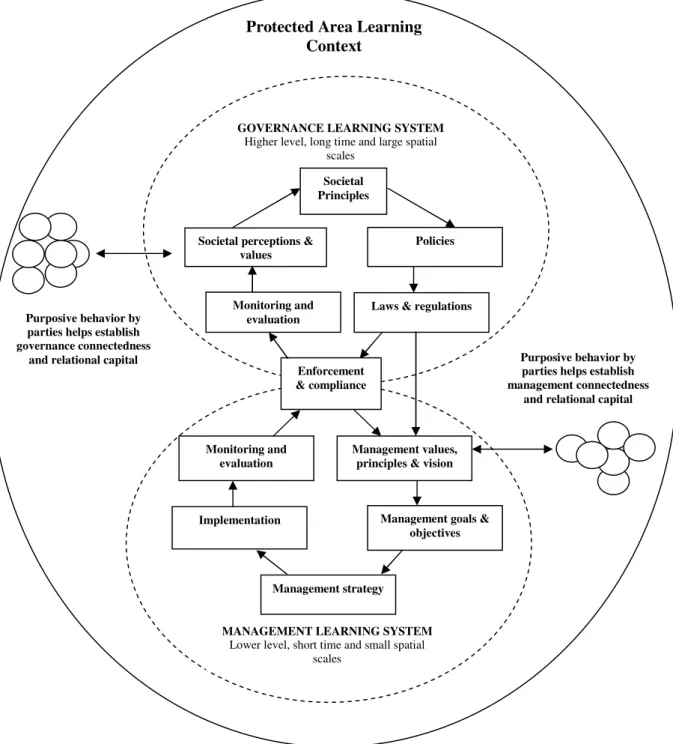
The establishment and maintenance of an integrated learning system for protected areas requires an understanding of governance learning and management learning (Folke et al.
2005). The strongly coupled connections between the two subsystems influence the performance of an integrated learning system. It is important that performance indicators of an integrated learning system reflect the effectiveness of the two subsystems (Bossel 2001). The derivation of such indicators must acknowledge that the creation of knowledge through governance learning and management learning occurs in a dynamic context of information flows which link multiple actors in an integrated learning system (Nonako 2004). Thus, the degree to which social actors are connected in an integrated learning system provides the premise on which those actors share information to create the knowledge required for effective protected area governance and management.
While some aspects of adaptive governance (Olsson et al. 2004, Folke et al. 2005) and adaptive management (Rogers 1998, Johnson 1999, du Toit et al. 2003) have been discussed in literature, the link between governance learning and management learning has remained largely unattended. Little attention has been explicitly given to the functional linkage between governance learning and management learning. Yet an integrated perspective provides a potentially useful framework for explaining and improving knowledge creation processes around which the concept of adaptability is structured and implemented (Biggs and Rogers 2003). To enhance such processes, we need to understand that successful adaptability for protected areas largely depends on the effectiveness of the efforts to integrate governance learning and management learning.
Accordingly, I propose that research on integrated learning systems is essential if we are to successfully promote learning as a fundamental component of the governance and management of protected areas.
ADAPTIVE MANAGEMENT OF DEMANDS ON PROTECTED AREAS
Adaptive management is one of the main management effectiveness approaches for protected areas (Hockings et al. 2000). Others include limits of acceptable change, recreation opportunity spectrum, goal-oriented planning, management-by-objectives, logical framework, visitor impact assessment, environmental impact assessment and strategic planning process, just to mention a few (Holling 1978, Bell 1984, Brown 1984, Hocking et al. 2000, Salafsky et al. 2001, Biggs and Rogers 2003, McCool et al. 2007).
The use of adaptive management began in the 1970s as a response to the challenges surrounding complexity, change and uncertainty as they relate to the use and management of natural resources (Holling 1973, 1978). While adaptive management is not necessarily the ‘best’ approach, it provides a useful systems approach for coordinating and harmonizing the activities of protected areas agencies (Berkes and Folke 1998, Johnson 1999, Gunderson and Holling 2002, Folke et al. 2005). It is basically premised on the need for agencies to develop organizational competences needed to adapt to the complex, ever-changing and uncertain conditions of protected areas. It does this by integrating design, monitoring and evaluation in protected area
management processes to systematically test assumptions in order to adapt and learn (Salafsky et al. 2001, Rogers 2003).
Adaptive management is premised on the principles of collaboration, whereby it attempts to incorporate the views and knowledge of interested and affected parties in the decision- making processes of protected areas (Berkes and Folke 1998, Johnson 1999, Folke et al.
2005). Given the nature of ever-changing competing demands on protected areas, agencies are encouraged to find better ways in which to work collectively with other social actors. However, it is acknowledged that management must proceed even with limited information and understanding about key determinant variables (Salafsky et al.
2001). In this way adaptive management is not only viewed as a collective decision- making process for protected areas, but also as a means for creating knowledge (Johnson 1999). The creation of knowledge in protected area management is thus viewed as a key attribute of adaptive management (Rogers 2003). This understanding stems from the perspective that management actions have to be treated as experiments (Holling 1995).
Protected area agencies are encouraged to treat management plans as hypotheses to be tested in practice. Such plans have to be continuously refined, corrected or rejected depending on the outcomes of particular management interventions, and in so doing
‘learning by doing’ becomes the means of management effectiveness for protected areas (Salafsky et al. 2001).
In general, protected areas are established in response to demands expressed by society over time and space (Bell 1984, Brown 1984, Brechin et al. 2003, Child 2004). However, despite the potential significance of adaptive management, systemic social analyses of demand management processes in protected areas have largely been missing in management effectiveness research. Most studies have not been taking sufficient account of how agencies manage competing societal demands on protected areas through adaptive management processes. Little attention has been explicitly given to the changing nature of competing societal demands (Wilshusen et al. 2003). And as a consequence, demand management has been typically assumed to be based on fixed technical instruments, such as quota setting exercises and carrying capacity assessments, as if demands were not
affected by changes in the social environment of protected areas (MacKinnon et al.
1986). This assumption has entailed improving the accuracy of demand forecasts and the use of the biophysical characteristics of demands to determine inventory and capacity requirements for protected areas agencies. Hence, research on societal demands has been reduced to a technical assessment of values and associated benefits, with relatively little attention being given to the social implications for management effectiveness (Anne- Marie and Chimere 2006). I therefore propose that research on adaptive management theory is necessary for understanding and effectively managing demands on protected areas.
SOCIAL SYSTEMS ANALYSIS
In this thesis I present concepts and principles which build on the new developments in systems thinking. The approach of systems thinking is essentially premised on the basic assumption that life on earth is governed by the laws of systems (Senge 1990). It could be argued that protected area agencies deal with systems, be it consciously or unconsciously, when managing in social environments. They do not merely deal with single social components. This is more the reason why the social environments of protected areas are associated with multiple actors, multiple relationships, and multiple demands (Wilshusen et al. 2003). Dynamic interconnections between such social variables could lead to greater uncertainty and limited predictability. In order to effectively deal with multiple social variables and their interconnections, systems thinking encourages us to use multiple perspectives and scales when analyzing and intervening in the social environments of protected areas (Nina-Marie and Kay 1999).
The philosophy of systems thinking suggests that the competent management of real- world problems requires an appreciation of real-world system complexity, change and uncertainty (Bossel 2001). Senge (1990: 69) attributes global system complexity, change and uncertainty to the fact that “humankind has the capacity to create far more information than anyone can absorb, to foster far greater interdependency than anyone can manage, and to accelerate change far faster than anyone’s ability to keep pace.” As
such, the philosophy of systems thinking is increasingly being applied in various disciplines such as ecological studies, ecological economics, integrated natural resources management, business management, post-normal science, and resilience analysis (Checkland 1985, Senge 1990, Walker et al. 2002). Similarly, research on the management effectiveness of protected areas needs to grapple with system complexity, change, and uncertainties. Such research should come to terms with the understanding that the world is increasingly becoming more complex and generating more change and uncertainty.
It is essential for research on the management effectiveness of protected areas to improve understanding of the dynamics that underlie complexity, change and uncertainty in the social environment of protected areas. Research needs to deal with problems that emerge from real-world system complexity, change and uncertainty. These problems are inherently multi-scale and involve interactions across different variables (Walker et al.
2002). Such a research agenda can only be adequately advanced by attending to social systems analysis. Studies on management effectiveness, however, have not been giving explicit attention to social systems analysis. Particularly, social systems analysis has rarely been used to examine processes located in the changing structures of social systems over time As such, the research methodology adopted for this study is social systems analysis. It is envisaged that this methodology, with its emphasis on a systems- based approach, will be used to reorient the study of management effectiveness into social environments.
RESEARCH PROPOSITIONS, OBJECTIVES AND THESIS STRUCTURE
It is in the light of the above discourse that the research issue addressed in this study was how to improve the understanding of social systems analysis in management effectiveness research on protected areas. To explore this issue, I derived four key propositions which provided an analytical framework for this study;
analysis of social attributes through a systems approach is central to the study of the management effectiveness of protected areas;
research on the role of a behavioral approach to relationships theory is necessary for analyzing collaborative processes;
research on integrated learning systems is essential if we are to successfully promote learning as a fundamental component of the governance and management of protected areas; and
research on adaptive management theory is necessary for understanding and effectively managing demands on protected areas.
The main objective of this research was to contribute to the improved understanding of social systems analysis in management effectiveness research on protected areas, with special reference to adaptive management. Its specific objectives were to:
develop propositions for incorporating the analysis of social systems into management effectiveness research;
examine the role of a behavioral approach to relationships theory in analyzing collaborative processes;
analyze the connection between governance learning and management learning as a fundamental component of integrated learning systems;
explore adaptive management theory as a management effectiveness approach for understanding and managing demands; and
synthesize the propositions to explore the challenges and opportunities of applying them at a broader scale in management effectiveness research.
This thesis consists of a series of papers that have been published in, or prepared for submission to, a range of scientific journals. Whilst I have led the development of the papers, I have acknowledged the contribution of others where appropriate. The paper presented in Chapter 2 articulates a social relationships perspective of collaboration in the management of social-ecological systems. It provides a conceptual premise for understanding the dynamics of social relationships that underlie collaborative processes.
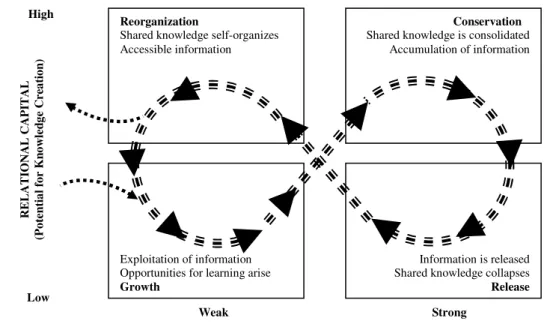
A framework based on resilience and social relationships theories is developed for analyzing effective collaboration. The elements of a behavioral approach to relationships theory are discussed as a foundation for resilient social relationships. The paper demonstrates that an analysis of resilient social relationships for effective collaborative management of social-ecological systems requires an understanding of the complexity and extent of relational change. By incorporating the models of Holling (1995) and Cousins (2002) into a behavioral approach to relationships theory, the paper proposes a conceptual framework that can be used to determine the potential for relational change based on relational capital and the degree of relational connectedness in the social relationships that underlie collaborative processes.
The paper presented in Chapter 3 illustrates that the strongly coupled connections between the two governance learning and management learning subsystems influence the performance of an integrated learning system. Performance indicators of an integrated learning system need to reflect the effectiveness of the two subsystems. The derivation of such indicators must acknowledge that the creation of knowledge through governance learning and management learning occurs in a dynamic context of information flows which link multiple actors in an integrated learning system. As such, I suggest that the degree to which social actors are connected in an integrated learning system provides the premise on which those actors share information to create the knowledge required for effective protected area governance and management.
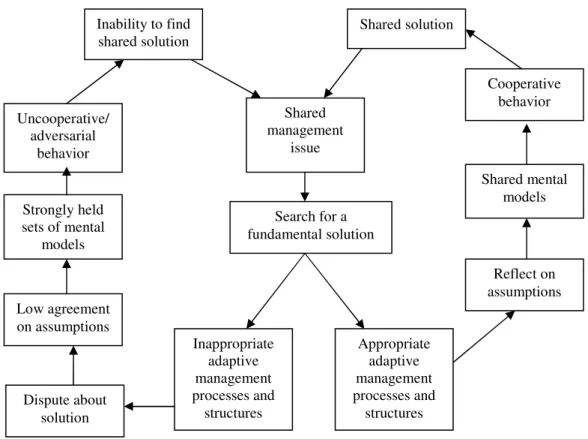
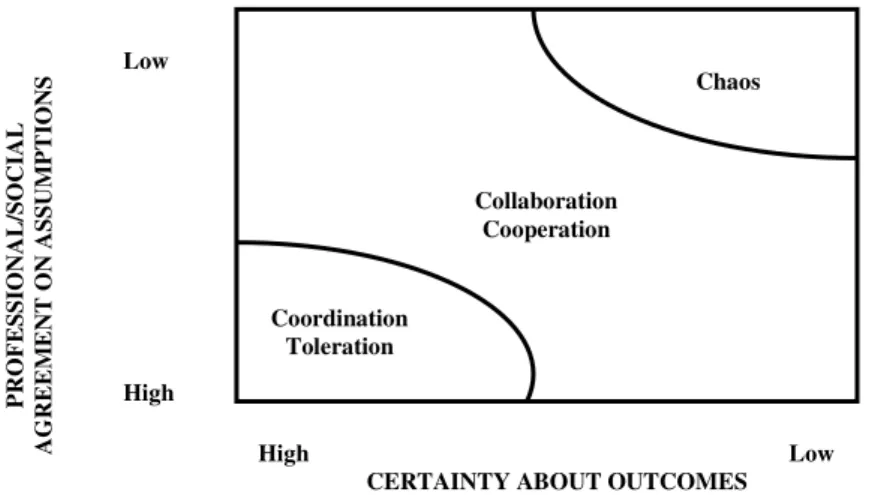
In Chapter 4, I present a paper that illustrates that protected areas are established in response to demands expressed by society over time and space. These demands are varied and commonly involve protection of natural and cultural heritage so that society can continue to enjoy them into the future. As the demands placed on protected areas continue to evolve and expand, so do their expressions which are expected to be reflected in the form of mental models in management planning processes. Accordingly, I argue that much of society’s perception of successful protected area management is determined by how management agencies understand, respond to and manage demands. Hence, for
protected area management to be effective, agencies must incorporate mental models into adaptive management of demands.
In Chapter 5, I provide an analysis of the collaborative arrangements in fire and water management in Kruger National Park. The analysis is conducted in the context of strategic adaptive management (SAM). The SAM approach was developed for the park to support and facilitate adaptive management in the rapidly evolving, multidimensional world of protected area management decision making. It focuses on pragmatic, goal- orientated adaptive management to emphasize its orientation towards management effectiveness. The SAM approach draws largely on the broader philosophy of adaptive management, whereby it affirms that the effective management of protected areas requires an appreciation of complexity, change and uncertainty. Therefore, SAM responds to the challenges and opportunities posed by the three phenomena by highlighting the need for protected area agencies to develop and maintain their competences to learn and adapt.
In Chapter 6, I synthesize the propositions by exploring the challenges and opportunities of applying them at a broader scale in management effectiveness research. These propositions are developed in Chapter 1 for incorporating the analysis of social systems into management effectiveness research. The propositions are applied in Chapters 2 to 5 to systematically analyze the main theoretical frameworks on which this thesis is premised. The application of the propositions provides useful insights into social systems analysis and management effectiveness research.
REFERENCES
Allee, V. 1997. The Knowledge Evolution: Expanding organisational Intelligence.
Butterworth-Heinemann, Boston.
Anderies, J.M., M.A. Janssen and E. Ostrom. 2004. A Framework to Analyze the Robustness of Social-Ecological Systems from an Institutional Perspective. Ecology and Society 9(1):18. http://www.ecologyandsociety.org/vol9/iss1/art18/
Anne-Marie, T. and Chimere, D. 2006. Does Resettlement Contribute to Conservation?
The case of Ikundu-Kundu, Korup National Park, Cameroon. Policy Matters 14: 113- 127.
Bailey, J.A. 1984. Principles of Wildlife Management. John Wiley and Sons, New York.
Bell, R.H.V. 1984. The Workshop Theme: Adaptive Management. In Bell, R.H.V. and McShane-Caluzi, E., editors: Conservation and Wildlife Management in Africa: The Proceedings of a Workshop Organized by the U.S. Peace Corps at Kasungu National Park, Malawi. Office of Training and Program Support, Forestry and Natural Resources Sector, U.S. Peace Corps.
Berkes, F. and C. Folke, editors. 1998. Linking Social and Ecological Systems for Resilience and Sustainability: Management Practices and Social Mechanisms for Building Resilience. Cambridge University Press.
Berkes , F., J. Colding, and C. Folke, editors. 2003. Navigating Social-Ecological Systems: Building Resilience for Complexity and Change. Cambridge University Press.
Biggs, H.C. and K.H. Rogers. 2003. An Adaptive System to Link Science, Monitoring and Management in Practice. In du Toit, J.T., K.H. Rogers and H.C. Biggs, editors: The Kruger Experience: Ecology and Management of Savanna Heterogeneity. Island Press, Washington D.C.
Bossel, H. 2001. Assessing Viability and Sustainability: A Systems-Based Approach for Deriving Comprehensive Indicator Sets. Conservation Ecology 5(2): 12. [online] URL:
http://www.consecol.org/vol5/iss2/art12/
Brechin, S.R., P. Wilshusen, C.L. Fortwangler and P.C. West, editors. 2003.
Contesting Nature: Promoting International Biodiversity with Social Justice in the Twenty-First Century. State University of New York Press, Albany.
Brown, P.J. 1984. Benefits of Outdoor Recreation and Some Ideas for Valuing Recreation Opportunities. In Peterson, G.L. and A. Randal, editors: Wildland Recreation Benefits. Westview Press, Boulder, CO.
Brunner, R.D. 2002. Problems of Governance. In Brunner, R.D., C.H. Colburn, C.M.
Cromley, R.A. Klein and E.A. Olson, editors: Finding Common Ground: Governance and Natural Resources Management in the American West. Yale University Press, New Haven.
Checkland, P. 1985. From Optimizing to Learning: A Development of Systems Thinking for the 1990s. Journal of Operations Research Society, Volume 36, 1985.
Operational Research Society, U.K.
Child, B., editor. 2004. Parks in Transition: Biodiversity, Rural Development and the Bottom Line. Earthscan, London.
Coleman, J.S. 1990. Foundations of Social Theory. The Belknap Press of Harvard University Press, Cambridge.
Cousins, P.D. 2002. A Conceptual Model for Managing Long-term Inter-organizational Relationships. European Journal of Purchasing and Supply Management 8:71-82.
Deshler, W.O. 1982. A Systematic Approach to Effective Management of Protected Areas. In World National Parks Congress, Bali, IUCN Commission on National Parks and Protected Areas.
du Toit, J.T., K.H. Rogers and H.C. Biggs, editors. 2003. The Kruger Experience:
Ecology and Management of Savanna Heterogeneity. Island Press, Washington D.C.
Folke, C., S. Carpenter, T. Elmqvist, L. Gunderson, C.S. Holling, B. Walker, J.
Bengtsson, F. Berkes, J. Colding, K. Danell, M. Falkenmark, L. Gordon, R.
Kasperson, N. Kautsky, A. Kinzig, S. Levin, K. Maler, F. Moberg, L. Ohlsson, P.
Olsson, E. Ostrom, W. Reid, J. Rockstrom, H. Savenije, and U. Svedin. 2002.
Resilience and Sustainable Development: Building Adaptive Capacity in a World of Transformations. Scientific Background Paper on Resilience for the Process of the World Summit on Sustainable Development on Behalf of the Environmental Advisory Council to the Swedish Government.
Folke, C., T. Hahn, P. Olsson and J. Norberg. 2005. Adaptive Governance of Social- Ecological Systems. Annual Review of Environment and Resources 30: 441-73.
Gunderson, L. and C.S. Holling, editors. 2002. Panarchy: Understanding Transformations in Human and Natural Systems. Island Press, Washington D.C.
Hardy, C. and N. Phillips. 1998. Strategies of Engagement: Lessons from the Critical Examination of Collaboration and Conflict in an Organizational Domain. Organization Science 9(2):217-230.
Hocking, M. 2003. Systems for Assessing the Effectiveness of Management in Protected Areas. BioScience 53(9): 823-832.
Hockings, M., S. Stolton, and N. Dudley. 2000. Evaluating Effectiveness: A Framework for Assessing the Management Effectiveness of Protected Areas. IUCN, Gland, Switzerland.
Holling, C. S. 1973. Resilience and Stability of Ecological Systems. Annual Review of Ecology and Systematics 4:1-23.
Holling, C.S. 1978. Adaptive Environmental Assessment and Management. John Wiley
& Sons, New York.
Holling, C.S. 1995. What Barriers? What Bridges? In Gunderson, L.H., C.S. Holling, and S.S. Light, editors: Barriers and Bridges to the Renewal of Ecosystems and Institutions. Columbia University Press, New York.
Hutchison, E.D. 2003. Dimensions of Human Behavior. Sage Publications, Thousand Oaks, California.
Huxham, C., editor. 1996. Creating Collaborative Advantage. Sage, Publications, London.
Imperial, M.T. 2004. Collaboration and Performance Management in Network Settings:
Lessons for Three Watershed Governance Efforts. IBM Centre for The Business of Government, Washington D.C.
Imperial, M.T. and D. Kauneckis. 2003. Moving from Conflict to Collaboration:
Lessons from the Lake Tahoe Experience. Natural Resources Journal 43(4):1009-1005.
Ireland, R.D., M.A Hitt and D. Vaidyanath. 2002. Alliance Management as a Source of Competitive Advantage. Journal of Management 28(3): 413-446.
Johnson, B. L. 1999. The Role of Adaptive Management as an Operational Approach for Resource Management Agencies. Conservation Ecology 3(2): 8. [online] URL:
http://www.consecol.org/vol3/iss2/art8.
Johnson, J.L., R.S. Sohi and R. Grewal. 2004. The Role of Relational Knowledge Stores in Inter-firm Partnering. Journal of Marketing 68 (July): 21-36.
Kinnaman, M.L. and M.R. Bleich. 2004. Collaboration: Aligning Resources to Create and Sustain Partnerships. Journal of Professional Nursing 20:310-322.
Knoke, D. 1990. Political Networks: The Structural Perspective. Cambridge University Press, New York.
Lee, K.N. 1993. Compass and Gyroscope: Integrating Science and Politics for the Environment. Island Press, Washington, DC.
MacKinnon, J., K. MacKinnon, G. Child and J. Thorsell. 1986. Managing Protected Areas in the Tropics. International Union for Conservation of Nature and Natural Resources, Gland, Switzerland.
Manfredo, M.J., J.J. Vaske, B.L. Bruyere, D.R. Field and P.J. Brown, editors. 2004.
Society and Natural Resources: A Summary of Knowledge. Prepared for the 10th International Symposium on Society and Resource Management held in Keystone, Colorado.
McCool, S.F., R.N. Clark, and G.H. Stankey. 2007. An Assessment of frameworks useful for public land recreation planning. Gen. Tech Rep. PNW-GTR-705. Portland, OR: U.S. Department of Agriculture, Forest Service, Pacific North Western Research Station. 125 p.
Nina-Marie, L and J.J. Kay. 1999. Celebrating Diversity: Adaptive Planning and Biodiversity Conservation. In Bocking, S., editor: Biodiversity in Canada: An Introduction to Environment Studies. Broadview Press, Ontario.
Nonaka, I. 2004. A Dynamic Theory of Organizational Knowledge Creation. In Starkey, K, S. Tempest and A. Mckinlay, editors: How Organizations Learn. Second edition, Thomson Learning, London.
Olsson, P., C. Folke, F. Berkes. 2004. Adaptive Co-Management for Building Resilience in Social-Ecological Systems. Environmental Management 34: 75-90.
Ostrom, E. 1990. Governing the Commons: The Evolution of Institutions for Collective Action. Cambridge University Press, New York.
Ostrom, E. 1998. A Behavioral Approach to the Rational Choice Theory of Collective Action: Presidential Address, American Political Science Association, 1997. American Political Science Review 92(1):1-22.
Pettigrew, A. M. 1973. The Politics of Organizational Decision Making. Tavistock, London.
Pettigrew, A. M. 1990. Longitudinal Field Research on Change: Theory and Practice.
Organizational Science 1(3):267-292.
Phillips, N., T.B. Lawrence, and C. Hardy. 2000. Inter-organizational Collaboration and the Dynamics of Institutional Fields. Journal of Management Studies 37(1):23-43.
Pinkerton, E. 1999. Factors in Overcoming Barriers to Implementing Co-Management in British Columbia Salmon Fisheries. Conservation Ecology 3(2): 2. [online] URL:
http://www.consecol.org/vol3/iss2/art2/.
Pomeroy, R.S., J.E. Parks and L.M Watson. 2004. How is your MPA doing? A Guidebook of Natural and Social Indicators for Evaluating Marine Protected Area Management Effectiveness. IUCN, Gland, Switzerland and Cambridge, U.K.
Rao, P.K. 2003. The Economics of Transaction Costs: Theory, Methods and Applications. Palgrave Macmillan, Hampshire.
Rogers, K.H. 1998. Managing Science/Management Partnerships: A Challenge of Adaptive Management. Conservation Ecology [online] 2(2): R1. Available from the Internet. URL: http://www.consecol.org/vol2/iss2/resp1/
Rogers, K.H. 2003. Adopting a Heterogeneity Paradigm: Implications for Management of Protected Savannas. In du Toit, J.T., KH. Rogers and H.C. Biggs, H.C., editors: The Kruger Experience: Ecology and Management of Savanna Heterogeneity. Island Press, Washington D.C.
Salafsky, N., R. Margoluis and K. Redford. 2001. Adaptive Management: A Tool for Conservation Practitioners. Biodiversity Support Programme, Washington, D.C.
Selin, S. 2004. Natural Resource Partnerships. In Manfredo, M.J., J.J. Vaske, B.L.
Bruyere, D.R. Field, and P.J. Brown, editors: Society and Natural Resources: A Summary of Knowledge. Prepared for the 10th International Symposium on Society and Resource Management held in Keystone, Colorado.
Senge, P.M. 1990. The Fifth Disciple: The Art and Practice of the Learning Organisation. Doubleday, New York.
Smit, P.J. and de Cronje, G.J. 1997. Management Principles: A Contemporary Edition for Africa. Second Edition, Juta & Co. Ltd, Kenwyn 7790.
Stankey, G.H. and S.F. McCool. 2004. Social Sciences and Natural Resources Management. In Manfredo, M.J., Vaske, J.J., Bruyere, B.L., Field, D.R., and Brown, P.J.
(Eds): Society and Natural Resources: A Summary of Knowledge. Prepared for the 10th International Symposium on Society and Resource Management held in Keystone, Colorado.
Turton, A., A. Earle, D. Malzbender, and P.J. Ashton. 2005. Hydro-political Vulnerability and Resilience along Africa’s International Waters. United Nations
Environment Program, Hydro-political Vulnerability and Resilience along International Waters, Division of Early Warning and Assessment-North America, Sioux Falls, SD.
Walker, B., S. Carpenter, J. Anderies, N. Abel, G. Cumming, M. Janssen, L. Lebel, J. Norberg, G.D. Peterson, and R. Pritchard. 2002. Resilience Management in Social- Ecological Systems: A Working Hypothesis for a participatory Approach. Conservation Ecology 6(1):14. [Online] URL: http://www.consecol.org/vol6/iss1/art14.
Wilshusen, P., S.R. Brechin, C.L. Fortwangler and P.C. West. 2003. Contested Nature: Conservation and Development at the Turn of the Twenty-first Century. In rechin, S.R., P. Wilshusen, C.L. Fortwangler and P.C. West, editors: Contesting Nature:
Promoting International Biodiversity with Social Justice in the Twenty-First Century.
State University of New York Press, Albany.
Wood, D.J. and B. Gray. 1991. Towards a Comprehensive Theory of Collaboration. The Journal of Applied Behavioral Sciences 27(2):139-162.
2
Resilient Social Relationships and Collaboration in the Management of Social-Ecological Systems
*NKHATA, A.B.,† C.M. BREEN† AND W.A. FREIMUND‡
INTRODUCTION
Collaborative strategies are increasingly being promoted as a means of addressing problems associated with the management of social-ecological systems (SESs) (Folke et al. 2002, Walker et al. 2002, Berkes et al. 2003). Whilst the concept of collaboration is not necessarily viewed as a panacea for all social-ecological problems (Hardy and Phillips 1998, Imperial 2005), the need for social actors to work together to enhance the capacity of SESs to cope with intermittent shocks has continued to receive enthusiastic attention (Berkes and Folke 1998, Blumenthal and Jannink 2000, Tompkins and Adger 2004, Newman and Dale 2005). Notwithstanding a growing appreciation of the importance of collaboration, little attention has been explicitly given to the dynamic long- term social relationships that underlie collaborative schemes in the management of SESs.
Despite a few notable exceptions (such as Ostrom 1990, Imperial and Kauneckis 2003), most studies have not been giving explicit attention to the changing nature of long-term social relationships. These relationships are usually characterized by processes through which collaborative actors influence each others’ behaviors over a period of time to advance individual and shared goals (Axelrod 1984, Ostrom 1998). To understand such relationships, we need to understand the behavioral processes through which collaborative schemes evolve over time. Not surprisingly, perhaps, the behavior of actors
* Published in Ecology and Society (2008). Online: http://www.ecologyandsociety.org/vol13/iss1/art2/.
† Centre for Environment, Agriculture and Development, University of KwaZulu Natal, Private Bag X01 Scottsville 3209, South Africa.
‡
over time is most commonly evidenced by implication rather than through specific and explicit application in research.
In this paper we propose and articulate a conceptual framework based on theories of resilience and social relationships for analyzing the behavioral processes of dynamic long-term social relationships that underlie collaborative arrangements in the management of SESs. We argue that an analysis of such processes requires an understanding of the complexity and extent of relational change. The framework we propose can be used to determine the potential for relational change as well as to categorize relationships based on the amount of relational capital and degree of relational connectedness. These elements of a behavioral approach to relationships theory are proposed as a foundation for resilient social relationships. Not only can such a perspective help us better understand and improve dynamic collaborative schemes, but also it can assist us advance the integration of human behavioral sciences into SES research.
CONCEPTUALIZING COLLABORATION AND RELATIONSHIPS
Different authors use different ways to define collaboration (see Wood and Gray 1991, Hardy and Phillips 1998, Phillips et al. 2000, Kinnaman and Bleich 2004, Selin 2004).
For the purposes of this paper, we conceive collaboration as a behavioral process that involves different actors working together to create more benefits than could be produced in unilateral settings (Hall 1995, Imperial and Kauneckis 2003, Kinnaman and Bleich 2004, Imperial 2005). This process is founded on long-term relationships through which actors influence each others’ behavior over a period of time to advance common and individual interests (Ostrom 1998, Cousins 2002). The benefits advanced for collaborative efforts include reduced transactional costs (Wood and Gray 1991), greater social-ecological resilience (Walker et al. 2002), enhanced performance (Imperial 2004), and improved governance (Imperial 2005). Following Bardach (2001) and Hardy and Phillips (1998), however, we do not view collaboration as a ‘fix-all’ strategy for all social-ecological problems. Its significance and appropriateness will depend on a range of
contextual, preferential and contingency factors (Wondolleck and Yaffee 2000, Imperial 2005). Accordingly, actors operating in particular SESs may opt for any of the several strategies of engagement such as toleration, avoidance, compliance, contention, and contestation (Hall 1995, Huxham 1996, Hardy and Phillips 1998, Cousins 2002), just to mention a few.
The term relationship means the manner in which actors interact with other actors, be they persons, groups, communities, or organizations (Ford et al. 1998). The state of interactions evinces the mode in which actors behave towards each other. By behavior, we mean the way in which actors act or do the things they do (Hutchison 2003). Whereas consistent patterns of actions constitute behavior and consistent patterns of behavior make up a behavioral style (Hall 1995), a single interaction between actors is called an episode (Ford et al. 1998). Each episode is shaped by the history of interactions in a relationship, and ultimately exerts influence on the future of that relationship (Axelrod 1984). Interactions unfold over time as actors act, react, and react to reactions thereby yielding long-term relationships (Hakansson and Snehota 1995).
Whilst it is not the intention of this paper to engage paradigmatic debates, broadly speaking two schools of thought that explicitly deal with relationships in social and behavioral sciences can be identified: social exchange and network approaches. The social exchange approach, whose contribution is mainly attributed to Blau (1964), seeks to understand the underlying processes that engender social interactions between actors.
It examines processes that regulate social relationships over time, and is premised on the understanding that human behavior is predisposed to maximizing benefits and minimizing costs (Emerson 1987). On the other hand, the network approach analyzes the structures that emerge and constrain social interactions (Granovetter 1985, Knoke, 1990).
It is typically founded on socio-grams which illustrate the links among network members (Newman and Dale 2005). Following Blau (1987) and Granovetter (1990), however, this paper recognizes that the two approaches are both useful frameworks for studying important social phenomena such as relationships. Given that they provide contrasting, and not necessarily comparative theoretical perspectives, they are based on different units
and levels of analysis, and thus may use different concepts and tools. In a sense, the two approaches deal with different aspects of social life, and each tries to explain phenomena which the other assumes to be given. Thus, they are not mutually exclusive.
In this paper the analytical approach is founded on a process-view of relationships. Our interest is the behavior of actors over time (Pettigrew 1973, 1990). From this perspective, the long-term relationships that underlie collaborative schemes in the management of SESs should not be construed as entities, but rather as dynamic behavioral processes. As with all behavioral processes, they should be viewed as having outcomes, no matter how definable or indefinable those outcomes may be (Cousins 2002, Kinnaman and Bleich 2004). Such a perspective denotes how mutual adaptations in behavioral interactions take place between actors involved in collaboration. The adaptations provide premises on which collaborative actors rationalize their behavioral styles. We cannot therefore fully understand the behavioral style of an actor without an understanding of how it is linked to relational change.
A FRAMEWORK FOR ANALYZING RELATIONAL CHANGE
Change is an inherently pervasive variable in the process of managing long-term social relationships. According to Ford et al. (1998: 26), managing long-term relationships is not “a linear process of moving them in one direction towards some ideal state.” It involves parties coping with discontinuous change in different circumstances at different times as they interact with each other. Most approaches to interpreting change in social relationships have been inadequate partly because they describe the development of relationships from initiation to stability. The concept of stability, however, has proved to be a difficult one for those researching collaboration (see Hakansson and Snehota 1995, Ford et al. 1998, Imperial 2005). As illustrated in this paper, most long-term relationships evolve through periods of instability. Also, it is important to note that not all relationships reach relative stability. Contemporary theoretical developments, therefore, stimulate a need to expand the range of frameworks to be used for interpreting change in social relationships.
We argue that a resilience approach offers a better perspective to the study of change in long-term social relationships, specifically those that underlie collaborative schemes in the management of SESs. We propose a conceptual framework which represents the phases of an adaptive cycle of long-term relationships in collaborative schemes. We postulate that long-term relationships, as complex behavioral processes, have a tendency of moving from an opportunistic state through collaborative and adversarial states into a tactical phase. The framework can be used to determine the potential for change based on the amount of relational capital and the degree of relational connectedness. These elements of a behavioral approach to relationships theory are proposed as a foundation for resilient social relationships.
The essence of the framework is to facilitate understanding and building of resilient social relationships for effective collaboration through interpreting and managing relational change. Without a sound theoretical underpinning we risk omitting the critical determinant variables that can help explain and predict effective collaboration. In this context, the centrality of relationship theory in the process of integrating human behavioral sciences in SES research cannot be overemphasized. Our framework however should be construed as a related set of explicit assumptions that can be used to better understand and improve collaboration. We acknowledge that our assumptions are inherently incomplete and will evolve as new understandings of collaboration emerge.
Issues that are strongly related to resilience in collaborative arrangements form the basis for the assumptions. We believe that effective collaboration in the management of SESs should be founded on resilient social relationships.
The two foundational models
The framework we propose builds on the works of Cousins (2002) (relationships theory) and Holling (1995) (resilience theory). Cousins (2002) proposes a model based on four types of inter-organizational relationships; adversarial, tactical, opportunistic, collaboration (see Figure 2.1). His model provides an approach for viewing different
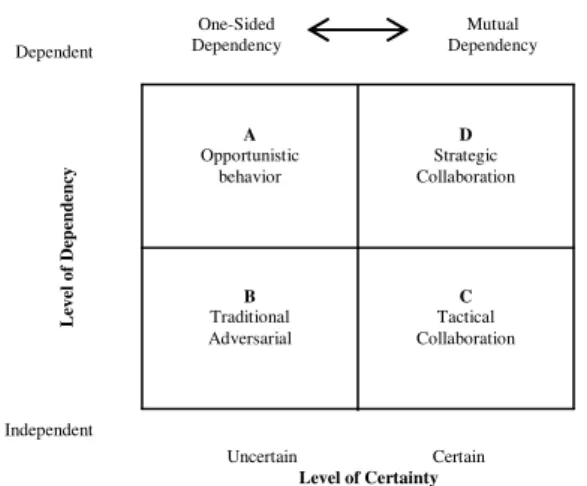
![Figure 2.3: A framework based on relational capital and relational connectedness for analyzing change in long-term social relationships (Adapted from Holling [1995] and Cousins [2002])](https://thumb-ap.123doks.com/thumbv2/pubpdfnet/10714144.0/41.892.175.663.490.809/framework-relational-relational-connectedness-analyzing-relationships-adapted-holling.webp)