THE ACADEMIC SELF-EFFICACY BELIEFS OF DISADVANTAGED GIFTED BLACK MIDDLE SCHOOL
STUDENTS IN THE NORTH WEST PROVINCE OF SOUTH AFRICA
SHADRACK KEITITh'IETSE SEMAKAl\""E B.A., B.ED.
Mini-dissertation submitted in partial fulfilment of the requirements for the degree
MAGISTER EDUCATIONIS
in
The Graduate School of Education in the Faculty of Education of the Potchefstroomse Universiteit vir Christelike Hoer Onderwys
SUPERVISOR: Prof. Dr. 1.L. De K. Monteith
POTCHEFSTROOM 1994
ACKNOlVLEDGEMENTS
I wish to express my sincerest gratitude to:
*
*
*
*
*
*
*
*
*
*
Professor J.L. De K. Monteith, my main supervisor, for his patience, understanding, commitment, unfailing and immeasurable guidance and advice. May God bless you.
The Old Mutual for partly supporting this research financially through the Old Mutual Project for the disadvantaged gifted student.
Professor H.S. Steyn, head of the Statistical Consultation Services, for his invaluable guidance and advice with the statistical analyses of the data.
Mrs. E. Mentz, for her unfailing preparedness, perseverance, patience and accuracy while performing the statistical analyses.
Professor Annette L. Combrink, head of the Department of English, for checking the language and editing the text.
Mrs. C.F. Rood, for her assistance with the bibliography layout.
Mrs. C. Postma, for formatting the text so neatly.
My late beloved and highly esteemed grandmother MMAPHIRI KGOMOTSO EMIL Y SEMAKANE. Thanks for love, comfort, moral support, encouragement and selfless sacrifice. Without you I shudder to contemplate how my life would be. I will always remember you with pride and dignity for you were and still are the wind beneath my wings.
My mother Ntobana and aunts Pampati, Sengaa, Nnani and Seeng, I love you all and am proud of you as you are of me. You gave me courage and motivation to climb the academic ladder even higher amidst multiple obstacles.
Mr Isaac Sipho Mfundisi, for his brotherly love, ceaseless inspiration and support.
*
*
*
*
*
*
My bosom and long time friend Shannon Bareng Molotsi, for his support, encouragement and being a friend through thick and thin at all times.
My dear wife MMAMOKGETHI. I was able to complete this piece of work because of your support and creation of a homely atmosphere conducive to studying. I love and cherish you.
My daughter OREFEMETSE. Though you kept calling for my attention while I was busy, I made it. Thank you for arriving while I was working on this project, I enjoyed your interrupting cries and together with this achievement you are a real bundle of joy.
My former colleagues and friends at Hebron College of Education, for making me believe in myself by your constant exhortations.
All the principals, teachers and pupils of the four Middle schools I used for this study. In particular, my friend MOLEFE MOLAPO who is a teacher at one of the four schools for collecting and delivering of data.
Above all, God the Almighty Father for life and good health throughout the years I was busy with this project.
SEMAKANE SHADRACK KEITUMETSE
Views expressed and conclusions reached in this study, are those of the author and should not be seen as those of Old Mutual or the Department of Education and Culture of the North West Province.
DECLARATION
I declare that The academic self-efficacy beliefs of disadvantaged black middle school students in the Nonh West Province of South Africa is my own work. It is being submittedfor the MAGISTER EDUCATlONIS degree to the PotcJzefstroom University for Christian Higher Education, Potchefstroom. It was not submitted before, for any
degree or examination in any other Universiry
SEMAKANE SHAD RACK KEITUMETSE MAY 1994
DEDICATION
In memory of my late beloved grandparents 1\1i.\lAPHffiI El\rllLY and KIBI DA VID SEMAKANE
TABLE OF CONTENTS
PAGE
ACKNOWLEDGEMENTS ... ...
iSUMMARY .... xiii
O~~OMMING
...•.•... ... Jriv
CHA~TERONE INTRODUCTION, STATEMENT OF THE PROBLEM AND OVERVIEW OF THE STUDy .. ,. .... ... 11.1 INTRODUCTION AND STATEMENT OF THE PROBLEM ... 1
1.2 AIM OF THE STUDY ... 3
1.3 RESEARCH HyPOTHESES ... 4
1.4 METHOD OF RESEARCH ... 4
1.4.1 Review of the literature ... 4
1.4.2 Empirical study ... 5
1.5 ORGANIZATION OF THE STUDy ... 5
CHA~TERTWO THE INFLUENCE OF SELF-EFFICACY ON LEARNING ... 6
2.1 2.2 2.3 2.4 2.4.1 2.4.1.1 2.4.1.2 2.4.1.3 INTRODUCTION ... 6
DEFINING SELF-EFFICACy ... 6
SELF-EFFICACY WITHIN THE CONTEXT OF MOTIVATION ... 8
SOURCES OF SELF-EFFICACy ... 10
Sources related to the learner ... 10
Enacti ve experiences ... 10
Vicarious experiences ... 11
Psychological state ... 12
2.4.1.4 2.4.2 2.4.2.1 2.4.2.2 2.4.2.3 2.4.2.4 2.4.2.5 2.4.2.6 2.5
Attributions ... 12
Sources related to the learning setting ... 13
Instructional events ... ·· ... 13
Task difficulty ... 14
Learning strategies ... 15
Performance feedback ... · .. · .. ··· .15
Persuasions ... '" ... 16
Goal setting ... 16
THE INFLUENCE OF SELF-EFFICACY ON ACADEMIC ACHIEVEi\IENT ... 17
2.5.1 The influence of self-efficacy on task choice ... 17
2.5.2 The influence of self-efficacy on persistence and effort expenditure ... 18
2.5.3 The influence of self-efficacy on choice of learning 2.5.4 2.5.4.1 2.5.4.2 2.5.4.3 2.6 strategies ... 18
The influence of self-efficacy on self-regulated learning ... 19
The relationship between self-efficacy and self-observation ... 19
The relationship between self-efficacy and self-judgement. ... 20
The relationship between self-efficacy and self-reaction ... 20
CONCLUSION ... 21
CHAPTER THREE
GIFTED STUDENTS ASD DISADVANTAGEDNESS ... 223.1 INTRODUCTION ... 22
3.2 DEFINITIONS OF GIFTEDNESS ... 22
3.2.1 The single-trait view of giftedness ... 23
3.2.2 The multi-trait view of giftedness ... 23
3.3 CHARACTERISTICS OF GIFTED STUDENTS ... 26
3.4 IDENTIFICATION OF GIFTED STUDENTS ... 31
3.4.1 Educational and psychological testing ... 31
3.4.2 Identification by teachers ... 33
3.4.3 Identification by parents ... 34
3.4.4 Identification by peers ... 34
3.4.5 Self-identification ... 34
3.5 CHARACTERISTICS OF DISADV ANT AGED GIFTED STUD ENTS ... 35
3.6 PROBLEMS WITH THE IDENTIFICATION OF DISADV ANT AGED GIFTED STUDENTS ... 39
3.6.1 Mediocre performance ... 39
3.6.2 Test bias ... 40
3.6.3 Identification by teachers ... .40
3.6.4 Bilingualism ... 40
3.7 CONCLUSION ... 41
CHAPTER FOUR
METHOD OF RESEARCH ... "' ... "'. "' ... 434.1 INTRODUCTION ... 43
4.2 AIM OF THE RESEARCH ... 43
4.3 EXPERIMENTAL DESIGN ... .43
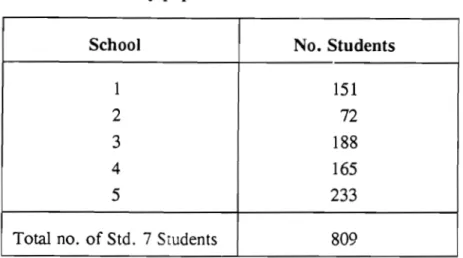
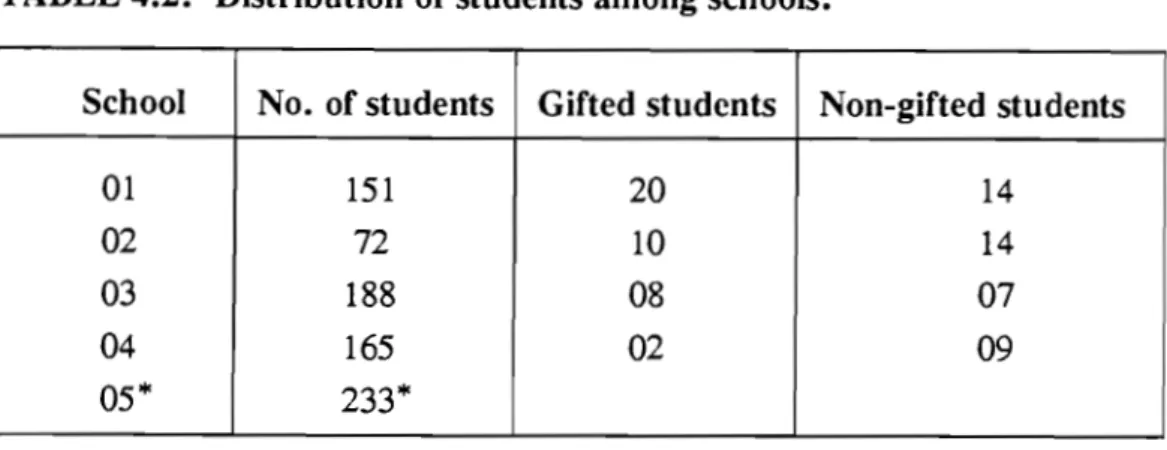
4.4 STUDY POPULATION AND IDENTIFICATION OF GIFTED STUDENTS ... 43
4.4.1 Study population ... .43
4.4.2 Identification of disadvantaged gifted students and disadvantaged non-gifted students as study sample ... 44
4.5 INSTRUMENTATION ... 45
4.5.1 Scales for Rating Behavioural Characteristics of Superior Students (SRBCSS) ... 45
\,
4.5.2 Self-Efficacy Questionnaire (SEQ) ... 46
4.5.3 Motivated Strategies for Learning Questionnaire (MSLQ) ... 50
4.5.4 Socio-Economic Status and Biographical Questionnaire ... 51
4.6 VARIABLES USED IN THE STUDY ... 52
4.6.1 Independent Variables ... 52
4.6.2 Dependent Variables ... 53
4.7 PROCEDURE ... 53
4.7.1 Identification of subjects ... 53
4.7.2 Administration of the tests ... 53
4.7.2.1 Self-Efficacy Questionnaire (SEQ) ... 53
4.7.2.2 Motivated Strategies for Learning Questionnaire (MSLQ) ... 54
4.7.2.3 Socio-Economic Status and Biographical Questionnaire ... 54
4.8 STATISTICAL TECHNIQUES ... 54
4.9 CONCLUSION ... 56
CHAPTER FIVE
STATISTICAL ANALYSES AND INTERPRETATION OF RESULTS ... 575.1 INTRODUCTION ... 57
5.2 HYPOTHESES ... 57
5.3 CATEGORIZATION OF THE VARIABLES USED IN THE STUDY ... 58
5.4 A COMPARISON BETWEEN DISADVANTAGED GIFTED STUDENTS AND DISADV ANT AGED NON-GIFTED STUDENTS ... 58
5.5 THE INFLUENCE OF THE INDEPENDENT VARIABLES ON THE ACADEMIC ACHIEVEMENT OF DISADVANTAGED GIFTED STUDENTS AND DISADV ANT AGED NON-GIFTED STUDENTS IN DIFFERENT SUBJECTS ... 62
5.5.1 Correlation coefficients with relation to academic achievement.. ... 62
5.5.2 The influence of the independent variables on achievement
in English ... 66
5.5.3 The influence of the independent variables on achievement in Mathematics ... 68
5.5.4 The influence of the independent variables on achievement in Science ... 70
5.5.5 The influence of the independent variables on achievement in Biology ... 72
5.5.6 Variables that make a statistical and educational significant contribution to achievement in the different subjects of disadvantaged gifted students and disadvantaged non-gifted students ... 74
5.6 THE INFLUENCE OF THE INDEPENDENT VARIABLES ON THE SELF-EFFICACY STRENGTH AND SELF-EFFICACY LEVEL OF DISADV ANT AGED GIFTED STUDENTS AND DISADV ANT AGED NON-GIFTED STUDENTS ... 75
5.6.1 Correlation coefficients with relation to self-efficacy beliefs ... 75
5.6.2 The influence of the independent variables on self-efficacy strength ... 76
5.6.3 The influence of the independent variables on the self-efficacy level ... 82
5. 7 CONCLUSION ... 84
CHAPTER SIX
SUMMARY AND CONCLUSION ... 866.1 INTRODUCTION ... 86
6.2 STATEMENT OF THE PROBLEM ... 86
6.3 REVIEW OF THE LITERATURE ... 87
6.3.1 Sources of self-efficacy ... 87
6.3.2 The influence of self-efficacy on learning ... 87
6.3.3 Gifted students and disadvantageness ... 88
6.4
6.4.1 6.4.2 6.4.2.1 6.4.2.2 6.4.2.3 6.4.2.46.5 6.6
6.6.1 6.6.2 6.6.36.7 6.8 6.9 6.10
METHOD OF RESEARCH ... 88
Subjects ... 88
Instruments ... 89
Scales for Rating Behavioural Characteristics of Superior Students (SRBCSS) ... 89
Self-Efficacy Questionnaire (SEQ) ... 89
Moti vated Strategies for Learning Questionnaire (MSLQ) ... 90
Sodo-Economic Status and Biographical Questionnaire ... 90
PROCEDURE ... 90
RESULTS ... 91
Hypothesis 1 ... 91
Hypothesis 2 ... 91
Hypothesis 3 ... 91
CONCLUSION ... 91
LIMITATIONS ... 91
RECOMMENDATIONS ... 92
CONCLUDING REMARKS ... 92
BIBLIOGRAPHy ... 93
APPENDIX A ... 1 03 APPENDIX B ... 1 09 APPENDIX
C ... ,. ... 144
APPENDIX D .... 150
LIST OF FIGURES
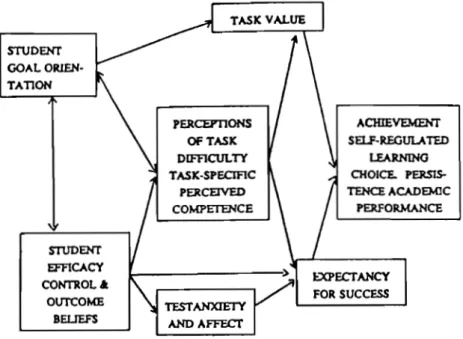
FIGURE 1: The general expectancy-value model of motivation ... 9LIST OF TABLES
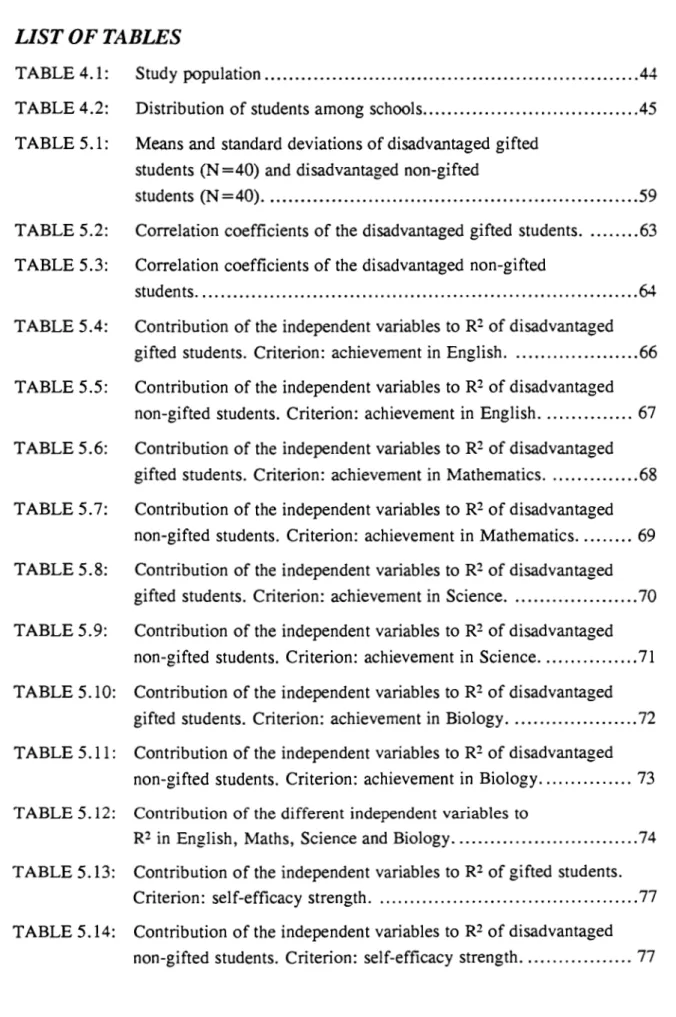
TABLE 4.1: Study population ... .44 TABLE 4.2: Distribution of students among schools ... 45 TABLE 5.1: Means and standard deviations of disadvantaged gifted
students (N =40) and disadvantaged non-gifted
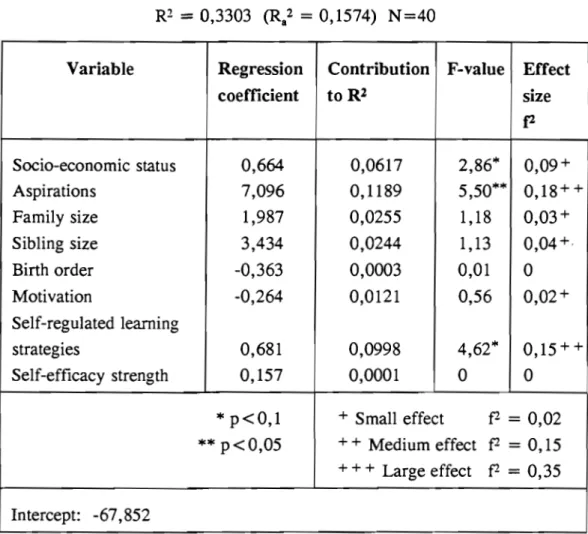
students (N =40) ... 59 TABLE 5.2: Correlation coefficients of the disadvantaged gifted students ... 63 TABLE 5.3: Correlation coefficients of the disadvantaged non-gifted
stud en ts ... 64 TABLE 5.4: Contribution of the independent variables to R2 of disadvantaged
gifted students. Criterion: achievement in English ... 66 TABLE 5.5: Contribution of the independent variables to R2 of disadvantaged
non-gifted students. Criterion: achievement in English ... 67 TABLE 5.6: Contribution of the independent variables to R2 of disadvantaged
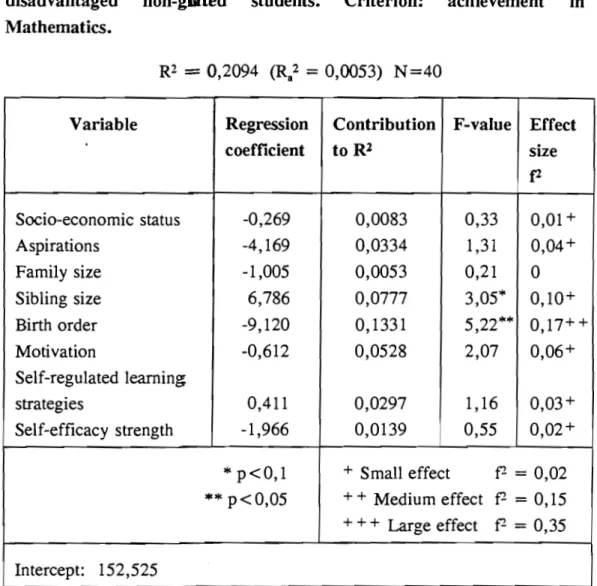
gifted students. Criterion: achievement in Mathematics ... 68 TABLE 5.7: Contribution of the independent variables to R2 of disadvantaged
non-gifted students. Criterion: achievement in Mathematics ... 69 TABLE 5.8: Contribution of the independent variables to R2 of disadvantaged
gifted students. Criterion: achievement in Science ... 70 TABLE 5.9: Contribution of the independent variables to R2 of disadvantaged
non-gifted students. Criterion: achievement in Science ... 71 TABLE 5.10: Contribution of the independent variables to R2 of disadvantaged
gifted students. Criterion: achievement in Biology ... 72 TABLE 5.11: Contribution of the independent variables to R2 of disadvantaged
non-gifted students. Criterion: achievement in Biology ... 73 TABLE 5.12: Contribution of the different independent variables to
R2 in English, Maths, Science and Biology ... 74 TABLE 5.13: Contribution of the independent variables to R2 of gifted students.
Criterion: self-efficacy strength ... 77 TABLE 5.14: Contribution of the independent variables to R2 of disadvantaged
non-gifted students. Criterion: self-efficacy strength ... 77
TABLE 5. 15: Average self-efficacy strength per level of self-regulated
learning strategies for disadvantaged gifted students ... 78 TABLE 5. 16: A verage self-efficacy strength per level of cognitive strategy
use for disadvantaged gifted students ... 80 TABLE 5.17: Average self-efficacy strength per level of cognitive strategy
use for disadvantaged non-gifted students ... 80 TABLE 5.18: Average self-efficacy strength per level of self-regulation
for disadvantaged gifted students ... 81 TABLE 5.19: Contribution of the independent variables to R2 of disadvantaged
gifted students. Criterion: self-efficacy level. ... 82 TABLE 5.20: Contribution of the independent variables to R2 of disadvantaged
non-gifted students. Criterion: self-efficacy leveL ... 83
SUMMARY
THE ACADEMIC SELF-EFFICACY BELIEFS OF DISADVANTAGED GIFIED BLACK MIDDLE SCHOOL STUDENTS IN THE NORTH WEST PROVINCE OF SOUTH AFRICA
The purpose of this study was to determine, by means of a review of the literature and an empirical investigation, the influence of certain variables on the academic achievement and the self-efficacy beliefs of disadvantaged gifted students.
From the review of the literature it was concluded that self-efficacy beliefs influence academic achievement. Students with a high sense of self-efficacy for accomplishing a task participate more eagerly in a learning task, work harder, persist longer and achieve at a higher level than those who doubt their capabilities. Students with a high sense of self-efficacy are more self-regulated than those with a low sense of self- efficacy.
It was concluded from the review of literature that disadvantaged gifted students perform lower than their potential due to various social and environmental factors.
Disadvantaged gifted students are characterized by under-achievement, lack of general motivation to learn, parents with a low level of education, teachers who lack appreciation, poor socio-economic background, academic skills deficit, low self- esteem, rebellious attitude, lower expectations, and avoidance behaviours.
Disadvantaged gifted students are very often not selected through the methods used for the identification of gifted students. This is because when those methods are used, the language, cultural and home background of the disadvantaged gifted students are not taken into consideration when results are interpreted.
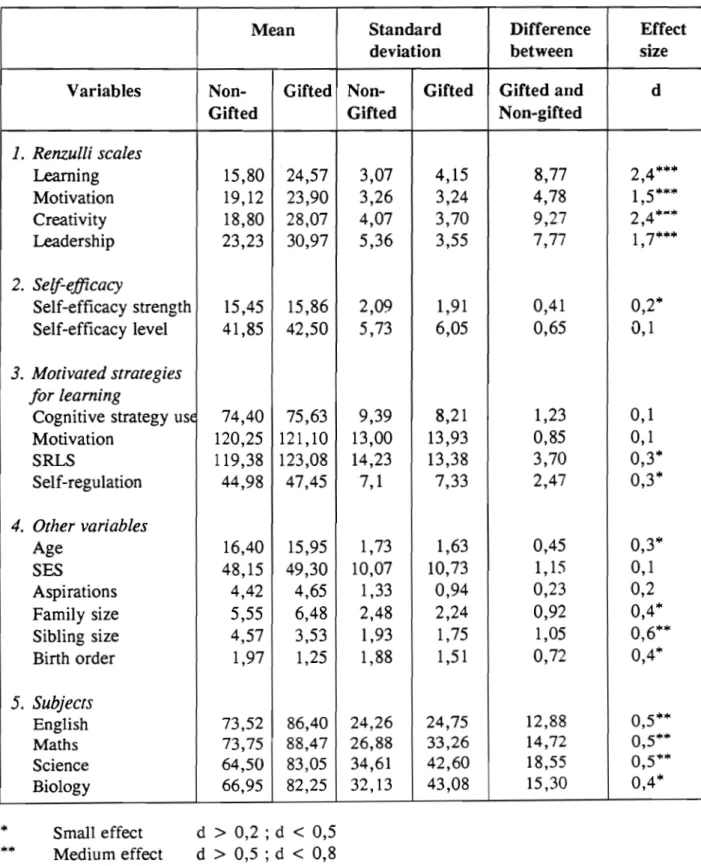
By means of an empirical investigation it could be concluded that there is a difference between disadvantaged gifted students and disadvantaged non-gifted students with relation to certain variables. The hypothesis that there is a relationship between certain variables and the academic achievement of disadvantaged gifted students and disadvantaged non-gifted students could be accepted. The hypothesis that there is a relationship between certain variables and the academic self-efficacy beliefs of disadvantaged gifted students could also be accepted.
OPSOMMING
Die doel van hierdie studie was om, deur middel van 'n literatuuroorsig en 'n empiriese studie, te bepaal of sekere veranderlikes 'n invloed het op akademiese prestasie en oortuiging van die eie self-doeltreffendheid van minderbevoorregte begaafde leerlinge.
Vit die literatuuroorsig het dit geblyk dat oortuiging van self-doeltreffendheid akademiese prestasie bernvloed. Leerlinge met 'n hoe mate van oortuiging van hulle self-doeltreffendheid neem met meer graagte deel aan 'n taak, werk harder, hou langer aan en presteer op 'n hoer vlak as diegene wat twyfel aan hulle eie vermoens.
Leerlinge met 'n hoe vlak van self-doeltreffendheid is meer self-regulerend as diegene met 'n lae vlak.
Dit kon uit die literatuuroorsig afgelei word dat minderbevoorregte begaafde leerlinge laer as hulle potensiaal presteer as gevolg van 'n verskeidenheid sosiale en omgewingsfaktore. Hierdie leerlinge word gekenmerk deur onder-prestasie, 'n gebrek aan algemene motivering om te leer, ouers met 'n lae onderwyspeil, onderwysers wat hulle nie verstaan nie, swak sosio-ekonomiese agtergronde, 'n gebrek aan akademiese vaardighede, lae selfbeeld, rebel se houding, laer verwagtinge en vermydingsgedrag. Sulke leerlinge word dikwels nie raakgesien en gerdentifiseer deur die metodes wat algemeen gebruik word vir die identifikasie van begaafde leerlinge nie, omdat in die metodes wat gebruik word die taal, kulturele en huislikeagtergrond van hierdie leerlinge nie in berekening gebring word wanneer die resultate bekyk word nie.
Deur die empiriese ondersoek kon vasgestel word dat daar wel 'n verskil is tussen minderbevoorregte begaafde leerlinge en minderbevoorregte nie-begaafde leerlinge.
Die eerste hipotese, naamlik dat daar so 'n verskil is, kon dus aanvaar word. Die hipotese dat daar 'n verband is tussen sekere veranderlikes en die akademiese prestasie van minderbevoorregte begaafde en nie-begaafde leerlinge kon ook aanvaar word.
Die derde hipotese, naamlik dat daar 'n verband is tussen sekere veranderlikes en die geloof in die eie akademiese self-doeltreffendheid van minderbevoorregte begaafde leerlinge kon ook aanvaar word.
CHAPTER ONE
INTRODUCTION, STATEMENT OF THE PROBLEM AND OVERVIEW OF THE STUDY
1.1 INTRODUCTION ASD STATEMENT OF THE PROBLEM
Every child is born with certain potentialities and capabilities. It is very important that these potentialities and capabilities be nurtured and developed, through education, to come to fruition by and within the child's environment (Kokot, 1992:43). This will enable the child not only to develop to his full potential but also make a meaningful contribution to the development and improvement of his community in all respects (i.e. economically, politically and socially (Holmes. 1985:7). Furthermore, this potential is a God-given gift and God expects this gift to unfold under the influence and guidance of a supportive environment (Olivier, 1985: 105; Schoeman, 1985: 111).
Not all children, however, are born with the same potentialities. Some have superior potential while others have less potential (Schoeman, 1985: 112).
Children with high potential or exceptional talent are described as gifted (Olivier, 1985: 105) while those with less potential are described as non-gifted.
In order for the child's potential to develop fully the environment in which he grows up must be suitably conducive, Le. the environment must be stimulating enough to enable the child to be shaped and developed to his maximum potential (Borland, 1989: 16). The environments that are not suitably conducive, thus hindering the development of the child's potential, are referred to as disadvantaged environments (Kokot, 1992: 172). Children growing up in such environments cannot develop their potential to the full and are said to be disadvantaged (Passow, 1986: 149). As Kokot (1992:39) puts it, if the interaction between the child and the environment is not planned and left to occur by chance, the child's potential will be restricted.
As the majority of South Africans (Le. blacks) live in poor socio-economic environments with an alarmingly large number of the population, especially the black population, either unemployed or earning low wages (Harker,
1991: 12), the typical environment of the black child can be classified as disadvantaged.
A question that arises is how the academic achievement of the black child from a disadvantaged environment is influenced by his disadvantaged environment. The question also arises as to how such an environment influences the academic achievement of the disadvantaged gifted child and how such an environment influences disadvantaged students' self-efficacy beliefs. This study therefore addresses the following questions:
*
*
What is the academic self-efficacy level of disadvantaged gifted students?
Does being disadvantaged have an effect on the academic self-efficacy of gifted students?
Self-efficacy refers to personal judgements of one's capability to organize and implement actions necessary to attain designated levels of performance in a specific situation that may contain novel, unpredictable and possibly stressful features (Schunk, 1985:208; Schunk, 1989: 13). Self-efficacy judgements are considered to be relevant to students' academic achievement because they have motivational effects (Norwich, 1987:384).
Roach and Bell (1989:67) describe a gifted student as a student who has superior capabilities or potential for learning. It is a student who shows exceptional ability, combined with outstanding academic achievement and exceptional talent in one or more areas (Congdon, 1985: 111).
According to Passow (1986: 149) the term "disadvantaged" represents a melding of two concepts, namely: (i) economic disadvantage, which is operationally defined in terms of poverty, and (ii) educational disadvantage, which is operationally defined in terms of below average academic achievement. Therefore the term "disadvantaged" is commonly used in the United States of America to include both racial and ethnic minorities and the poverty-stricken. From this it can be assumed that in the United States of America "minority" means exactly what it says since the United States of America's black student is a member of the minority groups. However, in South Africa the black student is a member of the (politically marginalized) majority group but has the same characteristics, such as economic and
educational disadvantageness, that a minority student in the United States of America has.
Existing literature points out that the most commonly overlooked gifted under- achievers are the disadvantaged students from low socio-economic backgrounds and that there is widespread misunderstanding of disadvantaged gifted students (Roach & Bell, 1989:67). This is a pathetic state of affairs because the gifted student who is under-achieving or who is not identified and catered for timeously and properly is not only wasted as an individual but is lost for the nation as well (Roach & Bell, 1989:68). One of the reasons why gifted students from low socio-economic backgrounds are overlooked and often not included in programs for gifted students is that test instruments and other identification methods are culturally biased (Davis & Rimm, 1989:283).
This suggests that relatively little is known about many aspects of the disadvantaged gifted students' achievement behaviours.
It is a well-known fact, which causes great concern, that the majority of disadvantaged students, mainly blacks in South Africa perform below average and have higher failure and dropout rates than whites (Harker, 1991:28). This, as Parke (1989: 12) puts it, does not mean there are no gifted students among black disadvantaged communities who could be obtaining several A's in their final-year examinations, because every community, no matter its composition, has gifted children. Therefore the reasons for the below average and mediocre performance of the disadvantaged gifted students have to be sought and their motivational level be investigated so that ways and means of helping them perform according to their capability be found.
The above scenario prompted the investigator to carry out this research along the lines of acceptable scientific methods of investigation in an attempt to furnish answers to the questions.
1.2 AIM OF THE STUDY
The aim of this research was to determine the influence of certain variables on the academic achievement and academic self-efficacy beliefs of disadvantaged gifted students by finding answers to the above-mentioned questions. Finding answers to the above-mentioned questions was regarded as essential by the investigator in order to contribute to a sound understanding of
the disadvantaged black students' achievement behaviours which in turn would lead to an improved development of their potential and skills.
1.3 RESEARCH HYPOTHESES
This study tested the following three hypotheses:
1. There is a difference between disadvantaged gifted students and disadvantaged non-gifted students with regard to certain variables.
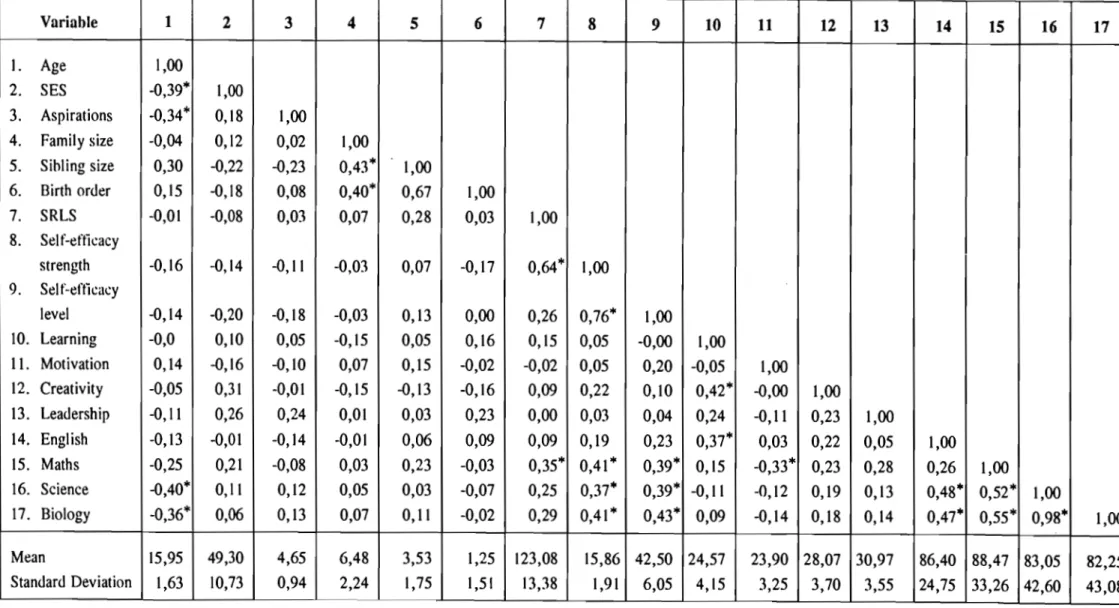
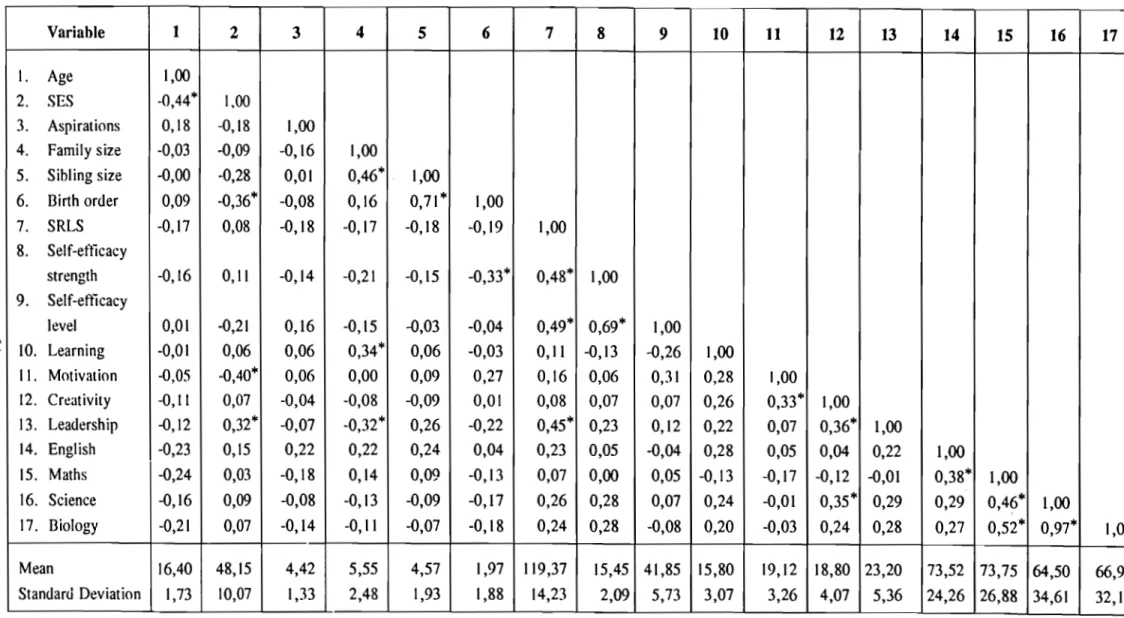
2. There is a relationship between certain variables and the academic achievement of, respectively, disadvantaged gifted students and disadvantaged non-gifted students.
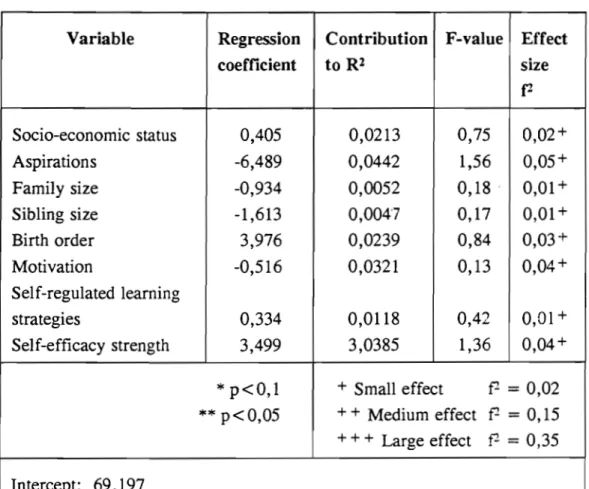
3. There is a relationship between certain variables and the academic self-efficacy beliefs of disadvantaged gifted students.
1.4 METHOD OF RESEARCH
The method of research for this study consisted of a review of the literature and an empirical investigation.
1.4.1 Review of the literature
Literature related to the problem questions was reviewed. Use was made of journals, bulletins, periodicals, books and theses that dealt with aspects of the problem. A DIALOG-search was performed with the following keywords:
*
self-efficacy,*
academic achievement,*
gifted student,*
economically and educationally disadvantaged student.The review of the literature obtained through the use of the above keywords is discussed in chapters 2 and 3.
· 1.4.2 Empilica/ study
To test hypothesis (par. 1.3) disadvantaged gifted students and disadvantaged non-gifted students were compared on the basis of the variables mentioned in paragraph 4.6. This was done by comparing their means and standard deviations (see Table 5.1).
To test hypothesis 2 (par. 1.3) correlation coefficients were first calculated, following which multiple regression analysis was used to determine the collective and separate influence of the independent variables on the achievement in English, Maths, Science and Biology with relation to both the disadvantaged gifted stUdents and the disadvantaged non-gifted students.
To test hypothesis 3 (par. 1.3) correlation coefficients were first calculated, following which multiple regression analysis was used to determine the collective and separate influence of the independent variables on the self- efficacy strength with relation to both groups of students.
1.5 ORGANIZATION OF THE STUDY
As already stated in paragraph 1.2, the aim of this study was to determine the influence of certain variables on the academic achievement and self-efficacy beliefs of disadvantaged gifted black middle school students. In order to achieve this aim a review of the literature on self-efficacy was made and this is reflected concisely in Chapter 2. It was also very essential to explore giftedness and disad\<antageness and this became the core of Chapter 3. In Chapter 4 the methodological procedures adopted to determine the int1uence of certain variables on the academic self-efficacy beliefs and the academic achievement of disad\<antaged gifted students are described. In Chapter 4 the population, sample, instruments and their administration are discussed.
Chapter 5 presents the statistical analyses and interpretation of the results.
Hypotheses are either accepted or rejected in Chapter 5. In Chapter 6 the summary of the study is given as well as the implications, limitations and recommendations.
CHAPTER TWO
THE INFLUENCE OF SELF-EFFICACY ON LEARNING
2.1 INTRODUCTION--:.:;;.
Bandura (1986:390) maintains that among the different aspects of self-knowledge, perhaps none are more influential in people's everyday lives than conceptions of their personal self-efficacy. Research conducted from a number of perspectives with a variety of labels and various theoretical traditions led to the growing conviction that personal expectations influence achievement behaviours such as choice of tasks, persistence and effort expenditure (Schunk, 1989: 16).
This chapter examines the concept "self-efficacy". The central idea in this chapter is that self-efficacy is an important variable in understanding pupils' achievement motivation and motivated learning (Schunk, 1985:208;
McCombs, 1988: 142; Pintrich, 1989: 125). First the term "self-efficacy" will be defined. Second, because self-efficacy is postulated to have motivational effects on the learners' achievement behaviours, self-efficacy will be discussed within the context of motivation (Schunk, 1981 :93). Third, various sources of self-efficacy will be discussed, as Bandura (1986:399) stated that people come to know their level of self-efficacy from various sources in a given activity. Finally, the influence of self-efficacy on learning will be explained, since performance outcomes as well as achievement behaviours are strongly influenced by an individual's self-efficacy perceptions (Bandura,
1986:393).
2.2 DEFINING SELF-EFFICACY
A review of literature reveals the following definitions of self-efficacy:
Bandura (1986:391) defines self-efficacy as people's judgements of their capabilities to organize and execute courses of action required to attain designated levels of performance. According to Bandura (1986:391)
self-efficacy is not concerned with the skills that one has but with one's judgements of what one can do with one's skills.
Schunk (1984:48) and Zimmerman (1989:329), in similar vein, define self-efficacy as personal judgements of performance capabilities in a given domain of activity that may contain novel, unpredictable and possibly stressful features. Schunk (1989:14) extends this definition by saying that self-efficacy for learning refers to students' beHefs about their capabilities to apply effectively the knowledge and skills they already possess and thereby learn new cognitive skills.
An analysis of these definitions reveals that the term "self-efficacy" refers to
"a belief in one's capabilities to carry out a task successfully". The central idea of self-efficacy therefore, is the conviction and confidence that one is capable to accomplish a learning task.
One other striking feature of these definitions is that the skills that one already possesses are not the focal point of self-efficacy, but rather one's judgement of what one can do with those skills successfully (Bandura, 1986:391). That is, one may have the necessary skills but if one is not adequately self-efficacious one may not accomplish the task (Bandura, 1986:391),
According to Schunk (1984:48) and Bandura (1982, quoted by Pintrich, 1989: 125) self-efficacy is situation-bound or domain-specific. That is, one feels more or less self-efficacious about a specific task and in a specific situation. This implies that if one feels less or more self-efficacious about a task in a particular situation it does not necessarily mean that one will feel the same about other tasks on other situations. For example, if a student feels more self-efficacious about accomplishing Maths or English tasks this does not mean he will feel the same about accomplishing Biology tasks.
Self-efficacy also denotes effort on the part of an individual. Bandura (1982, quoted by Schunk, 1989:21) states that individuals who are self-efficacious or feel confident that they are capable of performing a task successfully would take all the necessary pains to organise all courses necessary to attain higher levels of performance. This suggests that attainment of success depends on one's efforts.
Self-efficacy not only affects effort expenditure but also task persistence (Bandura, 1977a, quoted by Schunk, 1984:48). Individuals who hold a high sense of efficacy work harder and persist longer than those who doubt their capabilities, more especially when facing difficulties (Schunk, 1989:21).
For the purpose of this dissertation, the term "self-efficacy" will be understood, in accordance with the view of Bandura (1986:391) and Schunk (1984:48), to indicate the learners' personal judgements of their capabilities to execute learning tasks successfully at certain levels of performance even in the face of difficulties.
2.3 SELF-EFFICACY WITHIN THE CONTEXT OF kfOTIVATION
Motivation to learn can be defined as the degree to which learners exert effort to achieve academic goals that they perceive as being meaningful and worthwhile (Johnson & Johnson, 1984:250). It is because of motivation that a specific activity is chosen by an individual, and the longer an individual persists with a task depends on the intensity of the motivation she or he has (Maehr, 1984: 118). McCombs (1988: 142) believes that continuing motivation to learn results from the learner's judgement of self-efficacy and self-control in learning situations.
The preceding viev,rpoints on motivation give a clear indication that self-efficacy is embedded in motivation and is inextricably related to motivation. People who doubt their capability tend to give up easily when confronted with difficulties in executing tasks while those with a high sense of self-efficacy exert greater effort when they experience difficulties (Bandura, 1986:293).
Pintrich (1989: 120) describes the inextricable relationship between motivation and self-efficacy through his version of the general expectancy-value model of motivation. Figure 1 displays this version in which interactions among different motivational variables are clearly indicated (Pintrich, 1988:75). This version of the general expectancy-value model of motivation has two general paths, namely the expectancy path and the value path. In the expectancy path the following motivational constructs are included:
*
*
*
*
*
expectancies,
perceived competence, test anxiety,
perceptions of task difficulty,
students' beliefs about self-efficacy, control and outcome.
The interaction among these motivational constructs leads to achievement. The students' confidence that they will succeed is the basic outcome of the expectancy path (Pintrich, 1989: 125-126). The higher the level of self-efficacy the longer the persistence expended on the task (Pintrich, 1988:75). This indicates clearly that self-efficacy and motivation are inextricably bound because a highly motivated person does not give up easily in the face of aversive experiences (Maehr, 1984: 119).
STUDENt' CiOAL ORIEN- TATION
El'FlCACY COmltOL.l
OUTCOME BEtJE:fS
PERCEPTIONS OF TASK DIFFlCULTY
AN'DAFFECT
ACHIEVEMENT SELF· REGULATED
LEARNING CHOICE.. PERSIS- TENCE ACADEMIC
PERFORMANCE
FOR SUCCESS
FIGURE 1: The general expectancy-value model of motivation
The task-value path is the second path of the general expectancy-value model. In this path there are task-value and student-goal components which interact to produce achievement. The task-value component has interest, importance and utility values (Pintrich, 1988:76). Interest value denotes the students' inherent interest in the task, i.e. the students' enjoyment of the task
(Mckeachie, Pintrich & Smith, 1986:83) and importance value has to do with the students' understanding of the task's importance to their goals while utility value denotes the students' perception of the usefulness of the task to attain a goal (Pintrich, 1989: 122-123 & Mckeachie, et al., 1986:83-84). The student ~
goal component includes both short term and long term goals that students set for themselves (Pintrich, 1988:76). The goals enable students to understand the aspects in the task value component. There is an interaction between self-efficacy and students' goal orientation. For example, a student who wants to become an accountant (goal) must feel adequately self-efficacious in studying Accountancy because it is a required (utility value) course in the field of accounting. The value and the expectancy components of the general expectancy-value model of motivation, therefore, interact to determine the students' achievement behaviours and students' perceptions about themselves, i.e. self-efficacy also features in their interaction (Pintrich, 1989: 120).
2.4 SOURCES OF SELF-EFFICACY -
It is postulated by Bandura (1986:399) that knowledge about one's self-efficacy, whether accurate or faulty, is based on some sources. These sources of information, together with the underlying processes and skills, contribute to the development of one's judgements of self-efficacy (McCombs, 1988: 144). The subsequent section will focus on the various ways in which students acquire information about their level of self-efficacy.
Sources of self-efficacy can be differentiated in sources related to the learner and sources related to the learning setting.
2.4.1 Sources related to the learner
2.4.1.1 Enactive experiences
Enactive experiences refer to performance outcomes resulting from one's own actions (Schunk, in press; Schunk, 1991 :87). Consequences of one's own actions are important and very influential indicators to students of their
self-efficacy.
Students who generally experience success usually have their self-efficacy level raised while those who fail repeatedly will generally have a lower
self-efficacy level (Schunk, 1988:6). This, however, does not mean that an occasional success after a series of failures suddenly raises the self-efficacy level, or an occasional failure after many successes would lower self-efficacy (Schunk, 1989:24).
The extent to which people may have their self-efficacy perceptions changed on the basis of their enactive experiences depends on variables such as the amount of effort they expended, the difficulty of the task, amount of outside help they received and patterns of their success and failure (Bandura, 1986:401). Success at an easy task after working hard does not raise an individual's self-efficacy level, while on the other hand mastering a difficult task through minimal effort leads to a higher sense of self-efficacy (Bandura, 1986:402). Similarly, a person who attains success after help by other people will not have his self-efficacy level raised because this success will be ascribed to external factors rather than to personal capabilities (Schunk,
1985:210).
With regard to effort expenditure Nicholls (1984:47) stated that people tend to view effort as inversely related to capabilities, which suggests that when an individual attains success with less effort on a difficult task it shows that he has high ability. Conversely, success attained through hard labour signifies low ability more especially if the task was not considered difficult (Bandura, 1986:402).
The rate and pattern at and in which students reach their attainment also serve as indicators of their personal self-efficacy (Bandura, 1986:402). In the early stages of learning there are a number of failures and setbacks, but if learners can perceive progress this can promote their sense of self-efficacy for further improvement (Schunk, 1985:215). Students who experience periodic failures but continue to improve over time are likely to have their self-efficacy level raised more than those who succeed but realize that their performances are lower as compared to their prior rate of improvement (Bandura, 1986:402).
2.4.1.2 Vicarious experiences
Vicarious experiences refer to observing other people perform tasks successfully, more especially people who are similar to the observer (Bandura, 1986:399). An observer who sees other similar people perform tasks
successfully can have his or her perceptions of self-efficacy improved because this conveys to the observer information that he or she possesses the same capabilities to accomplish the tasks as well (Schunk, 1985:215).
In school, students frequently compare their performances with those of their classmates or peers and the successes of their classmates or peers on tasks convey to them information that they too have the capability to succeed (Schunk, 1985:213). This peer observation is a reliable source of self-efficacy to students because the observed peer might be similar in perhaps, age, gender, ethnicity or socio-economic status (Schunk, 1989:24), Observers also benefit a lot more with regard to self-efficacy information when they see others complete difficult tasks by determined effort than from those who accomplish easy tasks (Bandura, 1986:404). When an observed person attains success after much effort has been expended, this indicates to the observer that perseverance eventually brings success. Therefore, even jf the observer can struggle at the initial stages of a task, he will persist, for he believes that he is capable. This, according to Bandura (1986:404), helps to create the cognitive set in the observer that failures reflect insufficient effort rather than lack of ability.
2.4.1.3 Psychological state
The emotional experiences that one goes through while busy with a task or approaching a task enable one to judge one's capabilities (Bandura, 1986:401).
Emotional reactions such as trembling and sweating while students are engaging in a task or just before tackling a learning task is an indication that one does not consider oneself to be capable or self-efficacious (Schunk, 1988:8). A student who is calm while busy with a learning task feels efficacious about continuing to learn.
2.4.1.4 Attributions
Following the attribution theory, individuals make causal ascriptions for the outcomes of their actions; that is, they would like to discover why an event has had particular outcomes (Weiner, 1984: 19).
Personal outcomes are very often, therefore, attributed to causes such as ability, effort, task difficulty and luck (Schunk, 1989:24). These attributions affect self-efficacy perceptions either positively or negatively. When an individual attributes success to stable factors such as aptitude, ability and other personal traits, he is likely to have a sense of high self-efficacy (Weiner,
1986:229). Conversely, when an individual attributes failure to stable factors such as aptitude, ability and personal traits, he will have a sense of low self-efficacy (Schunk, 1989:24),
Attributions of success to unstable factors such as luck, an easy task and higher effort do not produce a high sense of self-efficacy because these factors that contribute to the success might not be there when the next learning task is tackled (Weiner, 1984:25). Although attributions of failure to stable and unstable factors both lead to feelings of low self-efficacy, attributions of failure to stable factors have a more negative effect on self-efficacy than attributions to unstable factors (Weiner, 1986:230). This is because unstable but controllable factors such as low effort, resulting in failure, can make an individual have expectations for success in future if he doubles his efforts (Schunk, 1985:216).
The amount of effort that is necessary to accomplish a task successfully also has an effect on an individual's self-efficacy perceptions. If the task is perceived as being moderate in difficulty, success with it after a lot of effort has been expended will not raise self-efficacy more than if less effort was expended (Schunk, 1989:24). Similarly, if the task is considered highly difficult, success after less effort has been expended will raise self-efficacy more than if more effort had been expended (Schunk, 1985:216). Conversely, if one fails after much effort has been expended one will feel less efficacious than when failure follows minimal effort. (Schunk, 1985 :216).
2.4.2 Sources related to the learning setting
2.4.2.1 Instructional events
Instructional events can be understood to refer to the teacher's explanations, demonstrations and reteaching, along with students' learning activities in the teaching-learning situation (Schunk, 1988:8). Indication of the purpose of
instruction, the way in which the learning task is presented to the students, the context of the learning task and the extent to which students actively participate in the lesson all have an influence on the students' self-efficacy.
A teacher who tells his students at the beginning of the lesson that the learning material dealt with will be covered in the test will make pupils who previously performed successfully in tests feel more efficacious than those who failed previous tests (Schunk, 1988:8). This is because students who succeeded previously believe in their capability to pass tests while those who failed feel that they are not good at tests.
Teachers who present and explain the learning material in such a way that the pupils understand readily make their students feel more efficacious about learning than students whose teachers do not facilitate their understanding (Schunk, 1985 :214). The use of a variety of instructional approaches such as practice, review, co-operative learning settings, peer modelling and dramatization amplifies opportunities for students to attain success, which in turn leads to a higher sense of self-efficacy.
Schunk (1988:9) states that instructional events also include a variety of variables such as the setting of the classroom, the instructional format, learning material and equipment used. Students' beliefs of how successful they can be when learning under these conditions can influence their self-efficacy_
Some students feel more self-efficacious for learning when they study alone while others feel more self-efficacious when they work with others on a learning task. This suggests that in a teaching-learning situation, if cognizance is taken of individual differences, students will frequently experience success - hence a sense of higher self-efficacy. Some students understand better when the learning task is presented through the use of teaching aids while others may benefit maximally even without the use of teaching aids.
2.4.2.2 Task diffiCUlty
The perceived difficulty or ease of the learning task also provides a basis for self-efficacy judgements. These judgements are made through attributional inferences on the performance outcome (Weiner, 1986:47) (also see par.
2.4.1.4).
Another variable that is very important with regard to task difficulty is the cognitive processing required by the material presented to the student.
According to Schunk (1985:211), for any learning event to succeed, there has to be an interaction between instructional events and the following cognitive processes: attending, coding, associating, rehearsing and monitoring. If a student encounters difficulties in cognitively processing information, this may lead to feelings of low self-efficacy because this denotes low ability (Nicholls, 1984:48). A student who carries out these cognitive processes successfully is likely to feel highly self-efficacious because ability is denoted by this success (Schunk, 1989: 14).
2.4.2.3 Learning strategies
A learning strategy is a sequence of procedures employed by the student to accomplish learning (Schmeck, 1988:5). In accordance with Mayer (1988: 11), knowledge and effective application of learning strategies positively influence the process and outcome of learning. It is this outcome that in turn influences the learner's perceptions of his level of self-efficacy. If the student believes that he understands the learning strategy and can apply it effectively this can lead to a greater sense of control over learning outcomes which in turn promotes feelings of self-efficacy (Schunk, 1988: 10). On the contrary, a student who does not believe that he can apply a learning strategy effectively is likely to feel less efficacious due to a sense of lack of control over learning outcomes. Furthermore, one may also assume from the attributional point of view that effective strategy training leads to the attainment of higher levels of performance attributable to ability which in turn gives rise to a high sense of self-efficacy.
2.4.2.4 Perfonnance feedback
In every teaching-learning situation students require teacher feedback so that they can know whether they are making progress or not. It is this feedback that informs students about their capability with regard to the learning material (Schunk, 1985:215). A teacher'S positive and encouraging remarks on the progress of the student (e.g. "That's good" and "You can still do far better than this") makes him feel more efficacious and this sustains motivation for learning. Conversely, a student who receives negative and discouraging
remarks is likely to believe that he is less capable, and will thus have feelings of lower self-efficacy.
2.4.2.5 Persuasions
In learning contexts and elsewhere, persuasions are used to convince people to believe that they are capable to achieve what they want (Bandura, 1986:400).
These persuasions have an effect on people's perceptions of self-efficacy. If a student is told by the teacher who is regarded as credible that he is capable, the student's self-efficacy will be raised. This is because the teacher knows the student and understands the nature and the demands of the task that the student has to perform (Bandura, 1986:406). It is the persuader's credibility and trustworthiness that convince the student that he is capable (Schunk, 1985:213). Because of these persuasions an individual will work harder, and hence improve his skills - which in turn will lead to higher performance. It is this higher level of performance that leads to a higher sense of self-efficacy (Bandura, 1986:400).
2.4.2.6 Goal setting
When students have set themselves or are given goals for learning. they may experience a sense of self-efficacy when they attain these goals (Schunk, 1985: 217). Goals exert their effect on self-efficacy through their specificity, difficulty level and proximity (Schunk, 1988: 13).
Specific goals raise self-efficacy more than general goals because progress towards an explicit goal is easier to gauge and working towards a specific goal leads to heightened motivation (Schunk, in press). When specific goals have been set there is a greater specification of the amount of effort required for success and this leads to boosted task performance. Clear, attainable goals produce higher levels of performance and it is this higher performance that indicates to the learner that he is capable, which leads to a sense of high self-efficacy (Bandura, 1986:472).
How much effort learners expend to attain a goal depends on the level at which it is set and the more challenging the goal the more the effort expended (Schunk, 1985:217). Bandura (1986:472-473) postulates that in situations
2.5
where one has control over activities, and when one sets oneself higher goals one's performance level improves. A learner who attains higher performances while perceiving that the goal was difficult and challenging will have his self-efficacy level raised more than the one who attained an easier goal (Schunk, in press).
Proximity of goals refers to how far goals project into the future and as Schunk (in press) puts it, proximal goals enhance achievement behaviours better than distal goals. A learner who strives to attain a goal that is at hand has more heightened motivation than the one who works towards the attainment of a distal goal or with no goal at all. This suggests that learners are sure of success if goals they want to achieve are proximal. One might infer that this is so because progress towards a proximal goal is easier to gauge than progress towards more distal goals.
THE INFLUENCE OF SELF-EFFICACY ON ACADEj~lIC ~
ACHIEVEAfENT
According to Schmeck (1988:317) learning has been traditionally defined as the effecting of relatively permanent changes in behaviour. This means that due to learning a student's reaction to any educational stimulus should be observably permanent once learning has occurred. There are a variety of partially agreeing definitions of learning by different psychologists who, nevertheless, generally agree that learning involves a change or modification of existing patterns of behaviour (Behr, 1988:45). This change in behaviour will have some influence on future performance. Zimmerman (1989:331) asserts that students' self-efficacy perceptions are closely related to the tasks they are engaged in as well as their performance levels. An inference can be made that self-efficacy infl uences students' learning activities.
2.5.1 The influence of self-efficacy 011 task choice
Every learning situation is characterised by students' decisions about courses of action to pursue and how long they have to continue with what they have undertaken to do (Bandura, 1986:393). In a teaching-learning situation, when students are presented with tasks and are given an option to choose, those who hold a low sense of self-efficacy for accomplishing a task may attempt to
avoid it, whereas those who believe that they are capable of accomplishing it will participate more eagerly (Schunk, 1988:4). This apparent choice among a set of action possibilities is the first indication of motivation. A student may have the necessary skills for mastering a task but if he does not perceive himself as capable of actually using those skills to master the task, he may fail or may not even attempt the task (Miller, 1989:234). Choosing a task and continuing with it depends on an individual's perceptions of his self-efficacy.
Students with a high sense of self-efficacy for accomplishing a task work harder, persist longer and achieve at a higher level than those who doubt their capabilities (Schunk & Rice, 1991 :352).
2.5.2 The influence of self-efficacy on persistence and effort expendiJure
Persistence is another behavioural pattern in learning that forms the basis for motivational inferences (Maehr, 1984: 118). Self-efficacy perceptions determine how long a learner will persist with a task in the face of obstacles or unpleasant experiences, and how much effort he will expend (Bandura, 1986:394). When a student has a higher sense of self-efficac)' he tends to persevere as well as double his efforts - more than an inefficacious student who might easily give up when he experiences setbacks. According to Kukla (1972: 168) students who succeed with their academic tasks perceive themselves as having tried harder than those who fail. Lack of effort leads to lower performance levels while increment in performance level is believed to be the result of more effort (Weiner, 1974:9).
2.5.3 The influence of self-efficacy on choice of learning strategies
Learning strategies are sequences of procedures implemented by the student for accomplishing learning tasks (Schmeck, 1988:5). The role of self-efficacy in the choice of learning strategies is pointed out by Palmer and Goetz (1988:50) when they say that students will only choose a particular learning strategy when they feel efficacious as to how that learning strategy is to be applied. Students who have a high sense of self-efficacy choose better and more effective learning strategies than those with a low sense of self-efficacy (Zimmerman, 1989:331). This latter view is very noteworthy in this regard because effective use of learning strategies leads to improved
performance (Mayer, 1988: 11) which in turn leads to a higher sense of self-efficacy (par. 2.4.2.3).
2.5.4 The influence of self-efficacy on self-regulated learning
Current theoretical views on learning regard self-regulated students as those students who actively seek and process information in the teaching-learning situation (Zimmerman, 1988:329). Consequently more emphasis is placed on students' readiness and ability to exercise control over their learning activities.
The following section will deal with the influence of self-efficacy on self-regulated learning which is one way in which students take up responsibility for their learning events.
Schunk (in press) defines self-regulated learning as learning that occurs from students' self-generated behaviour aimed at accomplishing a learning task.
This involves initiative and sustained perseverance on the part of the learner.
Self-regulated students do not rely much on their teachers for learning. They organize their learning activities and learn through self-discovery. The social cognitive theorists of learning view self-regulated learning as a result of an interactive process between self-observation, self-judgement and self-reaction (Zimmerman, 1988:330).
2.5.4.1 The relationship between self-efficacy and self-observation
Self-observation refers to students being fully aware of their actions in learning and systematically observing their performance (Zimmerman,
1988: 16). The purpose of self-observation is to inform oneself about how well one is progressing towards one's goal while one learns. As Schunk (in press) notes, having information about one's progress may motivate one to approach the learning task differently, Le. embark on a programme of change.
Students who evaluate their progress and realize that their progress is unsatisfactory will only embark on a changed programme if they feel more self-efficacious that they will accomplish more and that they can change their previous habits (Schunk, in press). Changing one's study routine, such as doubling one's efforts, leads to improved levels of performance (Weiner,
1974:9)
2.5.4.2 The relationship between self-efficacy and self-judgement
Self-judgement refers to students systematically comparing present performance with their goal (Schunk, in press). This means that a student may also compare his performance with the standards that are prevalent in the class or school. After self-judgement one will realize whether one is making progress or not. In learning settings students also compare their performance with those of others and this makes them re-evaluate their progress towards the achievement of success. The realization that one is making progress towards attaining one's goal enhances self-efficacy for performing well, which in turn sustains motivation that leads to higher levels of performance (Schunk, in press). Conversely, should a student realize that his performance is not up to the standard of the class and that others outperform him, he is likely to feel less self-efficacious and thus have less sustained motivation which then l~s to decreased performance levels (Schunk, in press). Students who are highly self-efficacious are more self-judgmental than those who are not highly self-efficacious (Zimmerman, 1988: 18).
2.5.4.3 The relationship between self-efficacy and self-reaction
Self-reaction refers to reacting to one' s performance on the basis of behaviours that led to the particular performance outcome (Zimmerman, 1989:334). When a student receives feedback, for example, through self-judgement about any work he has done he will naturally react in one way or another to the feedback. According to Schunk (in press) self-efficacy is one of the personal processes involved in the learner's self-reactions. The type of reaction he exhibits depends on his perceptions of self-efficacy. For example, the initial perception of self-efficacy will affect the learner'S choice of a learning strategy and after receiving feedback from using that strategy perceptions of self-efficacy will be different (Schunk, in press).
Self-efficacious students do not hesitate to embark on a new approach to their learning as a self-reactionary measure because they believe that the new approach will lead to improved performance or more accomplishments (Schunk, in press).
2.6 CONCLUSION
Although self-efficacy may be defined with the use of an enormous wealth of words, the central idea of this term is that an individual himself must come to the conviction that he has the capabilities to accomplish certain levels of performance.
Self-efficacy is inextricably related to motivation because motivation which is primarily concerned with activation and persistence of behaviour, also leads to the attainment of higher levels of performance.
An individual develops beliefs about his self-efficacy because of a variety of sources, some related to the learner while others stem from the learning settings.
Self-efficacy plays a significant role in the student's learning. The higher and firmer the self-efficacy perception of the student the better the performance outcomes and skills performance. Students with low sense of self-efficacy expend less effort, and cannot persist longer in the face of difficulties. In the interactive process among the self-regulatory aspects of self-observation, self-judgement and self-reaction, self-~ is. a key variable that influences the level of academic aChieve,v
CHAPTER THREE
GIFTED STUDENTS AND DISADVANTAGEDNESS
3.1 INTRODUCTION
Disadvantaged gifted students are faced with countless learning obstacles such as lack of finance for schooling, disrupted homes and lack of proper educational facilities (Pendarvis, Howley & Howley, 1990:301). According to Swassing (1985:7) gifted students have a very high level of confidence. As confidence may be regarded as a key ingredient of self-efficacy, the assumption can be made that disadvantaged gifted students should be able to handle the learning obstacles they are faced with because as Schunk (1989:21) puts it, individuals with high self-efficacy persist longer in the face of obstacles in order to attain their goals. The implication is that with longer persistence students with high self-efficacy are better able to overcome study obstacles than those with low self-efficacy. It is therefore the purpose of this chapter to describe the disadvantaged gifted students in order to be able to determine the relation between self-efficacy and disadvantaged gifted students.
Firstly, giftedness will be defined. Characteristics of gifted students and how they are identified will also be discussed. Finally, characteristics of the disadvantaged gifted students will be discussed as well as problems in the identification of gifted students among disadvantaged communities.
3.2 DEFINITIONS OF GIFTEDNESS
A review of the literature on definitions of gifted students or giftedness reveals that there are many definitions of giftedness which differ on some issues while agreeing on others (Frasier, 1987:157; Bell & Roach, 1987:178-179;
Cassidy & Johnson, 1986:15; Crocker, 1987:171). One of the reasons why there are a variety of definitions of giftedness is that there is no theoretically- based definition of giftedness which is universally accepted (Davis & Rimm, 1989:8; Whitmore, 1980:61; Roach & Bell, 1987: 178; Tannenbaum, 1983:85). Furthermore, the understanding of the concept giftedness differs