This dissertation represents a partial review of the literature regarding the relationship between algebraic graph theory and cryptography. In particular, we construct a Cayley graph associated with a Boolean function,Gf(Fn2,Ωwt(f)) = (V, E), where (Fn2,⊕) is assumed to be the group from which the graph is composed ,Ωwt (f) the Cayley set contains inFn2, and wt(f) the Hamming weight of the Boolean function f.
Elementary Group Theory
Then (G,◦) is a permutation group whose composition is the binary group operation and all group axioms are satisfied. That is, for a nit set Ω (say of ordern) then the symmetric group is formed by the set of all permutations of Ω under the binary operation "composition" denoted by Sn.
Elementary Graph Theory
Then G is said to be a symmetric graph if Aut(G) acts transitively on a set of ordered pairs of adjacent vertices. Moreover, we deny the spectrum of A, denoted the specification (A) to be the set of all eigenvalues of A.
Elementary Cryptography
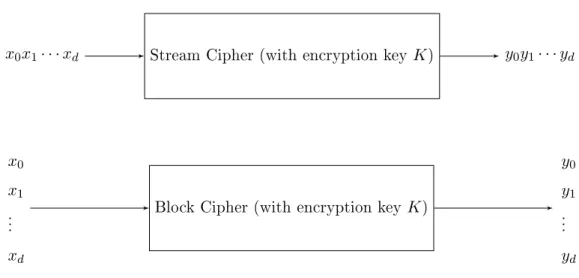
Stream ciphers operate explicitly on each bit of the plaintext by combining it with a generated key. What follows is the description of the algorithms of DES according to the DES steps.

Introduction
In this chapter we study the definitions and properties of Cayley and strongly regular graphs which are subfamilies of the family of algebraic graphs. We will look at some of the results drawn from the properties of these graphs, although we will limit our study to results that will help us to understand the relationship between these two families and the cryptographic functions that will be studied in the next chapter. to investigate. This review will include concepts such as eigenvalues of these graphs, circulation graphs extracted from Cayley graphs, the spectrum of graphs, and partial difference sets.
The idea of algebraic graph theory was introduced and explored, where ideas from algebra and group theory were put to good use.
Cayley Graphs
Although the following theorem is not proved in this dissertation, it is listed without proof because it gives a clear relationship between circuit graphs and Cayley graphs for the purpose of classifying Cayley graphs. The fundamental theorem for recognizing Cayley graphs (given below) helps us identify transitive vertex graphs that are not Cayley. For the special case of Cayley graphsG(G,Ω), the adjacency operator on an eigenfunction can be simplified to (Af)(g) = P.
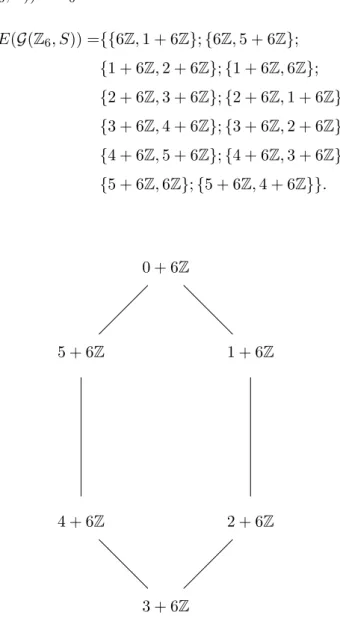
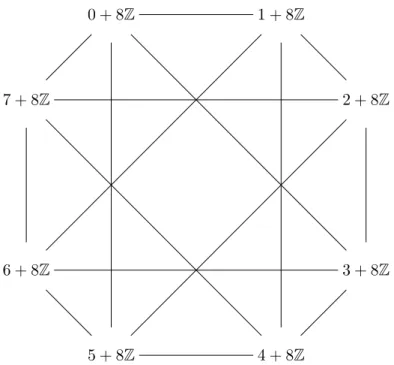
Let us consider the Cayley graph defined in Example 2.2.3 and show as an example that the special rule for obtaining the adjacency operator of Cayley graphs on an eigenfunction gives the same answer as the general method for all graphs to obtain the adjacency operator on an eigenfunction. Taking into account the method defined for the special case of Cayley graphs to obtain the adjacency operator on the eigenfunction, we evaluate (Af)(4 + 6Z): In example 2.2.3 we are given S ={1 + 6Z,5 + 8Z}, so . Consider the following lemma, which shows the relationship between the spectral information of a Cayley graph and the signs of the Abelian group used in constructing the graph.
Strongly Regular Graphs
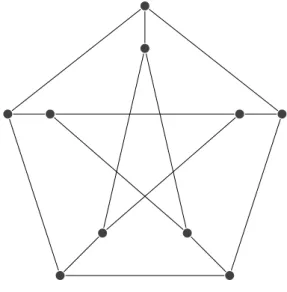
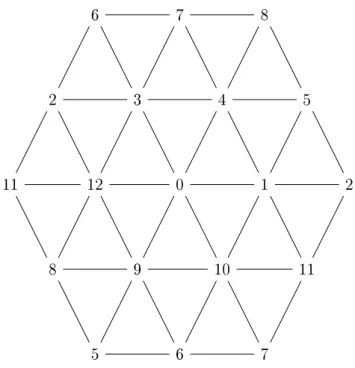
Note that the parameters of the Petersen graph as given in the definition satisfy the conditions of strongly regular graphs. Paley graphs, for example, are graphs constructed from the ring Z/pZ and the unidentified, stable inverse set Ω = {x2|x ∈ Z/pZ} and are strongly regular with parameters (n, r, λ , µ) as. It should be noted that not all given sequences of parameters generate a strongly regular graph.
However, the following theorem assures us that if there exists a strongly regular graph of some parameters, then a given sequence of incomplete parameters can be completed through a relationship between them. The next chapter introduces some notions in cryptography that relate well to Cayley graphs and SRGs. There we will note the role played by Cayley graphs in flow ciphers and further extend the notion of Cayley graphs to that of highly regular Cayley graphs in order to study their relationship to block ciphers.
Introduction
In Chapter 1, we noted that the security of stream ciphers and block ciphers relies on the randomness of the main stream generators and the design of cryptographically strong s-boxes. We present and discuss some well-known results, and properties of Boolean and skew functions that make them suitable for the cryptographic needs of pseudo-random number generators and s-boxes, respectively. Flow ciphers use Boolean functions to achieve standard security in pseudo-random number generators due to the properties these functions possess.
Block ciphers, on the other hand, use convolutional functions to achieve security in surrogate boxes. A linear approximation attack exploits the linearity of an expression that includes plaintext bits, ciphertext bits, and subkey bits [22]. A correlation attack focuses on the choice of the logic function used: it uses this function to regenerate the keystream by combining the outputs of linear feedback shift registers (LFSRs - will be deposited later in this chapter).
Boolean Functions
Furthermore, the algebraic degree of the ANF of f, denoted deg(f), is the number of variables in the highest order term with non-zero cogenes. Low algebraic immunity of f is always desired for an algebraic attack resistance of the cipher. Designing cryptographically strong Boolean functions for stream ciphers involves considering all of the above properties as part of the requirements to overcome well-researched attacks and possibly new ones.
On the other hand, there are exchanges between these properties according to the specific requirements of the figure. The output of the LFSR then becomes the input of the (typically non-linear) Boolean function used to produce the key stream. Although the methodology would differ depending on the type of generator (combination or lter), the emphasis here is on the fact that regardless of the type of generator, the output of the LFSR is the input of the Boolean function.
Bent Functions
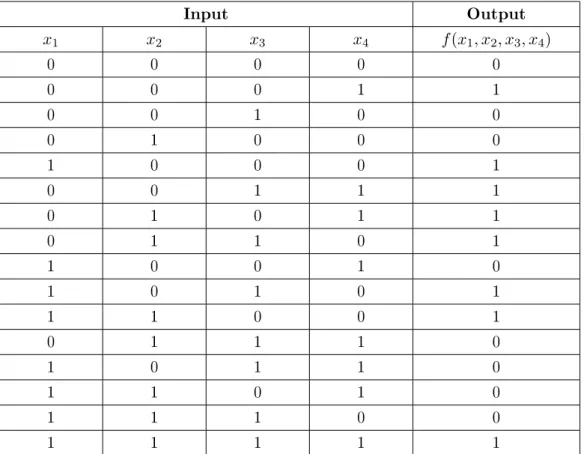
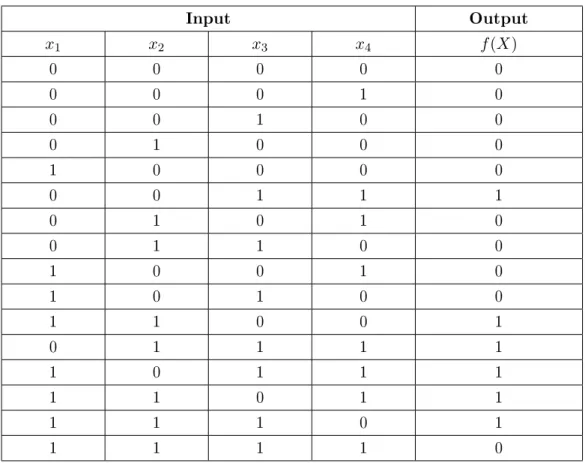
Assuming the 4th row of the truth table is as shown above, then the input bits are 0100, which corresponds to outer elements00 = 0 in decimal, giving the row position of the entry, and the middle elements10 = 2 in decimal, giving the column position of input . Similar calculations are performed for all entries in the truth table to construct the entire s-box. In this chapter, we considered private-key cryptography by focusing on the cryptographic functions used in stream and block ciphers.
We then extended our analysis to a special class of Boolean functions (the bent functions), evaluated their strength with respect to certain attacks, and discussed how it obtains the upper bound of one of the discussed cryptographic properties; non-linearity. In the next chapter, we will consider the relationship between algebraic graphs (the Cayley graphs and strongly regular graphs discussed in the previous chapter) and the cryptographic functions discussed in this chapter to explore the possibilities of interpreting the properties of a stream and/or block cipher through its associated graph. The main purpose of the research carried out in this thesis is to investigate and discuss the relationship between algebraic graphs and symmetric cryptography.
Introduction
In this chapter we revisit the properties and results discussed in Chapters 2 and 3, and use these properties and results to clarify the connections between cryptography based on Boolean functions and those bent on one side, and their characterizations in terms. of separate graphs, on the other hand. A cipher is said to be cryptographically strong if it can resist almost any known attack. The term cryptographically strong is commonly used, although imprecise, in the sense that ciphers are generally evaluated against other existing ciphers in their ability to resist a number of attacks that have been investigated in the cryptanalysis literature.
This chapter describes how we can make some of these cryptographic decisions about a cipher by studying its connected graph.
Boolean functions characterized by Cayley graphs
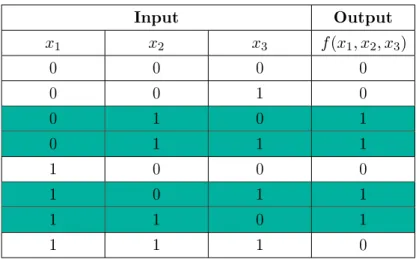
Let Gf = (V, E) be a Cayley graph associated with a given Boolean function f ∈Bn, and b(i),b(j)∈Fn2 be the binary representation of the integers,i and j, rows and columns of the corresponding adjacency matrix, respectively, such that0≤i, j≤n−1. In the following we discuss the nature of a strong connection between Cayley graphs and Boolean cryptographic functions by presenting a spectral perspective, where the spectral information of a Cayley graph can provide necessary but not sufficient results regarding the strength of the projected Boolean function. . tion. We recall the properties to consider when determining the ability of a code to withstand some known attacks; these include Boolean function balancing for resistance to statistical dependence and others discussed in the previous chapter.
In particular, the Walsh transform of a cryptographic function can be obtained from the eigenvalues of the connected Cayley graph. We also discuss the possibility of investigating the ability of a cipher to resist a correlation attack by examining the spectrum of the Cayley graph associated with a Boolean function and inferring from this whether the function is immune (or resistant) to ismth correlation or not. However, it now has b(0)6∈Ωwt(f) so that the main diagonal of the adjacency matrix, AGf, of the connected graph has only zeros;.
Bent functions characterized by Strongly regu- lar graphs
The next theorem, Theorem 4.3.2, paves the way for results that conclude and explain the relationship between strongly regular graphs and bent cryptographic functions. In this chapter, we reviewed the use of Cayley and strongly regular graphs for cryptographic applications. Strongly regular graphs were also discussed to define strongly regular Cayley graphs and distinguish them from general Cayley graphs.
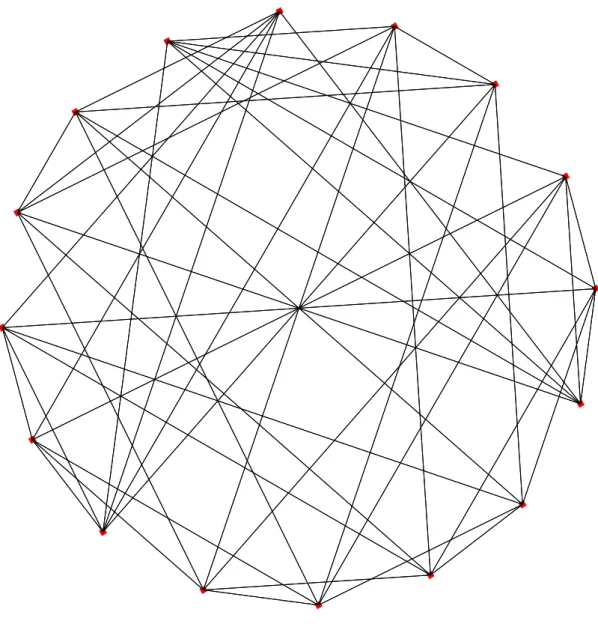
We then presented material discussing the connections between Cayley graphs and Boolean functions, as well as the connections between strongly regular graphs and bent functions. The key idea was to construct and define the Cayley graph associated with the Boolean function, both in general and those in the special case of the strongly regular Cayley graph associated with the bent Boolean function. We have shown that the construction of these graphs follows directly from the definition of Cayley and strongly regular graphs, where the group used to construct Cayley graphs is (Fn2,⊕).
![Figure 1.2: Isospectral non- isomorphic digraphs [27]](https://thumb-ap.123doks.com/thumbv2/pubpdfnet/10643386.0/26.892.177.707.319.617/figure-1-2-isospectral-non-isomorphic-digraphs-27.webp)