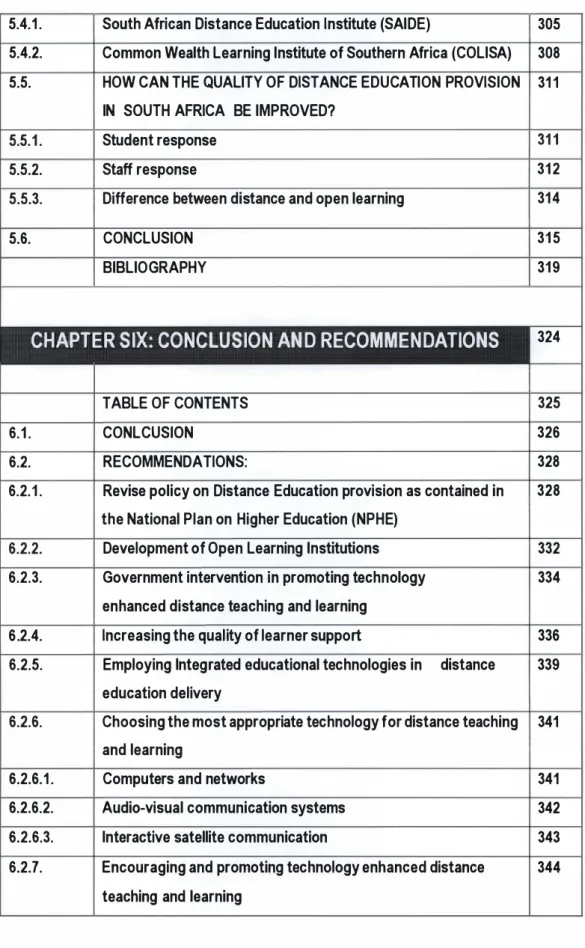
Recommendations are also offered to the Department of Education (DoE) regarding revising its policy as outlined in the National Plan for Higher Education (NPHE) with specific reference to distance education in South Africa. What is the type and quality of student support offered to tertiary 277 distance education students in South Africa.
CHAPTER ONE
BACKGROUND TO THE STUDY
This is largely attributed to traditional delivery systems that are still used in alternative education systems such as distance learning. Examines the role of technology in the delivery and provision of distance education and online learning in South Africa.
CHAPTER TWO
LITERATURE REVIEW
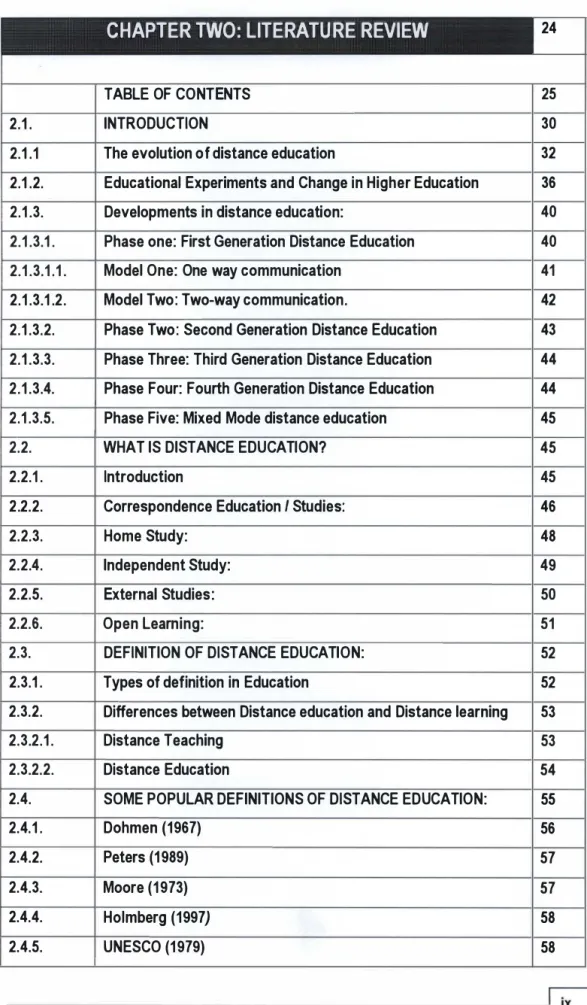
WHAT IS DISTANCE EDUCATION?
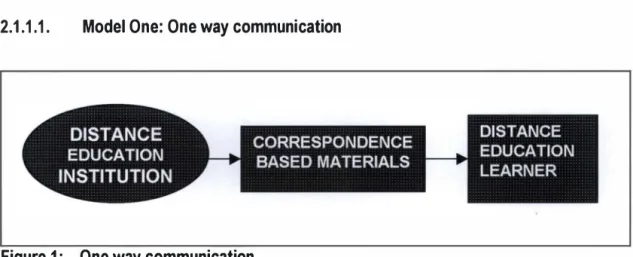
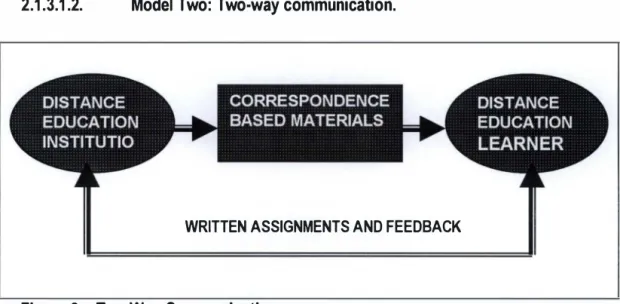
The term correspondence study is perhaps the most commonly used term applied to distance education. There is considerable concern about this confusion and the interchangeably use of the term correspondence study to refer to distance education. Scholars such as Keegan and Sewart (1 988) believe that the term correspondence study is rather "strange and lofty" in the context of describing distance education.
Perry (1 975) states very clearly that correspondence study is not an appropriate word to describe distance education. Distance education is a diverse delivery system that makes use of a multitude of technology-driven media. There is no doubt that correspondence study was one of the first forms of distance learning systems that has a history dating back to the 18th century.
Sewart (1 988) argues that the term "independent study" should be rejected altogether as a generic term referring to distance education.
DEFINITION OF DISTANCE EDUCATION
From the above categorization, based on the recommendations of Schramm (1 997), it becomes quite clear that the definitions surrounding distance education are immersed in a stipulative mode. In the context of distance education, students repeatedly use terninologies as synonyms and synonyms. Scholars in the 1960s and 1970s argued that there was a very fine line between any differences in distance education.
It was not until the late 1980s that distance education specialists such as Sewart ( 1 988) began to postulate a major shift in thinking about distance education as having two branches, namely distance education and distance learning. The absence of a universal definition resulted in different terms and concepts being thrown around in the field of distance education. Sewart (1 988) believes that the term "distance education" is jargonized and as such one needs to adopt a systems approach to understand the role, practice and theory of distance education.
He goes on to argue that distance education consists of two components, namely distance education and distance learning.
SOME POPU LAR DEFINITIONS OF DISTANCE EDUCATION
- UNESCO (1 979)
One of the first formal definitions of distance education was presented by Dohmen, who was the director of the German Institute for Distance Education. The opposite of distance education is "direct education" or "face-to-face education": a type of education that takes place with direct contact between lecturers and students. According to Gough, "distance education is a means of providing a learning experience for students through the use of self-study materials and access to educational resources, the use of which is largely determined by the student and which largely allow the student to choose the time, place, and circumstances of learning."
Distance learning is defined as a planned teaching/learning experience that uses a broad spectrum of technologies to reach students at a distance and is designed to encourage interaction between students and the certification of learning. Distance learning is instruction that does not restrict the student from being physically present at the same location as the instructor. Distance learning (or correspondence/home study) is the registration and study at an educational institution that provides teaching materials arranged in a sequential and logical order so that students can study them on their own.
The term distance learning represents a variety of educational models that have in common the physical separation between the faculty member and some or all students.
SYNTHESIS OF DEFINITIONS
It is no surprise to point out that every definition of distance learning emphasizes the separation between the learner and the learner, or vice versa. Distance correspondence education of the current era involves and maintains a balance between separation and direct contact between teacher and student. Until the late 1970s, the definitions of distance education placed great emphasis on the teaching and learning of individual students, viz.
Distance education definitions after the 1980s began to identify and recognize the role of videoconferencing; Teleconferencing and computer conferencing in group-based learning. Distance education specialists began to downplay the idea that distance education was based solely on individualized learning. Modern technologies began to give way to group-based learning opportunities and thus distance learning was able to fulfill group-based learning initiatives.
But in distance learning, there was no compulsion on the part of students to engage in group-based learning.
TECHNOLOGICAL INFLUENCES ON THE MODES OF DISTANCE EDUCATION DELIVERY
The telecommunications option for education is often perceived as expensive compared to face-to-face education or the more conventional distance education methods based on print and mail correspondence. Cost calculations, which include both communication costs and the cost of the tutor's time in creating feedback to students, show that telecommunication-based instruction can be more cost-effective than print-based instruction (Romiszowski & Iskandar: 1 992). AT&T's experience using audio teleconferencing has shown cost reductions of over 50% in actual training costs when calculated to include transportation and accommodation costs for remote participants (Chute: 1 988).
Furthermore, the cost of telecommunications is falling, while the costs of training space, personnel, and transportation are increasing, so the economic equation over time will favor increased use of telebased education. Research on distance education has generally shown that distance education, when properly planned, can be as effective as Although there are some exceptions regarding certain types of content or certain groups of students, the movement towards integrated multimedia networking can be expected to expand the range of effective distance learning applications (Collis: 1 99 1 ; Steinberg: 1 992; . Kaye : 1 992).
A potential advantage of such integrated networks in distance education is that they can be “user-driven.
TYPES OF SYNCHRONOUS AND ASYNCHRONOUS DISTANCE EDUCA nON DELIVERY
Print is one of the most enduring and useful technologies used to support education and training programs. One of the main strengths of print is that it is accessible to most learners. For example, some educational radio programs are broadcast late at night or in the early hours of the morning.
WWW provides users with a unified and convenient way to access the vast resources of the Internet. Mosaic was the first of the Internet tools we now call "web browsers". As a member of a group, a remote student can post a message to a discussion in the same way as using e-mail.
Education from reception grades up to PhD level is based on the model of the classroom/lecture hall format. At the reception grade levels, classes are organized and grouped according to the age of the student and not according to the type of learning the student needs. A person does not feel adrift on the sea of the Internet when he works in a community of people who face similar needs and challenges.
UN DERSTANDING AND IDENTIFYING THE PROFILE OF DISTANT EDUCATION STUDENTS
In distance education settings, technology is usually the channel through which information and communication flows. In general, they may be insecure about themselves and their learning, especially if they come from an educational institution that was characterized by traditional face-to-face contact education. Morgan suggests that distant students who are insecure about their learning tend to focus on memorizing facts and details in order to complete assignments and write exams.
Distance learners must become more selective and focused in their learning to master new information. Instructors can help motivate students at a distance by providing consistent and timely feedback, encouraging discussion among students, being well prepared for class, and by encouraging and reinforcing effective student study habits. The instructor can help distance learners explore their strengths/limitations and their learning goals/objectives by assuming a facilitating role in the learning process.
However, for distance learning to be effective, instructors must discover examples that are relevant to their distant students.
GUIDELIN ES FOR THE SELECTION OF MEDIA IN DISTANCE EDUCATION DELIVERY
The power of distance education in terms of increasing access, flexibility, personalization of education, reducing costs, increasing productivity, etc. The literature review has shown very convincingly that distance education is a very popular and effective way of education. The role of technology in fostering learning communities (both peer learning communities and thematic communities) is maintained to a much greater extent in distance education.
There is no doubt that educational landscapes around the world have long recognized the value and importance of distance education. Research has shown that there is no single way of delivering distance education that is better than another. Responses to "Labor Market Theories and Distance Education"Distance education is a Sui Generis form of teaching and learning.
34; Distance Education Task Force Report ”, Pennsylvania State University, University Park, PA.
CHAPTER THREE
THEORETICAL FRAMEWORK
Most educational landscapes in the world have tended to push distance education to the periphery of its mainstream educational activities. Peters (1 983) therefore argues that the division of labor is one of the main prerequisites for distance education. Due to the large number of students enrolling in distance learning courses, ways and means have been developed to cope with them.
The most important feature of the knowledge society is the decisive role that knowledge will increasingly play in the global economy. The characteristics of the two ways of knowledge production are briefly introduced in the following paragraphs. Arguably, the challenge of providing sustainable student support is one of the most important pedagogical challenges facing alternative systems of distance education delivery.
The alienation of the teaching-learning processes (due to the separation of time and space in DE) reinforces the need for student support. Establishing such a network will require significant changes in the distance learning institution's infrastructure and its delivery model. Recent technological developments are believed to eliminate some of the disadvantages of media in distance learning.