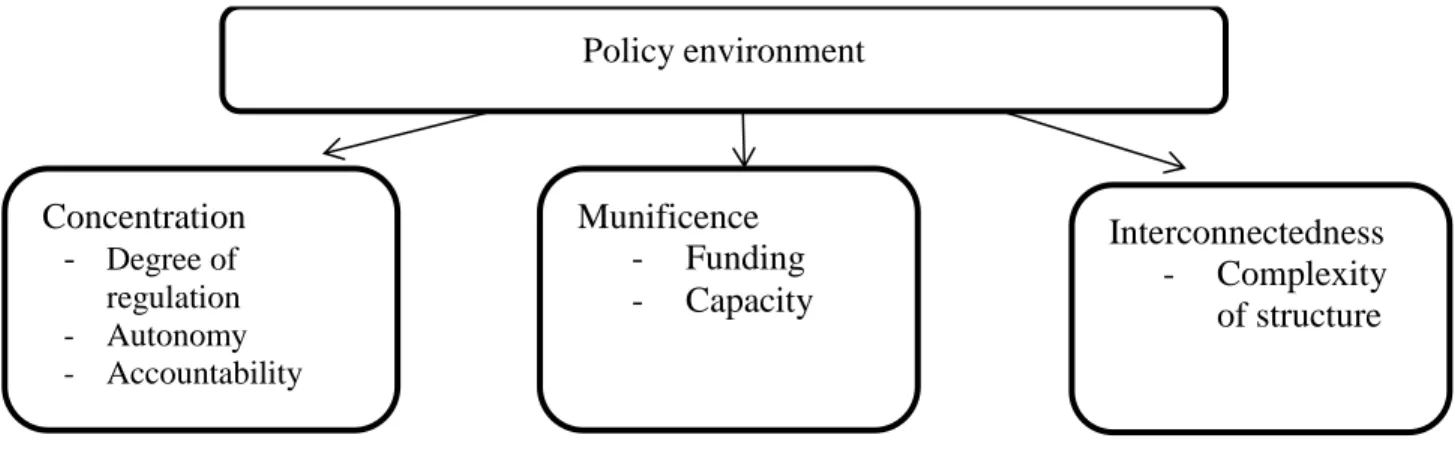
The main question posed in this thesis is: Is the governance of FET colleges significantly influenced by the environment. To answer the main question, the economic, political, political and geographical environments in which FET colleges in the province operate are explored.
Background
This was due to the inability of the colleges to respond to or articulate with the labor market. These reforms did not have the desired effect and as a result a national task force was commissioned by the Department of Education in 2000 to provide a provincial analysis of the problems encountered in the FET sector.
Review of literature
International discourse on the governance of vocational education and training
There has been growing recognition of vocational education and training as a solution to the problem of youth unemployment (Wolf, 2011:8). The global socio-economic landscape of vocational education and training has always been complex and differentiated.
South African Literature
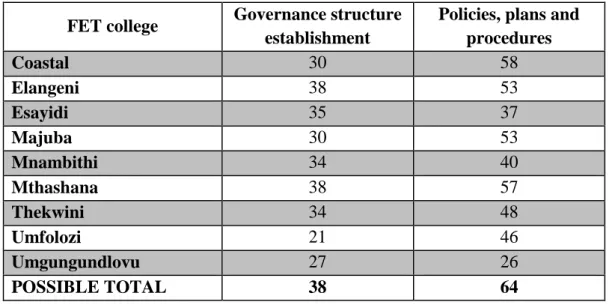
This hampered the FET sector's ability to respond to the country's education and training needs. Here, the definition of representativeness was expanded to include the number of areas of expertise in which council members were competent.5 The calculated national average was four areas.
Rationale for the study
As part of the research team, I conducted fieldwork in four FET colleges in South Africa. Due to the quantitative nature of the HSRC audit, these issues were not interrogated in the final reports.
Research questions
Source: Cosser, 2011 The interviews conducted revealed that management problems were attributed to external factors that were beyond the control of the FET colleges. What characteristics of the policy environment influence the management of the colleges in KwaZulu-Natal.
Structure of the thesis
Chapters six and seven concentrate on the two case studies, namely Thekwini and Mthashana FET Colleges. This section is guided by the question: "what is organizational governance?" The second purpose of this chapter is to determine how governance is expressed in public organizations such as the FET colleges in question.
What is governance?
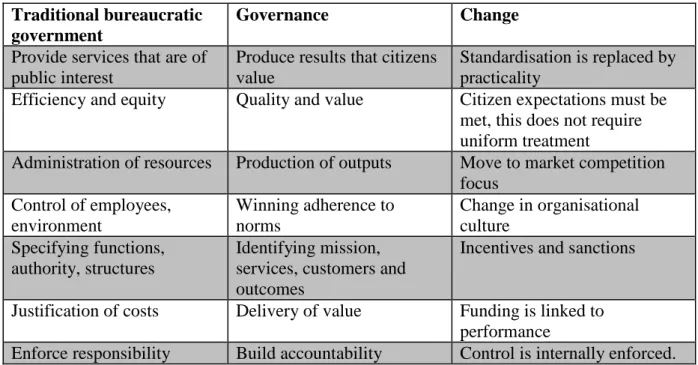
Governance and public administration
1994, "The Hollowing Out of the State: The Changing Nature of the Public Service in Britain", The Political Quarterly, vol. This proposal draws attention to the role of the private and voluntary sector in governance.
Reforming governance
Apart from good governance, corporate governance is a form of governance that is increasingly accepted in the public sector. The report refers to the ethical leadership of institutions as "the foundation of and reason for corporate governance" (Institute of Directors in Southern Africa, 2009: 21).
Theoretical perspectives on governance in organisations
To determine which model would be most appropriate for this study, each model is presented in Table 2.2 in terms of environmental characteristics and environmental change assumptions. While the organizational field model offers some promise, focusing on the organizations in the environment limits the nature of the organizational environment to one variable.
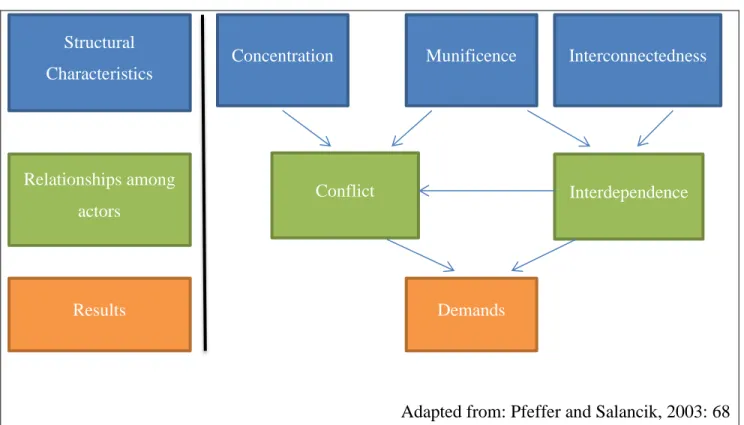
The ecological and resource dependency model
Structural characteristics
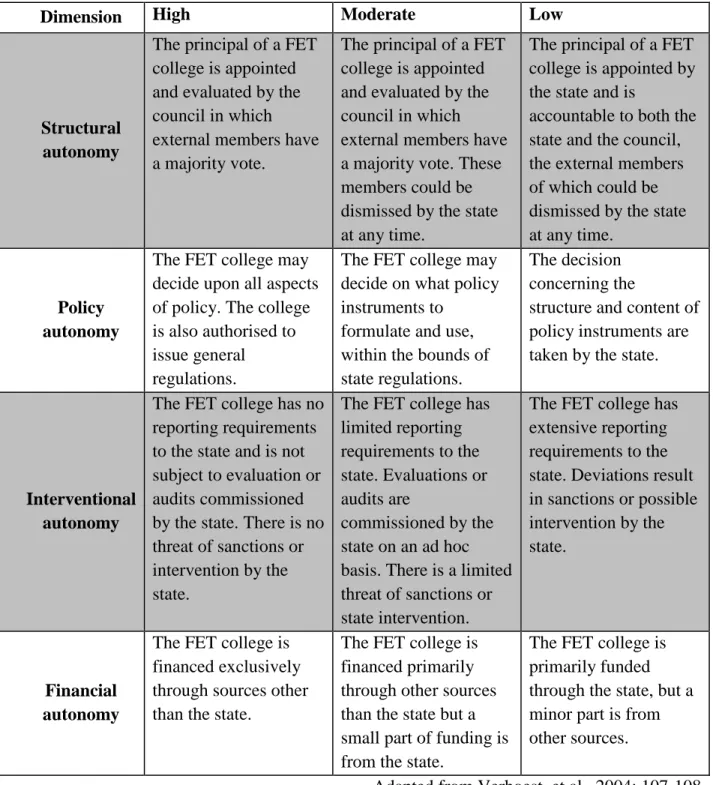
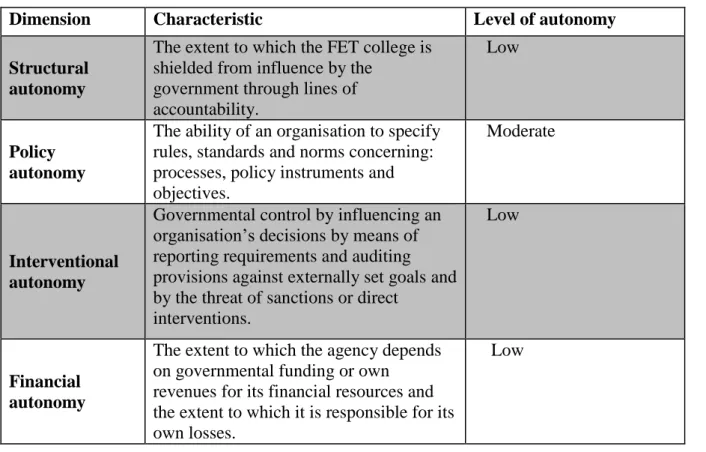
Structural The extent to which an organization is protected from government influence through accountability. Interventional autonomy refers to the degree to which an organization is free from reporting requirements, evaluation and audit requirements to the government.
Relationships among actors
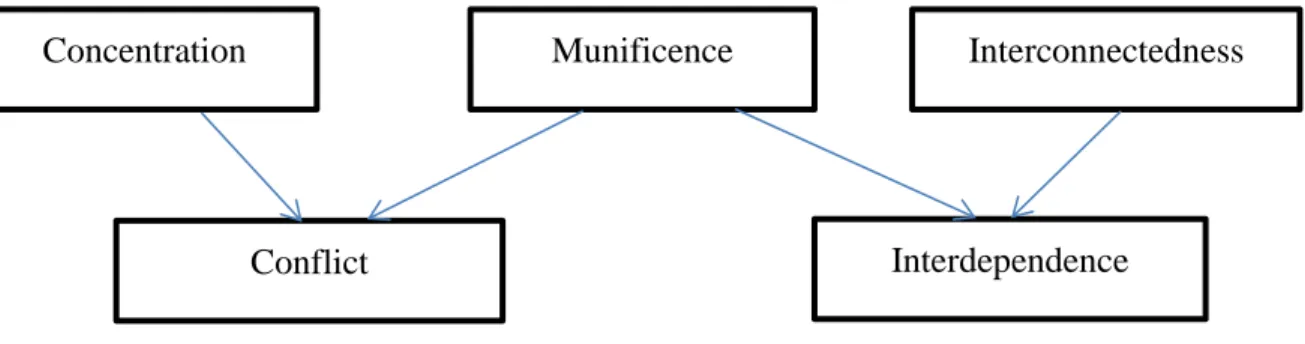
Increasing the number of interconnected organizations (that is, the complexity of the structure) also increases the number of potential actions that can have an impact on that organization (Dess and Beard, 1984: 56). On the other hand, scarcity of resources in a highly interconnected system can result in high levels of interdependence.
Uncertainty and demands placed on an organisation
Organisational responses to the environment
Compliance
The focal organization's compliance with the actor's demands does not conflict with the demands of other social actors; The focal organization has no influence on the formulation or expression of the actor's demands;
Avoidance and adaptation
Organizations responsible for policy implementation must in most cases adapt their structures to the requirements of the policy and the requirements of the environment. Changing organizational structures can be difficult because an organization can deal with many projects to which the existing organizational structure is adapted.
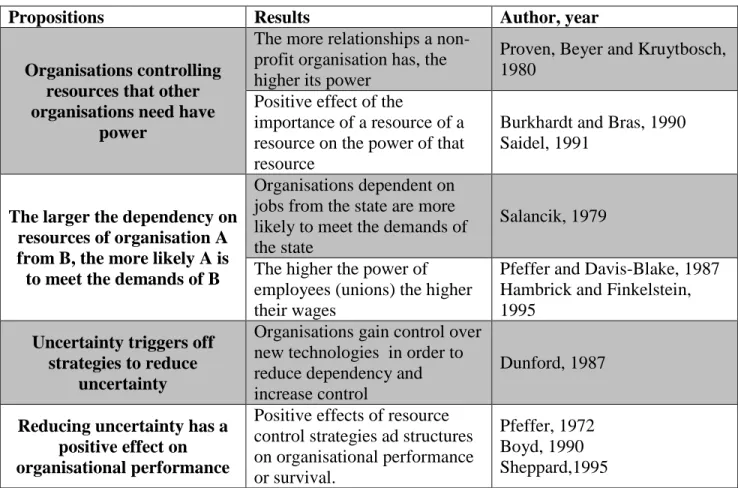
Empirical confirmation and scholarly criticism of Ecological and resource dependency
The greater the dependence on resources from organizations A and B, the more likely it is that A will meet B's demands. Organizations that rely on state jobs are more likely to meet state requirements.
Conceptual framework
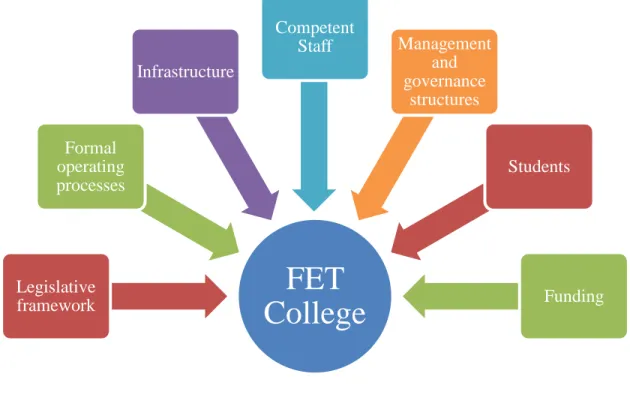
Ecological and resource dependency and FET colleges
- Environmental level
- Structural characteristics of the environment
- Relationships among the actors
- Organisational level
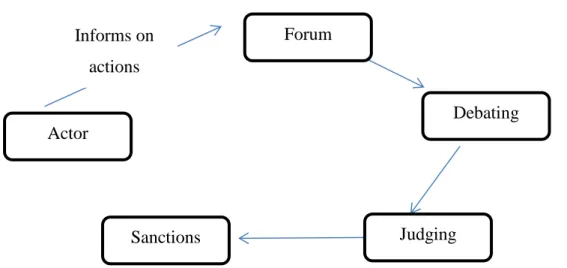
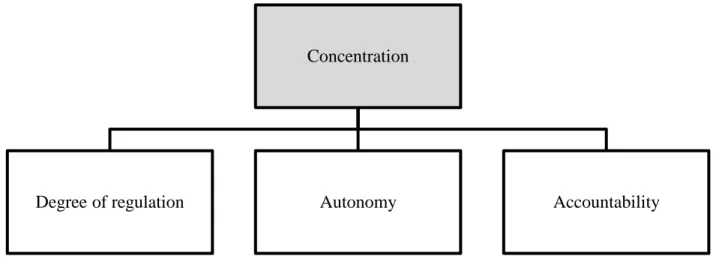
The concentration of the environment at a FET college will be examined by looking at: the degree of regulation; autonomy; and accountability. It will be important here to determine how the actors' actions affect the FET colleges.
Conclusion
Chapter One of this thesis briefly referred to the research methodologies used in this study. Throughout this chapter, the appropriateness of the methodology chosen is discussed with reference to the research objectives of this investigation.
Research methodology
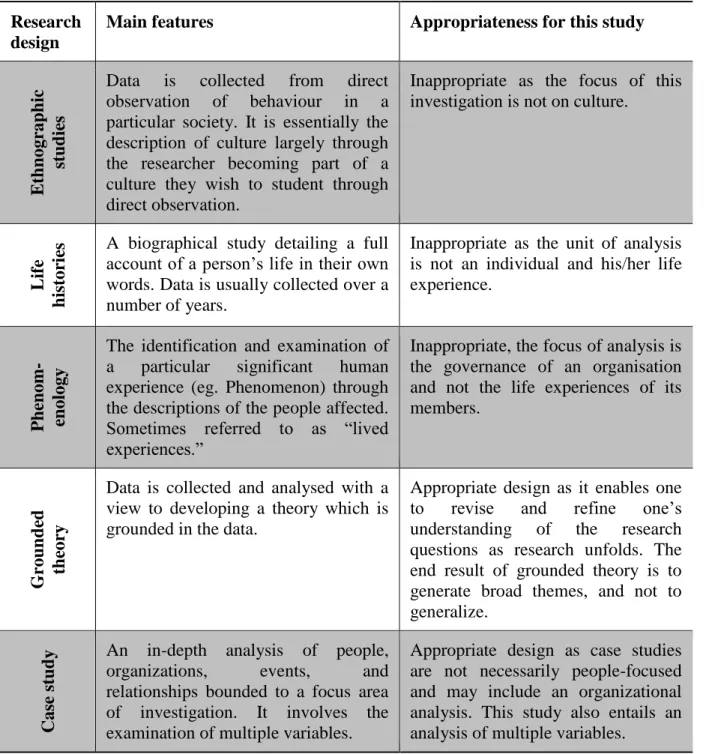
This research methodology was not considered appropriate for the purposes of this study due to its focus on isolating the unit of analysis from the context. The next section examines qualitative research designs, after which the features from Table 3.1 will be examined with reference to the specifics of this study.
Qualitative research designs
Second, the focus is on the social process rather than the outcome of the processes. Appropriate design as it allows one to review and refine one's understanding of the research questions as research unfolds.
Case study research design
- Contextual detail
- Selection of cases
- Multiple sources of data
- Analytical strategies
- Notions of objectivity in qualitative research
This is considered important because the degree of regulation of the general policy environment has an impact on the management of FET colleges. All interviews (both in 2010 and 2012) were held at the main administrative campuses of the colleges.
Ethical considerations
The informed consent form used to obtain participants' consent is in Appendix E. The content of the form was explained to the interviewees, who then signed this form.
Delimitations of this study
The problem I faced was that the immediate college context required detailed descriptions. For the two FET faculties used as case studies, respondents agreed to their names and the names of the FET faculties being published.
Conclusion
20 The House of Representatives was a body of South Africa's bicameral parliament, which existed from 1984-1994. 21 The House of Assembly was a body of South Africa's tricameral parliament which existed from 1984-1994.
Policy developments (1996-2012)
Corporate governance
The report refers to the ethical leadership of institutions as “the foundation and rationale for corporate governance” (Institute of Directors in Southern Africa, 2009:21). The King Report devotes a chapter to the roles and functions of the board (college council) and directors (college directors) of an institution (Institute of Directors in Southern Africa, 2009).
Using the ecological and resource dependency model
Concentration
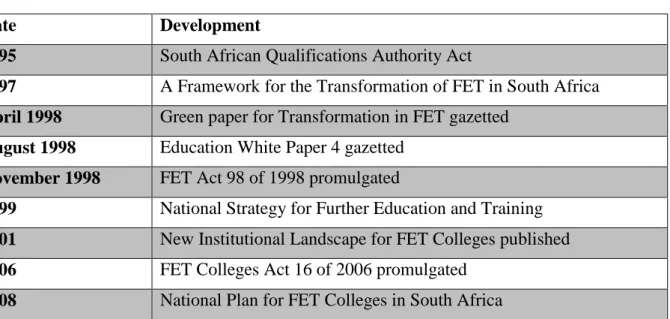
Due to the wide scope of the FET sector, some functions of FET colleges fall under other legislation. Accountability is the final dimension of concentration in the policy environment of the FET sector.
Munificence
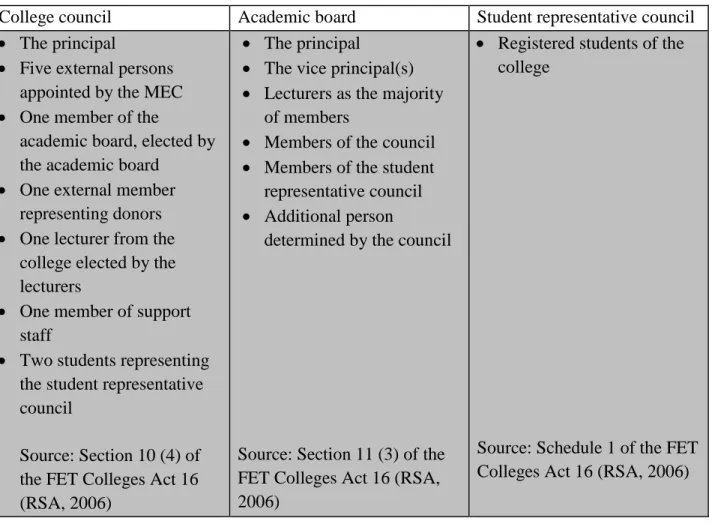
Further Education and Training (NBFET) was to be established as a consultative body to advise the Minister of Education to determine funding methods and norms and standards of funding (Department of Education, 1998). Section 10(7) of the FET Colleges Act 16 (RSA, 2006) requires a collegiate council to be competent in a range of specified areas. a) the council must be broadly representative of the further education and training system and related interests; .
Interconnectedness
The next section examines the nature of interconnectedness in the policy environment of FET colleges. This recommendation was realized in the establishment of Sector Education and Training Authorities (SETAs) by the Skills Development Act 97 of 1998.
Conclusion
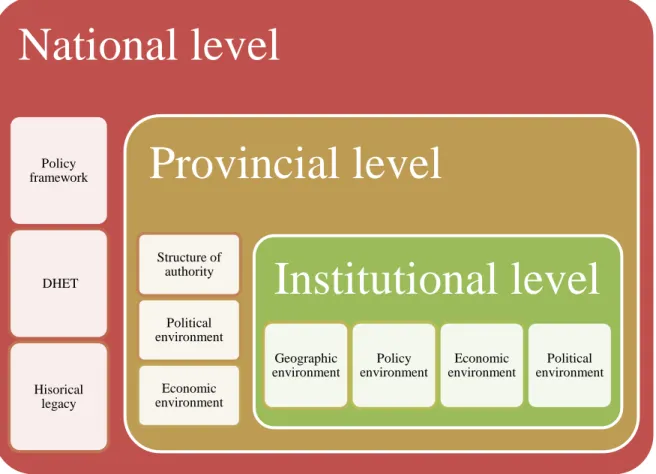
The purpose of this chapter is to provide an overall overview of the political, economic and structural environments in which the FET colleges in KwaZulu-Natal operate. The fourth part provides an economic overview of the FET colleges in the province with specific reference to: (1 ) dominant economic sectors, (2) employment and (3) poverty.
Using the resource dependency and ecological framework
The main purpose of this chapter is to provide an overview of the requirements (direct and indirect) placed on FET colleges in this province.
General environment of KwaZulu-Natal
Here, FET colleges in the province can play a role in upskilling (or improving) this part of the population. The discussion now turns to the environments that are likely to have an effect on the management of the FET colleges in the province.
Political environment
Provincial legislatures may adopt their own constitutions in accordance with the provisions of the South African Constitution Act 108 (RSA, 1996). However, the political landscape of the province of KwaZulu-Natal has undergone significant changes over the same period.

Economic environment
Economic sectors
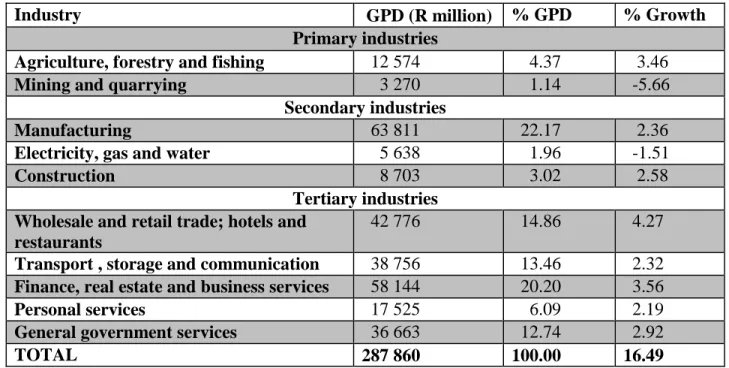
Source: Cosser, 2011 Of the 66 FET campuses in KwaZulu-Natal, 44 are located in municipalities where manufacturing is the dominant sector. All but one of the campuses of Mthashana FET College are located in such areas.
Employment
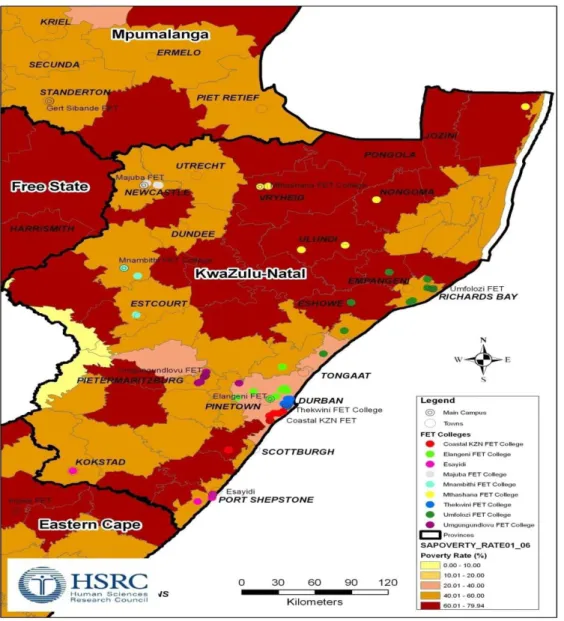
Since Pietermaritzburg is the provincial capital, it is logical that the college located in the city, Umgungungdlovu FET College, is located in an area where community services are the dominant economic sector. Three campuses of three different colleges (Esayidi, Elangeni and Coastal FET Colleges) are located in areas where agriculture is dominant and only one campus of Umfolozi FET College is located in an area where transport is dominant (Cosser, et al., 2011).

Poverty
Others in the economically inactive category are a potential constituency for FET colleges that help provide skills. Source: Cosser, et al, 2011. All campuses located in the 20-40% poverty level category are in the eThekwini Municipality, with the exception of the Albert Luthuli College Umfolozi FET Skills Campus, which is in the KwaDukusa Municipality.
Further Education and Training colleges in KwaZulu-Natal
Structure of authority
The organizational structure of the management of FET colleges in the province is presented in Figure 5.7. The principals of the FET colleges hold a Senior Manager position, which means that the principals report directly to the provincial authorities.
Problems and issues facing the governance of FET colleges in KZN
Difficulties experienced in another college relate to the implementation of centralized systems. the issue was the need to centralize the system and processes. A council chairman expressed the following: the principal's capacity, as [this current structure] may be putting too much pressure on the principal.
Conclusion
This area is needy and therefore required additional support... The funding issue was the biggest challenge, especially in terms of student scholarships not being enough to cover transport and accommodation. Five of the six themes discussed in this section refer to environmental influences on the colleges.
Background
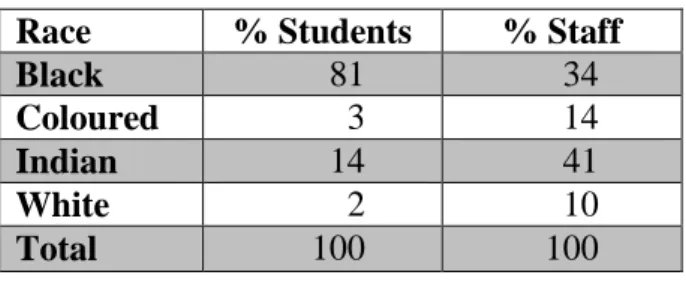
The second focus is to investigate how these have influenced the optimal functioning of the college. There was an accompanying change in the racial composition of the student body at the university after the merger.

Using the resource dependency and ecological framework
The turnover rate for NCV programs was 36% and 77% for Other Programs (short courses, adult learning, learning skills and abilities). Other programs exhibit throughput speeds that are significantly higher than the other two types of programs.
Environment
Policy environment
However, strong criticism of the NCV from industry and FET institutions themselves led to the DHET halting the process of a full transition to the NCV curriculum. Discussion of the problems with NCV has focused on its adequacy as a qualification.
Political environment
The Director of Academic Affairs at Thekwini VET College said that although colleges have gone through curriculum changes in the past, they have never been as chaotic as with the National Certificate Vocational (NCV) qualification. Source: Thekwini FET College Website; eThekwini Municipality, 2011 This wide spread of political parties in the municipality is notable for the operation of the college.
Economic environment
There is thus a need for Thekwini FET College students to be equipped with skills that complement the economic sectors of the Durban Metropolitan Area. Thekwini FET College, along with the other colleges in the area (Coastal and Elangeni FET Colleges), are tasked with providing these skills and related qualifications.
Structural Characteristics of the Environment
Concentration
Formal lines of accountability at Thekwini FET College exist between the Principal, College Council and College staff. The Thekwini FET College's Draft Financial Policy provides a framework for the administration and management of the College's finances (Thekwini FET College, 2009).
Munificence
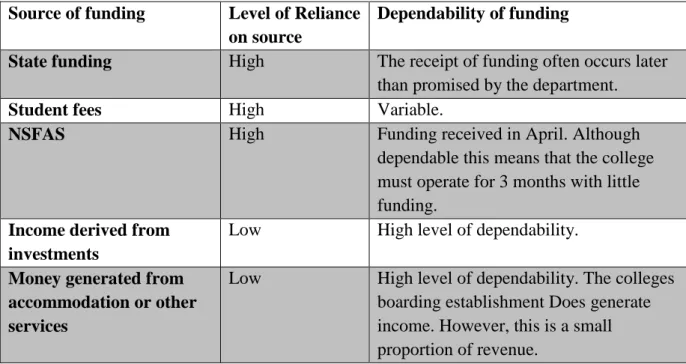
The next section examines human resources with specific reference to college council capacity. The chairman of the college council is a prominent businessman with strong ties to the ANC.
Interconnectedness
The college has an agreement with a private company (Zama Construction) to rent the college's workshops to the company for welding work. Decisions made by any of the 15 organizations with which the college is affiliated affect the college.

Relationship between Thekwini FET College and other actors
No references were found in the data that could indicate a conflict between the college and other organizations. These complaints have not escalated to such an extent that it could be considered a source of dispute between the parties.
Organisational level
Demands
This requirement is further qualified as a FET college is expected to deliver high quality vocational education with a view to being an "institution of first choice" (Nzimande, 2012). This requires Thekwini FET College to implement the new policies while phasing out the old ones.
Uncertainty
The principal must now report to both the collegiate council and the Department of Education. The state influences the decisions made by the Thekwini College Board due to the college's dependence on state funding.
Responses to the environment
In terms of remuneration and employment, college staff must be accountable to the college council. However, in terms of line management functions, staff are directly responsible to the college principal.
Conclusion
The structural characteristics of the environment and resource dependence on the state have resulted in an adaptation of Thekwini FET College's governance structure. As with the first case study, the focus here is to determine whether ecological factors and the dependence of the college's resources on other actors has affected the functioning of the college.
Background
In addition, this chapter will examine how these influences have affected the functioning of the College. First, wider environmental factors will be considered, which will then be followed by a discussion of the relationship between the College and the other organizations in the FET sector.

Using the resource dependency and ecological framework
Environment
- Policy environment
- Political environment
- Economic environment
- Geographic location
The reported lack of oversight of the university's workforce by senior management and the Ministry of Education; This led to disruption among students who called for the dismissal of the university's principal (HSRC, 2010).

Structural characteristics of the environment
Concentration
Minutes of the council meetings held in 2010 show that a council was actually established (HSRC, 2010). Mthashana FET College has not developed its own statute, nor had it adopted the standard version of the statute in 2010 (HSRC, 2010).
Munificence
Interconnectedness
Relationship between Mthashana FET College and other actors
Organisational level
Demands
Uncertainty
Responses to the environment
Conclusion
What characteristics of the external environment affect the governance of FET colleges?
What are the effects of the external environment on the governance of FET colleges? . 216
Why do the FET colleges respond in the manner that they do?
Concluding comments