South Africa is not spared from the problems of teenage pregnancy, whether related to health or the social sphere. These efforts have been hampered by the lack of adolescent voice in research as implemented interventions do not adequately capture the complexities of adolescent pregnancy. Guided by the Social Ecology Model and the Health Belief Model, this study aims to analyze adolescents' knowledge, attitudes and perceptions towards teenage pregnancy.
Using a case study approach, the study uses focus group discussions to elicit information from participants on their knowledge, attitudes and perceptions towards teenage pregnancy. To address the challenges of teenage pregnancy, there is a need to address the structural factors that influence adolescent knowledge, attitudes and perceptions.
INTRODUCTION
Conceptual knowledge is important to this study as it is important to understand what teenagers know about teenage pregnancy. This study uses the Social Ecology Model and the Health Belief Model as frameworks to better understand adolescent attitudes toward teenage pregnancy. This study aims to expand the framework through which teenage pregnancy is understood and how future interventions and programs will be designed and implemented, as a result of exploring adolescent knowledge, attitudes and perceptions towards teenage pregnancy.
The purpose of this study is to understand teenagers' knowledge, attitudes and perceptions about teenage pregnancy and factors that influence them. It is a qualitative study that aims to understand teenagers' knowledge, attitudes and perception of teenage pregnancy.
LITERATURE REVIEW
An understanding of these factors will enable a better understanding of the knowledge, attitudes and perceptions of teenagers regarding teenage pregnancy. The research concluded that there is no direct link between CSG and teenage pregnancy (Kesho Consulting, 2006). The high rate of abortion among teenagers, in the face of the CSG, is proof that there is no connection between the CSG and teenage pregnancy (Macleod, 2009).
One of these backgrounds is whether they are regarded as 'the other' in the discourse surrounding teenage pregnancy. The study also found that age at sexual debut increases the risk of teenage pregnancy. Inconsistent contraceptive use among teenagers has been identified as one of the reasons for teenage pregnancy (Varga, 2000; Swartz & Bhana, 2009; Wood & Jewkes, 2009).
This study addresses the perceptions and attitudes of black and black teenagers toward teenage pregnancy.
THEORETICAL FRAMEWORK
This level of the Model recognizes the social and cultural norms to which groups and individuals subscribe (McLeroy et al, 1988). The final level of the Social Ecology Model is the policy level, which includes policies that influence and influence an individual's behavior at all levels. At the individual level, knowledge, attitudes and perceptions guide the development and selection of the quantitative instruments of data collection for the study.
In addition, teens' knowledge, attitudes, and perceptions of teen pregnancy are interrogated using the Social Ecology Model's different levels of influence to understand how teens identify themselves with the broader community. The model provides a deeper understanding of the research problem (teenagers' knowledge, attitudes and perceptions towards teenage pregnancy). However, the multiplicity of levels and different approaches required to initiate change make it difficult to implement and monitor interventions (McLeroy et al., 1988).
Another challenge of the social ecology model is the challenge of changing social norms and public policy. 47 shortcomings of the Health Belief Model, where perception of susceptibility is always not explained by affirmative behavior. Perceived severity is defined as "an individual's perception of the seriousness of contracting the disease or condition" (Champion & Skinner, 2008:85).
The Health Belief Model value outcome is reflected when individuals rate the positive and negative aspects associated with behavior (Ogden, 2004). Calls to action give a disease or condition a 'human face' and make people aware of the disease (Rosenstock et al., 1988). This study utilizes all six concepts of the Health Belief Model in examining knowledge, attitudes, and perceptions regarding teen pregnancy among a sample of male and female high school students.
RESEARCH METHODOLOGY
In addition, qualitative research allows the researcher access to multiple, rich descriptive data that facilitate understanding of the phenomenon under study (Silverman, 2011). Here' are the initial set of questions to be answered and 'there' are the answers and conclusions to the questions asked” (Yin, 1993:19). The function of a research design is to ensure that "the evidence obtained enables us to answer the initial questions as unambiguously as possible" (de Vaus, 2002:9).
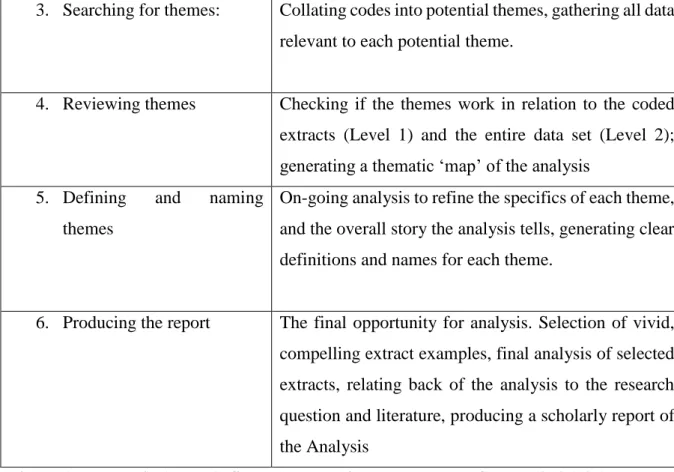
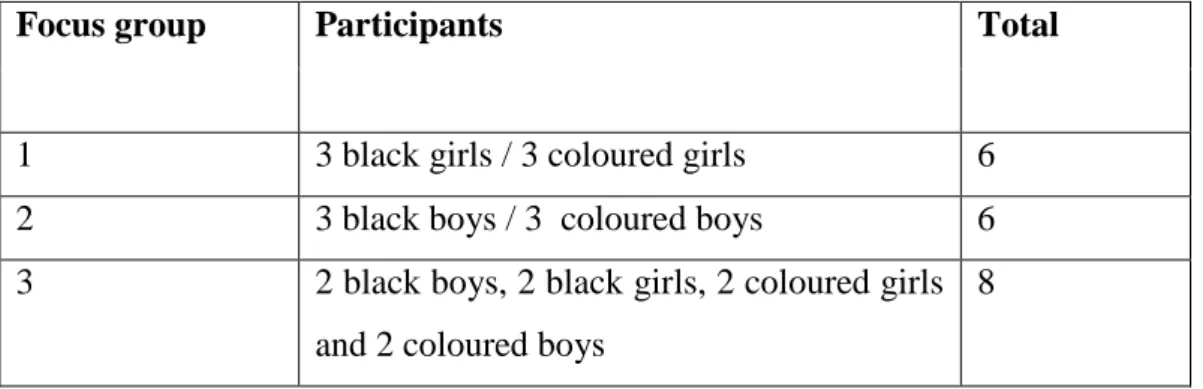
This allows the researcher to gain deeper understanding and understanding of the phenomenon under study. Random sampling is defined as “selecting a sample in such a way that each individual in the accessible population has an equal chance of being selected for the study. The researcher had to constantly encourage the quieter participants to engage and be part of the discussions.
Focus group discussions were conducted in one of the rooms provided by the school, audio recorded and transcribed verbatim. Through the focus group discussions, the researcher felt that the participants never lost sight of the fact that the research was part of the researcher's degree. Right at the beginning of the focus groups, participants asked the researcher if they had contributed anything to the final research project.
The researcher told the participants that they played an important role because their knowledge, attitude and perception towards the research problem were the core of the research. Credibility also refers to the extent to which the research reflects the lived experiences of the participants. Here too, the researcher's self-reflexivity is an important element of credibility, trust and authenticity of research.
DATA PRESENTATION AND ANALYSIS
The reasons why teenagers are involved in these relationships are woven into other levels of the social ecology model. The "sugar daddy" phenomenon, like rape, is also involved in other levels of the social ecology model. Sometimes you are embarrassed to even mention the name of your school because of the many pregnant girls or parents in the school.
Knowledge of the types of contraceptives available was outstanding among most participants. A user-friendly description of the female condom sheds light on the relationship teenagers have with condoms. The absence of the female condom in the media means that information about the condom remains rare, and at the same time, negative attitudes, representations and myths are formed, expressed and reinforced in the process.
Moderator: When you guys talk about safe sex, during intercourse or just before you have sex. Hlobisile (mixed FGD): I think girls need to be empowered that there is something wrong with the way we think or it's the way we were raised, I don't know. Their choices are influenced by the environment, that is, the economic situation in which they find themselves and the nurses' attitudes.
They have unprotected sex with a girl and when the girl comes with news of the baby, the boys always say the baby is not theirs. We discuss things that are not real because the teacher says we already know, but we don't, that's the crazy thing. The Child Support Grant (CSG) is a topical issue in South Africa, the controversy of the CSG lies in the debates as to whether access to the grant results in teenage pregnancy.
88 facilitates discussion on the relationship between father and daughter and what the absence of a father does to a daughter. Norms and sexual behavior of the male figure influence the girl's behavior (Blum & Mmari, 2005).
FINDINGS AND CONCLUSION
Teenage pregnancy is an indicator of unprotected sex and the risk of HIV infection is high, therefore there must be an increase in the use of double protection "double Dutch", which will protect teenagers from pregnancy and infection. While sugar daddies are part of the teenage pregnancy equation, boys both in and out of school also play a role. Contrary to research (Kesho Consulting, 2006; Makiwane &Udjo, 2006 and Macleod, 2009), there is a link between CSG and teenage pregnancy.
Teen pregnancies can be unplanned and unwanted (this is usually when there is no knowledge of contraception or misinformation), unplanned but wanted (cases such as rape and where the person did not want to be pregnant but will not terminate the pregnancy), planned but unwanted ( where the goal is, for example, access to the CSG) and ultimately planned and desired (in cases where the individuals want to have children because they are afraid of contracting HIV). 95 researcher to capture the essence of teenagers' knowledge, attitudes and perceptions towards teenage pregnancy. The purpose of the study was to analyze teenagers' knowledge attitudes and perceptions towards teenage pregnancy.
The Health Belief Model was applied in this study to understand teenagers' knowledge, attitudes and perceptions towards teenage pregnancy on an individual level. Teenage pregnancy and its 'negative' consequences: Review of South African research - Part 1. South African Journal of Psychology. The 'causes' of teenage pregnancy: Review of South African research - Part 2. South African Journal of Psychology.
Needs assessment report for the prevention of sexually transmitted infections, HIV/AIDS and teenage pregnancy among people in Dowa District in Malawi. Making sense of teenage pregnancy among school-going youth: The case of selected secondary schools of the eThekwini Municipality. I am conducting research to better understand teenage pregnancy under the Center for Communication and Media Studies (CCMS).
I am researching better understanding of teenage pregnancy at the Center for Communication and Media Studies (CCMS). The purpose of this study is to understand teenagers'. knowledge, attitudes and perceptions towards teenage pregnancy.