Submitted in fulfillment of the requirements for the degree of Master of Social Sciences, in the Postgraduate Program. It is submitted for the degree Master of Social Sciences in the Faculty of Humanities, Development and Social Sciences, University of KwaZulu-Natal, South Africa.
Introduction
Background to the Research Topic
Associated with ESC are Container Park and Wiggins Economic Hive; both units are strategically located to provide convenient, resourced and networked business premises. It is for these reasons that the current research delves into the strengths and weaknesses of the ESC project and its relationship with the Container Park and Wiggins Economic Hive projects.
Problem Statement and Justification
General Research Questions
What are the participants' perceptions of the impact of LED projects on their lives in Cato Manor? How does the sustainable livelihoods framework facilitate understanding of LED strategies and projects in post-apartheid South Africa?
Research Objectives
Primary Objective
Secondary Objectives
Preliminary Literature Review
Research Methodology
Significance of the Study
Furthermore, Cato Manor was chosen for this research because of its status as a Presidential Major Project (Cato Manor Social Development Strategy Review, 2005). For this reason, its successes could easily become a model for other major inner city development projects in the post-apartheid era.
Format of the Thesis
An explanation of the concept of sustainable development will form the first part of the literature review. The chapter summarizes the main findings of the research, including some recommendations that crystallized during the course of the research.
Conclusion
Chapter four discusses the research methodology used in terms of the proposed conceptual framework alongside the research design. Chapter five provides the findings of the study through a discussion of the themes that emerge from the analysis of primary data.
Introduction
Background of Cato Manor: Case Study Area
Cato Manor: The Early Years
Evidence shows that Cato Manor was settled by African communities in the pre-colonial era. Ultimately, in 1993, the Cato Manor Development Association (CMDA) was established to begin implementing the re-development of Cato Manor (CMDA Review, 2002).
Cato Manor: Post-1994
The more generally representative Cato Manor Development Forum (CMDF) was established in 1992 after protracted negotiations. The Cato Manor Development Association (CMDA) was established in 1993 as an implementation vehicle (Cato Manor Development Project Review, 2002).
Cato Manor’s Economic Status
In short, Cato Manor's LED program was created with the goal of addressing poverty and the need to integrate Cato Manor's economy with that of the wider metropolitan area (Cato Manor Development Project Review, 2002).
Development in Perspective
Two components of this are the establishment of an Entrepreneurship Support Center (ESC) for small factories and the construction of small-scale industrial workshops” (Capricorn et al., 2000:1). Therefore, the focused objective of ESC and ESP is to grow potential entrepreneurs into sustainable enterprises.
The Integrated Development Plan
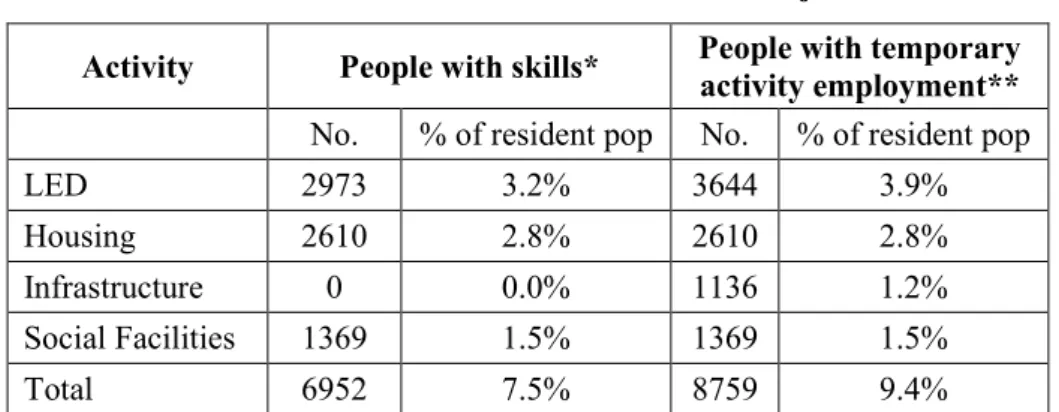
The activities of the ESC are structured to empower and nurture existing and new manufacturing SMEs within a dedicated manufacturing environment. Evidence of the success of LED will be found in the extent to which the empowerment skills gained from the project enable the recipients to increase their household income and thus move their households above the poverty threshold.
Conclusion
The research also looks at whether and how the participants are able to utilize the skills that the project has acquired, as well as the challenges they face after the duration of the project.
Introduction
Defining Development
Sustainable Development
Within the sustainable development approach, six issues were identified by the Commission as necessary to realize these principles. For this, one can argue that sustainable development places environmental issues above human development.
Sustainable Livelihoods Theory
Sustainable Livelihoods and its Assumptions
Theoretically, the SL approach has been put forward as an approach to understanding poverty – one that is considered by many to be comprehensive, realistic and builds on existing lessons. It has been critically argued that the approach brings together many issues in a single framework, but inevitably cannot encompass every part of development thinking, for example the issues of power relations (De Haan and Zoomers, 2005:31). However, more recent studies have attempted to address these shortcomings by framing issues related to power and poverty, arguing that the SL approach could become analytically more powerful if its theoretical depth were improved, especially in the areas of power relations.
Sustainable Livelihoods Frameworks
At the same time it aims to allow each framework to be adapted as lessons are learned so that multiple actors contribute to the evolution of the livelihoods framework. It is people-centred in the sense that it advocates that development policy and practice should be derived from an understanding of the poor and their livelihood strategies. In terms of livelihood development efforts, the main key objective will be to remove constraints to realizing potential, so that this will help people become stronger and better in terms of their ability to achieve theirs.
SL Approaches used regionally and internationally?
Critique of Sustainable Livelihoods (SL) and the Frameworks
SL approaches further enrich the discussion and offer a holistic perspective that enables the philosophy of access to resources to work. Therefore, such an analysis focusing on the different layers of the use of power would complement the conceptualization of access as a key issue in the livelihoods approach (De Haan and Zoomers, 2005). Because of this discourse on gender equality, “access to resources and means is also changing for the better, albeit gradually.
Conclusion
SL theory places less emphasis on needs than on community assets, strategies and strengths. In this research theoretically SL is presented as a theory that understands poverty – a theory that many see as comprehensive, realistic and built on existing learning. In the case of SL, the conventional view of research informing policy which frames practices also helps guide this research question of how the SL framework facilitates understanding of LED strategies and projects in post-apartheid South Africa.
Introduction
Research methods and approach
21. Would you say that the project aimed to improve the economic lives of the people in the area. 28. What would you say is the direct (short-term) benefit of the project for the participants. 30. What would you say are the indirect benefits of the project for the recipients (both short and long term).
Fieldwork process: collecting primary data
Archival and Documentary data
Most of the data on the history of Cato Manor was obtained from the archives at the Kwa-Muhle Museum in central Durban and the Kellie Campbell Africana library in Morningside, Durban. Additionally, the Kwa-Zulu Natal Income Dynamics Survey (KIDS) for analysis of household income and dynamics in Kwa-Zulu Natal was also used.
Interviews
Community leaders also provided us with information about the projects, but especially about their involvement in representing the rest of the community members. This was done with the help of the research and communications manager who helped secure the interviews taking into account their busy schedules. The subjects were explained what the purpose of the interviews was and how the data and findings would be used.
Questionnaire survey
In terms of Weber's (1949) formal and empathic understanding processes, I was able to establish a relationship with the subjects. Interviews were conducted using unstructured questions to give respondents freedom to guide the interview process. The content of the completed guides and additional notes, drafts and patterns were recorded and a qualitative analysis of the situation was presented.
Limitations
Conclusion
All in all, the research instruments used and the interviews conducted have provided a good insight into the development process and the people at the heart of the development.
Introduction
Analysis of the data
Prior
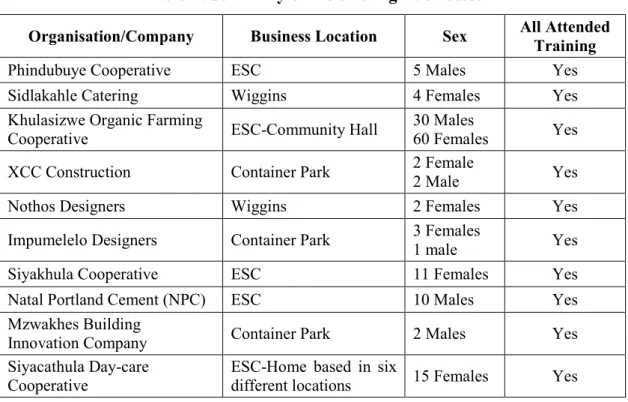
Together they devised a plan that would right the wrongs of the past and establish an institutional framework to facilitate the development process”.2 The Entrepreneurial Support Center (ESC) Container Park and Wiggins provide workplace and business support with the aim of maximizing job creation for Cato Manor residents as well as maximizing revenue to be reinvested in socio-economic projects in Cato Manor.
During
Both the members attended the 2007 marketing skills training facilitated by the Makho Communication of the ESC office. The NPC was formed by ten men and provides decentralized training for SMEs in Cato Manor located at the ESC. This business was registered in 2002 and started at Container Park but is now located on the ESC premises formed by five men.
After and/or continuation effects
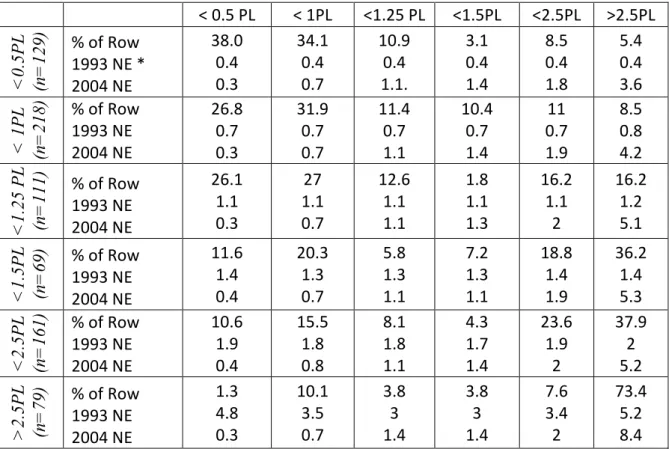
The remaining 28% of these households now enjoy a standard of living that exceeds the poverty line. Consistent with studies of the previous rounds of the KIDS data, those households that were well above the poverty line in 1993 largely maintained their positions or advanced over time. On average, households with spending more than 2.5 times the poverty line in 1993 had income growth of 61% over the 11 years of the study.
Interpretation
In that perceptions and meanings are built on the perspective of the subject's world and its environment. The most important factors of participation and the position of the subjects and their involvement in the ESC seemed important in the evaluation. Key funders of the CMDP are the South African Government, the European Union, the Provincial Housing Department and the eThekwini Municipality.
Conclusion
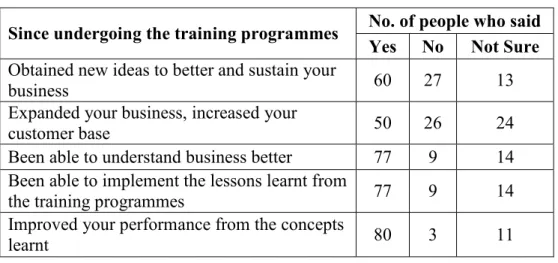
Where satisfaction was shown with all the development meetings, there was an acceptance from the participants, stemming from the fact that the projects allowed them to see themselves as capable actors who could control their own destiny. Responsive and participatory people-centered development allowed people to develop a sense of ownership in which it holds the potential for sustainable livelihoods. The states of excitement and engagement can be indicative from the participants that many aspects of the development initiatives taken in the ESC have the potential for positive impact towards the development of the city.
Introduction
Literature Review
Empirical Findings
The study showed that the European Union showed a great interest in Cato Manor and its upliftment of the community. The research findings explained that the majority of the small businesses in Cato Manor are considered sustainable, as businesses have been operational since 2000 and are still in existence as of 2010. The municipality has been named as one of the best performers in tourism (Parahanse and Goldman: 2006).
Limitations of the research
In assessing whether LED projects in Cato Manor are being perceived as addressing the issue of poverty, the study shows that LED projects help community participants rise above the poverty line. Parahanse and Goldman (2006) are also of the opinion that despite the seemingly favorable legal and political context and the significant resources of larger cities and the private sector, the experience of over ten years of applied LED in South Africa shows that the application of LED is possible, but difficult. For South Africa to have greater impacts requires clearer policy direction, a clear articulation of the mechanisms that can be used and greater mobilization of capacity.
Recommendations
General
Recommendation for further research
Conclusion
1994) "Micro-Enterprise Development in South Africa" report prepared for the European Union, Johannesburg, South Africa. 1998) "Poverty and Inequality in South Africa", Report to the Executive Vice-President and the Inter-Ministerial Committee on Poverty and Inequality, South Africa. 1997) “SMMEs and Poverty in South Africa” Input Report for the National Project on Poverty and Inequality, Johannesburg, South Africa.