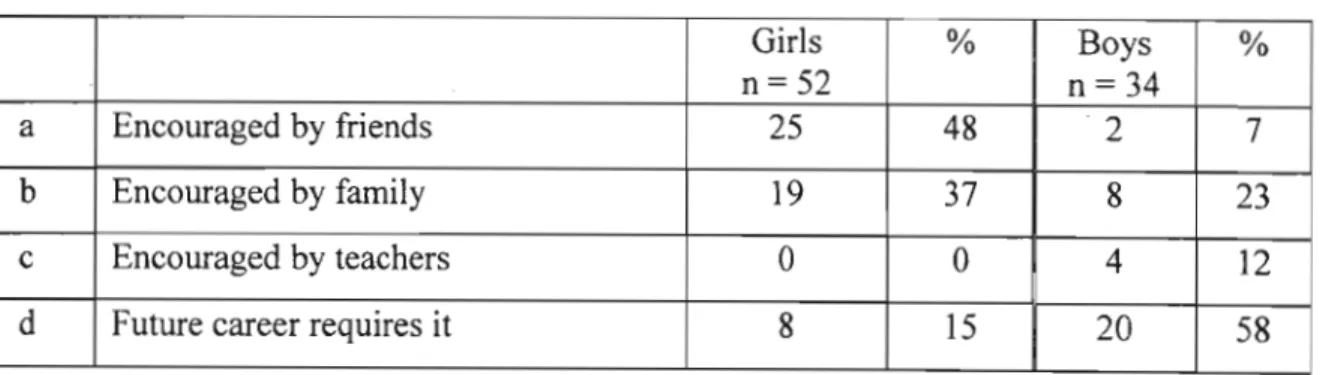
The data collected aimed to answer the following main question: What influences girls in their decision to choose to study Physical Science in a rural school. The study sought to answer the following main research question: What influences girls' decision to choose to study Physical Science in a rural school.
INTRODUCTION
THE NEED FOR WOMEN TO DO SCIENCE
The world as a whole cannot afford to neglect women while in Africa the dream of an African Renaissance will remain hollow if women do not take their rightful place in the world of science and technology.
WHY SCIENCE SHOULD BE TAUGHT AT SCHOOL?
It affects every aspect of our lives, for example, what we eat and what we wear; the work we do, what we think. He goes on to say that scientific education is about gaining competence in using the skills required in scientific activities.
GIRLS' PARTICIPATION IN SCHOOLING IN GENERAL
A study by Nassor (2001) in Zanzibar found that the enrollment rate of girls and boys in primary education was 81% and 82% respectively, and in primary education it was 71% for girls and 72% for boys. This indicates that there is little difference between the participation and enrollment rates of girls and boys in primary and secondary schools.
GIRLS' PARTICIPATION IN SCIENCE
Shymnsky and Kyle (as cited in Monk& Amosum, 2002), find that girls in single-sex schools achieve better in science than girls in mixed-sex schools. Girls in single-sex schools are taught all subjects and thus beliefs prevail in co-educational schools that subjects such as physical science and technical drawing, mathematics and·.
WHY ARE GIRLS RELUCTANT TO TAKE UP SCIENCE?
Nassor (2001), who conducted a research project to examine the behavior of the teacher and students in high school science classrooms in Zanzibar, found that teachers encouraged boys to investigate and be creative, while girls were ignored. For example, Swainson (as cited in Haambokoma, 2002) found that there is a lack of female science teachers in the school environment and this contributes to the low participation of girls in physics.
SUMMARY
Reddy (1998) confirms this view and says that women are underrepresented in science and technology. It is clear that the shortage of role models in these subjects will contribute to the low participation of girls in science.
INTRODUCTION
RESEARCH METHOD
As Cohen, Manion, and Morrison note, a case study is a unique example of real people in real situations that allows readers to understand ideas more clearly than simply by presenting them in abstract theories or principles" (p. 18l). Case studies do not allow for generalizations either about instance to instance or from instance to class. Their particular strength lies in their attention to the subtleties and complexities of the instance itself.
By paying careful attention to social situations, case studies can capture some of the discrepancies or conflicts between participants' views. Cohen et al. define triangulation as the use of two or more data collection methods in the study of certain aspects of human behavior. For example, the interviews with the students looked at the written reasons given in the questionnaire, and the observations were made to verify the classroom interactions talked about in interviews.
DESCRIPTION OF THE CASE
I chose this school because I work on the research side and the subjects would be easily accessible and therefore data could be collected easily. The school was founded in 1979 and had its first grade 10 science group in 1981. It was previously under the control of the KwaZulu Department of Education and Culture. As a result, many students cannot afford to pay the school fees, which are R65 per year per student, and therefore the school's annual budget is very low.
This affects teaching and learning in this school. Due to a limited budget, it has insufficient resources and operates in very difficult conditions. It is difficult to even buy all the consumables required for the practical work prescribed in the science curriculum.
DATA COLLECTION STRATEGIES
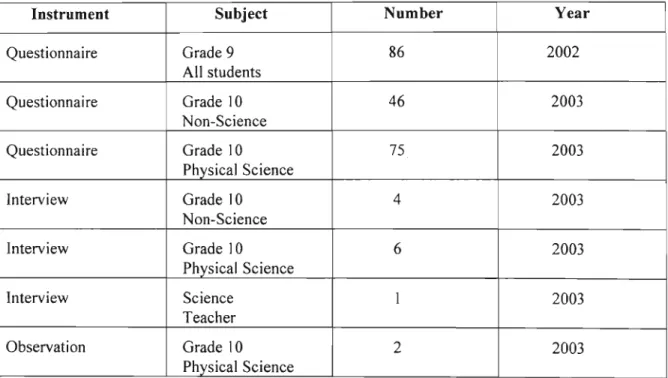
For this research, the use of the questionnaire technique was important because at the school there were more than 60 grade 9 students and so a questionnaire seemed appropriate to collect the necessary data. To overcome this problem, I fully explained to them the purpose of the study and also elaborated on what was required of them. It was indicated on the questionnaires that it was not a test, but an exercise designed to gather information about the participation of girls in science. The interview technique is relevant when the researcher wants to explore something in depth, when he wants to get a better understanding of the information.
The purpose of the teacher's interview was to hear her views on gender differences in the science classroom. Those that were carried out in the native language, first had to be translated, then categorized and classified according to the topic of the study. The main purpose of the classroom observations was to observe the patterns of interaction that exist between the science teacher and students and also between girls and boys.
SUMMARY
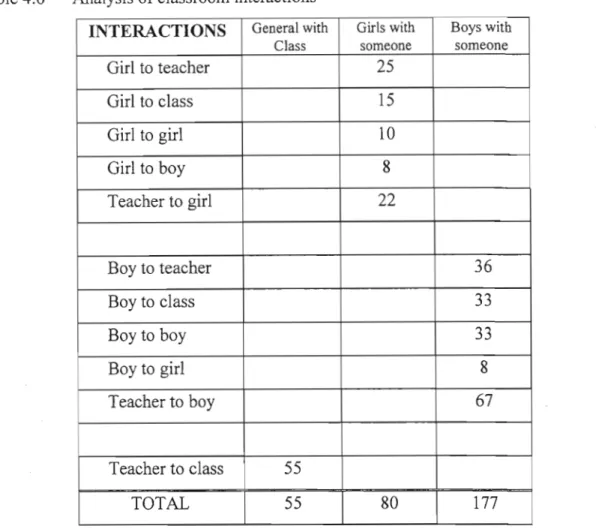
Cohen et al., (2000) state, "A structured observation is very systematic and enables the researcher to generate numerical data from the observation." The observation schedule was used to record how many times the teacher interacted with the boys or girls or how many times the students interacted with each other. As noted by Cohen et al. This method is useful to find frequencies or incidences of observed situations or behaviors so that comparisons can be made" (p.308).
After each lesson, I conducted a short informal interview with the teacher to get explanations for certain types of behavior observed during the lesson.
INTRODUCTION
THE QUESTIONNAIRES
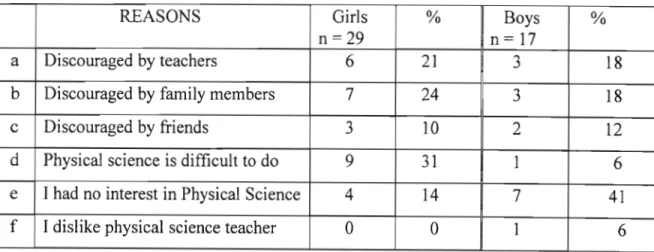
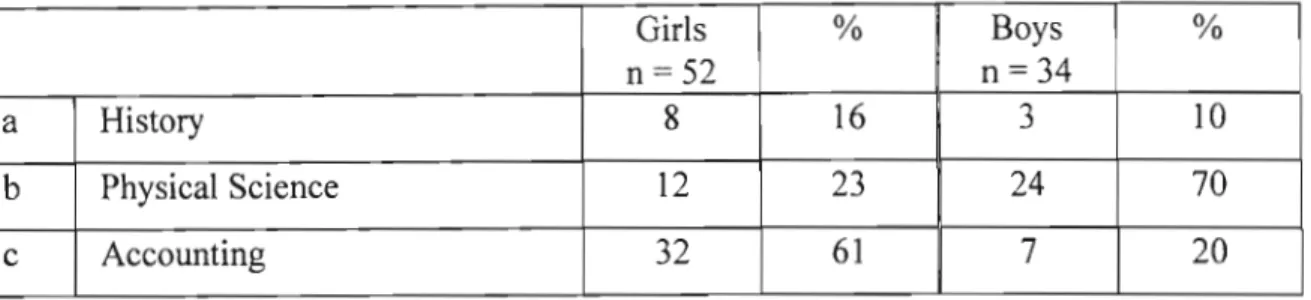
Non-Physical Science Students: These students have chosen not to study physical science in 10th grade. Students were asked to state a reason why they did not choose to study physical science in the 10th grade. 34;Physical science is difficult' was the main reason for girls, with 31% citing this reason, and 24% citing 'family members discouraging them'.
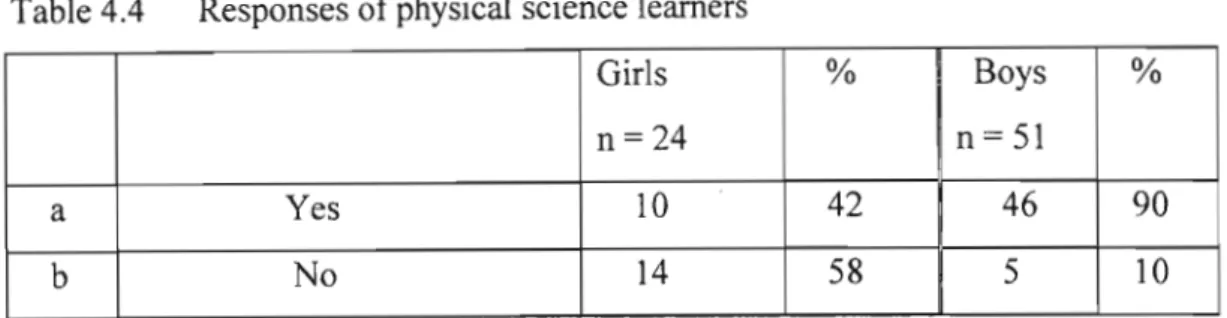
On the other hand, 41 % of boys indicated that they were not interested in Physical Science. Physical Science learners: Learners were asked if they were still satisfied with their subject choices (science package). From seventy-five questionnaires that were analyzed, 80% of the learners advised grade 9 learners to choose the physical science package.
INTERVIEWS
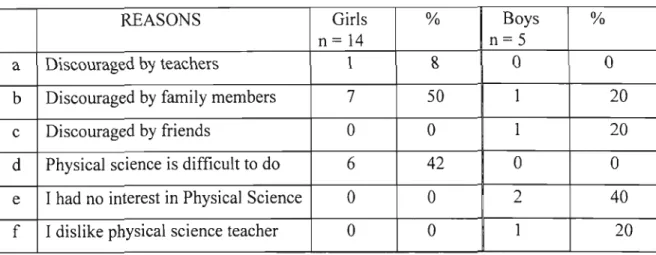
However, almost all would encourage students to take Physical Science. The findings on this question showed that both boys and girls were interested in the physical sciences. Physical science students: The interview revealed that both boys and girls enjoy student-student interactions, i.e. working in groups, especially in practical work. Non-physical science: Both boys and girls indicated that they received different treatment from each other in the classroom.
The interview questions sought answers regarding (a) students' attitudes toward physical science and (b) the influence of the classroom environment on learning. a) Students' attitude towards physical sciences. This is illustrated by the following remarks: "Girls generally have a less favorable attitude towards the physical sciences and tend to perceive it as a difficult subject". Most students reported that they believed that Physical Science was for all students.
CLASSROOM OBSERVATION
At the beginning of the lesson, the teacher referred to the section in the textbook that covered the topic and wrote the heading on the board. While the students were working, the teacher walked around, interacting with them, suggesting things to do and answering questions. Towards the end of the lesson, she summarized the lesson and gave the class their homework.
However, it is interesting to note that the teacher asked the boys proportionally more direct questions than the girls, that is, the teacher's bias against the boys fits her understanding that the boys are more active. The study could also have looked at how many times the science teacher interacted with the same student. In addition, the type of interaction could have been examined because there was a perception that the girls were shy and uncomfortable, while the boys showed confidence.
CHAPTERS
DISCUSSION AND RECOMMENDATIONS
- INTRODUCTION
- SUMMARY OF THE MAIN FINDINGS
- RECOMMENDATIONS
- LIMITATIONS
- CONCLUSION
Backer (1998), Haambokoma (2002), Kelly (1994) and Reddy (1998) cite the lack of female scientists as role models as a contributing factor to the low participation of girls in science. The classroom environment was one of the factors that contributed to the low participation of girls in science. They will also be more aware of the many career opportunities for women in science and better able to advise.
The findings provided some answers as to why the percentage of girls choosing science is smaller than that of boys and why girls are reluctant to participate in science. For me as a science teacher and the principal of a rural school, the study allowed me to contribute by raising the issue of girls' participation in science and some of the main factors that contribute to the current state of affairs to expose in a rural area. high. This gap between girls' and boys' participation in science and the reasons for it is a serious problem that needs to be addressed.
Helly (Eds.), Proceedings of the South African Association for Research in Mathematics and Science Education (pp.556-557). Lubisi (Eds.), Proceedings of the 10th annual conference of the South African Association for Research in Mathematics and Science Education, (pp. III- 93-98). Effects of cognitive development, age, and gender on high school students' performance in science and other subjects.
Helly (ed.), Proceedings of the l/hAnnual South African Association for Research in Mathematics and Science Education (pp.151-162). Proceedings of the 8th Annual Conference of the South African Association for Research in Mathematics and Science Education, (pp.504-51 0). Promoting Girls' Achievement in Science Subjects at Secondary School Level Uganda (Occasional Papef'No 1), 1-20, Department of Women and Gender Studies.
APPENDIX A
QUESTIONNAIRE
APPENDIX B
QUESTIONNAIRE NON - PHYSICAL SCIENCE LEARNERS
APPENDIX C
PHYSICAL SCIENCE) QUESTIONNAIRE
APPENDIX D
INTERVIEW SCHEDULE ( PHYSICAL SCIENCE LEARNERS)
APPENDIX E
INTERVIEW SCHEDULE
NON-PHYSICAL SCIENCE LEARNERS)
APPENDIX F
INTERVIEW SCHEDULE ( SCIENCE TEACHER)