by
CHRISTINE LUCIA
Introduction
Joshua Pulumo Mohapeloa (1908-1982) came from a third-generation Basotho family converted in the nineteenth century by the French-Swiss protestant Société des Missions Évangéliques chez les peuples non-chrétiens á Paris (SMEP; or Paris Evangelical Missionary Society, PEMS) (see Mohapeloa and Phakisi 2009; Gill 1993; Couzens 2003; Legassick 2010). The first three missionaries from PEMS had entered the world of the Basotho in 1833, one of them, Eugene Casalis, a “child of the Revolution and defender of the rights of man [who] helped build up the barricades in the revolution that overthrew the Bourbons” in Paris (Couzens 2003: 77). They were supposed to join a mission on the border of present-day Botswana, but John Philip of the London Missionary Society (LMS) under whose sway PEMS and other protestant missions fell, warned them of unrest, so they journeyed into the interior knowing that their plans might have to be changed upon their arrival at the LMS mission at Philippolis.
Here, the unrest and upheaval further to the north was confirmed, and thus the PEMS missionaries were very open to Adam Krotz who directed them towards Basotho Paramount Chief Moshoeshoe (Couzens 2003: 80). He had been fending off the gun- running and cattle-stealing Korana, and to help his task had already “sent to Philippolis to ‘buy’ a missionary”, as historian Martin Legassick puts it (2010: 235).
Missions have played a long and complex role in the history of southern Africa, their impact still not fully understood in relation to the development of music in the region. PEMS became the most important mission in what is now called Lesotho, its culture enormously influencing Mohapeloa as he grew up. This article traces some of the ways in which he managed to embrace its influence as a composer while retaining the integrity of the Sotho music that was the basis of his style, in the process laying down an archive of African song.
Mohapeloa, PEMS, and Lesotho
PEMS’ main mission station was established at Morija in the western lowlands, where Mohapeloa spent most of his life, and PEMS set up many satellite stations including one in Molumong in the eastern mountains, where he was born. (See Figure 1; Mokhotlong is the main town in this region.) The missions were staffed with both white expatriate
missionaries and Basotho. PEMS played a leading political role in Lesotho until after 1920 when it left political matters largely in the hands of the local educated leadership which it had trained while the mission gradually “handed over all remaining areas of responsibility”, a process completed in 1964 just before the country’s independence (Gill 1993: 191).1
Figure 1. Map of Lesotho showing Mokhotlong in the east and Morija in the west.
Courtesy Lonely Planet, http://www.lonelyplanet.com/maps/africa/lesotho (accessed 21June 2011).
Part of what I attempt to show here is that mission culture and infrastructure, including the Lesotho Evangelical Church (as PEMS became), were less hegemonic in Morija than they might have been elsewhere. Many other missionized peoples were subject to what the Comaroffs have called “the effort of others to impose on them a particular way of seeing and being, to colonize their consciousness with the signs and practices, the axioms and aesthetics, of [the] alien culture of capitalism in all its guises” (Comaroff and Comaroff 1989: 267). Lesotho has a predominantly farming economy, so the industrial culture of capitalism affected it largely indirectly, through the supply of migrant workers for the mines of the Witwatersrand (see Coplan 1992 and 1994). This huge migrant labour force impacted on Lesotho culturally, socially, and economically (and
1 Basutoland was established as a British High Commission Territory in 1868 to protect it against encroachment by Boer (Afrikaner) farmers of the Orange Free State, and became a British colony in 1884 (Couzens 2003: 297). The country gained independence in 1966. It is a kingdom entirely surrounded by South Africa. There were other missions in Lesotho, but none as important to its history as PEMS.
musically), but in many senses so-called ‘traditional’ culture still played a significant role, and PEMS did not seem bent on stamping it out. From whatever perspective one looks at their interaction with Basotho, as Stephen Gill points out (Gill 2009: 1-2), Basotho agency cannot be under-estimated: “Basotho, as any other people, were steeped in their own traditions, traditions that were multi-layered, evolving and elastic, and had the ability to sift, appropriate and adapt what was necessary from these new Christian and Western traditions at work in their midst” (ibid.: 5-6).
Mohoapeloa’s father, Rev. [Moruti] Joel Mohapeloane Mohapeloa held significant responsibility in the administration of the protestant church during the early twentieth century, “responsible, in addition to his clerical duties, for the oversight of all the PEMS schools situated over the whole Maluti (Drakensberg) area”, and being a composer himself “he organized large scale Music Competitions” for them (Huskisson 1969:
159). So Mohapeloa “grew up with song” as his brother Josias Makibinyane Mohapeloa puts it in a biographical sketch published after the composer’s death, singing “during evening family prayers” and singing the “compositions of other men in his area”
(Mohapeloa and Phakisi 2009: 4).
On top of this, Pulumo, the other children and other shepherds were able to entertain each other, they worked together. During their conversations, games and work that they did they were learning about the customs and traditions of Basotho. During many evenings, after eating, but before the prayer and going into the house, children told each other stories, folk stories, although on many occasions these were recited by the elders. There were also games that they played while sitting, especially when sitting around the fire, in winter.
Some of them were very old, ‘malataliana’ and others. There were those that we could say were contemporary, the ones that we may give the name of tongue twister … Other games were games for boys. That is when they were herding or in the kraal, having locked up the animals, having finished their herding work but before going home. Pulumo learned a lot from working with boys and men (ibid.).
At middle school in the Teachers’ Training School (Thabeng) in Morija, “music education was very important” (ibid.: 12), but Mohapeloa “did not just end up with the knowledge of singing and conducting only. He also studied staff notation [and]
was also taught how to play (piano) by Miss Florence Mabille” (ibid.: 13). He became fluent in tonic solfa, no doubt using the many solfa songbooks printed at the mission, which included Lipina tsa likolo tse phahameng, which translates as Songs of the higher schools (Morija Sesuto Book Depot 1907), and is still in print today.2 Its 98 unaccompanied choruses for S.A.T.B. give an idea of what the mission’s musical fare was, for Mohapeloa. It covers a range of eighteenth- and nineteenth-century music including the Huntsman’s Chorus from Weber’s Der Freischutz (under the title ‘Delay’
(Tieho)) and Beethoven’s ‘Creation’s Hymn’ (Tlotliso ea Molimo), together with
2 We know that he was familiar with this book because his transcription into staff notation of song no. 60, ‘Thapelo’ (Prayer) by Haydn, which is in the SAMRO Archive in Johannesburg (A04669);
and song no. 3, ‘Tlong Thaka’ (Come, Comrades) has been ascribed to him.
arrangements of Alpine folksongs, marches, and religious songs; indigenized by virtue of the way all texts were translated into Sesotho and all music notated in solfa. There were other songbooks, containing “compositions of other men in his area” mentioned above. Thus when he began composing in the 1920s, Mohapeloa joined a burgeoning tradition of African song composition in Lesotho (see Mohapeloa 1988(1935): 3).
The eclectic taste evident in almost 200 extant compositions left when he died in 1982 is broader than anything seen in Lesotho before or since; or in southern Africa as a whole. The output of Reuben Caluza for example, Mohapeloa’s famous older contemporary, is not as varied in style. Although Mohapeloa saw Caluza as “one of the main influences which caused me to feel like writing”, as he put it to David Coplan in 1978, he avoided imitating Caluza’s style because, he said, “it was all ragtime” (Coplan Interview 1978: In778 c.10).3
Morija
Morija in the nineteenth century was a typical mission station, with its church, training institute, bible school, bookshop-cum-publisher (Morija Sesuto Book Depot), post office, and printing press (Morija Printing Works).4 The oldest building in the village – indeed in Lesotho – is Maeder House (1843; see Gill 1995: 10), which for the last four decades of the nineteenth century housed the printing press. It gives an idea of what part of the village still looks like today. (See Figure 2.)
Figure 2. Maeder House, Morija. Photo by C. Lucia, 2006.
3 Anthropologist David Coplan interviewed Mohapeloa twice in 1978 when he was at the early stages of his research on Sotho music, and kept records of these interviews on field cards which he has kindly made available. They are an invaluable source, and I quote verbatim from them several times in this article, complete with Coplan’s abbreviations, which are idiosyncratic but self-explanatory.
4 Morija Museum and Archives also produces publications.
Most other missions in southern Africa are defunct, but Morija is still an important educational and religious centre, a village consolidated by the buildings and culture of education PEMS left behind, enhanced by newer institutions such as the Morija Museum and Archives, established in 1956. The Printing Works still produces educational publications including music songbooks and fiction for the whole country, and prints the weekly church newspaper Leselinyana la Lesotho (The Little Light of Lesotho) which keeps the local community abreast of international, national, and local news.
The mission and post-mission village environment may often have felt restrictive to Mohapeloa, but it provided a solid home base for his work. He was involved in the myriad tasks of a modernizing African village; he tended his own cattle and crops, raised a family, organized and conducted choirs including the ‘Baithaopi’ (Volunteers), wrote songs, and worked as a proof reader at Morija Printing Works. At the end of his life he also taught at National Teachers Training College (now the Lesotho College of Education) in Maseru (Eric Lekhanya pers. comm. 3 Feb. 2011).
Figure 3. Mohapeloa family portrait c1955. Photo courtesy Ntsiuoa Joyce Mohapeloa.
Figure 4. Mohapeloa’s choir, Baithaopi (Volunteers) in 1956.
Photo courtesy Leselinyana 89(42), 2, 15 October.
As a youth, Mohapeloa aspired to study medicine at the South African Native College in Alice, Eastern Cape; but he contracted tuberculosis in 1929 and was forced to leave the College (where he matriculated) since there was no cure for TB in those days. His daughter-in-law Ntsiuoa Mohapeloa describes the impact on him:
He told me that he was so sad about all that that he used to sit in the forest. Sit there, worry, being alone there. Then, he said to me, he would be listening to the birds chirping, you know.
Then he started to, you know, love nature, started to appreciate what was around him. He started to appreciate the countryside. He thought, ‘this is a wonderful country, I can write a lot about it’ (Interview: Ntsiuoa Mohapeloa, 28 Sep. 2006).
Such exposure at a critical point in his life attuned Mohapeloa to a degree most African composers are perhaps not attuned, to environmental sounds, and gave his music a special sense of place. “This place is the place which influenced him to be a great composer”, as one of his younger contemporaries, L.P. Phakisi put it (SABC 1989). I suggest however that his compositions embody a cultural task even greater than that of providing entertainment or representing the natural world: that of preserving African traditional music as a living heritage in/as, composition.
Mohapeloa’s songs and the ‘contamination’ of the mission
One hundred and thirty-seven of Mohapeloa’s songs were published during his lifetime by Morija Sesuto Book Depot, Oxford University Press, and Mazenod Institute. The rest are still in manuscript. The published collections are:
• Meloli le Lithallere tsa Afrika I [African songs and tunes]. Morija, Lesotho: Morija Sesuto Book Depot. 1st ed. 1935; last reprint 1988. [32 songs]
• Meloli le Lithallere tsa Afrika II. Morija, Lesotho: Morija Sesuto Book Depot. 1st ed.
1939; last reprint 1996. [32 songs]
• Meloli le Lithallere tsa Afrika III: Buka ea Boraro [Book Three]. Morija, Lesotho:
Morija Sesuto Book Depot. 1st ed. 1947; last reprint 1988. [28 songs]
• Khalima-Nosi tsa ’Mino Oa Kajeno [Shining examples of today’s music]: Harnessing Salient Features of Modern African Music. Morija: Morija Sesuto Book Depot. 1st ed.
1951; last reprint 2002. [5 songs]
• Meluluetsa ea Ntšetso-pele le Bosechaba Lesotho [Cries of approval about the development of the culture of Lesotho]. Foreword by Dibarata Ghosh. Cape Town:
Oxford University Press. 1st ed. 1976; out of print. [25 songs]
Some of his songs appear in other collections:
• Lifela tsa Sione [Songs of Zion], Morija: Morija Sesuto Book Depot, 1st ed. 1844; last reprint 2010. [Hymn 445]
• Hosanna: Lipina tsa Kereke [Hosanna: Church Songs], Morija: Morija Sesuto Book Depot, 1st ed. [n.d.]; last reprint 1955. [8 songs]
• Binang ka Thabo [Sing with joy] Mazenod: Mazenod Institute [n.d.]. [6 songs]
I call his compositions ‘songs’ because this is how they are referred to in the practice of ‘choralism’ as Grant Olwage (2003) has called it, involving millions of southern African peoples of many languages, traditions, and cultures. In the title of his three early collections (Meloli I, II, III) Mohapeloa avoids the usual Sesotho word for song, lipina, derived from ’mino, “an abbreviation of mobino, derived from the verb ho bina, to sing” (Wells 1994: 5). Many Basotho composers use lipina, but to emphasize the Africanness of his songs Mohapeloa devised the title Meloli le Lithallere tsa Afrika.
Meloli means ‘pleasant musical sounds’ (its root meaning is whistle, or the song of a bird) – according to my helpful translators Mantoa Smouse and Stephen Gill – rather than ‘melody’ in the Western sense. It is used here in conjunction with the idea of
‘nice songs’ or ‘adornments’ (from ho thallera, to adorn) or ‘beautiful embellishments’
(Mantoa Smouse pers. comm. Feb. 2009; Stephen Gill pers. comm. 28 Aug. 2011).
In one of many advertisements in Leselinyana for the Meloli series, the translation is
‘African Songs and Tunes’ (86(9): 3, 2 March 1953).
Mohapeloa only used ‘’mino’ once, for his 1951 songbook. In 1976, ten years after Lesotho’s independence, he decided on something more nationalistic: Meluluetsa ea ntšetso-pele … (Cries of approval about the development) ... le bosechaba’ (of the
nation). In the ‘Selelekela’ (Preface) to this book, Mohapeloa speaks of “rejuvenation”
and “reinvigoration”, and of how the music and words “uncover the Basotho customs which were oppressed by foreign customs” (Mohapeloa 1976: 13): still thinking in African terms, but with a newly patriotic awareness. “We tried to ‘Sothoize’ the music”, he says of this collection, “by ensuring that the melody of the song does not divert badly from the line of the speaking voice [and] by following Sesotho rhythm here and there, using assimilation and consonants popular in authentic Sesotho music” (ibid.).
His hybrid Western-African musical language may be seen as acculturated, written, as Gill puts it “according to the musical scales of the West, inculcated in him via his long exposure to the music of the missionaries [but also] captur[ing] something of the pentatonic scales and rhythmic complexity inherent in traditional Sotho musical styles” (1993: 193). The traditional or “authentic” as Mohapeloa calls it (1976: 13) is grafted onto a Western form. This seems to me somewhat more advanced than the way composition was in Lesotho before Mohapeloa’s time – the songs of his Basotho predecessors are almost overwhelmingly hymn-like. But solfa, which Mohapeloa used, does favour the major scale (d-r-m-f-s-l-t-d’) and is considered by some as challenging to the capturing of non-Western rhythms; and four part choralism was inculcated as the norm in mission schools.5
I prefer to see ‘the mission influence’ in Mohapeloa’s case as less hegemonic, but it has been seen so by others. I explain some of these negative views now in some detail, in order to explain later how my view differs. Choralism and tonic solfa notation arrived in southern Africa in successive waves throughout the nineteenth and early twentieth century, through the central role they both played in the non-conformist churches that drove many missions, including PEMS.6 Olwage has painstakingly traced the origins of this massive choral migration to Victorian Britain (2003: Ch. 1), its arrival in South Africa, its manipulation by education and the racialized “politics of hymning” (Olwage 2003: Chs. 2-5), and the kinds of compositions it spawned. I have noted elsewhere the rejection of African mission-derived composition by Western trained musicians (see Lucia 2008: 12-13). The following evidence lies behind my assertions.
Addressing the International Council for Traditional Music in 1954, Hugh Tracey sought support for his new International Library of African Music. This was to house field recordings of “eclipsed” traditional music, which he hoped would “fire the imagination of those African musicians who will help their people stand up to the vicissitudes of the industrial revolution which is sweeping across the continent”
5 As Coplan has shown, however, through the example of the political anthem “Nkosi Sikelel’
iAfrika” (Coplan 2008), one must be wary of equating hymn-like African song with mission- induced subservience.
6 The French and Swiss missionaries of PEMS would have been more familiar with the solfège system, in which doh (ut) is C, whereas the British solfa system (introduced by, for example, the LMS) uses a moveable doh. In Morija’s early songbooks a compromise was struck, probably on the basis of the widespread use of solfa (rather than solfège): songs in Lipina tsa Likolo for example are headed “Key G (sol)” or “key Bb (sib)”.
that had turned the “gay creative personality of [Africans’] own music” into a modern
“drab proletarian grey in imitation of others” (Tracey in Lucia 2005: 47). Observing the
“irreparable damage” done to traditional music by a combination of industrialization and missionization, Tracey made it his mission to record as much of it in sub-Saharan Africa as possible, before it disappeared into what he called “music of decay” where it became “eclipsed both by foreign prejudice and by indigenous gullibility”, or “music in reconstruction” exemplified by “[h]ymns for work songs, Victorian quartets for choirs, everything remade simple with tonic solfa” (ibid.).
A Departmental Inspector of Music, S.J. Newns, expressed his dislike of solfa as a compositional tool after adjudicating the Esther May Bedford composition prize at the South African Native College in 1936. “It must be insisted upon in future that the music be written in Staff Notation”, he said. “There is no picture of the pieces in sol-fa, and each note has to be read separately in laborious fashion” (Leselinyana 70(2): 2).7 The difficulty Newns experienced was perhaps due to his own lack of training. African composers would not share it; indeed Mohapeloa’s own view was that “[t]onic solfa is a boon, because when you write you can see what you’re writing, unlike staff” (Coplan Interview 1978: In778/2 c.7).
Musicologist and composer Percival Kirby complained that African composition
“is always composed after the European manner, and is based upon European scale systems and their accompanying harmonies” (1968: 276). To him this involved, as it did for Tracey, ‘loss’ through acculturation. For Kirby, even Ntsikana’s early nineteenth- century hymns showed signs that “European ideas had begun to ‘contaminate’
aboriginal music” (Kirby 1979: 86).
Ethnomusicologist Yvonne Huskisson described the effect of European part- songs, full of “contrapuntal intricacies and chromaticism” that were “revolutionary musical elements for the Bantu”, in similar terms. In the process of failing to master such elements, she claimed, composers (also) abandoned their indigenous culture:
“The advancement of the ‘indigenous’ was arrested and the ball of acculturation set in motion … Bantu individuality became unidentifiable, immersed in the inculcation of the essentials of Western civilization” (Huskisson 1969: viii). Recently, an article by ethnomusicologist Dave Dargie begins, “The view of Hugh and Andrew Tracey was that Christian Missionary activity of various kinds did considerable damage to traditional African music, trying to stamp out ‘heathen culture’ including ‘pagan’ practices of music and dancing” (Dargie 2009: 119).8
Thus was the acculturation of African composers like Mohapeloa seen in the
7 The £20 prize was awarded to M.M. Moerane for “an Album for the Young, comprising ten pieces for piano-forte” (ibid.), written in staff notation.
8 Dargie’s response as he launched his career in fieldwork was to try and “work within a dual frame of reference, encouraging African church musicians to bring their music into the church [and]
‘preserving’ as best I could (through recordings and other documentation) whatever traditional music I came across” (Dargie 2008: 119).
academy: doing irreparable damage to the traditional while not resulting in anything modern that matched up. There is something inveterately Romantic underlying such a discourse of loss and contamination, I suggest, which makes renewal possible only through re-inscription (via recordings, in Tracey’s case) of a genuinely unadulterated African folk music.
This is strikingly at odds with Mohapeloa’s own situation and experience. In the 1930s when his songbooks first appeared, his music would have been seen by Africans as Modernist rather than Romantic; indebted, as Grant Olwage has pointed out (2008), to discourses of New Africanism and American Negro revivalism prevalent among the Black intelligentsia of the 1930s. Modern here would not have meant Western or post-industrial, but African. “Black choralism’s engagement with folk music in the 1930s was a commitment to the modern”, as Olwage argues (Olwage 2008: 45), locating this engagement within the notion of a hybrid ‘Afro-modernity’ drawn from Guthrie Ramsey, in which black musical texts “critiqued, teased, and taunted” the boundaries of white modernism (Ramsey in Olwage 2008: 43). Mohapeloa used the word ‘modern’
in the subtitle of his 1951 collection, and although by then it meant something rather different – indebted to the jazz idiom – it shows him keeping up with the times, trying to be always in some sense contemporary.
Perhaps what Kirby and Tracey (in particular) perceived as the ‘teasing and taunting’ use of both Western and African music – contaminating both – is what really upset them. At any rate, Kirby and Tracey disapproved Mohapeloa’s aspirations, as a Western musician (in Kirby’s case) and a scholar of folk music (in Tracey’s). Mohapeloa’s four-year period of part-time study at Wits University (1939-42) while Kirby was Professor of Music there, resulted in nothing more than a few sections of courses taken up to second-year level (Wits Student Record, J.P. Mohapeloa, accessed 5 Oct. 2009).
He is not mentioned in Kirby’s memoirs, although Kirby’s many other ex-students are, and one would think he would have stood out if only as an African student (and an older man) among White students. Composer Stanley Glasser, an economics student at Wits at the time, recalls that Kirby and his colleague Pfaff “were highly impressed with Mohapeloa as a musical phenomenon, remarking on his musicianship, originality and imagination of his pieces and somewhat puzzled as what best to do for him” (Letter from Stanley Glasser to Christine Lucia, 8 Jun. 2009). They were unable to give him the benefit of the doubt to allow him to ‘qualify’ in any way, however.9
Tracey had no doubts. When asked by the Lesotho High Commission in London in 1968 for an opinion on Mohapeloa’s application for funds to do a study tour of composers and their use of traditional music in Kenya, Italy, Germany, England, and the USA, Tracey found that he could not endorse it. First, he said, Mohapeloa
“would benefit from a preliminary tour within Africa” for two years, and even after
9 For more detail on discrepancies between notions of qualification and on Mohapeloa’s relationship with Kirby, see Lucia 2007: 162-170.
that he would not be ready to go overseas, especially to the USA which “might undo any good work which he undertook on the African continent” (ILAM Hugh Tracey Correspondence Collection: file HTC-H051-01, folder ‘High Commissioner-006’).10 Tracey continues:
If he first becomes steeped in the music of Africa, from both a scientific and artistic point of view and gains experience in instrumental music, freed from his present leanings towards the mixing of African and European musics in his compositions, then, I would be the first to encourage him to go to America and attempt to recognise in the work of the Negroes, some vestigial remains of African musical culture. However what remains in America is very slight, and Negroes have, for the most part, done what so many others have done in Africa, and that is attempt to copy, as far as possible, the music of the Whites. It is clear that Mr. Mohapeloa is not in the nightclub, popular entertainment world which is the speciality of the Negro people, but it is a serious mistake … personally I feel certain that he has a great work to do if he can rid his mind of some of the notions which have confused his output during the last few years, and he may yet become an important contributor to Sotho Music (ibid.).
Aside from the irony of Mohapeloa’s knowledge of African music not being ‘scientific’
enough, when he grew up with it and knew it well enough to quote in his compositions (as I show below), Tracey’s opinion reflects an uncomfortable contemporary (1960s) segregationist view of African and Western: an example of the way an African intellectual’s “ethnic consciousness” in the 1930s had eventually, decades later, played directly into the hands of apartheid politics (Olwage 2008: 39-42).
So it was a no-win situation for Mohapeloa in the establishment: not African enough for Tracey, not Western enough for Wits. Yet his reception by African communities – in and far beyond Lesotho – was very different, as can be seen throughout the pages of Leselinyana, and from repertoire of songs by Mohapeloa choirs have continually chosen over the past eighty years. His music “was well received, it received good fame”
as his brother tells us (Mohapeloa and Phakisi 2009: 22). Moreover:
In 1937 Pastor E Sehloesing, one of the leaders of PEMS in those days, when he came back from Lesotho where he went to observe the standard of service of the church in Lesotho, he wrote about what he had learned mentioning that amongst the Basotho composers Mohapeloa was the best. (Journal des Missions, 1937, 29.) Also the fact that the second book was published in 1939, meant that the composer was active, encouraged by the good welcome of his work. With regards to what contribution the book Melodi I made to composing in southern Africa it is difficult to be selective. It needs to be looked at in the light of his compositions in general. However, singers, choir conductors as well as composers knew Mohapeloa’s songs and their structure; this did not end up in singing and directing of his songs, it went to their compositions as well (ibid.: 22-23).
10 I am grateful to Paulette Coetzee for drawing this correspondence to my attention.
Throughout southern Africa he is recognized for a hybridization of choral music in which Sotho music, language, and rhythm are very much to the fore (see for example Gosh 1976: 11-12). How did he accomplish such a hybridity, where Sotho traditional music is often re-imagined for four-part choir? By taking particular motifs, phrases, rhythmic patterns, modal scales and harmonies from authentic Sotho music including whole songs; and by using popular Black music of the 1940s (especially in his 1951 collection), as well as some aspects of cadencing and chord usage from mission- influenced hymnnody, elements of Western (especially Swiss) folksong, and traces of Western classical music. He combined these diverse elements without undue strain, I suggest, because of the kind of environment he grew up and spent his life in.
Mohapeloa’s Africanness subsists both in his own claims and in his music, so much so that I would argue that his songs as a whole can, in many creative and diverse ways, be seen as an archive of African music, written down in tonic solfa notation.
Solfa song as archive
Mohapeloa’s archive of song indexes not only traditional song as a continually renewing and transforming tradition (using tunes and folktales known to his contemporary communities), but also the sonic environment. His music is full of birdsong, animal noises, descriptions of people going about their daily rural or urban business, descriptions of villages, towns, rivers, mountains, weather, etc. The songs are short – often between one and four minutes long – and are ‘sonic snapshots’, recording experiences that go beyond a limited notion of song as genre to capture collectively 50 years of Lesotho’s history. They move back and forth across wide geographical terrain (rural and urban Lesotho and South Africa) and many social issues and individual experiences. They document rural life in contrast to the life of migrant workers on the mines (sometimes idealistically), and bring out the hardships of contemporary, modern Africa. “Meluluetsa” is dedicated, for example, “To the young generation of the Basotho, who can defy divisiveness and face the challenge Lesotho ‘m’a Basotho has offered to eradicate poverty, ignorance, soil erosion, disease, and fear” (Mohapeloa 1976: [6]).
The fact that his archive is creative work rather than field recordings makes it a living archive, open to interpretation as work. Choirs can (and do) adapt songs according to context, repeating sections, changing voices, transposing keys, modifying tempi and dynamics: examples of this can be heard on some of the several hundred recordings choirs made of Mohapeloa’s songs at the South African Broadcasting Corporation between 1961 and 2003.11 Even though the music appears fixed by notation, it is fluid, open to different possibilities, like any score; as Mohapeloa argued in fact, in the case of solfa. “Tonic solfa has more flex. to allow them to sing as they think right”, Mohapeloa
11 These are housed in the SABC Sound Archive in Johannesburg, and I am grateful to sound archivist Refiloe Jele for providing access to them.
told David Coplan, “esp. using semitones when [they] feel like it – they are not written – you have variability in creating your part because too much is not written in” (Coplan 1978: In778/2 c.7). The idea that semitones are “not written” in solfa while they are in staff is an interesting one since strictly speaking, they are (soh can be sharpened to se, or flattened to sa or ba as it is often called), but clearly Mohapeloa knows how choirs will interpret them, singing somewhere between soh and se, for example, or using glides typical of some traditional song. He knows, in other words, how the documentation of music that his scores embody will be read.
These are documents even great folklorists such as Hugh Tracey could not produce.
Nor would he want to, because they would be contaminating ‘the original’ that could only be fixed through sound recording. The nature of Mohapeloa’s archive makes it unlike recording, which fixes one performance for all time. In addition to establishing a new model for composition, then, Mohapeloa also established an African framework for preserving older music, one in which there was scope not only for interpretation but also for ongoing renewal of traditions seen as mutable.
In the ‘preface’ to the 1953 reprint of his first volume of songs (1935), which he calls
‘Khoro’ (Gateway or Entrance) and which is written in Sesotho, Mohapeloa explains his music’s links to the traditional. The preface begins with the word ‘Khoro’ itself:12
An eloquent young man jumps to the side, stepping out of line with the other dancers, with his nostrils wide-open and the corners of his mouth turned downwards. He positions himself in front to start a song, using the language of the honourable. He must concentrate so that his feet, hands and all the parts of his body can synchronize with what comes out of his mouth; he may not make a mistake with his singing or start with the wrong foot and cause the group to become confused and do the wrong things. This part of the mohobelo,13 when the starter starts creeping slowly back on his buttocks with a skill only known to him, then followed by an uproar, happiness, and agitation, is called an ‘entrance’ [khoro]. We use this word as a preface for this book containing songs for entertainment.14 We do not oppose the name ‘preface’ [selelekela], which is viewed and accepted by all those who speak Sesotho as an introduction of any Sesotho book. However, mohobelo was once the major form of entertainment at Moshoeshoe’s place, so we help ourselves to a name that is associated with it, in order to show how proud we are of being the grandchildren of the great dancers of Lesotho (Mohapeloa 2009: 3).
Referring to composers in Lesotho a few lines later, Mohapeloa says, “as long as all their songs are published, the case of African Music will be made in the right place, kept for the coming generations, as an example that they can follow or a place to start when investigating about what proper African music should be”. African traditional music
12 Translations of Sesotho texts in this article were done by Dr Mantoa Rose Smouse, whose assistance is gratefully acknowledged.
13 A dance-song performed by Basotho men, associated with paving the way for important people:
chiefs, or the king.
14 Lit. ‘songs for feasts of entertainment’ (lipina tsa mekete ea boithabiso).
can be preserved for future generations in tonic solfa songbooks, in other words, which then become a place to not just start but keep investigating what African music is or
“should be” in composition.
Mohapeloa’s upbringing had taught him well enough that the ‘traditional’ is dynamic: traditional being for him a concept in the present used in order to deal with the past. As scholar of Sotho music Robin Wells, puts it, speaking of his reasons for using the phrase ‘established canon’ rather than ‘tradition’: “‘tradition’ refers to a set of practices, objects or values selectively mobilized in the present in an attempt to re- establish notions of identity using resources from the past”; it is a “created concept”, says Wells, “providing people in the present with a constructed access to the past”
(Wells 1994: 2).
How, musically, does Mohapeloa make the case for a constructed access to the past,
“selectively mobilized” in the present? The best-known song from his first collection is No. 1, U ea kae? (Where are you going?), and I have analysed it elsewhere (Lucia 2008:
14-20 and 2007: 166-70) showing how he composed its two sections. He explained this to Coplan, who noted: “The staggered entries of the parts are an imp. Af. feature”.
1st note is accidental that keeps tone tune rela., some adulteration to fit correct tonic-solfa structures, depart from true Sotho melodic pattern. 1st phrase in song was composed by Mohapeloa, but main theme (“u ea kae”) is trad. Intro is attached to make it relevant to his own Bataung clan - famous for farming. Actual comp. is based on what he heard people singing when he was recovering from TB. In Intro., Taung can be replaced by any place name. The melody of the main section is the bsis – the harmony is not strictly African, but based on his imperfect knowl of West. har. at the time. Conclu has church feeling with hymn harmony: idea of formal ending added for beauty accord. to western concept of aesthetics (Coplan 1978: In778/2 c.3).
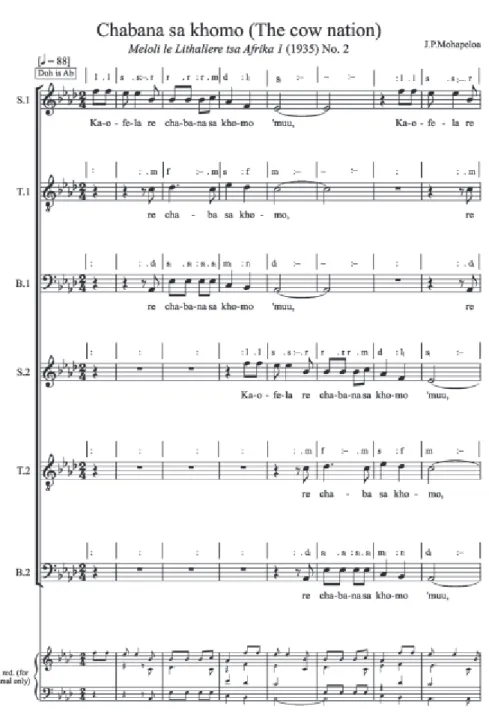
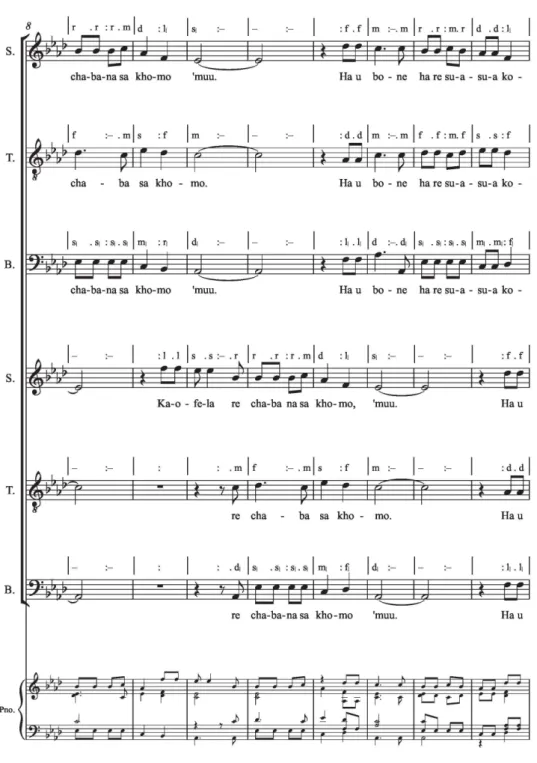
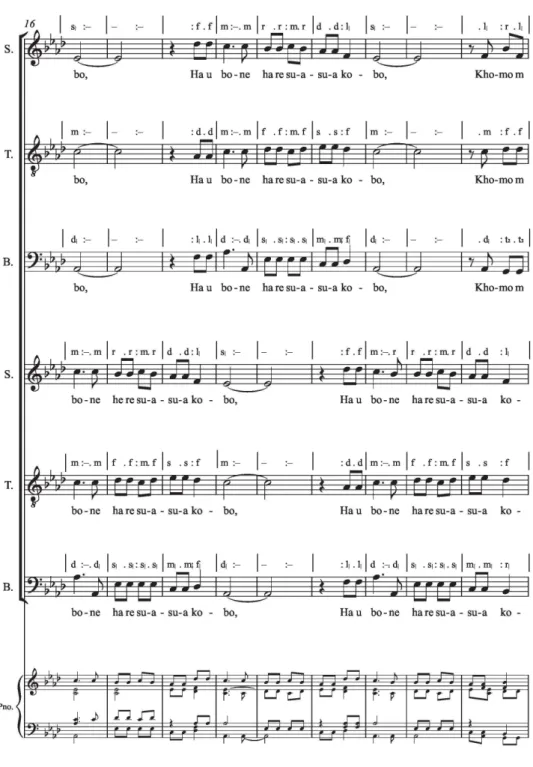
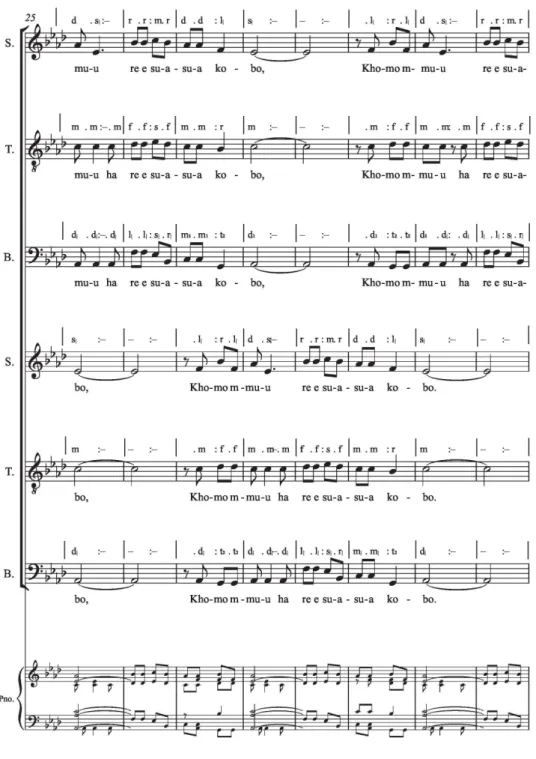
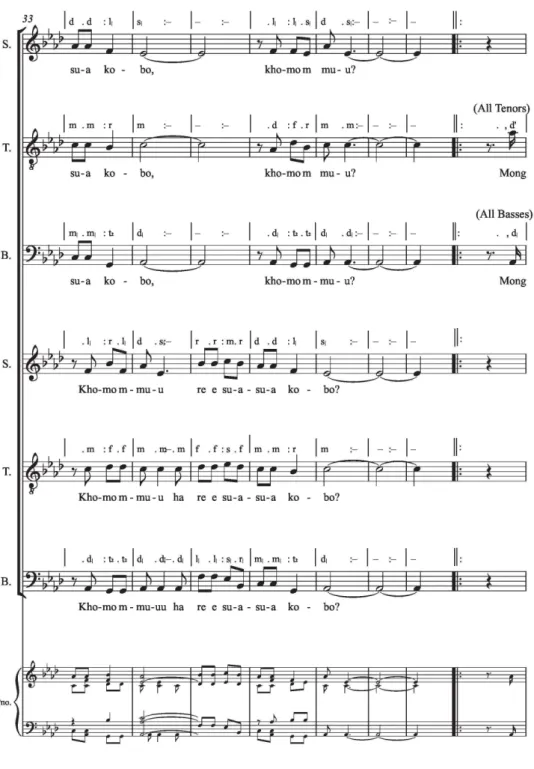
A similarly constructed synthesis is evident in Chabana sa khomo (The cow nation),15 the next song in the same collection. The 1st phrase (again) was almost certainly composed ‘in traditional manner’ by Mohapeloa, but the main theme, the refrain
‘Mong’a kobo’ (Owner of the hide/ blanket) is a folksong – collected by Hugh Tracey in the 1930s or ’40s.16 I show the text of this song in Figure 5, followed by the first page of Mohapeloa’s tonic solfa score in Figure 6, then my transcription of the whole song in dual staff-solfa notation in Figure 7.17 The folk version and a 1936 recording of the composed song are given on tracks 1 and 2 of the accompanying CD.
15 Cows are the major currency in rural southern Africa by which family rituals (especially marriage/death) are solemnized and people/families who were not necessarily related are brought into close relationship.
16 ‘Kobo’ is a blanket made of tanned cow hide.
17 The transcribed score has a piano reduction to give those who do not read a six-part choir score easily a ‘picture’ of the music.
Chabana sa khomo The cow nation
Kaofela re Chabana sa khomo, ’muu, All of us are a cow nation, moo,
All we nation of cow moo
Ha o bone ha re e sua kobo, Can’t you see when we soften the hide,
Not you see when we it tan blanket
Khomo mmuu re e suasua kobo, The cow goes ‘moo’ when we tan the hide,
Cow moo when we it tan blanket
Mong ’a kobo bohlajana, The owner of the hide is clever,18
Owner of blanket clever
He, h’a ntše, h’a ntše masuakobo; Hey! While some are still softening the hide;19
Hey while still while still skin-tanners
H’a ntše, masuakobo. While they keep softening.
While still skin-tanners
Hom, hom … (Humming).
Figure 5: Chabana sa khomo (The cow nation – or The small nation of the cow), translated by Mantoa Smouse (literal translation in small type on the left).
18 Implying that the owner is clever to be watching other people working so hard for him.
19 Stephen Gill suggests the phrase ‘h’a ntše’ might rather mean ‘not taking out’ i.e. not paying the workers (other than in food/drink).
Figure 6: Chabana sa khomo, first page of tonic solfa score (Mohapeloa 1988: 10).
2
Chabana sa Khomo
DY Ab S.T.B.S.T.B.
:1 .1 s .s
Ka-o· fe· I•
: -
,_
: - r .r :r .n d
cba· ba • na sa kbO f :-.n
•
cha ba sa
So ·•o :s, .So Mo eha· ba-na
..
kholo :-
•muu.
"
:-mo.
do : -
'muu.
s .s :-.r r .r :-.r
,.
·" ..
.do te
:1 .I
Ka•n•
:1, mo :f
:r, kho IDO
: - : - : - :r
"'
fe • ha
..
cha-ba -na sa·" ,.
f cba :-.1'1 ba .do re chaSo -.s, :.s, ba·na••
••
r .r :r 4 :1,
cba-ba · oa kho
,..
f :-
•
:fcha So ·•o
.
:s,..
Mo :ro khocluha • na kho mo :I ,I
Ka·o·
8
••
: -.l~ r .r :r'"
fill• ••
,, ,.
cba·ba · na••
f
:-."
••
cha ba• Cit So ·•o :a • • so
••
cha· bt·na..
So : -
,_
"muu,
M :-
,_
mo,
do : - : -
'mi.)U,
:f .t~ M : -
·"
Ra
"
bo nc:d .d
"
: -""
:1, .llo d :-.d.,
d :1, So :-
kho mo, 'mu.u,
s :f M
,_
..
no :t, kho mo . d, :-kho mo •muu.
10
So : -
'muu,
M : -
mo,
do
.-
'muu,
• ••
:-.rfe. Ia
.... , .
, .
.do
..
d :1,
kho mo
•
:f..
no :r, kho.kho mo :I .I
Ka· o·
r .r
'"
.rba
..
•u- •·f ,f
'"
.f••
·•o ISo ·•o,_
:-
,_
Figure 7: Chabana sa khomo, transcribed by Christine Lucia into dual staff-solfa notation (page 1 of next 7 pages).20
20 No tempo markings are given in the original solfa score. On the 1936 recording the first section and bars 46 to the end are sung approx. crotchet=88, with a faster tempo in bars 39/ii to 45. These indications have been added to the score as editorial suggestions in square brackets.
Figure 7: Chabana sa khomo, transcribed by Christine Lucia into dual staff-solfa notation, p. 2.
8
I r . r : r . m I
d · 11I s
11- ·
f fI m ·- m I r r · m r I
d d · 11f1 1""'"""1 ~ -
s.ffi~~~~~~~~~
.,;... ..._.., ...
T.
B.
f1
s.
.,;
f1 T.
~
B. :
fl
Pno.
{ ~,
cha-ba-na sa kho-mo 'muu. Ha u bo - ne hare su-a- su-a ko -
:- .ml s
:f :-1-
:-cha ba sa kho - mo.
I
Sl • Sl : Sl • SlI
ffil : fl--
cha-ba-na sa kho-mo
1- : -
I
:1 .1.._:;t'
:-
1-
..._..,
'muu.
:-
Is . s :- . r
~I r
~: r . m I
d...
: d . d
I m :-. m I
f . f :m.
fI s . s :
f-
Ha u bo - ne hare su-a - su-a ko -
--
Ha u bo - ne hare su-a - su-a ko -
:11
I
Sl : - 1- : -I
: r. r 1-~
Ka-o - fe-la re cha-ba nasa kho-mo, 'muu. Hau
1- : -
I
:I
:.m lr :- .ml s
:flm
: - 1- : -I
:d. d-
1-
re cha - ba sa kho- mo. Hau
1- : -
I
:I
: -~I
Sl • Sl : Sl. SlI
ffil :tilI
d1 : - 1- : -I
:11.11 1._ re cha-ba-na sa kho-mo
-
... 'muu. -..._-- Hau-
..rJ ~ I-
r---1-
r---1i: _.. r
i f f
t.r r:
f-c...ru
L I i.J .), .J. .), ~ _(I J ~
-
j"'jI I" I r I ~
Figure 7: Chabana sa khomo, transcribed by Christine Lucia into dual staff-solfa notation, p. 3.
16
I s1 1- · f f I m :-. m I r r · m r I d d ·I1 I s1 1- · r l1 I
,fl ~ - ~
s.r~~m~~~~m~~
.,; -~...
-~T.
B.
fl
s.
.,;
fl T.
~
B. :
bo, Hau bo-ne haresu-a-su-ako- bo, Kho-mom
I m :-
1-
:-: d. d I m :-. m I f . f : m f I s . s : f I m :- 1-
:- 1 .m :f .f 1-
bo, Ha u bo-ne hare su-a- su-a ko - bo, Kho-mom
:- :-
I .
~ :u .uI
- - ---
---
bo, Hau bo-ne haresu-a-su-ako- bo, Kho-mom
I m :-. m I r . r : m
,....,... r
1d . d: -~~
bo-ne here su-a - su-a ko -
I m:-.m If . f:mf Is . s: f
bo-ne
1
d ::.d1
bo-ne
hare su-a - su-a ko -
I
Si • Si: Si. SiI ffil.
IIll fi- i
--
hare su-a - su-a ko -
r nn
l...Jr
j"'j
I
Si : - 1- : -I : f . f I m :-. r I r . r : m
~ ,....,r
1d . d :II
--- ... -
bo, Hau bo-ne hare su-a- su-a ko-
lm :-
1- : -I : d. d I m :-. m I f .f:mf Is . s :f
-
bo, Hau bo-ne hare su-a- su-a ko-
1
d1 :-
1- : -I :11 .Ill d :--;dl I
Si • Si : Si • SiI ffil . ffil : fl
--- -- -
bo, Hau bo-ne hare su-a- su-a ko-
-
uu
l...J rj"'j _I
-
~ LJI
I
I
Figure 7: Chabana sa khomo, transcribed by Christine Lucia into dual staff-solfa notation, p. 4.
25 d s1 ·- I r r · m r I d d · l1 I s1
1- ·
r l1 I d s1 ·- I r .:!. · m r Ifl ~- - ~ 1'""""1
s.fft~~~~~~~~~
.,;...
~...
fl I T.
~
I B. :
fl L I
s.
.,;
fl T.
~
B. :
mu-u re e su-a - su-a ko - bo, Kho-mo m- mu-u re e su-a-
m .m:-.mlf .f:s.fl m .m : r lm : - 1- : - I .m :f. f I m . m: .mlf.f:s.fl
I
...
-
mu-u ha re e su-a - su-a ko - bo, Kho-mom- mu-u ha re e su-a-
dl . dl:-. <iJ Ill . 11 : Sl . fl I ffit. ffit : u ldt : - 1- : - I .dt : u. u 1 dt . dl: . dl Ill .11: Sl. fl I
"""""
-
"""""~
mu-u ha re e su-a - su-a ko - bo, Kho-mom- mu-u ha re e su-a-
Sl : -
1- : - I
..._..
bo,
lm : - 1- : - I
bo,
1 d1 : - 1- : - I
..._..
bo,
-
I' I I'
.11 : r .11 I d .Sl- lr .r :mr 1 d . d
"""""' 1""""1
... -
Kho-mom-mu-u re e su-a - su-a
.m : f . f I m . m-. m I f . f : s . f I m . m
Kho-mom-mu-u ha
. dl : u .u 1 d1 . dr-. dl
Kho-mom-mu-u ha
L.r J
I' 1 r
...
re e su-a - su-a
l11 .l1:s1.r1 lm1.m1
"""""
-
re e su-a - su-a
-
:11
ko -
: r
I
ko -
:u
ko -
L.r J
I Sl : - 1- : -
..__...
bo.
lm : - 1- : -
bo.
l<i! : - 1- : -
..__...
bo.
...
r 1 I'
I
I
I
Figure 7: Chabana sa khomo, transcribed by Christine Lucia into dual staff-solfa notation, p. 5.
33 fl
ld d ·l1 I Sl ...
1- II·l1 Sl I d 81"-
1- : - 1-II·
s. :
.,; - - _ . . - -_...-..._--
su-a ko - bo, kho-mom mu- u?
(All Tenors~
fl
lm.m : rl lm
: - 1- : -I .d :f .r lm .m:-1-
: - 1-II:
··~T. :
~ su-a ko
-
- bo, kho-mom mu- u?-
Mong(All Basses
lm1.m1
... :uI d1
: - 1- : -I . dl
: u .u 1d1 .dl:-1-
: - 1-II: 'dl I
B. : :
-
- - _ . . ---
-_...-..._--su-a ko - bo, kho-mom- mu- u? Mong
fl
I
.II: r .11 I d .
s~-I r .r :m.r ld .d
:III Sl
: - 1- : - 1-II:
"""""' ~
-
s. :
.,;
...
-~.._,.-Kho-mo m- mu- u re e su-a - su-a ko - bo?
fl
I .m : f .f lm .m-.m lr .f:s.flm.m : r lm
: -I
- .- 1-II:
I
T. :
~ ...
Kho-mo m- mu- u ha re e su-a - su-a ko - bo?
.- 1- :- 1- . dl :
u . uI dl .
dl-. <iJIll . 11 : Sl . fl I ffil . ffil :
u~
-
B.~:~~~~~~~~~:~
~---
Kho-mom- mu-uu ha re e su-a- su-a ko - bo?
.J ,...,
.
t....r u.~
n
Figure 7: Chabana sa khomo, transcribed by Christine Lucia into dual staff-solfa notation, p. 6.
40
(All Sops)
I1 I r I1 ·I1 I1 I d d ·I1
[a tempo]
I1 I r I1 ·I1 I1 I d d ·I1 I I
fl . ' ~·· .,
~ . ' ~·· .,
~
s.
.,;
Mong 'a ko-bo bo - hla-ja- na, Mong 'a ko-bo bo- hla-ja- na,
fl Is .,m:m .,m r
I :- ,d lm : · : I s .,m:m .,mlr
1
: . 'd lm .. ,d II :m I
T.
..
~
-
...-
...'a ko-bo bo- hla - ja- na, Mong 'a ko-bo bo- hla - ja- na, He, h'a ntse,
lm1 .,d1 :d1 I : I . . ,<I! lm1 .,d1:d1 I : I .. ,h lm1 :m1l B. :
'a ko-bo, Mong 'a ko-bo He, h'a ntse, •
f'l
{ v'
l.J c....J r··
v
r 7 l.J c....J i 7v
r 7 7'v
rPno.
47
fl L ~-~ ~ ., ..
1"""""1
s.
.,;
-
h'a ntsema- su-a-ko-bo; h'a ntsama - su-a-ko-bo. Ho-m, ho-
fl I
~
: s ,mlr .r:d .d II 1""""1 1"""""1 :m II~ : s ,m I r I :d .,dIm :d---
lr : - I T.~ h'a ntsema- su-a-ko-bo; H'a ntse, h'a ntsema - su - a. Ho-m, hom,
I fl :-
1-
:<I! ,d11
~. . h: 82 . S2lm1 :m1 lr1 : -1-
: dl ., <I! lt. : 82 ., dll a...;J!ll I r1 : - I B. :- . ... - . ....
h'a ntsema- su-a-ko-bo; H'a ntse, h'a ntse rna- su - a. Ho-m, hom,
f'l J - - J p:--, J - - J p:--,
{ v'
1 - T W"·
u u
I r 1 - 1 W"·r
t...J r f IPno.