The researcher conducted a literature review on the evolution of the clothing industry, internationally and locally, the emergence of the CMT factory in Durban and the key aspects that influence CMTs in their current environment, including but not limited to;. The absence of minimum price regulation on the cost of garments allows CMT distributors to outsource orders to the cheapest CMT.

Introduction and overview of the study
- Introduction
- Problem Statement
- Background of the Study
- Significance of the Study
- Overall Aims of the Study
- Specific Objectives
- Limitations of this study
- Research Methodology 1. Research Design
- Population and Sample
- Instrumentation
- Data Analysis
- Chapter Outline
Netshitomboni (1996) and Gannon (2002) provide a historical analysis of the garment industry, the rise of the CMT factory and the factors that have shaped the garment industry into its current structure. This study will highlight the factors that are proving challenging for CMT employers and will provide a useful insight into the CMT business from the perspective of the CMT employer.
CMTs and the evolution of the clothing industry
- Evolution of the global textile and apparel industry
- The Background of the Clothing Industry in Durban
- Cut, Make and Trim (CMT) Factories: A history and description
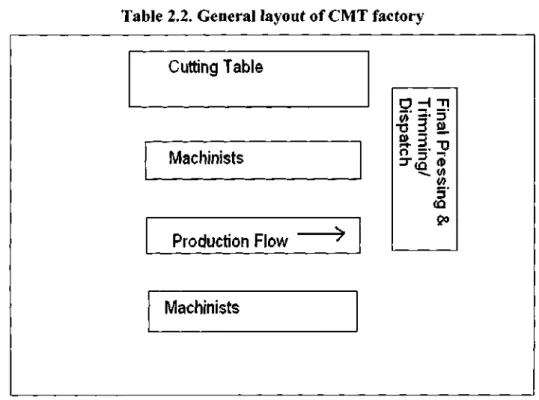
- Layout of CMT factory
- The rise of atypical forms of employment in order to remain competitive To keep up with a competitive environment employers have incorporated a concept
- The social effects on women
- Policies influencing the clothing industry
- Conclusion
More often than not, the owners of the CMTs were once employed in the garment industry (Netshitomboni, 1996). This recommendation took effect in the form of the Regional Industrial Development Program (RIDP) of 1987 (Netshitomboni, 1996).
Challenges facing CMT Employers
- Introduction
- Absenteeism
- Investment and technology
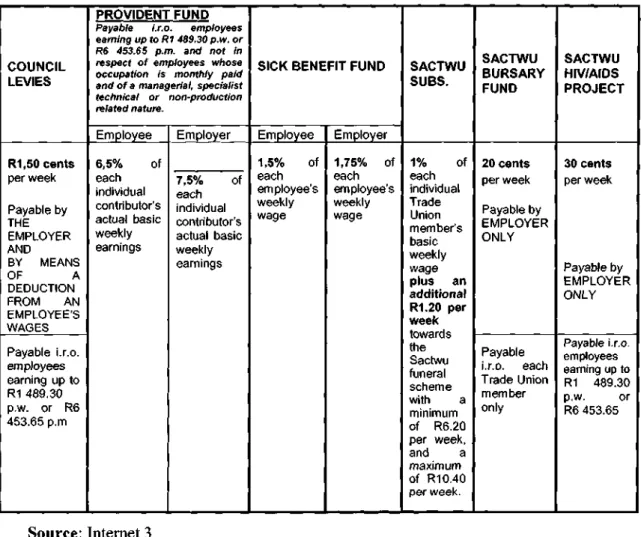
- Labour Market, Regulation and CMTs
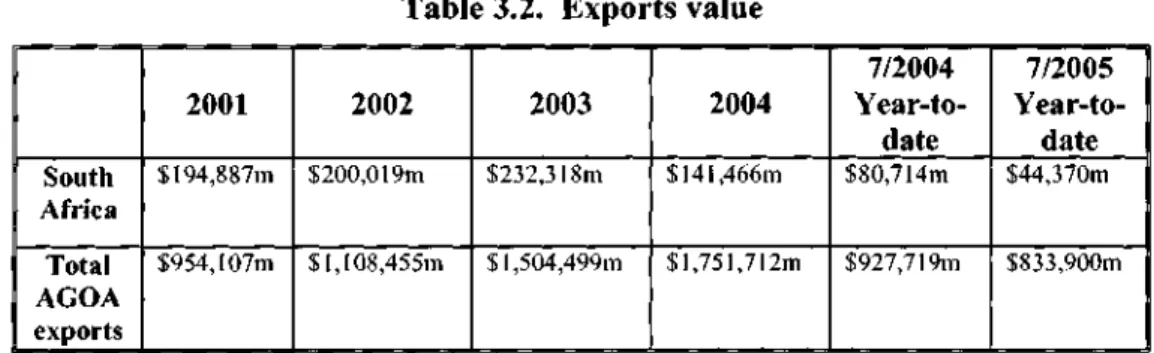
- National Policy and Trade liberalization
- Appreciation of the Rand
- Cheap Imports
- Skills base
- Innovation and Design Capacity
- Firm-Level Competitiveness
- CMT Distributors
- Conclusion
Later, a skills development strategy came into place in the form of the Skill Development Act, 197 of 1998 (SDA) and the Skills Development Levies Act, 9 of 1999 (SDLA). The consequences of the apartheid era remain in terms of the lack of investment in training and development of the black workforce. It is clear that there is a need for investment in competence development in the clothing industry (Vlok, 2006).
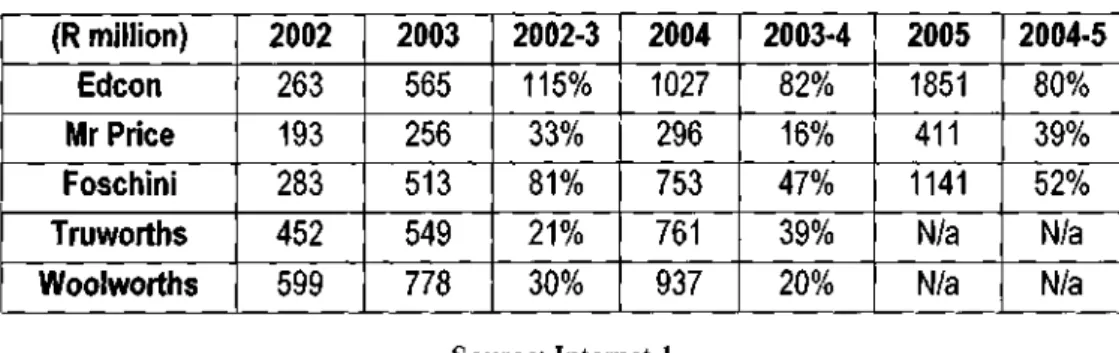
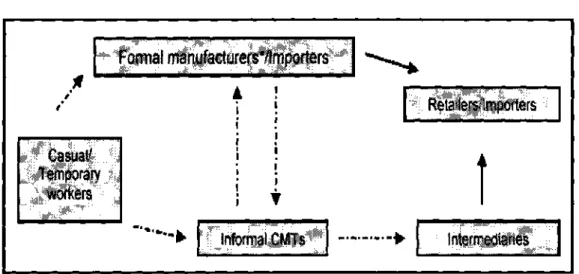
The unequal distribution of power in this relationship can be seen in the net returns where garment manufacturers, in the production of garments (determined by sellers), receive only about four percent while retailers receive about one hundred and fifty to two hundred and ten percent percent of clothing sales which may be higher when considering the cheap imported clothing sold by these retailers (Salinger et al, 1999).
Research Methodology
Introduction
Focus of the study
Objectives of the study
Sampling Technique and Description of Sample
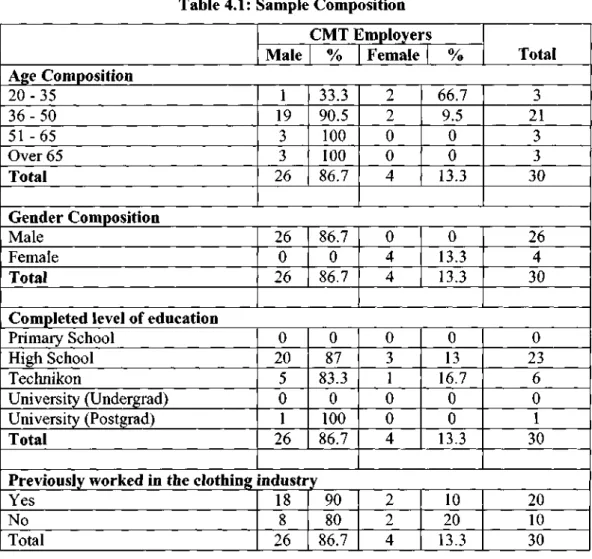
- Composition of sample
Probability sampling is when 'the elements of the population have some known chance or probability of being selected as sample subjects' (Sekaran, 2003: p 269). Non-probability sampling is when "the items do not have a known or predetermined chance of being selected as subjects." (Sekaran, 2003: p. 269). The advantage of area sampling is that it is cost effective and it is useful to establish the position of individuals in a particular locality.
The difficulty with area sampling is that it is not that easy to collect data (Sekaran, 2003).
Data Collection
- Description of Questionnaire
- Pilot study
- Data Analysis
- Descriptive statistics 4.5.3.1 (a) Frequencies
The central tendency of a distribution is an approximation of the middle of a distribution of values (Internet 4). Another measure of central tendency is the median, which is the middle of the distribution or the 50th percentile. According to Sekaran (2003; p. 398), the standard deviation 'provides an index of the spread of the distribution or variability of the data.' The standard deviation can be calculated by taking the square root of the variance (Sekaran, 2003).
Variance is a useful way to describe sample variability and is an extremely good index of the degree of dispersion.
Criteria for evaluating measurement 1. Reliability
- The test-retest method
- Internal consistency
- Validity
- Face validity or content validity
- Criterion validity
- Construct validity
- Sensitivity
However, the range does not take into account all observations, as it only highlights the extreme values of the distribution. As such, the coefficient is called the internal consistency or the internal consistency reliability of the test (Internet 5). When a measure is considered to provide suitable coverage of the concept, it is considered face validity (Zikmund, 2000).
Criterion validity is defined as 'the ability of a measure to correlate with other measures of the same construct' (Zikmund, 2000: p. 282).
Conclusion
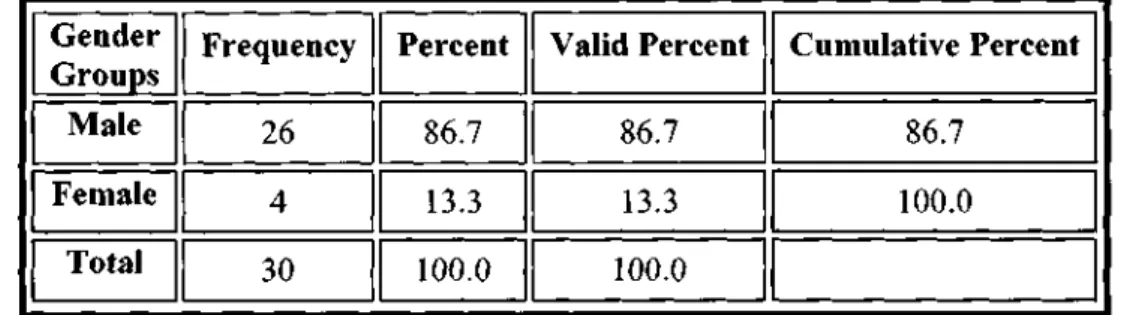
- Gender Composition
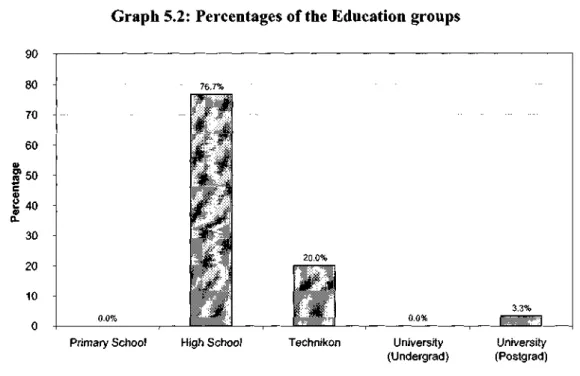
- Level of Education
- Previous Employment of CMT employers
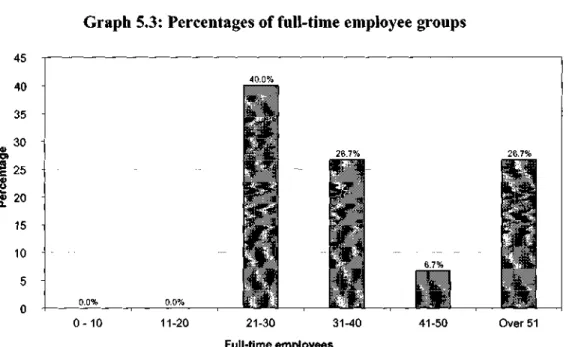
- Number of full-time employees
- Gender Composition of Workforce
Concurrent validity is when the new measure is obtained at the exact time as the criterion measure (Zikmund, 2000) and predictive validity when a new measure either predicts a future event or is related to a criterion measure administered at a later time. The only difference between concurrent validity and predictive validity is the time at which the measure is taken. While face or content validity is a subjective assessment, criterion validity is a more rigorous empirical test (Zikmund, 2000).
Frequencies and percentages are used to represent the gender composition of workers in the CMT factory.
General Information concerning the CMT factory
- Location of CMT factory
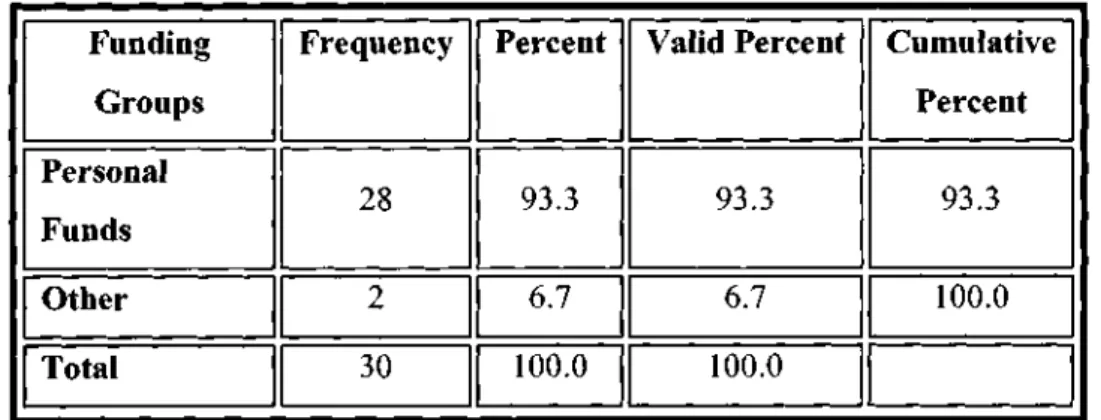
- Funding for the business
- Investment in new machinery
- Total Labour Costs
- Operational period of the business
- Management Training
- Garments Manufactured
The data below describes the options available to CMT employers for start-up capital. The data below shows CMT employers' labor costs relative to total costs. The data below shows the period of time these CMT employers have been in operation.
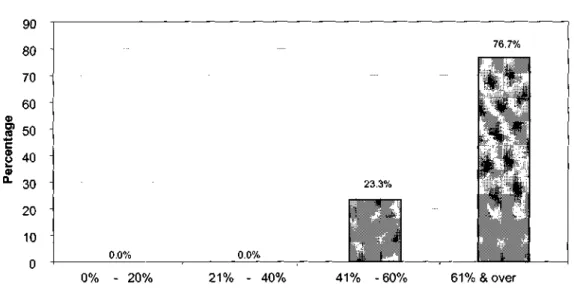
Twenty-five (83.3%) claimed that the CMT plant has been in operation for more than five years, 3.3% (1) indicated a period of two years or less, while four (13.3%) indicated a period between three and five years. .
Workforce
- Absenteeism affects my production levels
- Output per employee is consistent and acceptable
- Most of the employees are unskilled to semi-skilled workers The following data describes the skill levels of CMT workers
- I have the time and money to invest in skills development
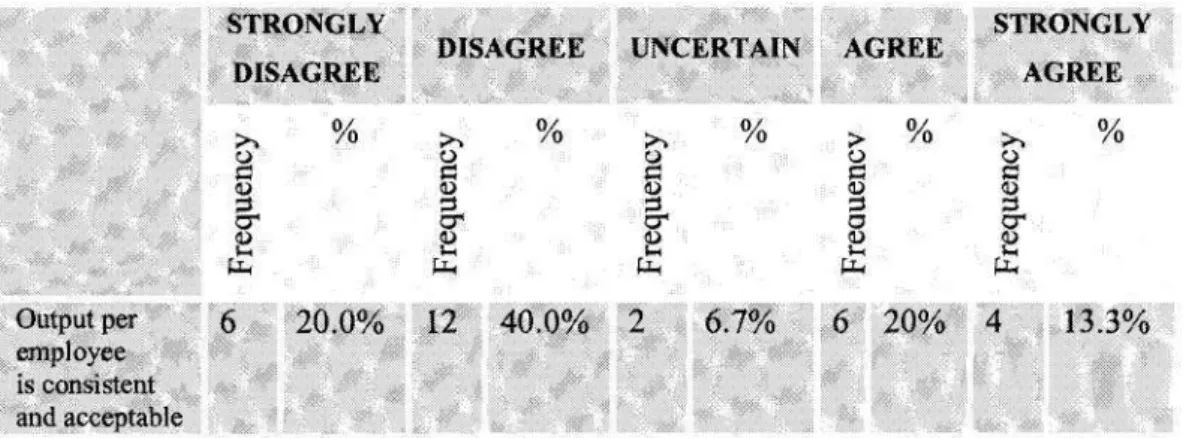
The average score of 2.67 means that the subjects do not agree that the result per employee is consistent and acceptable. This is confirmed by a minimum score of 2, which means that people do not agree, and a maximum score of 5, which means that people completely agree. The mean score of 1.23 shows that subjects strongly disagree that they have time and money to invest in skill development.
This is confirmed by a minimum score of 1, indicating that the subjects do not agree at all, and a maximum score of 3, indicating an uncertain answer as to whether they have the time and money to invest in skill development.
CMT Distributors
- CMT orders are frequent throughout the year
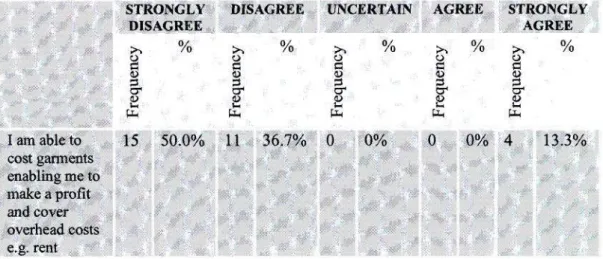
- I am able to cost garments enabling me to make a profit and cover overhead costs e.g. rent
- Cotton, packaging & delivery costs are covered by CMT distributors This data represents the costs covered by CMT distributors using frequencies and
- Payment for completed orders are received upon delivery of garments The following data shows whether or not CMT employers receive payment when
- The absence of minimum price regulation on the cost of garments allows CMT Distributors to outsource orders to the cheapest CMT
This is confirmed by a minimum score of 1 indicating that subjects strongly disagree and a maximum score of 5 indicating that subjects strongly agree that they can cost garments that make a profit and coverage. This is confirmed by a minimum score of 1 indicating that subjects strongly disagree and a maximum score of 5 indicating that subjects strongly disagree that cotton, packaging and delivery costs are covered by CMT distributors. A mean score of 4.90 indicates that the subjects strongly agreed that an absence of minimum price regulations on the cost of garments enables CMT distributors to outsource to the cheapest CMT factory.
This is confirmed by a minimum score of 4 indicating that subjects agree and a maximum score of 5 indicating that subjects strongly agree that no price regulation allows CMT distributors to contract cheaper CMTs.
Labour Regulation
- choose to be a member of the bargaining council
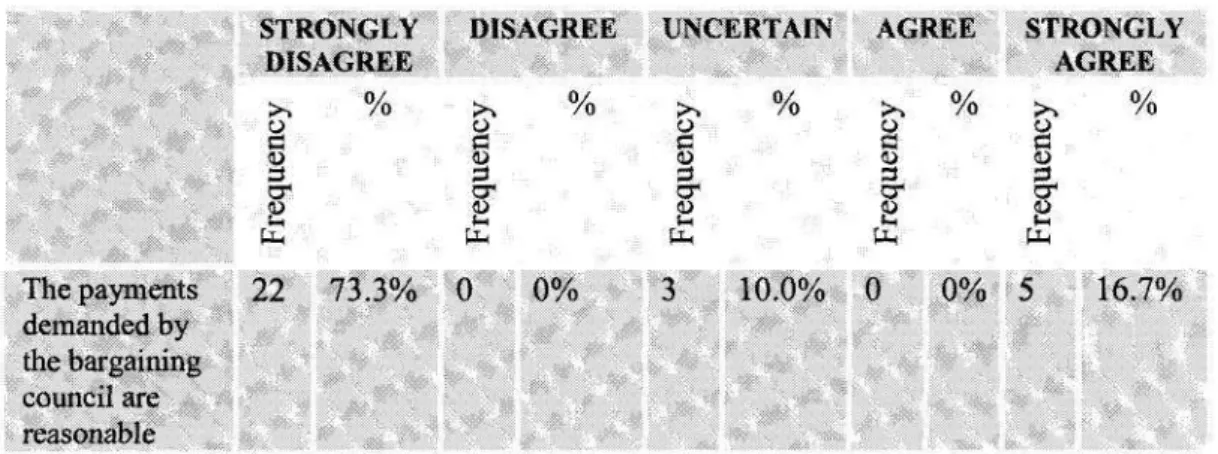
- The payments demanded by the bargaining council are reasonable
- Minimum wage regulation affects the business
- am unable to hire or fire employees based on my productivity needs The data presented shows the flexibility that CMT employers have regarding
- The Main Collective agreement does not represent the interests of all CMT employers
- It is not acceptable that CMTs are governed by the same regulations as large firms
This is confirmed by the minimum score of one indicating that subjects strongly disagreed and a maximum score of five indicating that subjects strongly agreed with this statement. The mean score of 4.77 indicates that the majority of respondents strongly agree that the main collective agreement does not represent the interests of all CBS employers. This is confirmed by the minimum score of four indicating that subjects agree and a maximum score of five indicating that the subjects strongly agree that the collective agreement does not represent the interests of all CBS employers.
This is confirmed by the minimum score of two indicating that the subjects disagree and a maximum score of five indicating that the subjects strongly agree that it is not acceptable for CMTs to be subject to the same rules as large companies.
Imports
- Cheaper imports affect the availability of CMT orders
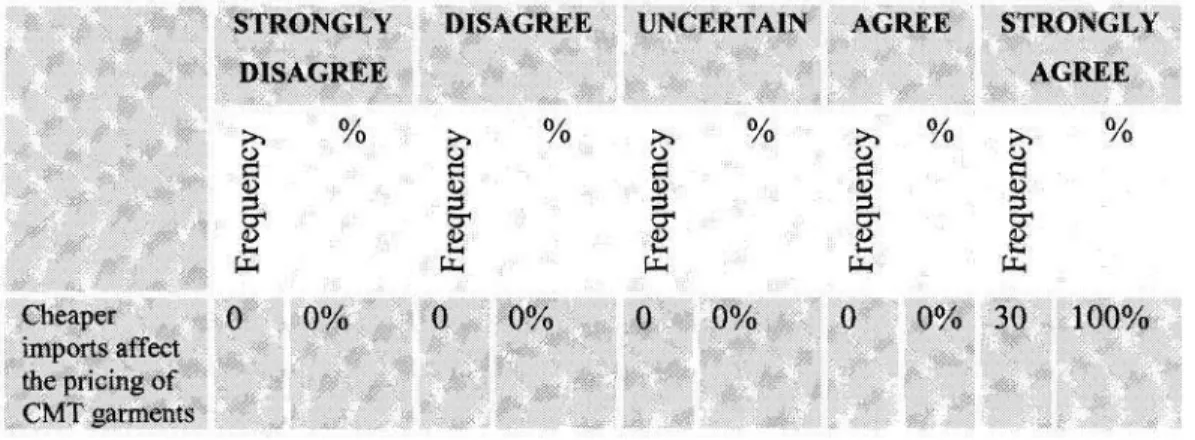
- Cheaper imports affect the pricing of CMT garments
- can not maintain the business if illegal/cheaper imports continue to enter the market
The data reflects the impact of cheaper imports in lowering the price of domestically produced garments by CMT. All subjects strongly agree that cheaper imports affect the prices accorded to garments supplied to CMTs. All parties fully agree that it is impossible to sustain business if illegal/cheaper imports continue to enter the market.
Internal Consistency
Chapter four examined the concepts of internal consistency and Cronbach's Alpha, a test used to determine correlations between items. An alpha of 0.726 is considered acceptable reliability, as Cronbach's Alpha generally increases as the correlations between items become stronger (Internet 5).
Conclusion
Discussion of Results
Introduction
Discussion of results based on variables studied
- Biographical variables
- The age groupings of CMT employers
- Gender analysis of CMT employers
- The education levels of CMT employers
- Familiarity with the clothing industry
- Complement of full-time workers
- Complement of part-time/casual workers
- Determination of workforce based on race
- Determination of workforce based on gender
- General Information
- Location of CMT factories
- Funding for the business
- Investment in new machinery
- Total Labour Costs
- Operational period of the business
- Management training
- Garments Manufactured
- Workforce
- Absenteeism affects my production levels
- Output per employee is consistent and acceptable
- Most of the employees are unskilled to semi-skilled workers
- Qualitative analysis
- CMT Distributors
- I am able to cost garments enabling me to make a profit and cover overhead costs e.g. rent
- Payment for completed orders are received upon delivery of garments Three (10%) subjects strongly disagreed and thirteen (43.3%) subjects disagree with
- The absence of minimum price regulation on the cost of garments allows CMT Distributors to outsource orders to the cheapest CMT
- Qualitative analysis
- Labour Regulation
- The payments demanded by the bargaining council are reasonable The majority of subjects (73.3%) strongly disagreed that payments demanded by the
- Minimum wage regulation affects the business
- The Main Collective agreement does not represent the interests of all CMT employers
- It is not acceptable that CMTs are governed by the same regulations as large firms
- Qualitative analysis
- Imports
- Cheaper imports affect the availability of CMT orders
- Cheaper imports affect the pricing of CMT garments
- I can not maintain the business if illegal/cheaper imports continue to enter the market
- Qualitative analysis
- Recommendations made by CMT employers
Historically, Durban successfully produced for the lower end of the market on a 'sweat labor' basis (Netshitomboni; 1996). The nature of the CMT factory is such that every minute must be a productive minute. This means that the majority of respondents prefer not to be members of the negotiating council.
The CMT factory is based on high productivity; if the workers are not productive then it negatively affects the survival of the business.
Conclusion
An audit should be conducted to determine the volume of imports that major retailers are engaged in. A study on CMT prices should be conducted to establish a fair minimum price regulation. Labor regulation must cover production needs and wages must be performance-oriented, as this sector depends on high levels of production to remain competitive on a domestic and global scale.
Conclusion and Recommendations
Introduction
Conclusions
Imported garments are entering South Africa at prices below the cost of the raw materials used to make them. Therefore, CMT distributors should be regulated in terms of prices offered to CMTs for manufacturing garments. The lack of technological development, low skill levels and the employer's inability to run the business based on productivity needs make it difficult for CMTs to remain competitive on a domestic and global scale.
As such, CMTs are often kept 'alive' even though these factories are usually operating at a loss or breaking even.
Recommendations
The situation facing the garment industry, especially CMTs, needs to be addressed by the government. The idea that a "one size fits all" policy should die out as it is clear that smaller firms experience different challenges and constraints than larger firms. Critically assess the amount of imports retailers are dealing with and determine whether clothing they claim to be “proudly South African” is actually made in South Africa.
It is also necessary to estimate the cost of legal imports to ensure that the prices of the garments are not lower than the cost of the raw materials required to make those garments.
Conclusion
Legislation in this industry is based on a "one-size-fits-all strategy", bargaining councils do not deal with the basic aspects of a CMT plant and do not understand what is required to run it successfully. Report submitted to the Industrial Strategy Project of the Congress of South African Trade Unions. Contracting, complexity and control: A review of the changing nature of subcontracting in the South African mining industry, Journal of the South African Institute of Mining and Metallurgy.
The importance of conducting and reporting pilot studies: The example of the Scottish Birth Survey.'.
UNIVERSITY OF
KWAZULU- NATAL