CHAPTER ONE INTRODUCTION
1.1 BACKGROUND
One of the most effective and important ways of dealing with government officials and members of the private sector, with respect to fraudulent acts and maladministration, is through the media. Since the country’s transition to democracy, the media has undergone a radical transformation. The media, which is truly the essence of a democratic South Africa, should be free and independent to deal with both the realities of the South African situation and the perceptions of the situation. The media is a reflection of what is going on in broader society and exposes the possible degeneration of values and standards in all spheres of the society, as but one of the major activities.
There are many facets that are unique to the South African newspaper scene, among them are the wide cultural variety of the country’s peoples and the geographical size of the land play an important role in the presentation and dissemination of information through newspapers.
There are local, suburban and community newspapers in South Africa. Some are sold and others are for free. The local newspapers supply communities with information, news on local taxing, local schools, local societies and churches and local sport and crime, which are the preferred diet of the local welfare of the local society in spite of being either good or bad, ugly or beautiful.
Ethical decisions in the newspapers determine what people will read. It means that newspaper reporters are confronted with ethical dilemmas daily in reporting news. Human communication influences people by supplying them with information that they use to make decisions, or it exposes people to lifestyles and various views that start to permeate their (own) duties.
Whether or not the responsibility is accepted, the challenge of acting ethically in the newspaper reporting remains.
In Public Administration, both the reputation and success of a government depend upon the conduct of public functionaries and what the public believes about the actions of the functionaries. As such, public functionaries are expected to adhere, at all times, to ethical conducts, within the public service that is always subject to formal prescriptions based on policy as expressed in terms of law (Hanekom et al., 1987: 157). Just like the media, public functionaries are confronted with dilemmas such as the following, amongst others,
i. Administrative discretion;
ii. Corruption ; iii. Conformity ; iv. Information leaks;
v. Values; and
vi. The relationship between the appointed officials and elected political office-bearers.
1.2 STATEMENT OF THE PROBLEM
Newspapers play a significant role in shaping the opinions of the public, exposing wrongs and corruption in public affairs. The law acknowledges that it is the right and duty of the newspapers to monitor and criticize government activities. In the same vein, journalists are expected to report reliable and believable information; checked along the way for accuracy. However, this is not always the case. Reporters’ reporting methods should be able to stand the scrutiny of day light. In this present research study, the ethical conduct of newspaper reporters in reporting educational matters in the Department of Education, in Limpopo, is viewed against the methods that the former uses to obtain and report information. The way newspapers report information is a matter of concern to the Department of Education in Limpopo and this research seeks to understand the depth of the problem.
1.3 RESEARCH QUESTIONS
Which criteria do newspapers use in the evaluation and publication of
information, and which consideration do they use to influence editorial decisions?
Why is there a concern from the Department of Education in the Limpopo Province about reports made by newspapers?
1.4 OBJECTIVES OF THE STUDY
1.4.1 To investigate the impact of newspaper reporting on educational matters in the Department of Education in Limpopo.
1.4.2 To understand the underprining factors that led the Department of Education in the Limpopo Province to raise a concern about unbalanced newspaper reporting.
1.4.3 To attempt to provide possible mechanisms to bring about a balanced newspaper reporting.
1.5 DATA ANALYSIS AND INTERPRETATION
The raw data collected were grouped into categories that address specific themes. Variations and connections between themes were identified and integrated to come up with an accurate and detailed interpretation of the research problem.
1.6 SCOPE AND LIMITATION OF THE RESEARCH
The present study is based in the Department of Education in the Limpopo Province. The fact that this research is confined to reporters in the Limpopo Province would not enable the present researcher to generalize the findings to all newspaper reporters in South Africa. Given that present study also appears to be sensitive, hence ethical consideration was taken care of so as not to prejudice the rights of the respondents.
1.7 CHAPTER OUTLINE CHAPTER 1: Introduction
Chapter one outlines the background of the study that forms the basis of the present research process. A detailed account of the statement of the problem, as well as the research questions, are given.
CHAPTER 2: Literature Review
This chapter focuses on the views of various authors on ethical conduct of media reporting, the dilemmas that the newspaper reporters are confronted with and the criticisms that are leveled against them.
CHAPTER 3: Analysis of the study
In this chapter, collected data are analyzed and interpreted. These data are segmented into meaningful units whereby related codes can be grouped. The original data text and the content is merged to forge a coherent argument.
CHAPTER 4: Research Methodology
This chapter outlines the research methodology and design that used to address the research problem in question and answer the research questions.
The target group, sampling method and sample size are also identified in this chapter.
CHAPTER 5: Conclusions and Recommendations
After interpreting the findings, the aims of the research are summarized and compared with the findings. Conclusions are drawn on how far the objectives of the research are achieved. Recommendations are made in response to issues raised.
1.8. CONCLUSION
Journalists are expected to report reliable and believable information checked along the way for accuracy. It is therefore imperative that unimpeded channels of communication be maintained with the public to ensure that governments
are accountable to the governed. The free the press, the greater the role it can play in maintaining democracy and by providing information, contribute to sound and stable government.
CHAPTER TWO LITERATURE REVIEW
2.1 INTRODUCTION
Since the 1990s, and especially after the democratic elections of April 1994, the mass media (newspapers) emphasis has no longer been mainly on single issues. News became more complex and journalists, as well as the public, needed to reflect on the ethical questions confronting them in a new media and socio-political environment. The media, in this research study, the newspapers, serves as the watchdog of public morals; as the mouthpiece of the public at large; and as an essential ingredient in unraveling or exposing corruption and other kinds of public-sector irregularities. Media also serves as a means for communicating among and between groups within the community, thus promoting social cohesion as well as social change.
The extent to which newspapers operate within a free South African society can be noticed by the following elements:
i. Publication and distribution are free from censorship or restriction by any third party, and are open to anyone without a permit or licence;
ii. Attacks on any government officials or political party are not punishable; and
iii. There is no compulsion to publish anything.
In this research study, an attempt is made to define ethics and, in particular, media ethics. Use is also made of the findings of other authors and present
some of the more recent arguments on the ethical conduct of newspaper reporters in reporting events or issues. Critical consideration of their different points of view is taken and a comparison is made.
In order to encourage and ensure that newspaper reporters report in an acceptable ethical manner, the legislation on how the media should conduct itself, the social responsibility of the media towards society or the public and the dilemmas that journalists are faced with, will be alluded to below. Although journalists are faced with dilemmas, the independence of the media in South Africa is enshrined in Section 16 of the country’s constitution. Coupled with this are journalistic codes that try to protect the independence of journalists from undue pressure from publishers and call for protection of the confidentiality of sources.
The research study also highlights the codes of ethical conduct of newspaper reporters. The forthcoming chapter two focuses on the views of various authors about the dilemmas that newspaper reporters face and the media values and norms that journalists have to comply with.It ends by providing guidelines for media organizations and makes inferences about the conduct of newspaper reporters.
2.2 DEFINITION OF ETHICS
Ethics attempts to outline what is right. It is that branch of philosophy that deals with what aught to be done, with what kinds of action are good and with personal values and individual character (De Beer, 1993: 250). Andrews (in Mafunisa, 2000: 68) defines ethics as standards that guide the behaviour and
actions of public officials in public institutions and which may be referred to as moral laws. Merril and Lee (1994: 374) define ethics as relating to self- imposed duty, a field of moral concern that is primarily individual or personal, even when it relates to obligations and duties of others. Ethics is an area in which each individual makes decisions about both private and public matters.
Since this research study evaluates the conduct of newspaper reporters when reporting educational matters in the Department of Education in Limpopo, media ethics, therefore, needs to be defined also.
2.3. MEDIA ETHICS
Media ethics (newspaper reporters included) has to do with standards and practices of the media. Since the media is made up of individuals, when we speak of media ethics we are talking about the ethics of individuals (Merrill and Lee, 1994: 374). According to Oosthuizen (1997: 225), media ethics is viewed as a branch of philosophy that assists journalists to determine what is right and how to choose the best from several alternatives. In Oosthuizen (1997: 226), Lowenstein and Merril (1990: 186) point out that ethics should, therefore, set forth guidelines, rules, norms, codes and principles that will lead journalists to make moral decisions. They should not be forced to do so.
Media ethics constitutes a normative science of conduct and must, therefore, be applied voluntarily. Normative ethics is concerned with what people and institutions aught to do and how they should conduct themselves (Oosthuizen, 2000: 38). Normative media ethics articulates the broad expectations of society. Newspaper reporters are part of society and, as such function within the parameters set by the expectations prevalent in a society at a particular time.
Media which in this research study refers to newspaper reporters, are often criticized for not displaying public concern about their ethical conduct. They are either seen as having no ethical principles and playing moral problems by the ear thus becoming hungry people seeking their own successes and believing that the end justifies the means. Journalists are seen largely as lacking moral commitment and a consistent and predictable ethical practice.
As Merrill and Lee (1994: 382) put it, “Just give the facts, don’t worry about the consequences, and don’t worry about outsiders telling you what to do – the press itself will determine what is right and wrong”.
Journalists must make decisions on a daily basis. Their behaviour is also judged by the society as being right or wrong, fair or unfair, good or bad, responsible or irresponsible. They sometimes find themselves in circumstances that dictate that they go against one obligation to serve a higher purpose (Oosthuizen, 1997: 225). At other times, they too need to choose between conflicting interests where the consequences might harm some or the other party. It is obvious that such decisions are not always easy to make. Journalists with a basic grasp of ethics, however, not only find it easier to make the decisions, but they also make the best decisions in terms of the interests which are involved (Oosthuizen, 1997: 225).
2.4. CODES OF ETHICAL CONDUCT FOR THE MEDIA
There are different codes of ethical conduct depending on the conventions and traditions of the country concerned and who formulates the codes. Most codes concentrate on matters to do with the provisions of reliable information
and on avoiding distortion, suppression, bias, sensationalism and the invantion of privacy (McQuail, 1994: 125). The common denominator of such codes is a professed loyalty to truth and accuracy, and a concern for fairness and good taste. Journalists’ Code of Conduct stresses truth as the goal and advises journalists against “pandering of morbid curiosity”
(Merrill and Lee, 1994: 383).
Oosthuizen (2002: 67) pointed out the following ethical codes for editorial staff among others:
• Honest reporting and contextualisation of news, by striving to disclose all
essential facts and not suppressing relevant available facts, or distorting by wrong or improper emphasis;
• To evaluate information solely on merit and not to allow advertising,
commercial, political or personal considerations, to influence additional decisions;
• To respect the legitimate rights to privacy of individuals and not to do
anything that constitutes an intrusion into private grief and distress, unless it is justified in terms of the public interest;
• To be sensitive when presenting brutality, violence, atrocities and personal
grief; and
• To be enterprising in dealing with issues that affect society and the
individual, in order to serve the public’s right to know.
In determining the ethical conduct of the newspaper reporters, Oosthuizen (2002: 121) states that when reporting news, members undertake to do such reporting truthfully, accurately and impartially, in a balanced, contextual and
factual manner. It is, therefore, a reporter’s responsibility to gather the news and to report fairly and accurately on the facts of a particular news situation (De Beer (Ed), 1998: 428).
Mandela (in Tysan, 1993; 411) once stated that a critical, independent and investigative press is the lifeblood of any democracy. It must be free from state interference. It must have the economic strength to stand up to the bullying by government officials. It must be protected so that it can protect our rights as citizens. As such, newspapers act both as a watchdog for citizens by scrutinizing and reporting on the performance of concentration of power, of which the government is the most important, and serve as a means for communication among and between groups within the community thus promoting social cohesion as well as social change. Do these newspaper reporters report ethically?
The causes of unethical media behaviour can be linked to their need to get hold of information at whatever cost. Various unethical techniques are used to make a point, such as approaching an organization (department) only a few minutes before the deadline with a sensitive issue, thus preventing the organization from giving a properly thought-out response (Malan and Smith, 2001: 26). When a reporter misrepresents a situation, misquotes a source or fabricates a quote, we often hear that he or she ‘meant well’, ‘didn’t know any better’ or was just careless’, (Merrill and Lee). What is needed is straight talk – calling unethical activity unethical. Occasionally, photographers are tempted to make pictures more eye-appealing by changing the angle of the shot or
cropping out certain details (photographs should give an accurate picture of an event and not highlight an event out of context). If newspaper reporters are to remain an important information source in our province, they must be a credible source of information. To be credible, they must be socially responsible and ethical, and social responsibility includes adherence to strict ethical standards and dedication to disclosing the truth about all institutions, including one’s own. Social responsibility means admitting mistakes and, if necessary, offering an apology for them (Wilson and Wilson, 1998: 392).
The media (newspapers) serves to inform the public about morals;serves as the mouthpiece of the public at large, and as an essential ingredient in unraveling or exposing corruption and other kinds of public sector irregularities (Bayat and Meyer; 1994: 224). But where the government tries to control the media (newspapers), or tries to muzzle the press, it will be impossible for the public to ascertain the true nature and extent of government activities. The freer the press, the greater the role it can play in maintaining democracy and, by providing information, contribute to a sound, stable government. The South African journalists are faced with dilemmas such as the following:
i. Facing a conflict of interest;
ii. Selecting and slanting of news;
iii. Conflict of interest between management and journalists;
iv. Pitfalls in gathering information;
v. Insider information; and
vi. Striking for truth, accuracy, responsibility and fairness.
In performing their duties, public administrators (in the Department of Education) and newspaper reporters must be mindful of the various cultural and traditional practices. Values held by the culturally diverse South African society are the ideals, beliefs and attitudes that underlie all personal, social and political relationships. High standards of ethical conduct are conducive to the efficient performance of a public service, and the newspapers are there to help maintain confidence in the government.
2.5. DILEMMAS THAT NEWSPAPER REPORTERS FACE
Although newspaper reporters are faced with a multiple of dilemmas in South Africa, journalists must ensure that their coverage of news events is sensitive to ethnic diversity, racism, religious differences, homophobic attitudes, and individuals who are physically or mentally challenged. (Wilson and Wilson, 1998: 387). These sensitivities must be exercised in deciding on stories to be covered, in assigning reporters to stories and in the way stories are reported and edited. Moral norms do not have to do only with human beings, but include the networks of institutions, organizations and structures created by people. These human constructions are also subject to moral criticism as they can function unjustly in society (Cameron and Stone, 1995: 75). Newspaper organizations are not exempted from this moral criticism. A variety of factors have to be weighted each time a decision is made about how to handle an ethical dilemma. Often these factors conflict and newspaper reporters can be put in a specially precarious position when their own values do not conform with practices they are expected to follow (Rubinstein, 1998: 178). Journalists with a basic grasp of ethics not only find it easier to make decisions, but they
also make the best decision in terms of the interests which are involved (Oosthuizen (Ed) 1997: 225).
The independence and integrity of newspapers are pre-requisites for truthful, accurate, fair and responsible reporting, which in turn are necessary if the public is to be kept fully informed. Therefore, freedom of press is a pre- requisite for a democratic society. In South Africa, the freedom of the press (printed) is protected under Section 16 (1) of the constitution (The Constitution of the Republic of South Africa Act 108 of 1996). Section 192 of the constitution provides that national legislation must establish an independent authority to regulate media in the public interest and to ensure fairness and a diversity of views broadly representing South African society (Cheminais et al., 1998: 80).
2.6. MEDIA VALUES AND NORMS
In a democratic framework like that of South Africa, the basic values of freedom, equality and order, become the performance norms to which newspapers are held accountable to the public interest by a democratic government. Related to this is the value placed on ensuring the existence of an outlet for voicing out a variety of opinions and securing their ability to operate unhampered by potential attempts of political actors to influence or dominate them (Curran et al., 1977: 282). The following values can be used to evaluate whether or not:
• Government conduct is in line with the expected role that such a government should play in a democratic dispensation; and
• Media policy and government expectations about media conduct
specifically articulate the public interest in its broadest sense (Oosthuizen, 2002: 82). Freedom and equality are articulated by the stipulations of Section 32 of the constitution that states that everyone has the right of access to the following:
(a) Any information held by the state; and
(b) Information held by another person that is required for the exercise or protection of any rights (The Constitution of the Republic of South Africa, 1996).
These norms and values provide the basis for sensitivity about responsibility and accountability. These values and norms determine that a government and its institutions will exercise authority in such a way that the interests and welfare of a society and its people are served.
Ethical issues fundamentally boil down to a conflict of interest between the public’s right to know and the individual’s right to privacy, the journalists ethical stand point versus that of the editor, the editor’s view versus that of the media’s management, and the journalist’s own conflicting interests (du Toit et al., 1998: 299). Although all areas of the (newspaper) print media face tough ethical decisions and are constantly being criticized for perceived failures in performance, two areas seem to receive the most criticism, namely:
• Coverage of news events; and
• Blurring of content.
These criticisms raise two questions, namely how vividly and how much detail do newspaper reporters tell and show about what happened? Among other journalists’s responsibilities, they must be accurate and fair in their reporting.
Accuracy means getting it right, whereas fairness means pursuing the truth with both vigor and compassion, and reporting information without favouritism, self-interest or prejudice (Wilson and Wilson, 1998: 375). For example, in order to be accurate, should you use the real names of people in news stories? What if the person is a rape victim? Would revealing the name be fair to the traumatized victim?
Most media organizations have a set of internal guidelines they expect their employees to follow and media reporters may be able to determine in advance whether their value systems will fundamentally conflict with a particular organization. The complex combination of principles, compromises and business concerns, which inform media ethics, helps reveal each media reporter’s character and professional identity (Rubinstein, 1998: 179). The values of freedom, equality and order as articulated by the constitution, are therefore the values that hold the media accountable to the public interest and will and should inform the media policy process.
On the other hand, ethics in the public service does not only mean that one should exhibit negative obligations such as to do no harm, to avoid injury or to keep out of trouble. On the contrary, the notion of governmental ethics suggests that administrators actively undertake acts that are socially just. Only by demonstrating the highest standards of personal integrity, honesty, fairness
and justice, can public officials inspire confidence and trust, which are the key ingredients of moral government (Bowman and Elliston, 1998: 317).
2.7. CONCLUSION
From the viewpoints of various authors in the abovementioned discussion, it is clear that there is no easy answer when it comes to ethics. Any answer to the question of how to deal with the ethics of the media requires a multi-pronged approach consisting of education, clear public standards and personal responsibility. All are important and no single element is more or less important than the other elements.
But, having said this, a good journalist should always take the interests of readers into account. To make provision for the interests of others, journalists must apply ethics. Readers or consumers on the other hand must be armed with assessment criteria that they can use to assess the legitimacy, accuracy, and validity of the reports they receive.
CHAPTER THREE
RESEARCH DESIGN AND METHODOLOGY
3.1 INTRODUCTION
Mouton(1996:107) describes a research design as”[a] set the researcher has set for himself/herself”. Mouton further states that the research design could be viewed as the blue print of a research project that precedes the actual research process. The research design, therefore, specifies clearly what a researcher wants to find and determines the best way to do it.
Since the present research study is a social science research, the research method to be used will be qualitative research. Although the present research is qualitative, some of the data may be quantitative but the analysis is basically qualitative. The qualitative method to be used in the study will incorporate considerations of the following: the respondents, the activities that participants are asked to perform and data analysis(Bless and Higston-Smith, 2000:143). The newspaper reporters in the Limpopo Province and the Department of Education in Limpopo are the focal point of the research study.
The present researcher’s method of data collection entails personal interviews and questionnaires. The data were collected by the present researcher himself, from newspaper reporters(of Capricorn Voice, Review and Sowetan); government officials; school managers; and learners. Although interviews were found to be ideal instruments to collect information from the respondents, the delicacy and sensitivity of the topic made some respondents
fail to elaborate extensively. The respondents were, therefore, found to be at ease in responding to questionnaires.
The present researcher’s method of data collection entails personal interviews and questionnaires. The data were collected by the present researcher himself, from newspaper reporters (of Capricorn Voice, Review and Sowetan);
government officials; school managers; and learners. Although interviews were found to be ideal instruments to collect information from the respondents, the delicacy and sensitivity of the topic made some respondents fail elaborate extensively. The respondents were, therefore, found to be at ease in responding to questionnaires.
3.2 POPULATION AND SAMPLE
The target group of the present study was newspaper reporters (from Capricorn Voice, Review and Sowetan), government officials, circuit managers, school managers and learners. This target group was chosen for a specific purpose, namely, to find out about the conduct of newspaper reporters in reporting educational matters in the Department of Education in Limpopo Province. McMillan and Schumacher (2001: 175) put it as a method whereby a researcher selects particular elements from the target population that will be representative or informative about the topic of interest. About 53 respondents were selected to complete three categories of questionnaires (Appendices F, G & H).
3.3 MEASURING INSTRUMENTS USED
The research problems Is best addressed by empirical studies. The data collected from the target group were mainly in the form of words (interviews and questionnaires) The data collected for analysis an interpretation were hybrid data (i.e. collected from both primary (people whom reporters write about) and secondary sources(articles, reporters and newspapers).
Techniques used to collect raw data included interviews- personal interviews(face to face interpersonal role situational in which an interviewer asks respondents questions designed to elicit answers pertinent to the research problem) and questionnaires( which help translate the research objectives into specific questions and answers to such questions provided data for solving the research problem.
Three questionnaires were distributed to 53 respondents. The first questionnaire (Appendix F) distributed was to collect information on the ethical conduct of the newspaper reporters (from reporters’ perspective). The second questionnaire (Appendix G) distributed to government officials, school managers was to collect information to the ethical impact of newspaper reporting on educational matters in the Department of Education in Limpopo Province. The third questionnaire (Appendix H) was distributed to gather information about the impact and effects that newspaper reporting has on learners at affected schools (eight schools were visited).
The type of questions that appear in the questionnaires include the following:
open-ended questions, closed questions, rank order type of questions and
dichotomic questions which took into cognizance the level of maturity, particularly Appendix H. The present researcher also took into account the effects that these measuring instruments may induce on the respondents.
These included the length of questionnaires and items that may have sensitive effects. The latter was noticed when the present researcher approached some of the respondents (school managers) who were reluctant to discuss incidents that were reported at their schools. But the present researcher was persuasive enough to get information after the confidentiality and anonimity of the respondents were guaranteed.
3.4 PROCEDURAL ASPECTS
:The present researcher secured appointments with the editors of Review and Sowetan to get first hand information about the values that inform newspaper policy process, and also what holds them accountable to public interest. They were also asked about the environment in which they work and their work relationship with the Department of Education in Limpopo Province.
The Department of Education was also visited by the present researcher. An overview interview (which was off-record) with the department’s spokesperson was conducted wherein the relationship between the department and the newspapers was alluded to (i.e., the impact that newspaper reports have on their working relationships). This was prompted by the Capricorn High School language saga policy between the HOD and the school manager.
Some of the school managers (about 8) whose institutions were the targets of newspaper reporters were visited. They were reluctant to partake in interviews unless a written letter of permission to conduct research from the department was produced. From the responses of those who were willing, the present researcher could detect a feeling of suspicion towards newspaper reporters.
3.5 QUESTIONNAIRES DISTRIBUTION
Questionnaires were distributed after face-to-face interviews were conducted with editors, school managers (some) and the office of the MEC. These questionnaires are to enquire about why respondents have a concern (particularly school managers and the MEC office) about the way in which newspapers report on educational matters, and what could be the underpinning factors.
The questionnaires distributed to newspaper reporters aimed at finding out which criteria do newspapers use in the evaluation and publication of information. Through these questionnaires, the present researcher wanted to review the methods the newspaper reporters use to obtain and report information. Are the methods ethical or not? The respondents will judge in this research study in the following chapter (Chapter four).
3.6 CONCLUSION
Although every effort was made to conduct the present research study in an extensive way, it was not an easy task for the researcher. The data collection method (personal interview) was met with repugnant respondents in some
cases. But the designated target population was given questionnaires in the end to respond to. The permission to conduct research at regional and district offices and schools took a long time to be granted although the request was made at the earliest time. This frustrated the present researcher to a certain extent. The newspapers were cooperative in dealing with the present researcher, even though not all of them responded to all questions contained in the questionnaires.
The types of questions asked and the methods used to obtain information from respondents shed some light on are, namely:
• Which criteria do the newspapers use in the evaluation and publication
of information and which consideration do they use to influence editorial decisions?
• Why is there a concern from the Department of Education in the
Limpopo Province against the reporting made by newspapers?
The present researcher, through data collection methods used, was able to investigate the impact of newspaper reporting and to understand the underpinning factors that led the Department of Education in the Limpopo Province to raise concern about “unbalanced” newspaper reporting. All of this are alluded to in forth coming Chapter four.
CHAPTER FOUR
ANALYSIS OF THE FINDINGS
4.1 INTRODUCTION
In every society, there are basic standards or expectations of what constitutes acceptable behaviour or proper conduct. This is what ethics is about. In terms of social expectations, circumstances often influence how specific behaviour is viewed, e.g., the reactions to a streaker at a sports match would be very different to a person who strips off in a blizzard to save the life of a child suffering from exposure. Because the newspaper reporters function in a specific society, their conduct is judged by that society as being right or wrong, fair or unfair, good or bad and responsible or irresponsible. Judging the behaviour of newspaper reporters or the consequences of their behaviour constitutes the domain of media ethics (newspaper reporters inclusive).
Newspaper reporters make decisions daily and sometimes find themselves in circumstances that dictate that they go against one´s obligation to serve a higher purpose. At other times, they need to choose between conflicting interests, where the consequences might harm one party or the other. But irrespective of the dilemmas they find themselves in, decisions must be taken.
This research study was prompted by the problem of the ethical conduct of newspaper reporters when reporting on educational issues in the Department of Education in Limpopo Province. Do the newspapers give a distorted picture of the activities of the department, with the distortion based on a value and
belief system that condemns reporters most-harshly when the image of the department is tarnished?
The account that follows draws on the experiences of respondents (government officials, school managers and learners) to the ethical conduct of newspaper reporters in the Limpopo Province when reporting on educational issues, for confirmation or contrast.
The researcher interprets data collected from respondents and give them meaning (giving the point of view of the people being studied) and translate them to be understandable. Data interpretation is done by finding out how respondents see the media world, how they define the situation or what it means to them.
4.2 VALUES THAT INFORM MEDIA POLICY PROCESS
Journalists’ Code of Conduct stresses truth as the goal. The chief problem with ethical codes is their vagueness and the use of generalities that are open to many interpretations. But, the fact is, in spite of the highly abstract nature of these codes, newspaper reporters in particular have a sense of what it means to work ethically.
In addition to ethical codes, the establishment of the Press Ombudsman of South Africa added weight to the concern for responsible reporting. The Ombudsman give personal and confidential hearing of disgruntled members,
mediate in disputes, investigate charge and criticize media personnel (inclusive of the newspaper reporters).
The Press Ombudsman embraces principles of human ethics that require newspaper reporters to undertake truthful, fair and accurate reporting of news in context, and in a balanced and actual manner. The press also undertakes to respect basic human rights by undertaking to exercise exceptional care and consider the concerns of individuals, bearing in mind that any right to privacy may be overridden by legitimate public interest.
The Department of Education in Limpopo wanted all schools in the province to implement a language policy whereby mother tongue should be one of the languages to be taught at schools. A confrontation ensued between the Head of Department (HOD) for education and the headmaster of Capricorn High School (CHS) when the latter “incited” learners to reject the implementation of this language policy. The newspapers covered this story extensively about the stand-off. This resulted in learner protest and a war of words between the Head of the Department for education and Capricorn High School learners.
The response about this saga from reporters’ perspective was that both sides were given a chance to respond. The Review newspaper was quick to indicate that the identity of learners who protested at Capricorn High School were kept confidential. But the response from the Polokwane Circuit Manager was that the language policy was used as a ploy to protect Afrikaans and English at the expense of African languages. This can be evidenced in the
reply letter from the reporter who covered the story wherein the reporter indicated having had an oversight of the original response from the MEC’s office. The reporter, in his/her reply, only commented on the grammatical mistakes he/she corrected in the letter from the MEC’s office. The facts were correct. Reporters sometimes find themselves in circumstances that dictate that they go against one’s obligation to serve a higher purpose. The public had to know in this case about the language-policy saga.The response of the affected learners was that reporters need to do some research in order to produce news that is fair and accurate.
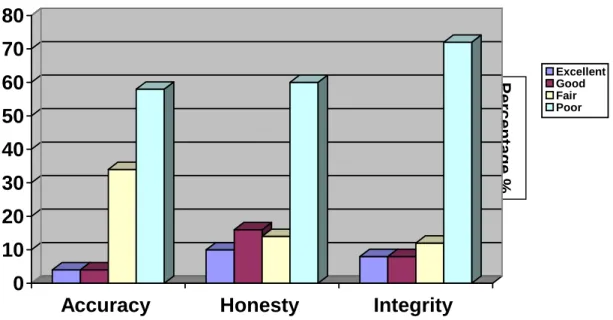
Figure 4.1 Graphical representation of the responses by selected learners affected by newspaper reporting.
Graphical representation in figure 4.1. show that of the fifty learners respondents given questionnaires, 58% indicated that reporters are not accurate in their reporting (light green colour in figure 4.1.). However, a few of learners, 4 % especially in the rural schools indicated that reporters report accurately when reporting on educational issues(maroon colour in figure 4.1.).
Percentage %
0 10 20 30 40 50 60 70 80
Accuracy Honesty Integrity
Excellent Good Fair Poor
They also felt that students/learners, and not only departmental officials, should also be approached by reporters to raise their opinions on educational issues that affect them directly because they think students are the ones that endure setbacks created by various “bodies”. This notion is indicated by their ratings of the intergrity of reporters which is 72 %(light green colour in figure 4.1.).The response indicates that learners are sometimes left out in crucial decisions that affect both their education and their future. Thus, the learner component of the School Governing Body was not consulted.
This language policy saga was also taken to the Provincial Legislature where the MEC for Sports, Arts and Culture remarked that those who are undermining our African languages have become irrelevant to our cause of building a new society …. This resulted in learner protest and a war of words between the Head of Department for Education and Capricorn High School learners. The MEC was flaying the reporter for what he termed “English in schools is imperialism” for her/his “support” of the headmaster.
4.3 METHODS NEWSPAPER REPORTERS USE TO OBTAIN INFORMATION
The newspapers serve as both the watchdog and mouthpiece of the public about the activities of the government and the private sector. In performing these responsibilities, reporters must be detached from the position of the object (the person being reported about) and the source of their reporting.
They must also be accurate and fair (by giving both sides of the story), remain
independent and report independently and most importantly, make a concerted effort to adhere to their codes of conduct.
Figure 4.2 Graphical representation of the responses of government officials about the ethical conduct of reporters.
Figure 4.2 above indicates percentage of government officials who disagree with the fact that reports are not guided by ethical questions when choosing the content of their papers.Figure 4.2. show that 60% of those officials who were given questionnaires disagreed and 30% strongly disagree with the factr that reporters are not guided by ethical considerations when choosing the contents of their papers.Only 10% strongly agreed(blue clour in Fig.4.2). In figure 4.1. learners also rated the accuracy,honesty and intergrity of reporters poorly-58%,60% and 71% respectively. These responses cast a shadow of doubt about the ethical conduct of reporters and the methods they use when reporting on educational issues.
Percentage %
0 10 20 30 40 50 60
Strongly Agree Disagree
Strongly Disagree
Having disputed the question “Is it ethically acceptable to use questionable methods to obtain information? All reporters indicated that the following methods are frequently used to obtain information:
• Interviews and follow-ups;
• Researches;
• Attending press events, conferences and media briefings;
• Going undercover; and
• Working from media releases.
Conversely, people who are being reported about were asked the question “Is it acceptable for newspaper reporters to use questionable methods to obtain information about the activities of the department? Respondents had different views about the issue. Equal number of these respondents was for and against. In one of the responses concerning a teacher at Sephaka-batho Secondary School, who was continuously absent from school and lagged behind with his syllabus, the respondents claimed that reporters got information about the teacher from School Governing Body members and learners. It is only the MEC’s spokesperson who can give details to the media about the activities of the Department of Education.
But from the methods alluded to in the second paragraph undercover is one method is suspected to have been used in this instance. But in doing so, do they get both sides of the story as the Journalists’ Code of Conduct stipulates? The overall responses from both government officials and learners indicate that reporters are not being fair and accurate in their reporting.
4.4 WHO ARE REPORTERS?
Do reporters and readers share similar viewpoints? Definitely no. Reporters sometimes cover events in ways that alienate or offend readers. Reporters are said to be rude and accusatory, and almost unpatriotic. They twist facts to suit their hidden agendas. They meddle in politics, invade people’s privacy, and then walk off without regard to pain and chaos they leave behind.
Against this background, the present researcher asked respondents to give their perspective of who reporters are.
• Instead of waiting relentlessly at the department to get answers the
public so desperately need, reporters provide us access to what we need to know;
• Report on only what the Department of Education has to say;
• Are the watchdog and mouthpiece of the public (particularly about he
activities of the Department of Education);
• Reporters publish educational issues prematurely;
• Delight in creating sensation and uncertainty;
• Politicize issues; and
• Report fairly and accurately
In the light of the above-mentioned responses about who the respondents think reporters are, the sub-headings that follow look at some of public (respondents) perceptions about newspaper reporters.
4.5 RESPONDENTS (PUBLIC) PERCEPTIONS ABOUT THE NEWSPAPERS
4.5.1 NEGATIVISM:
A frequent complaint was that newspapers concentrate on bad news. For example, the publication of poor results at Mogalatšane-Mphahlele School in the Mphahlele Circuit received so much media (newspaper) attention that even the National Minister of Education paid the school a visit. There was too much pressure put on the Provincial Education Department to such an extent that the affected headmaster at Mogalatšane-Mphahlele was relieved of her duties hence forth. The reasons behind the poor performance at the school were never investigated. The media only wanted the negative (one side) of the story.
There is the case of teachers who come to school drunk. Tipped-off by the School Governing Body members and some learners at Sephaka-batho Secondary, reporters covered a story about an educator ( at the school) who continuously absented himself from school because of drunkenness to such an extent that he could not finish the Grade 12 syllabus. The story, painted a negative and damaging image about the educator and the school. The negative image portrayed by the newspaper about the teacher filtered down to learners and had a negative impact on their results. The teacher’s image in the teaching fraternity and society at large received a flagging(Capricorn Voice 27-28 July 2005:03).
The negative image given to learners at Setotolwane after they ran riot over their “socialization” demand. Learners at this institution were said to have gone on a rampage because they wanted mixed residences. This story was flashed in all provincial newspapers. Learners’ views were put in a negative light. Was sexually mixed residential hostels the major reason behind their protest? Few agree.
Also, the negative impact the Capricorn High School language-policy saga had was illustrated by an article in Review titled “English in schools is imperialism”. This article was issued after the MEC for Sport, Arts and Culture launched a tirade against “imperialists” in the education system. He was referring to the failure of the Capricorn High School’s headmaster to implement an officially-sanctioned language policy that provides for the teaching of African languages at all public schools. This incident created negative perceptions within the African society about CHS’s head master – all thanks to the publicity it got from the press(Review 30-31 March 2006:02).
Actually, there is more good news in our newspapers than we might realize.
Most of reporters think that the negativity of the stories brings attention to the readers. Conflict fascinates them. The pleasant items (e.g., 100% Grade 12 results at Mbilwi High School in Vhembe District) are often too boring to stick to their memories.
4.5.2 INACCURACY AND UNFAIRNESS
Percentage %
Are news reported in newspapers inaccurate? Some, probably. Mistakes are inevitable considering the complexities involved in news gathering process.
An event occurs, and a reporter of that event has to filter through many layers of information under pressure of deadlines. But every single inaccuracy printed on the front page of a paper helps to erode public confidence. The common denominator of Journalists Codes is a professed loyalty to truth and accuracy, and a concern for fairness and good taste (Merill et al.1994:383
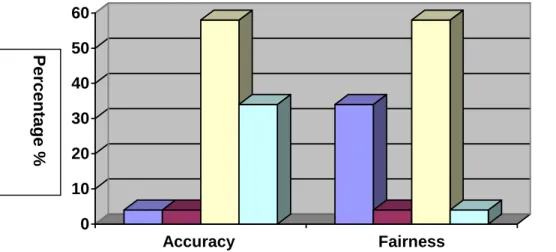
Figure 4.3 Graphical representation of the responses of learners and official about the accuracy and fairness of reporters.
Figure 4.3 above indicates the numerical data of the responses by learners and government officials in relation to the accuracy and fairness of newspaper reports, 59% indicated that the reports are accurate while 59% of the
0 10 20 30 40 50 60
Accuracy Fairness
Exelent Good Fair Poor
respondents show that reporters are fair in their reporting(yellow colour in Fig.4.3).
Contrary to what the respondents said earlier about the accuracy and fairness of newspaper reporters, when they were asked to rate newspaper reporters in later questions, the responses show that reporters actually report accurately and fairly, overall.In figure 4.1. 70% of learners rated the accuracy of reporters poorly. One Circuit Manager in the Capricorn District indicated that the language policy saga was reported biasely in support of the headmaster of Capricorn High School. The reporter was seen to have taken side, but in a response to rate the fairness of newspaper reporters, the same circuit manager indicated that reporters report fairly.
Reporters were once victims of attack in the Mogodumo Area wherein they allegedly reported that pregnant learners were allowed to attend classes at Dinao Secondary School in the Sepitsi Circuit, and also that over-aged learners at Mogalatšane-Mphahlele were being admitted. These allegations were reported without first verifying their facts or getting both sides of the story by reporters. The unfairness of the reporters was further illustrated by the response of one educator at Sephaka-batho in the Mogodumo Circuit. The educator was responding to the story that appeared in the Review newspaper that one male educator was continuously absent from school and he also failed to finish the syllabus for Grade 12 learners. This was construed as unfair because the reporter did not get the consent of the teacher before the story was published. The publication of the story led the community to rise up
against the school manager who was accused of colluding with the press in tarnishing the image of their “child” (the educator). They vowed that the teacher will never be removed from the school as it was then contemplated by the Provincial Education Department(Capricorn Voice 27-28 July 2005:03).
The Department of Education also received its share of the blame for the inaccurate and unfair reports. The respondent claimed (from Employee Relation Section) that the department politicizes issues. The Northern Review carried an article titled “MEC / Head conflict denied”. This article was prompted by a ravaging conflict between the MEC and the Head of the Department. The conflict was caused by the thin line that divides the role of the MEC and the HOD, e.g., political mandate and administrative roles respectively. The Congress of South African Students (Cosas) entered the fray and issued a statement to the effect that “the HOD is ineffective and incompetent and has failed to transform the Department of Education. This statement prompted the African Christian Democratic Party (ACDP) leader in the province to say that “the degrading language used in the press statements on the conflict is not condusive to good relationship and helps nothing towards solving the problem”.
The politicization of educational issues was further illustrated by the statement issued by Congress of South African Students in Review (15 June 2003: p3) that “This chief agent (Prof. Horror – HOD) is deliberately raising chaos in the department. Like he did with the Honorable Edgar Mushwana (former Education MEC), he is deliberately discrediting the MEC (then) by disclosing
internal / confidential information to the media to assassinate Honorable Joyce Mashamba”.
All this said, it is a well-known fact that complete objectivity in news reporting is a myth. The best one can do is to try to be objective. However, the consistent pursuit of objectivity is a basic tenet in news coverage. But the reading public does not always agree, particularly when it comes to the coverage of educational issues in the Limpopo Province.
4.5.3 ARROGANCE
Reporters and editors seldom win popularity contests, nor should they try to.
They are in the business of gathering news and presenting it to their readers.
They function to reflect what is good or evil in society (Department of Education) and, consciously or unconsciously, they shape society’s future. For reporters who cover government activities, they are often seen as prideful, self righteous and arrogant. A free press functions to preserve our democratic system of government. To keep anyone from tampering with the rights provided for in Chapter 2 (Section 16 (a-b) of the constitution (The Constitution of the Republic of South Africa, 1996), reporters must continue to examine the various valid criticisms and charges that are hurled at them.
Some reporters have been directly confronted by government officials. The reporter of the Review newspaper found that the Department of Education was not impressed by the way in which the newspaper reported “Disgust with
redeployment” and the language-policy saga at Capricorn High School in 2003 and 2006, respectively. Review in the former case published a report regarding the severe opposition from within the ranks of teachers who were being redeployed to rural areas, allegedly without prior consultations with the teachers or their unions. The report sparked sharp responses from officials who rejected the department’s redeployment policy. In the latter case, the issue was taken into provincial legislature chamber whereby the MEC for Sport, Arts and Culture labeled reporters and the headmaster of Capricorn High School as “imperialists”. He went on further to say that “The recent discussions about African languages in schools are an attempt to undermine the achievements of our revolutionary democracy(Review 30-31 2006:02).
The arrogant and biased manner in which the Capricorn High School Saga was covered prompted the Polokwane circuit manager to remark that the community has been misled in believing that public schools are useless. Most parents react by opting for private schools. He alleges that reporters delight in creating sensation and uncertainty that promote and market their papers at the expense of truth and facts. “Reporters dwell too much on the negatives”.
4.6 CONCLUSION
Some of these negative perceptions are perhaps deserved, but some are based on myth and misconception. From the responses, one is tempted to infer that reporters report accurately, fairly and honestly in compliance with the precinct of their code of conduct, the Freedom of Expression Institute (FXI) and the provisions of Chapter 2 of the constitution(The Constitution of the
Republic of South Africa,1996). We really read about reporters in Limpopo Province involved in litigation cases.This is indicative of their diligence in carrying out their mandate of informing the public.
To enable newspapers to inform the public about the activities of the Department of Education in Limpopo, reporters pledge to report news truthfully, accurately and fairly, and in a balanced manner. Reporters have confirmed that it is unethical to obtain information using questionable methods, but conceded justifiable to do such on grounds of overriding public interest and when a public figure is the object of investigation. However, the media’s defence of public interest must be weighed against the individual’s right to privacy. Social responsibility, accountability and professionalism are the values that should always be upheld in the media fraternity.
CHAPTER FIVE
CONCLUSIONS AND RECOMMENDATIONS
The present study pays attention to the ethical conduct of newspaper reporters when reporting on educational matters in Limpopo Province.
Newspapers serve as the watchdog of the public, as the mouthpiece of the public at large, but their duties (also) entail entanglement in ethical dilemmas from time to time. They (reporters) have to make individual or collective ethical decisions on a daily basis. These decisions are often very difficult to take.
These decisions, which newspaper reporters have to take, determine what the public may read, think, feel or talk about and sometimes even what they do.
This responsibility is a heavy burden, but it is part and parcel of working in the newspaper world.
It has become abundantly clear in this study that whether it is difficult to make decisions or not, there is an ethical responsibility upon reporters towards those decisions. As Oosthuizen (1997: 225) pointed out, journalists with a basic grasp of ethics not only find it easier to make decisions, but they also make the best decisions in terms of the interests that are involved.
The Department of Education in Limpopo Province sometimes finds itself at loggerheads with reporters about the decisions that (newspaper) reporters make when reporting on educational issues. On the other hand, reporters maintain that their journalistic responsibilities are adhered to. This, among others, requires of them to:
a. make a concerted effort to adhere to their codes of conduct and to improve the standard of reporting;
b. ensure that they remain independent and report independently; and c. be accurate and fair (by giving both sides of a story).
The intention of this study has been to investigate the impact of newspaper reporting on educational matters in the Department of Education in Limpopo and to understand the underpinning factors that lead to the department to raise a concern about the unbalanced newspaper reporting. The present researcher also intended to attempt to provide possible mechanisms to bring about a balanced newspaper coverage.
The present researcher found that ethical decisions fundamentally boil down to a conflict of interests between the public’s right to know (as provided in Section 14 of the constitution) and the individual’s right to privacy; journalists’
ethical stand point versus that of the editor and the journalist’s own conflicting interests. On the contrary, the notion of governmental ethics suggests that administrators actively undertake acts that are socially just. For reporters who cover government activities, they are often seen as prideful, self-righteous and arrogant. This assertion prompted Merill et al., (1994: 340) to remark that to keep anyone from tampering with the rights provided for in Chapter 2 (Section 16 (a-b) of the constitution(The Constitution of the Republic of South Africa, reporters must continue to examine the various valid criticisms and charges that are hurled at them.
The extent to which reporters should conduct themselves ethically is complicated by the tough ethical decisions that they have to make and the ethical dilemmas that go along with these decisions. These include, among others, accuracy and fairness; honesty and integrity; conflict of interest and invasion of privacy and anonymity; confidentiality, betrayal and deception.
Given the complex environment in which reporters have to perform their duties (i.e. of difficult ethical decisions and dilemmas), they are prone to be seen to be reporting unbalanced educational diet.
The complex environment under which reporters find themselves working, and the rate of criticism leveled against their decisions, prompted the present researcher to investigate the ethical conduct of reporters in Limpopo when reporting on educational issues. The premise of the present research study is based on ethical conduct of newspaper reporters.
In Chapter 1, the present researcher alluded to the questions that prompted the present research study and what this study hopes to achieve at the end of the investigation. To this end, a number of books were read about (the) media ethics (newspaper reporters included).
Chapter 2 of the present study delves on media ethics and much attention is focused on media responsibilities and accountability. Lowenstein and Merril (1990: 186) point out that ethics should, therefore, set forth guidelines, rules, norms, codes and principles that will lead journalists to make sound moral
decisions. For the media to perform its function (viz. providing quality information), it is essential that specific policies regulating and guiding the flow of information in society be developed and implemented. Oosthuizen (2002:
67) suggests the following ethical codes for editorial staff, among others:
• honest reporting and contextualization of news;
• evaluation of information solely on merit and not to allow political or
personal considerations to influence decisions; and
• to respect the legitimate rights to privacy of individuals and not to do anything that constitutes an intrusion into private grief and distress.
Since newspaper reporters are faced with dilemmas when making ethical decisions, this sometimes put them on a collision course with the Department of Education in Limpopo. But, in spite of the dilemmas they are confronted with, the independence, integrity and (sound) ethically acceptable conduct of reporters must be upheld if the public is to be kept fully informed.
Chapter 3 of the study elaborated on the method used to collect data. It also determined the size of the sample and identified the target group. In this chapter, the instrument used to collect data and the procedure followed in the collection of data is discussed.
The account that follows in Chapter 4 draws on the experiences of respondents to the ethical conduct of newspaper reporters in Limpopo Province when reporting on educational issues. The chapter provides the present researcher with the opportunity of finding out how the public perceives
the ethical conduct of newspaper reporters. It comes out vividly that respondents are skeptical about the values that inform media policy and the methods they use to obtain information. Newspaper reporters were, to a certain extent, perceived to be negative, inaccurate and unfair, and also showed an amount of arrogance in their reporting.
Based on the critical issues raised in the present study, the following recommendations are made:
a. When we talk about media ethics we consider how media personnel make decisions in the moral or ethical realm. We are concerned with reasons for doing this instead of that; for seeking better actions in the world of media reporting. For newspaper reporters to perform their duties to the fullest, it is, therefore, recommended that specific policies regulating and guiding the flow of information in the society be developed and followed;
b. The methods used by reporters to obtain information sometimes evoke doubts. Although the Journalists’ Code of Conduct stipulates that, in performing their responsibilities, reporters must be accurate and fair, they are more often than not at loggerheads with the Department of Education in Limpopo Province. In the light of this, it is recommended that the Journalists’ Code of Ethics be made public and be written in all official languages spoken in the province. And reporters must represent both genders and diverse cultural groups in the province.
c. The Department of Education in Limpopo also received its share of the blame. There is a tendency in the department of politicising educational
issues. This is evident where the Head of Department does not affiliate to the principle of the ruling party. There seems to be a thin line that divides the responsibilities of the Head of Department and the Executing Authority. It would, therefore, be recommended that the Executing Authority leaves the Head of Department to perform his / her administrative duties/responsibilities undeterred.
d. The powers of the provincial spokesperson be devolved to the districts offices throughout the province for speedy and accurate responses to issues in the vicinity of the district concerned.
BIBLIOGRAPHY
Babbie, E. 1998. The Practice of Social Research (8th Edition). Belmont:
Wadsworth Publishing Company.
Bailey, K.D. 1987. Methods of Social Research (3rd Edition). New York:
Collier Macmillan.
Bayat, S.M, and Meyer, I.H. 1994, Public Administration: Concepts, theory and practice. Halfway House: Southern Book Publishers (Pty) Ltd Bless, C., and Higson-Smith, G. 2000. Fundamentals of social research methods: An African Perspective. Lansdowne: Juta & Co.
Bowman, J.S., and Elliston, F.A. (Eds). 1998. Ethics, Government and public policy: A reference guide. New York: Greenwood Press
Cameron, R.G., and Stone, A.B. 1995. Serving the public: A guide for practitioners and students. Pretoria: J.L van Schaik
Cheminais, J., Bayat, S., Van der Waldt., G., and Fox, W. 1998. The fundamentals of public personnel management.. Cape Town: Juta &
Co Ltd.
Curran, J., Curevitch, M., and Woollacoff, J.(Eds). 1977. Mass communication and societ. London: University Press.
De Beer, A.S. 1993. Mass media for the nineties: The South African handbook of mass communication. Pretoria: J.L. van Schaik
De Beer, A.S.(Ed), 1998. Mass media towards the millennium: the South African
handbook of mass communication. Pretoria: J.L van Schaik
De Vos, A.S. (Ed), 2002. Research at Grass Roots: For the Social Sciences
and Human Service Professions. Pretoria : Van Schaik.
du Toit, D.F.P., van der Waldt , G., Bayat, M.S., and Cheminais, J. 1998.
Public Administration for effective governance. Cape Town : Juta & Co, Ltd
Frankfort-Nachmias, C, and Nachmias, D. 1992. Research Methods in the Social Sciences (4th Edition). London: St. Martin’s Press, Inc
Hanekom, S. X., Rowland, R.W., and Bain, E.G. 1987. Key aspects of Public Administration. Johannesburg: Southern Book Publishers (Pty) Ltd Mafunisa, M.J. 2000. Public Service ethics. Kenwyn: Juta & Co, Ltd
Malan F., and Smit, B. 2001. Ethics and leadership in business and politics.
Lansdoune: Juta & Co
McMillan, J., and Schumacher, S. 2001. Research in Education: A conceptual introduction. New York: Longman
McQuail, D. 1994. Mass communication theory: An introduction (third edition).
London: Sage Publication
Merril, J.C., Lee, J., and Friendlander, E.J. 1994. Modern mass media (Second Edition). New York: Harper Collins College Publishers Mouton, J. 1996. Understanding Social Research. Pretoria: J L. Van Schaik OOsthuizen, L.M. (Ed), 1997. Introduction to Communication: Journalism,
Press and Radio Studies. Lansdowne: Juta & Co. Ltd
Oosthuizen, L. M. 2002. Media ethics in the South African context. An introduction and overview. Lansdowne: Juta & Co. Ltd
Rubinstein, G.F. 1998. An introduction to mass communication. New York:
McGraw Hill
Tyson, H. 1993. Editors under fire. Sandton: Random House
Wilson, J.R., and Wilson, S.L. 1998. Mass Media Mass Culture: An Introduction (4th Ed), New York: McGraw Hill, Inc.
ACTS:
South Africa (Republic)The Constitution of the Republic of South Africa, 1996 (Act 108 of 1996).
REGULATIONS
Press Ombudsman of South Africa Freedom of Expression Institute (FXI)
NEWSPAPERS Review 15 June 2003 Review 17 – 18 July 2003
Capricorn Voice 27 – 28 July 2005 Review 30 – 31 March 2006