Child Soldiers and the Impact of Violence and Trauma on Their Psychosocial Development in the Democratic Republic of Congo
(DRC)
By
Mnikeni Comfort Phakathi
Submitted in Partial fulfillment of the Requirements for the degree of Master of Social Sciences (Conflict Transformation and Peace Studies) in the School of Social Sciences, College of
Humanities, University of KwaZulu-Natal
Supervisor Dr N. Chellan
November 2014
Declaration
I Mnikeni Comfort Phakathi student number 208521565, declare that,
1. The research reported in this thesis, except where otherwise indicated, is my original research.
2. This thesis has not been submitted for any degree or examination at any other university.
3. This thesis does not contain other persons’ data, pictures, graphs or other information, unless specifically acknowledged as being sourced from other persons.
4. This thesis does not contain other persons’ writing, unless specifically acknowledged as being sourced from other researchers. Where other written sources have been quoted, then:
a) Their words have been re-written but the general information attributed to them has been referenced
b) Where their exact words have been used, then their writing has been placed inside quotation marks, and referenced.
5. This thesis does not contain text, graphics or tables copied and pasted from the Internet, unless specifically acknowledged, and the source being detailed in the thesis and in the References sections.
Mnikeni Comfort Phakathi Student Name
____________ November 2014
Signature Date
Dedication
This dissertation is dedicated to my late Father, uHheshe mtaka Nomahheshe waseNtuthwini ozalwa uThikithi. Ngiyacelwa boMncwango ukuthi ningivumele ukuba ngiqhubeke nalemfundo ngize ngethweswe iziqu ze (Masters). Thank you for guiding and strengthening me all these years. I know you wanted this and I’m certain that you are smiling with my entire family lapho nikhona.
Acknowledgements
I would like to thank my brother Fezokuhle Phakathi for giving me the rare opportunity of studying at the University of KwaZulu-Natal. I feel indebted to you mnewethu. I am grateful to my entire family, most importantly my mother (maDlakadla) for support throughout my academic life. I almost quit when you suffered from a stroke in October.
Thank you very much Dr. Chellan for your supervision, patience, guidance and showing interest in my study
.
Many thanks to my friends and brothers Siyabonga, Thembani, Bheki, Bong’kosi, Nhlanhla, Lukhona and many more for helping me believe that I could do this despite all that I have been through in the recent years. You all have been my inspiration and I am sincerely grateful.Table of contents
List of figures ... vi
Table of abbreviations... vii
1 Chapter one: Introduction and Historical Background ... 1
1.1 Introduction ... 1
1.2 Historical Background ... 1
1.3 Definition of key terms ... 8
a) Child soldier ... 8
b) International law ... 9
c) Disarmament ... 9
d) Demobilisation ... 10
e) Reintegration ... 10
1.4 Research Problems and study objectives ... 10
1.5 Ethical Considerations ... 10
1.6 Hypothesis... 11
1.7 Key Objectives ... 11
1.8 Limitations of the study ... 12
1.9 Research Questions ... 14
2 Chapter two: A Summary of Literature on Child Soldiers in the DRC ... 15
2.1 Introduction ... 15
2.2 The magnitude of the phenomenon... 15
2.3 Reasons for enlisting ... 18
2.4 Political economy of the DRC war ... 21
2.5 Psychosocial wellbeing of child soldiers ... 23
2.6 Local, Continental and International law on child soldiers ... 25
2.7 Reintegration and current issues ... 28
2.8 Conclusion ... 37
3 Chapter Three: Data Analysis and Interpretation ... 38
3.1 Introduction ... 38
3.2 The views of the child soldiers ... 39
3.3 Theoretical Interpretation of the reaction of children on conflict ... 40
3.4 Children in Conflict ... 42
3.5 Child soldiers and the complexities ... 43
3.6 The realities about DDR in the DRC ... 44
3.7 Conclusion ... 47
4 Chapter Five: Conclusion and Recommendations ... 49
4.1 Introduction ... 49
4.2 Conclusion ... 49
4.3 Summary and ending remarks ... 54
5 Bibliography: 5.1 Published Sources, Journals and books ... 60
5.2 Relevant Unpublished Research ... 67
5.3 Internet Sources ... 68
List of figures
Figure 1: A Political Map of the (DRC) ... 4 Figure 2: Child labour (mining of coltan) ... 22
Table of abbreviations
AI ...Amnesty International BTT ... Betrayal Trauma Theory CAFF ... Children Associated with Fighting Forces CS ... Child Soldiers CNDP ... National Congress for the Defense of the People CPTS ... Conflict Transformation and Peace Studie DDR ... Disarmament, Demobilisation and Reintegration DRC ... Democratic Republic of Congo DSM4 ... Diagnostic and Statistical Manual of Mental disorders FAES... Forces Armada de El Salvado FARDC ... Forces Armées de la République Démocratique du Congo FDLR ... Forces Démocratiques de Libération du Rwanda FMLN ...Frente Farabundo Martí Liberacíon Nacional HRW ... Human Rights Watch ILO ... International Labour Organisation IPSTC ... International Peace Support Training Centre LCA ... Lusaka Ceasefire Agreement MONUC ... UN Organisation Mission in the Democratic republic of Congo M23 ... Mouvement du 23 NGO ... Non Governmental Organisation PTSD... Post Traumatic Stress Disorder RCD ... Rassemblement Congolais Pour la Democratic SALW ... Small Arms and Light Weapons UK... United Kingdom UN... United Nations UNCRC... United Nations Convention on the Rights of a Child UNHRC ... United Nations Human Rights Council UNSC ... United Nations Security Council UNICEF ... United Nations International Children Emergency Fund WV ...World Vision
Abstract
This study has reviewed psychological, social, economic and political literature, which focus on analysing and quantifying the Child Soldier (CS) phenomenon. It acknowledges the contributions made by lawmakers and theorists in trying to understand and prevent the scourge from persisting in the Democratic republic of Congo and spreading globally.
As proposals increase on how the children can be rehabilitated and reintegrated into original societies or places of safety, some activists prefer a long lasting political solution particularly an accountable management of natural resources through a democratically elected government. There are many factors contributing to the devastation suffered by child soldiers such as wide spread poverty and lack of infrastructure such as roads, schools and recreational facilities for children which inhibits development. Psychologists suggest digging deeper into the effects of stress and trauma on children affected by war because such children suffer pathologies greater than a Post-Traumatic Stress Disorder (PTSD). In addition, political economists argue that natural resources dependence and the unequal distribution have prolonged the war in the DRC and neighbouring countries.
Research proves that children show remarkable resilience when faced with danger and abuse. They choose to forget the life threatening events as a survival mechanism.
Misremembering helps them survive initially at the military camps. They apply the same mechanisms during reintegration with safer communities.
Key words: child soldiers; armed conflicts; psychosocial wellbeing; DRC; Great Lakes Region; DDR
1. Chapter One. Introduction and Historical Background 1.1 Introduction
This study reviews psychological, social, economic and political literature, which focuses on analysing and describing the Child Soldier (CS) phenomenon. The study acknowledges the contributions made by lawmakers and theorists in trying to understand and prevent the scourge from persisting in the Democratic republic of Congo and spreading globally. As proposals increase on how the children can be demobilised and reintegrated into original societies or places of safety, some activists prefer a long lasting political solution particularly an accountable management of natural resources through a democratically elected government. There remain many factors contributing to the devastation suffered by child soldiers such as wide spread poverty and lack of infrastructure such as roads, schools and recreational facilities for children.
Psychologists suggest digging deeper into the effects of stress and trauma on children affected by war because such children suffer psychiatric problems worse than Post-Traumatic Stress Disorders (PTSD) (Shaw, 2003, Klasen et al., 2010 and Betancourt et al., 2013). In addition, political economists argue that natural resources dependence and their unequal distribution have prolonged the war in the DRC and neighbouring countries (Ndikumana, 2000). This study aims at building on the accumulated body of knowledge in understanding the effects of recurring violent conflict on the psychosocial wellbeing of children in the Democratic Republic of Congo (DRC). The study zooms in on resilience, positing that the children choose to forget the occurrences to survive the life as a soldier, on the one hand, as a reintegrated former child soldier and civilian on the other hand.
1.2 Historical Background The Democratic Republic of Congo
The Democratic Republic of Congo (DRC), former Zaire gained independence from Belgium in 1960. It was one of the first few African countries to gain independence in its time. The population is estimated at just over seventy million. The capital city is Kinshasa surrounded by 11 provinces (Weiss et al. 2013). The DRC is in the Great Lakes Region and has experienced recurring turmoil and sporadic violence for decades distressing not only local people but neighbouring states. In 2005 there were over three million people who had died and more had been displaced as a result of the drawn-out civil war (Vlassenroot and Huggins,
2005). These figures do not represent the statistics of deaths since 1960 when the DRC gained independence.
The key role players have been the Mouvement du 23 (M23) politically opposed to the presidency and leadership of Joseph Kabila and known for the unchallenged seizure of Goma in 2012 (Kets, and De Vries, 2014 and Koko, 2014).In addition, theNational Congress for the Defense of the People (CNDP) was established in 2006 and a proponent of ending presence of foreign militias on Congolese soil. The Politico-military movement led by General Nkunda also advocates for the conversion of the DRC into a federal state (Spittaels and Hilgert, 2008). In addition, there is the Forces Démocratiques de Libération du Rwanda (FDLR) composed of former Rwandans some of whom had directly participated in the genocide. They are the largest armed group in the Kivu Provinces (Spittaels and Hilgert, 2008). The Forces Armées de la République Démocratique du Congo (FARDC), a politico- militaire group made up of integrated army units from different militias such as the Mayi Mayi and the government army (Spittaels & Hilgert, 2008). Significant contributors in the DRC conflict are the local defence militias called Mayi Mayi/ Mai Mai; it was formed in 2007 and is mainly made up of self-defence groups in the Kivu and beyond (Spittaels and Hilgert, 2008: 14 and Rouw & Willems, 2010).
The DRC government and militias have signed a considerable number of peace agreements but the war persists (Solomon and Swart, 2004). Important milestones towards peace have been taken including signing peace agreements and plans to implement, among other things Disarmament, Demobilisation, Reintegration and Peace-building (Rouw and Willems, 2010).
Agreements include the Lusaka Ceasefire agreement that was signed in July 1999. It brought about an elongated process that fostered some form of understanding between the government delegation and three rebel group representatives (Solomon and Swart, 2004). The Lusaka Ceasefire included other states, such as Zimbabwe, Namibia, Angola, Rwanda and Uganda (Solomon and Swart, 2004). Immediately after the assassination of Laurent Kabila however, Joseph Kabila (current DRC President) took power. He, therefore, expressed that although, on the one hand, it was a sad moment following the assassination of his father; on the other hand, it became an opportunity to rectify the injustices suffered due to war in his country. He openly criticised the influence of other countries in the DRC intrastate violence arguing that such involvement of countries such as Rwanda and Uganda had to cease immediately (Koko, 2007).
The speech by President Kabila was meant to restore confidence in the government and people of the DRC as well as the Great Lakes. He promised to support the Lusaka Ceasefire Agreement (LCA) as long as “aggressing armies from Rwanda, Burundi and Uganda withdrew unconditionally and without delay” from the DRC (Koko, 2007: 35). He further criticised the agreement not only because it seemed complicated but also due to the fact that it allowed neighboring Rwanda and Uganda to remain in the DRC and squander natural resources while perpetrating wars (Koko, 2007). He ultimately decided to suspend the agreement and began direct talks with Rwanda and Uganda, among other countries, while rejecting the UN peacekeepers program (Koko, 2007: 35-6).
The 2003 Pretoria Agreement sponsored by the UN and South Africa, facilitated by former Botswana President Sir Ketumile Masire, saw a new era of peaceful dialogue between an embattled government and rebel movements. That was despite criticism for leaving out spoilers at the negotiation table. An inclusive agreement was reached that was to affect both the DRC and the entire Great Lakes Region’s political landscape (Rodríguez, 2011). The Great Lakes has had what Vorrath, (2011) referred to as mutually reinforcing, widespread and linked violent conflicts. She argues that the continuous civil wars in the Great Lakes are
“strongly linked in a regional conflict formation that at times seemed almost impossible to break up” (Vorrath, 2011: 2). While conflict is commonplace, there is not much expected change in establishing and sustaining peace-building because there have not been profound changes in government leadership (2011: 3). The rebels are able to operate in different countries relying on the financial muscle built by exploited natural resources (Collier &
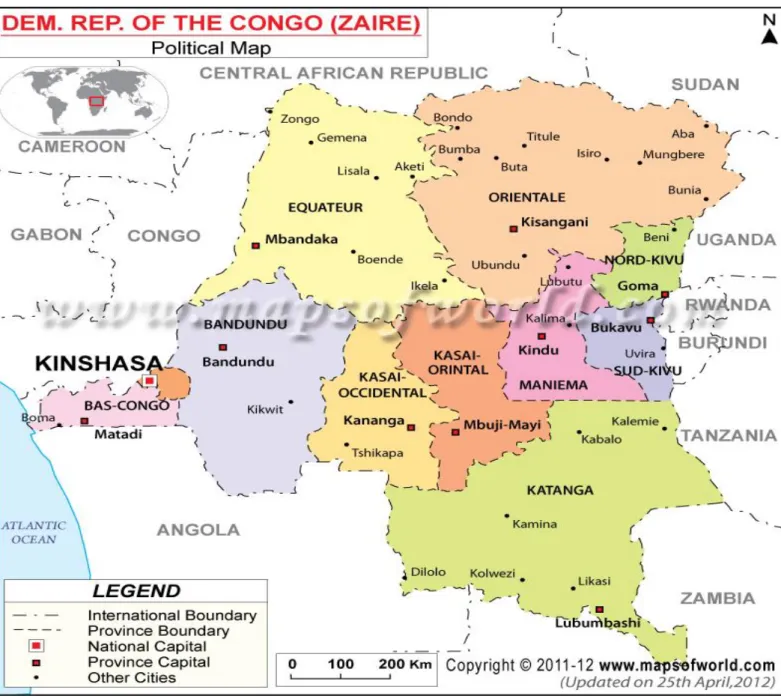
Hoeffler, 2004) for mobility and negotiating access. The map below expounds the nature of proximity DRC and the neighbouring states have. The closeness creates opportunity for uncontrollable access not only as a result of wars from other countries but abundant natural resources to sustain guerrilla tactics and the recruitment of child soldiers.
Figure 1. A Political Map of the Democratic Republic of Congo.
Web1. (Accessed August 2014)
The political map indicates the landscape of a country ravaged by intrastate wars particularly in the Eastern region. It also shows how close to the borders are the neighboring countries that have contributed directly and or indirectly in the wars including Rwanda and Burundi.
The DRC does not only share borders with nine other countries in the Great Lakes Region but is easily accessible through its porous borders (Ettang, 2011). Actually, the country’s natural resource endowment makes it lucrative to neighbouring legal and illegal migrants who flock the country in search of resources and a better life. The DRC faces cross-border challenges, increasingly rife sexual violence and rebel groups from neighbouring states. It is affected by a
“proliferation of small arms and light weapons, refugee flows, displacement of population, migration, and land conflict continue to increase the threats to regional peace and security”
(Ettang, 2011: 184). The inclusive government was meant to reduce both the cross-border challenges which mainly threaten security and thrive through the weakened government institutions but the persistent violence became a stumbling block (Boshoff, 2004).
Conflict in the Democratic Republic of Congo started before independence and continued immediately thereafter. The country became the private property of King Leopord II which led to the involvement of Europe, America and other countries in the West that participated in the prolonged civil strife. The assassination of Patrice Lumumba by Belgian and CIA agents coupled with the Backing of Mobutu Sese Seko demonstrate the unprincipled participation of the West in the DRC affairs (Gegout, 2009). The main source of conflict has consistently been access to easily available and heavily endowed natural resources. Other problems, such as ethnic clashes and territorial clashes, cannot be ignored. Evidence shows how profit-driven war-related interests have maintained the war in the DRC (Samset, 2002). For example, significant deposits of cobalt, copper, uranium, coltan and other natural resources including timber are the main reason for political and economic conflicts to strive persistently. Rebel groups in the East use such resources to fight the government (Lujala et al., 2005).
Historical accounts moreover, reveal that the name of the state changed three times from Congo Free State, to Zaire then DRC. Since the discovery of the land of plenty, the people are subjected to frequent civil wars, cheap forced labour and the recruitment of children for military work (Brett & Specht, 2004 and Carpenter, 2012). Besides, the involvement of local and international actors in exploiting easily available and seriously in-demand resources including coltan and gold fuel the conflict (Rodríguez, 2011). The state’s violence also emanate from neighbourhood violent conflicts and the movement of people from neighbouring countries through the porous borders into the DRC plus continuous search and harvesting of timber (Putzel et al., 2014). For example, as already indicated, dissidents from Rwanda fled Rwanda and regrouped in the DRC and formed the Forces De ́mocratiques de Libe ́ration du Rwanda (FDLR). Even though they cannot be clearly referred to as Rwandans as some were born in the DRC, such population consists of Rwandan Hutus in the main. They escaped Rwanda during the genocide period (Rodríguez, 2011: 176). They formed rebel groups and began amassing huge quantities of natural resources to fund their movement while hoping to establish a comeback on the Rwandan government (Rodríguez, 2011).
Child Soldiers in the DRC
Empirical data on the DRC has demonstrated consistent trends in the continual practice of recruitment of child soldiers for military responsibilities. Evidence also shows the DRC to have the largest concentration of child soldiers in the world with estimated Nine Para-militia groups involved in the conflict and enlisting child soldiers (Bell, 2006). The states’ army and rebel groups are perpetrators and have actively contributed to this humanitarian crisis (Becker, 2004 and Wessells, 2006). To be precise, all the parties involved in the DRC conflict recruit children to become soldiers (Becker, 2004: 2). Researchers have argued that these children become exposed to gruesome violence and they witness the worst atrocities during the recurring violent conflicts. They either witness or commit butchery, burning and boiling of bodies, cannibalism, decapitation, killing of own families, repeated rapes and mass killings with the phenomenon almost exclusively occurring in developing countries (Van Bueren, 1994, Becker, 2004, Clemesac, 2007 and Szijj, 2010). Child soldiers should not be analysed as a DRC and Africa only singularity as it remains a global phenomenon. The international community has been affected directly and indirectly for decades by such injustices occurring outside of the recognised World Wars.
An example may be found in Central America where the smallest yet densely populated state of El Salvador experienced volatile transit from a violent and repressive government to a civil war that lasted over a decade between 1980 and 1992. The left wing Frente Farabundo Martí Liberacíon Nacional (FMLN) rebel coalition and the Forces Armada de El Salvador (FAES) alliance of state armed forces are reported to have recruited children less than 16 years of age to participate in the civil war. Legislation was manipulated to allow for the recruitment of children into military activities (Verhey, 2001).
Research has revealed the complexities relating to child soldiers and violent youth in countries not experiencing civil wars in the full sense but with a strong presence of gang and organised criminal activity such as the United States of America (USA) (Wessells, 2006).
The broader analysis by Wessells has its shortcomings, however, as it is a view that depicts an analysis that criticises the classifying of children involved in any form of violence whether formal and or informal duties, compelled or voluntary as child soldiers or any other stigma imposing names. The criticism lacks a clear and credible definition of such children. What it clearly points out though is how children in Africa, Asia/Pacific, the Americas, Middle East and Europe/ Eurasia constitute the contested number of child soldiers that has constantly been
about three hundred thousand. In essence, the research shows exploitation of children for military reasons from almost all corners of the globe. Africa and Asia have been the most affected by the phenomenon (Wessells, 2006).
It is difficult to establish and conclude on one specific cause for children’s participation in military work. The reasons vary from country to country and they also differ from one conflict to the other within a state (Brett & Specht, 2004). The estimated figure as critics argue cannot be verified because it is almost impossible to access the military camps and ascertain the number of child soldier at a given time. Child soldiers include both boys and girls younger than ten years of age up to the age of 18. Africa has more children involved in war than any other continent currently because of the civil wars and escalating regional and ethnic tensions (Wessells, 2006). Children’s rights are grossly violated in many ways during violent conflicts leaving them brutally maimed and murdered regardless of whether they become part of the armies or not. Actually, children have (and continue to in current wars) suffered from trauma, exploitation, displacement and socio-economic and political deprivation. Despite political, humanitarian, legal and academic attempts to understand and propose solutions to the phenomenon, the number of child soldiers and the nature and extent of atrocities grow (Wessells 2006 and Honwana 2006).
The involvement of children in wars is a humanitarian crisis as it results in children being deprived of opportunities to play, to be protected, acquire basic education, live with families and interact with their immediate environment peacefully. The natural environment and involvement of adults in their development constitutes what Lareau (2011), refers to as
‘cultural repertoires’ for raising children. The repertoires are applicable despite family’s economic and social status and gender related interpretations. The United Nations Children’s Fund (UNICEF) under the theme ‘World Summit for Children’ concluded that children have rights to health, education, and freedom from violence and exploitation. Significantly, the Summit noted that the “first line of protection should be the family…in an atmosphere of happiness, love and understanding” (Web3, Roscoe, 2011 and Diers, 2013). Furthermore, the summit proposed that day care centers are an important form of support (web 3.). The protection of children and their fundamental rights have positive implications for the broader society. If children and their rights are placed at the centre of policy development and needs and interests at the forefront, societies will develop and heal (Roscoe, 2011: 14).
It is worth noting, moreover, that several international organisations including the United Nations (UN), Amnesty International (AI), Human Rights Watch (HRW), World Vision (WV) and many Non-Governmental Organisations have contributed to the intensification of campaigns aimed at reducing the number of children in the bushes (Roscoe, 2011). Research and proposed legislation are evidence of the meaningful contributions by local and international institutions fighting to protect children from all forms of deprivation, war, and exploitation and forced labour. Efforts to establish and enforce international law to prevent children under 18 in participating in military work are in advanced stages. However, there are still major contestations about the age restrictions. Even though 15 years old is mostly recognized by international criminal law, “eighteen is becoming the new normal” (Drumbl, 2012: 135). The Optional protocol I and II to the Convention of the Rights of a Child (CRC) adopted in 2000, the International Labor Organisation’s (ILO) Convention no. 182 and The African Charter on the Rights and Welfare of a Child brought into action in 1999 are among major international steps taken to protect children from participating in military work and child labor in general (Drumbl, 2012).
1.3 Definition of key terms a) Child Soldiers
The definition of a child soldier was initially created in the meeting that established the Cape Town Principles in 1997. This followed the assignment given to Graca Machel by the then Secretary General of the United Nations Boutros Boutros-Ghali (Wessells, 2006 and Szijj, 2010). The landmark enquiry into the impact of war on children remains unfinished business.
It has also led to a plethora of other pertinent investigations on children in affliction and their wellbeing on short and long term basis.
The Child soldier concept can be hypothesised contextually. This means that it is crucial that one recognizes the differences attached to the definitions of a ‘child’, on the one hand, and child soldier on the other hand, in different autonomous communities around the world.
Formal definitions emanated from the Cape Town principles (1997), and defined a child soldier as any person under the age of 18 years involved in any kind of regular or irregular armed group in any capacity. It further explains that the activities may include but not limited to cooks, porters, messengers and accompanying of such groups other than family members.
The children include girls recruited for sexual purposes (Szijj, 2010). The United Nations
International Children Emergency Fund (UNICEF) uses the same definition; adding that it does not refer only to children carrying arms but by simple association (MacMullin &
Loughry, 2004: 460).
Szijj, (2010: 334) contends that the term ‘child soldier’ in itself when pieced together is hazardous and problematic. The definition of the term childhood should be understood not only from an age point of view. In fact, due to certain social practices, such as child headed household, children cease to be referred to as children before they cross the 18-year mark. In essence childhood may be better explained from a responsibility perspective than an inference only drawn from their chronological age. It is as a result of social expectations that childhood is then defined by social roles, expectations and responsibilities (Honwana, 1999:
52). An example outside of conflict may be that of girl children getting married and bearing children at the ages of thirteen and fourteen years (Honwana, 1999). It stands to reason, therefore, that a child taking similar responsibilities as a ten-year-old soldier can no longer qualify to be called a child since they begin to play roles and responsibilities of adult beings (Honwana, 1999: 52). The UNICEF defines a child irrespective of socio-cultural conditions as someone less than that of 18 years of age unless the laws of a particular country set the legal age for adulthood younger than 18 years (Web3.). The UNICEF’s position, however, negates the realities about socio-cultural perspectives that may not have been currently enacted into state laws such as the early marriages. Further arguments on the definition are discussed in the magnitude of the child soldier phenomenon under literature review.
b) International Law
International Law can be interpreted as the law only concerned with governing relations between nation-states and intergovernmental organisations (Buergenthal et al., 2009).
Hughes-Wislon and Wilkinson, (2001) defined Disarmament, Demobilisation and Reintegration as follows;
c) Disarmament
Is the collection, documentation, control, and disposal of small arms, ammunition, explosives, and light and heavy weapons of combatants and often also of the civilian population. Disarmament also includes the development of responsible arms management programs.
d) Demobilisation
Is a formal and controlled discharge of active combatants from armed forces or other armed groups. The first stage of demobilisation may extend from the processing of individual combatants in temporary centers to the massing of troops in camps designated for this purpose (cantonment sites, encampments, assembly areas or barracks). The second stage of demobilisation encompasses the support package provided to the demobilised which is called reintegration.
e) Reintegration
Is the process by which ex-combatants acquire civilian status and gain sustainable employment and income. Reintegration is essentially a social and economic process with an open time frame, primarily taking place in communities at the local level. It is part of the general development of a country and a national responsibility and often necessitates long- term external assistance.
1.4 Research Problems and Study objectives
This study is designed to fulfill the requirements of a Master’s degree in Conflict Transformation and Peace Studies (CTPS) at the University of KwaZulu-Natal. Knowledge acquired will enable the researcher to formulate a view on the plight and challenges faced by children in the Democratic Republic of Congo paying needed attention to the Eastern region.
The research will build a body of knowledge on Conflict in Africa, the DRC, the dynamics in the Great Lakes Region, Sub Saharan Africa and the involvement of the International community in African security issues.
1.5 Ethical considerations
This study reflects an analysis of existing research findings and official documents.
Essentially, plagiarism and academic honesty had to be carefully considered. Fowler (2003:
1) cautions that “using someone else’s ideas or phrasing and representing those ideas or phrasing as your own, either on purpose or through carelessness, is a serious offense”. The study went through an evaluation to detect plagiarism using a credible turnitin scan. In addition, Fowler advises that avoiding plagiarism safeguards the integrity of every writer.
This was part of an ethical consideration in writing this study.
Apart from plagiarism, this research had to be conducted “to the highest ethical and procedural standards within the limitations imposed by time, money and opportunity”
Becker, Bryman and Ferguson, (2012: 57). This study had to be subjected to those rigorous ethical considerations. Firstly, it was of great importance to look at the nature of people chosen as a sample for this research and these are children in a coup and war prone country.
Secondly, the study requirement stipulates that subjects (such as children) be protected from any social, political, economic and physical harm or costs after the research is completed (Becker, et al. 2012). Despite being desktop, the study shows an ethical consideration that proves ‘reflexivity’ in order to imagine what the children under 18 years go through when associated with armies. In fact, deliberate attempts have been made, such as investigating their thinking patterns, to show thoughtfulness and awareness of what transpires in the bushes and camps where children are oriented into armies (Lahman, 2008). Besides the needed consciousness on researcher-child participant, this study has limited ethical research consideration because children are neither interviewed nor interacted with regarding the content requirements and methodology of a desktop short study.
1.6 Hypothesis
Children participating in war directly and/or indirectly suffer tremendous stress and other forms of psychosocial challenges. The appalling and life-threatening events endured by soldiers even well into adulthood was the basis for the research that occasioned the Post Traumatic Stress Disorder (PTSD) found in the third edition of the Diagnostic and Statistical Manual of Mental Disorders (DSM4) (Kerig & Wainryb, 2013). The description in the DSM4 reveals the nature and extent of trauma suffered by children in conflict and other disastrous conditions such as hurricanes and child trafficking. This study assumes that children exposed to recurring conflict and in forced movement and abuses suffer tremendous psychosocial development inhibition. Secondly, children suffering from extreme levels of trauma would consciously or unconsciously decide to misremember their plight. The Betrayal Trauma Theory (BTT) as espoused by (Freyd, 1998 and DePrince et al., 2012) elaborates the hypothesis at length under chapter two.
1.7 Key Objectives
Following are the reasons accounting for why the study focuses on the DRC,
a) The DRC has had the worst forms of killings outside the World Wars and natural disasters.
b) It has the largest concentration of child soldiers in the world constantly at approximately 7000 and these child soldiers are mostly between 12 and 17 years old (Johannessen and Holgersen, 2013: 55).
c) The war has occurred for over a decade and still continues especially in the Eastern region.
d) Displaced people are recorded mostly in the East that is the main focus of the study and records also show displacement from the West and Northern region of the DRC (Bell, 2006).
e) The violent conflicts are not only associated with the natural resources such as diamond but have devastating effects on the Great Lakes region (Marten, 2009).
f) Furthermore, the affected children do not only get exposed to atrocities but contribute to the violence. They are deprived of opportunities to basic health, education, family and community life.
g) Significantly these children are exposed to extreme forms of trauma, discrimination and isolation.
1.8 Limitations of the study
The study is almost absolutely dependent on other researchers’ views on the subject because of the very sensitive nature of the discussion on child soldiers. Secondly, the research could not be done in the DRC because of distance and availability of resources. It cannot be ignored that information regarding the conflict in the DRC is mostly “Western media representations”… resulting in ‘repeated familiar colonial and postcolonial imagery” (Baaz and Stern, 2008: 58). The outsider account, however, cannot downplay the significance of the child soldier phenomenon and its ramifications on both the country and the international community because it is also a global problem. The limitations are addressed by an analysis that draws from both historical ethnographic research and current news bulletin to identify and construe new findings.
Journal articles and books were identified as main sources for this study. The content was divided into topic-related groups with the aim of illuminating the salient topics seen to be crucial for the study. Over (n-122) articles were identified for this study. The first topic consisting of a sample of (n-14) articles discussed definitions of children involved in armies, the reasons for enlisting and their estimated figure globally. Secondly, Articles and books focused on the psychosocial wellbeing of children in war (n-19). Articles quantifying the role
played by natural resources to fuel conflict, which has a significant bearing on the use of children in wars, were (n-11). Reintegration of former child soldiers forms an important part of this study. As a result (n-15) articles were identified to expose the dynamics of reintegration, which form part of an important recovery process for ex-combatants. The other journal articles, dissertations and news bulletins covered topics such as Law and child soldiers, the Betrayal Trauma Theory and politics in Africa in relation to the plight of children as a result of violent conflicts. The choice of articles followed a purposive technique because the researcher purposely selected those books and articles that specifically discussed each of the relevant topics mentioned above. The purposive technique was based on the intentions of the study and knowledge of the topic by the researcher. Both the topic and the historical background became useful in selecting material. Another technique used was snowballing. Each article identified had similar sources listed as related articles, which were useful. The researcher was able to find both similar and or differing views on each chosen topic under the list of references provided by already selected readings.
The credibility of desktop studies in general and content analysis in particular stems from a long history. It is done by repeatedly reading and coding data to “achieve immersion and obtain a sense of the whole” of the studied phenomenon (Hsieh and Shannon, 2005: 1279).
The analysis of existing content may be used to validate existing theoretical framework. For example, the BTT is validated by beingtested against extreme forms of abuse instead of the conventional domestic abuse previously associated with. The theory gets supported and extended (Hsieh & Shannon, 2005).
The study remains a relevant and important niche area for knowledge production relating to child and human development juxtaposed with impeded development as a result of violence and disturbed patterns for child and human development. It highlights on the impact of violence on children of which some are not considered to be in a position of taking rational decisions because of age and dependency. In addition, the chosen country has been confronted with a recurring scourge of ruins, social fragments, and humanitarian crisis and unaccounted for natural resources. The volatile social, political and economic situation in the DRC warrants not only empirical data collection but also rapid content analysis and refining.
The analysis of existing empirical data represents an opportunity for increasing the body of knowledge on African security, child soldiers, psychosocial response to violence and abuse.
Furthermore, this study analyses an important context, which is the DRC, emphasising its
location in the African continent and the Great Lakes (Ritchie, Lewis, Nicholls and Ormston, 2013).
The methodology reflects the objectives of the study highlighting the relationship between violence and diminished chances for a universally envisaged child development pattern. The research is limited to an analysis that emanates not only from secondary data directly focusing on violent conflicts and the involvement of children but gradually introduced means to prevent such. Apart from focusing on research and official documents, more information was drawn from news-focused sources. The diversity in the data collection may prove demanding, but enabled the analysis to be diverse and relevant. Actually, the news aspect deliberates on current affairs and responses from such institutions as the United Nations and International Labour Organisations (ILO) on such violent occurrences.
There is particular attention allocated to the Eastern region because of continuing wars despite recorded state and regional agreements. That region is the most affected by the civil war. Secondly, many of the rebel groups both from Congo and the neighbouring countries get started in the same region because of the porous borders and plentiful natural endowments (Mumwi 2012). Those include underground resources such as coltan and others such as timber. The natural resources are easy to access and play a significant role in funding the establishment of insurgents and their sustenance.
1.9 Research Questions
a) What contributes to children enlisting for military responsibilities?
b) What is the impact of war and violence on children living in the DRC?
c) What programs are in place to enhance disarmament, demobilisation and reintegration of child soldiers in the DRC?
d) How effective is implementation of the application of local and international law in preventing recruitment of children into military work?
2 Chapter Two. A Summary Review of Literature on Child Soldiers in the DRC
2.1 Introduction
This chapter focuses on examining how children in the DRC have had to adjust to the lives of combatants. They become perpetrators and or victims of continuous violence that has led to mass victimisation and displacement in Africa and beyond. The nature and extent of brutality and victimisation of children in armed conflict has invited significant attention from researchers and policy makers (Mann, 1987, Cohn, 1994, Macksoud & Aber, 1996, Faulkner, 2001, Oliveira, 2003, Becker, 2004, Betancourt et al., 2009, Lee, 2009 and Maxted, 2010).
The body of research quantifies the atrocities that rob children of an opportunity to be nurtured and developed reasonably, normally, and morally in accordance with the standard expressed by the UN agencies such as the UNICEF. Notably, there is certainly a challenge faced by many African states. However, the DRC remains the major focus because of the civil war that started in 1998. The DRC is under scrutiny because in 2005 alone, thousands of children were killed, displaced and socially deprived. These atrocities were accompanied by 25 000 reported cases of rape in the Eastern region (Bell, 2006: 3).
2.2 The Magnitude of the Phenomenon
The nature and extent of the child soldier happenings is quantified in three different aspects.
Firstly, it is an estimated number of the children in violent conflicts with particular emphasis on the DRC. Secondly, there is an attempt to respond to the question of the affected countries around the world. The third aspect studies the contended definitions of the phenomenon to justify the current estimation of the child soldier humanitarian issue.
The child soldier phenomenon has dreadfully been part of almost all civil unrests in Africa and beyond. In fact, despite Africa being the most affected recently, the entire globe has experienced in one form or the other of forced recruitment of children to directly participate in wars (Verhey 2001). Government armies and rebel/liberation movements alike have recruited children for military and other responsibilities such as spying (Wessells, 2006). If the definitions of a child include the age and responsibilities and expectations from the individual, then these people cease to fit in such a definition. The vacuum demands a befitting definition of the individual who cannot be an adult because of age but also not a child as a result of behavior and experience. It should, indeed, probe a necessary question on the acceptable definition/s of a soldier as well. It is becoming essential that there be an
investigation on the definitions, number, location and the activities the children do to predict the possible future occurrence of the phenomenon. The investigation is likely to encourage research aimed at separate philosophical definitions of children, on the one hand, and soldiers younger than 18 years of age on the other hand.
Besides a clear definition of the term ‘child’ in such circumstances, researchers also grapple with the legitimacy of using ‘child soldiers’ as an umbrella term. The challenge lies in that the term tends to be limiting. For instance, in Northern Uganda children were abducted for sexual exploitation purposes while others spied and some became carriers of supplies but were never trained to carry arms and use them (Wessells 2006). There are, therefore, difficulties in defining them as children or adults who are soldiers (Wessells 2006: 6). It is in that regard, therefore, that some researchers crafted and preferred the disputed term Children (minors) Associated with Fighting Forces (CAFF).
The controversy associated with the label is centered on the deprivation of support for those who maybe be seen as porters, spies and sex slaves instead of child combatants. Also, it is important to understand how the social and environmental alterations such as displacement and the abrupt and forced creation of refugee camps (largely due to violent conflicts) impact on the psychosocial wellbeing of these children. It remains a daunting mission for researchers and policy makers. Wessells (2006: 4) holds the view that an understanding of the urgency and scale of the calamity may “leverage both public support and governmental and intergovernmental action to end child soldiering”. Important as it may be, the position lacks clarity on what is to be done when the atrocities mostly on poor individuals and communities are sustained intentionally by both local and international power structures such as governments. The separation of children based on forced allocation of duties-such as military work, leaves the children with stigma and creates unnecessary prejudice. Such affect children differently at times according to their gender. This becomes evident during reintegration into original communities.
Child soldiers are part of almost every war and conflict globally. In most cases they are victims. Child soldiers can be traced as far back as the thirteenth century. Fox (2005) and Szijj (2010: 344) relate to the historical existence of child soldiers by arguing that they should not be seen as a new occurrence. The writers further claim that if there is anything new, it can
only be the unprecedented proportions and not the uniqueness of the phenomenon (Fox 2005:
28). What further exacerbates the issue is that it has now spread globally and across cultural backgrounds, which could easily make the occurrence seem new. Moreover, the importance of the recruitment of children for military purposes should not only be interpreted as phenomenal because of numbers but significantly as a result of rising frequency and distribution (Fox 2005: 29). It has, indeed, become a new approach to modern interpretation of violent conflict.
There is an estimated global figure of three hundred thousand children recruited for purposes of military work consistently (Becker, 2004, Betancourt et al., 2009, Lee, 2009 and Szijj 2010). Wars in more than 80 countries globally have not only seen the slaughter of two million children but many have been displaced and disabled (Betancourt et al. 2012). Even though the statistics on survivors are not publicised as much as those about displaced and killed child soldiers, there are many children that survive recruitment and horrific military camp life (Klasen et al. 2010). There is also an omission on the survival mechanisms children employ to endure violence in the camps and stigma in communities after reintegration. The Betrayal Trauma Theory is one of the useful theories that explain the survival mechanisms employed by the harmed children. Due to uncertainty on the figures and the difficulty in obtaining accurate ones, the figures remain virtual estimations. Child soldiers are either abducted or become soldiers voluntarily. Both circumstances leave psychological and physical scars that no form of aid may repair. Becker (2004) argues that the Lord’s Resistance Army in Uganda forced over 8000 children to become soldiers between 2002 and 2003. This is an example of a rebel movement operating in Central Africa including the DRC that contributes to the global harm on children.
The warlords in most instances and government armies to a certain extent see children as a force that is cheap, compliant and effective (Becker 2004). While conflict is resolved in one state or between states, new wars erupt across the globe opening space for the recruitment of children under 18 years. That leads to the recruitment of more children to become soldiers (Becker; 2004). Despite commitment by states and the international community to protect children from violence and child labour through legislation such as the 1989 UN convention on the Rights of the Child; children under the age of 18 continue to be recruited into military tasks in many civil wars (Singer: 2004). In order to understand children outside of military life there is, moreover, a need for a proper understanding of military thought and life. What is
a soldier outside the ‘child’ definitions? Due to the scope of this study, defining a soldier is only limited to those soldiers under 18 years of age. It is the thinking of the army personnel that influences the recruitment of children. It should, therefore, form part of the broader enquiry to understand military officers. According to Huntington, (1957), military life in accordance with national security policy should “enhance the safety of the nation’s social, economic, and political institutions against threats arising from other independent states”
(1975: 1). Clearly, the recruitment of children is a clear violation of such policy.
As evidenced by the increasing non-state militias, the crafting of security policy cannot, therefore, only be within the scope of independent states. It should, however, extend to all forms of threats on an autonomous state. In essence, the existence of non-state militias seem to be inevitable, hence the need for regulation despite formal recognition from the UN. The regulation will help children living in isolated camps far from their communities that are almost impossible to access because of strict security measures put in place by rebel leaders (Szijj 2010). In the Democratic Republic of Congo, children have been involved in and became victims of conflict that has left over five million victims since the war started in the late 1990s. The rate of the death of children due to war in the DRC is greater than general child deaths caused by normal diseases in China which is a country 23 times its population (Bell: 2006).
2.3 Reasons for enlisting as child soldiers
The involvement of children in any form of labour is heavily dependent on the political and economic conditions of that specific society. Consequently, the political and economic conditions have a bearing on how the society organises itself and the relations built with the external world. Ideological differences probably stemming from instability and volatile political history influence the choice of solutions amidst indecisive and panic-stricken dialogues or lack thereof. Angola, Sudan, the DRC have had many African peace deals strained by political instabilities (Englebert, and Tull 2008).The political decisions on peace excluded stakeholders considered insignificant in those conflicts and the resolutions thereof.
The exclusion gives birth to the uncertainty of adherence to the agreements. In many cases, the government is unable to protect its people and the people find relief in violence (Szijj 2010: 348). This has been the norm in the DRC.
Children are an extension of a broader society dominated by adults and their prescribed views. Dictating for children to become child soldiers, as their society and its government plays a vital role especially in condoning and perpetrating the practice. It can be argued thus that child soldiers get recruited within a state or outside of a state because they are affected directly or indirectly by the conflict. For instance, child soldiers recruited in the DRC include children from the DRC and the neighbouring countries such as Rwanda. The recruitment of Rwandese shows the effect of war, whether positive or negative, on neighbouring Rwanda.
Despite the relationship between their accessibility juxtaposed with the Rwanda Genocide, they contribute on the fueling of war in the DRC currently (Spittaels and Hilgert 2008).
It is already documented that the reasons for enlisting vary revealing profound continuum between internal and circumstantial choice on the one side and coercion on the other (Derluyn, Vindevogel and De Haene 2013). While some rebel groups recruit through forced methodology such as abduction, violence and threats, there are instances where children are encouraged by their families and broader social networks to join the military. Those circumstantial choices are meant to address family problems such as poverty. They also seem ideal when a community is threatened. For instance, conflict on land and ethnic disputes leave children convinced by the community to train as soldiers for its defense. It is mostly done on the basis of ideological motivation, economic prospects and protection from violence (Derluyn et al. 2013). When interviewed the former child soldiers cite ideological commitments, access to economic activities and prospects for education likely to be provided by the armed groups (Derluyn et al. 2013).
Children as young as ten years are forced to leave school, family and their communities to participate in civil war. The practice was abolished by almost all states except Myanmar in the mid-twentieth century but resurfaced as more rebel movements were formed (Brits and Nel 2012: 467). Brett and Specht (2004) alluded to three major factors contributing to children joining armed forces. Firstly, most of the children come from poor backgrounds and they come from conflict torn areas. Secondly, the choice of a combatant lies in individual personal history which enables the child to decide on participating or not. The third and last aspect illustrates how children are compelled to be combatants because all support structures that form their world crumble and leave them unable to choose anything else but enlisting as child soldiers (Brett and Specht 2004: 3-4). In essence, the three reasons for joining have been found to be unique to individuals. The unique ability to make a choice to participate can
be attributed to the ability of a child to show resilience and the attitude towards reintegration.
If child relience to brutality and stigma is real, then the BTT is justfied in proposing that children choose to repress their experiences of abuse. These children escape from the camps and risk being recaptured and punished in other instances killed for possible fear of sharing internal information to enemies.
Honwana (1999: 52) describes the reasons for recruitment from the view point of the rebel leaders and posits that children are seen as being “synonymous with wealth” because of their abilities to grow and excel under strenuous conditions. In a rather radical position Rosen (2014) argues that local, national and international reasons for the recruitment of children should be considered when analysing child soldiers. Premising the argument on the wellbeing of child soldiers, the author suggests that countries immersed in war leave not just adults but children with no option but to join and become direct participants in the war. This proves then that research should not only investigate the impact of war on children but also how a community can prevent an ongoing conflict because that in turn will save children from enlisting as soldiers.
In addition, in a different book Rosen (2005) states that it would be a misguided conclusion if analysts were to formulate a view on child soldiers from a stigmatised point of view. The writer discourages an analysis emanating from a well-propagated view of “ a young boy, dressed in a tee shirt, shorts, flip-flops, holding an AK-47…a tough-talking twelve-year old in a camouflage” (Rosen 2005: 1). Firstly, the view is skewed because it excludes women and girls as soldiers. Secondly, the stigma-oriented view provides incomplete information about other critical activities the children get to do in the camps such as spying. The conditions are unique and despite similarities with regards to reasons for war such as disputes over natural resources, there continue to be socio-cultural and political differences in the manner in which the conflicts start and persist. In quintessence, it is being too idealistic to imagine that the children live in peaceful areas and brutal rebel leaders/groups ‘forcefully conscript’ them all over the world. Therefore, Rosen (2014: 3072) contends that an analysis into the phenomenon “require[s] a more nuanced perspective of the conditions under which” they assume the military responsibilities. An example of essential investigation should be a focus on the effect of being a spy of a terrorist grouping on children involved.
2.4 Political economy of the DRC war
Historical events show weak and unstable governance entrusted with huge quantities of natural resources to be vulnerable to violent conflicts. The 1999 Lusaka Ceasefire agreement, 2002 Pretoria Agreement and many other agreements including the 2005 elections were significant political moves towards peace. However, protracted conflict especially in the Eastern region has rendered the DRC a collapsed state (Szijj 2010: 344) because it fails to establish itself as a country with a government accountable, democratic and protective of its citizens. Even though ethnic violence including but not limited to alienation of Banyarwanda and Banyamulenge from the rest of Congolese population (Rouw and Willems 2010) natural resources remain at the heart of the DRC violence (Carpenter 2012).
War is driven by certain economic values, ideological convictions and transactions to continue. Similar to any commodity to be exchanged in a market, the existence of war requires an easily available human resource, easily obtainable weapons such as Small Arms and Light Weapons (SALW) and unsettled dialogues between communities and governments.
Children have become a commodity in conflicts and serve handlers to advance their missions resulting in continued devastation and exposure to brutality. The DRC has had constant conflicts and civil wars resulting in millions of victims so many times and it has been dubbed a country that has experienced Africa’s World War (Szijj 2010: 354). The economy plays a pivotal role in the involvement or lack thereof of the neighbouring countries. Evidence point to implicit and or explicit involvement of the Central African Republic, Sudan, Uganda, Rwanda and many others even outside of Africa in the conflict in the DRC. Interference by countries in the Great Lakes Region and rest of the world happens for ethnic reasons, Rwanda bears testament to this. However, the role of economic interferences as a centripetal force cannot be underestimated due to the great demand for natural resources (Szijj 2010: 354).
Figure 2. Child labour (Mining of coltan)
Web3. (Accessed in November 2014)
The figure above demonstrates how children are used mostly for illegal mining of coltan.
This is part of the DRC’s economy that is not accounted for and contributes to the perpetration of conflict. While agriculture remains the major contributor to the DRC economy, it is not disputed that the mining sector both formal and informal remains likely to be the country’s primary vehicle for economic growth (Dagne 2011). The question would be on policy promulgation and implementation to the favour of the DRC than proving an antithesis. The country boasts almost all natural resources in demand in the international market and more especially needed by the developed countries. In fact, in 2001 a panel of experts appointed by the United Nations reported how the mineral resources and other forms of wealth were exploited in the DRC. The scramble is even done by people and companies outside of the DRC local economy. Needless to say, the international actors “operate as gatekeepers between different competing groups and thus can never resolve conflict between them” (Vlassenroot, and Raeymaekers, 2008). Bringing an end to the conflict would jeopardise their interests in the natural resources.
Political regimes also played important unique roles in opening spaces for local, regional and international actors to access control to the places and plunder their resources. Mobutu Sese Seko through his divide and rule tactics did not only open space for neighbouring Rwanda, Uganda and Angola to access the DRC but promoted ethnic polarisation. That has contributed into the economic dynamics and exacerbated the conflicts particularly in the Kivus (Mumwi 2012). There is contention on semantics especially on whether the process should be termed, illegal, exploitation or even looting. Despite accuracy on terminology, evidence indicates that since the discoveries by colonial masters and the promotion of conflict by King Leopold II
there has always been massive mineral deposits in the DRC (Marten 2009: 467).
Additionally, the natural resources made the DRC one of Africa’s main economic powers before the discoveries and demand for oil in the 1970s (Marten 2009).
According to the DRC Ministry of Mining between 1989 and 1995 copper, diamonds, oil and zinc were the most produced minerals and metals in the DRC. The natural resources are wide spread and demands fluctuate but quantity is undeniably massive. The resources are not only sources of income and livelihood but also sources of the ongoing conflict. The DRC Soldiers with armies from Rwanda and Uganda through an initiative called Rassemblement Congolais pour la Democratie (RCD) dispossessed a syndicate of stockpiles of money and other valuables looted and illegally transported to Kampala and Kigali for exports (Jackson 2003).
Suffice to say, conflict is also between local and neighbouring countries seeking to amass the heavily endowed resources. Millions of Congolese could not be prevented from relocating to the Eastern region because of mining even though the region is extremely violent. As a result, mass exodus responded to an abrupt demand for Columbite-tantalite commonly known as coltan in the year 2000 (Jackson 2003 and Nest 2011). It was again an opportunity for economic empowerment and inevitably a contributing factor to tensions and violent conflict due to population growth and competition.
The DRC has abundant natural resources (Szijj 2010) that were referred to as conflict minerals on the Wall Street Reform and Consumer Protection Act signed by the USA president in 2010 (Dagne 2011). Children are used, therefore, as soldiers in the fight for the resources as well as exploited as child labour to extract them. The international community has been involved in taking important policy decisions about the DRC civil wars. For instance, since 1999 the United Nations Security Council essentially deployed personnel to constitute the UN Organisation Mission in the DRC (MONUC). The mission was meant for peacekeeping missions authorised to use force if necessary (Dagne 2011: 9-10). Adversely, the mission has been criticised for its inability to provide sufficient protection to civilians constantly targeted by government forces and rebel groups. The UN secretary general Ban Ki Moon admitted to the uncontrollable humanitarian crisis in the DRC in 2008 (Szijj 2010).
2.5 Psychosocial wellbeing of child soldiers
Even children leading normal lives experience childhood trauma in peaceful communities.
Trauma experiences vary in nature and depend on intensity of the experience and resilience
by the affected child. For example, constant movement of family, changing of immediate environments, friends, parents’ divorce and strict parenting may cause stress and trauma (Suárez-Orozco, 2000). However, distinctly, children in war-torn areas such as the Democratic Republic of Congo experience severe forms of trauma. They become targets and lured into military responsibilities by state armies and Para-militias (Johnson et al. 2010) thus hindering their nature-nurture growth and development patterns. The children involved in the wars according to Bell (2006: 5) suffer chronic lack of education. These children suffer recurring traumatic experiences for a long time since both boys and girls could get recruited from the age of seven (Wessels 2011: 8) and may be kept until their adulthood. This is done in the DRC. War leaves over four million children in the DRC unable to attend primary school education. Extreme levels of poverty, displacement and abduction make school out of reach. The children are unable to pay for the school fees as they live in bushes far from any infrastructure including schools, safe homes, and recreational facilities resulting in distracted yet necessary routine life because of the volatile civil strife (Collier and Hoeffler 2004).
In essence, their mental state has to shift from being a child to a soldier with responsibilities much more demanding than that of adults in peaceful environments. These children (child soldiers) are compelled to choose between two distinct moral conditions formed by the difference between social peace and civil war (Honwana 1999). This is evident in Kerig and Wainryb’s (2013) research that posited that children’s involvement in armed combat is calamitous and chronic. The children suffer from exaggerated levels of trauma. Their trauma is complicated and widespread (Kerig & Wainryb 2013). In a sample of over 280 former child soldiers in Sierra Leone, findings reveal a complex nature of the trauma suffered by children. In addition, data shows how a significant number of families misconstrued what their children suffered as child soldiers (Kerig & Wainryb 2013). A misunderstanding of the experience would consequently bring about failure in reintegrating and rehabilitating the ex- combatants.
Child soldiers do not only suffer from challenges relating to socio-political and economic issues but research illustrates the extent of psychological predicament that is likely to be fatal as compared to physical wounds. Psychological scars gradually haunt the child and a cycle of violence and yearning for vengeance become inevitable. A vengeful former child soldier is a clear threat to humanity and global peace. Writers describe the severity of trauma suffered by