Client perceptions of social skills development occupational therapy intervention groups in an
acute psychiatry setting
Student: Andrea Radnitz Student no: 9804482
Supervisor: Chantal Christopher Co-supervisor: Thavanesi Gurayah
Submitted in fulfilment of the requirements for the degree of Masters of Occupational Therapy in the School of Health Sciences, University of KwaZulu-Natal
i I, Mrs Andrea Radnitz, declare as follows:
1. That the work described in this thesis has not been submitted to UKZN or other tertiary institution for purposes of obtaining an academic qualification, whether by myself or any other party.
2. That my contribution to the project was as follows:
I designed and prepared the proposal, funded and conducted the research, transcribed and analysed the data and constructed the articles and thesis documents under the guidance of my supervisors.
3. That the contributions of others to the project were as follows:
No other people had significant intellectual contributions to this study.
Signed ______________________ Date________________
ii Pre-amble:
This document is written in the format of a “Masters by manuscript”, as per the requirements of the University of KwaZulu-Natal’s research office. The transition away from “Masters by dissertation” has been made in 2017, by the University of KwaZulu-Natal, in order to encourage students to publish their work, thereby, making more of the research conducted for degree purposes accessible to the public, to aid in the transfer of knowledge. The university’s formatting requirements can be found under attachment A. The research articles have been referenced according to the guidelines of the journals to which they will be submitted. The rest of the document, for consistency, has been referenced according to the guidelines of the second journal article; an adapted Harvard referencing system. These guidelines can be found in Appendix J
Dedication:
To my Lord and Father, Jesus Christ.
Acknowledgements:
I would like to acknowledge Abigail Foley and Margaux D’Hangest D’Yvoy who gave willingly of their time to conduct the focus groups. I thank my supervisors who both went out of their way to support and encourage me despite the pressures in their own lives. I am indebted to my husband and my sons who have made it possible for me to complete this study, through their encouragement and support, and by graciously giving me space to work. Finally my thanks go to the many colleagues who have shared their wisdom and insight into this study and our clients who so enthusiastically participated.
iii Contents:
CHAPTER 1: INTRODUCTON ... 1
1.1 INTRODUCTION ... 1
1.2 BACKGROUND ... 1
1.3 STUDY CONTEXT ... 2
1.4 PROBLEM STATEMENT: ... 3
1.5 RESEARCH QUESTION ... 3
1.6 RESEARCH AIM ... 3
1.7 RESEARCH OBJECTIVES ... 3
1.8 LITERATURE REVIEW ... 4
1.8.1 Occupational therapy in mental health care ... 4
1.8.2 Mental health problems are a significant and growing concern ... 7
1.8.3 Interpersonal relationships and mental health ... 7
1.8.4 Group work... 8
1.9 SIGNIFICANCE AND RATIONALE ... 10
1.10 METHODOLOGY ... 10
1.9.1 Research Design ... 10
1.9.2 Population ... 10
1.9.3 Sampling Strategy ... 11
1.9.4 Data collection ... 12
1.9.4 Participants ... 15
1.9.5 Data Analysis ... 19
1.9.6 Ethical Considerations ... 19
CHAPTER 2: PRESENTATION AND INTERPRETATION OF FINDINGS ... 22
2.1 INTRODUCTION ... 22
2.2 CONTRIBUTION RECORD ... 24
2.3 PUBLICATION DETAILS: ARTICLE 1 ... 24
2.4 JOURNAL INFORMATION ... 24
2.5 ABSTRACT ... 25
2.6 ARTICLE 1 ... 26
2.7 BRIDGING ... 48
2.8 PUBLICATION DETAILS: ARTICLE 2 ... 49
iv
2.9 JOURNAL INFORMATION ... 49
2.10 ABSTRACT ... 50
2.11 ARTICLE 2 ... 51
CHAPTER 3: SYNTHESIS ... 70
3.1 SUMMARY OF CONCLUSIONS ... 70
3.2 OUTCOMES OF OBJECTIVES ... 71
3.3 PERSONAL REFLECTION ... 73
3.3.1 Research content: ... 73
3.3.2 Research process: ... 74
3.4 RECOMMENDATIONS ... 74
3.4.1 Recommendations for research ... 74
3.4.2 Recommendation for the study site: ... 75
3.4.3 Recommendations for health systems and policy ... 76
3.5 REFERENCES ... 77
APPENDIX A: INSTRUCTIONS’ TO STUDENTS ON MASTERS BY MANUSCRIPT: ... 86
Outline of thesis: ... 86
APPENDIX B: SEMI-STRUCTURED QUESTIONS FOR THE FOCUS GROUPS... 87
APPENDIX C: INFORMATION LETTER TO PARTICPANTS ... 89
APPENDIX D: INFORMATION LETTER TO THE STUDY SITE ... 91
APPENDIX E: INFORMED CONSENT FORM, ENGLISH ... 93
APPENDIX F: INFORMED CONCENT FORM, ISIZULU ... 96
APPENDIX G: BIOGRAPHICAL QUESTIONAIRE ... 98
... 98
APPENDIX H: ETHICS CERTIFICATION ... 101
Certificate of Completion ... 101
APPENDIX I: BREC APPROVAL LETTER ... 102
APPENDIX J: GROUPWORK JOURNAL: NOTES FOR AUTHORS ON MANUSCRIPT SUBMISSION ... 103
Appendix K Letter of receipt of journal article: ... 105
[Groupwork] Submission Acknowledgement Sept 30 ... 105
v List of tables:
Table 1.1 Focus groups Participants………14 Table 2.1 Table of themes………..21 List of figures:
Article 1:
Figure 1: Summary of themes and sub-themes………..25 Article 2:
Figure 1 A diagram illustrating the themes and sub-themes………50
List of Abbreviations:
MHCU………Mental health care user
List of operational definitions:
Interpersonal relationships: This refers to the relationship between two individuals.
The well-being of this relationship can be influenced by many inter- and intrapersonal factors.
Social skills: This refers to the set of skills an individual holds, with which they communicate and relate to other people. These skills include the ability to
communicate, both verbally and non-verbally, listen effectively, and manage conflict effectively.
1
CLIENT PERCEPTIONS OF OCCUPATIONAL THERAPY INTERVENTION GROUPS IN AN ACUTE PSYCHIATRIC
SETTING:
CHAPTER 1: INTRODUCTON
1.1 INTRODUCTION
Occupational therapy is deeply rooted in mental health care, especially in the treatment of hospitalised or institutionalised clients (Paterson, 2008). Despite this long history and the continued, regular use of this therapeutic mode in current practice, research in this area is currently severely limited (Cowls and Hale, 2005;
Occupational Therapy Association of South Africa, 2014; Scanlan, Argent, Ayling, Mouawad and Woodward, 2015).
1.2 BACKGROUND
This study developed out of the frustration of looking for evidence on which to base practice as a group work occupational therapist, and finding very limited information.
This dearth of information impacts on occupational therapists ability to choose the most effective interventions and make effective choices of group structuring and handling principles. . I believe that if we as occupational therapists want to keep our role in the treatment of MHCU’s then we need to firstly, better understand and grow its value, and secondly, we need to prove to other professionals that our work has worth. This thought was then confirmed as I started reading articles and literature, where I discovered many calls to research and thoughts that concurred with and expanded my own (Lloyd, and Williams, 2010). I could not expect other therapists to do this work if I was not prepared to contribute myself. This study comes as a result of this conviction.
After some reading it was apparent that it would be difficult to quantify the efficacy of group therapy intervention, and so the study would need to be a qualitative one.
Although clients do not always have emotional insight into their difficulties and the impact of each intervention, they are able to tell their own stories and comment on the
2
functional changes that they have made as a result of intervention. The clients’
perceptions impact on their investment in therapy and their treatment compliance and are therefore useful in starting to understand the impact of occupational therapy groups and altering group therapy to strengthen clients’ investment in treatment.
In both the global and the South African context mental illness is a growing concern, and using resources efficiently in the treatment of these disorders is becoming critical.
Occupational therapists cover many topics and areas during group intervention with MHCUs. To study all of these in this study would make the data to broad or the study too large. To gain more depth of insight and make the data size manageable a
particular area of intervention needed to be chosen. As Literature shows Interpersonal relationships play an important role in mental health and human development (Baron, Branscombe, & Byrne, 2009; Cassidy, 2002; Yalom & Leszcz, 2008) and mental health problems impact on the clients’ interpersonal relationships (Buist-Bouwman et al., 2006) the study was initiated in this area.
1.3 STUDY CONTEXT
The study was set in KwaZulu-Natal, South Africa, in an acute private psychiatric clinic that provides voluntary inpatient care for adults with general psychiatric disorders. The majority of the clients admitted to the facility are members of a medical aid or medical insurance plan which covers the expenses incurred by the admission.
A few clients pay their medical expenses personally. The three-week treatment plan includes occupational therapy groups, psychology groups, and individual consultations with psychologists and psychiatrists. The 21-day group programme is structured around three themes, interpersonal relationships, self-awareness and emotional management, with each theme taking one week. There are a total of 25 therapy groups offered during the week Clients are strongly encouraged to attend most groups, but are often called out of the group programme for individual consultations with doctors and psychologists. The programme is relatively consistent
3
with planned groups and activities, but is sometimes adapted for special occasions or public holidays and particular groups’ needs.
1.4 PROBLEM STATEMENT:
Occupational therapists need to be able to provide effective and efficient therapy to MHCUs. To do this they need a greater understanding of how the MHCUs perceive occupational therapy groups and what techniques and tools make a significant impact on the clients daily functioning, particularly in terms of interpersonal relationships, which have a broad impact on clients functioning in many areas of their daily functioning. Further a deeper understanding of occupational group work is vital to providing an effective service.
1.5 RESEARCH QUESTION
What are client perceptions regarding occupational therapy intervention groups which facilitate the remediation or strengthening of interpersonal relationships at the study site? Furthermore, what are the clients’ perceptions regarding the efficacy, applicability, and meaningfulness of the group content?
1.6 RESEARCH AIM
The aim of this research project was to investigate and describe the inpatient clients’
perceptions of occupational therapy intervention groups in terms of their efficacy in the facilitation and strengthening of clients’ interpersonal relationships.
1.7 RESEARCH OBJECTIVES
1. To explore the participants’ interpersonal relationships and to understand how any interpersonal difficulties are related to their mental health.
2. To describe how clients’ perceptions of their relationships and interpersonal styles have developed as a result of group therapy, and if, or how, the clients’
social skills repertoire has been strengthened. Furthermore, to describe clients levels of confidence in using their social skills to remediate or strengthen their relationships.
4
3. To explore clients perceptions of which occupational therapy groups or exercises were effective in strengthening their social skills repertoire and which groups or exercises were deemed to be less effective or ineffective.
4. To explore clients’ experience of group therapy, the groups’ levels of cohesion, trust and openness, focusing on Yalom’s 11 principles, to discover how being a group member impacted on members’ abilities and opportunities to practice and strengthen their social skills.
5. To identify gaps in the group content or process where clients still experience a lack of, or unresolved difficulties with regard to their social skills repertoire and to explore clients’ experiences of the order of the groups presented, the structure of the groups and their suggestions, advice, and recommendations for the group content, presentation and format.
1.8 LITERATURE REVIEW
An initial search for literature pertaining to occupational therapy group work, in acute psychiatric settings was conducted in google scholar, a few relevant articles where found and the relevant references of these articles were searched for further information. The search was broadened to Pubmed, Wiley online library and Sage journals once the researcher had access to the university library.
1.8.1 Occupational therapy in mental health care
From as early as 1922 the philosophy of improving client’s mental health through participation in meaningful activities was described in literature (Meyer, 1922). This has become the underpinning philosophy for contemporary occupational therapy intervention, and continues to guide occupational therapists thinking and practice (Patterson, 2008). The occupational therapists’ role in the treatment of mental health care users (MHCU) remains an important one, despite the many changes and challenges in the present-day mental health care systems (Patterson, 2008; Smith and Mackenzie,2011; McMorris, 2017).
5
Occupational therapists play a key role in inpatient care, from admission to discharge.
The four core elements of occupational therapy practice, in adult acute mental health settings, are: individual assessment, therapeutic groups, individual treatment and discharge planning (Lloyd, et al., 2010). The focus of this study is on the third core element, that is, therapeutic groups. Despite group work being a core element of occupational therapy intervention in mental health, there is currently limited research on these groups (Cowls, et al., 2005; Sporild and Bonsaksen, 2014). There is however, extensive evidence on the efficacy of group therapy from the field of psychology (Yalom and Leszcz, 2005).
Occupational therapists use participation in meaningful activity to promote healing (Law, 2002), based on the philosophy that purposeful, meaningful activity or occupation has value and can give a sense of self-efficacy and self-esteem (Trombly, 2014). The use of occupation in a social environment can assist clients in achieving self-actualisation, developing clients’ self-esteem and confidence (Rebeiro and Cook, 1999). Some of the activities included in occupational therapy intervention groups with MHCU include: art, music, movement, role play, sport, activities of daily living, games, and leisure (Duncan and Prowse, 2014; Nott, 2014; van Greunen, 1997).
Most occupational therapists working in mental health care regularly use creative activities (Craik, Chacksfield, & Richards, 1998), such as crafts as these help to anchor clients in the here and now, and can be used to influence the clients’
thoughts and emotions (Perrin, 2001). Occupational therapists combine the powerful benefits of participation in occupation with the benefits of group therapy during occupational therapy intervention groups.
Recently healthcare has made a significant shift towards evidence-based practice.
Evidence-based practice assists clinicians to offer the most appropriate and efficient service to clients while considering the clients’ values and needs (Upton, Stephens, Williams, and Scurlock-Evans, 2014).
6
Occupational therapists have started working towards evidence in our practice, through researching and documenting what we have seen in our practice, and proving that participation in meaningful activity is therapeutic. Despite this progress, there are still significant gaps in our evidence and in our knowledge of best-practice in the area of mental health care (McMorris, 2017). It is important that therapists have access to research on best group work practice, hence underpinning the need for this study.
One of the studies that has started the process of building evidence for our practice is a study conducted in an acute inpatient setting in Canada, by Cowls and Hale (2005), on what clients’ value in occupational therapy groups. This qualitative pilot-study, based on the interviews of eight participants, found that clients value participation and activity. Not only did the clients prefer activity-based groups to verbal groups, but they also demonstrated a greater improvement in skills after attending activity-based groups. Their clients valued topic related warm-ups and activities, and repetition of information as retention is impacted negatively by anxiety. Their clients had a mixed response to skills teaching, with all but one client finding it valuable. Furthermore clients valued group cohesion and support from other group members, both inside and outside of the groups, and found hearing others’ experiences beneficial. Several clients appreciated anger management and assertiveness training and wanted more of this in the programme, however, others found it overwhelming. This study was a pilot study that used a very small sample size and was only conducted at one site in Canada, which limits the generalizability to Southern Africa due to our vastly different cultural and socio-economic climate. It will add to the generalisability of both studies if the results are similar.
Despite this literature review showing that group therapy has been an integral tool in the treatment of MHCUs in acute facilities and the significant increase in the occurrence of mental illness, this is the only study found in literature based on this population and their perceptions’ of group therapy. This is a travesty, and demands an urgent response of further study of such a vital and far reaching global need.
7
1.8.2 Mental health problems are a significant and growing concern
On the global level, mental health disorders are a significant and growing concern, with unipolar depression alone being predicted to be the second highest contributor to the global burden of disease by 2020 (Murray and Lopez, 1997). This growing burden in conjunction with the current trend of shorter hospital admissions pressurises occupational therapists to make our treatment as effective as possible (Cowls, et al., 2005). This study is designed to contribute to the effort to produce research studying client satisfaction with occupational therapy services and was aimed to explore the value of group therapy in the clients’ perspective and improve the services offered in order to effectively treat clients with mental health difficulties.
On the national level, South Africans live in a context of violence, rape, abuse, increasing crime, escalating HIV infections, high male infidelity, dispersed families, high unemployment rates and financial strain (Wojcicki, 2002; Hölscher, 2008;
Gibson, 2012; Harrison, Cleland and Frohlich, 2012; Bennett, Hosegood, Newell and McGrath, 2015). Research shows that some of the risk factors for mental health disorders are severe early life stress, abuse, neglect and separation from either parent during childhood, lower childhood socio-economic background, financial strain, isolation and stressful life circumstances, as well as poor perceived physical health (Chan and Zeng, 2011; Eriksson, Räikkönen, and Eriksson, 2014). Many of the risk factors for mental health problems are entrenched in the current South African socio- economic climate, resulting in many clients with mental health difficulties and very limited access to treatment. This necessitates not only effective therapy but treatment that is efficient in terms of resources such as therapist time and clients’ medical aid benefits.
1.8.3 Interpersonal relationships and mental health
Interpersonal relationships play an important role in mental health and human development (Dozier, Stovall, and Albus, 2002; Yalom, et al., 2005; Baron,
8
Branscombe, and Byrne, 2008). Literature shows that mental health problems impact on the clients’ interpersonal relationships (Zlotnick, Kohn, Keitner, Della and Ba, 2000; Hammen, and Brennan, 2002; Buist-Bouwman, De Graaf, Vollebergh, Alonso, Bruffaerts and Ormel, 2006) and on their ability to perform their activities of daily living (Buist-Bouwman et al., 2006).
Research has shown that woman with depression have interpersonal discord which then contributes to stressful life events, leading to exacerbated symptoms of depression in both themselves and their offspring (Hammen, Shih and Brennan, 2004). These maladaptive interactions include dependence on others, seeking reassurance in ways that distance others, and relying on others for a sense of self- worth (Hammen et al., 2002). The significant impact of interpersonal difficulties on the individual and on their social systems (Hammen et al., 2002) makes the treatment of social competence and enduring family discord important in treating depression (Hammen et al., 2004).
1.8.4 Group work
1.8.4.1 Benefits of group work
Although there is limited research on occupational therapy groups in mental health, there is extensive literature on the significance of group therapy from the field of psychology. Group therapy is a significant aspect of mental health intervention and has been shown to have many benefits to clients with mental illness (Yalom, 1983;
Finlay, 1993; Duncan, 2014; Yalom et al., 2005; Corey, Corey and Corey, 2008).
According to Yalom and Leszcz, group therapy is an effective form of therapy and is at least equal to individual psychotherapy in its power to provide meaningful benefit (Yalom et al., 2005). The fact that group therapy is effective and makes good use of limited resources makes it a vital tool in mental health.
9
Yalom (1983) explored why group therapy has such a significant impact. He proposed eleven therapeutic factors which are inherent in group therapy and increase its value. These factors include the instillation of hope, universality, imparting of information, altruism, corrective recapitulation of the primary family group, development of socialising techniques, imitative behaviour, catharsis, existential factors, cohesiveness and interpersonal learning.
1.8.4.2 Group works relevance to interpersonal relationships
Yalom (1983) asserts that the group acts like a social microcosm, meaning that both maladaptive and adaptive behaviours, in the group are reflective of larger patterns of behaviour outside of the group. Through group therapy then, people with disordered interpersonal relationships are able to develop more adaptive and gratifying relationships. This is achieved by understanding how they relate to and impact on other group members. Through the opportunity to practice and receive feedback group members are able to improve social skills and develop more meaningful interpersonal relationships. Yalom (2005) describes how the therapeutic factor
‘interpersonal learning’ assists clients within groups to experience a ‘corrective emotional experience’; this is the healing through experiencing meaningful interactions’ within the group that disconfirms the clients’ pathogenic beliefs.
Madeleine Duncan (1997, p. 266) summarises the value of group therapy when she says: “The group experience is primarily used in Occupational therapy to help the client gain more appropriate intra- and interpersonal behaviours.”
1.8.4.3 Defining occupational therapy group work:
The position statement on therapeutic group work in occupational therapy describes occupational therapy groups in terms of four criteria. Occupational therapy groups address dysfunctional occupational performance areas, in mental health care; social participation is often a key area of difficulty. Occupational therapy groups have clear goals and these are achieved through the use of activity, task or occupation which
10
supported through the use of appropriate, intentional questions to assist the clients to reflect on the process (Occupational Therapy Association of South Africa, 2014).
1.9 SIGNIFICANCE AND RATIONALE
This study has particular significance for occupational therapists working in acute mental health settings, however, it may also be of interest to other therapists working through the medium of group work. The second article in particular describes group techniques and structure that could be applicable to many therapists running groups with clients in the acute phase of treatment. As this is a qualitative study, it gives therapists a glimpse into groups from the perspective of the client, and as a result, may assist therapists to deepen their levels of understanding and gain a more client- centred approach.
1.10 METHODOLOGY 1.9.1 Research Design
Qualitative research is useful in answering open-ended questions, such as how people experience events (Terre Blanche, Kelly and Durrheim, 2006; Willig, 2013). A qualitative design was used for this study as it allowed for rich and in-depth study (Patton, 2002; Mack, Woodsong, MacQueen, Namey, and Guest, 2005), as this was necessary for answering the question of how participant s perceive occupational therapy groups.
An exploritative and descriptive design was used in the study. The use of this design was important due to the dearth of research on this topic in the Southern African context the relevant themes and ideas needed to first be described and unearthed.
Denzin and Lincoln described research at this level needing to be from a interpretative and naturalist approach in order to understand phenomena and what meaning participants’ bring to them (Denzin and Lincoln, 2000)
1.9.2 Population
11
The clients at the study site are divided into 2 units, the general unit, and the dual diagnosis unit. Clients from the general unit formed the population for this study.
Clients from this unit are admitted to hospital for the treatment of mental health disorders that are not co-morbid with any substance abuse. Common diagnoses include, but are not limited to, major depressive disorder, post-traumatic stress disorder, bi-polar mood disorder, and general anxiety disorder. The population tends to be predominantly female clients of all races and ranges in age between 18 and 75 years. The total population size varies but is usually between fifteen and forty patients.
1.9.3 Sampling Strategy
The sample was accessed through the use of purposive sampling. This non- probability sampling technique is often used in clinical research where participants meeting the inclusion criteria are selected to participate in the study (Mack, et al., 2005; Acharya, Prakash, Saxena and Nigam, 2013). The inclusion criteria were as follows:
• Participants must have been an inpatient during the week of the research.
• Participant s must have attended at least seventeen of the twenty-five therapy groups during the week.
• Participant s had no active psychosis for at least 7 days prior to the focus group.
• The participant had been a member of the higher functioning general unit group.
The third inclusion criterion, around the number of groups attended, was included to ensure that participants had a relatively thorough understanding of the groups presented so that they can give accurate comment on the progression and content of the groups. This criterion had to be abandoned before the first focus group, as the population was small at the time, with only three of the participants meeting this criterion Exclusion of all but three of the participants would have taken much valuable data from the focus group. Although this did impact on some of the participants’ ability
12
to comment on the fullness of the group programme, it added to the richness of the data as it afforded an opportunity to compare participant s who attended the more groups to those who had not. After the withdrawal of this criterion participants had attended between five and twenty-three groups, of a maximum of twenty-five groups during the week of the focus group.
1.9.4 Data collection
Focus groups were chosen as a means of data collection as they increase the quality and depth of the data obtained. The group process allows participants to be stimulated by others’ ideas, and to explore their own perceptions and views through interaction with others. Due to these benefits focus groups have been used extensively to study peoples’ understanding of disease and health services (Kitzinger, 1995; McMillan and Schumacher, 2006). Focus groups are effective as they are non- threatening, and helpful in obtaining people’s perceptions (Ogunbameru, 2003;
Marczak and Sewell, 2013; Krueger and Casey, 2014). The data was collected over a four-month period, through the use of a series of four 60 to 90-minute focus groups, one after each ‘interpersonal relationships’ themed week, run on a Friday late afternoon, after the conclusion of the group programme.
The entire general unit population was invited to join the study by the researcher, at the end of one of the occupational therapy groups. They were clearly informed of the aims, and that their participation was entirely voluntary and their decision not to participate would not impact on their further treatment in any way. Participant s were offered an information sheet, detailing all of this information. The group was reminded of the study on the day of the focus group. The individuals who had not met the inclusion criteria were offered refreshments, thanked, and excused from the focus group. Refreshments were offered at the start of the focus groups while the paperwork was being executed, to assist the participants to feel comfortable and to thank them for their participation in the study. The participants were asked to fill out an informed consent form, which included permission that the participant be audio recorded during the focus group. They then filled out the demographics form and a
13
request for feedback form was also circulated for those who wanted feedback on the outcome of the study. The focus group was conducted by a facilitator (clinical psychologist) and a research assistant (occupational therapist). The researcher herself did not conduct the focus groups as she was one of the group therapists working at the site at the time, and a therapist’s presence in the group may influence the participant s to be less critical out of a desire to please their therapist or out of fear of repercussions. Both the focus group facilitator and the research assistant had worked at the study site in the past and so were very familiar with the group programme and the study site itself. The focus group facilitator followed an interview schedule (Please see appendix B for the semi-structured questions), which was constantly applied across the focus groups. The interview schedule was designed by the researcher to prompt participants to describe where their relationships had been prior to treatment and compare this to the changes, if any, as a result of the intervention. As this is an acute unit, the entire population is discharged and replaced by new group members over a three week period; each focus group was run with participants willing to participate during the time of their admission.
The focus groups were audio recorded by the research assistant and who also wrote down some of the content with each speaker’s pseudonym and significant body language to assist with accurate transcription.
For a study to be considered trustworthy four strategies need to be considered, that is credibility, dependability, confirmability, and transferability (Houghton, Casey, Shaw and Murphy, 2013). Credibility refers to the truth, value and believability of the findings (Shenton, 2004; Cohen, and Crabtree, 2006; Greenwood and Levin, 2007).
The research feedback is valuable in adapting and deepening the therapeutic process and programme at the study site. Credibility was ensured through prolonged engagement, analyst triangulation, and negative case analysis. Prolonged engagement makes a study more trustworthy through the researcher having a greater overview of the population and not just a snapshot at the time of the study. As the researcher works in the setting where the research was conducted she has prolonged
14
engagement with the setting and topic. The fact that the researcher is employed at the site could allow for researcher bias to influence the study outcomes. This has been managed through the use of reflexivity and transparency in the research process. The first level of reflexivity was done through reflection on the data during the transcription process, with the researcher reflecting on her feelings and responses to the raw data. Regular, open conversations with the focus group facilitator, research assistant and supervisors assisted in a second level of reflexivity as the data was coded and themes developed.
Analyst triangulation was done through conversations about the grouping and coding of data with the supervisors. The focus group facilitator and supervisors were asked to check the transcripts and read the articles to check if they believed that it was an accurate reflection of what the participants had said.
As the researcher is a therapist working on the unit, she did not conduct the focus groups. Both of the facilitators who conducted the focus groups had previously worked at the facility and had a good idea of the programme and the study site.
Unfortunately, one of the participants was seen by this psychologist for individual therapy, and the facilitator also filled a locum position for a few groups before one of the focus groups, this may have biased the data, any apparently biased comments around this facilitators groups have been excluded from the data.
Negative case analysis concerns the act of giving attention to, not only the cases that fit the explanations, but also understanding those that don’t (Mays and Pope, 2000).
Participant s’ thoughts that did not agree with the majority have been reported on in this study so that a complete unbiased voice is heard from the participant s. Four focus groups were conducted so that saturation could be achieved. Gaining four sets of participant s’ ideas and perceptions, helped to identify if perceptions are consistent across the population or only isolated thoughts.
15
Analyst triangulation was done through the inclusion of one of the research assistants and the supervisors of this study in conversions around the data analysis and understanding of themes and reading of the articles. Peer debriefing: the study, particularly the transcripts, coding, thematic analysis and final report were discussed with neutral peers to highlight any alternative explanations of the data (Spillett, 2003;
Kielhofner, 2006).
The concept of transferability refers to the researcher’s responsibility to offer a thick description of the setting of the research and the researchers’ field experiences so that readers are able to decide if the information gained would be transferred as useful in the reader’s context (Cohen et al., 2006; Houghton et al., 2013). Direct quotes from the data have been included in the report. A description of the clinic setting and a rich description of the participants allows other therapists and researchers to identify whether the findings would match with their population.
Dependability refers to how stable the data is, as well as to strategies that assist to confirm dependability, such as an audit trail and reflexivity (Houghton et al., 2013).
Dependability in this study was ensured through offering a clear explanation of decisions made in the data gathering, analysis processes and reflection, and description of how the researcher’s ideas and circumstances impacted on these decisions. Confirmability refers to how neutral and accurate a data set is (Houghton et al., 2013). The same processes were used for confirmability as for those of dependability.
Power differential: in order to prevent a power differential the participant s were given no indication that the researcher had any desire for the findings to reflect in a positive way or that the groups or therapists themselves were under any scrutiny.
1.9.4 Participants
Twenty-five participant s between the ages of 18 and 50 years old participated in the study, which included twenty females and five males. This gender imbalance is
16
typical of the distribution of the participant s within the study population. In order to protect confidentiality and ensure anonymity, each participant was given a participant number and then a pseudonym, congruent with their gender and culture.
Of the 25 participants eight were English home language speakers, 13 spoke IsiZulu, and four spoke isiXhosa. At the time of the study 17 participants were employed on a full-time basis, one was self-employed, one in part-time employment, one was unemployed, three were currently studying and one was a grade 12 learner. The last participant did not fill in the answer to this question. For 20 of the participants this was a first admission, four participants reported that this was their second or third admission. One participant reported that she had been admitted more than six times, the researcher queried the accuracy of this response for her knowledge of the participant and the participant s age, this may have been a response error. At the time of the study 14 of the participants considered themselves single, one in a relationship, six were married, one widowed and three divorced.
17 Table 1.1 Focus groups Participants:
Participant Number Article pseudonym Age Gender Home language Marital status Number of mental health in-patient admissions (inclusive ) Number of groups attended in the week Highest level of education Current Employment status
Focus group 1
P1 Bandile 26 m IsiZulu Single 1 22 Gr 11-12 Part-time
employment
P2 Ayanda 29 F IsiZulu Single 1 19 Post-grad
studies Full-time employment
P3 Anne 30 F English In a
relation- ship
1 16 Gr 11-12 Full-time
employment
P4 Cath 30 F English Divorced 1 14 Gr 11-12 Full -time
employment
P5 Khanyi 22 F IsiZulu Married 2 12 Not yet
graduated Currently studying
P6 Grant 24 m English Single 1 16 Gr 11-12 Full-time
employment P7 Londi 18 F IsiZulu Single *6 or
more 20 Gr 8-10 Currently studying
P8 Mpume 25 F IsiZulu Single 1 5 Gr 11-12 Full -time
employment Focus group 2
P10 Peter 41 M English Married 1 23 Gr11-12 Self-
employed P11 Mandla 50 M IsiZulu Divorced 1 16 Post-grad Full-time
employment
P12 Menzi 34 M IsiXhos
a Single 1 13 ? Currently
studying P13 Pt was called out at the start so did not part.
P14 Musa 37 M IsiZulu Single 1 23 Not yet
graduated Full-time employment
P15 Sarah 36 F English Married 1 18 Gr11-12 Full-time
employment Focus Group 3
18
Participant Number Article pseudonym Age Gender Home language Marital status Number of mental health in- patient admissions (inclusive ) Number of groups attended in the week Highest level of education Current Employment status
P16 Nandi 30 F IsiZulu Single 1 19 Tertiary
education Full-time employment
P17 Buhle 31 F IsiZulu Single 3 10 Gr11-12 Full-time
employment
P18 Julie 41 F English Married 1 22 Gr11-12 Full-time
employment
P19 Fikile 28 F IsiXhos
a Divorced 2 15 Tertiary
education Full-time employment
P20 Zanele 30 F IsiZulu Single 1 11 Tertiary
education Full-time employment
P21 Zodwa 30 F IsiZulu Married 1 11 Gr11-12 Full-time
employment
P22 Noma 30 F English Single 1 8 Tertiary
education Not employed Focus group 4:
P24 Thandiwe 31 F IsiXhos
a Single 2 5 Tertiary
education
P25 Janet 18 F English Single 1 18 Gr11-12 Learner
P26 Wandile 34 F IsiXhos
a Single 1 17 Not yet
graduated Full-time employment
P27 Sné 45 F IsiZulu Married 1 18 Tertiary
education Full-time employment P28 Sibongile 50 F IsiZulu Widowed 1 12 Tertiary
education Full-time employment
Note: all names used in the table are pseudonyms.
Note: The participant numbers are not consecutive, due to participants being called out at the beginning of the focus group to see doctors and for ease of numbering.
There is no P9, or P23 and P 13 was called out, this leaves 25 actual participants.
* Researcher queries the accuracy of this response.
19 1.9.5 Data Analysis
After data collection, the recordings were transcribed by the researcher herself. This transcription was checked against notes taken down by the research assistant during the focus group to ensure accurate transcription and improve credibility. The transcriptions were audited by research supervisors to ensure accurate transcription.
Thematic analysis, using a realist approach, was used to analyse the data. Thematic analysis is a technique used to organise, analyse and report themes or patterns within a data set. Thematic analysis was chosen as it produces a rich, and complex understanding of the data, and is useful in understanding participants’ emotional experiences (Braun, and Clarke, 2006; Saldana, 2015). A realist approach allows language to be understood as a means to communicate meaning and experience;
this means that the data was understood as it was expressed without adding layers of hidden agendas or motivations (Braun, et al., 2006). Inductive thematic analysis was used to identify themes in the data. Inductive analysis is driven by the data, allowing the data to be grouped into codes and themes without a preplanned coding matrix (Braun et al., 2006).
The aim of data analysis was to clearly understand participant s’ perceptions of all areas of occupational therapy groups through organising the data into clear themes.
After the initial transcription, the data was coded, by typing words or phrases summarising the statement, alongside each comment. The codes where then studied to identify themes but printing the material and dividing the codes into themes and sub theme. This allowed the researcher to group and regroup codes until they made the most sense. These themes were then reviewed, defined and finally reported (Braun et al., 2006; Saldana, 2015).
1.9.6 Ethical Considerations
Ethical approval was gained from the UKZN Humanities and Social Science Research Ethics Committee (Approval number _BE208/16_) as this study was conducted with a vulnerable population. Permission to conduct the study was also
20
obtained from the gatekeepers of the clinic, at both a local and national level. There are four principles to consider in biomedical research ethics. These are respect for persons, beneficence, justice, and respect for communities (Mack et al., 2005) and these principles underpinned my research.
With regard to respect for persons, the participant’s autonomy and confidentiality were respected through the completion of a detailed consent form (available in either English or isiZulu) in which the aims and procedures of the research are described.
This included a section explaining that the focus group would be audio-recorded and a section informing them that they could leave the study at any time with no negative consequences. Respect for the individual participant s’ was upheld by the focus group facilitator and research assistant during the data collection.
The participant s’ confidentiality has been respected by encoding the participant ’s biographical information so that their identity is protected. Data has been stored electronically, accessed via a password known only by the researcher and supervisors. The data will be directly fed back to the participant s that requested feedback and to the clinic’s therapeutic team so that future participant s can benefit from the study.
Beneficence: the participant s may have benefitted from the study through seeing that their opinions are important and valid and by having offered them an opportunity to be assertive. It may have given them an opportunity to process their group therapy experiences on a different level. The data gained from this study may be used to help therapists gain a better understanding of participant s’ perceptions and experiences of group therapy and thus be more understanding and effective as therapists.
Secondly, the data gained could assist with development of occupational therapy groups and programmes that are a more positive and effective experience for future clients.
21
Justice: This study sought to maintain justice as those participant s that were prepared to participate in the focus group had the opportunity to have their opinions and thoughts heard and may have gained benefit from attending the focus group. The data will be directly fed back to the site’s therapeutic team so that future clients can benefit from the study.
With regard to respect for community, the report and publication of the data have been written in a way that is respectful to both clients with mental health difficulties and the site population.
Non-maleficence: Risks to the participant s in this study were limited to loss of respect or positive regard from group therapists, this risk was be limited through maintaining confidentiality and through the use of codes for participant ’s biographical information on the transcripts and report. This risk was also prevented through the use of external therapists to lead the focus groups.
22
CHAPTER 2: PRESENTATION AND INTERPRETATION OF FINDINGS
2.1 INTRODUCTION
The findings of this study have been presented in the form of two scientific journal articles. The first “Group therapy as a vehicle to address relationship problems in occupational therapy” discusses how the participant s’ relationships were impacted by the group therapy programme. The second: “The insider perspective: occupational group therapy process and content in an acute mental health facility.” describes the participant s’ perspectives on the group content, techniques, and process.
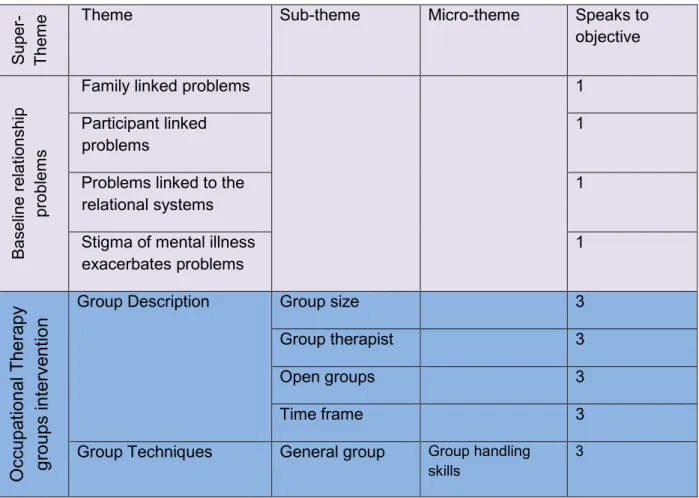
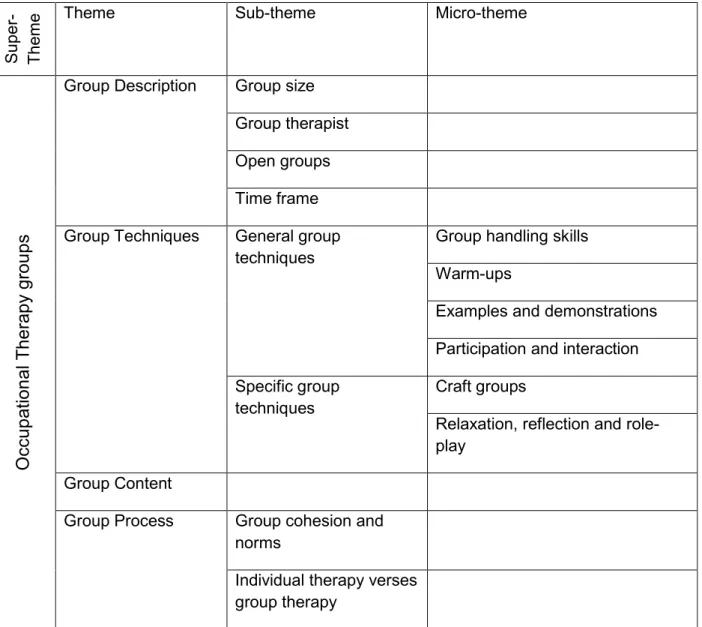
The themes of the study are laid out in the table below. Themes presented in the table below in purple are discussed under Article 1 and themes represented in blue under article 2.
Table of themes:
Super- Theme Theme Sub-theme Micro-theme Speaks to
objective
Baseline relationship problems
Family linked problems 1
Participant linked
problems 1
Problems linked to the
relational systems 1
Stigma of mental illness
exacerbates problems 1
Occupational Therapy groups intervention
Group Description Group size 3
Group therapist 3
Open groups 3
Time frame 3
Group Techniques General group Group handling
skills 3
23
techniques Warm-ups 3
Examples and
demonstrations 3 Participation and interaction 3 Specific group
techniques
Craft groups 3 Relaxation, reflection and role-play 3
Group Content 3
Group Process Group cohesion
and norms 4
Individual therapy verses group therapy
4
I So we were given the skills and applied them
Personal benefits of
group work 2
Family love and support in the groups makes a space to practice skills
2
Family love and support outside of the group time
2
Groups helped to develop insight and to evaluate relationships
2
Responsibility versus
blame 2
dema nding now
Direct impact of groups on the participants' relationships
2
24 Plans to implement
skills in these
relationships vs doubts about their ability to do so, impacted by missed groups.
2
Limitations of group
therapy 2
Note objective 5 is discussed under the recommendations section within the articles.
2.2 CONTRIBUTION RECORD
The student conceptualised the papers and was the main author. My supervisors Chantal Christopher and Thavanesi Gurayah contributed towards the writing of these articles.
2.3 PUBLICATION DETAILS: ARTICLE 1
Title: “Group therapy as a vehicle to address relationship problems in occupational therapy”
Author: Andrea Radnitz
Main supervisor: Chantal Christopher Co-supervisor: Thavanesi Gurayah Status: to be submitted
2.4 JOURNAL INFORMATION
This scientific journal article was written for publication in the South African Journal of Occupational Therapy. This journal publishes articles with relevance to occupational therapy in Africa. References for this journal must adhere to an adjusted Vancouver system, as described in the journal and must be published in the order that they appear in the article.
25 2.5 ABSTRACT
Background: This qualitative study set in an acute inpatient psychiatric clinic investigates the efficacy of occupational therapy groups targeting interpersonal relationships, from the participant s’ perspective.
Purpose: This study was designed to explore the effect of occupational therapy groups on participant s’ interpersonal relationships.
Method: Four, sixty-minute focus groups were used to ascertain the participants’
experiences of groups and the effect of these on relationships. These sessions were audio-recorded and transcribed. Thematic analysis was used to analyse the data.
Findings: This article tells the story of the development of the participants’
relationships through the journey of attending group therapy, from the initial struggles in their personal relationships, through the development of insight into these difficulties, the learning of skills and problem-solving solutions, to the application of some of the skills and hope for future relationship development.
Three themes are discussed in the article. “We all have relationship problems”
outlines the participants understanding of their relationship problems. The second theme “we were given the skills and applied them” describes how group therapy helped them develop further insight and acquire greater relational skills. “I am less demanding now” describes how developing insight and skills have impacted the participants’ actual relationships and their hopes for their relationships. Conclusions:
Participants gained significant benefit from group work, on both a personal and a relational level. Group therapy provided a safe place to learn and then practice the skills that participants had learnt. The insights gained into adaptive and maladaptive relationships and participants’ interpersonal styles through group therapy assisted participants in strengthening their relationships with group members and others.
Despite improved knowledge, insight and skills, participants were not always able to use their skills consistently. One factor that improved their confidence to apply skills was consistent group attendance.
26 2.6 ARTICLE 1
Group therapy as a vehicle to address relationship problems in occupational therapy Introduction
Mental health difficulties are a pervasive and growing global issue affecting many people across the globe1. In 2013 mental and substance use disorders were the leading cause of
“years of life lived with disability” worldwide3:1579 and it is predicted that by 2020 unipolar depression alone will be the second highest contributor to the worldwide burden of disease2. This challenges health systems globally and makes the prevention and treatment of these disorders a priority. Effective and efficient therapy in mental health practice, including occupational therapy practice, is hence important on a national and global level.
Occupational therapy has deep historical roots in mental health care, especially in the treatment of hospitalised clients4. Group work is one of the core elements of occupational therapy interventions in mental health, and many researchers have emphasised the need for further research in this area5–8 as there is limited current research to show evidence for practice. In an attempt to contribute to research in this domain, this study was designed to investigate the efficacy of occupational therapy group interventions within an acute in-patient facility programme. These groups were aimed at enhancing the quality of the mental health care users’ (MHCUs) interpersonal relationships.
Literature review
The relational difficulties of MHCUs
Interpersonal relationships play a vital role in fostering mental health9–11. Research shows that MHCUs have chronic problems such as poor interpersonal skills, difficulty forming relationships, poor social skills, conflicts with authority, dependency, isolation, inability to express and control anger and hypersensitivity to separation11–14. Almost all clients admitted
27
in crisis to an in-patient facility “suffer from a breakdown or absence of supportive relationships with others”11:487. Mental health problems impact on the clients’ social relationships and their ability to perform daily activities15, making them an important focus of treatment in acute psychiatric facilities.
The Occupational therapist in the treatment of MHCU’s
Occupational therapists play a key role in in-patient care of clients in acute mental health settings, where the four key areas of practice are: individual assessment, therapeutic groups, individual treatment and discharge planning16.
Occupational therapists have expertise and skills which translate into a unique practice of group-work, specifically occupation-focused groups14. These groups differ from psychology groups in that they include activity or “occupation” such as art, music, movement, role play, sport, activities of daily living, games and leisure13,17,18. Occupational therapists use meaningful activity to provide authentic opportunities for clients to improve life skills and interpersonal relationships14. Group therapies within the discipline of psychology utilise a range of theoretical frameworks such as behavioural, cognitive, humanistic-existential and psychodynamic therapy, which may involve talk, interaction, reflection and interpretation19.
The value of group therapy
Although there is limited research on occupational therapy group work, there is extensive literature on group therapy from the field of psychology. Group therapy has been shown to have many benefits to MHCUs11–13,20,21 and is an effective form of therapy that is able to provide clients with as much benefit as individual therapy11. The fact that group therapy is both effective and efficient with therapists’ time makes it a vital tool in mental health care.
28
Madeleine Duncan13:266 summarises the value of group therapy when she says: “The group experience is primarily used in occupational therapy to help the client gain more appropriate intra- and interpersonal behaviours”. This study explores how the clients have benefited from group therapy in terms of both their intra- and interpersonal skills, and how learning from the group has been transferred into personal relationships.
Study Context
This study was set in an acute, voluntary, private in-patient psychiatric clinic in KwaZulu- Natal, South Africa, which admits clients with mental health challenges such as mood disorders, post-traumatic stress disorder and anxiety disorders. The treatment plan offers five groups per day, covering the themes of self-awareness, emotional management and interpersonal skills. In addition to occupational therapy and psychology group interventions, individual psychotherapy, as well as psychiatric consultations are offered. Although a three- week programme is offered, the average length of stay is 14 days.
Methodology Design
A qualitative design was used to explore clients’ perceptions’ of group therapy, as this paradigm is concerned with meaning and lived experiences 22, and allows for rich, detailed, in depth study23,24.
Participants, Sampling and Data collection
Clients from the clinic’s general unit formed the population for this study. Clients in this unit are admitted for the treatment of mental health disorders, which are not co-morbid with any substance abuse. Purposive sampling, a non-probability sampling technique, was used to access this sample; by only including clients who met the inclusion criteria into the sample.
29
This technique is most often used in clinical research to select the most appropriate clients to a study25. Clients participating in groups held within the higher functioning, general unit during the data collection period, were included in the sample if they had not displayed any psychotic features during this time and had signed informed consent to participate in the research.
The data was collected over four months, through a series of four 60-minute focus groups, one after each ‘Interpersonal relationships’ themed week. Focus groups are effective as they are non-threatening, and helpful in obtaining people’s perceptions26–28. The population was invited to join the study, were clearly informed of the aims of the study, that their participation was entirely voluntary and their decision not to participate did not impact on their further treatment in any way. Twenty-five clients, five males and twenty females between the ages of 18 and 50 years of age participated in the study. In order to protect confidentiality and ensure anonymity, each participant was given a pseudonym. The focus groups were audio recorded and the facilitator followed a semi-structured interview schedule, which was consistently applied across the focus groups.
Findings and Discussion
Three main themes from the data will be presented. The first theme, we all have relationship problems, outlines the participants’ understanding of their relationship problems. The second theme, we were given the skills and applied them, describes how group therapy helped them develop further insight and acquire greater relational skills. Then finally, I am less demanding now, describes how developing insight and skills have impacted on the participants’ actual relationships and their hopes for their relationships.