My use of the term "think-make-be" placed this study in an ongoing investigation of my art-making in the time of COVID-19. Another parameter of resistance/limitation was my body's somatic involvement in making art as an 'embodied involvement'.
Research questions
To achieve this, it was necessary to identify and expand the parameters that include selected "resistances" and "adaptations" in my evolving artistic practice during the time of COVID-19. To examine and question the new "choreography" in dance between my human agency and material factors in order to develop a new way of thinking and artistic practice in relation to the notions of aesthetics and process.
Review of Literature
Practice-Led Research (PLR) literature
Bolton & Delderfield's (2018) Reflective Practice: Writing & Professional Development reaffirmed the value of this inclusion of reflective practice in all aspects of the PLR as it encompassed an embodied experience that had as many viewpoints and contexts as possible.
Decentering the human subject
As such, the key ideas of 'embodiment' and 'materiality' were implicated in the 'dance of agency' as the human (artist) body interacted and became entangled in the autonomous materials (Pickering, 2012:1). These ideas about agency and non-human (posthuman) performativity were further developed in the work of Barad's (2003) Posthumanist Performativity: Toward an Understanding of how Matter comes to matterand (2007) Meeting the Universe Halfway: Quantum Physics and the Entanglement of matter and meaning .
Science and Art (Transdisciplinarity)
These concepts of material and substance did not exist in a vacuum and other papers applied these concepts to disciplines such as psychology - Bastalich's (2020) Interpretivism, social constructionism and phenomenology; art - Lange-Berndt (2015) Materiality and ecocriticism - Mortons (2011) The Mesh. Mcphie's (2018) I knock on the stone front door: Performative pedagogy beyond human history and Morton's (2011) The Mesh, examined the excessive human focus of the Anthropocene era and its consequences for ecology and the earth.
Research Methodology
- Posthuman Performativity
- Reflection
- Material Facilitation
- Virtual space
- Practice-led research (PLR)
A focus on embodiment consisted of carefully monitoring, documenting and reflecting (both visually and verbally) the human (mine) artistic and physical input into the artwork, with the intention of 'reducing' it. In addition, the virtual exhibition was an accommodation for some of the current resistances inherent to the Covid pandemic (Pickering 1995: 559).
Structure of dissertation
I contended that this mixed methodology would assist me during this practice-led research project and lead to more specific insights and further questions about art practice as the 'dance' progressed. While Practice-led Research dealt with the nature of practice and led to new knowledge that was operationally relevant to that practice (Candy 2006:1), the 'post-mortem' of practice.
Introduction
It was important in this process to document/reflect during and after each exercise session.
Working on a construction site
Insights
An awareness of the ubiquity of building materials became evident during this phase of my PLR. I had previously purchased "art materials" at great expense and developed a value system that seemed dependent on having unusual imported papers, equipment, and materials. On the other hand, I found the attempt to relinquish my human agency extremely threatening because of the apparent lack of control in my artistic practice.
This exercise had already raised a question about the possibility of other kinds of aesthetics and criticism. The potential for a virtual component of the exhibition arose as the website now hosts the videos, photos, journal entries and virtual 'tours' I have produced to showcase material agency and my new dance of agency (see Question 1.2) (Pickering 2012 : 1).
Working with Alchemy
Resistances in my art
- Time as a resistance
- Form as a resistance
- Scale as a resistance
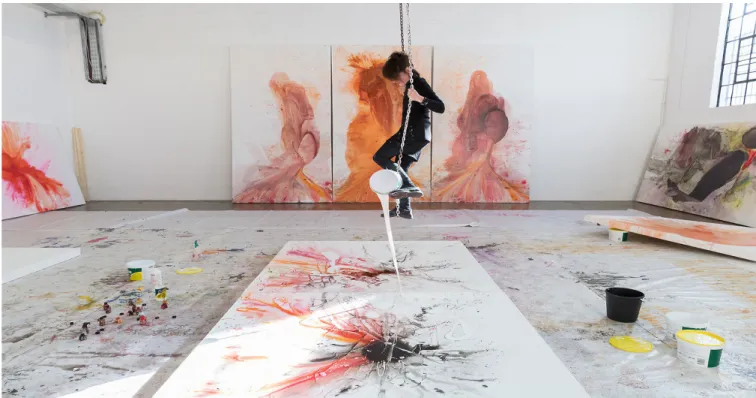
I experienced a similar ephemerality and endlessness of the chemical processes, which I identified as resistances in my practice. This opened me up to the infinite possibilities of the hardware store as a source of art materials. Siopis physically crawled over the horizontal canvas and immersed her body in the messiness of the glue and ink (Siopis in Perryer 2018:9).
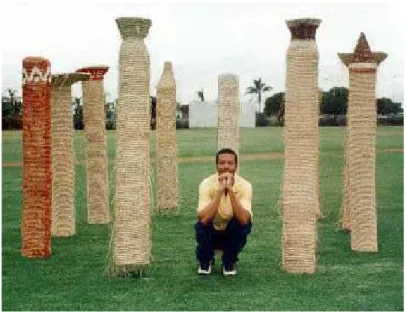
The physicality of the exhibition space was necessary to be able to justify this. In the photograph of the sculpture Free Stamp (1991) (Figure 43), the scale of the work can easily be compared to a human figure.
Insights
The act of taking a small object, which existed in the mundane, mundane office world where it was rarely noticed, and bringing it to the attention of the human viewer through a monumental scale change certainly emphasized Siopis's point. about the impact of large size on viewers. I found that the unobtrusive, intimate nature of alchemical performativity was overlooked in my work and the challenge for me was to make this activity visible. My material was the most mundane and ubiquitous on this intimate, invisible level and a change of scale was also a strategy, with technology such as photography, videography and virtual tours used as an accommodation, just as the scanning electron microscope (SEM) made visible are the invisible properties of materials at the micro level (Open University homepage).
As an insight, I suggested that these ongoing performative demonstrations in the gallery were my adaptation to the timescales of material agency as stated in my intent. This was recorded and posted on my magazine website. The role of digital media in this adaptation to the constraints of materials was important to resolve issues of both time and scale and included curatorial decisions regarding a dynamically interactive virtual exhibition and its physical performative months in an exhibition ran space (map pin Ammazulu Sculpture Precinct).
Working with Rust
Insights
Ironically, Smithson used gallery spaces to display his work, otherwise I speculate it would have remained unknown due to its inaccessibility, with the 1970 Spiral Jetty in a Deserted Landscape perhaps his best-known example. My work, due to the limitation of scale imposed by my body, was displayed in a booth, but a digital virtual exhibition of the original site had an added value, as it had the effect of allowing people to see the work without traveling to a location. remote location (Ammazulu sculpture area map pin) (as described in question 1.2).
Working with natural UV light
Insights
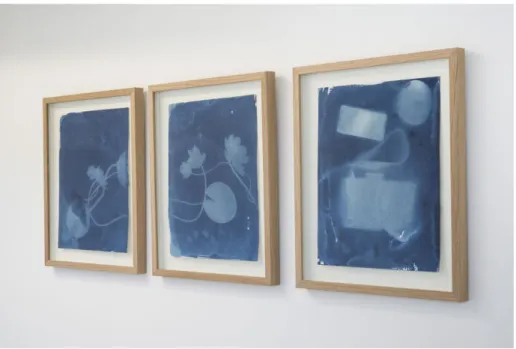
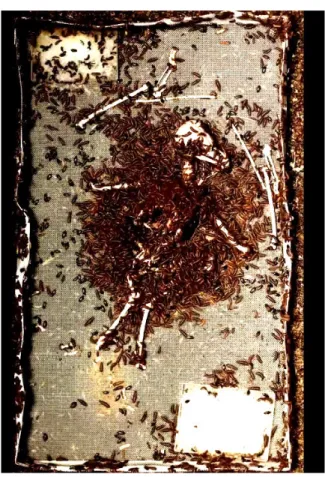
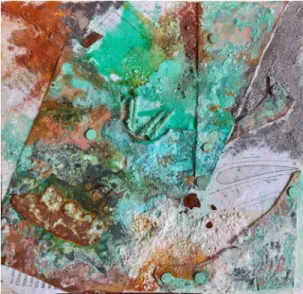
The performativity and process of my hybrid cyano prints also provided me with cathartic opportunities for spiritual healing as I interacted with the inevitability of the alchemy of the materials, as detailed in queston1. They operated independently of my control and created the realization that the physical and spiritual worlds were all one. In addition, the messy nature of the cyano prints paid no attention to human formal considerations such as composition and handling of color and texture.
Working with clay, mycelia, and fibre
- Clay - an embodied engagement with grief
- Mycelia - an entangled engagement with grief
- Fabric and fibre - a contemplative engagement with grief
- Insights
It also tried to identify some of the parameters in my practice that acted as resistances in my 'dance of freedom of choice' (see questions 1 and 1.1 of my research questions). He was looking for a sensory experience where touch is paramount and where the shape of the clay spoke to the symbiotic relationship between the earth and man. My goal in my current work is to rethink this relationship with matter or nature at the level of the physical human body.” (Perryman.
The ephemeral nature of both fungi and many chemical processes was one of the resistances I identified in my emerging practice in line with my research questions 1.1 and 1.2 and adapted using digital and virtual methods. One of the recurring resistant parameters in my emerging practice was the element of time (in line with my research question 1.1).
Introduction
Application of methodology
However, the ongoing nature of the physical exhibition, which ran over two months, precluded any premature closure. This was in line with my research question 1.1, as spiritual healing became one of the paradigms in my research. This was measured by my self-report as part of the reflexive and meditative process in my developed practice (On-line journal).
Another resistance or challenge was the quality of formlessness, which was a function of materials such as glue and gravity, as explained on pages 34-40. However, according to Siopis, it was not necessary to talk about the formal aspects of the painting, but about the process (Siopis in Perryer.
Limitations of this research
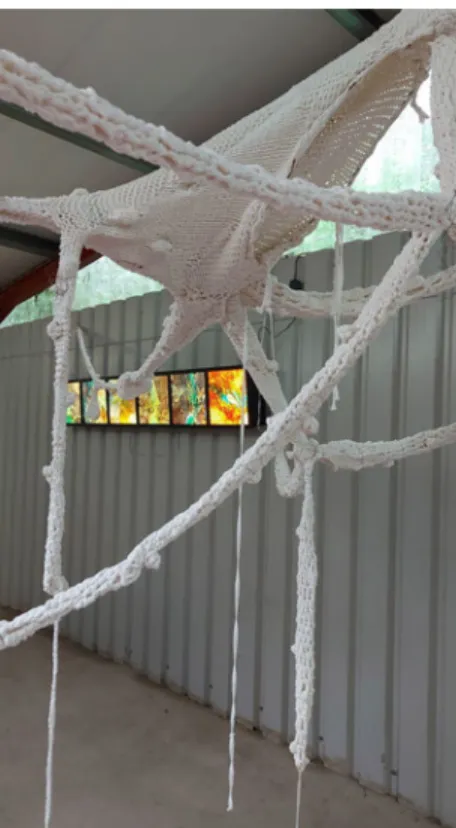
A grant enabled the purchase of a TV to show the process videos and the printing of some of the photographs as acknowledged on the front page. I felt that the viewers of the physical exhibition were important and so physical limitations that prevented adequate viewing became limitations. Dissemination of the findings of this PLR project then became problematic with the lack of foot traffic.
This load shedding results in the TV, high beam and LED lighting not working. It also caused many delays in the realization of the research project in terms of power tools and computer equipment.
Reflection on the research questions
Posthumanist theory (Pickering et al) allowed me to interrogate, in my artwork, the traditional boundaries between human, animal and inanimate. My original traditional art-making techniques and methods evolved over the course of this research into new ways of doing/thinking/being that I find liberating (Moore, journal entry). The initial resistances I encountered at the beginning of this project transformed from PLR to accommodations as I learned to coexist with the autonomous inanimate and animate matter in my body of work while using my new 'dance of agency' to guide my work. embodied engagement with material agency in my artistic practice.
This is a paradigm shift that I feel is essential in this current time on our planet.
2014).On Grief and Grieving.Scribner - commemorative issue Available at: https://grief.com/the-five-stages-of-grief/ (Accessed: 18 August 2022). Presentation for training workshop. https://docs.google.com/presentation/d/11J1mmSjfmHsN3f3sMnUbs-yMhZxO_5Ru-1CjvFu4Ow.