More details emerged in the Todesco [13] study, which focused specifically on the effects of unexpectedness. Similar results emerged in the studies by Gazoni [7] and Bauer [8], with more than 70% of respondents indicating a high level of emotional impact (guilt, anxiety, reliving the event). Can the anesthesiologist involved in the incident be considered temporarily "impaired" in the period immediately following a disaster.
These interviewees described their experiences and various unpleasant symptoms in the aftermath of the event. A broader search of the literature yielded two interesting studies on the experiences of teachers [25] and working mothers [26]. The descriptions obtained here gave, in the respondents' own words, interesting, detailed examples of some of the effects being investigated, e.g.
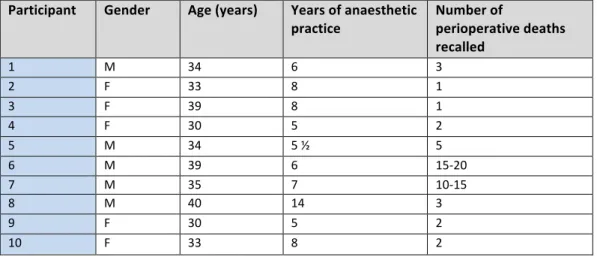
Post-event support was infrequent and inadequate, and time off from work in the aftermath of the event was rare. Of the 10 participants included in the study, there was a fair distribution of gender, age and years of age. Confidentiality of the participant was limited as the content of the interviews and direct quotes were reproduced in the research paper.
Consent to participate in the study as well as for the use of direct quotations was obtained from the participants. In the described cases, none of the participants were relieved of duty or given a period of rest. Some participants described further effects on their professional functioning in the days following the perioperative death.
![Table (2) Commonly used sampling methods [38]](https://thumb-ap.123doks.com/thumbv2/pubpdfnet/10639298.0/41.918.147.829.362.1046/table-2-commonly-used-sampling-methods-38.webp)
RELATIONSHIPS
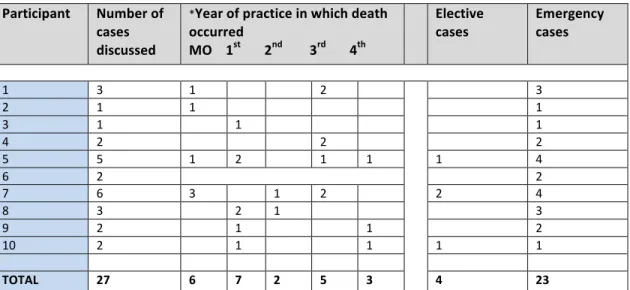
I don't think the anesthesia was the limiting factor in this patient's improvement, it was the injury.” He described how in many cases the patient's behavior (alcohol-related pedestrian/motor vehicle accidents, alcohol-related assault, etc.) played a significant role in sustaining a life-threatening injury. After closure of the abdomen, the patient continued to bleed and all team members jointly decided to withhold further intervention.
By all accounts, one would expect a similar process of rationalization, reflection and acceptance of the loss. Although her assessment of the patient's prognosis and the decision made by the theater team was clinically and ethically reasonable, her reaction on another level was completely emotional, which in turn made her doubt the rationality of the earlier decision. Another element that distinguishes electives from emergency patients is the amount and nature of interaction with the patient.
Participants described how this interaction, however brief it may be, creates a “relationship of trust” and positive expectations, resulting in a greater personal impact on the anesthetist in the event of the patient's death. Although an elective case, the participant noted that the lack of prior interaction with the patient meant that the death had little personal impact on him. Another dynamic expressed by two of the participants regarding their last interaction with a critically ill patient prior to induction was that while talking with their patients, they were aware of the possibility that the patient might die during the course of the procedure. or to be transferred. in ICU after surgery, ventilated, with minimal chance of recovery.
We're the last people they see before they get anesthetized----- and if they don't go to the ICU or wake up----- it's ----- I don't know, that was a weird feeling for me. ..try not to give the impression that they won't make it. I never feel comfortable giving bad news to people---- I don't know if it's something you get 'comfortable' with---- you get better at it, it gets easier, but it always is. The difficulty is to face the family----- I find it very difficult---- not to talk to them, but to deal emotionally with their pain.
I would have been in a situation where I don't know how to explain to them that this patient is dead. In this section, participants described that the nature of the case -‐ elective, emergency, trauma‐‐related -‐ had a significant influence on the impact after a patient's death. Interaction with patient's family before or after death contributed to the emotional impact experienced.
PERSONAL IMPACT
The majority of the trauma-related emergencies described by my participants were on-call cases, at night or in the early hours of the morning. One participant described how this physical exhaustion had a greater impact on her than the emotional content of the case. Informal discussions with the relevant consultant on call at the time of death were occasionally undertaken, but as described by the participants, these.
It served to ease their worries, alleviate feelings of guilt and personal responsibility, and provide reassurance and positive feedback about their anesthetic management and decision-making. In relation to the personal impact experienced following a perioperative death, participants described a sense of personal responsibility for the outcome of the case and also spoke of the physical exhaustion caused by such stressful events. Objectively, this is easily refutable, but much less so in the heat of the moment, or when rejection might imply inadequacy. [16].
I kind of dismiss these cases because of the amount of trauma I was exposed to in my freshman and sophomore years. Is there too much that is incompatible with life, regardless of surgery or anesthesia; they will fail; or they are borderline and you can try to help them.” This process of rationalization, particularly in relation to the severity of the injury and the prognosis of the patient, is similarly described by Palmer [22] in his study of paramedics.
Another strategy described by Palmer [22] in which the practitioner distances himself from the patient's personal circumstances is that of 'language change'. This was evident in the narratives of all participants, with most patients identified not by their name or personal descriptive details, but by the clinical details of the case: “the stab heart”, “the heart patient”, “the MVA”. Based on the persistence of the negative effects experienced, and the lack of awareness of those effects, a.
At the other end of the spectrum, some participants described desensitization as a state of detachment, whereby they become "dull" and "feel nothing". Among the many factors that may influence participants' responses, some may be predictable in terms of the distress they cause: the death of a child, fatal. All of these factors can be red flags for the individual and others to be more aware of the impact the event may have.
For the purposes of this study, a "perioperative death" is defined as any patient death, regardless of the cause of death, that occurs during the period of time from the patient's entry into the Theater Complex until discharge from the Theater's Recovery Room. Do you remember experiencing particular physical symptoms as a result of the case – immediately or in the days after it?