However, this veneer of technicality hides the complex governmental work involved in producing, maintaining and using the database. On the basis of mainly interview material with key informants, I examine the production of the data stored in the database. I consider, through policy and document analysis, the use of the database and its data in the actual practice of decision-making about housing distribution.
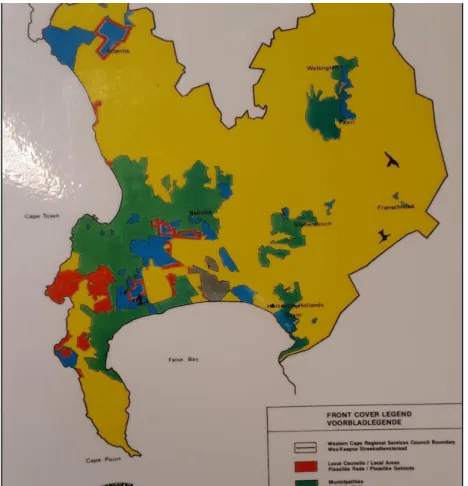
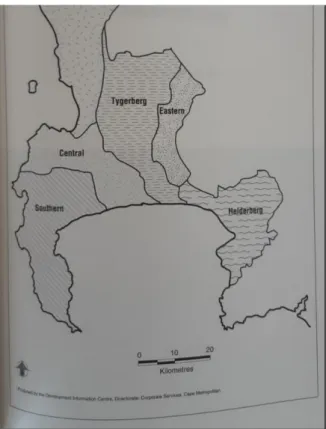
90 Figure 5.1 A map of the municipal extent of the Cape Divisional Council, 1985, including the local areas (Divisional Council for the Cape 1986a). 128 Figure 5.11 An extract of the count of applicant numbers based on the integration of the Nkonki data set into the city's housing database (City of Cape Town 2006b: 3). 155 Figure 6.9 A section of the application form that gathers information about any disabilities in the family.
Introduction
The database's range of visibility provides the governmental options within housing distribution. First, I examine how housing allocation dictates the existence of the database as a way of making sense of housing seekers. Through policy and document analysis, I examine the use of the database and its data in the actual practice of decision-making on housing distribution.
8 With this research, I demystify the database and make visible the work of the state in its production and its operation on the scales and spheres of the state. The sixth chapter deals with the composition of the database and examines the data that make it up. In doing so, I justify how the database is essential for the implementation of the country's housing policy.
Inside out: From housing allocation to the politics of data
While the centrality of the state's role is a critical point in South Africa, any attempt to In the next section, I turn to the South African state's central role in low-cost housing delivery and demonstrate how housing allocation is a critical site for the disaggregation of the state's instruments for decision-making. In this section, I examine a well-developed debate in academic literature on the topic of the state's work to make citizens legible.
In the following section, I turn to the state's production of numbers and statistics for governance as a way of reflecting on the state's computational practices. The housing database is sidelined as one of the state's technical decision-making tools, something so banal that it is ignored. Recognizing that data is imagined and shaped allows for a surface of the state's work in carrying out these processes of imagining, shaping, maintaining and storing data.
Examining ‘boring’ things: The database and its methodological challenges
This investigation began its journey in response to calls to investigate the day-to-day practices of the state. The central role of the state is a crucial point in South Africa, especially when it comes to the formal distribution of state housing opportunities. In this case study, an examination of the housing allocation process requires unpacking the housing database and the housing allocation technologies that preceded it.
In the public domain, the specifics of how the allocation decision database works are not disclosed, making its logic invisible. This reluctance to consider the database on the part of senior officials, however, indicates the importance of the database's role in housing allocation. Instead of institutional ethnography, I undertook what would become database ethnography as a state tool.
I was aware of the day-to-day work that facilitates the development and maintenance of the database and the data in it. By tracing the development of the database as a tool used by the state for decision-making, I adopted this approach, which privileges and foregrounds contexts, crucial in the study of a contentious topic such as housing distribution. My first interview directly related to the database was with a former official from the City of Cape Town and the Western Cape provincial government.
This was confirmed in my subsequent interview with a senior official in charge of database management. Later, trying to understand the location of the database in the city, I interviewed a long-time official of the neighborhood housing office. This chapter arises from the need to understand the political context that necessitated the development of a database for decision making on fair housing allocation.
By attending to the complexities of the database's form and function, I make visible the state's commitment to the production of this tool.

Fragmented to integrated: The making of fair allocation policy
Cape Town is a useful example of the complexity of housing allocation processes during the apartheid era. This is one example of changing housing allocation practices in former colored areas during the late apartheid period. The archival material documents a complex and compelling illustration of the development of housing policy and the tools with which the policy was implemented in the South Peninsula Municipality.
By opening up the waiting lists to those who had previously been denied access to the list, the demand for housing in Cape Town increased significantly. The report dealt quite radically with the abolition of the waiting list, as it had been described. The report is one of the few places where the merits of the waiting list are discussed.
Preference for housing assistance would be given to applicants who live in the area of the municipality. The need for residents of informal settlements to qualify for the Housing Subsidy Scheme is noteworthy because this requirement is not mentioned in relation to other housing allocations (either new build allocations or council housing re-lets). The complexity of the housing allocation policy development process in the South Peninsula Municipality echoed the processes experienced in other local councils in Cape Town.
By 2004 and the adoption of the City's housing allocation policy, the policy approved by the Mayor. It refers to the current metropolitan municipality, rather than the iterations of the previous local authorities. The City's Housing Grant Policy was revised in 2009 following the publication of the National Housing Grant Guidelines by the National Department of Housing (City of Cape Town 2009b).
The 2013 version outlines in great detail the roles and responsibilities of the various role players involved in the housing allocation process.
Waiting lists, registers, and legacy systems: The making of the database
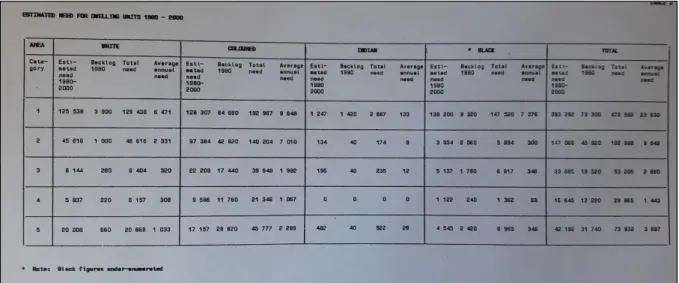
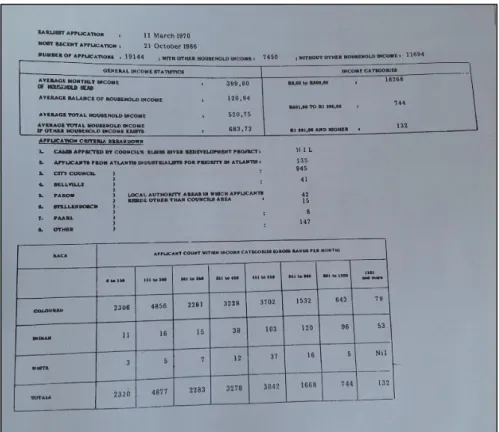
Data from the late 1980s show how the computerization of housing waiting lists enabled the use of this information for housing needs. The capabilities of computerized waiting lists were also recognized by officials from other local authorities. Furthermore, the computerization of waiting lists meant that it became much easier to report and analyze housing data (the uses of this housing demand data are documented in Chapter 6).
A report from the Cape Housing Needs and Demand Assessment Program lists the limitations of the data. 119 Figure 5.9 Map of the six local government bodies that together made up the Cape Metropolitan Area. The table shows very clearly how the changes in the constitution of the local government bodies affected the housing need numbers.
The reconfiguration of the local authorities required a reconstitution of the housing waiting lists to follow suit. The division of the housing waiting lists was necessary because of the local government's commitment to spatial correction through housing development. This quote shows how the housing waiting lists continued to be racially based before the implementation of the new municipal configuration.
This chapter describes the development of the housing database of the various waiting lists of the metropolitan municipalities into one integrated housing database. After the development of the database, a separate section was developed in the City to manage the housing application information. This chapter has focused on the development of the housing database as the main tool through which housing allocations are made by the City of Cape Town.
The chapter documents the computerization of early housing waiting lists, from application forms to waiting lists.
Capturing, collating, and cleaning data: Producing and maintaining the database
141 are critical to the rollout of the housing database – despite the fact that the database is used variably and selectively. The purpose of the map is to show the uneven spatial distribution of housing offices across the city. The form then asks for the applicant's residential details (strictly in the sense of an address, rather than a statement of living conditions) (see Figure 6.7).
156 Figure 6.9 Part of the application form collecting details of any disability in the family. The accessibility and inclusiveness of the state is also extended by offering the application form in three languages. In the next section, I will go over how the database is created through the application form capture.
Each application form component becomes a piece of data in the relational database universe. Standardizing data across the Province was and continues to be a major task. One official noted that “the state of the data was so dirty, a big part of my job was cleaning the data” (retired housing official, CCT and PGWC, 29 November 2016).
The official noted that this type of data maintenance is resource-intensive, especially in the province's smaller municipalities. The next section examines how this data is protected by the database's technology. These security features start at the beginning of the request process, where the requests enter a retention area before they are approved for inclusion in the database.
Because of this political interest in the data, the development of the data from the application forms expressly avoids any link with politics. I showed how the state has a strong focus on ensuring the integrity of the data and therefore the accountability of the database. 184 Figure 6.17 An illustration of the process of the state's work in making housing allocation decisions.
A mode of housing governance: The database’s multiple forms and functions
Crafting state tools: Building a vocabulary for the state’s work