DEVELOPMENT AND IMPLEMENTATION OF AN INSTITUTIONAL REPOSITORY WITHIN A SCIENCE, ENGINEERING AND TECHNOLOGY
ENVIRONMENT
Mini-dissertation by
Adèle van der Merwe (7622449)
Submitted in partial fulfilment of the requirements for the degree
MAGISTER PHILOSOPHIAE (INFORMATICS)
in the
DEPARTMENT OF INFORMATICS
of the
FACULTY OF ENGINEERING, BUILT ENVIRONMENT AND INFORMATION TECHNOLOGY
UNIVERSITY OF PRETORIA
Supervisor: Prof. J.H. Kroeze April 2008
Acknowledgements
Special words of gratitude go to:
•
My sons Barend and Renier van der Merwe: Thank you for your support and willingness to settle for fast foods.•
Family and friends: Your belief in my abilities, as well as your support over the last three years while I was studying, meant a lot to me.•
Martie van Deventer, Madelein van Heerden, Yvonne Halland, Annette Joubert and Ina Smith: Without your advice, contributions and brain-storming the IR project would not have been the success it was.•
Siphethile Muswelanto: Thank you for standing in for me during an unforeseen crisis and for your initiative and assistance. Having somebody like you as an assistant was not only a pleasure but also a priceless advantage.•
Ciaran Mac Carron: Thank you for your strict but kind editing of my work.TABLE OF CONTENTS
GLOSSARY ...v
1 INTRODUCTION AND PROBLEM STATEMENT ... 1
1.1 Problem Statement ...1
1.2 Objectives...2
1.3 Outline of Scope...3
1.4 Limitations of this Research ...5
1.5 Theories ...6
1.6 Research Approach and Research Questions...7
1.7 Methodological Approach...8
1.8 Design and Layout ...10
1.9 Conclusion...10
2 LITERATURE REVIEW ... 12
2.1 Relevant Literature ...12
2.1.1 Introduction to the relevancy of institutional repositories
... 12
2.1.1.1 Defining the concept ‘Institutional Repository’ ... 12
2.1.1.2 The emergence of Institutional Repositories... 14
2.1.1.3 Benefits and value of an IR ... 16
2.1.1.4 Generic features of institutional repositories ... 17
2.1.1.5 Stakeholders ... 18
2.1.2 Development and planning of an IR
... 18
2.1.3 Development worksheet
... 20
2.1.4 Challenges facing implementation of an IR
... 22
2.1.5 Technological issues
... 25
2.1.5.1 Proprietary vs. Open Source Software... 26
2.1.5.2 IR software ... 28
2.1.5.3 DSpace... 31
2.1.6 Policy issues
... 33
2.1.6.1 Essential elements in policies ... 34
2.1.7 Cost models
... 36
2.1.8 Preservation issues
... 37
2.1.9 Compliance and content recruitment issues
... 40
2.1.9.1 Pre-publications and other issues regarding copyright materials ... 42
2.1.10 Operational issues
... 43
2.1.10.1 Quality control and standardization... 43
2.1.10.2 Auditing ... 45
2.2 Identification of the Gap between Problem Statement and Literature ...47
2.3 Conclusion...49
3 DEVELOPMENT OF A REPOSITORY... 50
3.1 Introduction...50
3.2 User Requirements and Specifications (URS)...53
3.2.1 Structure and features of repository
... 55
3.2.2 Internal controls
... 57
3.3 Policies, Procedures and Managerial Reports...59
3.4 Compliance ...61
3.4.1 Procedures and processes
... 62
3.4.2 Standards and quality control of metadata
... 67
3.5 Determining success...68
3.5.1 Visibility and Usage Statistics
... 69
3.6 Skills development ...74
3.7 Conclusion...75
4 RESULTS AND DISCUSSION ... 77
4.1 Lessons learned ...78
4.2 Problems experienced ...79
4.3 Evaluation and reasoning...80
4.4 Recommendations ...81
4.5 Expected Contribution to Knowledge ...84
4.6 Future research ...85
4.6.1 Determining the h-index
... 85
4.6.2 Determining the Return-on-Investment
... 85
4.7 Conclusion...86
5 CONCLUSION ... 87
6 REFERENCES... 91
Attachment A: CSIR Research Space Policy: Stakeholders and compliance ... 100
Attachment B: CSIR Research Space Policy: Metadata, data, submission and preservation... 106
Attachment C: Structure of CSIR Research Space... 108
Attachment D: Complete list and usage by country - November 2007 ... 110
List of figures
Figure 1: Content types as reflected in DOAR repositories ... 25
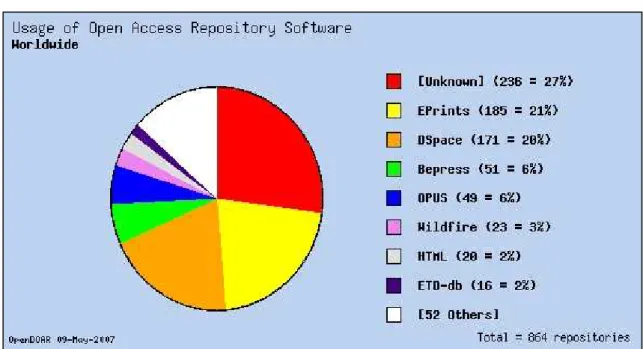
Figure 2: Graphical representation of Repository Software ... 28
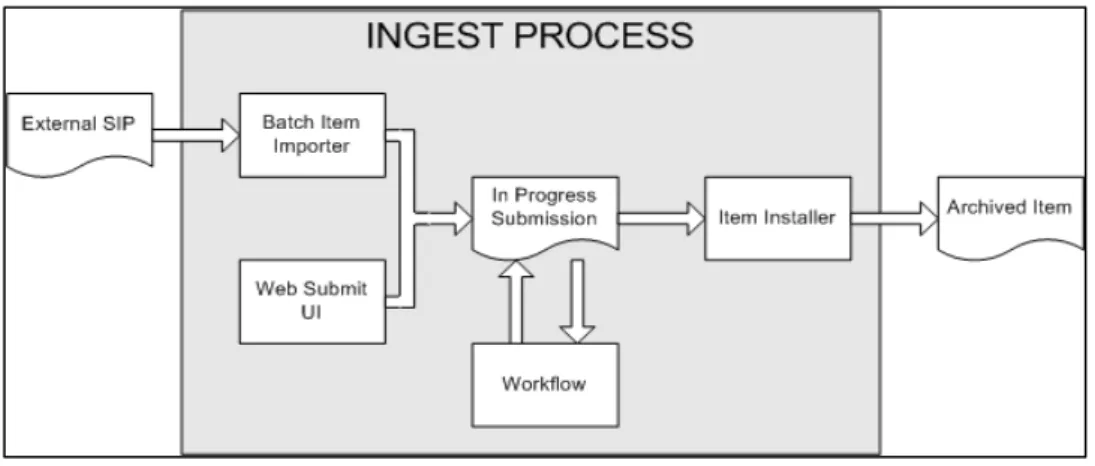
Figure 3: DSpace Ingest process ... 32
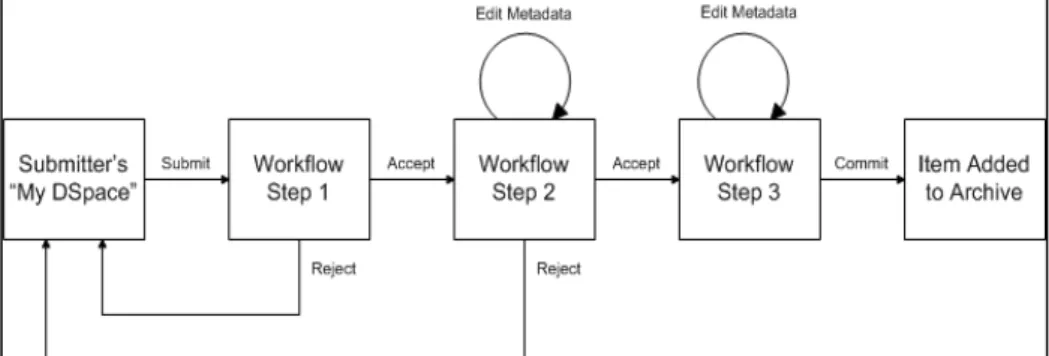
Figure 4: Submission workflow in DSpace ... 33
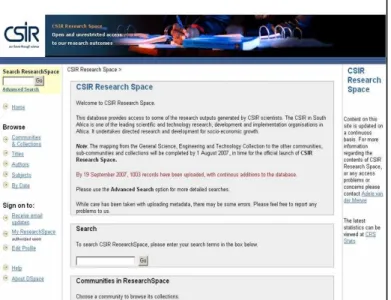
Figure 5: Research Space homepage... 51
Figure 6: CSIR Homepage ... 51
Figure 7: CSIR Research Space structure ... 55
Figure 8: Authorization management by means of policies ... 58
Figure 9: Access rights according to groups ... 59
Figure 10: TOdB/CSIR Research Space linked workflow, taken from the work document ... 64
Figure 11: CSIR Research Space workflow ... 66
Figure 12: Graphical representation of usage ... 70
Figure 13: Search engine connections - November 2007... 72
Figure 14: Daily visits - November 2007 ... 73
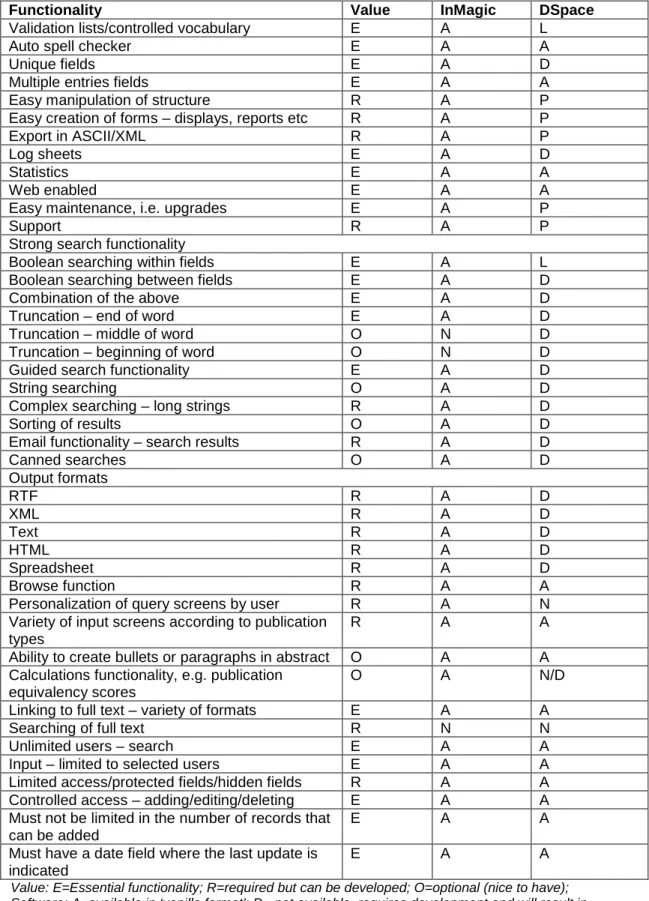
List of tables Table 1: Comparison of functionalities: InMagic (proprietary) and DSpace (OSS)... 27
Table 2: RoMEO Colours ... 42
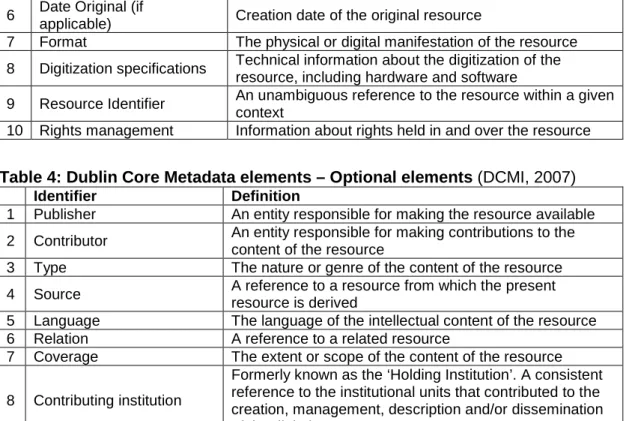
Table 3: Dublin Core Metadata elements – Mandatory elements ... 44
Table 4: Dublin Core Metadata elements – Optional elements... 44
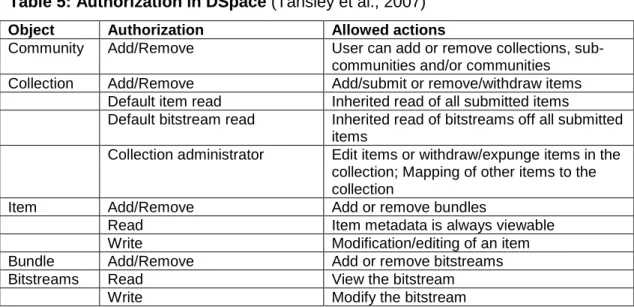
Table 5: Authorization in DSpace ... 46
Table 6: Usage August 2007 - November 2007 ... 69
Table 7: Monthly breakdown for August-November 2007... 70
Table 8: International access - Status in November 2007 ... 71
Table 9: Items with the 12 highest view scores... 73
GLOSSARY
AbbreviationsBOAI: Budapest Open Access Initiative
CSIR: Council for Scientific and Industrial Research CSIRIS: CSIR Information Services
DCMI: Dublin Core Metadata Initiative
EBAS: Enterprise-Based Applications and Systems FOSS: Free Open-Source Software
ICT: Information, Communication, and Technology IP number: Internet Protocol number
IPR: Intellectual Property rights IR: Institutional Repository IS: Information System
ISBN: International Standard Book Number KPI: Key Performance Index
KRA: Key Result Areas OA: Open Access
OpenDOAR: Directory of Open Access Repositories OSI: Open Society Institute
OSS: Open Source Software R&D: Research and Development ROI: Return on Investment
SET: Science, Engineering and Technology
SHERPA: Securing a Hybrid Environment for Research Preservation and Access TOdB: Technical Outputs Database
UP/AIS: University of Pretoria’s Academic Information Services URI: Unique Resource Identifier
URL: Uniform/Universal Resource Locator URS: User Requirement Specifications
Working definitions
Bitstreams: In the context of this document, digital data transmitted between systems, irrespective of format.
Copyright owner: The person/institution holding the copyright, not necessarily the author/institution who owns the intellectual property right.
Curate/Curation: In this case identification, collection, safekeeping and management of explicit information sources, normally done by a curator.
End-users: The individuals/data consumers for whom the product was intended vs.
intermediaries preparing/selling/managing the product.
e-Science: is used to describe scientific endeavours that requires distributed networks and/or that uses immense data sets
Explicit knowledge: Knowledge/information captured in print or other media.
Harvest: Retrieval and transfer of metadata from one database to another.
H-Index: The quantification of scientific productivity and impact of an individual scientist.
Hybrid system: The combination of a fee-based or managed accessed system and a free or open access system.
Ingest: The workflow process that accepts and loads a digital file.
Intellectual Property: The intangible creativity/knowledge of an individual.
Interested parties: Wider than peers only, as the man-on-the-street with a passing interest in specific information is included. See also end-users.
Just-in-case: Subscription to a journal because it might contain valuable information.
Just-in-time: Provision of relevant and specific information in a digital format on demand, usually within twenty-four hours.
Knowledge artefacts: Codified/explicit knowledge, irrespective of format
Metadata: Information describing a physical item, sometimes also called ‘data about data’
Open URL Resolver: an actionable URL service based on metadata
Peer review: The reviewing process done by academic peers to determine the quality and accuracy of an article.
Post-print: The final accepted and published version of an article.
Pre-print: The final edited version of an article prior to publication and peer review
Preservation: In this scenario, ensuring that the digital format is accessible in future by means of migration or any other action deemed necessary.
Self-archiving: The process whereby authors can submit the metadata and full-text item of their own publications into a database
Shared understanding: Ensuring that all the parties understand exactly what is meant and that they do not attach their own interpretation to terminology.
SHERPA RoMeo: Publisher's copyright & archiving policies developed and maintained by SHERPA
Stakeholders: used as a collective noun to include data/information producers, including authors, data consumers and funding agencies
Summary
Parallel to the Open Source Software movement, there is an increased demand and need for free, open access to information resources. The Open Access initiative is characterized by two strategies: namely the promotion of self-archiving or, alternatively, publishing of research articles in open-access journals. The purpose of an Institutional Repository (IR) is to provide a suitable archival environment for the self-archiving of digital items.
This study provides a clear understanding of the issues surrounding the implementation of an IR. Issues discussed include software selection, as well as the development, implementation and marketing of an IR. An equally important issue is individual skills development. Attention is given to the development of the policies that are required by an organization and its main stakeholders. These policies form an essential part of the development of an information system. Issues such as acceptance, usage, population, and management of the repository are reported on. The actual work that was done at the CSIR is used as a case study. The implementation process at the CSIR and the subsequent lessons learnt are used to highlight some of problems experienced and how these problems were solved. Issues that still need investigation, e.g. long-term preservation, are discussed.
1 INTRODUCTION AND PROBLEM STATEMENT
1.1 Problem Statement
‘Doing what little one can to increase the general stock of knowledge is as respectable an object of life, as one can in any likelihood pursue.’
Charles Darwin (Darwin, n.d.)
The CSIR is a knowledge-based Science, Engineering, and Technology (SET) organization. One of the tangible outputs generated by the organization is explicit knowledge. The pressure on researchers to produce explicit knowledge artefacts contributes towards the plethora of explicit knowledge available in today’s environment. The challenge facing most organizations, including the CSIR, is managing the vast volume of knowledge artefacts, ranging from research reports, books, research papers and conference papers to ad hoc explicit records in a variety of electronic formats, including e-mails, faxes and audiovisual material. Not only is effective management required but also the preservation and curation of the knowledge artefacts in order to facilitate efficient retrieval and to benefit from shared knowledge. Although preservation and curation have always been important, the preservation and curation of digital formats play an essential role in future research activities.
Researchers often express the need of the international scientific and research community to be able to monitor and share in the work that their peers are doing.
This trend is evident in the emergence of the h-index developed by Hirsch (2005). In order to receive the recognition of their peers, organizations are expected - and perhaps even required - to be able and willing to: a) share their research and b) to provide the access required. The value of explicit knowledge artefacts is evident in all scientific fields. Value is determined by peer recognition and it is often regarded as the most important form of recognition. Positive and value-based recognition of the organization, the individual researcher or even of the research teams has become essential in a very competitive environment. In order to meet these demands, an Information System (IS) for the efficient and functional storage and retrieval system should be in place.
The emergence of Institutional Repositories (IR) is the result of an attempt to address some of these demands. However, the exact structure and function of such
a repository is subjected to individual organizational cultures and to their definition of a repository’s purpose and functionality. It is therefore essential to identify and define all the relevant issues relating to the development of a repository and to determine the relevancy of these issues to an organization such as the CSIR.
Furthermore, it is necessary to determine if an IR will fulfil the needs expressed above and to what extent.
1.2 Objectives
The primary objective of this study is therefore to investigate the current international trends for an institutional repository within a scientific, SET based, research organization. This will be done in terms of software and user requirements, developmental and implementation policies, and implementation and marketing issues. The focus is on the development of the IS (the IR) rather than on the skills generally associated with Information Science. It is important to note that, within the context of this dissertation, an IR cannot exist without a suitable information system being in place. However, out of necessity, reference will be made to some issues normally associated with the Information Science field. It is impossible to develop and implement an IR without an in-depth understanding of the underlying issues and factors that exist. Therefore, an extensive collaboration between Information Science, Information, Communication and Technology (ICT) and stakeholders are required, as IRs are just a small part of the general move towards E-science within a virtual environment.
Articles in scholarly journals show an increasing exaltation of the value and benefits of OSS products. Simultaneously an increase in the demand for open access to information and data is emerging. It is important that open access is not confused with free access, although the two concepts normally go hand-in-hand and are often regarded as synonyms. The Budapest Open Access Initiative (BOAI) refers to open access as the ‘…free and unrestricted online availability …’ of data and to the fact that authors will be given ‘…vast and measurable new visibility, readership and impact’ (BOAI, 2007). The initiative is supported by two strategies: namely self- archiving, whereby authors are provided with the infrastructure to submit suitable material in an open-access archive or, alternatively, the right and freedom to publish their publications in accredited open-access journals. The Berlin Declaration on Open Access to Knowledge in the Sciences and Humanities expands on this approach by stating that contributions should ‘include original scientific research
results, raw data and metadata, source materials, digital representations of pictorial and graphical materials and scholarly multimedia material’ (Max Planck Society, 2003).
Secondary objectives of this study are:
•
To identify and select the most suitable software and platform within the Open Source movement;•
To determine and develop the policies that will be required by the organization and its main stakeholders;•
To monitor skills development and career growth; and•
To identify the essential IS project management aspects required to address issues regarding the acceptance, use, population and management of the repository, e.g. change management.1.3 Outline of Scope
First, it is essential to determine the technological demands that an IR must meet in order to be successful. With the Open Source Initiative (OSI) gaining momentum, one of the challenges facing organizations is the development of an institutional repository using open-source software and running on an open-source platform. The selected product should address and alleviate the shortcomings of earlier Open Source Information System products and should prove to be both cost effective and efficient. Some of the major challenges in selecting a suitable platform relate to compatibility issues, limitations of the existing infrastructure, availability of skilled resources and the fact that the open-source movement is still in its infancy. It is therefore essential to determine whether existing open-source repository products will meet the expectations and growing demands of IR champions. The platform selected will also have to satisfy criteria such as security, access control, adaptability, ease-of-use and long term archiving and accessibility.
The second challenge relates to the policies (or lack thereof) within the organization as applicable in the context of IS. Where policies are not consistently enforced or where there is an inadequate awareness of the existence of these, problems can arise, e.g. lack of standardization regarding formats and software, lack of compliance and lack of proper infrastructure support. It is therefore necessary to identify methods or tools to rectify this problem. The implementation of additional policies might also be required. Existing policies could require updating, because of
unanticipated and unavoidable changes resulting from changes in technology, awareness, commitment and perceived needs. The scope of the policies adopted will be addressed. Some of the issues that are considered include the technological requirements, behavioural issues, stakeholder expectations and incentive statements of the organization. Although more of a peripheral nature, the absence of behaviour modification might influence the success of the project.
However, in order for developers and the operators to have the insight required, the organization’s management team will have to be clear and specific regarding its requirements. To date the CSIR’s IR project team has been an informal, ad hoc group of interested and enthusiastic individuals. It might therefore be necessary to form a more formal project team to achieve success with the implementation of the IR. In addition, it was essential that the team learned from identified and historical mistakes made during the development of existing and previous databases, especially when formalizing the policies and structure of the repository.
Representatives of all the relevant stakeholders were involved in the project team on a needs basis.
The third challenge facing the CSIR’s IR development team and the organization was that of ensuring the effective and efficient use of the repository, as well as delivery of the required outputs. Issues that were considered include methodologies to ensure quality, standardization and compliance. It is therefore important for the IS to manage these issues. To date, compliance in terms of contribution and submission to the bibliographical database has been a cause of concern. The lack of standards and compliance invariably results in the provision of incomplete or faulty information and records, which could result in a poor performance evaluation. It is therefore necessary to understand why there is a resistance on the side of authors, as indicated by their poor participation. In addition, it is necessary to understand why there is a general lack of adherence to policies and why information is not supplied in the required formats. This is partially done by determining whether the IR meets the expectations of the stakeholders and whether the correct platform was selected.
Mutually agreed upon procedures must be identified in order to prevent a recurrence of existing negative behavioural patterns. It is necessary to determine whether the product is the reason for the poor behaviour or whether there are softer, behaviour- based problems.
A lack of visibility has potentially negative results in terms of the reputation and recognition of the organization. As with the implementation of any IS product, the champion of the repository will have to create a true appreciation and awareness of the benefits associated with compliance amongst the knowledge workers within the organization. Factors that make repositories effective include: a) clearly stated systems requirements, b) software that meets the demands and expectations of the participants and that can grow with changing demands, c) ‘enthusiastic’ compliance and support from the knowledge workers and the organization’s management teams and d), the implementation of standards and policies that address expectations, incentives and recognition. A lack of interaction and cooperation between the team leader (as a representative of the developers) and the champion (as a representative of the stakeholders) would most likely lead to a breakdown in communication resulting in misunderstanding and misinterpretation of the needs and purpose of the repository. At best, this would result in a low return on investment but it could also result in outright rejection of the repository. A break in trust and support might be impossible to repair and could lead to the ultimate failure of the project.
1.4 Limitations of this Research
The development of an IR is a work-in-progress. It is impossible to reach a point at which complete satisfaction can be announced and where development of the repository can be regarded as 100% complete and where pure maintenance kicks in. Continuously changing needs, constant improvements in software and increasing demands by end-users, management, and authors place an ever-present demand on adapting the functionalities and features of the repository. It was therefore necessary to restrict this particular study to a fixed time period.
It is extremely difficult to determine the Return-on-Investment (ROI) in terms of an IR, as the value knowledge and information is difficult to measure. It is also difficult to measure the impact that individual authors are making within their respective research areas and the potential impact of an IR in this area. There is a plethora of information regarding the challenges facing long-term preservation. However, there is a lack of affordable solutions. Unless this problem is solved in an affordable and efficient manner, any repository is doomed to eventual failure. Additional systems development is required in all three cases. These issues will be discussed in more detail in the section on future research.
1.5 Theories
An overview of the concept of an institutional repository, together with an understanding of the technological issues involved, placed in context within certain assumptions made on a daily basis, is required for a true understanding of institutional repositories. Institutional repositories and the open-source initiative are regarded as two sides of the same coin. Ideally, both issues should be investigated simultaneously. Unfortunately, as this was not feasible, certain assumptions regarding prior knowledge of the open-source initiative had to be made. Clarity regarding the features, structure, principles and policies associated with institutional repositories were available in the form of empirical data and case studies.
Unstructured interviews were used to obtain additional data and insight regarding anticipated use and value, as well as of obstacles in the acceptance of a repository.
Empirical data will mainly be used to obtain information regarding the existing developmental status of relevant software. Software specifications will enable the different products to be analysed and compared and will facilitate the selection and recommendation of the most suitable product. The empirical data that will be used are aspects such as proven compliance with operating systems such as Linux, hardware requirements, compatibility with the existing infrastructures and available support.
Available case studies of some of the bigger institutions and organizations will be analysed in order to become familiar with current approaches, problem areas identified and potential workable solutions to be proposed. Published reports by institutions that have already implemented a repository can potentially be used to identify applicable bottlenecks within the organization.
Literature surveys will be done on full text, peer-reviewed e-journal platforms such as ScienceDirect and ISI Web of Knowledge. Scientifically based Internet search engines, e.g. Scopus and Scirus, will be used to obtain the case studies and empirical data required, based on a tested literature search strategy. By making use of the alerting services of the above-mentioned resources, relevant and up-to-date information will be available for use. Because of the existing dynamic development phase surrounding repositories, up-to-date information is an essential tool and method for staying abreast of new developments, directions and implementation.
1.6 Research Approach and Research Questions
In order to obtain an acceptable level of understanding and insight into the complexities of an institutional repository, a critical interpretive approach will be used. The author’s role as a team member of the institutional repository development project constitutes a significant basis for this decision. This is further enriched by her role as team leader for the population and marketing of the IR within the organization. Although some of the research questions can be explained through the adoption of a positivistic approach, the positivistic research methodology is not the preferred methodology for obtaining the in-depth insight required for the softer issues, namely the behaviour and reaction of the human actors. The empirical data that can be obtained by making use of the positivistic approach will provide valuable insight into existing infrastructures, as well as into the potential impact of the envisaged repository on the infrastructure. The techniques used in the positivist approach, e.g. those emphasising the observable, will help to obtain the required insight.
Use of the interpretive method falls short of providing the insights required to achieve the understanding that will be required to motivate those involved in the project. More involvement is required if the currently evident lack of compliance regarding submission and quality is to be investigated. By making use of a critical interpretive paradigm and through consultations and discussions, it is possible to identify the reasons for the lack of compliance, standardization and poor quality. It is essential to create a non-threatening environment for successful interaction. In a culture as diverse as that of the CSIR, making use solely of the interpretive paradigm cannot provide the in-depth insight required regarding the role that a diversified culture plays in the ultimate success or failure of an information system such as an IR. Critical interpretivism not only allows – but also demands – that the researcher delves more deeply into the real world of the human actors. An understanding of their fears and concerns is required. Resistance to change is a major aspect that must be included in the analysis of the final project and implementation plans. According to Ngwenyama and Lee (1997), it is essential that the researcher be sensitive to the real-life world of those involved. This sensitivity will provide invaluable inputs and insights into the investigation of questions such as lack of compliance. To date these questions, as they relate to the specific environment and context of this research project, remain unanswered.
1.7 Methodological Approach
The hypothesis is that a well-planned and structured Institution Repository using OSS will enable the management, curation and retrieval of explicit knowledge within a SET environment. It is expected that the information contained within this dissertation will contribute to the IS field by highlighting the roles that project management, systems development and management, change management and organizational cultures play in determining the outcome of an IS project.
Because of the nature of Institutional Repositories and the impact of open access publications, extensive use has been made of web-based searches. The scholarly federated search engine of Google (http://scholar.google.com) has been used for Internet-based literature searches, as it is also an open URL resolver. Google Scholar provides an environment whereby the researcher has access to full-text items published in scholarly journals. It also provides an overview of peer-reviewed publications. As the basic principles of institutional repositories are closely related to peer-reviewed, free and accessible web-based information, this was deemed the most suitable vehicle for obtaining current and reliable information. However, where information via Google Scholar does not meet the requirements, subscription-based sources, such as ISI Web of Knowledge, and specialised databases were used. The project itself formed a crucial part of this dissertation and a critical review is provided to determine whether the correct approach and sequence of activities were used.
Errors in judgement will be noted and included as these formed a crucial part of the research.
An extensive and up-to-date literature survey was required to achieve an understanding of the current state of affairs, both nationally and internationally. The use of alerting services facilitated developed awareness of changes to technology and of the emergence of new technologies, e.g. software, thereby supplementing the existing information available. Understanding of how other institutions make use of the available technology was necessary to obtain a clear and less subjective perspective. This was achieved by joining a Listserve (Smith, 2007a) of IR developers and through close interaction with the Academic Information Services of the University of Pretoria.
As issues such as copyright, curation and ownership have specific legal implications, it was necessary to keep informed regarding possible changes in national and international legislation. To achieve this goal, the legal services of the
organization were consulted to provide advice and guidance where required. The combination of literature and legal advice should therefore provide the background and insight required. The work done by SHERPA in terms of obtaining copyright clearance proved to be of immeasurable value.
As a literature survey can only supply a foundation, interviews and personal discussions with stakeholders were used to obtain a more comprehensive insight into expectations and needs. Continuous interaction was required to ensure that all the parties reached consensus. The preliminary selection of role players included representatives of the ICT team, Information Management Services, the organizational executive management team and the contributors and operators.
Formal and informal discussions with selected representatives from each sector were used to determine the success of the project.
An analysis of the existing proprietary database, of identified shortcomings and of already expressed improvement requirements were used as basis for the development of the repository. The structure of the existing database was compared with IR structures currently in use. The best features of these were evaluated in terms of functionality and applicability. However, the final structure of the repository was determined by the existing limitations of the software. The assistance of the ICT development team was crucial during the development and implementation of the IR project. A relationship based on trust and respect was developed in order to develop a product that met the basic requirements of all the interested parties.
Interaction and consultation with the executive management team was required to ensure its support for the information services management team. Extensive use was made of emails to ensure that observations, interpretations and conclusions were correct. Personal contact was limited because of time constraints and conflicts in schedules. In lieu of a formal questionnaire, systems-generated statistics were used to determine the success of the project. Further interaction with the most prolific report-writing researchers contributed to identification of their frustrations and concerns. These were addressed and allayed where possible.
Discussions with the individual operators were approached on a more personal and mostly informal manner in the form of ad hoc problem solving, brainstorming and training sessions. Through formal meetings (CSIRIS, 2007) and informal discussions, perceived and real problems with procedures and policies were
identified and resolved. Informal group discussions were especially helpful for obtaining clarity and resolving misunderstandings.
The research methodology was based on insight and information gained by means of a postgraduate course presented by the University of Pretoria (Roode & Byrne, 2006).
1.8 Design and Layout
The theoretical considerations and research methodology were discussed in Sections 1.5 – 1.7. In order to provide a background and to move towards a shared understanding of IRs, an in-depth literature survey was conducted. The results of this are given in Chapter 2. This survey covers all the essential aspects associated with the planning, development and functioning of an information system such as an IR. Chapter 3 covers the systems development of the repository as well as the policies and workflow processes developed. Chapter 3, a case study, also provides feedback of the usage during the first four months following its implementation in August 2007 and identifies some of the development challenges. In Chapter 4, the lessons learnt are discussed, as well as the corrective action taken during the development and implementation process. Chapter 4 concludes with a brief discussion of the recommendations made, the anticipated contribution to knowledge and of further research required. Chapter 5 provides a summary and conclusion of the work done.
1.9 Conclusion
The main points of this dissertation are the development and implementation of an OSS information system (a repository) to manage, curate and distribute the explicit knowledge of an organization. Although the study is closely related to Information Science, the emphasis is on the development of the system itself rather than on the indexing and information management skills required. However, in order to place the features and functionality of the IS in context, reference is made to those issues normally associated with Information Science. It is important to emphasize the close collaboration and, in the context of this dissertation, the interdependency between the research areas of Information Science and Information Technology.
Institutional repositories are continually presenting new challenges for the developers of IS products. An IR should comply not only with the demands of OSS but also with those of open/free access. With OSS still in its infancy, its development provides challenges to the developers in terms of finding the best possible products to meet their clients’ demands. It is also a challenge to identify a product that will be compatible with the existing infrastructure and with enterprise-based systems.
Existing proprietary systems that meet these demands are available at a cost but, as these are neither OSS- nor open-source compliant, use of these systems is prohibited and therefore a workable alternative must be identified and implemented.
Implementation of an IR in an organization calls for effective change management, targeting the developers as well as the end-users. As any IS system cannot function in isolation, the impact and demand of peripheral study areas influence the final product. If the purpose and functionality of the repository is not clear, it will be impossible to select a suitable platform. In the context of this dissertation it is impractical to separate these two study areas. The literature overview provided in Chapter 2 aims to provide the insight required and to provide motivation for linking the two subject areas.
2 LITERATURE REVIEW
Shared understanding of all the issues surrounding an IR, both in terms of an IS as well as in terms of the role of Information Science is essential. The focus of this chapter is the discussion and analysis of the information that is available in the literature. Section 2.1.1 consists of an introduction to the development and relevance of institutional repositories from a holistic viewpoint. Sections 2.1.2 to 2.1.5 focus more on the IS issues, namely on the technology itself, e.g. hardware and software. Attention is also given to the problems surrounding the preservation of digital items. Section 2.1.6 focuses on policy issues including legal implications and combines the IS side with the Information Science influence. In Sections 2.1.7 to 1.1.10, operational issues of the repository itself, e.g. preservation, compliance, quality control and auditing, and operational issues are discussed. Through-out this study, attention will be given to the human factor. It is not feasible to separate soft (behavioural) and hard (technology) issues, as doing so would create a skewed perspective. In Section 2.2 the gap between the problem statement and available literature is discussed.
2.1 Relevant Literature
Literature will firstly be discussed within the framework of the relevancy of institutional repositories. Secondly, the gap existing between the problem statement and the availability of relevant information will be identified and discussed.
2.1.1 Introduction to the relevancy of institutional repositories
The issues discussed in this section include an explanation and discussion of the concept of institutional repositories. The development and planning of an IR, using a worksheet, will also be discussed. Other discussions include technological issues, policies, cost models, preservation, compliance and content recruitment, as well as operational issues.
2.1.1.1 Defining the concept ‘Institutional Repository’
It is necessary to understand exactly what the term ‘institutional repository’ means to stakeholders. The term repository as it refers to a storage unit is in itself well-known (Fowler, Fowler & Thompson, 1995). The question is often raised whether or not the term ‘institutional repository’ is just another name for an old and existing service, be
it a library, warehouse, database, or archive. The intention is therefore to provide enough information to distinguish between an institutional repository and already existing repositories as mentioned above. The question that needs to be answered is whether it is as simple as Rankin (2005) states, namely, that an IR is ‘… a set of services for storing and making available digital research materials created by an institution’. Rankin’s definition is enforced by that of Lynch (2003) who defines IRs as services that are provided to the members of a community for the ‘…
management and dissemination of digital material created by the institution and its community members.’ It is important to note that these two authors are placing an emphasis on the concept of service rather than on a physical storage area or unit.
The service that is provided refers to the information system and the digital submission and preservation of information. The importance of this distinction will become clear throughout this study. In February 2008 new terms were introduced, namely the concept of a ‘digital repository’ (McHugh et al., 2007) and ‘trusted digital repositories (Harmsen, 2008). The basic concept is the same. However, much greater emphasis is placed on the digital features of repositories.
Crow (2002:4) extends the definition by referring to IRs as ‘… digital collections capturing and preserving the intellectual output of a single or multi-university community’. Crow’s definition also focuses on a service rather than a physical storage area. He justifies his definition by pointing out that institutions, such as universities, need to take back and retain the ownership and control of scholarly communications and to reduce the monopoly currently exercised and enjoyed by publishers. However, although the emphasis is on service, sufficient and effective digital storage in terms of hardware is assumed and will not receive any in-depth discussion in this study, as the emphasis is on software and IS policies.
IRs can also serve as tangible indicators of research quality and applicability by means of usage statistics. IRs therefore have an important role to play in terms of increasing public awareness of the value of the research done by individual institutions and individuals. Crow’s (2002) reference to a multi-university community also pulls in the concept of a global community, highlighting the fact that the digital age has an even bigger impact on the information overload than did the industrial revolution of the 18th and 19th centuries or the information age of the 20th century.
The term ‘university’ can, however, be regarded as a generic representation of any organization executing research, as the principles and values surrounding IRs are the same, irrespective of the core business of the organization.
2.1.1.2 The emergence of Institutional Repositories
The emergence of Institutional Repositories followed closely on the heels of the Open Source Software and Open Access initiatives. In Chapter 1, mention was made of the BOAI and the Berlin Declaration. The BOAI (2007) emphasizes the fact that the Internet had a fundamental and dramatic influence on the availability and distribution of scholarly information. This statement is underscored by the Berlin Declaration (Max Planck Society, 2003), which states that the Internet should be seen as a tool for improving the ‘global scientific knowledge base’. The Declaration goes on to emphasize that all stakeholders should specify the measures that should be taken to make effective use of the Internet. Two conditions that must be satisfied in order to make open access contributions a reality are listed in the Declaration.
These are:
•
‘The author(s) and right holder(s) of such contributions grant(s) to all users a free, irrevocable, worldwide, right of access to, and a licence to copy, use, distribute, transmit and display the work publicly and to make and distribute derivative works, in any digital medium for any responsible purpose, subject to proper attribution of authorship … as well as the right to make small numbers of printed copies for their personal use.•
A complete version of the work and all supplemental materials, including a copy of the permission stated above, in an appropriate standard electronic format is deposited (and thus published) in at least one online repository using suitable technical standards … that is supported and maintained by …. well established organization that seeks to enable open access, unrestricted distribution, inter- operability, and long-term archiving’ (Max Planck Society, 2003).The purpose of an IR is therefore to facilitate and meet the demands as expressed by BOAI and the Berlin Declaration. Since the implementation of IRs, open access and how this term should be interpreted became an important discussion point, as access forms the basis of any IR.
It is again important to point out that free access does not necessary imply that access to the full text item is free-of-charge. In general, free and full access to the full text item is assumed and is within the principle of open access. Statistics presented indicate that about 74% of repositories follow the open-access approach, the remainder having some form of access control. There is a bigger trend in developing countries towards access control but about 66% of repositories in
developing countries still opt for free and open access (Primary Research Group, 2007). However, this issue is still being debated heatedly by publishers, authors and knowledge organizations, as there are hidden costs that must be provided for, especially in terms of sustainability. The final decision is therefore left to the discretion of individual institutions and authors to decide whether charges will be levied for the downloading of the full text items of which they are the copyright holders.
The situation is further complicated by contractual obligations when research is done for a third party under contract. Where intellectual property rights differ from copyright ownership, separate negotiations are called for to obtain the necessary permission to publish the full text item in a repository. For the purpose of this document it is, however, assumed that free access to information includes free (gratis) access to the full text item, with no membership fees or other hidden costs, other than the users’ own direct Internet and online costs. The assumption is therefore that the hosting organization will carry all the development, maintenance and sustainability costs and that access will be granted as stipulated within the Berlin Declaration (Max Planck Society, 2003).
Another reason for the emergence of IRs is the exorbitantly high costs of scholarly journals. In the current international ‘library’ financial environment, budgets for published journals are generally insufficient. This can be attributed to library budgets becoming increasingly limited while the costs of scientific and scholarly journals are increasing by an estimated 15% annually (Halland, 2007). In recent times, this has caused a drastic cutback in journal subscriptions, resulting in a ripple effect where end researchers are unable to keep up-to-date with what is happening in their research environments. Anuradha (2005:169) explains this by stating that IRs ‘…
were born out of problems with the current scholarly communication model developed by commercial publishers and vendors. The establishment of IR in the developing countries ensures that their national research becomes part of the mainstream and contributes on an equal footing to the global knowledge pool’. IRs provide a workable solution and alternative to the ever-increasing costs of scholarly publications. By making information readily available, insight into the quality and value of research is provided. A further positive outflow is that IRs enable interested parties to establish contact with each other, thereby playing the role of an invisible college or community. IRs can also serve as a valuable tool for safeguarding the
explicit organizational memory in ways that a traditional paper-based archive cannot easily achieve.
In conclusion, it is essential to note that the access referred to implies Internet access, open to any interested party, and that is it generally free of charge to the end user. It also implies that OSS products will be used as these help to keep the costs lower, making the service more affordable as licence fees are excluded. The development of the information system in terms of system design forms a crucial element of the repository. Furthermore, although free and complete sharing is implied, national and international copyright laws must be observed. The final decision on whether or not to implement an IR will be influenced by how an organization can benefit from such a service.
2.1.1.3 Benefits and value of an IR
Allard et al. (2005:170) explain the value of IRs as services that ‘… provide members of the university community with the ability to add, or self-archive, items they have authored into the repository, thereby facilitating instant access to their work.’ Anuradha (2005) emphasises that a successful IR is dependent on the collaboration and cooperation between the generators of the materials, e.g.
researchers and knowledge workers, and the expertise obtained from librarians, archivist, record managers, administrators, policy makers and IT staff. These statements are applicable to all generators of explicit research output, irrelevant of their core business.
The effective and clear communication of the strategic benefits of IRs is essential to ensure success and support. An adequate awareness of potential problem areas or of existing author reluctance to participate prior to the implementation of an IR is required and in this instance knowledge-sharing becomes an essential tool. One of the most important benefits of an IR is the affordable preservation and dissemination of scholarly communications. Crow (2002:6-7) highlights the fact that IRs increase access to research information, thereby also increasing competition amongst publishers, whilst simultaneously decreasing their monopolies. The strong reaction towards ever-increasing journal prices and the subsequent cancellation of subscriptions led to a move from ‘just-in-case’ to ‘just-in-time’ provision of information. It is especially here that emerging IRs address the pressing need by creating awareness, self-archiving and ‘perpetual’ access to scientific knowledge. A Unique [Uniform] Resource Identifier (URI) is used to identify and locate an item.
Broeder et al. (2006:8) compare URIs with ISBN numbers, as each URI uniquely identifies an item, irrespective of where it is located. In addition, URIs are not subject to the same instabilities associated with URLs in terms of system changes.
The development and maintenance of an IR can be very expensive and will require a long-term commitment for financial support (Gibbons, 2004). An international survey done in 2006 found that the mean start-up cost of an IR in a developed country is R 12 347 990.65 and for developing countries R 567 531.12. The global annual mean operational cost is R 767 971.31 (based on Bailey et al., 2006). It is essential that the repository be defined clearly and according to the expressed requirements and purposes of the institution rather than according to pre-existing perceptions and vague generalities. The savings that use of an OSS brings is counterbalanced by the development costs but will prove substantial in the long- term.
2.1.1.4 Generic features of institutional repositories
The features of an IR are influenced by the organizational definition. However, as evident in the available literature (Anuradha, 2005; Barton & Waters, 2004; Crow, 2002; Devakos, 2006) the main challenge of an IR is to have the right technology and the required policies in place to ensure the effective long-term access and distribution of information in a digital format. Several authors (Anuradha, 2005;
Barton & Waters, 2004; Gibbons, 2004) place this in context by discussing the international usage of IRs. The authors point out that, although institutions have unique cultures and assets, all tertiary institutions ultimately use IRs for the same purpose, namely for promoting scholarly communication by storing study material and courseware or by the electronic publishing of selected items. This entails the management of research and scholarly documents, including the long-term preservation of digital format. All this helps to increase the prestige of the institution by highlighting the scientific research potential of the institution.
In addition, IRs are interoperable and encourage free, open and easy access to explicit research outputs. The library plays an important role in housing and managing these digital artefacts, as it is an extension of existing services. It is important to remember that IRs are institutionally defined, community-driven, community-focussed, and are supported by the owning institution.
Although current literature mainly concentrates on tertiary institutions, the basic criteria are also applicable to any organization that generates research outputs requiring long-term value that requires digital preservation and curation.
In summary therefore, the core features of an IR are to promote scholarly communication by providing access to stored digital material while ensuring perpetual preservation of material within a community-focussed framework.
However, development and implementation of an information system such as a repository require a detailed analysis of the purpose, intent and goal of the repository.
2.1.1.5 Stakeholders
Based on the work of Jones et al. (2006), the following represent the current interest of stakeholders in an IR within the SET environment:
•
Author: The value of future research uses, including reuse of research already done in new publications; tangible recognition, both within the organization and from funding organizations; peer recognition on an international level; long-term preservation and accessibility of the explicit output; and acknowledgement of integrity of the work done by a researcher. The calculation of the h-index therefore becomes of utmost importance to the authors.•
Organization: the ability to use and reuse contributions in similar environments;recognition on both national and international levels regarding the quality of research undertaken at the institution facilitated by the dissemination of the information; acknowledgement of the integrity of the work done by the organization; and long-term preservation and accessibility of the explicit output.
•
Users – the scientific community: the ability to use the work in personal or new research; re-engineering of previous research; affordable access and use; easy access from remote locations; reliable/reputable information; and ensured long- term preservation and accessibility of the explicit output. The scientific community includes other research organizations, academic institutions, interested companies, organizations and interested individuals.2.1.2 Development and planning of an IR
The emergence of IRs, their value and their stakeholders were discussed in Section 2.1.1.2. The most important concept of all of this is captured in the term
‘institutionally defined and supported’ or ‘community focused framework’ (Anuradha,
2005; Billings, 2005; CSIR, 2007a). These terms are explained in a variety of ways within the literature. The assumption is that the needs and expectations of institutions differ and that different approaches are thus required. Differences in approach will affect the final structure, the contents that will be included, compliance management approach and the willingness to support the IR.
Information in existing publishing models is scattered throughout thousands of scholarly, peer-reviewed journals, thus making it difficult to obtain a holistic view of an individual institution’s research. With IR, the otherwise scattered information can be grouped within a single information system that provides a holistic overview of the research and research quality in a simplified manner (Crow, 2002). The provision of a single entry access point for multiple repositories within a single organization also provides the holistic overview that is required. Together with technological developments, e.g. digital publishing and omnipresent networking, and the emergence of open-source standards, a significant drop in on-line storage costs has significantly stimulated the development of this much-needed service (Lynch, 2003). Lynch points out that, by centralising the stewardship of the scholarly communications, researchers can focus on the aspects in which they excel, namely research, and move away from administrative red tape (Lynch, 2003). Freeing researchers and scientists in this way contributes towards the sustainability of a repository, as they then have a stake in the product.
Crow (2002) highlights the developmental advantages of IRs at the hand of a content layer and a service layer. The advantage of separating the content and service layer is that the separation allows the institution to take control over the value-added service without infringing on the rights of individual authors. In terms of content, IRs can provide seamless searches, facilitating interdisciplinary research and discovery, a personalised content management system and the empowerment of researchers by providing a self-archiving system. Billings (2005) expands on the list of value-added services by including the link between the contents of an IR and scholarly publications of all types, including patents. All these sources could be centralised in a single location or else accessed from a single access point. The use of filters would facilitate alerting services in terms of new research in a user- specified research area (Crow, 2002) and would therefore help to prevent an information overload.
The service layer, on the other hand, covers registration, certification, citation linking and awareness and is more likely to be managed and supported by the ICT group rather than by the IR team or the relevant authors. The maintenance of file servers and network connectivity, as well as upgrading form a crucial element in the long- tem availability of the IR.
For the purpose of this study, it will be assumed that the support is in place, that the IR is sustainable and that the system as a whole complies with the requirements of the stakeholders.
2.1.3 Development worksheet
With their publication, Barton and Waters (2004) provide a basic guideline document that is very valuable to any developer and planner of an IR, as it forms a checklist of all the essential activities. Their work forms the basis of this section, as they provide valuable guidance through the provision of worksheets. The authors cover issues such as development of the IR, planning of the service, selection of the correct software platform, legal and regulatory issues and cost models. The work of Lynch and Lippincott (2005) and of Rankin (2005) also serves to place the development of institutional repositories in context, although not to the same extent as that of Barton and Waters (2004). The development of an IR follows a predictable course, e.g.
obtaining background information, the development of a service definition and service plan, the assembling of a development team, selection and installation of the most suitable software platform, and finally the marketing and launching of the service (Barton & Waters, 2004).
Some pressing challenges face the development and implementation of an IR.
Included in these is the rate at which the IR is adopted by knowledge workers and at which compliance improves within and according to internal policies. The provision by the institution of a sustainable infrastructure is crucial. Efficient management and recording of intellectual rights and copyright issues are essential to protect the integrity of the institution. The availability of institutional support, cost management;
digital preservation and identification of all the stakeholders are other challenges that must be resolved to ensure the success of the repository (Barton & Waters, 2004).
The workbook prepared by Barton and Waters also provides valuable guidelines for defining the purpose and services of the IR, in terms of both contributors and end users. Some of the issues they regard as essential represent a clear statement of the mission of the IR. Others include the identification of key stakeholders, affordable services and top priorities, from short-term to long term (Barton & Waters, 2004).
Anuradha (2005) provides valuable insight to this process by presenting her analysis of the implementation of the institutional repository, PRABHAVIS, at the Indian Institute of Science (IISc). The works of some other authors, e.g. Björk (2004), focus on the barriers or resistance to change with which an IR are confronted and provide some insight on how to address these issues. Rankin (2005) provides an extensive framework of topics that should be considered during the development, planning and implementation of an IR. These include issues such as the contents of the repository, the set-up and maintenance costs of the repository, including the availability of off-the-shelf software vs. the development of an OSS product.
Other issues listed by Rankin that influence the individual institutional definition include organizational, administrative and cultural issues. He also includes content policies, accession retention and preservation of the digital contents issues. The involvement and participation of the researchers, intellectual property rights and access rights should also receive attention. Lastly, it is important that technical, technological and infrastructure issues be considered (Rankin, 2005).
The preservation issue should be addressed as part of the development plans of the IR (see Section 2.1.8). Although persistent URIs do enable long-term access, media-dependent data will require migration from time to time to ensure long-term preservation (Billings, 2005). However, with the implementation of an IR, the responsibility and costs for the migration process are transferred from individual authors to the organization, i.e. the IR administrators, thereby facilitating the long- term access and availability of data. Because IRs have the potential to become tangible indicators of research relevance and activities, long-term access to the data is essential (Crow, 2002). This emphasises the need for high quality and durable migrated information in order to ensure long-term retrieval. In this context, quality and durability refer to the digital format of the item and not to its content. However, even more challenges face the IR team.
2.1.4 Challenges facing implementation of an IR
Although Björk (2004) tends to view the situation from an open-access viewpoint, his principles are applicable to all IRs. The competition between an IR and commercial publishers is a major obstacle that cannot easily be overcome. Other typical barriers are the legal framework within which the organization functions, existing organizational IT infrastructures, business models, recognition and awards, marketing, critical mass and the standard of indexing services. It is impossible to provide a ready-made solution as the character of the organization will determine the route to be taken. Awareness of potential pitfalls is therefore essential during the planning and development process.
Van Westrienen and Lynch (2005) report on the status of academic IRs as it was in 2005 and Sanger (2006) looks into the future with his concept of the perfect information resource. Although Van Westrienen and Lynch did not execute a truly global survey, they do provide a glimpse of the situation as it was in the early stages. They list 35 repositories in 12 countries. By 2007, this number had risen to 56 repositories in 11 countries surveyed (Primary Research Group, 2007). Sanger’s perfect information resource is fully aligned with the concept of an IR. His description of the resource can be summarised as follows: An Internet-mediated project featuring maximum involvement by both experts and the public, working together and free of commercial influence providing a maximally free product that is arranged into taxonomically sorted portals (Sanger, 2006:4). If Van Westrienen and Lynch’s information is compared with Sanger’s perfect resource, it is clear that IRs still have along way to go to address the needs existing within user communities.
As information relating specifically to the scientific community is scarce, the insight provided by Anuradha is invaluable, especially her tabular analysis of the identified metadata fields used in the PRABHAVIS repository (Anuradha, 2005). In addition, the author points out that the data were harvested from a variety of sources, resulting in a variety of formats, standards and in duplicate records. This is a common occurrence when using harvested data. The value of making use of harvested data vs. the need to validate and monitor the content is thus debatable.
During the development of PRABHAVIS, priority was given to the collection, archiving and dissemination of information of the data. However, the developers at IISc went further to determine that the IR should provide a single access point and should act as a self-evaluation tool (Anuradha, 2005). In order to achieve their goals,
the developers had to implement algorithms to sift the records in order to standardise the metadata and to remove duplicate records. Although data mining falls outside the scope of this study, it deserves future analysis and monitoring.
Anuradha (2005) provides a brief background on how these algorithms were developed and implemented. However, the background provided by Anuradha will be useful to any institution planning to use data mining (harvested data) and for a theoretical comparison of existing database vs. that which is required for an institutional repository.
During the development of the IR, some critical core functions should be planned and provided for. A mistake here could be very costly and could lead to the ultimate rejection of the IR. The following are loosely based on the work of Billings (2005):
•
Submission and editing of digital material by the author or other authorised individuals – how will internal control authorise individual rights to add or edit items?•
Enhancement of the metadata, e.g. authors, keywords, abstract and physical description by implementing standards and guidelines – the monitoring of quality to ensure user satisfaction is essential and must be