DIVISION OF REVENUE BILL
(As introduced in the National Assembly (proposed section 76); explanatory summary of Bill published in Government Gazette No. 39707 of 18 February 2016)
(The English text is the offıcial text of the Bill)
(M
INISTER OFF
INANCE)
[B 2—2016]
ISBN 978-1-4850-0294-9No. of copies printed ...800
To provide for the equitable division of revenue raised nationally among the national, provincial and local spheres of government for the 2016/17 financial year, the determination of each province’s equitable share and allocations to provinces, local government and municipalities from national government’s equitable share and the responsibilities of all three spheres pursuant to such division and allocations; and to provide for matters connected therewith.
PREAMBLE
WHEREAS section 214(1) of the Constitution of the Republic of South Africa, 1996, requires an Act of Parliament to provide for—
(a) the equitable division of revenue raised nationally among the national, provincial and local spheres of government;
(b) the determination of each province’s equitable share of the provincial share of that revenue; and
(c) any other allocations to provinces, local government or municipalities from the national government’s share of that revenue, and any conditions on which those allocations may be made;
WHEREAS section 7(3) of the Money Bills Amendment Procedure and Related Matters Act, 2009 (Act No. 9 of 2009), requires the introduction of the Division of Revenue Bill at the same time as the Appropriation Bill is introduced,
B E IT THEREFORE ENACTED by the Parliament of the Republic of South Africa, as follows:—
ARRANGEMENT OF PROVISIONS OF ACT Sections
CHAPTER 1
INTERPRETATION AND OBJECTS OF ACT 1. Interpretation
2. Objects of Act
CHAPTER 2
EQUITABLE SHARE ALLOCATIONS
3. Equitable division of revenue raised nationally among spheres of government 4. Equitable division of provincial share among provinces
5. Equitable division of local government share among municipalities 6. Shortfalls and excess revenue
5
10
CHAPTER 3
CONDITIONAL ALLOCATIONS TO PROVINCES AND MUNICIPALITIES
Part 1Conditional allocations
7. Conditional allocations to provinces
8. Conditional allocations to municipalities
Part 2Duties of accounting officers in respect of Schedule 4 to 7 allocations
9. Duties of transferring officer in respect of Schedule 4 allocations 10. Duties of transferring officer in respect of Schedule 5 or 6 allocations 11. Duties of receiving officer in respect of Schedule 4 allocations 12. Duties of receiving officer in respect of Schedule 5 or 7 allocations
13. Duties of receiving officer in respect of infrastructure conditional allocations to provinces
14. Infrastructure conditional allocations to metropolitan municipalities
15. Duties in respect of annual financial statements and annual reports for 2016/17
Part 3Matters relating to Schedule 4 to 7 allocations
16. Publication of allocations and frameworks
17. Expenditure in terms of purpose and subject to conditions 18. Withholding of allocations
19. Stopping of allocations 20. Reallocation of funds 21. Conversion of allocations 22. Unspent conditional allocations
CHAPTER 4
MATTERS RELATING TO ALL ALLOCATIONS 23. Payment requirements
24. Amendment of payment schedule 25. Transfers made in error or fraudulently
26. New allocations during financial year and Schedule 7 allocations 27. Preparations for 2017/18 financial year and 2018/19 financial year
28. Transfers before commencement of Division of Revenue Act for 2017/18 financial year
CHAPTER 5
DUTIES AND POWERS OF MUNICIPALITIES, PROVINCIAL TREASURIES AND NATIONAL TREASURY
29. Duties of municipalities
30. Duties and powers of provincial treasuries 31. Duties and powers of National Treasury
CHAPTER 6 GENERAL
32. Liability for costs incurred in violation of principles of cooperative governance and intergovernmental relations
5
10
15
20
25
30
35
40
34. Financial misconduct 35. Delegations and assignments 36. Exemptions
37. Regulations
38. Transitional measures for municipal election in 2016 39. Repeal of laws and savings
40. Short title and commencement
SCHEDULE 1
Equitable division of revenue raised nationally among the three spheres of government SCHEDULE 2
Determination of each province’s equitable share of the provincial sphere’s share of revenue raised nationally (as a direct charge against the National Revenue Fund)
SCHEDULE 3
Determination of each municipality’s equitable share of the local government sphere’s share of revenue raised nationally
SCHEDULE 4
Part AAllocations to provinces to supplement the funding of programmes or functions funded from provincial budgets
Part B
Allocations to municipalities to supplement the funding of programmes or functions funded from municipal budgets
SCHEDULE 5
Part ASpecific purpose allocations to provinces
Part B
Specific purpose allocations to municipalities
SCHEDULE 6
Part AAllocations-in-kind to provinces for designated special programmes
Part BAllocations-in-kind to municipalities for designated special programmes SCHEDULE 7
Part A
Allocations to provinces for immediate disaster response
Part BAllocations to municipalities for immediate disaster response
5
10
15
20
25
30
35
CHAPTER 1
INTERPRETATION AND OBJECTS OF ACT Interpretation
1. (1) In this Act, unless the context indicates otherwise, any word or expression to which a meaning has been assigned in the Public Finance Management Act or the Municipal Finance Management Act has the meaning assigned to it in the Act in question, and—
‘‘accreditation’’ means accreditation of a municipality, in terms of section 10(2) of the Housing Act, 1997 (Act No. 107 of 1997), to administer national housing programmes, read with Part 3 of the National Housing Code, 2009 (Financial Interventions: Accreditation of Municipalities);
‘‘allocation’’ means the equitable share allocation to the national sphere of government in Schedule 1, a province in Schedule 2 or a municipality in Schedule 3, or a conditional allocation;
‘‘category A, B or C municipality’’ means a category A, B or C municipality envisaged in section 155(1) of the Constitution;
‘‘conditional allocation’’ means an allocation to a province or municipality from the national government’s share of revenue raised nationally, envisaged in section 214(1)(c) of the Constitution, as set out in Schedule 4, 5, 6 or 7;
‘‘Constitution’’ means the Constitution of the Republic of South Africa, 1996;
‘‘corporation for public deposits account’’ means a bank account of the Provincial Revenue Fund held with the Corporation for Public Deposits, established by the Corporation for Public Deposits Act, 1984 (Act No. 46 of 1984);
‘‘disaster’’ means a national, provincial or local state of disaster declared in terms of section 27, 41 or 55 of the Disaster Management Act, 2002 (Act No. 57 of 2002);
‘‘Education Infrastructure Grant’’ means the Education Infrastructure Grant referred to in Part A of Schedule 4;
‘‘financial year’’ means, in relation to—
(a) a national or provincial department, the year ending 31 March; or (b) a municipality, the year ending 30 June;
‘‘framework’’ means the conditions and other information in respect of a conditional allocation published in terms of section 16 or 26;
‘‘Health Facility Revitalisation Grant’’ means the Health Facility Revitalisation Grant referred to in Part A of Schedule 5;
‘‘Human Settlements Development Grant’’ means the Human Settlements Development Grant referred to in Part A of Schedule 5;
‘‘Integrated City Development Grant’’ means the Integrated City Development Grant referred to in Part B of Schedule 4;
‘‘Integrated National Electrification Programme Grant’’ means the Integrated National Electrification Programme Grant referred to in Part B of Schedule 5 or Part B of Schedule 6;
‘‘legislation’’ means national legislation or provincial legislation as defined in section 239 of the Constitution;
‘‘level one accreditation’’ means accreditation to render beneficiary management, subsidy budget planning and allocation, and priority programme management and administration, of national housing programmes;
‘‘level three accreditation’’ means an executive assignment to administer all aspects, including financial administration, of national housing programmes;
‘‘level two accreditation’’ means accreditation to render full programme management and administration of all housing instruments and national housing programmes in addition to the responsibilities under a level one accreditation;
‘‘Maths, Science and Technology Grant’’ means the Maths, Science and Technology Grant referred to in Part A of Schedule 5;
‘‘medium term expenditure framework’’ means a budgeting framework applied by the National Treasury which—
(a) translates government policies and plans into a multi-year spending plan; and (b) promotes transparency, accountability and effective public financial manage-
ment;
5
10
15
20
25
30
35
40
45
50
55
section 1 of the Municipal Structures Act;
‘‘Municipal Finance Management Act’’ means the Local Government: Munici- pal Finance Management Act, 2003 (Act No. 56 of 2003);
‘‘Municipal Structures Act’’ means the Local Government: Municipal Structures Act, 1998 (Act No. 117 of 1998);
‘‘Municipal Systems Act’’ means the Local Government: Municipal Systems Act, 2000 (Act No. 32 of 2000);
‘‘Neighbourhood Development Partnership Grant’’ means the Neighbourhood Development Partnership Grant referred to in Part B of Schedule 5 or Part B of Schedule 6;
‘‘organ of state’’ means an organ of state as defined in section 239 of the Constitution;
‘‘overpayment’’ means the transfer of more than the allocated amount of an allocation or the transfer of an allocation not in accordance with a payment schedule;
‘‘payment schedule’’ means a schedule which sets out—
(a) the amount of each transfer of a provincial equitable share or a conditional allocation for a province or municipality to be transferred in terms of this Act;
(b) the date on which each transfer must be paid; and
(c) to whom, and to which bank account, each transfer must be paid;
‘‘prescribe’’ means prescribe by regulation in terms of section 37;
‘‘primary bank account’’ in relation to—
(a) a province, means a bank account of the Provincial Revenue Fund, envisaged in section 21(2) of the Public Finance Management Act and which the accounting officer of the provincial treasury has certified to the National Treasury; or
(b) a municipality, means the bank account of the municipality as determined in terms of section 8 of the Municipal Finance Management Act;
‘‘Provincial Roads Maintenance Grant’’ means the Provincial Roads Mainte- nance Grant referred to in Part A of Schedule 4;
‘‘Public Finance Management Act’’ means the Public Finance Management Act, 1999 (Act No. 1 of 1999);
‘‘Public Transport Network Grant’’ means the Public Transport Network Grant referred to in Part B of Schedule 5;
‘‘Public Transport Operations Grant’’ means the Public Transport Operations Grant referred to in Part A of Schedule 4;
‘‘quarter’’ means, in relation to—
(a) a national or provincial department, the period from—
(i) 1 April to 30 June;
(ii) 1 July to 30 September;
(iii) 1 October to 31 December; or (iv) 1 January to 31 March; or (b) a municipality—
(i) 1 July to 30 September;
(ii) 1 October to 31 December;
(iii) 1 January to 31 March; or (iv) 1 April to 30 June;
‘‘receiving officer’’ means, in relation to—
(a) a Schedule 4, 5 or 7 allocation transferred to a province, the accounting officer of the provincial department which receives that allocation or a portion thereof for expenditure via an appropriation from its Provincial Revenue Fund; or
(b) a Schedule 4, 5 or 7 allocation transferred or provided in kind to a municipality, the accounting officer of the municipality;
‘‘receiving provincial department’’ in relation to a Schedule 4, 5 or 7 allocation transferred to a province, means the provincial department which receives that allocation or a portion thereof for expenditure via an appropriation from its Provincial Revenue Fund;
‘‘School Infrastructure Backlogs Grant’’ means the School Infrastructure Backlogs Grant referred to in Part A of Schedule 6;
‘‘this Act’’ includes any framework or allocation published, or any regulation made, in terms of this Act;
5
10
15
20
25
30
35
40
45
50
55
60
‘‘transferring officer’’ means the accounting officer of a national department that transfers a Schedule 4, 5 or 7 allocation to a province or municipality or spends a Schedule 6 allocation on behalf of a province or municipality;
‘‘Urban Settlements Development Grant’’ means the Urban Settlements Development Grant referred to in Part B of Schedule 4;
‘‘working day’’ means any day except a Saturday, a Sunday or a public holiday as defined in the Public Holidays Act, 1994 (Act No. 36 of 1994).
(2) Any approval, certification, decision, determination, instruction, notification, notice or request in terms of this Act must be in writing.
Objects of Act
2. The objects of this Act are—
(a) as required by section 214(1) of the Constitution, to provide for—
(i) the equitable division of revenue raised nationally among the three spheres of government;
(ii) the determination of each province’s equitable share of the provincial share of that revenue;
(iii) other allocations to provinces, local government or municipalities from the national government’s share of that revenue and conditions on which those allocations are made;
(b) to promote predictability and certainty in respect of all allocations to provinces and municipalities, in order that provinces and municipalities may plan their budgets over a multi-year period and thereby promote better coordination between policy, planning and budgeting; and
(c) to promote transparency and accountability in the resource allocation process, by ensuring that all allocations, except Schedule 6 allocations, are reflected on the budgets of provinces and municipalities and the expenditure of conditional allocations is reported on by the receiving provincial departments and municipalities.
CHAPTER 2
EQUITABLE SHARE ALLOCATIONS
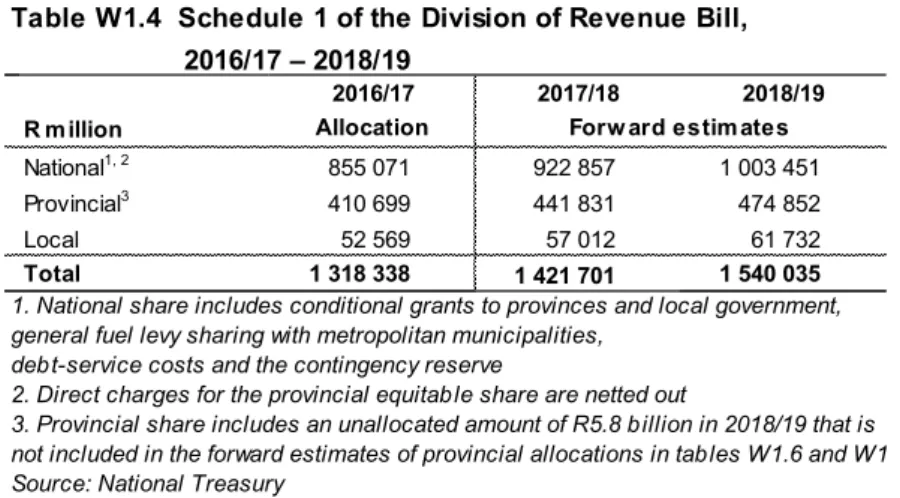
Equitable division of revenue raised nationally among spheres of government 3. (1) Revenue raised nationally in respect of the 2016/17 financial year must be divided among the national, provincial and local spheres of government as set out in Column A of Schedule 1.
(2) The envisaged division among the national, provincial and local spheres of government of revenue anticipated to be raised nationally in respect of the 2017/18 financial year and the 2018/19 financial year, and which is subject to the Division of Revenue Acts for those financial years, is set out in Column B of Schedule 1.
Equitable division of provincial share among provinces
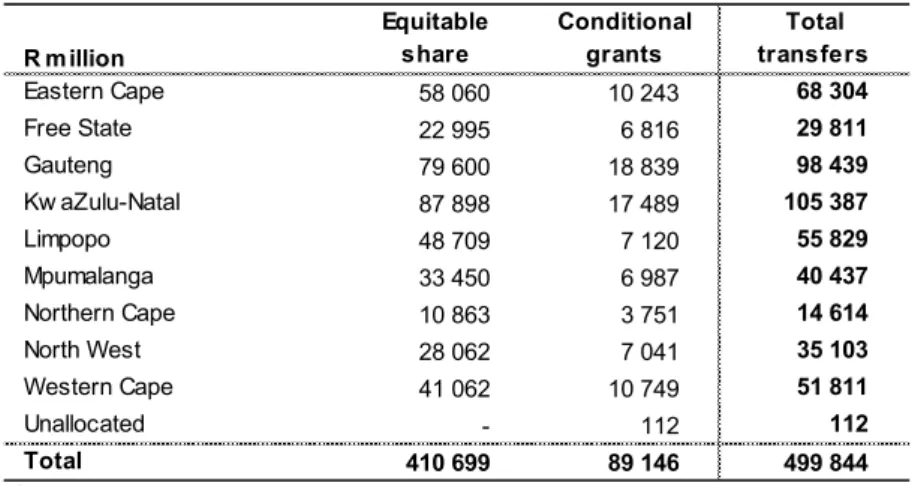
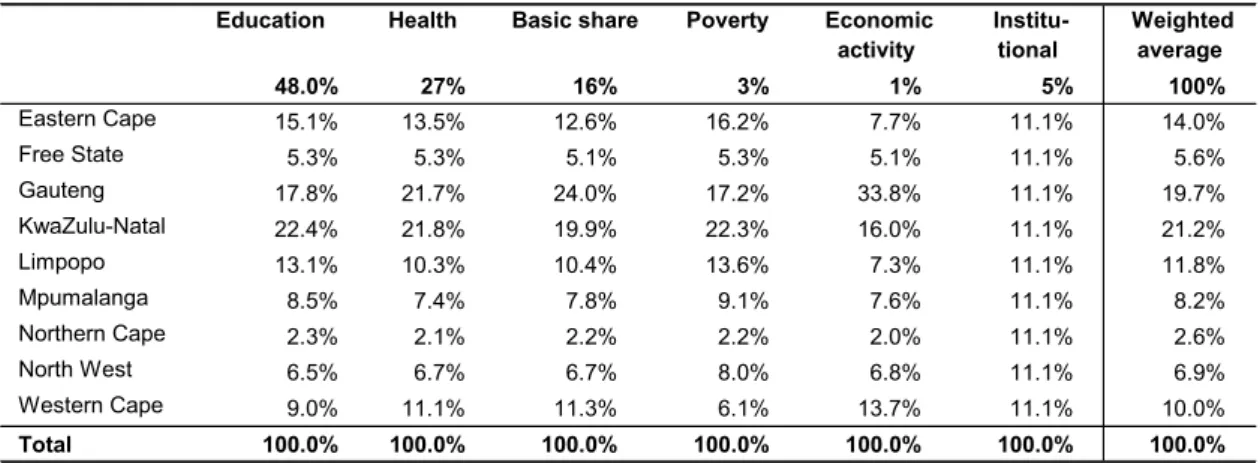
4. (1) Each province’s equitable share of the provincial share of revenue raised nationally in respect of the 2016/17 financial year is set out in Column A of Schedule 2.
(2) The envisaged equitable share for each province of revenue anticipated to be raised nationally in respect of the 2017/18 financial year and the 2018/19 financial year, and which is subject to the Division of Revenue Acts for those financial years, is set out in Column B of Schedule 2.
(3) The National Treasury must transfer each province’s equitable share referred to in subsection (1) to the corporation for public deposits account of the province in accordance with the payment schedule determined in terms of section 23.
Equitable division of local government share among municipalities
5. (1) Each municipality’s equitable share of local government’s share of revenue raised nationally in respect of the 2016/17 financial year is set out in Column A of Schedule 3.
5
10
15
20
25
30
35
40
45
50
raised nationally in respect of the 2017/18 financial year and the 2018/19 financial year, and which is subject to the Division of Revenue Acts for those financial years, is set out in Column B of Schedule 3.
(3) The national department responsible for local government must, subject to section 38(3), transfer a municipality’s equitable share referred to in subsection (1) to the primary bank account of the municipality in three transfers on 4 July 2016, 1 December 2016 and 17 March 2017, in the amounts determined in terms of section 23(2).
Shortfalls and excess revenue
6. (1) If the actual revenue raised nationally in respect of the 2016/17 financial year falls short of the anticipated revenue set out in Column A of Schedule 1, the national government bears the shortfall.
(2) If the actual revenue raised nationally in respect of the 2016/17 financial year exceeds the anticipated revenue set out in Column A of Schedule 1, the excess accrues to the national government, and may be used to reduce borrowing or pay debt as part of its share of revenue raised nationally.
(3) A portion of national government’s equitable share or excess revenue envisaged in subsection (2), may be appropriated through the applicable legislation envisaged in section 12 of the Money Bills Amendment Procedure and Related Matters Act, 2009 (Act No. 9 of 2009), to make further allocations to—
(a) national departments; or (b) provinces or municipalities.
CHAPTER 3
CONDITIONAL ALLOCATIONS TO PROVINCES AND MUNICIPALITIES
Part 1Conditional allocations
Conditional allocations to provinces
7. (1) Conditional allocations to provinces for the 2016/17 financial year from the national government’s share of revenue raised nationally are set out in—
(a) Part A of Schedule 4, specifying allocations to provinces to supplement the funding of programmes or functions funded from provincial budgets;
(b) Part A of Schedule 5, specifying specific purpose allocations to provinces;
(c) Part A of Schedule 6, specifying allocations-in-kind to provinces for designated special programmes; and
(d) Part A of Schedule 7, specifying funds that are not allocated to specific provinces, that may be released to provinces to fund an immediate response to a disaster.
(2) An envisaged division of conditional allocations to provinces from the national government’s share of revenue anticipated to be raised nationally for the 2017/18 financial year and the 2018/19 financial year, which is subject to the annual Division of Revenue Acts for those years, is set out in Column B of the Schedules referred to in subsection (1).
Conditional allocations to municipalities
8. (1) Conditional allocations to municipalities in respect of the 2016/17 financial year from the national government’s share of revenue raised nationally are set out in—
(a) Part B of Schedule 4, specifying allocations to municipalities to supplement the funding of functions funded from municipal budgets;
(b) Part B of Schedule 5, specifying specific purpose allocations to municipali- ties;
(c) Part B of Schedule 6, specifying allocations-in-kind to municipalities for designated special programmes; and
5
10
15
20
25
30
35
40
45
50
(d) Part B of Schedule 7, specifying funds that are not allocated to specific municipalities that may be released to municipalities to fund an immediate response to a disaster.
(2) An envisaged division of conditional allocations to municipalities from the national government’s share of revenue anticipated to be raised nationally for the 2017/18 financial year and the 2018/19 financial year, which is subject to the annual Division of Revenue Acts for those years, is set out in Column B of the Schedules referred to in subsection (1).
(3) If approved by the National Treasury after consultation with the national Department of Transport, allocations for specific transport contracts for capital projects from the envisaged conditional allocations for the Public Transport Network Grant listed in Column B of Part B of Schedule 5, may not be altered downwards in the Division of Revenue Acts for the 2017/18 financial year and 2018/19 financial year.
(4) (a) A municipality may only with the approval of the National Treasury pledge, offer as security or commit to a person or institution any envisaged conditional allocation to the municipality for the 2017/18 financial year and the 2018/19 financial year, for the purpose of securing a loan or any other form of financial or other support from that person or institution.
(b) Before making a decision, the National Treasury must—
(i) notify the relevant transferring officer of the approval sought by a municipal- ity and that the officer may submit comment to the National Treasury regarding the approval sought, within five working days after notification or such longer period as the National Treasury may approve; and
(ii) consider any comment so submitted by the officer.
(c) A municipality must report on any project pledged to be partially or fully funded in terms of paragraph (a) in the format and on the dates determined by the National Treasury.
Part 2
Duties of accounting officers in respect of Schedule 4 to 7 allocations
Duties of transferring officer in respect of Schedule 4 allocations
9. (1) The transferring officer of a Schedule 4 allocation must—
(a) ensure that transfers to all provinces and municipalities are—
(i) deposited only into the primary bank account of the relevant province or municipality; and
(ii) made in accordance with the payment schedule determined in terms of section 23, unless allocations are withheld or stopped in terms of section 18 or 19;
(b) monitor information on financial and non-financial performance of programmes partially or fully funded by an allocation in Part A of Schedule 4, in accordance with subsection (2) and the applicable framework;
(c) monitor information on financial and non-financial performance of the Urban Settlements Development Grant and Integrated City Development Grant against the capital budget and the service delivery and budget implementation plan;
(d) comply with the applicable framework;
(e) submit a quarterly financial and non-financial performance report within 45 days after the end of each quarter to the National Treasury in terms of the applicable framework; and
(f) evaluate the performance of programmes funded or partially funded by the allocation and the submission of such evaluations to the National Treasury—
(i) in respect of a provincial department, within four months after the end of the 2016/17 financial year of the provincial department; and
(ii) in respect of a municipality, within four months after the end of the 2016/17 financial year of the municipality.
(2) Any monitoring programme or system that is utilised to monitor information on financial and non-financial performance of a programme partially or fully funded by a Schedule 4 allocation must—
(a) be approved by the National Treasury;
5
10
15
20
25
30
35
40
45
50
55
beyond the provision of standard management and budget information;
(c) be compatible and integrated with and not unnecessarily duplicate other relevant national, provincial and local systems; and
(d) support compliance with section 11(2).
(3) A transferring officer may only transfer the Urban Settlements Development Grant to a recipient metropolitan municipality, if the municipality has submitted a built environment performance plan in terms of section 14(1).
Duties of transferring officer in respect of Schedule 5 or 6 allocations 10. (1) The transferring officer of a Schedule 5 or 6 allocation must—
(a) not later than 14 days after this Act takes effect, certify to the National Treasury that—
(i) any monitoring or system that is utilised, is compatible and integrated with and does not duplicate other relevant national, provincial and local systems; and
(ii) in respect of a Schedule 5 allocation, any plans requested in respect of how allocations will be utilised by a province or municipality, as the case may be, have been approved before the start of the financial year.
(b) in respect of Schedule 5 allocations—
(i) transfer funds only after receipt of all information required to be submitted by the receiving officer in terms of this Act and submission of all relevant information to the National Treasury;
(ii) transfer funds in accordance with the payment schedule determined in terms of section 23, unless allocations are withheld or stopped in terms of section 18 or 19; and
(iii) deposit funds only into the primary bank account of the relevant province or municipality; and
(c) ensure that all other provisions of this Act and the relevant framework for the transfer of the allocation are complied with.
(2) The transferring officer must submit all relevant information and documentation referred to in subsection (1)(a) to the National Treasury within 14 days after this Act takes effect.
(3) A transferring officer, who has not complied with subsection (1), must transfer the allocation in the manner instructed by the National Treasury, including transferring the allocation as an unconditional allocation.
(4) Before making the first transfer of any allocation in terms of subsection (1)(b), the transferring officer must take note of any notice in terms of section 31(1) containing the details of the relevant primary bank accounts.
(5) The transferring officer of a Schedule 5 allocation to a municipality is responsible for monitoring financial and non-financial performance information on programmes funded by the allocation.
(6) The transferring officer of a Schedule 5 or 6 allocation must, as part of the reporting envisaged in section 40(4)(c) of the Public Finance Management Act, submit information, in the format determined by the National Treasury, for the month in question, and for the 2016/17 financial year up to the end of that month, on—
(a) the amount of funds transferred to a province or municipality;
(b) the amount of funds for any province or municipality withheld or stopped in terms of section 18 or 19, the reasons for the withholding or stopping and the steps taken by the transferring officer and the receiving officer to deal with the matters or causes that necessitated the withholding or stopping of the payment;
(c) the actual expenditure incurred by the province or municipality in respect of a Schedule 5 allocation;
(d) the actual expenditure incurred by the transferring officer in respect of a Schedule 6 allocation;
(e) any matter or information that may be required by the relevant framework for the particular allocation; and
(f) such other matters as the National Treasury may determine.
(7) A transferring officer must submit to the National Treasury—
(a) a monthly provincial report on infrastructure expenditure partially or fully funded by the Health Facility Revitalisation Grant, National Health Insurance
5
10
15
20
25
30
35
40
45
50
55
60
Indirect Grant, School Infrastructure Backlogs Grant or Maths, Science and Technology Grant within 22 days after the end of each month, in the format determined by the National Treasury; and
(b) a quarterly performance report of all programmes partially or fully funded by a Schedule 5 or 6 allocation within 45 days after the end of each quarter, in accordance with the relevant framework.
(8) The transferring officer must evaluate the performance of all programmes partially or fully funded by a Schedule 5 or 6 allocation and submit such evaluations to the National Treasury—
(a) in respect of a provincial department, within four months after the end of the 2016/17 financial year of the provincial department; and
(b) in respect of a municipality, within four months after the end of the 2016/17 financial year of the municipality.
(9) The transferring officer for the Public Transport Network Grant, Neighbourhood Development Partnership Grant or Integrated National Electrification Programme Grant to a metropolitan municipality—
(a) may only transfer the grant if the municipality has submitted a built environment performance plan in terms of section 14(1);
(b) must take into account that built environment performance plan when monitoring and evaluating the performance of the municipality and assessing envisaged plans and allocations for the municipality.
(10) The transferring officer of the Human Settlements Development Grant may only transfer the grant to a province after the relevant receiving officer has complied with section 12(6)(a) and (b).
Duties of receiving officer in respect of Schedule 4 allocations
11. (1) The receiving officer of a Schedule 4 allocation is responsible for—
(a) complying with the relevant framework for the Schedule 4 allocation; and (b) the manner in which the Schedule 4 allocation received from a transferring
officer is allocated and spent.
(2) The receiving officer of a municipality must—
(a) ensure and certify to the National Treasury that the municipality—
(i) indicates each programme partially or fully funded by a Schedule 4 allocation in its annual budget and that the Schedule 4 allocation is specifically and exclusively appropriated in that budget for utilisation only according to the purpose of the allocation; and
(ii) makes public, in terms of section 21A of the Municipal Systems Act, the conditions and other information in respect of the allocation, to facilitate performance measurement and the use of required inputs and outputs;
(b) when submitting the municipality’s statements in terms of section 71 of the Municipal Finance Management Act for September 2016, December 2016, March 2017 and June 2017, report to the transferring officer, the relevant provincial treasury and the National Treasury—
(i) in respect of the Urban Settlements Development Grant and the Integrated City Development Grant, on financial performance against its capital budget and the measures defined in its service delivery and budget implementation plan; and
(ii) in respect of any other Schedule 4 allocation, on financial performance of programmes partially or fully funded by the allocation; and
(c) within 30 days after the end of each quarter, report to the transferring officer and the National Treasury—
(i) in respect of the Urban Settlements Development Grant and the Integrated City Development Grant, on non-financial performance for that quarter against the measures defined in its service delivery and budget implementation plan; and
(ii) in respect of any other Schedule 4 allocation, on non-financial performance of programmes partially or fully funded by the allocation.
(3) The National Treasury must make the report submitted to it in terms of subsection (2)(b) or (c) available to the transferring officer of the Urban Settlements Development Grant, Public Transport Network Grant and Integrated National Electrification Programme Grant and the accounting officer of any other national department having responsibilities relating to the applicable allocation.
5
10
15
20
25
30
35
40
45
50
55
60
provincial treasury and the transferring officer—
(a) as part of the report required in section 40(4)(c) of the Public Finance Management Act, reports on financial and non-financial performance of programmes partially or fully funded by a Schedule 4 allocation;
(b) a quarterly non-financial performance report of programmes partially or fully funded by a Schedule 4 allocation within 30 days after the end of each quarter;
and
(c) a monthly provincial report on infrastructure programmes partially or fully funded by a Schedule 4 allocation within 15 days after the end of each month, in the format determined by the National Treasury.
(5) The receiving officer must report on programmes partially or fully funded by a Schedule 4 allocation against the relevant framework in its annual financial statements and annual report.
(6) The receiving officer must evaluate the financial and non-financial performance of the provincial department or municipality, as the case may be, in respect of programmes partially or fully funded by a Schedule 4 allocation and submit such evaluation to the transferring officer and the relevant provincial treasury within two months—
(a) in respect of a provincial department, after the end of the 2016/17 financial year of the provincial department; and
(b) in respect of a municipality, after the end of the 2016/17 financial year of the municipality.
Duties of receiving officer in respect of Schedule 5 or 7 allocations
12. (1) The receiving officer of a Schedule 5 or 7 allocation must ensure compliance with the relevant framework.
(2) The relevant receiving officer must, in respect of a Schedule 5 or 7 allocation transferred to—
(a) a province, as part of the report required in section 40(4)(c) of the Public Finance Management Act, report on the matters referred to in subsection (3) and submit a copy of that report to the relevant provincial treasury and the transferring officer;
(b) a municipality, as part of the report required in terms of section 71 of the Municipal Finance Management Act, report on the matters referred to in subsection (4) and submit a copy of that report to the relevant provincial treasury, the National Treasury and the relevant transferring officer; and (c) a province or municipality, submit a quarterly non-financial performance
report within 30 days after the end of each quarter to the transferring officer and the relevant provincial treasury.
(3) A report for a province in terms of subsection (2)(a) must set out for the month in question and for the 2016/17 financial year up to the end of the month—
(a) the amount received by the province;
(b) the amount of funds stopped or withheld in terms of section 18 or 19 and the reason for the stopping or withholding;
(c) the actual expenditure by the province in respect of Schedule 5 and 7 allocations;
(d) the amount transferred to any national or provincial public entity to implement a programme funded by a Schedule 5 allocation on behalf of a province or to assist the province in implementing the programme;
(e) the available figures regarding the expenditure by a public entity referred to in paragraph (d);
(f) the extent of compliance with this Act and with the conditions of the allocation provided for in its framework, based on the available information at the time of reporting;
(g) an explanation of any material difficulties experienced by the province regarding an allocation which has been received and a summary of the steps taken to deal with such difficulties;
(h) any matter or information that may be determined in the framework for the allocation; and
(i) such other matters and information as the National Treasury may determine.
5
10
15
20
25
30
35
40
45
50
55
(4) A report for a municipality in terms of subsection (2)(b) must set out for the month in question and for the 2016/17 financial year up to the end of the month—
(a) the amount received by the municipality;
(b) the amount of funds stopped or withheld in terms of section 18 or 19 and the reason for the stopping or withholding;
(c) the extent of compliance with this Act and with the conditions of the allocation or part of the allocation provided for in its framework;
(d) an explanation of any material problems experienced by the municipality regarding an allocation which has been received and a summary of the steps taken to deal with such problems;
(e) any matter or information that may be determined in the framework for the allocation; and
(f) such other matters and information as the National Treasury may determine.
(5) The receiving officer must evaluate the financial and non-financial performance of the provincial department or municipality, as the case may be, in respect of programmes partially or fully funded by a Schedule 5 allocation and submit such evaluation to the transferring officer and the relevant provincial treasury within two months—
(a) in respect of a provincial department, after the end of the 2016/17 financial year of the provincial department; and
(b) in respect of a municipality, after the end of the 2016/17 financial year of the municipality.
(6) (a) The receiving officer of the Human Settlements Development Grant must, in consultation with the transferring officer, publish in the Gazette within 14 days after this Act takes effect, the planned expenditure from the Human Settlements Development Grant, for the 2016/17 financial year, the 2017/18 financial year and the 2018/19 financial year per municipality with level one or level two accreditation.
(b) The planned expenditure must indicate the expenditure to be undertaken directly by the province and transfers to each municipality.
(c) The receiving officer of the Human Settlements Development Grant may, by notice in the Gazette, after taking into account the performance of the municipality and after consultation with the affected municipality and in consultation with the transferring officer, amend the planned expenditure for that municipality published in terms of paragraph (a).
Duties of receiving officer in respect of infrastructure conditional allocations to provinces
13. (1) The receiving officer of the Education Infrastructure Grant, Health Facility Revitalisation Grant, Human Settlements Development Grant or Provincial Roads Maintenance Grant must—
(a) submit to the relevant provincial treasury a list of all infrastructure projects partially or fully funded by the relevant grant over the medium term expenditure framework for tabling as part of the estimates of provincial expenditure in the provincial legislature in the format determined by the National Treasury;
(b) within seven days after the tabling in the legislature, submit the list to the transferring officer and the National Treasury;
(c) after consultation with the provincial treasury and the transferring officer, submit any amendments to the list, together with reasons for the amendments, to the provincial treasury for tabling with the adjusted estimates of provincial expenditure;
(d) within seven days after the tabling in the legislature, submit the amended list to the transferring officer and the National Treasury;
(e) report on all infrastructure expenditure partially or fully funded by the relevant grant to the transferring officer, relevant provincial treasury and the National Treasury in the format and on the date determined by the National Treasury;
(f) within 15 days after the end of each month, submit to the relevant provincial treasury and transferring officer, a draft report on infrastructure programmes partially or fully funded from those grants in the format determined by the National Treasury;
5
10
15
20
25
30
35
40
45
50
55
a final draft report on infrastructure programmes partially or fully funded from those grants;
(h) within 29 days after the end of each month, submit to the relevant provincial treasury, the transferring officer and the National Treasury, a final report; and (i) within two months after the end of the 2016/17 financial year—
(i) evaluate the financial and non-financial performance of the province in respect of programmes partially or fully funded by the grant based on the infrastructure budget of the province; and
(ii) submit the evaluation to the transferring officer, the relevant provincial treasury and the National Treasury.
(2) The receiving officer of the Education Infrastructure Grant or Health Facility Revitalisation Grant must—
(a) within 15 days after the end of each quarter, submit to the transferring officer and the relevant provincial treasury a draft report on the filling of posts on the approved establishment for the infrastructure unit of the affected provincial department in a format determined by the National Treasury;
(b) within 22 days after the end of each quarter, submit to the National Treasury, a final draft report on the filling of posts on the approved establishment for the infrastructure unit of the affected provincial department;
(c) within 29 days after the end of each quarter, submit to the transferring officer, the relevant provincial treasury and the National Treasury, a final report on the filling of posts on the approved establishment for the infrastructure unit of the affected provincial department; and
(d) ensure that projects comply with infrastructure delivery management best practice standards and guidelines, as identified and approved by the National Treasury.
Infrastructure conditional allocations to metropolitan municipalities
14. (1) The receiving officer of a metropolitan municipality must, by 27 May 2016, submit to the National Treasury a built environment performance plan that includes all projects partially or fully funded by—
(a) the Integrated City Development Grant, Urban Settlements Development Grant, Public Transport Network Grant, Neighbourhood Development Partnership Grant or Integrated National Electrification Programme Grant referred to in Part B of Schedule 5; and
(b) money allocated for the Human Settlements Development Grant received from a province.
(2) The built environment performance plan, referred to in subsection (1), must—
(a) be in the format determined by the National Treasury, including information on the project pipeline for catalytic urban development projects;
(b) demonstrate that the planned expenditure in the municipality’s integration zones from all the grants referred to in subsection (1)(a) collectively, increases annually; and
(c) be approved by its municipal council.
(3) The National Treasury must, within seven days after the submission in terms of subsection (1), make available each built environment performance plan to all affected transferring officers and provincial departments.
(4) (a) The receiving officer must report in its annual financial statements on the expenditure from each of the grants mentioned in subsection (1)(a) in each integration zone of the municipality against its built environment performance plan.
(b) The transferring officer of the Integrated National Electrification Programme Grant referred to in Part B of Schedule 6 must report in its annual financial statements on the expenditure in each integration zone of every municipality against the built environment performance plan of the municipality.
Duties in respect of annual financial statements and annual reports for 2016/17 15. (1) The 2016/17 financial statements of a national department responsible for transferring an allocation in Schedule 4, 5 or 7 must, in addition to any requirement of any other legislation—
5
10
15
20
25
30
35
40
45
50
55
(a) indicate the total amount of that allocation transferred to a province or municipality;
(b) indicate any transfer withheld or stopped in terms of section 18 or 19 in respect of each province or municipality and the reason for the withholding or stopping;
(c) indicate any transfer not made in accordance with the payment schedule or amended payment schedule, unless withheld or stopped in terms of section 18 or 19, and the reason for the non-compliance;
(d) indicate any reallocations by the National Treasury in terms of section 20;
(e) certify that all transfers to a province or municipality were deposited into the primary bank account of a province or municipality; and
(f) indicate the funds, if any, utilised for the administration of the allocation by the receiving officer.
(2) The 2016/17 annual report of a national department responsible for transferring an allocation in Schedule 4, 5 or 7 must, in addition to any requirement of any other legislation indicate—
(a) the reasons for the withholding or stopping of all transfers to a province or municipality in terms of section 18 or 19;
(b) the extent that compliance with this Act by provinces or municipalities was monitored;
(c) the extent that the allocation achieved its objectives and outputs; and (d) any non-compliance with this Act, and the steps taken to address the
non-compliance.
(3) The 2016/17 financial statements of a provincial department responsible for receiving an allocation in Schedule 4, 5 or 7 must, in addition to any requirement of any other legislation—
(a) indicate the total amount of all allocations received;
(b) indicate the total amount of actual expenditure on each Schedule 5 or 7 allocation; and
(c) certify that all transfers of allocations in Schedules 4, 5 and 7 to the province were deposited into the primary bank account of the province.
(4) The 2016/17 annual report of a provincial department receiving an allocation in Schedule 4, 5 or 7 must, in addition to any requirement of any other legislation—
(a) indicate the extent that the provincial department complied with this Act;
(b) indicate the steps taken to address non-compliance with this Act;
(c) indicate the extent that the allocation achieved its objectives and outputs;
(d) contain any other information that may be specified in the framework for the allocation; and
(e) contain such other information as the National Treasury may determine.
(5) The 2016/17 financial statements and annual report of a municipality receiving an allocation in Schedule 4, 5 or 7 must be prepared in accordance with the Municipal Finance Management Act.
(6) The National Treasury may determine how transferring officers and receiving officers must report on conditional allocations to municipalities within 30 days after the end of each quarter to facilitate the audit of the allocations for the 2016/17 financial year.
Part 3
Matters relating to Schedule 4 to 7 allocations
Publication of allocations and frameworks
16. (1) The National Treasury must, within 14 days after this Act takes effect, publish by notice in the Gazette—
(a) the conditional allocations per municipality for Part B of Schedule 5 allocations;
(b) the indicative conditional allocations per province for Part A of Schedule 6 allocations and per municipality for Part B of Schedule 6 allocations; and (c) the framework for each conditional allocation in Schedules 4 to 7.
(2) For purposes of correcting an error or omission in an allocation or framework published in terms of subsection (1)(a) or (c), the National Treasury must—
(a) on its initiative and after consultation with the relevant transferring officer; or 5
10
15
20
25
30
35
40
45
50
55
by notice in the Gazette, amend the affected allocation or framework.
(3) The National Treasury may, after consultation with the relevant transferring officer and by notice in the Gazette, amend an indicative conditional allocation in Schedule 6 published in terms of subsection (1)(b).
(4) Before amending a framework in terms of subsection (2), the National Treasury must submit the proposed amendment to Parliament for comment for a period of 14 days when Parliament is in session.
(5) An amendment in terms of subsection (2) or (3) takes effect on the date of publication of the notice in the Gazette.
Expenditure in terms of purpose and subject to conditions
17. (1) Despite a provision of other legislation to the contrary, an allocation referred to in Schedules 4 to 7 may only be utilised for the purpose stipulated in the Schedule concerned and in accordance with the applicable framework.
(2) A receiving officer may not transfer any portion of a Schedule 5 allocation to any other organ of state for the performance of a function to be funded by the allocation, unless before the transfer is made, the receiving officer and the organ of state agree to a payment schedule, the receiving officer has notified the transferring officer and the National Treasury approves the agreed payment schedule and—
(a) the transfer—
(i) is approved in the budget for the receiving provincial department or municipality; or
(ii) if not so approved—
(aa) the receiving officer notifies the National Treasury that the purpose of the transfer is not to artificially inflate the expenditure estimates of the relevant provincial department or municipality and indicates the reasons for the transfer; and
(bb) the National Treasury approves the transfer; or
(b) the transfer is for the payment for services or goods procured in accordance with the supply chain management policy or procurement policy of the relevant province or municipality and, if it is an advance payment, paragraph (a)(ii) applies with the necessary changes.
(3) For purposes of the implementation of a Schedule 6 allocation to a municipality—
(a) Eskom Holdings Limited may receive funds directly from the transferring officer of the Department of Energy;
(b) a water board, as defined in section 1 of the Water Services Act, 1997 (Act No.
108 of 1997), may receive funds directly from the transferring officer of the Department of Water and Sanitation.
(4) (a) For purposes of the Human Settlements Development Grant, a receiving officer and a municipality with level one, two or three accreditation as at 1 April 2016, must, by the date determined by the National Treasury, comply with subsection (2) by—
(i) entering into a payment schedule; and
(ii) submitting the payment schedule to the National Treasury.
(b) If a municipality receives accreditation after 1 April 2016, the National Treasury may approve that paragraph (a) applies.
(c) If the transfer of the Human Settlements Development Grant to a municipality with level three accreditation is withheld or stopped in terms of section 18 or 19, the receiving officer must request the National Treasury to amend the payment schedule in terms of section 24.
(5) If a function which is partially or fully funded by a conditional allocation to a province is assigned to a municipality, as envisaged in section 10 of the Municipal Systems Act—
(a) the funds from the conditional allocation for the province for the function must be stopped in terms of section 19 and reallocated in terms of section 20 to the municipality which has been assigned the function;
(b) if possible, the province must finalise any project or fulfil any contract regarding the function before the date the function is assigned and, if not finalised, the province must notify the relevant municipality and the National Treasury;
(c) any project or contract regarding the function not finalised or fulfilled at the date at which the function is assigned, must be subjected to an external audit
5
10
15
20
25
30
35
40
45
50
55
60
and the province and the municipality must enter into an agreement to complete the project or fulfil the contract through ceding it to the municipality;
(d) money that is retained by the province for any contract related to the function that is not ceded to the municipality must be spent by 31 March 2017 and will not be available in terms of section 30 of the Public Finance Management Act or section 22(2);
(e) the receiving officer of the province must submit to the transferring officer and the National Treasury a list of liabilities attached to the function, that were not transferred to the municipality, within seven days after the function is assigned to provide for the adjustment of the applicable allocations; and (f) the receiving officer of the municipality must, within one month from the date
of the stopping of funds in paragraph (a), submit to the transferring officer a revised plan for its planned expenditure.
Withholding of allocations
18. (1) Subject to subsections (2) and (3), a transferring officer may withhold the transfer of a Schedule 4 or 5 allocation, or any portion thereof, for a period not exceeding 30 days, if—
(a) the province or municipality does not comply with any provision of this Act;
(b) roll-overs of conditional allocations approved by the National Treasury in terms of section 22 have not been spent; or
(c) a satisfactory explanation is not given for significant under-expenditure on previous transfers during the 2016/17 financial year.
(2) If an allocation is withheld in terms of subsection (1), it suspends the applicable payment schedule approved in terms of section 23(3) until it is amended in terms of section 24.
(3) The amount withheld in terms of this section in the case of the Health Professions Training and Development Grant or the National Tertiary Services Grant listed in Part A of Schedule 4 may not exceed five per cent of the next transfer as contained in the relevant payment schedule.
(4) A transferring officer must, at least seven working days before withholding an allocation in terms of subsection (1)—
(a) give the relevant receiving officer—
(i) notice of the intention to withhold the allocation; and
(ii) an opportunity to submit written representations as to why the allocation should not be withheld; and
(b) inform the relevant provincial treasury and the National Treasury, and in respect of any conditional allocation to a municipality, also the provincial department responsible for local government.
(5) A notice envisaged in subsection (4) must include the reasons for withholding the allocation and the intended duration of the withholding to inform the amendment of the payment schedule in terms of section 24.
(6) (a) The National Treasury may instruct, or approve a request from, the transferring officer to withhold an allocation in terms of subsection (1) for a period longer than 30 days, but not exceeding 120 days, if the withholding will—
(i) facilitate compliance with this Act; or (ii) minimise the risk of under-spending.
(b) When requesting the withholding of an allocation in terms of this subsection, a transferring officer must submit to the National Treasury proof of compliance with subsection (4) and any representations received from the receiving officer.
(c) The transferring officer must again comply with subsection (4) when the National Treasury instructs or approves a request by the transferring officer in terms of paragraph (a).
Stopping of allocations
19. (1) Despite section 18, the National Treasury may, in its discretion or on request of a transferring officer or a receiving officer stop the transfer of a Schedule 4 or 5 allocation, or a portion thereof, to a province or municipality—
(a) in the case of—
5
10
15
20
25
30
35
40
45
50
55
envisaged in section 216(2) of the Constitution, occurs; or (ii) a municipality, if—
(aa) a serious or persistent material breach of this Act, as envisaged in section 216(2) of the Constitution, read with section 38(1)(b)(i) of the Municipal Finance Management Act, occurs; or
(bb) a breach or failure to comply, as envisaged in section 38(1)(b)(ii) of the Municipal Finance Management Act occurs;
(b) if the National Treasury anticipates that a province or municipality will substantially underspend on the allocation, or any programme, partially or fully funded by the allocation, in the 2016/17 financial year; or
(c) for purposes of the assignment of a function from a province to a municipality, as envisaged in section 10 of the Municipal Systems Act;
(2) The National Treasury must, before stopping an allocation in terms of subsection (1)(a)(i) or (b)—
(a) comply with the procedures in section 18(4)(a); and
(b) inform the relevant provincial treasury of its intention to stop the allocation.
(3) The National Treasury must, before stopping an allocation in terms of subsection (1)(a)(ii), comply with the applicable provisions of section 38 of the Municipal Finance Management Act.
(4) The National Treasury must give notice in the Gazette of the stopping of an allocation in terms of this section and include in the notice the effective date of, and reason for, the stopping.
(5) (a) If—
(i) an allocation, or any portion thereof, is stopped in terms of subsection (1)(a) or (b); and
(ii) the relevant transferring officer certifies in writing to the National Treasury that the payment of an amount in terms of a statutory or contractual obligation is overdue and the allocation, or a portion thereof, was intended for payment of the amount,
the National Treasury may, by notice in the Gazette, approve that the allocation, or any portion thereof, be utilised to pay that amount partially or fully.
(b) The utilisation of funds envisaged in this subsection is a direct charge against the National Revenue Fund.
Reallocation of funds
20. (1) When a Schedule 4 or 5 allocation or a portion thereof is stopped in terms of section 19(1)(a) or (b), the National Treasury may, after consultation with the transferring officer and the relevant provincial treasury, determine the portion of the allocation to be reallocated, as the same type of allocation as it was allocated originally, to one or more provinces or municipalities, on condition that the allocation must be spent by the end of the 2016/17 financial year.
(2) (a) When a Schedule 4 or 5 allocation, or a portion thereof, is stopped in terms of section 19(1)(c), the National Treasury must, after consultation with the transferring officer and the relevant provincial treasury, determine the portion of the allocation to be reallocated, as the same type of allocation as it was allocated originally, to the affected municipalities, on condition that the allocation must be spent by the end of the 2016/17 financial year.
(b) The portion of the allocation reallocated in terms of paragraph (a) is, with effect from the notice in the Gazette in terms of subsection (3)(a), regarded as having been converted to an allocation in Part B of the same Schedule it appears before the reallocation.
(3) (a) If the transferring officer of a Schedule 6 allocation indicates in writing to the National Treasury that a portion of the allocation is likely to be underspent, or needs to be reprioritised to meet a priority, the National Treasury may, at the request of the transferring officer, determine that the portion be reallocated, as the same type of allocation as it was allocated originally, to a provincial department of another province or to another municipality.
(b) Before requesting a reallocation, the transferring officer must notify the affected provincial department or municipality of the proposed reallocation and give the provincial department or municipality at least 14 days to provide comments and propose changes.
5
10
15
20
25
30
35
40
45
50
55
60
(c) When making a request in terms of paragraph (a), the transferring officer must submit to the National Treasury comments and proposed changes provided by the affected provincial department or municipality in terms of paragraph (b).
(d) The reallocated portion must be spent by the end of the 2016/17 financial year.
(e) The reallocated portion is regarded as having been converted to an allocation to the relevant provincial department or municipality with effect from the date of the notice in the Gazette in terms of subsection (4)(a).
(4) (a) The National Treasury must—
(i) give notice in the Gazette of a reallocation in terms of subsection (1), (2) or (3); and
(ii) provide a copy of the notice to the transferring officer and each affected receiving officer.
(b) The reallocation of a portion of an allocation not spent by the end of 2016/17 financial year is eligible for a roll-over in terms of section 22(2).
(5) (a) When an intervention in terms of section 100 or 139 of the Constitution or section 137, 139 or 150 of the Municipal Finance Management Act takes place, the National Treasury may, despite subsection (1) and on such conditions as it may determine, authorise in relation to—
(i) section 100 of the Constitution, the transferring officer to spend an allocation stopped in terms of section 19 on behalf of the relevant province;
(ii) section 139 of the Constitution or section 137 or 139 of the Municipal Finance Management Act, the intervening province to spend an allocation stopped in terms of section 19 of this Act on behalf of the relevant municipality; or (iii) section 150 of the Municipal Finance Management Act, the relevant
transferring officer to spend an allocation stopped in terms of section 19 on behalf of the relevant municipality.
(b) An allocation that is spent by the transferring officer or intervening province referred to in paragraph (a) must, for the purposes of this Act, be regarded as a Schedule 6 allocation from the date on which the authorisation is given.
(6) (a) On a joint request by the transferring officer and the National Disaster Management Centre, established by section 8 of the Disaster Management Act, 2002 (Act No. 57 of 2002), the National Treasury may approve that a conditional allocation in Schedule 4, 5 or 6, or a portion thereof, be reallocated to pay for the alleviation of the impact of a disaster or the reconstruction or rehabilitation of infrastructure damage caused by a disaster.
(b) Before the National Treasury approves a reallocation, the receiving officer of the conditional allocation in Schedule 4 or 5 or the transferring officer of a Schedule 6 allocation must confirm that the affected funds are not committed in terms of any statutory or contractual obligation.
(c) The reallocated funds must be used in the 2016/17 financial year in the same sphere the allocation was originally made and for the same functional area that the original allocation relates to.
(d) The transferring officer must determine the conditions for spending the reallocated funds, after consultation with the National Disaster Management Centre and with the approval of the National Treasury.
(e) Subsection (4) applies with the necessary changes to a reallocation in terms of this subsection to another province or municipality.
Conversion of allocations 21. (1) If satisfied that—
(a) the conversion will prevent under-expenditure or improve the level of service delivery in respect of the allocation in question; and
(b) the affected national or provincial department or municipality has demon- strated the capacity to implement projects,
the National Treasury may, in its discretion after consultation with the relevant transferring officer and receiving officer or at the request of the transferring officer or the affected receiving officer, convert any portion of—
(i) an allocation listed in Part B of Schedule 5 to one listed in Part B of Schedule 6;
(ii) an allocation listed in Part B of Schedule 6 to one listed in Part B of Schedule 5;
5
10
15
20
25
30
35
40
45
50
55
60
Grant; or
(iv) the National Health Insurance Indirect Grant listed in Part A of Schedule 6 to the Health Facility Revitalisation Grant or the National Health Insurance Grant listed in Part A of Schedule 5.
(2) If satisfied that a municipality has failed to follow procurement procedures prescribed in terms of the Municipal Finance Management Act, the National Treasury may, in its discretion after consultation with the relevant transferring officer or at the request of the transferring officer or the affected receiving officer, convert any portion of an allocation listed in Part B of Schedule 5 to one listed in Part B of Schedule 6.
(3) Any portion of an allocation converted in terms of subsections (1) or (2) must be utilised for the same province or municipality to which the allocation was originally made.
(4) The National Treasury must—
(a) give notice in the Gazette of a conversion in terms of subsection (1) or (2); and (b) provide a copy of the notice to the transferring officer and each affected
receiving officer.
(5) A conversion in terms of subsection (1) or (2) takes effect on the date of publication of the notice in terms of subsection (4)(a).
(6) If an allocation listed in Part B of Schedule 7 is insufficient for a disaster referred to in section 26(3)(a), the National Treasury may, after consultation with or on the request of the relevant transferring officer, convert any portion of an allocation listed in—
(a) Part A of Schedule 7 to one listed in Part B of Schedule 7; or (b) Part B of Schedule 7 to one listed in Part A of Schedule 7.
(7) The National Treasury must—
(a) in the notice published in terms of section 26(3)(c), include notification of the conversion in terms of subsection (6) and the effective date referred to in subsection (8); or
(b) provide a copy of the notice to the transferring officer.
(8) A conversion in terms of subsection (6) takes effect on the date that the National Treasury approves it.
Unspent conditional allocations
22. (1) Despite a provision to the contrary in the Public Finance Management Act or the Municipal Finance Management Act, any conditional allocation, or a portion thereof, that is not spent at the end of the 2016/17 financial year reverts to the National Revenue Fund, unless the roll-over of the allocation is approved in terms of subsection (2).
(2) The National Treasury may, at the request of a transferring officer, receiving officer or provincial treasury, approve a roll-over of a conditional allocation to the 2017/18 financial year if the unspent funds are committed to identifiable projects.
(3) (a) The receiving officer must ensure that any funds that must revert to the National Revenue Fund in terms of subsection (1), are paid into that Fund by the date determined by the National Treasury.
(b) The receiving officer must—
(i) in the case of a provincial department, request the roll-over of unspent funds through its provincial treasury; and
(ii) inform the transferring officer of all processes regarding the request.
(4) The National Treasury may, subject to subsection (5), offset any funds that must revert to the National Revenue Fund in terms of subsection (1), but not paid into that Fund by the date determined in terms of subsection (3)(a)—
(a) in the case of a province, against future advances for conditional allocations to that province; or
(b) in the case of a municipality, against future advances for the equitable share or conditional allocations to that municipality.
(5) Before any funds are offset in terms of subsection (4), the National Treasury must give the relevant transferring officer, province or municipality—
(a) notice of the intention to offset amounts against future advances for allocations, the intended amount to be offset against allocations and the reasons for the offsetting; and
5
10
15
20
25
30
35
40
45
50
55
60
(b) an opportunity, within 14 days of receipt of the notice, to—
(i) submit written representations and other written proof that the allocation, or a portion thereof, was either spent in terms of the relevant framework or is committed to identifiable projects;
(ii) propose alternative means acceptable to the National Treasury by which the unspent allocations can be paid into the National Revenue Fund; and (iii) propose an alternative payment schedule in terms of which the unspent
allocations will be paid into the National Revenue Fund.
CHAPTER 4
MATTERS RELATING TO ALL ALLOCATIONS Payment requirements
23. (1) (a) The National Treasury must, after consultation with the provincial treasury, determine the payment schedule for the transfer of a province’s equitable share allocation.
(b) In determining the payment schedule, the National Treasury must take into account the monthly expenditure commitments of provinces and seek to minimise risk and debt servicing costs for national and provincial government.
(c) Despite paragraph (a), the National Treasury may advance funds to a province in respect of its equitable share or a portion of it which has not yet fallen due for transfer in terms of the payment schedule—
(i) for cash management purposes relating to the corporation for public deposits account or when an intervention in terms of section 100 of the Constitution takes place; and
(ii) on such conditions as it may determine.
(d) Any advances in terms of paragraph (c) must be offse