
Thus, the challenges of good governance in Rwanda were analyzed through the lens of Network Management Theory (NMT). This means that the current government of Rwanda believes that the genocide was caused by the freedom of the press and the unrestricted freedom of expression of the society.
CONCLUSION
Mobilizing Rural Institutions for Sustainable Livelihoods and Equitable Development: A Case of Decentralization in Ethiopia Development: A Case Study of Gram Panchayats in the West. Applying the concept of good governance to promote local economic development: contribution and challenge', International Journal of Economic Development.
Abstract
The analysis also argues that most of the challenges experienced in the region go back to the region's systems and structure, which are characterized by fissures, poverty, greed, autocracy and an archaic mentality. Countries in the region must be honest with each other and crack down on dissenters and violators.
Introduction
Theoretical framework
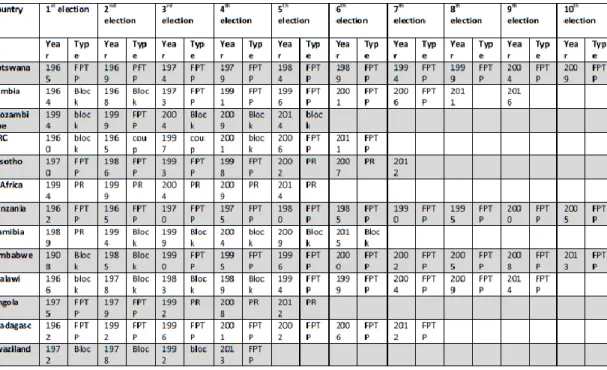
As a result, Zimbabwe has had 10 presidential and legislative elections, while Angola has held four elections during the tenure of current leaders. The question has always been "Are the elections properly designed and conducted?" The study therefore tries to understand why, despite all the elections, democracy remains only a dream and the leaders fail to interpret the votes of the voters.
Democracy
During this period, both leaders have been directly or indirectly involved in corrupt practices, making them as dirty as their subordinates. Both leaders have invented their own forms of democracy, which they say empowers them to stay in office.
Features of democracy
Each of the three branches of government is expected to fulfill its role independently of the others. It is the independence of each of the branches that ensures the smooth functioning of the governance systems.
Elections and their challenges
In a democracy, every citizen should be able to express his/her opinion, as long as it remains within the limits of the constitution. In the same vein, modernity has also introduced technology in response to the needs of today's political and economic dispensation.
Election-related violence in SADC
There is also a need to introduce systems that cater to both the majority and the minority population as defined in the constitution, as a way to avoid a situation where 51% of the voting population oppresses 49% in the name of the majority. What is often ignored is that the voting population does not represent the entire population of a given territory (Bogaards, 2013). The interests of minority voters must also be accommodated to prevent anger and potential grievances and conflicts.
While in other countries the opposition parties learn from their past mistakes (Rakner and Walle, 2009), in Zimbabwe there is never room for correction of the mistakes, let alone coalition efforts.
SADC’s stance on democracy
Practice influenced some of the regional body's challenges through precedence where other leaders were allowed to get away with it (Matlosa, 2005). Operationally, the agenda of the body to ensure standard democracy in all the member states where the rule of law, constitutionalism, peace and good governance is practised, has been derailed by mistakes in some member states (Matlosa, 2005). In 2008, Morgan Tsvangirai of the Movement for Democratic Change (MDC) also withdrew from the second round of the election, leaving Mugabe in a lonely race.
There has also been widespread criticism of the Independent National Electoral Commission (CENI) regarding the partial conduct of the elections in Kabila's favor (Phezo, 2010).
Leadership arrogance
Despite the fact that the country experienced a protracted civil war that ended after the death of Jonas Savimbi, a rebel leader in 1992, 25 years later, no change is evident on the ground. Santos, who over the years has built an empire, tamed the people of Angola through his narrow leadership. While elected leaders may be interested in fixing systems, they also take advantage of twisted laws to tilt the landscape in their favor.
Looking at the killing and displacement of people during the period of ground invasion since 2000 in Zimbabwe;.
Frequency of elections in SADC
The analysis shows that there is no direct connection between the independence period and the frequency of elections, nor is there a connection between the number of elections and the number of leaders holding office.
Conclusion
This study observes that the theory of democratization through elections in Africa appears to be a victim of a similar problem of overgeneralization. It is some of these problems that led to the protection of leaders such as Mugabe when he rigged the elections in 2002 and 2008, and Mswati when he instigated coups in 1998 and 2001. Others were Santos in his manipulation of the constitution and Rajoelina when he staged a coup in 2009.
Conference report held at the EISA Symposium, Preventing and Managing Violent Electoral Conflict in Africa: Exploring Good Practice.
Child insurgents in West Africa: The Boko Haram example In Nigeria, Chad and Cameroon
According to Fatma Samoura, the United Nations Humanitarian Coordinator in Nigeria, more than 200,000 boys and girls live in abductions, and girls are constantly in forced marriage and sexual slavery. 6. The ability to turn captured boys and girls into killers has become a major source of concern for the governments of Nigeria, Chad, Cameroon and the international community. Child rebels are a threat to national security and the stability of the pro-insurgency political system.
Years of brutality and violence indoctrinate children into a culture of aggression and a cycle of violence.7 The aim of this study is to examine the involvement of children (under the age of 18) in the Boko Haram insurgency in Nigeria, Cameroon and Chad, and to discuss the developmental implications of child insurgency in the three countries.
Conceptual framework
Rescued captives represent danger to the larger society, as the process of rehabilitation may not successfully extricate former abductees from violence or the act of aggression.
History of children’s participation in insurgency
The history of children and young people's involvement in violence, armed conflict, demonstrations or rebellions in Africa is not that different. In recent times, children and young people have been seen in civil wars, rebellions and armed conflicts across Africa. The wars in Liberia, Sierra Leone and Uganda were not without the involvement of children and young people.
Children and youth dominated the conflict to the extent that it was labeled a "Youth Crisis".30 Children were involved in the war mainly due to the destructive effects of the All People's Congress (APC) rule since 1968.
Children’s participation in Boko Haram insurgency
It is estimated that over 6,000 children took up arms between 1989 and 1997.27 According to UN sources, over 15,000 children were involved in the armed forces between 2000 and 2003.28 Many of these children were recruited forcibly and involuntarily. Liberians United for Reconciliation and Democracy (LURD), the Movement for Democracy in Liberia (MODEL) and the National Patriotic Front of Liberia (NPFL) extensively recruited children between 2000 and 2003.29. The rule of the APC destroyed the opportunities of the youth to create a meaningful life for themselves in the cities. 31.
Kony raided children at night and also abducted children in towns and schools.33 According to The Lancet, around 20,000 children were abducted; about 8,400 of them between June 2002 and June 2003.34.
Mode of conscription
Training of abductees
For Rahila Amos, a former Boko Haram captive who escaped after months of training, the system of grooming would-be bombers involved food shortages and promises of eternal life. Throughout her stay in Boko Haram captivity, she was fed one meal a day, which caused her to lose weight drastically. Abductees are kept in a long trench for several days and eat one meal a day, a corn paste made from corn powder.45. The brutality and heartlessness of the child rebels is the direct result of the consumption of hard drugs and alcoholic beverages.
It can be deduced from the above routine that hostages under Boko Haram captivity received training in both the Quran and violence.
Child insurgents and Boko Haram terrorism in Nigeria, Cameroon and Chad
In Kolo Fata, the Cameroonian army lost one officer, while the Boko Haram group lost 80 people were kidnapped and three died during attacks on villages in Northern Cameroon.58. In the ensuing firefight, over 200 Boko Haram fighters and bombers, including boys and girls, were killed, while one Chadian soldier lost his life and nine others were wounded.60. The case of Fata, who was kidnapped in 2014 and later rescued by Nigerian soldiers in 2016, is quite revealing.63 She was sexually abused by male Boko Haram fighters.
More importantly, Amina Ali's ordeal in Boko Haram captivity is an indication of the "bush woman" role played by girls.
Security and development implications of child insurgents in West Africa
They therefore resorted to violence to draw attention to themselves and possibly be invited to discuss their own terms and receive their due benefits.70 According to Alizie Maureen, these boys (NDA) are not just new recruits, they are younger militants who have not benefited from it. from the late President Yar 'Adua's Amnesty program in 2009. They are out to get their own benefits.71 From the above analysis, it is clear that neglected, ill-treated ex-child fighters have often taken to the streets and protested against the authorities for their failure to fulfill settlement promises, which include non-payment of reintegration benefits. Since November 2014, it is estimated that 1 million children have lost access to education.72 Children's lost school years reduce society's human and economic development potential and also damage the chances of stable democracies that are demonstrably linked to human and social well-being.
Findings
Investigating the Boko Haram insurgency in Northern Nigeria and the search for a permanent solution to the crisis. Basic references in the text References in the text where the author of the source is known. In the reference list, list the first and last names of the first six authors and abbreviate the remaining authors to et al.
If author and publisher are identical, use the word Author as the name of the publisher. For articles in newspapers or magazines where no author is mentioned, the title is used instead of the author. Include the initials and surname of the communicator and specify the date as accurately as possible.

