SOCIO- ECONOMIC CHALLENGES FACING THE ELDERLY: PERSPECTIVES AND EXPERIENCES OF OLDER PEOPLE IN FOLWENI TOWNSHIP IN
KWAZULU NATAL
Charlotte Zamokuhle Biyela Student Number: 217076739
Submitted in partial fulfilment of the requirements for the degree of Masters in Population Studies
School of Built Environment and Development Studies University of Kwazulu-Natal
Supervisor: Professor Pranitha Maharaj
2019
DECLARATION I, Charlotte Zamokuhle Biyela, declare that:
(i) The research reported in this dissertation, except where otherwise indicated, is my original research.
(ii) This dissertation has not been submitted for any degree or examination at any other university.
(iii) This dissertation does not contain other person’s data, pictures, graphs or other information, unless specifically acknowledged as being sourced from other persons.
(iv) This dissertation does not contain other persons’ writing unless specifically acknowledged as being sourced from other researchers.
(v) This dissertation does not contain text, graphic or tables copied and posted from the internet, unless specifically acknowledged, and the source being detailed in the dissertation and in the references sections.
Signed ………
ACKNOWLEDGEMENTS
My sincere thanks and gratitude should go first, to my supervisor, Professor Pranitha Maharaj for her tireless effort in reading and re-reading my work to ensure that I came up with a good dissertation. Without your patience and guidance, this work would not have been a success.
Special thanks to my family, particularly my husband Mr Themba Biyela for being supportive, my children Awande, Biyela, Lwandle Biyela and Melo Biyela for being so supportive and continue to encourage me when I became discouraged.
To my friends, thank you for being so supportive, your words of encouragements have helped me.
To my colleagues at school, thanks very much, I would not have done this without you.
To my colleague, Mr Armstrong Luhlongwane thank you for allowing me time to finish my studies, your support is very much appreciated.
To the local authority at Folweni Township, thank you for your input.
Finally I would like to thank God for his grace that has seen me this far.
DEDICATION
I humbly dedicate this work to my family for the sacrifices they made whilst I pursued this dream and milestone. I love you so much.
ACRONYMS
AU - African Union
CAI - Committee on Ageing Issues
DRTS - Demand Response Transportation System EPWP - Extended Public Works Programme GNP - Gross National Product
HIV/AIDS - Human Immunodeficiency Virus/Acquired Immunodeficiency Syndrome
ICPD - International Conference on Population and Development IEA - International Energy Agency
ILC - International Longevity Centre ILO - International Labour Organisation MDG - Millennium Development Goals
MIPAA - Madrid International Plan of Action on Ageing NDA - National Development Agency
NGO - Non-governmental organisation PAYG - Pay-as-you-go
PDP - Population Development Programme PRB - Population Reference Bureau
SASSA - South African Social Security Agency SFA - Strategic Focus Area
TFR - Total fertility rate UN - United Nations
UNAIDS - United Nations Programme on HIV/AIDS
UNDESA - United Nations Department of Economics and Social Affairs UNECE - United Nations Economic Commission for Europe
UNFPA - United Nations Population Fund UNPD - United Nations Population Division WHO - World Health Organisation
FIGURES
Figure 1.1: Socio-Ecological Model 5
Figure 2.1: Demographic Transition 11
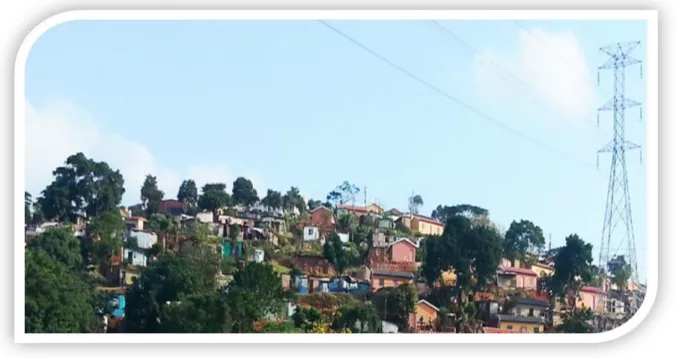
Figure 3.1: Folweni Township Photo 26
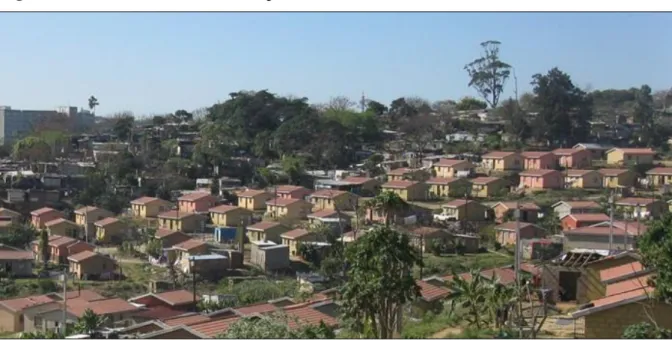
Figure 3.2: Folweni Township Photo 27
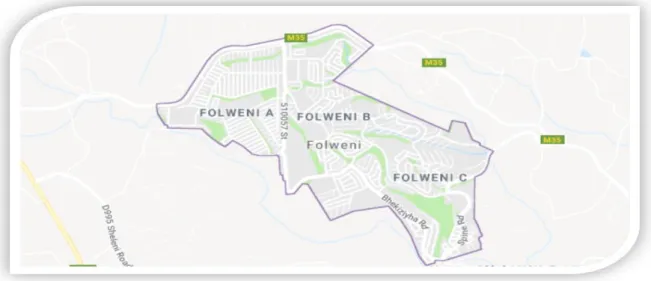
Figure 3.3: Part of Folweni Township 28
TABLES
Table 2.1: Proportion of World Population 12 Table 4.1: Demographic Profile 36
ABSTRACT
The “number of older persons in South Africa is larger than in any other country in Africa. In 2017, approximately 4.54 million (8.4%) people were aged 60 years and over. The number of older persons is likely to increase to 11% by 2030. Increasingly, studies suggest that old age comes with multiple health challenges. The study investigated the challenges facing the older persons in Folweni Township in KwaZulu-Natal. For the purposes of this study, an older person is defined as someone aged 60 years and older. The aim of the study was to understand the challenges facing the older persons in Folweni Township. A case study research design was used. For this study, purposive sampling was employed to select 20 participants; 10 females and 10 males. Data was collected using qualitative in-depth interviews. The study found that the challenges older persons face include among others economic; costly medical bills, limited education, poverty, inadequate grants, lack of planning for retirement, social; lack of older persons care, lack of support networks, lack of opportunity to participate in decision-making processes, lack of entertainment, lack of clear purpose of life, lack of accessible, acceptable and available transport, and health; disease conditions, lack of access to primary health care, lack of community care, lack of adequate food, impact of HIV and AIDS, physical and psychological challenges, and witchcraft.
Informed by the findings in this study, there is a need for government policy makers, professionals, and stakeholders to formulate interventions relevant to lived experiences of the older persons in Folweni Township. Interventions on older people’s livelihood, economic, social, health, support systems and community services challenges can help to improve the basic quality of life of older persons in” Folweni Township and other parts of South Africa.
Key Words: Challenges, Livelihood, Economic, Social, Health, Support systems, Community services, Older persons, and Folweni Township.
TABLE OF CONTENT
Declaration ... i
Acknowledgements ... ii
Dedication ... iii
Glossary of acronyms ... iv
Figures... v
Tables ... vi
Abstract ... vii
CHAPTER ONE ... 1
Introduction and background to the study ... 1
1.1 Introduction ... 1
1.2 Background to the study ... 2
1.3 Research problem ... 3
1.4 Research questions ... 4
1.5 Research objectives ... 4
1.6 Theoretical framework ... 4
1.7 Outline of the dissertation ... 6
CHAPTER TWO ... 7
2.1 Introduction ... 7
2.2 The concept of ageing ... 7
2.2.1 Biological aspects of ageing ... 8
2.2.2 Social aspects of ageing ... 8
2.3 Understanding of the concept of the older persons ... 8
2.3.1 The Young Old ... 9
2.3.2 The Old ... 9
2.3.3 The Old Old ... 9
2.4 Population ageing ... 9
2.5 Population ageing in south africa ... 14 2.6 Causes of population ageing ... Error! Bookmark not defined.
Stage One ... Error! Bookmark not defined.
Stage Two ... Error! Bookmark not defined.
Stage Three ... Error! Bookmark not defined.
2.7 CHALLENGES FACING AFRICAN OLDER PERSONS IN SOUTH AFRICA ... 16
2.7.1 Health care cost problems ... 16
2.7.2 Accusations of witchcraft ... 17
2.7.3 Poverty and unemployment ... 18
2.7.4. Children without parents as a burden on the older persons ... 18
2.7.5 Older persons taking care of orphans ... Error! Bookmark not defined. 2.7.6 Experience of loneliness ... 20
2.7.7 Abuse of older persons ... 21
2.7.8 Crime ... 22
2.7.9 Inadequacy of grants ... 23
2.8 SUMMARY ... 25
CHAPTER THREE ... 26
3.1 Introduction ... 26
3.2 Study context ... 26
3.3 Qualitative methodology ... 28
3.4 Research design ... 29
3.5 Process of data collection ... 30
3.6. Data quality control ... 30
3.7 Data analysis ... 31
3.8 Ethical considerations ... 32
3.9 Limitations of the study... 33
3.14 Summary ... 33
CHAPTER FOUR ... 34
RESULTS ... 34
4.1 introduction ... 34
4.2 demographic information ... 34
4.3 older people’s main sources of livelihood... 35
4.4 Attitudes to aging ... 38
4.5 Challenges facing older persons ... 40
4.5.1 Economic challenges facing older persons ... 40
4.5.2 Social challenges ... 43
4.5.3 Health issues ... 46
4.6 Support systems and their challenges... 49
4.7 Older persons’s main sources of support ... 51
4.8 Community services for older persons ... 53
4.9 Summary ... 55
CHAPTER FIVE ... 56
DISCUSSION, CONCLUSIONS AND RECOMMENDATIONS ... 56
5.1 Introduction ... 56
5.2 Discussion ... 56
5.3 Recommendations ... 63
5.4 Conclussion ... 66
Reference list ... 67
Appendix a ... 75
Interview guide ... 75
Appendix b ... 77
Declaration letter ... 77
Appendix c ... 78
Consent form ... 78
Appendix d ... 81
Ethical clearence ... 81
CHAPTER ONE
INTRODUCTION AND BACKGROUND TO THE STUDY 1.1 INTRODUCTION
The “population of the world is experiencing unprecedented growth and one of the factors contributing to this growth is the increase in the number and proportion of older persons.
According to the United Nations (2017), the number of older persons, that is those aged 60 years or above is likely to be more than double by the year 2050 and more than triple by 2100 (United Nations, 2017). This means that the older population is likely to rise from 962 million in 2017 to 2.1 billion in 2050 and 3.1 billion in 2100 (WHO, 2017). According to WHO (2017), worldwide, the population of people aged 60 or above is increasing faster than the population groups of all younger” people.
The United Nations (2017:8) observes that “in 2017, there was an estimated 962 million people aged 60 or above in the world, comprising 13 per cent of the global population. The population aged 60 or above is growing at a rate of about 3 per cent per year. Currently, Europe has the greatest percentage of population aged 60 or over (25 per cent). Rapid ageing will occur in other parts of the world as well, so that by 2050 all regions of the world except Africa will have nearly a quarter or more of their population aged 60 and above. The number of older persons in the world is projected to be 1.4 billion in 2030 and 2.1 billion in 2050 and could go up to 3.1 billion in 2100. Globally, the number of persons aged 80 or over is projected to triple by 2050, from 137 million in 2017 to 425 million in 2050. By 2100 it is expected to increase to 909 million, nearly seven times its” value in 2017 (United Nations, 2017).
Scholars argue “that the percentage of the older people aged 60 and above in South Africa is larger than in any other country in Africa (Bohman, Vasuthevan, Turok, 2012; Statistics South Africa, 2016). In 1990, older people in South Africa accounted for 6% of the population (World Health Organisation, 2015). In 2017 approximately 4.54 million (8.4%) people were older than 60 years (Statistics South Africa, 2017). The number of older people is likely to increase to 11% by 2030 (World Health Organisation, 2015). It is thus unarguable that the number of older people in South Africa is growing. Therefore, there is a need to pay attention to older people’s quality of life. In many countries in Africa aging is closely
associated to retirement and being a pensioner (Worsfold, 2005). Turok (2012) states that aging makes people exempted from ordinary labour and socio-economic roles and responsibilities. This view is supported by Thukwayo (2014) who explained that aging, above 60 years, is a time when people become less productive and active, and sometimes unproductive and inactive. The lifestyle of older people is mainly determined by their economic and health conditions hindering them from engaging in socio-economic activities to benefit their countries and families. Bury M (2013) said that aging is a time when people by nature become incapable of being part of the labour force and need to rest. Ramashala (2014) observed that aging is associated with increased chronic illnesses and disabilities. This finding is supported by Baloyi (2010) who stated that the longer a person lives the more likely a person will experience illnesses and disabilities. In addition, Bigombe & Khadiagala (2013) argue that aging makes it difficult for people to live independently such that they need support. Old age is also understood as a time when people need more attention including care and medical assistance. Mbiti (1991:115) put it very well when he said that: “when parents become old and weak it is the duty of the children, especially the heirs or sons, to look after the parents and the affairs of the family.” Older people need a lot of care ranging from cooking, shopping, cleaning, to practical domestic” responsibilities.
1.2 BACKGROUND TO THE STUDY
Older ““people are at an important biological phase in their individual lifetime. Old age has an influence on different aspects of the country including socio-economic, demographic, and social welfare. This has captured the interest of policy makers, as governments seek to set national priorities that cater for older persons as a vulnerable group. The Older People’s Act 2006 defines an older person as a person who, in the case of a male, is 65 years of age or older and, in the case of a female, is 60 years of age or older. This study uses 60 years of age and older to refer to an older person. Studies have been c
onducted to understand the needs of older persons but not on their challenges in KwaZulu- Natal in Folweni Township. This study setting was chosen because it is one of the townships in KwaZulu-Natal with the highest number of households headed by older people (Statistics South Africa, 2017).
Though “government provides social grants to older people, many scholars argue that the older persons remain poor because many are carers and breadwinners, and the expenditure of
taking care of the family is very high (Van Der Gaag, and De Beer, 2015). The situation of the older people is worsened by lack of economic security, access to health and human services, adequate housing and personal safety. (Case, 2004). A study by (Petersen, Kandelman, Arpin and Ogawa, 2010, confirm this situation which found that older people suffer because of lack of basic services. The United Nations (2017) states that the implications of an aging population affect nearly all sectors of society, including the demand for housing, transportation and social protection, as well as family structures and intergenerational ties. It also affects labour and financial markets. The severity of the challenges that older people in South Africa face gave rise to this study to investigate the socio-economic challenges facing the older people in Folweni” Township in KwaZulu-Natal.
1.3 RESEARCH PROBLEM
The Older Persons Act, 2006 ““was put in place by the South African government to protect, promote and maintain the status, rights, well-being and security of older persons. In support of the Older Persons Act, South Africa has seen several non-governmental organisations (NGOs) focusing on the needs of the older people. The organisations include the Institute of Aging in Africa (Conradie and Charlton 2012), and the South African Council for the Aged (Joubert, Swart and Reddy, 2008) working closely with the Department of Social Development. Though the rights of the older population are spelt out in the Older Persons Act 13 (Republic of South Africa 2006), older people continue to be undermined by a range of ills such as lack of family support, shelter and access to medical facilities Older persons also suffer abuse, abandonment, and other socio-economic challenges that are currently widespread in South Africa (Case, 2004). Therefore, this study will investigate the socio- economic challenges facing the older persons in Folweni Township in KwaZulu-Natal. The findings of the study may help to inform the welfare of the country in diverse ways in particular in the generation of policy interest around the challenges of the older population.
The study may also help government to set national priorities that cater for the older population as a vulnerable” group.
1.4. RESEARCH QUESTIONS
The study aims to answer some key questions including:
What are the experiences of the older persons in Folweni Township in KwaZulu-Natal?
What are the socio-economic challenges facing older people in Folweni Township in KwaZulu-Natal?
What are the measures put in place to deal with the socio-economic challenges that affect older people in Folweni Township in KwaZulu-Natal?
1.5 RESEARCH OBJECTIVES
The overall objective of the study is to understand the challenges facing the older persons in Folweni Township in KwaZulu-Natal.
The specific research objectives of the study is:
To determine perspectives and experiences of aging population in Folweni in KwaZulu Natal.
To understand the socio-economic challenges facing older people in Folweni Township in KwaZulu-Natal.
To determine strategies put in place to cope with challenges that affect older people in Folweni Township in KwaZulu-Natal.
1.6 THEORETICAL FRAMEWORK
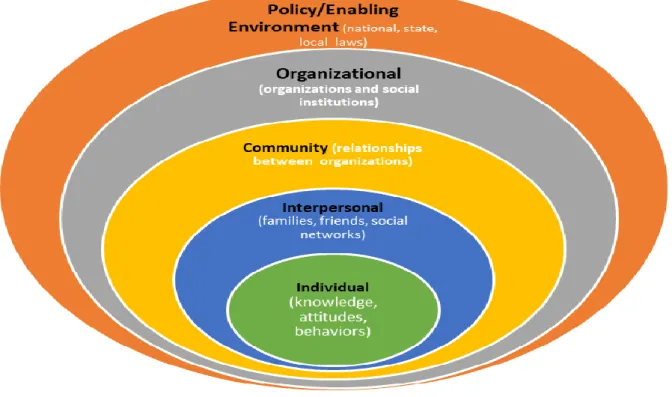
This “study draws on the socio-ecological model to understand the challenges facing older people. Several “studies indicate that the socio-ecological model (SEM) is effective in examining numerous and varied challenges facing a given community. “The SEM posits that a person’s behaviour is integrated in a dynamic network of intrapersonal characteristics, interpersonal processes, institutional factors, community features and public policy. The model assumes that interactions between individuals and their environment are reciprocal, implying that an individual is influenced by his or her environment and the environment is influenced by the individual. It is also assumed that the environment is comprised of several
overlapping levels (Dahlberg and Krug, 2001). Figure 1.1 depicts the various levels in the socio-ecological” model.
Figure 1.1: Socio-Ecological Model levels
Source: Dahlberg and Krug (2001:9)
The “intrapersonal level encompasses the participant’s knowledge, awareness, attitudes, beliefs and perceptions of the challenges of aging. These factors are also influenced by the individual’s physical and social environment. The older person’s family, friends and health care providers comprise important components of the interpersonal level. The social or healthcare institution’s rules, regulations and general attitudes toward the aging shape the institutional level within the model. Characteristics of the community that may influence an older person include local cultural attitudes about aging, the availability of public transportation and safety of the neighborhood. Public policy regarding socio-behavioural support of older persons is informed by local, state and government laws. The theory therefore argues that to understand the challenges older persons face, it is important to take into account the complex interplay between individual, relationship, community, and societal factors. It allows the researcher to understand the range of factors that make older persons
face challenges or have their challenges addressed. The overlapping rings in the model illustrate how factors at one level influence factors at another level” (Dahlberg and Krug, 2002).
1.7 OUTLINE OF THE DISSERTATION
The “dissertation has five chapters with the first chapter providing an overview of the study.
This chapter gives background information on the research problem, the significance of the study, research questions and objectives. Chapter two presents literature on the concept of aging at the global level, and a review of studies outlining challenges facing the older persons. The next chapter presents the research methodology. It starts by outlining the study context. In addition, the chapter describes the data collection instruments and analysis techniques. The chapter ends by highlighting ethical measures that guided the study. Chapter four presents the main findings from the interviews. The final chapter presents and discusses findings in detail together with the theoretical underpinnings of the phenomenon of socio- economic factors that influence the challenges facing” older people.
CHAPTER TWO LITERATURE REVIEW 2.1 INTRODUCTION
The “number of older persons in South Africa is growing fast and so are the challenges. The increasing number of older persons is likely to have far-reaching implications making it imperative for South Africa to reconfigure its developmental policy in order to meet the needs of the ageing population. To understand the phenomenon of the challenges that are faced by the elderly, this study will investigate the challenges facing older persons in Folweni Township in Kwazulu-Natal. The first part of this chapter explores the concept of ageing in populations and the second part investigates the causes of ageing, the third part explores the effects of having an ageing population, and the fourth part deals with challenges faced by older” persons.
2.2 THE CONCEPT OF AGEING
The concept of ageing is understood as a person’s mental and physical status at a given time.
The concept of ageing, according to Zaidi (2008) has an influence on how society is structured, which in turn has an influence on people’s roles and status. Therefore, the concept of ageing is understood as changes that take place in people’s lives that are unavoidable, and these include social, and physical changes (Zimmer and Martin, 2007) that have negative and positive effects on human” beings.
Scholars (Aboderin, 2016; Ahmad and Ismail, 2011; Bloom, 2011) “however argue that it is difficult to define ageing because many aspects are involved in the understanding of the concept of ageing. Some of the multiple-dimensional issues that have an influence on the understanding of the concept of ageing include culture, demography, physiology, race, and ethnicity. All the concepts of ageing underscore the phenomenon of people experiencing age-related decline in their capacity to function as before. The most important perspectives of aging are biological and social as discussed” below.
2.2.1 Biological Aspects of Ageing
Scholars (Disney, 2006; Creedy and Guest, 2009; Bulete, 2011) “argue that senescence is one explanation of ageing. This is a phenomenon that explains that human beings undergo a physiological process where there is an increase in age because of the isolation of cells in the body. The isolated cells have limited capacity to both divide and renew themselves. As a result, Ferreira and Kowal (2006) argues that this makes the body to have reduced capacity to respond to the body challenges such as risk of diseases, stress and homeostatic imbalances.
Senescence reduces people’s expectation and lifespan that increases mortality caused by disease in an ageing body that has reduced functional capacity (Grady, 2016). Greer (2016) added that there is no inherent chronological marking of old age. Therefore, the biological definition suggests that a person is said to be ageing as they advance through the passage of the” lifecycle.
2.2.2 Social Aspects of Ageing
The Health Systems Trust (2011) “states that ageing is a phenomenon that has an influence on the inner operations of society. For example, ageing has an influence on people’s participation in society, their social roles and actions. Hue (2010) also explained that ageing has an influence on how society is organised. In addition, the understanding of ageing is different from culture to culture and society to society. For example, in Africa, ageing is seen as a positive perspective because older people are seen as having a higher level of information, knowledge, and wisdom than young people. While in Europe, ageing is perceived as a phenomenon that brings problems to families and society because ageing comes with greater dependency that is viewed as a burden to family members and” society.
2.3 UNDERSTANDING OF THE CONCEPT OF THE OLDER PERSONS
The definition of older persons is different from one context to another, but many societies define the older persons as a group of people that have reached an age where they qualify for social security benefits, retirement, health care plan and pension schemes” (Ito and Tabata, 2010).
As a “result, development programmes and public policies refer to the older persons as
‘pensioners’. Several demographers understand the older persons as people aged 60 years and above. Ageing is a result of the normal ageing life cycle that starts by the young moving
chronologically to the status where they are transformed in terms of size, status, characteristics, and role in society (Jorgensen, 2011). The socio-economic changes influence the creation of the final age group of the older persons. In addition, the older persons’ age group is divided into different categories; young” old, the old, and old old.
2.3.1 The Young Old
This is a “sub-group of older persons’ age cohort that have retired and reached retirement age but are still full of vigour (Kalula, 2010). This group of people is able to engage in different activities without being hindered by physical challenges because of their good” health.
2.3.2 The Old
This “is “an age group of the older persons who are still healthy and able to engage in normal daily activities such as participating in economic activities (Health System Trust, 2011). The age cohort is also relatively not affected by physical disabilities but prone to senescence.
Demographers put this age between 75 and 85 years” (Kocak, 2011).
2.3.3 The Old Old
Scholars “(Kresl and Ietri, 2010; Mason and Lee, Lan and Yen 2011) understand this group as one that is unable to participate in normal economic development activities and is susceptible to disabilities and diseases causing limited functional capacities. Lee, Lan and Yen (2011) argue that most of the people in this group need everyday care in health institutions and fall in the age 85 years and above. This age cohort is ageing retirees suffering effects of economic changes and experiencing family constellations, and failing body and mind. The oldest of the old also experience physical illness, and depend mostly on family members for most things. However, lifestyles and new technology is helping the old old with energetic living. Kurek (2011) found that the population of the old old is increasing fast and state support is not increasing” accordingly.
2.4 POPULATION AGEING
Marquez (2010) “argues that life is characterised by societal transitions or changes in everyday life and human activities. Maree (2007) said that the post-industrial society is inebriated with many changes such as ageing of populations. Population ageing is caused by continued fertility” declines.
Ageing complicates society as low infertility continues. Lutz, Sanderson and Scherbov (2008) said that population ageing means several things including:
Slow movement towards an older population;
An average of the people in the given population are growing older;
Increase in the number and proportion of people aged between 65 years and above in a given population or setting.
Demographically “and statistically speaking, when older persons who are 65 years and more make up less than 4% of the population that population is considered young population.
When a population has 4% and 7% of ageing people it is considered as a mature population, when a population has 7% and more of ageing people it is called an older population, and when the population has 14% and more of the ageing people it is regarded as an ageing” society (Murdoch, 2007).
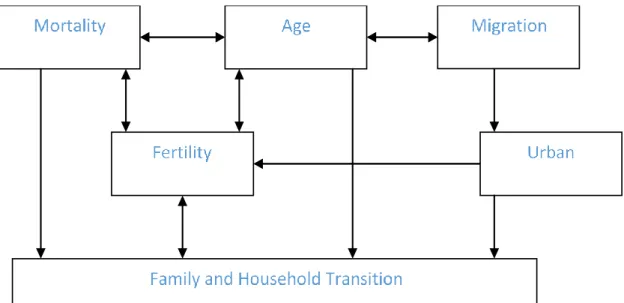
The “ageing population is caused by interrelated demographic changes: usually the transition experienced is due to the following changes (National Institute on Ageing and National Institute on Health, 2007):
Health and mortality: this is because of a shift from deaths at younger age (due to communicable diseases) to deaths at older age (due to degenerative diseases), and people living longer because of the life expectancy gains;
Fertility transition: this is a shift from natural high fertility to controlled low fertility and few births;
Migration transition: this is a situation where people from overpopulated areas move to urban areas;
Family household transition: this is where family structures change because of other transitions as shown in the figure below.
Figure 2.1: The transitions that comprise the impact of demographic transitions on society
Source: Adapted from Weeks (2008:23)
Pelser (2016) “said that a combination of consequences increase life expectancy, and both mortality and fertility transitions influence the population to experience ageing transitions.
Ageing therefore alters a population’s composition and structure. A few number of people who join the group of older persons makes the number of older persons to” increase.
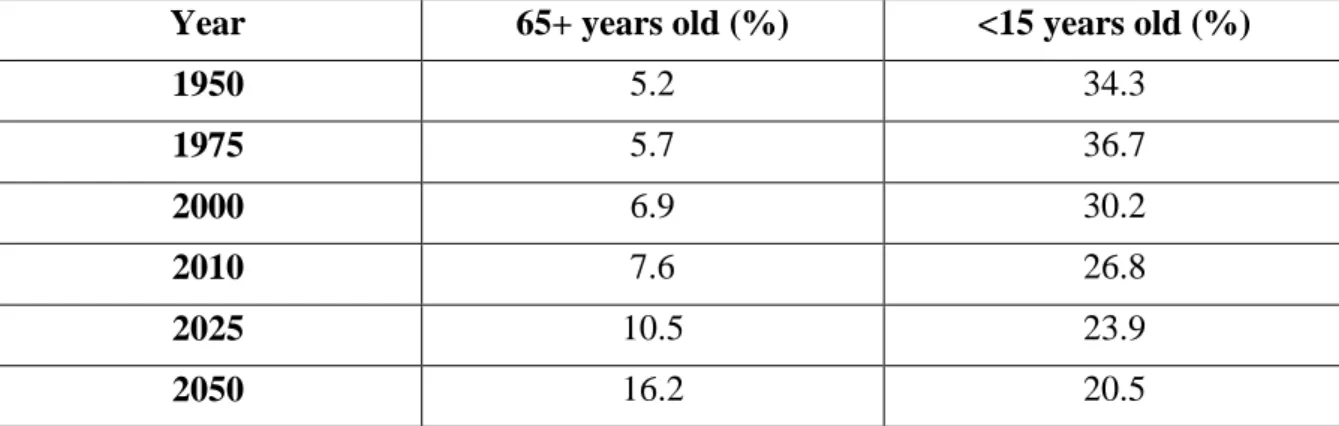
It is “possible that in 2050 the number of people will be more than the number of young people (National Institute on Ageing and National Institute on Health, 2007). This means that our population may have older persons aged 65 years and above that will make the number of older persons come to 1.2 billion by 2025 and this number is likely to double by 2050. The number of older persons may be more than 15% of the world’s population (National Institute on Ageing and National Institute on Health, 2007) as shown in the” table below.
Table 2.1: Proportions of world population aged 65+ years old and <15 years old
Year 65+ years old (%) <15 years old (%)
1950 5.2 34.3
1975 5.7 36.7
2000 6.9 30.2
2010 7.6 26.8
2025 10.5 23.9
2050 16.2 20.5
Source: Constructed with data from UNDESA (2015:34) 2.4.1 CAUSES OF POPULATION AGEING
Scholars (Phang, 2005; Population Bureau, 2010; McNeil, 2010) argue that “for most of human history, the majority of populations have been very young. These populations’ age structures were made up of a large proportion of young people (0-14 years old); a modest fraction of people in the young adult and middle adult ages (15-64 years old), and very few older people (65+ years old). However, due to the iterative consequences of various transitions, populations inevitably experience changes in their age structures, resulting in the experience of the ageing transition” (Ahmad and Ismail, 2011; Weeks, 2012). Populations experience the following three stages of alterations to” their age structures:
Stage One
First, scholars argue that “populations experience a rejuvenation of their age distribution due to declines in mortality. This allows for the proportion of children to increase because of increased survival at younger ages, while also having the strongest impact on ageing indices.
The transition that has an impact on the age structure of a population is most often the mortality transition that encompasses the transition from high death rates to much lower death rates. However, there is no central or unilateral road to low mortality, as the pattern of death, but rather, a combination of many different elements ranging from improved nutrition to improved education” (Weeks, 2012).
Stage Two
Second, “populations experience a maturation in their age structure due to fertility reductions, which result in populations experiencing declines in their proportion of young people, which
is accompanied by a rise in the proportion of adults of working age. The historical reduction in birth rates have seen many populations experiencing transitions from total fertility rates of 6 to 8 children per women in the 19th and 20th centuries, to 2.6 children per women in 2000, and 2.4 children per women in 2010 (Tapinos, 2000; UNDESA, 2015). In this stage, “scholars argue that although mortality declines may initiate the progression and ageing of populations, the defining factor in the demographic transition is the progression towards the maturation of any population which regards human capability and its control over fertility levels; the actual reproductive performance of an individual, a couple, a group, or a population (PRB, 2004).
Human beings historically have not allowed for natural fertility that exists in the absence of deliberate fertility control to define populations. Weeks (2008:202) put it well that: “the genius of the species has not been to rely on a birth rate so high that it can overcome almost any death rate, no matter how high. The genius of the species is rather to have a few offspring and invest heavily in their care and training.” This mind set has come to define modern and contemporary population thinking and has often led to populations experiencing fertility transitions which embody the shift from high fertility, characterised by only minimal individual deliberate control of fertility, to low and sometimes extremely low fertility, which is entirely under a woman’s or couple’s control” (PRB, 2004).
Stage Three
Third, populations “finally become older in their age structure once they have experienced lengthy periods of fertility and mortality decline, resulting in the proportions of both children and adults of working age declining, while the proportion of older persons rises (Vos et al., 2008). Scholars (Kendall, 2011; Kurek, 2011; Weeks, 2012) argue that the health and mortality transition (stage 1 of population ageing), as well as the fertility transition (stage 2 of population ageing), may engineer the initial ageing of populations, but populations only experience significant transitions towards becoming older populations, if there are lengthy declines in both mortality and fertility over the same period. This combined effect (stage 3 of population ageing) results in the proportions of both children and adults of working age declining, while the older persons population invariably ages” (Vos et al., 2008).
The occurrence of mortality “declines when fertility is still high or increasing, only serves to produce a survival boom which results in more people living to older ages, thus improving life expectancy. Moreover, the occurrence of fertility declines when mortality is high will reduce the number of younger persons; yet, the ageing of populations will be reduced due to
persistently high and affective mortality rates that remove the potential people who will age and eventually reach the older persons cohorts. These older persons would have added to the growing numbers of older persons. In the third stage of population ageing however, both fertility and mortality are declining together, thereby producing the prime conditions for population ageing. For example, countries experiencing the ageing transition are characterised by mortality declines resulting in more people surviving to older ages and living longer, while fewer people born results in reductions within the younger age cohorts.
Consequently, this allows for greater numbers of people to enter older age cohorts, while fewer enter the younger ones, when fertility declines accordingly take place. Overall, stage three produces populations where there are imbalances in young-old ratios”.
By and large, the “progression of populations through each stage results in two salient effects:
i) in the short term, sustained reductions in fertility and mortality produce increases in the proportion of children and youth; whereas ii) in the long term, sustained reductions in these demographic processes lead to older populations. Furthermore, age distributions are also bound to be affected by migration processes that may either accelerate or slow down population ageing. In the end, populations experience a transition from the classical picture of a high fertility, high mortality society with a broad base built of numerous births, to a contemporary illustration of a low mortality, low fertility postindustrial society” (Kendall, 2011; Kurek, 2011; UNDESA, 2017; Weeks, 2012).
2.5 POPULATION AGEING IN SOUTH AFRICA
One “developing country set to face the inescapable effects of population ageing is South Africa, which, since the early 1990s, has experienced rapid declines in both fertility and mortality rates, while also experiencing increased longevity among certain population cohorts (Aboderin, 2015; Department of Social Development, 2010). Even though the impact of HIV and AIDS has perpetuated an increase in mortality over the past few decades, increased longevity has generated an escalation in the number of older persons in the South African population (Ziehl, 2007). As Joubert and Bradshaw (2006:3) declare, “although the proportion of the older population will increase moderately over the projection period, the absolute size is projected to increase by 112 per cent, from 2.47 million in 1985 to 5.23 million in 2025, i.e. a doubling over the course of 40 years”. Census 2001 counted 3.28 million older persons. These figures reveals that population growth in the older age cohorts
will be considerably more rapid than in the age cohorts younger than 60 years old. Pelser (2009) and UNDESA (2015) reveal that it is more realistic that by 2025, there will be approximately 3.9 million older aged South Africans. Furthermore, South Africa also faces issues not dealt with before by many other nations which are experiencing the ageing transition. Weeks (2012) explains that due to transitions not necessarily occurring in a smooth, uniform manner, especially when alterations in the age structure that are part of the age transition arise, there are opportunities for inequities to creep into the social structure.
This calls for concern, as South Africa’s more variable age transition can potentially cause further changes in economic organisation, political dominance, and social stability. This can be noted from examining the country's population structure which has experienced major emigration in the young white cohorts, as well as rising mortality rates among young and middle-aged blacks due to high HIV/AIDS prevalence rates”(MacFarlane, 2005).
In addition, “the country will also experience a double demographic burden, which refers to a trend within the ageing transition, in which several parts of the nation will encompass both high child dependency and high old-age dependency. This places conflicting pressures on the economically active cohorts who will become the smaller of the age cohorts. This means that much of the resources required for social expenditure and security for both young and older persons are provided both indirectly and directly by activities of the economically active age cohorts. The country will be faced with dealing with the burdens of two dependent groups, not only one, as in the case of developed nations who have progressed furthest in the ageing transition (UNDESA, 2015). This illustrates that South Africa will witness the progression of the ageing effect, as well as inequities that serve to construct more complex ageing implications. The implications of experiencing the ageing transition are not all disadvantageous to the country; with careful planning, South Africa may be able to harness the various opportunities of having an older population, who provides an immense consumptive and knowledgeable force”(Department of Social Development, 2012).
For South Africa to effectively deal with the issue of population ageing, the State should plan ahead in order for the country to be able to afford to grow old. One way of doing this regards the implementation and activation of socio-economic policies that emphasise ageing and accommodate the social, economic and environmental impacts” of ageing.
2.6 CHALLENGES FACING AFRICAN OLDER PERSONS IN SOUTH AFRICA Older persons in South Africa as in many developing countries are prone to a number of challenges, these include economic, social and health related issues. Many older adults in South Africa are overburdened with caregiving, which exacerbate their financial challenges.
Poverty is also rife among the older persons in South Africa; this is because they live most of their life in poverty, which is transferred to their old age, as they are reliant on the grant provided by the government. Studies also reveal that older adults face social challenges such as elderly abuse, crime and in some communities; they are even accused of witchcraft put in involuntary isolation. This section will provide a detailed discussion on the types of challenges facing the elderly in South Africa.
2.6.1 Health care cost problems
Studies (Ferreira and Lindgren, 2008) “show that although many people have free access to health care in South Africa, older persons, who need some specialised forms of health care because of their age, are not covered by many of the medical aid schemes. “Most hospital cash back plans do not cover people over the age of 65 years” (South African Hospital Plan, 2015:1). Unlike a medical aid that cannot discriminate against a person based on age, hospital cash back plans are insurance policies. Insurance companies have to bear the greater risk with this age group and will therefore not offer cover for the insurance of older persons as it becomes expensive. Aging exposes people to a range of health problems. The poor health often experienced by the aged and the retired is exacerbated by high medical aid costs.
Theron (2014) noted that although some retirement funds appear to be improving the quality of medical aid for pensioners, the majority of pensioners lacked this service - 75% of the retirement funds do not offer such” benefits.
In agreement, Maharaj (2014) “argues that aging does not only lead to health challenges discussed above but increases social and economic demands for the South African communities. However, the South Africa government like many African governments are not able to respond effectively to the health issues and other needs of the older population (Maharaj, 2014). To respond for example to health issues facing older persons would require a better understanding of the socio-economic and demographic situation of the older population in South Africa” (Maharaj, 2014; Grundy, 2008).
2.6.2 Accusations of witchcraft
Older “person in South African are accused of witchcraft (Theron 2014; Keikelame and Ferreira, 2014:3). Witchcraft in South Africa is used as one of the cultural explanation of the causes of diseases (Grundy, 2008). The abuse resulting from the accusation of witchcraft is a unique case of abuse as it often befalls older persons who, because of their physical appearance: appearance of extensive wrinkles; physical limitations such as walking slowly, dragging of legs; and sometimes mental incoherence such as talking to oneself, talking in a confused manner, are labelled as witches (Morrow- Howell, 2016). Once suspected, these older persons are often stigmatised and ostracised by the community. They suffer psychological abuse as they are mostly socially isolated and verbally assaulted. Sometimes they suffer physical abuse and in several cases are set alight and killed for being witches” (Keikelame and Ferreira, 2014; Department of Social Development, 2016).
Tubb (2011) “found that HIV and AIDS are often rationalised through the lens of witchcraft in South African cultures: “the practice persists in poor settings in part because witchcraft can be used in communities without routine access to modern medicine and science to explain seemingly inexplicable instances of death and misfortune” (Mgbako, 2011:7). For example, in KwaZulu-Natal where this study was conducted some communities like so many others across South Africa believed that HIV and AIDS deaths were caused by a curse from God.
They believed that curse was cast by witches and a witch was anyone who lived to be "very, very old" or in local parlance, anyone over the age” of 60 (Gumede, 2012:23).
Witchcraft is “strongly associated with the abuse of older persons. At least 75 percent of the women who appeared as victims in witchcraft cases in the Thohoyandou Magistrate's Court were older persons. They are often frail and less powerful than their assailants, they are therefore seldom able to resist attack (Pelser and Redelinghouys, 2008). They are sometimes perceived to do no work for their share of the wealth. For example, they would not be working when the youth leave early in the morning for school or other activities and they would have completed their daily tasks when the youths return late in the day (Bond et al., 2014). There is a belief in Venda that women have many secrets and that by the time they are old they know about many things. Hence” the Venda saying that: "all women are the same and all women are witches” (Payze, Minnaar ,and Offringa,1992:3).
In this “context, medical issues are interpreted in a culturally sensitive manner. For example, 80 percent of sick people seek the attention of a traditional healer in South Africa before seeking a doctor (Pelser and Redelinghouys, 2008). The police men who persecute ‘witches’
are hailed as selfless heroes committed to 'freeing' people from 'supernatural evils'. Police are fighting a losing battle as they address only the symptoms of a deep-rooted problem. The problem is that police can only act against those who physically attack the victims not against those who indoctrinate the youths to believe in witchcraft. The master-minds behind the killings are often left alone”” (Department of Social Development (2016).
Witch hunts, “the heavy stigma and the reliance on ‘traditional healers’ and medicine actively complicate the difficulties and suffering of older people in dealing with the disease (Pelser and Redelinghouys, 2008).
2.6.3 Poverty and unemployment
Theron (2014:20) “cites the widespread assumption that older persons' debts will be settled and their children will be self-supporting by the time they retire, leaving them as the sole beneficiaries of the monthly pension. However, this is rarely the case. In South Africa, the majority of the population, black people in particular, live in poverty and retire” in poverty.
Unemployment “in South Africa is an undeniable reality for many people, even for those who have families and children to take care of. The result is that older persons who receive grants or other retirement benefits often find themselves burdened with the responsibility of caring for children or grandchildren. For some families, older person's pension is the family's only source of income. “A pensioner may have no choice but to use this small amount of money to support the family” (Legido-Quigley, 2013:12; Moller and Sotshongaye, 2006:4). The South African old-age pension is too small to be an effective measure of poverty eradication, but it is still regarded as a major source of income to support poor families (Lam, Leibbrandt and Ranchhod, 2006). This makes unemployment one of the causes for the desertion of the older person by the middle-aged and young” people.
2.6.4. Caregiving burden on older person
Children “with deceased fathers and children who have been abandoned by their fathers become a burden to take care of and to be provided with a decent education. Ernest (2013) conducted extensive research into the effects of divorce on children globally by identifying a large number of problems that resulted from the separation of parents. Of relevance to this
study is the fact that divorce results in many children being raised in single-parent households, and their financial support is often inadequate (Theron, 2014). In such situations, where single parents have parents who receive a pension, the pensioner would try to reduce the burden on his or her child by using the little money he or she receives to ensure that the children in the household receive education, shelter, food and clothing. In fact, this means that the pensioner is responsible for supporting the family financially” (Ernest, 2013:24).
Similarly, “there are children whose fathers have abandoned them by being unfaithful to their mothers; this is frequently experienced by both adult women and teenage girls. (Ratele, Shefer, and Clowes, 2012:538) conducted a qualitative study on the experience of 29 young men who grew up without their biological fathers because of abandonment. Grandparents were often obliged to use their pension to help” them.
Khomo (2014) “reports the heart-breaking story of a family in KwaZulu-Natal where the death of the three adult children left seven children in the care of their grandparents. This is one of the mostly disturbing challenges older persons have to deal with, particularly in the black communities. 'In the last two years the burden has increased', the report reads. 'The kids are growing up and have started attending high school. This means they need more expensive items and more expensive support.' In another case in Emadakeni, near Queenswood, an old woman was left to care for all her grandchildren solely from her pension after her three daughters died. The extent of the financial burden forced the children to stop attending school because of the unaffordability of school uniforms and other relevant items (Thukwayo, 2014).
This is just one case, but there are many children who have to discontinue their studies due to this problem - particularly in areas where the community forums, who should watch over the orphans, are not” functional.
In South Africa, “older persons frequently find themselves in the position where they have to use their pensions to support orphaned children whose parents died for any one of a range of reasons. In particular, the high incidence of HIV and AIDS in this country is costing the lives of many black people -often those in an age group that would, under normal circumstances, be taking care of their own children. Older persons are therefore left with no other choice but to take on the responsibility of care for their grandchildren” (Ernest, 2013:24).
Although Theron's research (2014) “was done in the Potchefstroom area, particularly within the predominantly white old age institutions, some of the problems, which were indicated as encountered by older persons, are similar to those encountered by black older persons in their respective rural communities. Theron (2014:6) confirms that these are a few cases out of many where older persons have to look after their orphaned grandchildren whose parents died of HIV and AIDS. The challenge to make the situation better is mostly to ask for the children to be registered in order to receive a social grant. Theron (2014) suggests that older persons should be assisted to register these children for” social grants.
2.6.5 Experience of loneliness
Some “older persons complain about feeling forgotten by friends and family (Ernest, 2013). In some cases, loneliness occurs, because older persons do not receive regular visits and have no one to talk to after younger members of the family relocate to urban areas in search of jobs.
In other cases, older persons are left alone, because they, themselves, have chosen to remain in their traditional homes or villages for a variety of reasons (Davey, 2016:128-141). De Haan (2015) is only partially correct in arguing that, in some cases, relocation is the reason why younger people do not accept the responsibility for the caring of aging parents. This may be true in some cases, but in others it is the parents who do not wish to join their children in the cities and towns, because they prefer to remain in the villages and continue to engage in the activities they are used to. That is why the black older persons who are in the local day care centres, mentioned by Theron (2014:5), are doing well and look happy. They have regular interaction with their families, relatives” and community.
Joubert and Brandshaw (2006:206) “found that at the familial or household level, internal migration may affect older persons; this can be either beneficial, when older persons are in receipt of remittances from working relatives, or disadvantageous, when they lose their traditional care-giving base as children” migrate.
One “pattern of migration that is presently common in South Africa is when members of the younger generation relocate to urban areas to seek employment and end up owning or renting smaller properties to accommodate themselves alone (Ernest (2013:24). This leaves older persons to live lonely lives in the traditional rural areas. The social isolation experienced by older persons is often associated with a sense of confusion, particularly in those who suffer from chronic illnesses” (Roos and Malan, 2012:2).
According “to World Health Organisation (2015), the proportion of people, living in rural areas, dropped from 48% to 38% between 1990 and 2011, whilst the migration of people from rural to urban areas increased from 52% to 62% in the same period. These statistics are derived from the research conducted by Turok (2012:13), who argues that South Africa is one of the most populous and rapidly urbanising countries. The relevance of migration and urbanisation to this article lies in the fact that, whilst it is mostly young people who migrate to cities and towns, hunting for work and more conducive life circumstances, many members of the older generation prefer to remain in the rural areas and are therefore left in solitude, receiving only occasional visits in the villages from young people. Bohman et al (2007:352) clarify this relationship by showing that young and middle class people are often forced to migrate to urban centres in search of job opportunities, leaving the aged in rural areas to face a life of loneliness and” alienation.
As May (2003:18) “points out: the extended family is an important safety net for older persons especially black Africans. The rapid rate of urbanisation of young people, seeking employment and education, therefore isolates older persons from their children, and leaves them to live a solitary life” (Ramashala, 2014:2).
2.6.6 Abuse of older persons
According to (Sneed and Cohen, 2013) “one 80 year old woman was locked (by her own son) in a windowless room without any running water or electricity for almost a year where she received food every fourth day. The violation of older persons' human rights is escalating as many of them are forced to change their property ownership to children and relatives, whilst others are raped and even” killed.
Ferreira and Lindgren (2008:98) “define elder abuse as “the maltreatment of an aged person or any other infliction of physical, mental or financial power on an aged person which adversely affects that person”. De Haan (2015:165) observes that elder abuse is a widespread problem that arises from a number of factors, including their children's need to share in their pension.
Baloyi (2010:4) quotes Calvin Sengani (a former police commissioner in Limpopo), who stated that some 4810 rape cases of women and children had been reported in 2002 in Limpopo alone. In that report he added that a 75-year-old woman had also been raped by a 25-year-old. The article therefore shows that crime of violence is also aimed at older persons
(Ferreira and Lindgren, 2008:98). This is a clear indication of the need to ensure the security of the older persons in this country particularly in rural areas, where they can easily become targets of rapists and” thugs.
Older “persons are also sometimes physically and emotionally abused by their children or relatives. Brennan and Heiser (2004:57) reported that the predominant types of abuse are physical, psychological and financial. Such abuse is often accompanied by neglect in the form of refusal or failure to provide older persons with necessities such as food, shelter, clothing, comfort and” hygiene.
Some “families are so poor that they simply have no resources to help older persons, whilst others are guilty of deliberate neglect. In some cases, family members say that they find older people to be stubborn and difficult to deal with, whilst others argue that they receive a pension and so should be able to take care of themselves (Ferreira and Lindgren, 2008). This kind of betrayal and neglect often causes emotional distress for older persons and undermines their trust in young people. African Eyes News Service (AENS 2014:6) reported that a certain grandmother and a pensioner in Motlatse village, outside Acornhoek in Mpumalanga was raped by her own nephew. This suggests that, although many similar cases are not reported, violence against older persons is a global phenomenon” (Gillam, 2014).
2.6.7 Crime
Studies (Ernest, 2003, Braungart and Hoyer, 2015.) “raised the issue regarding crime in which older persons are victims because of isolation. Braungart and Hoyer, 2015.) found that many older persons feared becoming victims of crime and tended to be housebound. Many studies (Ernest, 2003; AENS 2014:6) referred to older persons’ need for social inclusion by family and community but there was also an inclination to isolate themselves because of crime. Yet this tendency appears to be a double-edged sword, in that the reason behind the self-imposed isolation in itself may also result in becoming victims of crime Braungart and Hoyer, 2015.) Some older persons are victims of crime at the hands of their own grandchildren who are involved in crime themselves (AENS, 2014:6). Such theft is often also accompanied by disrespect and sometimes assault. Kasiram and Hölscher (2015) found that a simple strategy not to fall victim to crime was not possessing or keeping valuables at home. In agreement, Mudananhu (2008) said that keeping valuables such as money and appliances out of the home, however, appears to be more than just an inconvenience but, rather, a form of self-
deprivation akin to staying at home to avoid crime. As such, it seems to be a stopgap in the face of high levels of vulnerability and hardly addresses the vulnerability experienced by older persons” (Kasiram and Hölscher, 2015).
2.6.8 Inadequacy of grants
South Africa’s policy “on older persons in the form of a social pension scheme dates back to 1928 with the introduction of the Social Pension Act from which Black South Africans were excluded (Kasiram and Hölscher, 2015). Although the 1944 Pension Law Amendment Bill provided for the welfare of older Black South Africans, the value of the pension was of a mere one-tenth of that accorded White people. Finally, in 1965, under the National Welfare Act, a uniform and incremental pension scheme was made available to all Black South Africans. The Social Assistance Act of 1992 made strides in deracialising pensions and achieving pension parity, which was finally granted only in 1993, just one year prior to the first democratic elections. By 1993, the take-up rate among eligible Black South African men and women stood at 80 percent. At this time, the maximum benefit was equal to twice the median per capita income in rural areas and three times the level of the least generous World Bank” poverty line (Department of Social Development, 2012).
In 1994, the “South African Constitution made it clear through Section 27 of the Constitution of South Africa that: “Everyone has the right to...social security, including, if they are unable to support themselves and their dependents” (Department of Social Development, 2012:20).
This includes “the older persons. To ensure such a goal, the South African government has made much progress in facilitating the implementation and use of the Aged Persons Grant, as well as a Grant-in-Aid that enables incapacitated older persons to obtain the assistance of a caregiver (Lloyd-Sherlock, 2012). The South African Social Security Agency (2016) posit that South Africa’s public welfare system is exceptional among developing countries, and even matches the aims and outputs of many developed countries. According to the Department of Social Development (2012:21), such a grant has been able to reduce the poverty gap for older persons by approximately 94%. Furthermore, a War Veterans Grant is also payable to old men and women who served in the former South African Defence Force during World War I and II. In 2002, the pension was raised to more than twice the median
monthly individual earnings of Black South Africans, becoming an important route to escape poverty for many families” (Lloyd-Sherlock, 2012:23).
Nowadays, “in South Africa, non-contributory pensions reach 1.9 million older persons (South African Social Security Agency, 2016). The social pension system in South Africa is one of the most far-reaching and generous in the developing world, representing the core component of the South African social safety net. The pension is a non-contributory, means-tested pension that is payable to women aged 60 and above and men aged 65 and above. Pension benefits a are an important source of income to poverty-stricken family units. Pension sharing is common in multigenerational households and is used to support all co-resident family members, and to pay school fees as well as clothes and medicines” for grandchildren.
In the “context of extreme poverty when the older persons support their grand-children through school and their children through illness, the amount of pension received becomes the only income and is therefore crucial. Unfortunately, few older persons in charge of their grandchildren take advantage of child support grants, foster care grants, disability grants, school fee exemptions a year and free antiretroviral therapy government hospitals (Ferreira, 2015:2). This is because the foster care grant, much bigger than the child support grant, is only awarded when the older carer establishes legal guardianship through the children’s court, which takes at least two years, whereas the child care grant can go through within weeks. Moreover, many older Black South Africans do not have birth certificates, so they have to rely on their identity papers for proof of age. But these are often inaccurate, so the person has to obtain new papers before applying for a” pension.
The “households that rely most heavily on the social pension are not only mostly Black and poorer but are also larger in size (South African Social Security Agency, 2016:5). Multi- generational households are common amongst Black South African families, accounting for the larger household size at the bottom of the income distribution (60 percent of all Black pensioner households are three-generation households with children, compared to only 9 percent of White pensioner households). A further 14 percent of Black pensioner households are skip-generation households containing only grandparents and young children” (Department of Social Development, 2012:9).
These “findings resonate with other research showing that older persons, particularly Black women, are increasingly assuming the role of primary caregiver and that South Africa’s social pensions are therefore vitally important for the welfare of the unintended beneficiaries.
Mgbako (2011:2) said that pension receipt has been positively and significantly associated with improvements in older persons’ lives and those relying on older persons for health status, school attendance, and others. Bulete (2011:12) argues that social grants for older persons is not enough. In light of this evidence, providing pensions to the older persons would lead to the devolvement of resources to all strata of society. Older persons, especially grandparents through social grants seem fundamental for the distribution of resources and maintenance of an adequate standard of living. Therefore, the challenge is that the social grants are often inadequate and not available to all people, but rather, to certain eligible older persons. Thus, it is not entirely universal in provision. Even though the grant is limited to certain older persons, it remains a primary source of income for many older persons who would otherwise be living in abject poverty” (Kasiram and Hölscher, 2015).
2.8 SUMMARY
The “chapter presented literature review summarising and explaining current state of knowledge on challenges facing older persons. The first section of the chapter explored the concept of ageing in populations and the second section investigated the challenges faced by older persons such as livelihood challenges, economic challenges, social, health challenges, support systems challenges, and community services challenges, and the chapter ends with this chapter” summary.