EDUCATING LEARNERS WITH COMMUNICATION DISORDERS: AN EXPLORATION OF THE EXPERIENCES OF MAINSTREAM EDUCATORS IN
RURAL KWAZULU-NATAL
___________________________________________________________________
A research report submitted to the Discipline of Speech-Language Pathology in the School of Health Sciences in fulfilment of the requirements for the degree Master of
Communication Pathology (Speech-Language Pathology)
___________________________________________________________________
Researcher: Nomfundo Peaceful Ngcobo (200308067)
December 2017
PLAGIARISM DECLARATION: Final Dissertation Discipline of Speech-Language Pathology
As the candidate’s Supervisor, I agree/do not agree to the submission of this dissertation.
_________________ _____________________
Supervisor Date
I, Nomfundo Peaceful Ngcobo declare that
(i) The research reported in this dissertation, except where otherwise indicated, is my original work
(ii) This dissertation does not contain other persons’ data, pictures, graphs or other information, unless specifically acknowledged as being sourced from other persons.
(iii) This dissertation does not contain other persons’ writing, unless specifically
acknowledged as being sourced from other researchers. Where other written sources have been quoted, then:
a) Their words have been re-written but the general information attributed to them has been referenced using the American Psychological Association formatting for citation and referencing.
b) Where their exact words have been used, their writing has been placed inside quotation marks, and referenced.
c) This dissertation does not contain text, graphics or tables copied and pasted from the Internet, unless specifically acknowledged, and the source being detailed in the dissertation and in the References sections as according to the American
Psychological Association formatting for citation and referencing.
(iv) I have not allowed, and will not allow anyone to copy this work, with the intention of passing it off as their own.
Student Signature: _________________________
Date: ______________________
Plagiarism is the presentation of work that has been copied in whole or in part from another person’s work, or from any other source such as published books, periodicals, internet, newspapers, films, television and even verbally without due acknowledgement in the text. Plagiarism is considered a contravention of Rule 9(e)(i)(ff) of the UKZN Student Disciplinary Rules Handbook (2004). For more detailed information on plagiarism see the PLAGIARISM POLICY AND PROCEDURES Ref CO/05/0412/09.
http://education.ukzn.ac.za/Libraries/Plagiarism_Policy/Plagiarism_Policy_-_CO05041209_sflb.sflb.ashx
PLAGIARISM DECLARATION: Research Submissions to Supervisor Discipline of Speech-Language Pathology
Declaration
1. I know that plagiarism is wrong. Plagiarism is the use of another’s work and to pretend that it is my own.
2. I have used the American Psychological Association formatting for citation and referencing. Each significant contribution to, and quotation in this research submission from the work or works, of other people has been attributed, cited and referenced.
3. This report is my own work.
4. I have not allowed and will not allow anyone to copy this work with the intention of passing it off as his or her own work.
___________________________
Signature of student
___________________________
Date
Plagiarism is the presentation of work that has been copied in whole or in part from another person’s work, or from any other source such as published books, periodicals, internet, newspapers, films, television and even verbally without due acknowledgement in the text. Plagiarism is considered a contravention of Rule 9(e)(i)(ff) of the UKZN Student Disciplinary Rules Handbook (2004). For more detailed information on plagiarism see the PLAGIARISM POLICY AND PROCEDURES Ref CO/05/0412/09. http://education
.ukzn.ac.za/Libraries/Plagiarism_Policy/Plagiarism_Policy_-_CO05041209_sflb.sflb.ashx
ACKNOWLEDGEMENTS
I would like to extend my gratitude to the following individuals who have contributed to the undertaking and completion of this project:
To Jesus Christ my Lord and personal saviour who gave me strength to complete this thesis despite many challenges. Philippians 4:13 “I can do All Things through Christ who strengthens me”.
To the parents who gave consent for their children to be screened and observed as part of this study.
To all the educators who participated eagerly and willingly in this study.
Ms Desiree John for her patience, support, continued guidance and supervision throughout this project.
My parents and siblings who started this journey with me and continued to cheer me on even after I got married.
My husband and children for their patience, love and support throughout this study.
Last, but not least, Ms Nana Mbele, for looking after my baby, Dumezweni Zibusiso Buthelezi, for the long hours that allowed me to dedicate time to complete this study. To you I am eternally grateful.
CONTENTS
DECLARATION………...II ACKNOWLEDGEMENTS………...IV LIST OF TABLES………VIII LIST OF FIGURES………...IX LIST OF FREQUENTLY USED ABBREVIATIONS………..X DEFINITION OF RELEVANT TERMS………...XI ABSTRACT………..XIII
MAP OF THE ILEMBE HEALTH DISTRICT IN KWAZULU-NATAL………...1
CHAPTER 1 ... …..2
1.1 Introduction………2
1.2 Background/ Context of the Problem………....3
1.3 The Problem Statement………..6
1.4 Rational of the Study………...6
1.5 The Research Question………..8
1.6 The Aim and Objectives……….8
1.7 Overview of the Research Design and Methods………...8
1.8 Outline and Focus of the Thesis Chapters………...9
1.9 Summary/ Conclusion………..10
CHAPTER 2: LITERATURE REVIEW ... ………11
2.1 Introduction……….11
2.2 The Implications of Educating Learners with Communication Disorders.... …..11
2.3 A Historical Perspective on the Education of Learners with Special Needs …14 2.4 A South African Perspecive on the Education of Learners with Special Needs ... 17
2.5 Factors Affecting Education of Learners with Communication Disorders in ... Under-Resourced Communities in South Africa... 21
2.6 The Experiences of Mainstream Educators of Learners with Communication .... Disorders ... 23
2.7 Summary/ Conclusion………26
CHAPTER 3: METHODOLOGY ... …28
3.1 Introduction………..28
3.2 Aim………28
3.3 Objectives………28
3.4 Research Approach………28
3.5 Research Site………..29
3.6 Participants………..30
3.6.1 The study population………..30
3.6.2 The sampling technique……….31
3.6.3 Criteria for selection………32
3.6.4 The recruitment strategy………....34
3.6.5 The sample size………...34
3.7 Data Collection ... ………….34
3.7.1The data collection method ... …34
3.7.2 The data collection process ... …35
3.7.3 The data collection instrument………....…….….…… .…38
3.8 Data Analysis. ... …39
3.8.1 Data management ... ……….39
3.8.2 Data analysis process ... ………..40
3.8.3 Data representation. ... ………40
3.9 The Pilot Study ... ………..41
3.10 Data Quality Issues ... ………42
3.11 Ethical Considerations ... …46
3.12 The Research Procedure………...48
3.13 Conclusion………49
CHAPTER 4: RESULTS AND DISCUSSION ... ……….50
4.1 Introduction ... …….….50
4.2 Objective One ... …..….51
4.3.1 Positive experiences ... ….51
4.3.2 Negative experiences ... …..….57
4.4 Objective Two. ... ……….65
4.4.1 Transformational experiences ... …..….65
CHAPTER 5 ... ………67
5.1 Conclusion ... …………..67
5.2 Research and Practical Implications………...69
5.3 Limitations of the Study………..71
REFERENCES ... …. ……….74
LIST OF APPENDICES.. ... ...83
LIST OF TABLES
Table 3.1. Description of the Participants of the Main Study ... 31
Table 3.2. Motivation for Interview Questions and Prompts…………………..39
Table 3.3. Objectives and Procedures of the Pilot Study ... 41
Table 4.1. The Nine Surbodinate Themes in Relation to the Two Objectives ... 50
LIST OF FIGURES
Figure 2.1. The Hierarchy of Education Structures with Levels of Support………….19 Figure 3.1. The Data Collection Process ... 36 Figure 5.1. The Core Findings of the Study ... 68
LIST OF FREQUENTLY USED ABBREVIATIONS TERM
ADHD Attention Deficit Hyperactivity Disorder ASD Autism Spectrum Disorder
ASHA American-Speech-Language-Hearing-Association CD Communication Disorder
DBST District Based Support Team DOE Department of Education DOH Department of Health
HPCSA Health Professions Council of South Africa KZN KwaZulu-Natal
SBST School Based Support Team
SIAS Screening, Identification, Assessment and Support SLT Speech Language Therapist
SMT Senior Management Team
UNESCO United Nations Education Scientific and Cultural Organization
UK United Kingdom
USA United States of America
DEFINITION OF RELEVANT TERMS
TERM DEFINITION
Communication Disorder
Any impairment of hearing, language or speech which interferes with the ability to transmit or receive linguistic information (Stedman, 2005) Context The interrelated conditions in which something exists or occurs in
an environment or setting (Jejunum, 2003)
Educator A person such as a teacher or school administrator who has a job in the field of education (Jejunum, 2003)
Experience The fact or state of having been affected by or gained knowledge through direct observation or participation
The act or process of directly perceiving events or reality(Jejunum, 2003)
Inclusion Involves the placement of learners with disabilities in mainstream schools with the aim of promoting equal access and opportunities for all learners (Department of Education (DOE), 2001)
Learner A person who is trying to gain knowledge or skill in something by studying, practicing or being taught (Jejunum, 2003)
Mainstream School
A regular school that was originally intended for children without disabilities (DoE, 2001)
Full Service School
A mainstream education institution that provides quality education to all learners by supplying the full range of learning needs in an equitable manner (DoE, 2009)
Rural Balfour, Mitchell & Moletsane (2008) state that rurality is associated with a degree of isolation, poverty, strong community ties and poor health. It refers to an area that is a distance from most resources (i.e. shops) and is generally accessed by dirt roads, and has homes lacking in basic amenities (e.g. running water). This is the definition that was be applied to the current study.
Transformational Experiences
Transformational experiences are those that change from negative to positive, in the context of increased support (D’amant, 2009)
The Cascade Model of Teacher
The cascade model involves the delivery of training through layers of trainers until it reaches the final target group (Bett, 2016).
Training
ABSTRACT
Aim: To explore mainstream educators’ experiences of educating learners with
communication disorders in rural KwaZulu-Natal. An exploration of mainstream educator’s experiences provided insight into the current status of service delivery for learners with communication disorders in rural mainstream schools of the iLembe South Circuit District.
Background: The researcher’s personal experience has revealed that learners with
communication disorders are promoted based on age. Such learners are not literate when they exit the secondary education system. Inclusive policies have been developed to facilitate the process of transformation but the implementation of such policies remains a challenge.
Design: A qualitative, phenomenological approach was adopted.
Method: Eleven Black African mainstream educators were interviewed individually using a semi-structured interview schedule.
Results and Discussion: A thematic analysis yielded three superordinate and nine
subordinate themes. Positive educator experiences were related to individualizing educational practices, accessing support teams and collaborating with private and public health
professionals. Negative educator experiences were related to large classes, poor quality of educator training, implementation of the National Education Policy on Promotion, non- existent and dysfunctional support teams and poor collaboration amongst professionals. A few of the educators experienced a shift in their thinking and embraced inclusive practices. It is argued that paradigm shifts are facilitated in the context of increased support and hindered when the system is flawed by many challenges. The proper implementation of South African Educational policies is emphasized, as well as collaborative teamwork for the learner with a communication disorder. The limitations of the study are highlighted.
Key words: Inclusion, Educators, Experiences, Communication Disorders, Rural
MAP OF THE ILEMBE HEALTH DISTRICT IN KWAZULU-NATAL
Chapter 1 1.1 Introduction
Learners with communication disorders (CD) may not be receiving quality education in the province of KwaZulu-Natal (KZN) (Department of Education (DoE), 2001). Learners with severe learning barriers, who should be educated in full service schools, are often retained in mainstream schools (DoE), 2001). Learners with mild and moderate learning barriers, who have been admitted to mainstream schools, are also a concern (DoE, 2001).
Most rural learners with CDs display difficulties with reading and writing, despite the fact they increase in age and grade levels in school. The learners progress from grade to grade although the performance remains poor as observed during speech-language intervention.
Despite the guiding policies, there is growing concern that mainstream learners with barriers to learning maybe receiving an inferior quality of education. Advocating for quality
education, amongst other responsibilities, remains the role of the speech-language therapist (SLT) (The American Speech-Language-Hearing Association (ASHA), 2013).
The researcher adopted a qualitative method of enquiry to explore the educators’
experiences. The qualitative approach allowed the researcher to gain a deeper understanding of the lived experiences of mainstream educators who educated learners with CDs in rural KZN. Understanding the experiences of educators allowed the researcher to make
recommendations that could bridge the gap between policy and practice. This chapter will contextualized the problem, present the problem statement, the research question, aims, objectives and the rationale for the study. It will also provide an overview of the research design and the methodology that was adopted to answer the research question. Finally, the outline and focus of the thesis chapters will be provided.
1.2 Background/Context of the Problem
Globally learners with special educational needs were separated from other learners.
Over the past two decades however, there has been a transition from educating such learners in segregated schools to adopting a more inclusive approach to education (Forlin, Keen &
Barret, 2008). This move towards inclusive practices was first cited in the World Conference on Education for All in Thailand in 1990 (Miles & Singal, 2010). This conference made a significant contribution by acknowledging that many vulnerable and marginalized learners were excluded from the education system worldwide (Miles & Singal, 2010). This event was followed by the development of the influential Salamanca Statement (United Nations
Educational Scientific and Cultural Organization (UNESCO, 2005; 2017). This statement was reinforced in the World Education Forum at Dakar in April 2000 (Forlin et al., 2008).
The Millennium Development Goals were another important initiative towards
promoting education for all (United Nations, 2002; UNESCO 2005; 2017). The United States of America (USA) and the United Kingdom (UK) developed legislation to support inclusion in relation to international trends (Forlin et al., 2008). South Africa, which has a rich history of segregation and discrimination, introduced inclusive practices after 1994 (Mweli, 2009).
Policies, such as the Department of Health (1997) Integrated National Disability Strategy and the White Paper 6: Special Needs Education were formulated after 1994 (DOH, 1997; 2001).
The Education White Paper 6 advocates for equal access to education for all learners (DoE, 2001). Despite the formulation of this policy, fundamental tensions and contradictions exist between policy and practice (D’Amant, 2012). The contrast between policy and practice is particularly apparent in South African rural schools (Gardiner, 2008).
The rural context poses additional challenges because of the country’s previous history of marginalization. The education system was divided in terms of race and language. White people who lived in urban areas were favoured and Black people who lived in rural Bantu areas were disadvantaged (Gardiner, 2008). Rural schools suffered serious neglect because of the unfair Apartheid Era. Rural schools had fewer classrooms, poor access to water,
electricity and telephones and no access to internet and libraries (D’Amant, 2012; Gardiner, 2008). Therefore, teachers, who teach learners in rural schools, often reside in the nearest towns because of the lack of infrastructure in the rural areas (Gardiner, 2008).
There are many implications to educators residing in the towns instead of the rural community. Educators arrive late for work and are unable to assist learners who require attention after hours (Gardiner, 2008). Educators do not participate in community events and therefore have limited knowledge of community issues (Gardiner, 2008). The relationship between the educator and the parents or caregivers of learners in the rural community is that of mistrust (Gardiner, 2008). The educators claim that the caregivers are ignorant, whilst the caregivers claim that the educators are arrogant (Gardiner, 2008). Neither the schools nor the communities appear to have accepted each other in ways that are mutually supportive
(Gardiner, 2008). Thus, learners with CDs who reside in rural areas, face additional challenges which are a consequence of residing in a rural context.
Inclusive education policies focus on creating a positive learning environment for all learners in mainstream schools (DoE, 2001). This transformation however, warrants a shift for the educator as they journey towards embracing a new culture of inclusion within their schools. The literature confirms that mainstream educators are pivotal to the success of an inclusive model of education (Forlin et al., 2008). Their role includes adapting the
curriculum, modifying educational materials and collaborating with other professionals (Forlin et al., 2008). The preparation of South African educators to work in inclusive environments has not been satisfactory (Forlin et al., 2008). Educators have reported many challenges with the implementation of inclusive policies (Balfour, Pillay & Moletsane, 2004;
D’amant 2012; Forlin et al., 2008; Goodman & Burton 2010; Nkambule).
These challenges are classified into three groups: administrative, classroom-based and personal (Forlin et al., 2008). Educators reported having high workloads and no learner non- contact time to develop modified programs and curriculum material (Beyene & Tizazu, 2011;
Forlin et al., 2008). There is minimal collaboration with other professionals due to the lack of time (D’amant, 2012; Forlin et al, 2008; Goodman & Burton 2010; Nkambule et al., 2011).
Educators are overwhelmed with learners’ difficult behavior, lack of resources and large numbers of learners (Forlin et al., 2008; Goodman & Burton 2010; Nkambule et al., 2011;
Moyi, 2012). These challenges can translate into a negative or substandard educational experience for learners with CDs.
The Cascade model of professional development has also influenced educators’
experiences of inclusion. Research reveals that this model is ineffective as a means of preparing educators for the implementation of inclusive policies (Ntombela, 2006). The training was conducted during workshops which were two hours in duration and included members of the management team or one representative per school (Ntombela, 2006; Yeni, 2012). The trained individual was then responsible for the dissemination of the information to the rest of the staff (Ntombela, 2006; Yeni, 2012). Incorrect information has been cascaded down to educators, resulting in an increase in fear and a negative attitude toward inclusive
policies for mainstream schools. This has significant implications for the inclusion of learners with communication disorders in mainstream schools.
1.3 The Problem Statement
Learners with CDs in rural mainstream schools may not be receiving quality education.
Such learners exit the school system with little or no functional literacy. Policies have been developed to guide the education of learners with barriers in mainstream settings. The White Paper 6 on Inclusive Education is one such policy but there is concern about its
implementation. Mainstream educators play a primary role in implementing inclusive policies for learners with barriers (Forlin et al., 2008). Such educators however have varying
experiences which may influence their ability to fulfil their role as one of the critical members of the team. This may translate into a negative educational experience for the mainstream learner with a CD. The researcher therefore sought to explore the experiences of educators educating learners with CDs in mainstream schools. An exploration of mainstream educator’s experiences will serve to provide insight into the status of service delivery for learners with CDs in rural mainstream settings.
1.4 The Rationale for the Study
South African learners with CDs who reside in rural areas may be receiving an inferior quality of education. Such learners are released from school with little or no functional literacy. According to the DOH (1997, p7), “the high level of functional illiteracy amongst disabled adults is a direct result of the lack of educational opportunities for children with disabilities, especially in the rural areas.” These illiterate adults were once children who did not have access to education. The speech-language therapist (SLT) is in an ideal position to advocate for appropriate education for the learner with a CD (ASHA, 2013). The researcher
seeks to advocate for quality education for learners in rural KwaZulu-Natal. Access to appropriate education is a basic human right.
The South African Constitution confirms that access to education is a basic human right.
Everyone should have equal access to education without any discrimination (Klug, 2010).
Chapter Two of 1996 guarantees fundamental rights to all citizens. It includes the equality clause and the right to freedom from discrimination based on social criteria. Discrimination based on disability is emphasized and people with disabilities are guaranteed the right to be treated equally. The National Children’s Rights Charter (1992) also reinforces the right to education in South Africa (Davel, 2000). This research therefore adopts the stance of advocacy, equality, human rights and redress.
The theoretical framework that informed separate education facilities for children with special needs focused on the medical model of disability (DoE, 2001). The medical model regards disability as a defect or sickness which must be cured through medical intervention (DoE, 2001). Inclusive education demands a paradigm shift. It prioritises support to meet the needs and maximize the potential of all learners (DoE, 2001). It embraces concepts like barriers to learning and development instead of special needs, prefers learning support to remedial education and focuses on system changes rather than changes within the individual (DoE, 2001). These were the concepts that were applied in this thesis. The change in
terminology shift from a medical model to a rights based model of support.
The aim of this research is to explore mainstream educators’ experiences of educating learners with CDs in the iLembe South Circuit District (KwaZulu-Natal). The researcher’s personal experience of working in this community is that learners with CDs are promoted
based on age. Such learners are not literate when they exit the secondary education system at the age of eighteen years. An exploration of mainstream educator’s experiences will therefore provide insight into the current status of service delivery for learners with CDs in this
community. It was proposed that such an exploration would add to the body of existing research. It was also hoped that the recommendations would serve to decrease the gap between policy and practice and improve the quality of education for the mainstream learner with a CD.
1.5 The Research Question
What are mainstream educators’ experiences of educating learners with CDs in rural KwaZulu-Natal?
1.6 The Aim and Objectives
To explore mainstream educators’ experiences of educating learners with communication disorders in rural KwaZulu-Natal.
1.6.1 To explore classroom, institution (mainstream school) and district-based experiences.
1.6.2 To explore transformation in the educators’ experiences.
1.7 Overview of the Research Design and Methods
A qualitative phenomenological approach to research was adopted. A qualitative
approach allowed for the documenting of rich contextual data. Phenomenology identifies the essence of human experiences of a phenomenon, as described by the participants (Creswell, 2009). The study population consisted of educators employed at mainstream schools in the South circuit wards of Ozwathini, Insuze and Ubhaqa in the iLembe District of KwaZulu- Natal in South Africa. A purposeful sampling technique was adopted to select participants.
Purposeful sampling is described as the selection of participants based on particular
characteristics (Ritchie, Lewis & Elam 2003). The sample consisted of 11 educators who met the participant selection criteria.
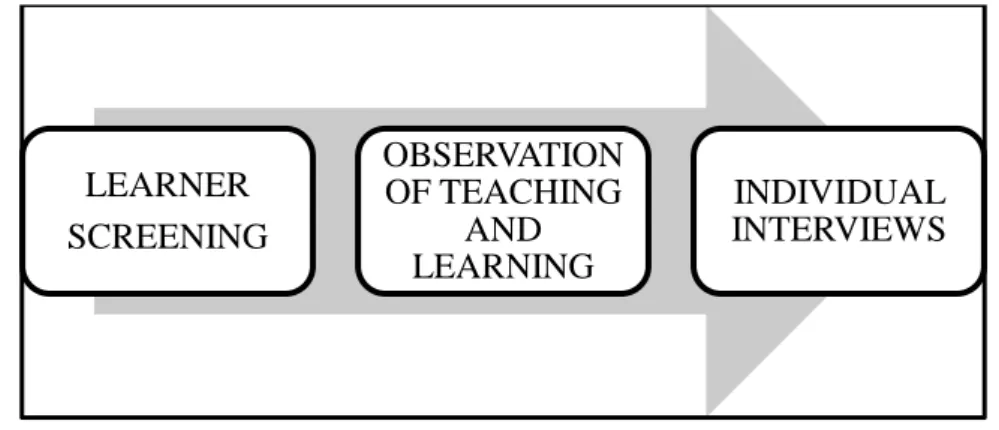
The data collection was divided into three phases. First, the learners with CDs were screened to confirm the presence of the CD. The researcher then conducted brief observations of educator-learner interactions during a lesson. The observations served as a point of
reference for the individual interviews. The interviews were guided by a schedule which consisted of five open-ended questions which encouraged the educators to tell their story.
This was consistent with a phenomenological approach to research. The results were then analyzed thematically and interpreted to reveal the experiences of mainstream educators.
1.8 Outline and Focus of the Thesis Chapters
Chapter Two documents the literature review. It has been divided into five sub-headings.
This chapter explores the implications of educating a learner with a CD and provides a historical overview of educating learners with barriers to learning. It also presents a South African perspective on the education of such learners, elaborates on the rural context and the experiences of educators.
Chapter Three presents the methods used including a description of the research design, the study sample, data collection and analysis procedures, issues related to the quality of data and ethical considerations.
Chapter Four describes and discusses the research results. This has been presented according to the three superordinate and nine subordinate themes that emerged after the thematic analysis.
Chapter Five provides the conclusion, implications and the limitations of the study.
1.9 Summary/Conclusion
South African learners with CDs who reside in rural areas may be receiving an inferior quality of education (Gardiner, 2008). The education of learners with barriers to learning has been affected by the poor implementation of inclusive policies. Mainstream educators of learners with special needs describe administrative, classroom-based and personal challenges (Forlin et al., 2008). These challenges could translate into a negative educational experience for the learner in rural mainstream schools in KZN. The SLT is in an ideal position to
advocate for quality education for the learner with a CD. This is consistent with basic human rights and the South African Constitution.
Chapter 2: Literature Review 2.1 Introduction
The purpose of this literature review is to draw the reader’s attention to the implications of educating a learner with a CD. It also orientates the reader to a historical and a South African perspective on the education of learners with barriers to learning. Furthermore, it draws attention to the factors that affect the education of learners in under-resourced
communities in South Africa. Finally, it highlights core themes that emerge in the literature on mainstream educators’ experiences of inclusive education. The depth and scope of this review has been informed by the aims and objectives of the research.
2.2 The Implications of Educating Learners with Communication Disorders
The American Speech-Language-Hearing Association (1993) defines a CD as a problem with the ability to receive, send, process and comprehend concepts of verbal, nonverbal and graphic symbol systems. A communication disorder may be evident in the processes of hearing, language and/or speech. It may range in severity from mild to profound. It may be developmental or acquired (ASHA, 1993). A communication disorder may result in a primary disability or it may be secondary to other disabilities (ASHA, 1993). Nearly one in twelve (7.7 percent) American children, between the ages of 3-17 years, have a disorder related to voice, speech and/or language (National Institute on Deafness and other Communication Disorders, 2016). The prevalence of CDs is estimated to be more than ten percent in South Africa (Popich, Louw and Eloff, 2006).
Communication disorders maybe classified according to four types: speech, language, hearing and central auditory processing disorders (ASHA, 1993). Speech disorders refer to the impairment of the articulation of speech sounds, fluency and/or voice (ASHA, 1993).
Language disorders are impairments in comprehension and/or use of spoken, written and/or other symbol systems (ASHA, 1993). Hearing disorders are the result of impaired sensitivity of the physiological auditory system. Hearing disorders may limit the development,
comprehension, production and/or maintenance of speech and/or language. Central auditory processing disorders are deficits in the information processing of audible signals not
attributed to impaired peripheral hearing sensitivity or intellectual impairment (ASHA, 1993).
A learner may therefore demonstrate one or a combination of CDs that may have a negative impact on academic performance.
A communication disorder can affect a learner’s performance at school as learning takes place through the process of communication. Spoken language provides the foundation for the development of reading and writing (ASHA, 2013). Spoken and written language has a reciprocal relationship, with each building on the other, to result in general language and literacy competence. This commences early in a child’s life and continues throughout adulthood (ASHA, 2013). Problems with reading, difficulties understanding and expressing language, misunderstanding social cues, refusing to attend school and poor performance in tests are signs that a learner’s CD is affecting his learning (ASHA, 2013). A communication disorder can therefore serve as a severe barrier to academic success. Such learners therefore require adaptation of the environment to cope in a mainstream school.
Optimal service delivery for a learner with a CD requires collaborative teamwork (ASHA, 2013). The team may include parents, audiologists, psychologists, social workers, mainstream educators, special education teachers, guidance counsellors, physicians, dentists, nurses and SLTs (ASHA, 2013). Speech-language intervention can help children become effective communicators, problem-solvers and decision-makers (ASHA, 2013). The services
may be delivered during individual/small group sessions and lessons in the classroom (ASHA, 2013). The speech-language therapist may adopt a consultative model with educators and parents or participate in team teaching with the educator (ASHA, 2013).
Consequently, communication goals are integrated with academic and social goals (ASHA, 2013). The educator and the SLT are therefore critical members of this team.
The educator is directly responsible for the learner’s academic development. The role of the educator includes identifying barriers to learning, adapting the curriculum, adapting the education materials and collaborating with other professionals (DoE, 2001; Forlin et al., 2008). The speech-language therapist, on the other hand, assesses and treats the learner with a CD. She is also responsible for collaborating with parents and other professionals (Shipley &
McAfee, 1992). The SLT advocates on behalf of the learner and the family during service provision. Advocacy is one of the key competencies on the South African Health Professions Council’s Profile for a speech-language therapist (HPCSA, 2012). Advocating for quality education for learners with CDs was the main rationale for conducting the current study.
This section of the review drew attention to the implications of educating a learner with a CD. It motivated that such learners require adaptation to the environment in order to access the curriculum. It emphasized the importance of collaborative teamwork and the role of the educator and the SLT within the context of this team. Advocacy was identified as a key competency of the SLT and the main rationale for conducting the study. The next section of the review presents a historical perspective on the education of learners with barriers to learning.
2.3 A Historical Perspective on the Education of Learners with Barriers to Learning Historically people with disabilities were institutionalized in places that provided little or no education (hospitals or asylums). During the Middle Ages, people with disabilities were put to death, used as servants or ridiculed for their deformities (Read & Walmsley, 2006;
Tremblay, 2007; UNESCO, 2005). During the Renaissance period, people with disabilities were cared for in isolation. They were treated as human beings but denied education. Pedro Ponce de Leon documented the first experience of education for deaf children in 1578 (Tremblay, 2007). Abbe Charles Michel de l’Epee created the first institute for the deaf in 1790. Louis Braille invented the “Braille script” in 1829 (Read & Walmsley, 2006;
Tremblay, 2007; UNESCO, 2005). French physician and educator, Jean Marc Gaspard Itard was one of the first teachers to promote the use of special teaching methods for disabled children. This marked the beginning of special education for children with special needs.
Students with disabilities accessed education in highly specialized settings where they were segregated according to type of disorders (Read & Walmsley, 2006; Tremblay, 2007;
UNESCO, 2005). Students had access to trained staff, equipment and specialized services.
Special schools however were based upon the medical model. Learners were viewed as individual objects that needed to be treated, changed, improved and made more normal (Tremblay, 2007). The medical model viewed the disabled person as needing to fit in rather than thinking about how society should change (Read & Walmsley, 2006; Tremblay, 2007;
UNESCO, 2005). This model focused on the diagnosis and placement of the learner in a special school that catered for the learner’s special needs (DoE, 2001). The focus was therefore not on the barriers in the environment but on the deficits within the learner.
Service delivery to learners with disabilities has evolved globally and locally. It has shifted from the medical model to a social model of disability (DoE, 2001; Tremblay, 2007).
The social definition of disability acknowledges that disability is dependent upon the context and is a consequence of discrimination, prejudice and exclusion (DoE, 2001; Tremblay, 2007). This move served as an impetus for the transition from segregated to inclusive practices (Tremblay, 2007). International pressure was responsible for the shift to a social model of disability. The literature differentiates amongst three forms of international pressure: ethical and moral, conceptual and economic (Tremblay, 2007). The ethical and moral pressure is related to the development of several international declarations.
Many international declarations affirm education as a basic human right. These include the Universal Declaration of Human Rights (1948), the United Nations Convention on the Rights of the Child (1989), the World Declaration for Education for All (1990), Standard Rules on the Equalization of Opportunities for Persons with Disability (1993), the Salamanca Statement (1994) and the Dakar Framework for Action (2000). The United Nations
Educational Scientific and Cultural Organization also released a guide for ensuring inclusion and equity in education (UNESCO, 2005; 2017). These declarations strived to eliminate discrimination against individuals from accessing education. They emphasizes that learners with special needs should have access to regular schools (DoE, 2001; Tremblay, 2007).
Admission to regular schools is the most effective means of building an inclusive society.
Conceptual pressure is another form of international pressure. The concept of normalization recognizes that the learner with barriers should be educated in a typical environment (Read & Walmsley, 2006; Tremblay, 2007; UNESCO, 2005). It advocates for bringing people closer to their communities rather than institutionalizing them away from
their communities. The concept of placement in a less restrictive environment acknowledges that children with disabilities should be educated with children who are not disabled.
Placement should only occur when education in regular classes is unsuccessfully (Tremblay, 2007). The concept of adaptation focuses on increasing learner participation and success in the natural school and community (Read & Walmsley, 2006; Tremblay, 2007; UNESCO, 2005). Finally, the concept of integration differentiates between two practices: mainstreaming and inclusion.
Mainstreaming is defined as the selective placement of learners with special needs in one or more regular classes (Read & Walmsley, 2006; Tremblay, 2007; UNESCO, 2005). The learner has to earn the opportunity to be moved to a regular class by demonstrating an ability to cope with the work. Mainstreaming therefore focuses on making the learner fit into an existing system (Tremblay, 2007). Support was given to some learners and this generated the term ‘learners with special educational needs’ (DOH, 1997). Such labelling still located the problem with the affected learners, rather than with the school or society (DOH, 1997).
Mainstreaming still promoted stigmatization and segregation (DoE, 2001). These challenges could only be addressed by a system that supported inclusion (DoE, 2001; Tremblay, 2007).
Stainback, Stainback & Stefanich (2017), define inclusion as education for all learners in a regular classroom. Inclusion therefore ensured appropriate educational programs for every learner.
There is some controversy in the literature as to whether inclusive practices are appropriate for learners with all types of disabilities. The South African Deaf community believes that hearing impaired children need special schools (White Paper on the Integrated National Disability Strategy, DOH1997). They claim that this is of cardinal importance to
their acquisition of concepts (DOH, 1997). A similar finding was reported in the USA and the UK. Blind and partially sighted children required more individual attention and support than that which the mainstream school could provide (Sukhraj-Ely, 2008). Inclusive education may therefore be more suitable for children with particular kinds of disabilities.
This section of the review presented a historical perspective on the education of learners with barriers to learning. It originates from the place where people with disabilities received little or no education to a system that recognizes differences in learners who have a right to access the most appropriate educational programme. It drew attention to the factors that were responsible for the transition from segregated to inclusive practices. It differentiated between mainstreaming and inclusion. It raised the question that inclusive education may be
appropriate for children with certain kinds of disabilities. The next section of the review presents a South African perspective on the education of learners with barriers to learning.
2.4 A South African Perspective on the Education of Learners with Barriers to Learning
South Africa adopted a dual education system for approximately 120 years (DoE, 2001).
Children with disabilities were placed in special schools or classes and children without disabilities were educated in regular classes in mainstream schools (DoE, 2001). South Africa chose to implement an inclusive education system in 2001 (DoE, 2001). Inclusive education involves the placement of learners with disabilities in mainstream schools with the aim of promoting equal access and opportunities for all learners (DoE, 2001). This practice is consistent with the Constitution of the Republic of South Africa (Klug, 2010). Its
implementation was scheduled to take place over a few decades with the initial focus being on primary education.
The policy framework for this new education system was documented in White Paper 6 on Special Needs Education: Building an Inclusive Education and Training System (DoE, 2001). It was the government’s post-apartheid response to the unequal distribution of
resources for learners with disabilities. Education White Paper 6 therefore affirmed education as a basic human right (DoE, 2001). The education system was restructured to integrate children with disabilities with children without disabilities in mainstream neighborhood schools (DoE, 2001). It was anticipated that this would facilitate social inclusion and the overall inclusion of disabled learners into society from an early age (DoE, 2001). It would also ensure that the rights and needs of disabled people would be accepted and respected by persons without disabilities.
An inclusive education system was expected to minimize the intrinsic (problems resulting from the CD) and extrinsic barriers (systemic problems preventing learner
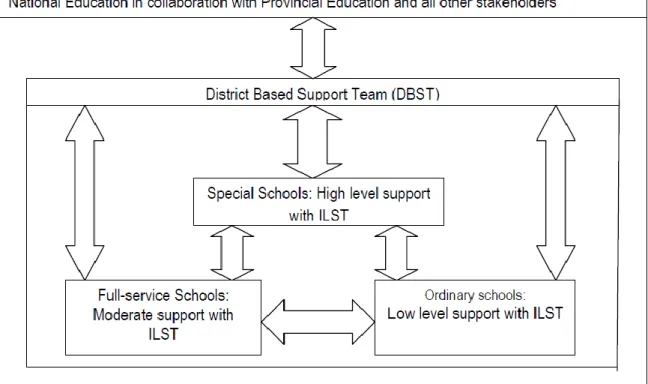
participation) to learning (DoE, 2001). Three levels of support were identified. Learners with mild barriers will receive low-level support in mainstream schools. Learners with moderate barriers will receive moderate-level support in full service schools. Learners with severe barriers will receive high-level support in special school (DoE, 2001). Additionally, full service schools will serve as resource schools to mainstream educators in that area. District- based personnel will also be deployed to assist mainstream educators in that area (DoE, 2001). The Policy on Screening, Identification, Assessment and Support (SIAS) provides additional guidance on the provision of support for learners with learning barriers (DoE, 2014).
The provision of support is structured hierarchically. It commences with the mainstream educator followed by the School-Based Support Team (SBST) and finally the District-Based Support Team (DBST) (DoE, 2014). The educator develops a classroom-based intervention for the learner after conducting an assessment. The School Based-Support Team intervenes after the educators’ classroom intervention has failed. This team consists of the principal (who is directly responsible for the establishment of this support team), senior management members, educators with learners with learning barriers, and educators with specialized skills (DoE, 2014). This team meets to review the educator’s plan. If the SBST fails, the learner is referred to the DBST. The District-Based Support Team provides direction in respect of strategies, programmes, services and resources that will enhance the SBST plan (DoE, 2014).
The figure below illustrates the hierarchy of the structures for the levels of support (Laalje, 2015).
Figure 2.1. The hierarchy of education structures with levels of support (Laalje, 2015).
The literature reveals that mainstream educators receive minimal support at the institutional and district levels. The SBST are not functional. Laalje, (2015) suggests that dysfunctional support teams hinder the placement of learners in special schools. Yeni (2012) further states that school management teams understand inclusive policies but experience difficulty with the implementation thereof. Ntombela (2006) confirms that school
management teams lack confidence to provide support to educators. Furthermore,
understaffing results in the provision of inappropriate and inadequate support services at the level of the district (Ntombela, 2006). The successful implementation of inclusive policies is dependent upon functional SBSTs and DBSTs. The purpose of such teams is to coordinate learner and educator support services (DoE, 2001). There are bound to be negative educator experiences in the absence of such teams. This translates into a poorer quality of education for the learner with a CD.
Other professionals play a significant role during the SIAS process. Schools may require the support of psychologists, audiologists, SLTs, occupational therapists and physiotherapists to conduct formal assessments. These professionals constitute the DBST (DoE, 2014). The District-Based Support Team captures the assessment results on the Disability and Health Assessment form (DoE, 2014). The assessment results inform the SIAS process by removing barriers and increasing the learners’ participation in education (DoE, 2014). Resource
constraints at the district level cause parents to engage professionals privately (Laalje, 2015).
Other parents may access professionals employed within the public healthcare system
(Laalje, 2015). Consequently, other professionals make a significant contribution to the SIAS process.
This section of the review introduced a South African perspective on the education of learners with barriers to learning. It tracked the transition from a dual education system to an inclusive education system with three levels of support. It elaborated on two significant policies: the Education White Paper 6 and the SIAS policy. The next section of the review focuses on the education of learners with CDs in under-resourced communities in South Africa.
2.5 The Education of Learners with Communication Disorders in Under-Resourced Communities in South Africa
South Africa has a rich history marked by discrimination and marginalization of certain groups of people during the Apartheid Era (DoE, 1997; Engelbrecht, 2006). One of the many consequences of apartheid was a severe under-funding of social and economic services in the former Bantustans and 'independent' states (DoE, 1997; D’Amant, 2012; Gardiner, 2008).
This had a severe impact on people with disabilities who found themselves in an inhospitable environment, facing poor living conditions and unable to access the help they needed (DOH, 1997; Gardiner, 2008). The lack of timeous and appropriate medical care contributed to an increase in preventable secondary and tertiary disabilities (DOH, 1997). The rural
communities remain the most affected. The education system was divided in terms of race.
White people who lived in urban areas were favoured over Black African people who lived in rural areas (Gardiner, 2008). Rural schools therefore suffered serious neglect. Poor
infrastructure and overcrowding is still a characteristic of rural schools (Gardiner, 2008; D’
Amant, 2012). High learner numbers are a reality in the former Bantu schools. The
overcrowded classrooms contribute to a high learner to teacher ratio and negative educator experiences.
Special schools in rural areas had reduced capacity to meet the needs of the majority of the learners. Learners were mainstreamed by default when they could not be accommodated in special schools (DoE, 2001). This resulted in learners progressing from grade to grade and eventually excluded due to the inflexible curriculum (DoE, 2001). Approximately 70% of the children with disabilities of school-going age were outside of the public school system (DoE, 2001). This resulted in illiteracy and low skills amongst adults with disabilities and reinforced the high levels of unemployment (DoE, 2001; Filmer, 2008). Thus, learners with CDs who resided in rural areas in South Africa were the most disadvantaged and did not gain access to an appropriate education.
Parents of learners with disabilities in rural areas are more likely to be illiterate. The Disabled Children Action Group (DICAG) estimates that 98% of mothers of children with disabilities living in rural areas are unemployed, semi-literate or functionally illiterate single women (DOH, 1997). Mothers of children with disabilities are often disserted by spouses, ostracized by their communities and banished into isolation by their extended families. They tend to withdraw into a world of their own (DOH, 1997). Such mothers experience many challenges, such as fetching water or firewood and paying for expensive private transport to hospitals, schools and pension pay points (DOH, 1997; Gardiner, 2008). Although a
percentage of people with disabilities receive social security benefits, these benefits are often used to pay neighbours and family members to perform tasks and so the cycle of poverty and disability continues (DOH, 1997; Gardiner, 2008).
This section of the review drew attention to the challenges of educating learners with communication disorders in under-resourced communities in South Africa. It describes the intergenerational impact of discrimination and marginalization in rural areas. The final
section of the review focuses on the experiences of mainstream educators of learners with communication disorders.
2.6 Mainstream Educators’ Experiences of Educating Learners with Communication Disorders
The Oxford dictionary (2010) defines experience as practical contact with and
observation of facts or events. This definition also includes an event or occurrence that leaves an impression on someone. This definition reflects the concept that was under exploration in the current study. A review of the literature on mainstream educators’ experiences revealed two main themes: negative and transformational experiences. The negative experiences were related to low levels of educator self-efficacy, poor quality of in-service training, resource constraints and learner-based challenges. Each of these sub-themes will be discussed in detail below.
Mainstream educators have low levels of self-efficacy when educate learners with barriers to learning. Weber (2013) states that educators have limited knowledge of developmental disabilities such as Autism Spectrum Disorder (ASD) or Attention Deficit Hyperactivity Disorder (ADHD). There are increased level of stress as educators are unable to cope with learners who have developmental disabilities (Chetty, 2013; Forlin et al., 2008;
Goodman & Burton 2010; Moyi, 2012; Nkambule et al., 2011). Educators have limited and distorted knowledge of inclusion strategies making them unable to adapt the curriculum so that it is accessible to all learners (Chetty, 2013; Mayaba, 2008; Weber, 2013). The rural context poses an added challenge as many of the educators are unqualified (Mukeredzi, 2009). Thus, mainstream educators feel ineffective when educating learners with barriers to learning.
The low levels of self-efficacy may be related to poor in-service training. A review of the literature revealed that educators do feel unprepared to meet the needs of diverse learners.
Educators feel they lack the skills and knowledge to educate learners with special needs (Forlin et. al, 2008; Goodman & Burton, 2010; Laalje, 2015; Lawrence, 2012). Educators who received in-service training, claim that it is either insufficient or distorted (Ntombela, 2006). The Cascade model of training resulted in distorted information on inclusion (Humphrey & Symes, 2011; Ntombela, 2006). This model advocates the training of some senior members of staff who are then responsible for the dissemination of information to other staff members. It has been described as an ineffective model of training. Humphrey and Symes (2011) report greater levels of self-efficacy in members of the senior management team and special needs coordinators than subject educators. The training has also been criticized for being too theoretical and not practical (Ostendorf, 2012). Consequently, an educators’ negative experience of inclusion may be related to insufficient and inappropriate training.
Members of the school management teams agreed that educators needed training on inclusive practices (Yeni, 2012). Ntombela (2006) states that educators have had very limited experience of information, training and/or support in preparation for the development of an inclusive system of education. Pre-service training is essential for preparing educators to meet learner needs (Fidelia, 2013). Teacher training needs to be reviewed so that teachers are able to adapt learning programs, teaching techniques and materials to suit the needs of
learners with barriers (DoE, 2001; McConkey & Bradley, 2010). The quality of in-service training therefore hinders the inclusion of learners with CDs in mainstream settings. The gap between educators’ training and learner needs contributed to negative educator experiences.
Resource constraints may also contribute to educators low levels of self-efficacy.
Educators may experience reduced levels of support because of the lack of access to
professionals with expertise (D’amant 2012; Forlin et al., 2008; Goodman & Burton 2010;
Nkambule et al. 2011). There is often fragmented or no communication amongst
professionals because of the absence of systems to facilitate better communication (D’amant 2012; Forlin et al., 2008; Goodman & Burton 2010; Nkambule et al. 2011 ). A lack of specialized equipment and resources can hinder inclusion in mainstream schools (D’amant, 2012; Forlin, et al., 2008; Goodman & Burton, 2010; Mayaba, 2008; Mweli, 2009; Nkambule et al., 2011). The rural context poses an added challenge due to past imbalances (Engelbrecht, 2006; Gardiner, 2008). Resource constraints may therefore contribute to negative educator experiences.
Learner-based challenges also contribute to negative educator experiences. Educators are overwhelmed with learners’ difficult behavior according to the nature and severity of the disorder (Forlin et al., 2008; Goodman & Burton 2010; Nkambule et al., 2011; Moyi, 2012).
The large number of learners in the class makes it difficult for the educator to give individual attention to learners with barriers. The educators’ are unable to design individualized learner support programmes, which facilitates the learner’s move to the next grade (Forlin et al., 2008). Learners progress from grade to grade despite poor performance. They eventually exit the secondary school system with little or no functional literacy. Thus, educators’ experiences of inclusion are shaped by learner-based challenges.
Transformational educator experiences are those that change from negative to positive.
Transformation is a complex process. Educators need to undergo a paradigm shift and unlearn previous discriminatory beliefs and embrace new ways of thinking about and
practicing education (D’ amant, 2012; Ntombela, 2009). It requires a reconstruction of the way educators perceive themselves as people and professionals (D’ Amant, 2012). The educator needs to be flexible and have a genuine belief in her pupil’s ability to succeed (Moodley, 2009). The educator needs to be flexible and explore other ways to accommodate the learner in the classroom. Weber (2013) reports using autism specific tools for learners with ASD. Moodley (2009) identifies preferential seating and correct positioning of the learner with ADHD. When educators embrace inclusion they are able to develop
individualized practices to meet learner needs (D’Amant, 2012). The factors that contribute to transformational experiences include increased personnel support (presence of an assistant teacher), team collaboration, goal sharing, exposure to inclusive practices and the provision of resources (D’ Amant, 2012).
The final section of the review focused on mainstream educators’ experiences of educating learners with CDs. The literature revealed two main themes: negative educator experiences and transformational experiences. These two themes were discussed in detail with support from the literature.
2.7 Summary/ Conclusion
A communication disorder can affect a learner’s performance at school. Spoken language provides the foundation for the development of reading and writing (ASHA, 2013). Optimal service delivery for a learner with a CD requires collaborative teamwork (ASHA, 2013).
Education of learners with barriers has evolved from segregation in special schools, to mainstreaming and lastly to inclusion (Read & Walmsley, 2006; Tremblay, 2007; UNESCO, 2005). The South Africa Department of Education developed the Education White Paper 6 as a framework for the inclusion of learners with barriers (DoE, 2001). The Screening,
Identification, Assessment, Support policy provides further guidance on the provision of support for learners with barriers to learning (DoE, 2014). Although policies are in place, implementation remains a challenge. The rural context poses additional challenges due to past imbalances (DOH, 1997; Gardiner, 2008). Consequently, educators experience low levels of self-efficacy for various reasons (D’amant 2012; Forlin et al., 2008; Goodman &
Burton 2010; Nkambule et al. 2011). Transformation can only become a reality when educators have adequate support, team collaboration and exposure to inclusive practices (D’
Amant, 2012).
Chapter 3: Methodology 3.1 Introduction
This chapter describes the methods that were used to answer the research question: What are mainstream educators’ experiences of educating learners with CDs in rural KZN? The aim and the objectives of the research are listed, the research design, site and participants are described in detail. The methods that were used to collect and analyse the data are discussed.
Data quality and ethical issues are raised as these are important considerations of qualitative research.
3.2 Aim
To explore mainstream educators’ experiences of educating learners with communication disorders in rural KwaZulu-Natal.
3.3 Objectives
The objectives of this study were as follows:
3.3.1 To explore classroom, institution (mainstream school) and district-based experiences.
3.3.2 To explore transformation in the educators’ experiences.
3.4 Research Design
A qualitative, phenomenological approach to research was adopted. Phenomenological research attempts to identify the essence of human experiences of a phenomenon, as
described by the participants (Creswell, 2009). This method is useful when collecting descriptions of people’s experiences and the meanings they attach to reality. A qualitative approach aims to understand a topic in the participant’s natural setting where they experience the issue or problem under study (Creswell, 2009). It allowed the researcher to engage with the participants physically and become the main instrument for data collection (Creswell,
2009). This helped the researcher to gain the best understanding of the meaning that participants held about the problem or issue (Creswell, 2009). The researcher explored the nature of mainstream educators’ experiences of educating learners with CDs in rural KZN.
3.5 Research Site
The selected schools fell within the iLembe District, in the rural wards of Insuze, Ozwathini and UBhaqa (Refer to Page 1). The iLembe district comprises of a smaller urban area and a larger rural area. This district has a population size of 662 413. Black African people constitute 82% of this population and IsiZulu is the most commonly spoken language.
The schools are situated in Ndwedwe which has a population of 145 163. The key features that define Ndwedwe are the new developments that have emerged at various levels. These developments include business parks, business cluster developments, agricultural
distribution and housing estates. The construction of roads and the access to electricity are some of the new developments in the rural areas. (www.ndwedwe.gov.za &
www.Ilembe.gov.za/index.php/local-municipalities).
The schools service under-resourced communities as indicated by mud houses and no supply of water and electricity. The primary phase of each of the schools offers an isiZulu medium of instruction, with a transition to English from Grade Four. The communities are predominantly Black African with a history of political unrest and limited resources stemming from the Apartheid Era. They all offer free education to learners. All schools consisted of a single storey building, with some schools being better resourced than others.
Such schools touted computer rooms, libraries, electricity and water-borne sewage while other schools did not have these luxuries and still depended on pits as ablution facilities.
All the schools were challenged by high learner to teacher ratios, with the highest being 49:1. The problem of lack of teacher assistants and adaptations in the environment to allow for inclusion. They did not have remedial/specialised classrooms. All schools seemed to have dysfunctional support systems for learners with barriers. They were burdened with the
problem of learners being raised by their grandmothers while the parents were employed in urban areas. There was a general problem of illiteracy amongst the caregivers.
3.6 Participants
3.6.1 The study population.
The study population consisted of mainstream educators who taught learners with communication disorders in the South circuit wards of Ozwathini, Insuze and Ubhaqa in the iLembe District of KwaZulu-Natal in South Africa. These wards are situated within a rural community which is the focus of this study. The sample consisted of 11 participants. All the participants were Black African females who spoke isiZulu as the first/home language and English as the second language. All participants were currently educating a learner or learners with CDs. The average age of the participants was 47 years and the average number of years of teaching experience was 19 years. The oldest participant was 58 years and had taught for 34 years. Two of the participants had biological children with learning barriers. One of those participants shared their experiences of educating her child. Table 4.2 illustrates some of the participant characteristics.
Table: 3.1
Description of the Participants of the Main Study Cod
e
Age Years of Experience
Qualification Grade Residence
P1 40 4 years Primary Diploma in Education (PDE);
Advanced Certificate in Education (ACE); B. Ed
Grade 1 Yes
P2 53 20 years B. Ed;
FDE;
Junior Primary Teachers Diploma (JPTD)
Grade 3 Yes
P3 46 21 years Bachelor in Education Honours (B. Ed Honours);
Primary Teachers Diploma (PTD);
Higher Diploma in Education (HDE);
Grade 2 Yes
P4 40 19 years B. Ed. Honours; HDE; PTD Grade 1 No P5 58 34 years B Ed. Honours; B. Ed;
PTC; Diploma in Education; FDE
Grade 2 Yes
P6 37 9 years B. Ed Grade 3 No
P7 48 20 years PTD; JPTD; HDE, B. Ed. Honours Grade 2 Yes P8 48 23 years B. Ed Honours, BA; Diploma Grade 1 No P9 49 25 years B. Ed Honours; Advanced Diploma in
Education (ADE); HDE; Senior Primary Teachers’ Diploma (SPTD)
Grade 3 No
P10 51 13 years B. Ed. Honours, B.A., PTD Grade 2 Yes
P11 48 25 years B Ed. Grade 1 No
3.6.2 The sampling technique.
A purposeful sampling technique was adopted to select participants. Purposeful sampling allows for the selection of participants based on particular characteristics (Brink, van der Walt & van Rensburg, 2012). Purposeful sampling involves selecting those participants that help the researcher to understand the research question and problem (Creswell, 2009).
Mainstream educators, who were educating learners with communication impairments and who were employed in rural schools, were selected purposefully to participate in the research.
Such participants represented the key criteria for this study.
The advantage of purposive sampling was that the sample was selected based on
knowledge of the phenomenon being studied (Brink et al., 2012). The researcher is aware that generalization to other educators is not the focus or priority of this research.
3.6.3 Criteria for inclusion/exclusion.
The inclusion criteria were as follows:
3.6.3.1 Qualification.
Educators had to have a basic qualification in education and be registered with the South African Council for Educators. The experience of qualified educators could be different to the experience of underqualified educators. The most common qualification was the Bachelor of Education.
3.6.3.2 Employment status.
Educators had to be currently employed in a primary mainstream school. This criterion ensured that participants related recent experiences during the interview. All participants were employed in mainstream primary schools in the iLembe District of KwaZulu-Natal.
3.6.3.3 Experience of basic education.
Educators had to have a minimum of two years of work experience as primary mainstream educators. The experiences of an educator who has been exposed to basic teaching and learning for more than two years will be different to that of a novice educator, and this is the experience that the researcher aimed to explore. The work experience of the participants for this study ranged from four to thirty four years.
3.6.3.4 Experience of educating learners with communication disorders.
Educators had to have experience educating a learner or learners with CDs. This criterion was essential as participants had to be able to engage meaningfully with the topic under study. Learners were screened to confirm the presence of a CD. Only educators teaching learners with a confirmed CD were included.
3.6.3.5 Language proficiency.
Educators had to be proficient in either English or isiZulu. Proficiency in either one of the languages eliminated barriers during the interview; as the interviewer; who is also the researcher, is proficient in both English and isiZulu. English and isiZulu are also the two most common languages spoken in KZN (Broeder, Extra & Maartens, 2004; Mesthrie, 2008).
Educators spoke both English and isiZulu; though they were mostly fluent in isiZulu and preferred to communicate more in isiZulu.
3.6.3.6 Age, gender and ethnicity.
Participants had to be of any age, gender or ethnicity. The educators’ ages ranged from 37 to 58 years. They were all females and all Black African.
The exclusion criteria were as follows:
3.6.3.7 Special educators’ qualification.
Participants who had a degree or diploma in special education were excluded from participating in the study. Such participants may have had experiences that were different to that of the general mainstream educator.
3.6.3.8 Experience of special education.
Participants who had been previously employed in schools for learners with special educational needs were excluded from participating in the study. Again, such participants may have had experiences that were different to that of the general mainstream educator.
3.6.4 The recruitment strategy.
Permission was obtained from all gatekeepers. The researcher then approached principals of the schools and asked them to identify educators who taught learners with CDs. The researcher then screened these educators to determine if they met the other criteria for inclusion. Informed consent was obtained from educators who met all the criteria for inclusion. (Refer to Appendix 6).
3.6.5 The sample size.
It is suggested that the size of the sample should allow the necessary data to be collected (Kvale & Brinkman, 2009). Participants were selected until data saturation occurred. Data saturation is the point at which new data ceases to emerge during the data collection process (Brink et al., 2012). The sample eventually consisted of eleven participants.
3.7 Data Collection
3.7.1 The data collection method.
Individual semi-structured interviews were conducted to gather the data. An interview is defined as a process whereby the interviewer