I declare that this dissertation entitled "Educators' Perceptions of Principal Selection in Umzinyathi Area of KwaMashu District" is my own work and that all sources used and cited have been cited and acknowledged and that this work has not been submitted to any other university. In this study, I investigated educators' perceptions of the selection of principals in Umzinyathi area of KwaMashu district. This study examined teachers' perceptions of principal selection in the Umzinyathi area of KwaMashu District, KwaZulu-Natal Department of Education.
Conceptual frameworks, motivation for this study, theoretical location of the study and questions for research are also outlined. My personal experience as a school principal is that Circuit Inspectors and sometimes Chairmen of School Committees used to recommend to the Chief Inspector of the Department of Education, individuals who should be appointed as school principals. Since 1996, the management of the selection process, including the recommendation for the appointment of principals, has been delegated.
The obligations of the state, as an employer, in relation to the selection process are set out in Article 195 and 197 of the Constitution of the Republic of South Africa (1996) while the obligations of the employer in general by the Labor Relations Act (1998 ) be prescribed. ) and the Employment of Educators Act (1998). This study investigated the perception of educators in the Umzinyathi area of the KwaMashu circle on whether the educators feel that the criteria laid down by legislation are met by the Selection Committees in this area.
Purpose of the study
34; recommend to the Head of Department the appointment of teachers to the school, subject to the Employment of Educators Act 1998, as amended, and the Labor Relations Act." Resolution 5 of 1998 of the Education Labor Relations Council (ELRC) states established widely agreed upon parameters within which such a study was considered important because teacher perception plays an important role in determining whether or not selected candidates are acceptable to teachers.
Conceptual framework
Motivation for the study
It has already been pointed out that in the new education dispensation, the selection of principals is the job of the school boards. In carrying out this task, school boards are obliged to set up selection committees. Selection committees (as will be discussed in more detail in Chapter 2) are composed of a department representative, parents, teachers, and teachers' unions.
One of the issues that prompted this study was school-level anecdotes about educators' dissatisfaction with school board involvement. It is claimed that this dissatisfaction stems from the perception that the selection process uses criteria other than those set out in the regulations. As a result, the view is that some individuals are favored at the expense of others who may be better qualified for the positions.
The focus was on whether educators felt that the selection boards followed the guidelines and procedures set by the KwaZulu-Natal Department of Education. The aim was therefore to develop a better understanding of what appears to be dissatisfaction with the process.
Theoretical location of the study
Questions for the research
The study was limited to only two neighboring schools in one area, Umzinyathi, and one circuit, KwaMashu. Also, the research focused only on the perception of educators and excluded the parental component of the school's governing body, which participates in the selection of principals. Consequently, the findings derived from this study cannot in any way be considered generalizable to the entire KwaMashu circuit.
However, the qualitative nature of the study means that the findings may provide useful guidelines for further studies on this topic. Also of importance is that the study's qualitative nature also enabled a deeper understanding of the stated issue of focus.
Structure of the study
Chapter five presents the summary, conclusions and recommendations regarding proposed improvements to the implementation of the selection process and related further studies.
Introduction
The relationship between universalism and the selection process prescribed by the KwaZulu-Natal Department of Education
- Sifting
- Shortlisting
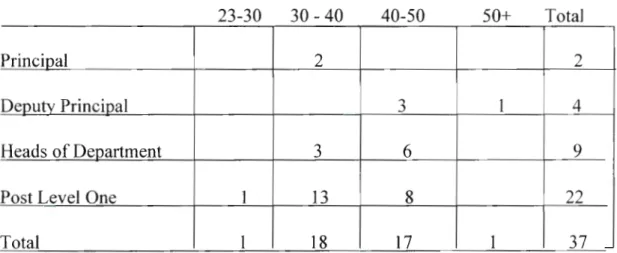
The first step III of the KwaZulu-Natal Department of Education staff selection process involves the screening of applications. As mentioned earlier, the purpose of this study was to investigate the perceptions of teachers on the selection of school principals in Umzinyathi area of KwaMashu district. This meant that the experience of the selection process was fresh in the minds of both educators and principals.
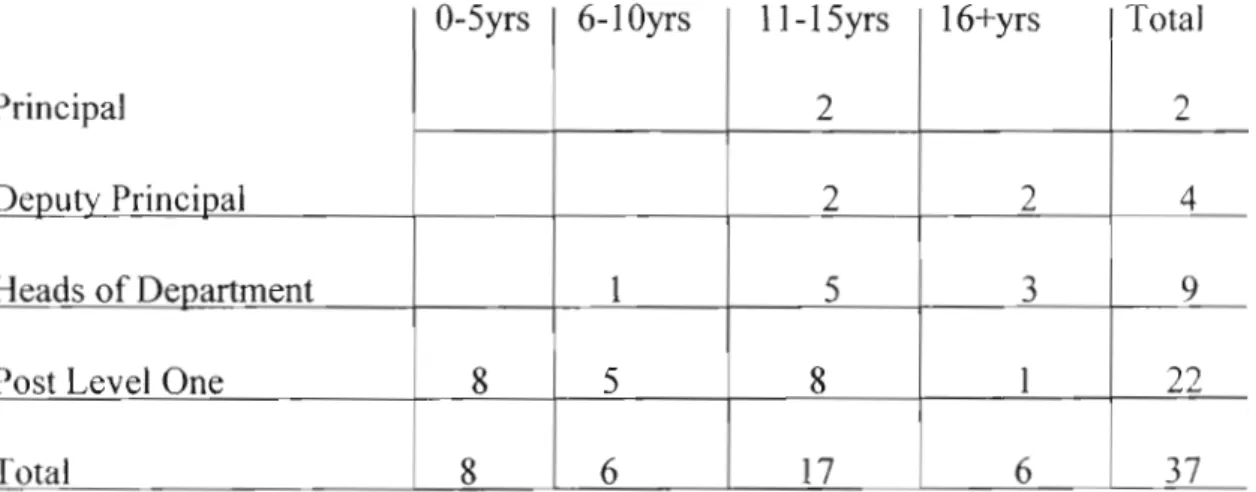
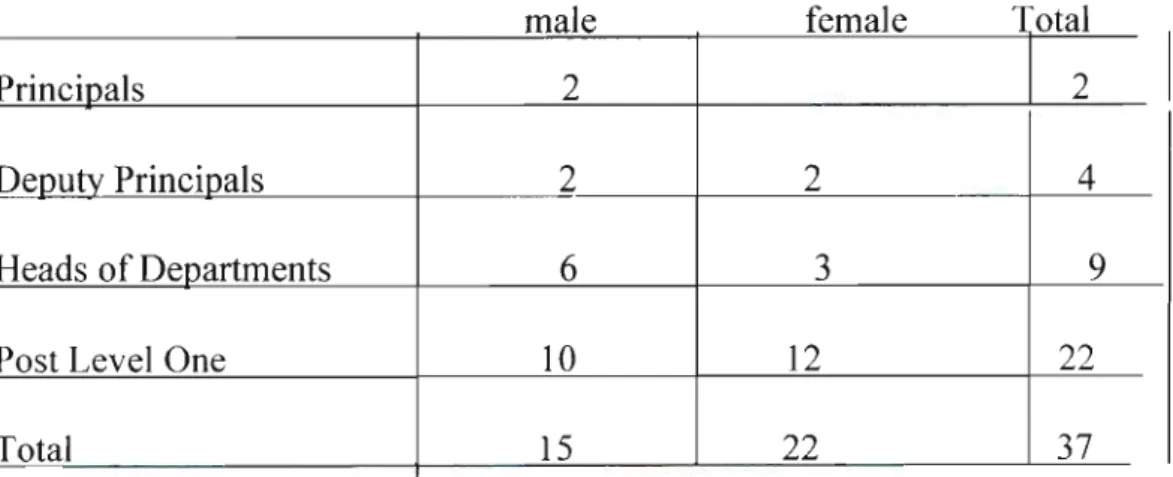
This helped to calculate the prevalence rate of individual teachers' perceptions in the sample schools. In this chapter, I present and discuss findings from a study of teachers' perceptions of the selection of school principals in the Umzinyathi area of KwaMashu District. Fourteen first-level teachers (64%) out of twenty-two had more than 6 years of teaching experience.
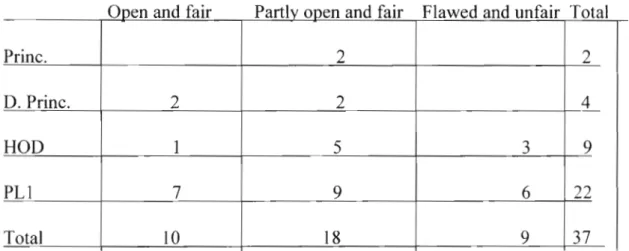
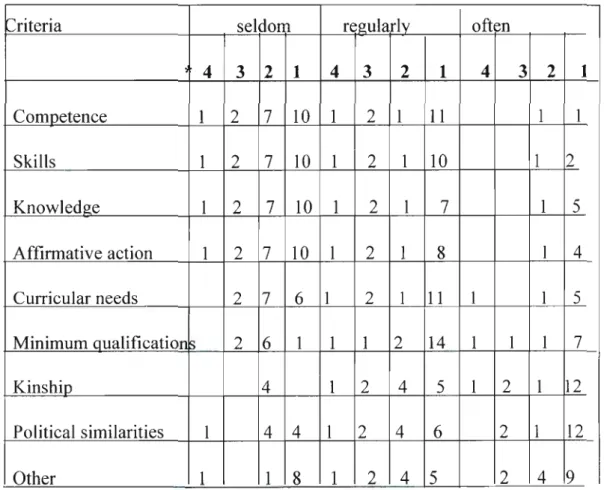
The above findings show that about half (48%) of the teachers are of the opinion that the selection process for principals in Umzinyathi area of KwaMashu district is partially open and fair. From the above, it can be seen that the majority of educationists believe that the selection of principals in the Umzinyathi area v. In addition, fifteen (41%) of the thirty-seven participants, consisting of one principal, two vice-principals, four department heads, and twelve first-level positions, felt that other criteria were often used in the selection of principals.
Only ten (27%) of thirty-seven participants felt that other criteria were rarely used. This gives the impression that the majority of teachers believe that criteria other than those mentioned in the procedures for the selection of school leaders are used. The majority of participants indicated that they had no confidence in the selection of school leaders in the Umzinyathi area. of the KwaMashu circuit.
The answers to the question about educators' perception of the inclusion of different stakeholders in the selection commissions show that the majority of the sample educators believed that parents, educators and teachers' unions should not be involved in the process. On the other hand, twelve of the thirty-seven participants (32%), the majority of whom were first-level educators (75%), believed that teachers' unions should be involved in the selection of principals. The findings are that educators are of the opinion that improvements, such as workshops, are needed.
The answers show that the majority of vice-principals (75% of them) and half of the principals generally believe that the selection process. On the other hand, department heads (78%) and senior educators (82%) were generally of the opinion that the selection process has no advantages.
Part Two: Findings from interviews
What are your views on the composition of Selection Committees particularly regarding Departmental representatives?
From the above, it appears that the general opinion of those interviewed was that department representatives should be involved in the selection process of. Only one participant, a director, of the eight participants interviewed felt that the interview should be the only instrument used in the selection process of. principals because “the Ministry of Education decided it should be so.” Seven. In this chapter, I presented and discussed the findings on the perception of Urnzinyathi educators on the selection process of school principals.
In the following chapter, I present the summary of the study and the recommendations drawn from the conclusions drawn in this study. The first part is a summary of the study which includes the main findings and conclusions drawn from the findings about educators' perceptions of the principal selection process in Umzinyathi zone of KwaMashu District. In this study I explored educators' perceptions of the selection of school principals in Umzinyathi area of KwaMashu District.
Key Question 1: What is the perception of the teachers on the selection of principals in Umzinyathi area of KwaMashu circuit. Findings are that the teachers' perception of the selection process of principals in the Umzinyathi area of KwaMashu Circuit was partially open and fair. Key question 2: What contributes to the perception of these educators about the selection of school leaders in the Urnzinyathi area.
Another contributing factor to the perceptions was poor performance in schools in the Umzinyathi area of the KwaMashu constituency. Educators are of the opinion that criteria used by selection committees are not those prescribed by the KwaZulu-Natal Education Department. This study only investigated educator perceptions of the choice of principals in one area and one district.
The purpose of the study is to explore teachers' perceptions of the selection process of principals in the Umzinyathi area of KwaMashu Circuit. The title of the project is: Perceptions of Educators on the Selection of Principals in Umzinyathi Area of KwaMashu Circuit. The purpose of the study is to explore the educators' perception of the selection of principals.
I will not reveal the name of the school or the names of teachers who will accept my request to participate in the project. I will not reveal the name of the school or the names of teachers in the report.
PROVINCE OF KWAZULU-NATAL
DEPARTMENT OF EDUCATION