i Title Page
UNIVERSITY OF KWAZULU-NATAL
Empowering Women in the Workplace: A South African Perspective
Ajaikumar Ratelal Daya By 207526539
A dissertation submitted in partial fulfillment of the requirements for the degree of
Master of Business Administration
Graduate School of Business and Leadership College of Law and Management Studies
Supervisor: Professor Anesh Maniraj Singh
2011
University of KwaZulu-Natal
Graduate School of Business and Leadership College of Law and Management Studies
ii Declaration I Ajaikumar Ratelal Daya declare that
(i) The research reported in this dissertation/thesis, except where otherwise indicated, is my original research.
(ii) This dissertation/thesis has not been submitted for any degree or examination at any other university.
(iii) This dissertation/thesis does not contain other persons’ data, pictures, graphs or other information, unless specifically acknowledged as being sourced from other persons.
(iv) This dissertation/thesis does not contain other persons’ writing, unless specifically acknowledged as being sourced from other researchers.
Where other written sources have been quoted, then:
a) their words have been re-written but the general information attributed to them has been referenced:
b) where their exact words have been used, their writing has been placed inside quotation marks, and referenced.
(v) This dissertation/thesis does not contain text, graphics or tables copied and pasted from the Internet, unless specifically acknowledged, and the source being detailed in the dissertation/thesis and in the References sections.
Signature:
iii
Acknowledgements
I wish to express my sincere appreciation and gratitude to the following individuals, without whose assistance, this study would not have been possible:
To my wife Deepa and children Abhay and Sonali, thank you for your unconditional support and patience and allowing me the time and space to achieve this degree.
To my supervisor, Professor Anesh Maniraj Singh, thank you for believing in me and encouraging, guiding and supporting me during my study.
To the students and my two sets of group members, thank you for understanding who I am and giving me the support throughout my study.
To Dr K B Parag, thank you for allowing me the flexitime and the use of company resources in the completion of my studies.
iv Abstract
Empowerment is the degree of flexibility and freedom provided to individuals to make decisions in relation to their work. Individuals tend to respond more creatively when given additional responsibilities and are encouraged to contribute to and attain satisfaction from their work and its environment. Women in South Africa have unfortunately found it difficult to take advantage of this flexibility and freedom due to the countries past policies and laws. They have to face various barriers that restrict them from advancing in their careers and in the workplace, particularly at senior management levels. One of these barriers is to balance work and family life. The government has legislated policies and procedures for the empowerment of women in the workplace. Companies are required to use these policies and procedures to promote women to senior levels of management. The aim of the study is to determine whether women in South Africa are being empowered in the workplace and the impact of organisational practices on their progression. This study used a quantitative research design and data was collected using an electronic questionnaire in the Greater Durban Area using a non-probability sample. There were 129 respondents who responded to the electronic questionnaire of which only 121 were valid responses. The study showed that women were not accepted in a managerial role yet respondents preferred female managers due to their influence in the workplace. Barriers which affected women in acquiring higher positions in their companies were identified.
The findings indicate that organisations which have policies and procedures in place invest in developing female leaders and managers. Based on the research findings it is recommended that organisations need to be more supportive of women with families. In this way they could retain the best. In addition, organisations need to ensure that for empowerment of women to materialise;
power sharing, skills development and positive relationships should be a part of their organisations’ empowerment strategy. Government may need to change certain policies and procedures to encourage the promotion of women in the workplace.
v
Table of Contents
Title Page ... i
Declaration ... ii
Acknowledgements ... iii
Abstract ... iv
Table of Contents ... v
List of Figures ... ix
List of Tables ... x
CHAPTER ONE ...1
INTRODUCTION ...1
1.1 Introduction ...1
1.2 Motivation for the study ...2
1.3 Focus of the study...3
1.4 Problem statement ...3
1.5 Objectives ...4
1.6 Limitations of the study ...4
1.7 Chapter Outline ...5
1.8 Summary ...6
CHAPTER TWO ...7
Literature Review ...7
2.1 Introduction ...7
2.2 Background ...8
2.3 Definitions ...9
2.4 Barriers to women’s career progression ...10
2.4.1 Family-related barriers ...11
2.4.2 Societal-related barriers ...11
2.4.3 Organisational-related barriers ...12
2.4.4 Gender stereotyping barriers ...13
2.5 Women in management: career and family challenges ...14
2.6 Gender inequality in management ...15
2.7 What is empowerment and who benefits? ...22
vi
2.8 Summary ...24
CHAPTER THREE ...26
Research Methodology...26
3.1 Introduction ...26
3.2 Statement of the research problem ...26
3.3 Aim and Objectives of the Study ...27
3.3.1 Aim ...27
3.3.2 Objectives ...27
3.4 Sampling ...28
3.5 Sample Size ...29
3.6 Data Collection Strategies ...30
3.7 Data Collection Instrument ...31
3.8 The Questionnaire as a Research Tool ...32
3.9 Questionnaire Design ...33
3.10 Statistical Analysis of the Questionnaire ...33
3.10.1 Questionnaire Reliability ...33
3.10.2 Questionnaire Replication ...34
3.10.3 Questionnaire Validity ...34
3.11 Administration of the Questionnaire ...35
3.12 Data Analysis Method ...35
3.13 Summary ...35
CHAPTER FOUR ...37
Results ...37
4.1 Introduction ...37
4.2 Biographical characteristics of respondents ...37
4.3 Objective 1: Ascertain individuals view on women’s career advancement..38
4.3.1 Reasons why women are unable to progress in their careers....38
4.3.2 Reporting to a woman manager ...40
4.3.3 Influence of women managers in the workplace ...41
4.3.4 Barriers to career advancement for women ...42
4.3.5 Barriers to progression faced by women ...43
4.3.6 Women need to be given equal opportunities ...44
vii
4.3.7 Outcome of Objective 1...45
4.4 Objective 2: Gender and race impact on progression ...45
4.4.1 Barriers to progression faced by women ...45
4.4.2 Gender versus barriers to career advancement for women ...45
4.4.3 Gender versus women’s ability to progress in their career...46
4.4.4 Race versus women’s ability to progress in their career ...47
4.4.5 Outcome of Objective 2...47
4.5 Objective 3: Organisational practices...48
4.5.1 Organisational policies and procedures in place for the progression of women ...48
4.5.2 Organisational investments in developing female leaders ...49
4.5.3 Women in my organisation who have received necessary training are excellent managers ...50
4.5.4 Outcome of Objective 3...51
4.6 Summary ...51
CHAPTER FIVE ...52
Discussion ...52
5.1 Introduction ...52
5.2 Demographics ...52
5.3 Findings of the study ...53
5.3.1 Objective 1: To ascertain individual’s view on women’s career advancement ...53
5.3.1.1 Reasons for non-progression ...53
5.3.1.2 Relationships with managers ...54
5.3.1.3 Barriers and their impact ...55
5.3.1.4 Equal opportunities ...57
5.3.2 Objective 2: To investigate barriers faced by women in achieving higher positions in companies...58
5.3.2.1 Advancement for women ...58
5.3.2.2 Ability to progress in a gender and race perspective ...59
5.3.3 Objective 3: To examine the impact of organisational practices in promoting women to executive positions ...60
viii
5.3.3.1 Policies and Procedures ...60
5.3.3.2 Investment in female leaders ...61
5.3.3.3 Training to be excellent managers ...61
5.4 Summary ...62
CHAPTER SIX ...63
Recommendations and Conclusions ...63
6.1 Introduction ...63
6.2 Key findings ...63
6.3 Recommendations resulting from this study ...65
6.4 Limitations of the study ...67
6.5 Recommendations for future studies ...68
6.6 Summary ...68
References ...70
Appendix 1 ...77
Appendix 2 ...81
ix
List of Figures
Figure 2.1 Labour Force Participation Survey ...19
Figure 2.2 Incidence of Management Positions ...20
Figure 4.1 Reasons for non-progression of women ...39
Figure 4.2 Choice of reporting to a woman manager ...40
Figure 4.3 Women managers not influential ...41
Figure 4.4 Barriers to career progression for women ...42
Figure 4.5 Barriers faced by women ...43
Figure 4.6 Equal opportunities for career progression ...44
Figure 4.7 Organisational policies and procedures ...48
Figure 4.8 Developing female leaders ...49
Figure 4.9 Excellent managers ...50
x
List of Tables
Table 2.1 Mid –year population estimates for South Africa by population group
and gender, 2010 ...17
Table 2.2 Mid-year population estimates by population group, age and gender, 2010 ...18
Table 2.3 Gender Parity Index ...19
Table 4.1 Biographical characteristics of respondents ...38
Table 4.2 Central tendency result of reporting to a women manager ...40
Table 4.3 Central tendency result for influential women managers ...41
Table 4.4 Central tendency result for barriers to progression ...42
Table 4.5 Central tendency for equal opportunities ...45
Table 4.6 Gender versus barriers to progression ...46
Table 4.7 Gender versus choice for non-progression ...46
Table 4.8 Race versus choice for non-progression ...47
Table 4.9 Central tendency for policies and procedures ...49
Table 4.10 Central tendency for developing female leaders...50
Table 4.11 Central tendency for excellent managers ...51
1
CHAPTER ONE INTRODUCTION 1.1 Introduction
The apartheid era in South Africa defined women to be inferior to men and bestowed upon them the status of minors in both the public and private sectors (National Gender Policy Framework 2003). The unequal sharing of power led to the exploitation of women and resources such as information, time and income being unequally distributed (Mathur-Helm 2005). South Africa has always strived to promote the rights of individuals irrespective of age, race, gender, class and disability (Constitution of the Republic of South Africa 1996).
For this purpose, the South African government endorsed the Convention on the Elimination of All Forms of Discrimination Against Women (CEDAW) in January 1996. The Gender Policy Framework outlines the policies and strategies aimed at implementing human rights laws for improving the status of women in the workplace.
Whilst great advances have been made towards gender equality in the public and private sectors, women continue to be noticeably excluded from many areas of society, in particular the formal economy. An important aspect of this economic exclusion is the unfair treatment of women in the workplace (Chan 2006). The
“glass ceiling” is used to explain why women fail to achieve senior management roles and are prevented from attaining senior levels of management due to the various related barriers (The world needs women leaders 2008). On the other hand, some levels of advancement are prevented by other women who had achieved these levels thus creating a new ‘glass ceiling’.
Although legislation has provided policies and procedures for the progression of women, organisations lack of understanding the legislation has led to the underutilisation of the best and brightest women (D’Agostino & Levine 2010).
2 1.2 Motivation for the study
In the changing global and economic times, women’s empowerment and the barriers they face in the workplace has been drawing the attention of most organisational researchers where changes in senior management are being reported and the status of professional women is being debated (Mathur-Helm 2005). Women in South Africa only began to meet this global economic change since the democratic elections in 1994. However, despite changes in legislation to empower women in South Africa, the majority still hold secondary positions and are frequently or mostly being underutilised in the market place.
The intention of this study is to create awareness amongst leaders about the barriers faced by women in the workplace and balancing the conflicting roles of family and career. According to Ezzedeen and Ritchey (2009), women fail to reconcile career aspiration with family. Women are efficient but many do not possess the traits of being independent, confident and assertive. Due to past policies of organisations and government, many women are not skilled enough to take on positions in management. Despite governments’ intervention to promote women into management positions, there are not many that reach these levels in organisations. According to Ismail and Ibrahim (2007), women have to work harder and longer to prove their credability in their organisation. This study is deemed necessary and will benefit:
Women: By making them aware of the barriers that prevent them from advancing to senior management levels. Understanding that the government has policies and procedures in place for the progression of women and that the organisations they work for can use the policies and procedures to promote women in management.
Companies: By allowing them the opportunity for promoting gender equity and implementing work-life balance policies for women based on the underlying gender ideologies (Straub 2007). This will change the company mindset so that the company can be competitive in the global marketplace.
3
Government: By helping to improve on the Gender Policy Framework so that the policies and strategies relating to gender equality and women’s empowerment become more efficient and successful.
1.3 Focus of the study
The focus of this study is to identify the barriers that women face in the workplace and to determine if and why women are under-represented in senior management levels in their organisations within the Greater Durban Area. This study also focuses on the responsibilities of organisations in their attempt to empower women to move to senior management levels. The responses of respondents will be compared to the literature of organisational researchers to compare whether they are similar or dissimilar. The Greater Durban Area was chosen for the researcher’s convenience and due to time constraints.
1.4 Problem statement
Although a number of women have been entering the workforce in South Africa, the majority of senior management positions have been held by men (Weyer 2007). Despite the various government policies and legislation to promote the advancement of women in the workplace, they remain employed at the lower ranks in organisations (Mathur-Helm 2005). Kargwell (2008) asserts that this under-representation of women in senior management results in family-work conflict. This contributes to the glass ceiling formed as a result of attitudinal and organisational prejudices which prevent women from progressing to management levels. This study will answer the question “What can be done to increase the number of women in management?”
The sub questions include:
Are women being empowered in the workplace?
What are the factors affecting women in progressing to management levels?
4
What and how are the barriers faced by women impinging on the progression of women to higher position in companies?
Does the ‘glass ceiling’ created by male domination still exist?
Do women who are empowered reach senior management?
Do women who reach senior management create their own ‘glass ceiling’?
What are organisations doing to influence the career progression of women to executive positions?
1.5 Objectives
In order to obtain a better understanding of the lack of empowerment of women in the workplace, this study set out to accomplish the following:
To ascertain individual’s views on women’s career advancement
To investigate barriers faced by women in achieving higher positions in companies
To examine the impact of organisational practices in promoting women to executive positions
1.6 Limitations of the study
The following limitations to this study include:
The study was conducted within a particular region and not nationally.
The participation of male to female respondents was not proportional.
5
The race ratio of respondents is not proportional to the demographics of the province.
These limitations will be discussed in detail in Chapter Six.
1.7 Chapter Outline
This study is made up of six chapters. Chapter One presents an overview of the study followed by chapters of a literature review, the methodology adopted, results and discussion of the results of this study and ending with recommendations and conclusions.
Chapter One introduces the study by providing an overview of the key issues relating to the empowerment of women in the workplace. Furthermore, the motivation of the study and limitations are highlighted.
Chapter Two presents the literature review in which a greater understanding of the barriers that face women and the organisational practices are discussed using journal articles and other authoritative sources.
Chapter Three discusses the methodology adopted for this study. The sample and sampling size followed by the research instrument and data collection method are explained. Likewise the administration of the questionnaire and analysis method are specified in respect of the construct to be measured.
Chapter Four contains the results of the data of the survey from respondents. The empirical data is analysed and presented in a way to address the objectives
Chapter Five presents an interpretation of the findings from chapter four by contrasting the findings to the literature review from chapter two.
Chapter Six discusses whether the objectives of the survey have been met or not.
The recommendations and conclusions of the survey are provided.
6 1.8 Summary
In this chapter the motivation, the problem statement and objectives for the study are highlighted. Furthermore, the limitations of the study are introduced. The literature review in the next chapter provides a detailed understanding of the study from the perspective of other researchers by means of journals and other authoritative sources.
7
CHAPTER TWO Literature Review 2.1 Introduction
Women have been in the labour market for more than 20 years in developed and developing countries (Ismail & Ibrahim 2008) irrespective of their racial identity (Mathur-Helm 2005). Over the last decade, women have been increasing and participating continuously in the labour market (Nagy 2005). The educational and economic activity levels have identified two interrelated processes; the demand for equality and the appearance of women in management (Nagy 2005).
South Africa has embraced women as professionals and as equals and has made every endeavour to utilise their full potential in the labour market, and conferred upon them equal representation in senior levels of management (Mathur-Helm 2005). Studies in Norway, the USA, Canada, Australia, New Zealand and the United Kingdom have monitored the presence of women in senior management levels and reveal that the lack of women in management positions is a global phenomenon (Straub 2007). Women still face barriers to career advancement internationally and their progression to senior executive levels is blocked (Straub 2007). Government and organisations have implemented various policies and procedures such as equal opportunities and affirmative action to eradicate the gender inequality in the workplace (Mathur-Helm 2005).
This study is conducted in the field of management to create an understanding in relation to the barriers faced by women and their progression to senior management levels.
The relevant literature has been reviewed relating to the empowerment of women in the workplace. The focus of this review begins with the background of the problem in South Africa. This is followed by the barriers faced by women in achieving positions in senior levels of management and reflect on empowerment and its benefits.
8 2.2 Background
The United Nations Private Sector Forum on the Millennium Development Goals 2010 discussion reported that investing in gender equality and women’s empowerment was the key factor for the progression of women internationally.
However, socially, economically and politically, women are faced with barriers in the workplace despite their progress worldwide (Empowering women and achieving equality 2010)
The international human rights framework was built on feminist theories and common experience of subordination. The civil, social, political and economic rights of women had been revealed through feminist theories interpreted by women’s experience internationally (Romany 1996).
Women in South Africa were also discriminated against and victimised due to the White male dominated society which restricted women’s professional and social growth and development (Mathur-Helm 2005). It is evident that not only does South Africa have barriers that prevent women advancing in their careers but so too do countries like Australia, Canada and the United States. Of the 52 percent of women in South Africa, 46 percent are in the labour force. Of the 46 percent, none held managerial and professional specialty positions but 25.3 percent are executive officers, corporate officers or executive managers, the highest between the four countries. However, only 14.3 percent of women in South Africa held board directors positions, whilst Canada and the United State had 14 percent and 15.2 percent respectively (Catalyst 2010). It is evident that women need to be empowered to break the bonds that prevent their corporate success.
Since democracy in 1994, access to political power was denied to women, however, if power was granted, “women might wield economic power as proprietors and managers of businesses and households” (Walker 2008). Perrot as cited by Walker (2008: 591) claims that domesticated women are the resource to the foundation of a “budgetary matriarchy”. This then questions the type of leadership role women should adapt. “Women are more likely than men to adopt a transformational leadership style and therefore it could be argued that women
9
should be running the world’s major corporations as well as playing key roles in national and international politics. However, a review of the CEOs of major US and European firms or a quick scan of the world’s political leaders indicates that a resource with the potential to bring about much needed changes in both business and politics is being squandered” Hogue and Lord (2007 cited in The world needs women leaders 2008:27).
2.3 Definitions
A barrier is defined as a factor, event or phenomenon that prevents individuals from progression (Ismail & Ibrahim 2007).
“Empowering” or “empowerment” means to provide the means to undertake certain actions. South African Black societies were oppressed for many decades before 1994, especially women, due to the fact that they are Black and female (Romany 1996). Therefore, the subordination faced by Black women was magnified by sexism that overlapped with racism and economic deprivation (Romany 1996).
“Transformational leadership is defined as the facilitators for role modeling and the use of problem solving approaches” Hogue and Lord (2007 cited in The world needs women leaders 2008:27). Kreitner and Kinicki (2008:479) define
“transformational leadership as bringing about trustworthiness, seeking development in other, self-sacrifice and serve as moral agents”, focusing on the objectives rather than the needs of the workgroup.
Transactional leadership, however, is characterised by a top-down definition of role responsibilities. Kreitner and Kinicki (2008:479) define “transactional leadership as a system of rewards and punishment to meet the organisations goal”. Evidence exists where men and women experience executive leadership differently. This evidence suggests that men’s careers tend to be linear while women’s are characterised by interruptions and exits due to the phenomenon called the ‘glass ceiling’ (Ezzedeen & Ritchey 2009).
10
2.4 Barriers to women’s career progression
The ‘glass ceiling’, is an invisible barrier that prevents individuals from advancing to senior managerial positions. Nagy (2005) confirms that “the term ‘glass ceiling’
was introduced in the 1970s to describe an invisible artificial barrier, formed as a result of attitudinal and organisational prejudices, which prevented women from attaining senior executive jobs. O’ Connor (2001) whilst sharing the same sentiments as Nagy also postulates that there may be more women than men who would rather not be in management positions. This is seen as the need for satisfaction which women wish to achieve rather than merely a move to positions which do not satisfy their needs. Kargwell (2008) agrees with O’ Connor by showing that female managers give priority to their families rather than their jobs.
Married women who have children need to find the assistance of external sources.
This gives rise to a priority given to families which plays a negative role in career progression thereby creating the perception that women are under-represented at senior management levels. Regmi, Naidoo and Regmi (2009), in their study of Nepalese immigrants in the United Kingdom, found that despite the implementation of numerous employment acts to protect employees, discrimination in the workplace still persisted in terms of gender and ethnicity.
These results were further enhanced by Morgan and Ragins as cited by Regmi, Naidoo and Regmi (2009), that the ‘glass ceiling’ theory is created by barriers to promotion in factors such as gender, age, race, ethnicity, colour, culture and ideology. Studies done by the Chartered Institute of Personnel Development (2004 cited in Regmi, Naidoo & Regmi 2009) show that discrimination leads to decreased motivation, physical abilities and organisational performance.
According to Kreitner and Kinicki (2008:44), “women constituted 46 percent of the labour force in 1996 and were expected to represent 48 percent by 2010” but still faced the ‘glass ceiling’. Ismail and Ibrahim (2008) found that family responsibility was the most significant barrier for women. Women find it difficult to cope with workloads and moreover, struggled to gain credibility and respect from supervisors and managers (Ismail & Ibrahim 2008). Competition with the opposite sex,
11
networking and establishing independence was not a barrier for women in this study. Ismail and Ibrahim (2008) also found that women resigned most often due to family responsibility. According to Powel and Graves (2003 as cited by Ismail &
Ibrahim 2008), organisations in Malaysia are struggling to retain “their best and brightest women” all due to this invisible barrier. It is important to understand the barriers faced by women and identify strategies that can be used to overcome these barriers associated with balancing work and family life. Four types of barriers to women’s progression exist, namely, “family, societal, and organisational-related” and gender stereotype barriers (Ismail & Ibrahim 2008:54;
Wood 2008:615).
2.4.1 Family-related barriers
Charles and Davies (2000 as cited by Ismail & Ibrahim 2008), make reference to the fact that traditionally people are led to believe that domestic responsibility is a women’s primary role and any other role taken by women detracts from their ability to perform this role, which causes conflict. According to Kargwell (2008), “a woman sacrifices her career for the sake of her children’s upbringing”. Nagy (2005) found that women reduced their chances of career advancement considerably when their timing to start a family and begin a career coincided, therefore they were at crossroads. Rosser, Maskel-Pretz and Hopkin and Miller in Ismail and Ibrahim (2008) found in their study that women scientists and engineers find it difficult to advance in their careers when it came to balancing family and career life. Ismail and Ibrahim’s (2008:54) study shows that women need to understand the barriers faced by family and career life and recommend women to
“think early about the strategies they must devise to achieve their career and family goals.” Hewlett as cited by Ezzedeen and Ritchey (2009) found that women have to make changes that men do not have to make. The biological reality women face is that their career building years coincide with their fertility, thus making it difficult for them to start a family (Ezzedeen & Ritchey 2009).
2.4.2 Societal-related barriers
The belief, that women give less effort and priority to work demands, creates a
12
perception that women are less committed workers (Ismail & Ibrahim 2008).
Ridgeway as cited in Ismail & Ibrahim (2008) add that this belief has created barriers for women who want to advance in the workplace. On the other hand Nagy (2005) is of the opinion that society does not reward and value women who rise in their careers as it goes against the traditional values i.e. to be a ‘mother’ or
‘housewife’, creating a negative perception in society towards women in male roles due to their masculine behaviour. Hungarian women face difficulty in achieving managerial positions in their socio-economic system because their role expectations are very traditional, thus them having to make choices between family and career (Nagy 2005). Furthermore, this societal barrier does not allow women to present their ideas and thus reduces their ability to make influential decisions in the workplace. D’Agostino and Levine (2010) argue that the societal barriers in the United States exist due to the glass ceiling.
In a Malaysian study conducted by Ismail and Ibrahim (2008) on barriers to progression, three statements were posed to women: society is still biased against women; there is not hope for talented women; and women get lonely as they become successful. The study showed that women were in agreement with the statements. As women break away from the norms of traditional womanhood, the weakening effects of societal pressure is felt. This results in situations where women are paid less than their male counterparts and results in the perception that women are subjected to gender-related discrimination (Ismail & Ibrahim 2008).
D’Agostino and Levine (2010) argue that barriers do not pose a threat to women’s progression but instead highlight that a sustainable, diverse and competent female workforce is essential to compete globally. Pesonen, Tienari and Vanhala (2009:332) make reference to the fact that female board members in Finland have digressive resources which become logically contextual when their “(re)production is considered”.
2.4.3 Organisational-related barriers
Organisational culture is “the collection of traditions, values, policies, and attitudes that constitute a pervasive context for everything we do and think in an organisation” (Mullins 2005:891). Ismail and Ibrahim (2008:60) found that 72
13
percent of women in their study of a Malaysian multinational oil company agreed that the organisation was more male oriented and that women had to compete on men’s terms. Almost fifty percent (49.9%) also agreed that women had to work harder and longer to achieve the level of progression men had. Ismail and Ibrahim (2008) argue that organisational-related barriers are the key catalyst in Malaysian work-life policies where formal policy is overridden by cultural norms. Oakley, Singh and Vinnicombe (as cited by Pesonen, et al 2009) emphasise that women face multiple barriers in organisations. The support women receive is less than that which their male counterparts receive. Women are put into positions to manage people instead of being put into positions to manage competitiveness and business orientation where important networks are kept out of their reach (Pesonen, et al 2009). Nagy (2005) found that companies preferred to employ single women than those married with other responsibilities. Nagy (2005) cited in her study of Gender Management in Hungary that after graduating, men start their careers in management more often than women do. In the same study she also cites that the proportion of male managers as opposed to female managers is an obstacle in organisations where senior management positions are strictly and exclusively reserved for men whereas women are only posted to middle and lower management positions. Rose and Hartmann and Blau et al (as cited by D’Agostino & Levine 2010), claim that gender equality can only be achieved when organisational policies, flexible work hours, pay during absenteeism, child care subsidies, home based employment, mentoring, networking and creating a better work environment are encouraged.
2.4.4 Gender stereotyping barriers
Wood (2008) notes the perception that women are more suited for the supportive, nurturing role of motherhood rather than the decision making role of management.
This perspective of gender stereotyping explains why there are low numbers of women in Australia in senior or executive positions (Wood 2008:614). Lyness and Heilman as cited by Wood (2008:615) suggest that “gender bias against female managers in organisations is attributed to a perception of lack of person-job fit, which detrimentally affected performance evaluations, and in turn impacted on the career advancement outcomes of women managers.” The attitude of such
14
organisations lack the acceptance of women in a management roles, and may be influenced by gender stereotyping perceptions which attributes to the creation of barriers for women in career advancement (Wood 2008). Heilman et al (as cited by Roehling, Roehling & Guy 2009), found that “successful performance may overcome the negative stigma of being an affirmative action appointment”.
Catalyst (2007) reports that gender stereotyping became a powerful but invisible threat to women in senior positions and the organisations they worked for. It is argued that stereotyping reflects the behaviour of individuals within an organisation but strangely research does not accurately represent reality but more so misrepresents it. Companies which fail to address stereotype bias will eventually lose female talent at senior management to competitors (Catalyst 2007).
Catalyst (2007) further found that the perception of women leadership was misleading. The study showed stereotyping amongst the participants and that stereotyping has in some way underestimated and underutilised women’s talent in organisations. Catalyst (2007) said “organisations need women’s talent in order to succeed”.
2.5 Women in management: career and family challenges
According to Katz and Kahn as cited by Ezzedeen & Ritchey (2009), career and family can either hinder or facilitate each other, given that work-family research has its conceptual roots in role conflict theory (Ezzedeen & Ritchey 2009). Byron, Ezzedeen and Swiercz, Dierdorff and Ellington, Greenhaus and Beutell, Netemeyer et al. as cited by Ezzedeen and Ritchey (2009) go on to say that the focus on conflict is caused by the participation in one role by virtue of participation in another. Women have the ability to derive greater benefits by engaging in multiple roles (Ezzedeen & Ritchey 2009).
Drucker always reflected in his work that gender diversity played an important role in organisations (Oyler & Pryor 2009). Furthermore, Drucker maintained that American adult females held more meaningful knowledge of career and financial
15
decisions, as they were forced to take control of the household when their spouses had gone to war (Oyler & Pryor 2009).
Ezzedeen and Ritchey (2009) make reference to the fact that women’s stereotyping clashed with the notion that single mindedness and the display of traits like independence, confidence and assertiveness are a prerequisite for executive advancement. Here, women face a double disadvantage, when women display organisational traits, they are said to be not very family oriented and when family responsibility traits are displayed, they are said not to be organisationally oriented (Ezzedeen & Ritchey 2009).
People are forced to strategise their lives around the everyday challenges consisting of redesigning one’s roles and relationships, manipulating resources and demands (Voydanoff 2005). Women enter into social networks, mentoring programmes and promotional opportunities to advance in their career (Brett &
Stroh 2003). Women executives seldom rely on the organisation for support but cope with making discreet decisions regarding career and family by either leaving their career or delaying marriage and parenthood (Blair-Loy 2001). In the United States of America women executives have both challenges and opportunities concerning career and family; however, more emphasis is put on the challenges facing them rather than on their adaptability to the changing environment in response to family and career life (Ezzedeen & Ritchey 2009).
2.6 Gender inequality in management
According to the Commission on Gender Equality (CGE 1999), South African women constitute a major segment of the population but account for only a third of the labour force. At this point women are found to hold more stereotyped domesticated jobs. “Thus gender equality, within the workplace, according to the CGE, was underpinned by job segregation and perceived roles associated with gender group” (CGE 1999).
There were 189 governments that attended the Fourth World Conference on Women in Beijing in 1995. It was confirmed at this conference that although
16
women progressed over the period 1985 to 1994, gender equality was a matter of fundamental human rights and a prerequisite for social justice (Fourth World Conference on Women 1995). A Declaration and Platform for Action was then signed to monitor the need for women to work together and in partnership with men towards the common goal of gender equity worldwide. Although the Beijing Declaration and Platform for Action is a stand-alone document, it builds upon consensus and progress made at earlier UN conferences/summits, particularly the Conference on Women in Nairobi in 1985 which developed the Nairobi Forward- looking Strategies for the Advancement of Women (United Nations 1996).
The Platform for Action set out in Beijing in 1995 focuses on 12 critical areas to achieve gender equality and the empowerment of women:
women and poverty
education and training of women
women and health
violence against women
women and armed conflict
women and the economy
women in power and decision-making
institutional mechanisms for the advancement of women
human rights of women
women and the media
women and the environment
the girl child
The Platform for Action set the gender balance target for South Africa to be at least 50/50 by 2010.
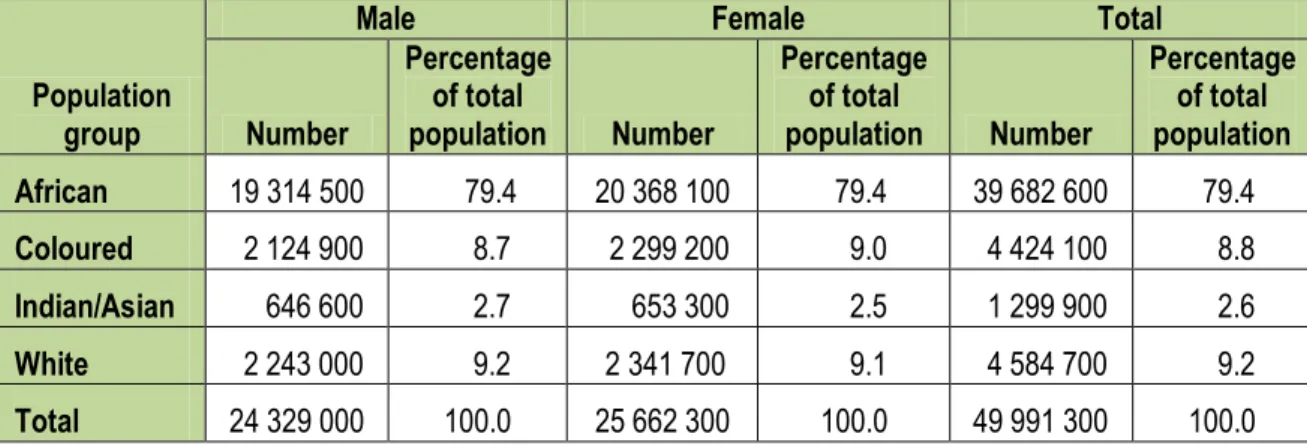
According to Statistics South Africa (2010), there were 25 662 300 women in South Africa as shown in Table 2.1.
17
Table 2.1 Mid –year population estimates for South Africa by population group and gender, 2010
Adapted from Statistics South Africa, mid-year population estimates
Population group
Male Female Total
Number
Percentage of total
population Number
Percentage of total
population Number
Percentage of total population African 19 314 500 79.4 20 368 100 79.4 39 682 600 79.4 Coloured 2 124 900 8.7 2 299 200 9.0 4 424 100 8.8 Indian/Asian 646 600 2.7 653 300 2.5 1 299 900 2.6 White 2 243 000 9.2 2 341 700 9.1 4 584 700 9.2 Total 24 329 000 100.0 25 662 300 100.0 49 991 300 100.0
As can be seen the total population in South Africa as per the mid-year population was estimated at 49 991 300 of which 51 percent of the population was female.
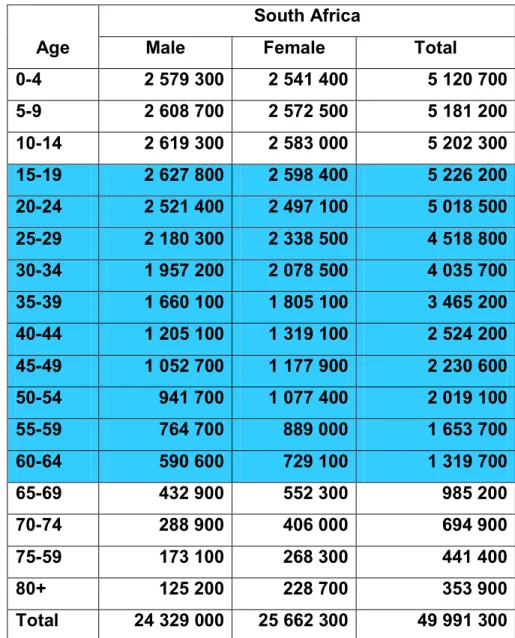
Table 2.2 shows that out of 25 662 300 females in South Africa, 16 510 100 made up the labour force which represented 64 percent of the total female population in South Africa aged 15 to 64, which co-incidentally was the same percentage amongst the male population (Statistics South Africa 2010). This then shows that the target for 2010 set in the Platform for Action in Beijing in 1995 have been reached.
18
Table 2.2 Mid-year population estimates by population group, age and gender, 2010
Adapted from Statistics South Africa, mid-year population estimates
Age
South Africa
Male Female Total
0-4 2 579 300 2 541 400 5 120 700 5-9 2 608 700 2 572 500 5 181 200 10-14 2 619 300 2 583 000 5 202 300 15-19 2 627 800 2 598 400 5 226 200 20-24 2 521 400 2 497 100 5 018 500 25-29 2 180 300 2 338 500 4 518 800 30-34 1 957 200 2 078 500 4 035 700 35-39 1 660 100 1 805 100 3 465 200 40-44 1 205 100 1 319 100 2 524 200 45-49 1 052 700 1 177 900 2 230 600 50-54 941 700 1 077 400 2 019 100
55-59 764 700 889 000 1 653 700
60-64 590 600 729 100 1 319 700
65-69 432 900 552 300 985 200
70-74 288 900 406 000 694 900
75-59 173 100 268 300 441 400
80+ 125 200 228 700 353 900
Total 24 329 000 25 662 300 49 991 300
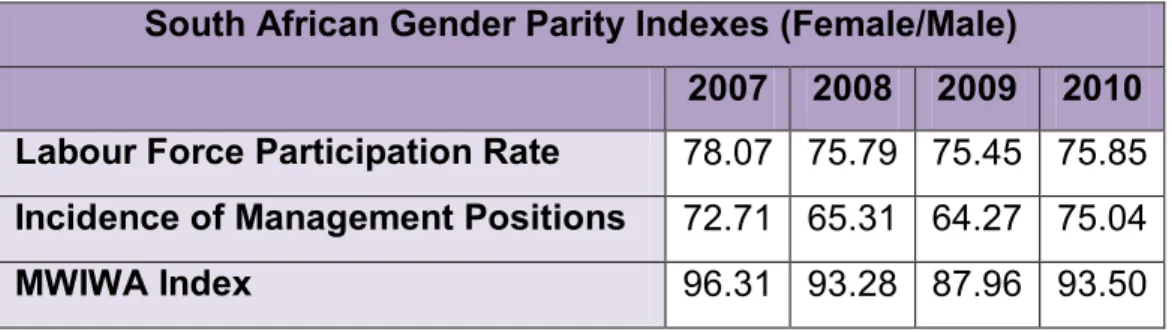
According to The Mastercard Worldwide Index of Women’s Advancement (MWIWA) 2010 the index rose from 87.96 percent in 2009 to 93.50 percent in 2010 as shown in Table 2.3. It can be seen from Table 2.3 that the highest level reached was 96.31 in 2007.
19 Table 2.3 Gender Parity Index
Adapted from The Mastercard Worldwide Index of Women’s Advancement 2010 South African Gender Parity Indexes (Female/Male)
2007 2008 2009 2010 Labour Force Participation Rate 78.07 75.79 75.45 75.85 Incidence of Management Positions 72.71 65.31 64.27 75.04
MWIWA Index 96.31 93.28 87.96 93.50
According to The Mastercard Worldwide Index of Women’s Advancement 2010, women have been advancing in the past except for the drop in 2009, which recovered in 2010. The South African labour force participation rate rose marginally from 75.45 percent in 2009 to 75.85 percent in 2010, which means those women and men between the ages of 15 and 65 formed part of the labour force in South Africa. The incidence of management positions rose from 64.27 percent in 2009 to 75.04 percent in 2010, which means that both female and male positions in management increased by almost 11 percent from 2009 to 2010.
Figure 2.1 Labour Force Participation Survey
Adapted from The Mastercard Worldwide Index of Women’s Advancement 2010
47 46.5 45 45.2
60.2 61.4 59.6 59.5
0 10 20 30 40 50 60 70
2007 2008 2009 2010
Percentage
Year
South Africa: Labour Force Participation Rate
Women Men
20
As can be seen in Table 2.3 the Labour Force Participation rate rose marginally from 75.45 percent in 2009 to 75.85 percent in 2010. Table 2.3 shows that although the labour force participation is 75.85 percent, 45.2 percent of the female population made up the labour force in South Africa in 2010. In comparison to the male population, the labour force made up 59.5 percent. This reflects a slight decline in the male labour force whilst females have a slight incline. The data shown in Figure 2.1 reveals that men still hold a higher number of jobs than women.
The Mastercard Worldwide Index of Women’s Advancement 2010 released in August of 2010 shows that the incidence of management positions rose from 65.31 percent in 2008 to 75.04 percent in 2010 (Table 2.3). This suggests that women advancement seems to be growing on a yearly basis.
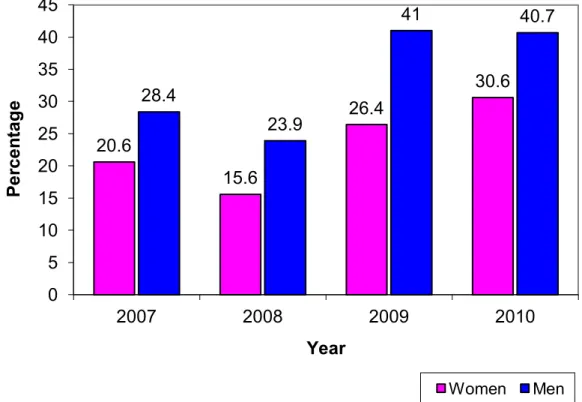
Figure 2.2 Incidence of Management Positions
Adapted from The Mastercard Worldwide Index of Women’s Advancement 2010 20.6
15.6
26.4
30.6 28.4
23.9
41 40.7
0 5 10 15 20 25 30 35 40 45
2007 2008 2009 2010
Percentage
Year
South Africa: Incidence of Management Positions
Women Men
21
Figure 2.2 shows that the number of women in management positions has grown in South Africa from 2008 to 2010 from 15.6 percent to 30.6 percent respectively.
This Indicates that women are increasing in high positions year on year. However, Enslin–Payne argues in the Business Report that “women continue to be disadvantaged in the workplace through holding fewer top jobs than men” (Enslin- Payne 2010). This contrasts with what is being published by the Mastercard Worldwide Index of Women’s Advancement 2010.
Mathur-Helm (2005) found that organisational researchers were paying more attention to women in management worldwide by reporting the changes of top and senior management positions. Her study showed that the awareness created by these researchers merely reflected on women’s intellectual and professional contributions. The study reveals that women worldwide are still in secondary positions, being underutilised in the market and were considered a waste of resources. The Catalyst as cited by Mathur-Helm (2005), reports that “within the Fortune 500 companies, only one in eight corporate officers were women” and very few women actually broke the ‘glass ceiling’. According to Wilson as cited by Mathur-Helm (2005), in the United Kingdom, of the 75 percent of female employees in the services sector, only 24 percent held management positions and 9.9 percent directorships. Cooke Fang as cited in Mathur-Helm (2005) reports that in China, women make up 47 percent of the labour force and very few move up to management. When women reach management positions, promotions took place at a slow pace, caused by the laws and policies that prevent women from “setting foot into certain domains of the male’s world” (Mathur-Helm 2005).
According to Mathur-Helm (2005), in South Africa, it is only recently that attention has been paid to problems faced by women in the workplace and in management positions. Various initiatives and documents illustrate this point, such as the National Women’s Empowerment Policy, the Commission on Gender Equality, the Women’s Charter for Effective Equality (1993), and the Current Constitution of the Republic of South Africa (1993), among others. Woman in the lowest ranks of organisations find it difficult to rise to senior and executive management levels, and are not benefiting from government policies and legislation towards career advancement (Mathur-Helm, 2005).
22
2.7 What is empowerment and who benefits?
According to Dainty, Bryman and Price (2002), empowerment yet poorly defined has been a subject of immense debate. The term rarely defined is commonly used as an idiom. The reason for this lack in definition is because it is mostly used in management programmes like Business Process Re-engineering (BPR) and Total Quality Management (TQM) (Dainty et al 2002). Empowerment has a wide variety of uses from deceptive empowerment where a high level of involvement and delegation is prominent to sham empowerment where something is not what it appears to be (Greasley, Bryman, Dainty, Naismith & Soetanto 2008). The term is more to be used in decision-making or giving power of authority over job content and job context. However the term “power” seems to be most common throughout the definition of empowerment though some would argue that empowerment should be used to equalise and promote trust and collaboration (Greasley et al 2008).
The term empowerment is used to denote the enhanced involvement of employees in organisational processes and decision-making. Though some proponents of empowerment see it as a manifestation of democratic ideals, most support the idea as a means of promoting employee well-being, and more especially as a way of harnessing the knowledge and abilities of employees as a whole to promote performance (Greasley et al 2008).
Empowerment requires a certain degree of characteristics within an organisation.
Employees need to know and understand the vision and goals of senior management where openness and teamwork are of greater need (Quinn &
Spreitzer, 1997).
Empowerment has evolved into two perspectives:
Structural empowerment: this refers to the sharing of power related to the organisational policies and practices and the latitude granted to employees to make decisions (Greasley et al 2008).
Psychological empowerment: based on employees perceptions and beliefs
23
of power, competence, control and self-efficacy (Greasley et al 2008).
The psychological state of employees as outlined by Lee and Koh (2001:686) has four dimensions:
Meaningfulness – the value of the task at hand.
Competence – the belief an individual has over their capabilities to skillfully perform tasks.
Self-determination – choices made towards behavioural patterns.
Impact – degree to which individuals have influence over the outcome.
The benefits of empowerment can be broadly divided into two areas: namely benefits to the organisation and benefits to the employee. Most research in the area of empowerment is based on the organisations benefits where the organisation attempts to enhance empowered working (Cunningham et al 1996).
The empowerment of managers in an organisation is considered ideal for the improvement of managing work organisation and job performance and not necessarily for the benefit of the employees (Greasley 2008). Whilst global competition and the change in business environment have provoked organisations to increase efficiency and performance, it can be argued that organisations have gained tremendously in various economic performance areas (Applebaum, Hebert
& Leroux 1999). This being so, Argyris (1998) argues that empowerment remains a myth rather than a reality.
Whilst empowerment drives the economic performance of organisations, there are also benefits for employees. Empowerment has brought about change in employees behaviour patterns where empowered employees reduce conflict and ambiguity by placing controls within their own environment (Nykodym, Simonetti, Warren & Welling 1994). Spreitzer et al and Koberg et al as cited by Greasley (2008) suggest that employees who are empowered become motivated and satisfied whilst being loyal to the organisation. This would greatly impact employee performance and effectiveness.
24
Whilst there are accounts of the supposed advantages of empowerment to both individual and team performance, it still remains a poorly defined concept, which is frequently used in a rhetorical sense (Mondros & Wilson 1994).
2.8 Summary
For empowerment to be successful, organisations need to facilitate teamwork (Greasley 2008). However, to begin this process an understanding of empowerment is necessary (Greasley 2008).
Attitudinal and organisational prejudices create the ‘glass ceiling’ which prevents individuals from advancing to senior levels of management, in particular women (Nagy 2005). From the ‘glass ceiling’ emerged other such barriers that women were unable to penetrate (Ismail & Ibrahim 2008).
With the emergence of democracy in South Africa in 1994 and the re-alignment of the Constitution in 1996, the Gender Policy Framework was passed to provide guidelines to empowering women in the workplace amongst other issues relating to gender equality (Mathur-Helm 2005). The introduction of affirmative action and equal opportunities legislation did little to assist women in acquiring senior management positions (Mathur-Helm 2005).
Women were found to have work-life balance issues and were faced with organisations misunderstanding of legislation policies and practices and thus women were being under-utilised in the labour market (Straub 2007). Although the percentage of males (59.5%) in the labour force was higher than females (45.2%) (The Mastercard Worldwide Index of Women’s Advancement 2010), women are making every effort to increase the numbers in management.
The review of literature in this chapter gave a wide view as to the barriers that face women in the world and in South Africa. It also gave a view of what the South African government and organisations are doing to empower women in the workplace. The literature provides a solid foundation for the comparisons of
25
results from other studies to the results of this study. The next chapter looks at the methodology used for this study.
26
CHAPTER THREE Research Methodology 3.1 Introduction
The literature review in chapter two forms the basis of the empirical study to determine the barriers affecting the empowerment of women in organisations in the Greater Durban Area. It also explains the impact of organisational practices towards career progression for women. This chapter fully describes the research methodology used to carry out this study.
According to Bryman and Bell (2007), a research method is a technique for collecting data using a specific instrument.
This chapter discusses the aim and objectives of the study and a motivation for using the quantitative method for the research.
3.2 Statement of the research problem
Although an increasing number of women enter the workforce each year, the majority number of senior management positions in the world are held by males rather than females, limiting women’s access to leadership positions (Weyer 2007). Despite numerous employment acts being implemented to overcome unequal gender and ethnic treatment in the workplace, racial discrimination is still a major barrier which affects employee motivation and commitment (Regmi, Naidoo and Regmi 2009). After more than a decade since the new Employment Equity Act in South Africa, companies who were required to hire and promote women, still have senior management and company boards dominated by White males (The Economist 7th October 2010). Nelson Mandela said in his opening speech after being released from Robben Island “for generations Black women have been the most oppressed group in our society” (Romany 1996: 857). South African Black women make up 86% of the domestic workers where there is no statutory minimum wages (Romany 1996), although since this minimum wages for
27
domestic workers has been legislated (department of labour 2011).
Based on the background above, the research questions for this study are:
Are women being empowered in the workplace?
What are the factors affecting women in progressing to management levels?
What and how are the barriers faced by women impinging on the progression of women to higher positions in companies?
Does the ‘glass ceiling’ created by male domination still exist?
Do women who are empowered reach senior management?
Do women who reach senior management create their own ‘glass ceiling’?
What are organisations doing to influence the career progression of women to executive positions?
3.3 Aim and Objectives of the Study 3.3.1 Aim
The aim of the study is to determine whether women in South Africa are being empowered in the workplace and the impact of organisational practices on their progression.
3.3.2 Objectives
The objectives of this study are to:
To ascertain individual’s views on women’s career advancement
28
To investigate barriers faced by women in achieving higher positions in companies
To examine the impact of organisational practices in promoting women to executive positions
Based on the research problem, aim and objectives, the method of how this study was conducted can now be discussed. The discussion starts with the sampling method and sample size followed by the description of the data collection strategies used.
3.4 Sampling
Due to the large population in South Africa and the time constraints, in addition to costs, accuracy of results, speed of data collection and the availability of the population elements, a sample of the population is used. Conclusions can be drawn of an entire population by selecting some elements of a population as a sample (Cooper & Schindler 2001). Sampling is the technique of selecting a part of the population to determine the characteristics of the population (Coldwell &
Herbst 2004). Sampling is a subset of the population selected for investigation (Bryman & Bell 2007).
Two types of sampling exist in research, probability and non-probability sampling.
Probability sampling is a sample that has been selected using random selection
“so that each unit in the population has a known chance of being selected”
(Bryman & Bell 2007: 182) and non-probability sampling is the sample that has been selected from the population by the researcher, where it is difficult to assess whether the sample is representative of the population (Coldwell & Herbst 2004).
The two types of sampling stated above have different sampling techniques.
Depending on the study, time and resources available, different techniques of probability sampling and non-probability sampling can be used (Sekaran 2003).
The common techniques used for probability sampling are (Coldwell & Herbst 2004): Simple random sampling, Systematic random sampling, stratified sampling
29 and cluster sampling
The common techniques used for non-probability sampling are (Coldwell & Herbst 2004): convenience sampling, purposive sampling and snowball or chain sampling For the purpose of this study, a quantitative research design has been selected.
The quantitative research design was selected so that real data could be collected from participants and analysed (Bryman & Bell 2007). Convenience sampling has been selected because the information which needs to be collected is from elements in the population who are available to provide it i.e. non-probability sample (Coldwell & Herbst 2004). Snowball sampling has also been selected where member of the population who are selected in the convenience sampling know other members of the population who would be good examples for the study (Coldwell & Herbst 2004). In this study, the researcher selected member from the Graduate School of Business (UKZN), colleagues at work, relatives, and members at St. Augustines Hospital who lived in the Greater Durban area. The researcher requested the members selected identify other members who would be good candidates for the study. Non-probability sampling is restricted where the selection of members cannot be determined and can be restricted to the generalisability of the population (Sekaran 2003). The advantage of this type of sample is that every participant will be able to answer the research questions and the researcher can statistically achieve the objectives related to the characteristics of the population based on data collected (Saunders, Lewis & Thornhill 2003).
3.5 Sample Size
Research is a cross-sectional design of collecting data through the use of a questionnaire or a structured interview (Bryman & Bell 2007). Cooper and Schindler (2001), argue that research design is a plan and structured investigation into obtaining answers to research questions. Coldwell and Herbst (2004) ask researchers to consider the following when deciding on a sample size:
The population relating to the study is finite or infinite;
The precise estimate the researcher wants to achieve;
The confidence level that is required for the study;
30
The number of variables required for the study to be examined;
The diversity of the population.
The sample size is dependent on the sampling design. Even if a large sample size is drawn, an inappropriate sample design would not yield the correct results to be generalised to the population (Sekaran 2003). Saunders et al (2003) argued that based on probability, the larger the sample size the lower the margin of error. A sample size should be determined after examining the respondents profile (Hair, Money, Samouel & Page 2007).
The population for this study consisted of employees at different levels of management. Mastercard Worldwide Index of Women’s Advancement (2010) showed that the female labour force was 16 510 100 and that 30.6 percent were in management positions. However, the survey did not show how many females by ethnic group, nor what percentages are in the Greater Durban Area.
In terms of accuracy, the sample size could produce a degree of bias where the sample elements underestimate or overestimate the population values (Cooper &
Schindler 2001). Efficiency can be attained by using a reduced sample size if a level of precision is given (Sekaran 2003).
The estimated population in the Greater Durban Area was 3 million of which 68%
of the population was Black followed by Asians (20%), White (9%) and Coloured (3%) (About Durban 2011). According to The Survey System (2007) a sample size (n) of 384 is required in this study for a population (N) of 3 million at the 95 percent confidence level and 5 percent margin of error. This survey attracted 129 respondents of whom only 121 respondents provided valid responses.
3.6 Data Collection Strategies
Data can be collected using several techniques, in different settings, and from different sources (Sekaran 2003). The collection of data is largely determined by the approach required by the study (Cooper & Schindler 2001). The reliability and accuracy of data is dependent on the selection of the data collection method (Hair
31
et al 2007). Quantitative data is captured through the use of numeric means while qualitative data is captured in narrative form (Hair et al 2007). The quantitative approach is used for a defined research problem whilst the qualitative approach is used to identify a research problem to assist in formulating and testing conceptual frameworks (Hair et al 2007).
The researcher used an electronic self-completion questionnaire for the purpose of the study. The questionnaire was accompanied by a covering letter which explained the purpose of the study before a respondent moved on to the questionnaire. The advantage of using this approach is that it can be completed anonymously, is inexpensive, easy to compare and analyse, can be administered to many people and lots of data can be obtained (Coldwell & Herbst 2004).
3.7 Data Collection Instrument
Saunders et al (2003) raised the importance of data collection wherein the researcher develops a theory and hypothesis, and then designs a research strategy or the data collected develops theory as a result of the data analysis.
There are three methods of collecting data i.e. interviewing, using a self- completion questionnaire and observation of people or market phenomena (Cooper & Schindler 2001).
Cooper & Schindler (2001) define interview as a two-way conversation between the interviewer and the respondent to gather information. Interviews can be structured or unstructured conducted face to face or by telephone (Sekaran 2003).
A self-completion questionnaire is a method of collecting data where the respondents answer the same set of predetermined questions without the interviewer being present (Saunders et al 2003). According to White (2000) a self- completion questionnaire is a structured interview where the interviewer is absent.
Interview and self-completion questionnaires require the researcher to interact with the respondents using a structured questionnaire, however another technique where questionnaires are not required to gather data is known as observation (Sekaran 2003). Observation is a technique in which the researcher formulates