The study also aims to assess the state of employee awareness of entrepreneurship offerings at TVET Colleges. The South African government's position to mandate TVET colleges to formalize the process of empowering the youth for entrepreneurship is a noble idea. The emphasis in entrepreneurship as taught in high schools is that entrepreneurship involves creating and building something of value, such as a business enterprise. or company with very few resources.
Problem Statement
Its purpose is also to assess the state of employee awareness of entrepreneurial offers at TVET schools. Staff perceptions were assessed based on their personal attitudes and perceptions towards it; their state of awareness of the entrepreneurial offer in their institutions; and their perceptions of how students accept and/or perceive entrepreneurial offerings.
Objectives
The study specifically focuses on assessing the level of preparedness of business studies lecturers in TVET college in Durban area towards entrepreneurship education. What recommendations can be made to the Durban TVET colleges to improve the provision of entrepreneurship education.
Limitations of the Study
Thus, the researcher designed the questionnaire in such a way that it would not take much time to complete. Further, the researcher personally collected the data and in the process, he clarified the gray areas without necessarily violating ethical rules.
Brief on research Methodology
The study was conducted during evaluation time and the management allowed the lecturers a few minutes to participate in my questionnaire, which could have compromised their opinion over time on the questionnaires as they had to rush through. For example, the pilot study for this questionnaire showed that the instrument could be completed in less than 10 minutes.
Structure of the Study
- Chapter One – Introduction
- Chapter Three – Research methodology
- Chapter Four – Presentation of Results, Discussion and interpretation This chapter presents the findings of the study and proceeds to provide an analysis
- Chapter Five - Conclusions and recommendations
The fifth chapter presents conclusions and recommendations based on the findings presented in the fourth chapter. The content of the chapter includes a summary of the study, conclusions from the findings, recommendations and opportunities for further research.
Conclusion
This chapter attempts to align the literature with the three objectives developed in this chapter. The sections covered in this chapter include research philosophy, methods, research strategy, population, sampling, pilot study, questionnaire administration, data analysis, ethical considerations, and issues related to validity and reliability.
Introduction
Defining and Clarifying the Key Concept – Entrepreneurship
Entrepreneurship therefore refers to the ability to create a business where none existed before and is important to every economy worldwide. Ayonmike (2016) highlights that individuals' ability to learn quickly is linked to the ability to develop new ideas and to discover new ways of looking at problems and opportunities.
The importance of entrepreneurship education
Entrepreneurship education programs have been very useful in both Europe and the United States (Ashmore, 2012). According to Ayonmika (2016), entrepreneurship education, which is part of the higher education package, brings a renewed desire for self-starting.
The TVET Colleges and entrepreneurship education offerings
The DHET (2013), emphasizes that the development of efficiency and capacity at TVET colleges is an important strategic plan. Currently, TVET colleges operate in parallel with basic education providers while competing with universities in terms of student intake (Council 2012).

TVET College challenges towards entrepreneurship education offerings Entrepreneurship education outputs have been under scrutiny and this was done
According to (Jones, 2007; Neck and Greene, 2011) entrepreneurship education can become too strained to deliver due to the nature of teaching strategies. Learning games that simulate the real world seem to be gaining ground in entrepreneurship education.
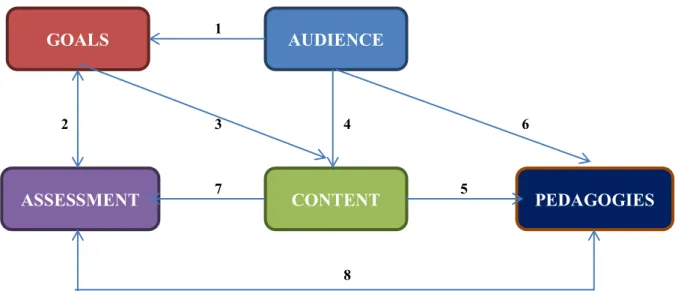
The TVET business management Lecturer and preparedness to offer entrepreneurship education
Entrepreneurial attitude and efficacy
Therefore, to improve students' entrepreneurial learning and competencies, qualified lectures that have a positive attitude toward entrepreneurship and a strong sense of entrepreneurial self-efficacy should be provided (Adedovin, 2010). However, research on entrepreneurial attitude has generally focused on looking at students' attitudes towards entrepreneurship (Harris and Gibson, 2008) and there is less information about teachers' entrepreneurial attitudes.
Ways to enhance TVET education towards entrepreneurship education According Adedoyin, (2010) there are two areas of entrepreneurship education,
According to Sydney and Shaw (2014), the Department of Higher Education and Training needs to review and refocus the links on education and training, so that young people become relevant and confident when they go out into the world of work. Higher education institutions like Technical Vocational Education and Training Colleges should be the promoters of entrepreneurial agenda and promote it as a viable course as well as the best option for employment.
Conclusion
Therefore, TVET colleges must join the party by refocusing their role in the South African economy. Entrepreneurship program at TVET colleges should be competency driven as content as the design of TVET had to be more practical in approach.
Research Philosophy
Positivist research philosophy
Specifically, the chapter included research philosophy, design, strategies, population, sample size, research instrument, pilot study, data analysis, questionnaire design, and ethical considerations. A positivist research philosophy is concerned with the creation of objective truth, which results in either proving or disproving a belief or theory, regardless of the case. Positivist philosophers “often presuppose scientific methods; to standardize the process of generating data by quantifying observed phenomena in order to improve accuracy in the interpretation of parameters and relationships between them” (Creswell, 2013:57). The results of a positivist research philosophy are that falsehoods are eliminated and truths are accepted as reality. (Creswell, 2013:57).
Phenomenological research philosophy
A positivist research philosophy is concerned with generating the objective truth that results in proving or disproving a belief or a theory, whatever the case may be. A positivist philosophy generates facts that are objective insofar as they lead to insights into the readiness of teachers in teaching entrepreneurial courses in TVET colleges.
Research Design
Exploratory Research
The exploratory research design was not used for this research because of its inability to provide an analytical perspective on the research topic. The purpose of descriptive research design is to explain the “who, what, when, where and how” of a topic of interest (De Vaus, 2010:81).
Explanatory Research
The reason why the descriptive research design was not adopted for this study is because it is judgmental to the research topic in the sense that it does not provide an analysis of the nature of the lecturer's readiness to teach entrepreneurship courses. Explanatory research design is also variably known as the analytical research design because its focus is on the analysis of the cause and effect scenarios Paul, Gardner.
Causal research designs
Paul, Gardner & Haeffele (2012:12) pointed out that an interpretive research design is defined as an approach that brings together ideas that help the researcher understand cause and effect that explains why things are the way they are.
Research Strategy
Since these are more related to scientific fields, the experimental research design was not found to be relevant to business-related research and was therefore disregarded for use in this study. The quasi-experimental research design is conducted in an artificial laboratory or in a field environment conducted in a non-randomized manner to investigate a phenomenon of interest.
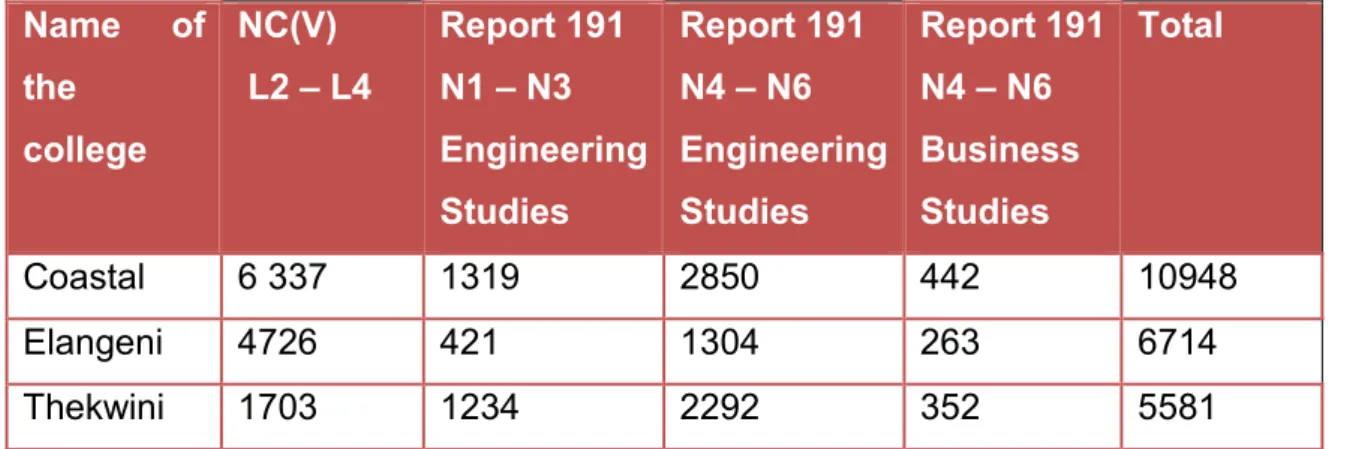
Target Population
Sampling strategy
Not every member or element of the population has an equal chance of being selected from the sampling frame. Stratified sampling ensures that the profile of the sample matches the profile of the population.
The Research Instrument
Questionnaire development
The questionnaire was designed after factoring the study objectives, research questions and literature review on the readiness of lecturers in teaching entrepreneurship modules in VET colleges.
Letter of consent
As a part of research ethics, permission to conduct the study was obtained from the identified college authorities before starting the research.
Pilot Study
Questionnaire Administration
Data analysis
Validity and Reliability
Test-retest reliability
Parallel forms of reliability
Validity
Content validity assesses the level to which the research questions in the research instrument cover all the research objectives (Welman Content validity was ensured in this research by incorporating all the necessary questions in the questionnaire that lead to the fulfillment of the research objectives. Criterion-related validity speaks of the ability of the measurement that used in the research instrument, to predict or project the likely results in the same or similar research area (Welman, 2009:141).
Limitations of the study
Ethical considerations
Permission to conduct research - The researcher obtained permission from the authorities of the three TVET colleges around Durban that participated in the study. Protecting anonymity - Respondents' anonymity was ensured by ensuring that personal details of individuals were not included in the questionnaire. This ensured that the anonymity, identity and privacy of the respondent remained protected.
Conclusion
Principals of all three TVET Colleges in Durban gave the study ethical permission to conduct the study. The chapter further described the pilot study, factors that put limitations on the study, ethical considerations were taken into consideration during the conduct of the study.
Introduction
Response rate
Background information
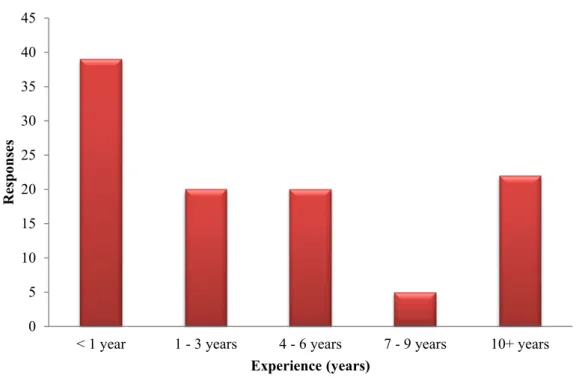
Years of experience
The least represented group were lectures with 7 to 9 years of experience with only 5 (5%) participants emerging from their ranks. Experience counts in any job, and the fact that the greater number of readings were known suggests that the product that would come out of the system would be half-baked.
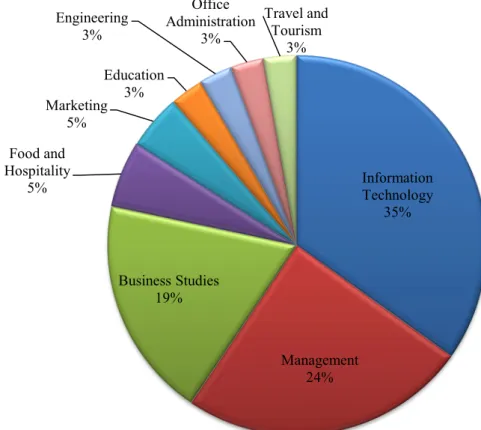
Lecturing department
This could possibly mean that the new lectures lacked experience of TVET university offerings, particularly on entrepreneurship. Technology, Office Administration; and the Travel and Tourism departments had the lowest representation, each with 3% of participants representing them.
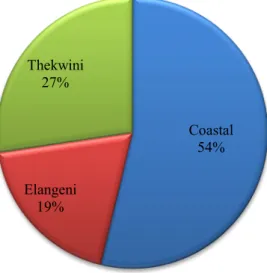
Participant distribution by campus
Among the coastal campuses, the As-Salaam campus had the highest representation with 37% of participants from this campus representing the Coastal TVET College. The Kwini TVET college had the highest representation on the Springfield campus with 38% of participants from this college taking part in the survey.
Objective 1: To determine entrepreneurship offering at TVET Colleges This was the first objective of the study, which sought to advance an understanding
- Subjects offered
- Student enrolment numbers
- Content delivery and assessment methods
- Content delivery
- Assessment Method
This was the most common means by which entrepreneurship was delivered of the 6 proposals detailed in Table 4.3. It was known that the NCV certificate in entrepreneurship was offered in the departments of 38% of the 106 participants.
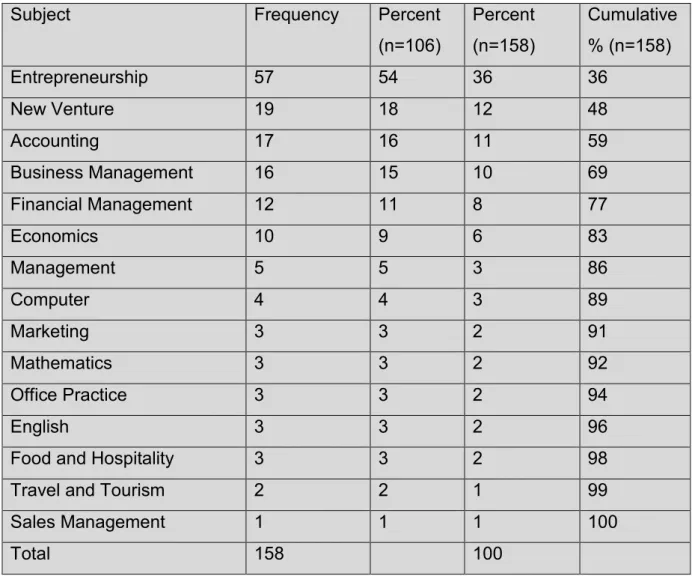
Objective 2: To determine challenges that TVET Colleges are facing in offering Entrepreneurship as a programme
Student entrepreneurial efficacy received the second highest ranking as one of the main challenges facing colleges in offering entrepreneurship programs. The fundamental task for VET academics is to constantly test the relevance of curricula and training programs (Gibbs, 2009).
Objective 3: To evaluate the solutions proposed by lecturing staff towards improving entrepreurship education in TVET colleges
- Role playing as a solution to enhancing entrepreneurship education The purpose of this section was to ascertain if role-playing had an effect on the
- Design implementation & shadowing of entrepreneurs as a solution to enhancing entrepreneurship education
- Provision of resources by TVET colleges as a solution to enhancing entrepreneurship education
- Offering entrepreneurship course as a solution to enhancing entrepreneurship education
According to Trading Economics (2013), while funding was essential for entrepreneurship, TVET colleges must focus on the teaching component, while the national government through its various structures provides the funding to equip students with the much needed resources. The negative result may be a result of the fact that the lecturers, through their experience, know very well the capacity of the TVET colleges to provide funding.

Conclusion
The objectives were chosen for the purpose of defining the entrepreneurship offer in VET Colleges, identifying the challenges that VET Colleges are facing in offering Entrepreneurship as a programme, and to suggest strategies to improve entrepreneurship offers in VET Colleges. The conclusions are followed by recommendations for VET colleges regarding strategies for improving the delivery of entrepreneurship courses.
Summary of the study findings
This chapter presents the conclusions and recommendations for the study regarding the aims and objectives of the study. All the three research objectives drawn for the realization of the study may have been fulfilled.
Conclusions from the study
Objective 1: To determine entrepreneurship offerings at TVET Colleges in the Durban area
Objective two: To determine the challenges that TVET Colleges face in offering entrepreneurship education
Identifying the challenges faced by VET colleges may have successfully met the second objective.
Objective three: To evaluate the solutions proposed by lecturing staff towards enhancing entrepreurship education
Recommendations of the study
The management of TVET colleges should be actively involved in the promotion of entrepreneurial education by providing all the necessary resources for the successful implementation of the entrepreneurship course offerings. The proposed solutions/recommendations highlighted in section 5.2 are sensible and realistic and can be adopted by TVET colleges.
Scope for further research
TVET colleges should undertake academic exchange programs with other renowned tertiary institutions from other countries with a view to benchmarking their entrepreneurship programs with the international best. For example, TVET colleges can assemble a team of experts in entrepreneurship and give them terms of reference that include conducting research of curriculum content of entrepreneurship colleges offered in recognized institutions such as Harvard and Yale University or the University of Cape Town or any other recognized tertiary institution in order to adopt the content for local presentations.
Chapter Five and overall study conclusion
34;Entrepreneurial Attitudes and Entrepreneurial Effectiveness of Technical High School Students." Journal of Vocational Education and Training. 34;The State of Entrepreneurship Education in the United States: A Nationwide Survey and Analysis." International Journal of Entrepreneurship Education.