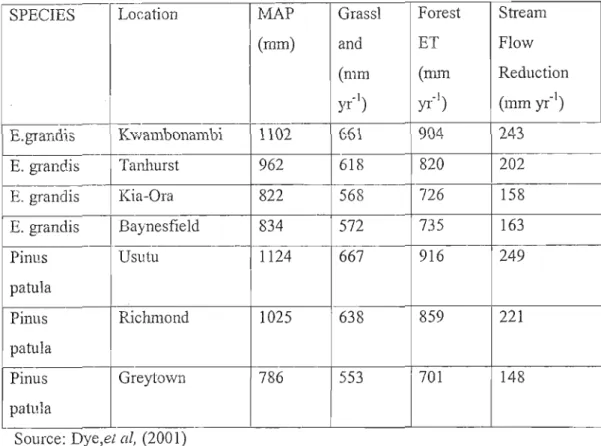
ET water is used because it has been discovered that water is lost due to afforestation. This is clear that the value of water for eucalyptus grandis using ET water is higher than that of pinus patula.

Problem Statement
Therefore, planting forests tells us that there would be reduction in water supply due to aquifers. For example, in the United States (US), an aquifer was supposed to live for a period of one hundred years, but was pumped in such a way that it ended up living for 40 years (Winpenny, 1994).
The Objectives of the Study
This means that different methods must be developed to value water in commercial forestry.
The Need for the Study
The Scope of the Study
The Organization of the Study
LITERATURE REVIEW AND VALUATION METHODS
Introduction
The Water Use in the Commercial Forestry
An increase in the demand for forest products means that stream flows will be significantly reduced. In economic terms, this means that the opportunity cost of using water must be taken into account.
The Valuation of Water as an Environmental Resource
First, according to Alan Gilpin (1999); National Research Council (1997), value can be defined as the 'value in exchange'. Finally, value can be defined as the total economic value (TEV) attached to environmental resources.
The Valuation Methods
Damage prevention costs can be seen as part of the value of water. The problem with this method is that in most cases individuals are limited by income rather than demand. By local we mean the change in production due to the assessment of the value of environmental resources.
The MPP is then multiplied by the marketable share of the crop to obtain the marginal value product (MVP) of the crop. Furthermore, consumer surplus does not change because the price of the crop is constant. When estimating the value of environmental resources, we focus only on the linear programming (LP) method.
The definition of the hypothetical market determines the quality of the answers obtained by the researcher. This is the actual questioning of individuals regarding their valuation of the proposed good or service, and their socio-economic situation. The choice of the right population is actually the population that will be affected by the proposed change.
THE VALUATION OF WATER IN THE COMMERCIAL FORESTRY: THE CONCEPTUAL FRAMEWORK
- Introduction
- The Valuation of Water in the Commercial Forestry in South Africa
- Data Sources and ~ompliter Packages
- Summary
In addition, this method does not use the actual yield to estimate the value of water, but rather the predicted yield. This book provides all the costs needed to assess the value of water in commercial forestry. As stated above, the value of water using the residual method is estimated only on ET water.
Finally, when estimating the value of water using the residual method, we use the achlaal yield. However, when estimating the value of water using the MVP method, we use the predicted yield. This new yield is used in estimating the value of water using the marginal value product (MVP) method.
Finally, the estimation of the value of water can be done using the Microsoft computer package. The estimation of the value of water used in commercial forestry can be done using the residual method and the MVP method. The use of ET and SFR water in estimating the value of water causes the results to be different.
ANALYSIS AND DISCUSSION OF FINDINGS
Introduction
Evapo-transpiration
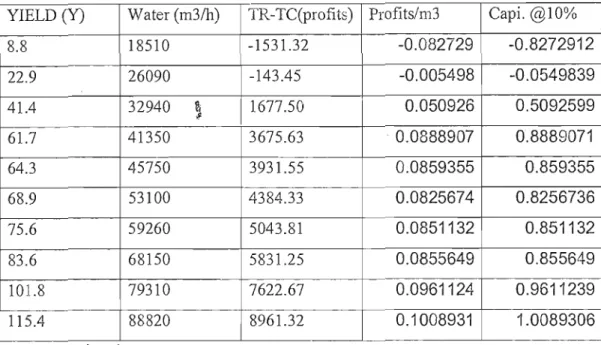
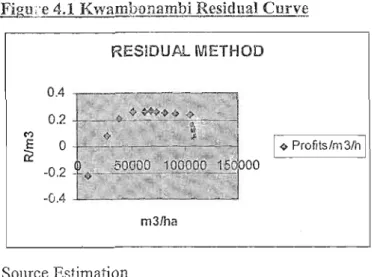
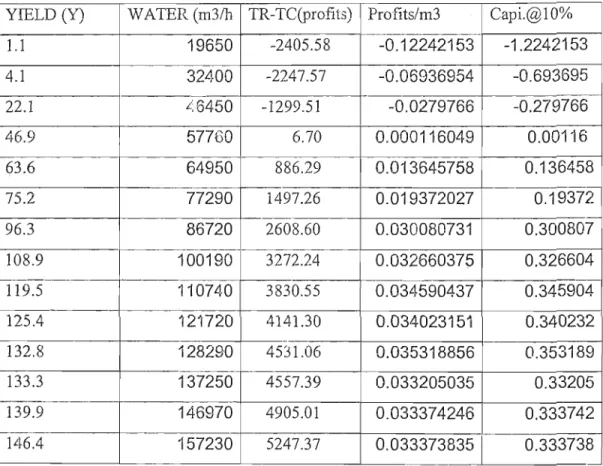
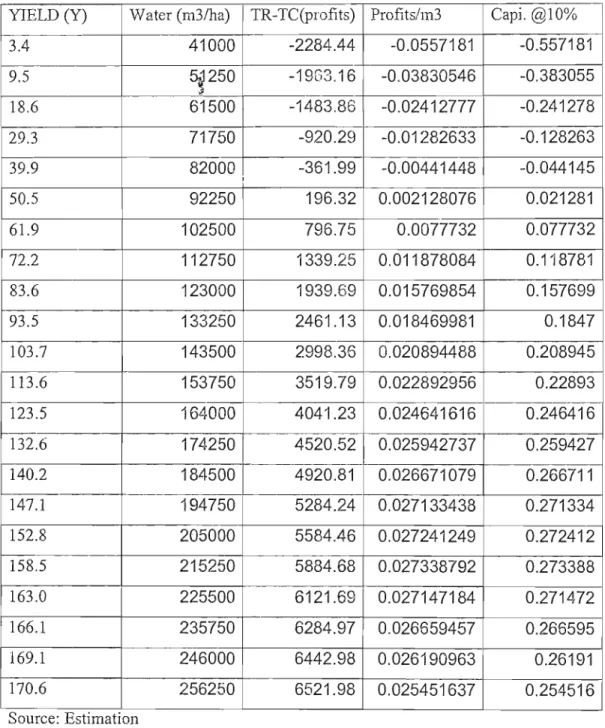
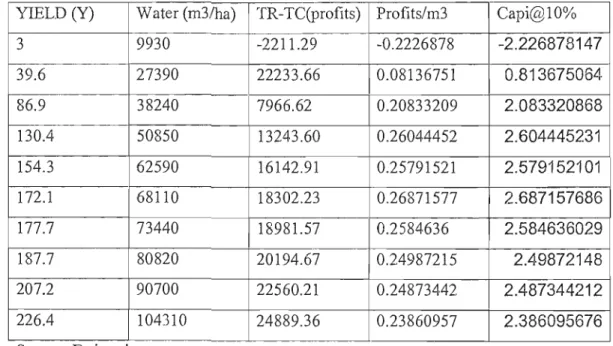
This is the first method that can be used to estimate the value of water in commercial forestry. The results of the two tables above show that for Kwambonambi site the value of water starts by increasing and then reaches a maximum point and then starts to decrease. However, in the case of Kia-Ora, results show that the value of water for this site continues to increase.
Moreover, this species shows that the value of water for Kwambonambi is higher than that of Kia-Ora. This shows that the value of water is higher when compared to that of IGa-Ora. Since water values vary, it is imperative that graphs can be displayed below to see the relationship between water value and water quantity.
ESIDUAL METHOD
- Stream Flow Reduction (SFR)
- Summary
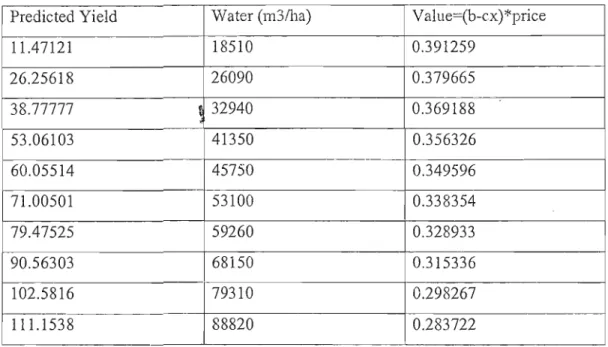
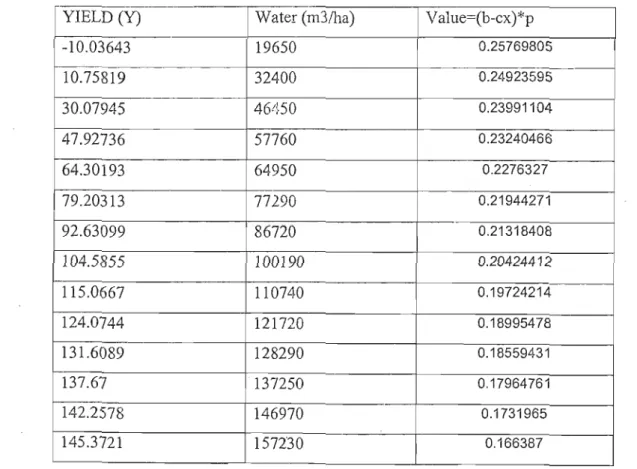
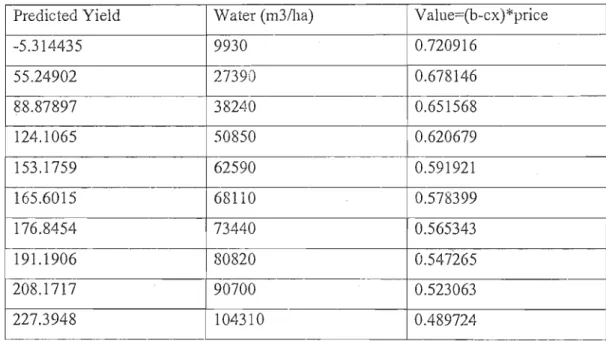
The purpose of this subsection is to estimate the value of water using the MVP method. This is due to the fact that we estimate the value of water using. In the case of Kwambonambi, the value of water starts from 72 cents and drops down to 49 cents.
The results above show the results of the value of water after estimating the function. This shows that the value of water is lower for pinus pahlla than for eucalyptus. It is clear that the value of water is higher for SFR water than for ET in both species.
Lower rainfall in the Kia-Ora means that the value of water must be higher than the Kwambonambi site. However, the value of water using the SFR water continues to decrease because we use the MVP method. Even in the case of ET water, the value of water decreased with the MVP method.
CHAPTERS
SUMMARY, CONCLUSIONS, POLICY RECOMMENDATIONS AND LIMITATIONS OF THE STUDY
Summary
Furthermore, a price signals that the opportunity cost of using a resource has been foregone. In the case of commercial forestry, the water used could have been used in other sectors or to grow others. In the case of environmental resources, there are four methods that can be used.
Two methods have been developed for estimating the value of water in commercial forestry, namely the residue method and the marginal value product (MVP) method. And in the case of pinus patula, they range from 26 cents to 12 cents. This water only uses the MVP method to estimate the value of the water in the ad.
Finally, it should be noted that the main objective of the study is to assess the value of water in commercial forestry. This research objective is addressed in the sense that water used in commercial forestry can be valued using supply and demand forces. To estimate the value of water in the commercial strip using two water sources, ie, evapotranspiration (ET) and streamflow reduction (SFR) water.
Conclusions and Policy Recommendations
If it had not been for regulations, it would have been difficult to estimate the value of water. Their impact on the assessment of the value of water is that they involve legal action if they are not obeyed. The laws also recommend paying a price for water so that water can be allocated efficiently.
Furthermore, the funds would ensure that the foresters grow trees of high value rather than those of low value because the value of water is derived from the output. In the case of commercial forestry, two methods have been developed to estimate the value of water. What is unnecessary about these methods is that they have to estimate the value of water in commercial forestry.
In this study, two types of forest products were used to assess water value. This also tells us that there must be other ways to solve the water problem in this country when it comes to reforestation. Fortunately, this study can regulate water use as the value of water is assessed and eventually the price of water is linked to water for commercial forestry.
Limitations and Areas of Further Study
Profile and Analysis of the South African Commercial Forestry Industry with Special Focus 011 Non-Timber Forest Products (NTFP) Research. Gilpin, Alan (1999) Environmental Economics: A Critical Review, New York: John Wiley and Sons, LTD. 1980) Water QualiZV in Catchment Ecosystems, New York: John Wiley and Sons, LTD. OECD (1994) GECD-Project Papers ([/ld Policy Appraisal: Integrating Economics and Environment. 1993) Economic Values and the Natural World.
Ackennan, D.P.· (1973) Meeting South Africa's Future Demand for Wood. September 1976) Control of Water Catchments by Ti,e Department of Forest1}'. The impact of vegetation control on pine establishment at four sites in the summer rainfall region of South Africa. Matheson, S.M. (1991) Future Water Issues: Confrontation or Compromise, Journal of Soil and Water Conservation, Volume 46 n02: pp Plantation ForestJ}' in SouthAfrica and its Impact on Biodiversity and Water.
APPENDICES
Appendix C.3: Land Capitalization Formula The third formula is land capitalization. APPENDIX D: ET-APP and MPP RESULTS USING ACTUAL PROFIT This appendix discusses the derivation of the average physical product (APP) and marginal physical product of evapo-transpiration (ET) of water. In case of valuation of any good, that good must be produced in the second stage where MPP is less than APP but greater than zero.
The two sites show what we expect, as both APP and MPP start rising, then reach a maximum and then start to fall. APPENDIX E: ET-APP and MPP RESULTS WITH PREDICTED YIELD The essay stated that we have two methods that can be used to estimate the value of water in commercial forestry, namely: the residual method and the marginal value product (MVP) methods. APP values above start rising and reach a maximum point and then start falling at both locations.
In the vase of the pinus patula, APP values begin to increase to an inaxial point and then begin to decrease. In the case of Richinond, the values start to fall and towards the end they start to rise. It is then difficult to identify the second phase, which is the production phase if the values do not reach a maximum. APPENDIX F: SFR APP and MPP WITH PREDICTED YIELD The tables below show the APP and MPP values using the SFR water.