Naidoo P, Jinabhai CC, Taylor M, Role and contribution of private health sector physicians in the management of HIV-infected patients in the Ethekwini Metropolitan area of KwaZulu-Natal. Naidoo P, Esterhuizen TM, Jinabhai CC, Taylor M, Evaluation of the clinical management of HIV-infected patients by private practitioners in eThekwini Metro, KwaZulu-Natal.
Abstract
Although many studies have been conducted on HIV/AIDS, fewer have been conducted in the private sector regarding the management of this disease, including the adherence monitoring practices of physicians, their training needs and sources of information, and their willingness to treat patients in the public sector. . . A literature review was also conducted on barriers that prevent physicians from treating patients with HIV/AIDS.
Introduction
Background
- The Human Immunodeficiency Virus (HIV)
- The HIV/AIDS Epidemic: Global, African and South African perspectives
- The role of government policy on HIV and AIDS
- Treatment regimes in public and private healthcare sectors
- Antiretroviral (ARV) drugs
- Combination therapy and ARV treatment guidelines
- Medical Aid in relation to HIV/AIDS
- Private Healthcare Sector
Penetration allows the nucleocapsid (genetic core) of the virus to be injected directly into the cytoplasm of the cell. Most of the eThekwini metro is urban (central) and suburban (south, north and west) with a small rural constituency (in the inner west and further south).
Problem Statement
- HIV management by Private Sector Doctors
- Role and clinical contribution of doctors in the HIV epidemic
- Barriers that prevent doctors from managing HIV/AIDS patients
- Interface between public and private health care sectors
AIDS has emerged as a critical public health problem in the developing world, and the involvement of both the public and private health care sectors in its management. As a result, many of the doctors who trained before 1996 would not have received any formal training in the drug management of HIV and AIDS patients.
Rationale of the study
Aims and Objectives
To investigate private practitioners' HIV/AIDS medication and clinical care in eThekwini Metro in KwaZulu-Natal. To identify strategies used by private sector doctors to improve the adherence of their patients in the eThekwini Metro of KwaZulu-Natal.
Method
Most of the eThekwini Metro is urban (central) and suburban (south, north and west) with a small rural constituency (inner west). Evaluation of private sector doctors HIV/AIDS drug and clinical management in the eThekwini Metro of KwaZulu-Natal,.
Study Framework
34 formed between the public and private sectors to help the rapidly approaching crisis in the public sector in terms of HIV management, then the willingness of the private sector to manage HIV patients in the public sector should be known. The final paper found in Chapter 8, which was part of phase 3, highlights the problem of adherence in patients visiting private sector doctors and some of the positives in terms of why they take their medicines.
Role and contribution of private healthcare sector doctors in the management of HIV- infected patients in
Barriers to HIV Care and Treatment by Doctors
A review of the literature
Evaluation of the Clinical Management of HIV infected patients by Private Sector Doctors in the eThekwini
Metro of KwaZulu-Natal
Evaluation of the Clinical Management of HIV-infected patients by Private Sector Doctors in the eThekwini.
Identification of sources for seeking HIV and AIDS information amongst private sector doctors
Respect for Follow-up Practices in the Private Health Sector Physicians managing patients with HIV and AIDS v.
Adherence Monitoring practices of private healthcare sector Doctors managing HIV and AIDS patients in the
Willingness of private doctors to manage HIV and AIDS patients in the public sector in eThekwini Metro.
Private sector doctors’ willingness to manage public sector HIV and AIDS patients in the eThekwini Metro
Factors influencing HAART adherence among private health care sector patients in a suburb of Ethekwini.
Factors influencing HAART adherence among private health care sector patients in a suburb of the Ethekwini
Metro
Discussion
However, this study confirmed that not all private sector doctors were treating HIV and AIDS patients in KZN's eThekwini Metro. Urgent educational interventions should be provided to improve the knowledge base of private sector physicians in HIV and AIDS management. 81 workshops are to be organized to facilitate the broadening of HIV and AIDS management among private sector doctors.
Understanding and reducing these barriers could help all private sector physicians in the metro get involved in HIV treatment. The NDOH recommendation that patients be referred to specialists if drug failure occurs was adhered to by more than 40% of physicians in the study. There is an urgent need to address these shortcomings in private healthcare if a meaningful partnership is to emerge.
Equally important is the role that patients visiting doctors in the private sector can play in managing the HIV epidemic.
Limitations
Conclusion and Recommendations
Conclusion
That private health practitioners in the eThekwini metro obtained their information from reliable sources to have up-to-date knowledge of the overall management of HIV-infected patients, but electronic sources were least accessed. Physicians in the private sector who manage HIV and AIDS patients were monitored for compliance using various monitoring tools, but the reliability of the tools was not assessed by all of the physicians. Doctors have strategies to improve patient adherence to ARV treatment, but more needs to be done in this area.
Private sector doctors are willing to help treat HIV and AIDS patients in the public sector, sharing their models and experiences and helping the government manage South Africa's HIV-infected population. However, there are barriers to doctors wanting to treat HIV patients in the public sector that need to be addressed. Adherence to antiretroviral treatment is a problem among patients in the private health sector in KwaZulu-Natal, and there are barriers to adherence.
In this study, the reasons for the use of medications and compliance are related to adequate information provided by the doctor.
Recommendations
General Recommendations
Adherence interventions should include specific educational sessions with each patient and include a program for providing the necessary support in an open and non-judgmental manner throughout the life course of treatment. A multidisciplinary team approach involving the nurse and pharmacist should be encouraged, where intensive counseling and pharmacy refills can be used as tools to improve and monitor adherence to treatment in HIV and AIDS patients. The pharmaceutical formulation of certain antiretroviral drugs should be reconsidered to facilitate the swallowing of these drugs or, where possible, improvised preparations made and provided to patients experiencing such problems in the short term.
Dosage forms should be prescribed according to individual preference, but when not available, tablets should be carefully broken into smaller sizes, if scored, encouraged and advised to take the whole dose.
Further research areas that are identified include
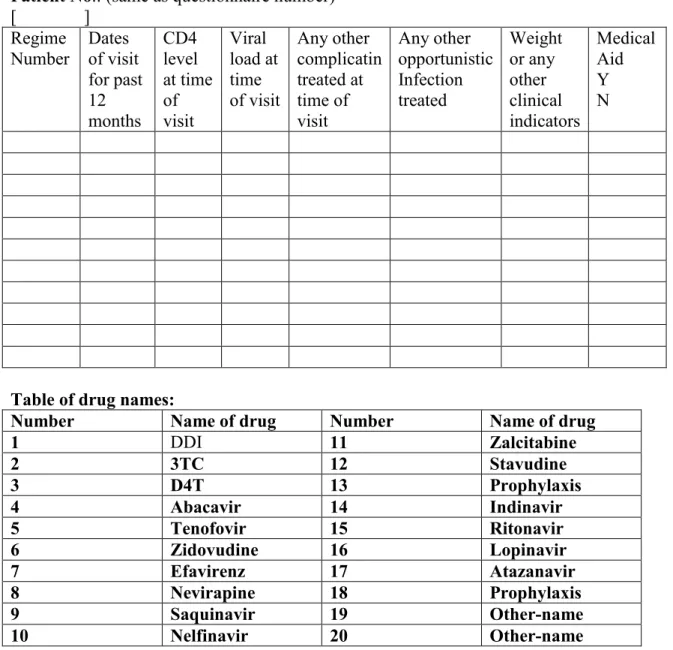
11. A study to examine the costs of HIV care in private healthcare (including all costs associated with doctor visits, blood tests, laboratory and medications), but excluding hospital costs. Clinical outcomes can be determined by clinical indicators such as weight loss/gain, adverse events experienced and treated by a physician, the presence of opportunistic infections, CD4 counts, and viral load data.
Verdensomspændende HIV & AIDS-statistik Globale HIV/AIDS-estimater, slutningen af 2007 http://www.avert.org/worldstats.htm [Tilgået 17/1/09]. 12. Centre for Actuarial Research, South African Medical Research Council og Actuarial Society of South Africa, november 2006, The Demographic Impact of HIV/AIDS in South Africa-National and Provincial Indicators for 2006. 17.Abdool Karim SS, Abdool Karim Q ( eds), HIV/AIDS i Sydafrika, HIV Infection in South Africa: The Evolving Epidemic.
WHO, UNAIDS, UNICEF, Progress Report 2008: Towards universal access: scaling up priority HIV/AIDS health interventions. The importance of the doctor-patient relationship in HIV/AIDS treatment: a case report. 55.Lien Q, Mayer K, McGarvey ST, Lurie MN, Phuong D, Knowledge, attitudes and practices among physicians about HIV/AIDS in Quang Ninh, Vietnam.
73.Massiah E, Roach TC, Jacobs C, et al., Stigma, discrimination and HIV/AIDS knowledge among physicians in Barbados.
APPENDICES
Flow Chart
Questionnaires
- Introductory letter, consent form and questionnaire
- Questionnaire
- Introductory letter, consent form , questionnaires and history profile
- Introductory Letter
- Consent Form & Questionnaire
- Questionnaire
- Your demographics
- The characteristics of your HIV and AIDS patients and
- To do an assessment of your clinical management of HIV and AIDS patients
Where do you get information about HIV and AIDS: (Check all that apply). Are you currently feeling properly outnumbered by Medical Devices for the treatment of HIV and AIDS patients? If YES, do you think you have what it takes to manage HIV and AIDS patients in the public sector?
Do you think the following can play a role in managing HIV and AIDS? Do you follow any published treatment guidelines when managing your HIV and AIDS patients? Do you measure the following when diagnosing patients with HIV and AIDS?
Do you (or through an interpreter) / nurse / peer counselor advise your patients with HIV and AIDS on the following.
Thank you Doctor for your time in filling out this questionnaire and for your contribution to science
Thank you Doctor for your time in completing this questionnaire and for your contribution to science.
Do you have any questions or comments relating to the study?
Introductory Letter
The information you give me will help me find better ways to help you. Answering these questions is voluntary and the answers you give will not be shared with your family members or friends. In this research I will also look at your prescriptions or profile to see if the medicine has helped you and if you are following the treatment.
If you need help filling out this questionnaire, please let your doctor know so I can get someone to assist you. Do not write your name on the questionnaire, but you must sign your name on the informed consent form giving me permission to conduct the survey and interview you and to look at your scripts/profile. Since your participation is voluntary, you can also withdraw from the study at any stage.
This study received ethics approval from the University of Natal, Nelson R. Mandela School of Medicine, Research Ethics Committee, reference no.
Consent form & Questionnaire
DO NOT WRITE YOUR NAME
If YES, how often would you say you missed taking your medicine Once a day Once a week Twice a week Other - please specify. If you missed taking your medication, please indicate whether it was for any of the reasons below. I forgot to take my pills I had too many pills I had too many side effects.
Had trouble taking the medicine Don't have someone to remind you to take the pills. How often have you had blood drawn for HIV and AIDS in the past 12 months? If you have limited HIV and AIDS funding, what do you do when your benefits run out?
Evaluation of clinical and drug management of HIV/AIDS patients in the private health care sector of Ethekweni metro of KwaZulu-Natal.