
The purpose of this study was to investigate the alleged racism and lack of transformation in the advertising, marketing and communications industry based on plenary hearings held in Parliament from November 2001 to October 2004. Communications and the Government's communications and information system (both determined to to be catalysts and not agitators) took the initiative to establish a task force to put together an Indaba of all interested parties and anyone who had even the remotest interest in the issue regarding the allegations that the industry was still mired in the old apartheid mentality.
Introduction
Motivation for Research
It is true that some consumers are worth more than others because they have more purchasing power” (Koenderman, 2002). Business Day's advertising consumption per reader, for example, is higher than any other daily newspaper, because it is read by the rich", concludes Koenderman (2002).
Definition of Terms
Media, in the context of this study, broadly refers to means and platforms of communication, it will include and be limited to radio, television and newspapers. Professionals who reserve advertising space or place advertisements in the media (radio, television and newspapers) are called Media Planners.
Statement of the Research Problem
After defining the concepts used in this study, the following presents the setting of the research problem. The research also provides a foundation for other researchers who may be interested in further research into monitoring the progress of racial transformation in the advertising and media sectors.
The Purpose of the Study
Then, the research questions and a formal thesis proposal based on information from data sources identified during the pilot study were generated. The data for this project study was collected using field notes, observations, questionnaire surveys, semi-formal interviews and industry submissions to Parliament.
Research Strategy and Research Methods
The researcher also relied heavily on data mining from the Internet, blogs, and chat rooms, where issues of transformation in the industry were widely debated. Out of 30 executives approached only 18 from 8 different agencies participated in the survey.
The Relevance of the Study
The researcher seeks to understand whether racial transformation has been achieved in the advertising and media industry as a result of government intervention. As citizens of a country that witnessed the miracle of a smooth transition in 1994, it would be sad if all the dreams and aspirations of a united South Africa for all races were destroyed in the workplace.
Division Of Chapters
Chapter five is the final chapter that discusses the summary of the study.
Conclusion
The purpose of the research design is to provide “the most valid and accurate answers to the research questions” (McMillan & Schumacher, 1993:31). The researcher attempts to explore the issues of lack of racial transformation in the advertising and media industry.
Literature Review on Racial Transformation in the Advertising and Media Industry
Literature Review
- Features of Qualitative Research
- Racism
- Transformation in Other Fields
- Trasformation and Leadership
- Transformation and Empowerment
- Transformation in the Media and Advertising Industry
Tudor (1997:49) analyzes "the ways in which (films about) sport reflect, imitate and question cultural values". Since implementing their transformation policy, "ACA has [consistently] monitored [its] members' progress on key empowerment variables through [their biannual] surveys" (ACA website, 2005).
Conclusion
Promote Transformation: Actively participate in the industry transformation process by (1) attracting new black talent to the media industry, (2) promoting training and retention programs among AMF members, and (3) eliminating all discriminatory practices in the profession. Evaluation of the impact of government intervention implemented between 2001 and 2004 accelerated racial transformation in the advertising and media industries.
Research Design and Methodology
Design of the Study
Design refers to “the procedures for conducting the study, including when, from whom, and under what conditions the data were obtained. A qualitative research model was preferred over a quantitative proposal because "the researcher had little control over the events and the study required a contemporary focus in a real-life context" (McMillan & . Schumacher.
Qualitative Approach
- Features of Qualitative Research
- Assumptions about the World
- Multi-Method Strategies
- Goals
- Researcher’s Role
- Context Sensitivity
Hittleman and Simon (1997:42) assume that "qualitative research is a term used for a broad range of research strategies" that has roots in the research of the social sciences, especially the field research of anthropology and sociology. A qualitative research method is a preferred approach in this research as it enables the researcher to obtain immediate information about the perceptions of the participants (government, industry leaders, company managers, black employees and general public) as indicated in the first chapter.
Collection of Data
This section of the research also details the procedures followed in combination with the above instruments of data collection. In this sense, the perspective gained was a privileged one, as most of the participants had highly instrumental roles in determining public policy for (racial transformation in . the industry). Most of the interviews took place in Johannesburg. took place because this is where the majority of media and advertising agencies are headquartered.
Reliability and Validity
Due to these sensitivities, the possibility of collusion remained and the risk to the legitimacy of the research was always a concern, always monitored throughout the research process. The risk of validating the authenticity of the research, as Campbell (1969) addressed, was also seriously considered. Great effort was also made to provide as faithful a representation of the interview as possible, with the researcher's own comments recorded as accurately as those of the subjects interviewed.
Data Analysis
After the interviews were conducted, the researcher took notes during the interviews or within 24 hours after the interview. Using grounded theory (Lincoln & Guba themes and thematic threads emerging from the interviews were also examined.
Limitations
This process helped to gain trust from the respondents and to assure them that their views and opinions were valued and protected. This made the interviews easy to conduct when the in-researcher and an interviewer finally met. The researcher always emphasized that the interviews were for academic and research purposes and that other individuals from other companies operating in the media and advertising sector were also interviewed.
Conclusion
It is difficult to assess how much this approach helped to influence the respondents' disclosure and to what extent their bias influenced what they expressed. Data analysis began with the systematic indexing of all transcripts obtained from the interviews. When themes or common themes were identified, the data were coded using emerging categories.
Introduction
The Context of the Research Study
Submissions from stakeholders and industry representatives act as the basis from which the research questions were formulated. These submissions were express commitments and manifestos made by the industry with their willingness and persuasion from the government. It also appears that the industry is fully committed to specific measurable goals and has put the transformation debate at the top of their agenda.
Data Analysis
- Association of Communication and Advertising (ACA)
- The Advertising Media Forum (AMF)
- Advertising Standards Authority (ASA)
- South African Advertising Research Foundation (SAARF)
- National Association of Broadcasters (NAB)
- Marketing Federation of South Africa (MFSA)
The ASA "works closely with government, regulatory authorities, consumer organizations and industry to ensure that advertising content meets the requirements of the Code of Advertising Practice." (ASA website, 2005). ACA, NAB and the print media of South Africa are some of the members of the ASA. In January 2003, the ASA conducted an interim study of the needs and awareness of the Advertising Standards Authority of South Africa.
Members of the NAB work closely with members of the advertising and marketing industry at various levels. The establishment of the MFSA in 2002 was a milestone and an important first step in the transformation process.
Interpretation of Data
- Accelerating Transformation and Empowerment
- Measuring Progress
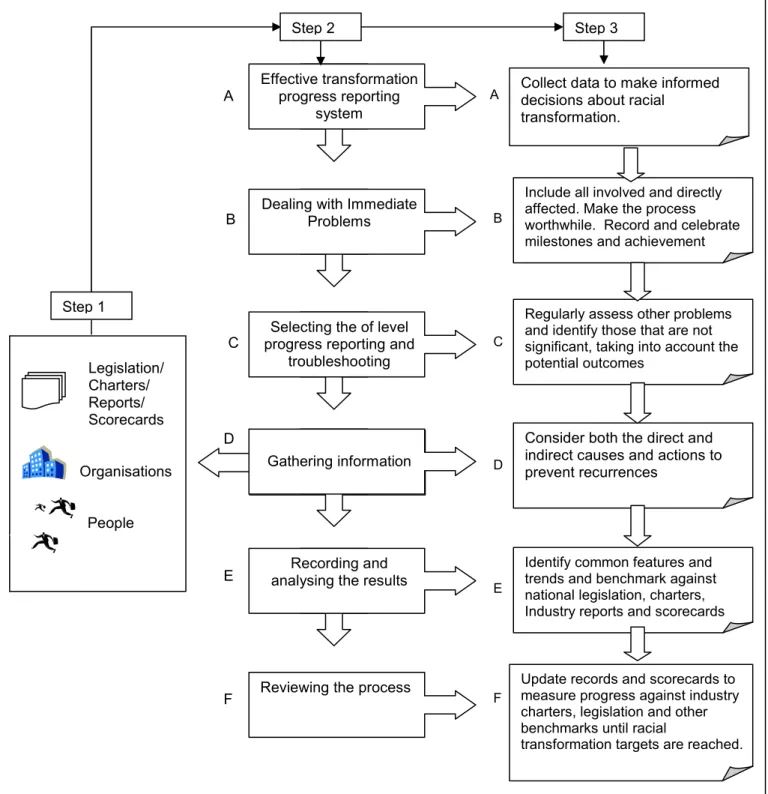
In formulating the clusters that appear in the researcher's diagram (Figure 1, pg. 85), the researcher identified themes and issues facing the industry in addressing the challenges of racial transformation. Creating a level playing field – government and industry must be involved in setting up curricula and cultivating new talent. The positive work and results should be shown to the industry as success stories.”
Conclusion
The Transformation of the Advertising and Marketing Industry, Retrieved October 4, 2005, from - http://www.gcis.gov.za/docs/portcom/02aca.html. The Transformation of the Advertising and Marketing Industry, retrieved October 4, 2005, http://www.gcis.gov.za/docs/portcom/amfrep04.html. The Transformation of the Advertising and Marketing Industry, Retrieved October 4, 2005, from - http://www.gcis.gov.za/docs/portcom/asareport04.html.
Summary of Findings, Recommendations and Conclusion
Summary of Findings
Lobedu Leo Burnett closed a 51% BEE sale to Brimstone Investment Corporation, a black economic empowerment company listed on the Johannesburg Stock Exchange (JSE) (Publicis Groupe, 2005). Before then, Leo Burnett South Africa was 100% owned by Burnett in the United States of America (Publicis Groupe, 2005). The targets for black ownership in the industry as outlined by the Marketing, Advertising and Communications Sector's Broad-Based Black Economic Empowerment Charter.
Recommendations
Ideally, individuals who have benefited from such deals should also "ensure that they continually strive to remove industry barriers and act as mentors to new entrants" (GCIS website, 2005). Successful black role models should be encouraged to participate in the educational process [teaching and mentoring]” (Respondent 16, 2008). The challenge remains to increase the proportion of black students enrolled in the creative program, which in 2005 was still less than 10%.
Conclusion
Portfolio Committee on Communications Hearings into Transforming the Advertising and Marketing Industry: Progress Report to the Portfolio Committee on Communications. Report to Portfolio Committee on Communications Hearings into Transformation of the Advertising and Marketing Industry, Retrieved 04 October 2005, from - http://www.gcis.gov.za/docs/portcom/nab04.pdf. Report to Portfolio Committee on Communications Hearings in Transformation of the Advertising and Marketing Industry, Retrieved 04 October 2005, from - http://www.gcis.gov.za/docs/portcom/saarfpresent04.pdf.
A sample of five agencies that are members of the Communication and Advertising Association will be included in the research. The evolving role of the black middle class cannot be separated from the rise of black economic empowerment (BEE), which has brought with it new complexities.
Letter to Potential Participants
Letter to HR Department
Letter of Informed Consent
Questionnaire
Will the black middle class please stand up?
SA’s Top 20 Advertising Agencies – 2006
SA’s Top 15 Specialist Agencies Ranked by Income -2006
SA’s Top 5 Media Agencies
What Senior Executives Think?
AdSpend by Medium Excluding Self Promotion
10 Most Valuable South African Brands
World’s Most Valuable South African Brands
Top 100 Advertisers
