EVALUATION OF DIFFERENT TEMPERATE WINTER FODDER SPECIES (FESTULOLIUM HYBRIDS, DACTYLIS SPECIES, LOLIUM HYBRIDS) AND GRASS-LEGUME MIXTURES IN THE WARMER SUMMER RAINFALL AREAS OF
SOUTH AFRICA
By
EZEKIEL SIMON KABINE
RESEARCH MINI-DISSERTATION
Submitted in fulfilment of the requirements for the degree of
MASTERS OF SCIENCE in
AGRICULTURE (PASTURE SCIENCE) in the
FACULTY OF SCIENCE AND AGRICULTURE (School of Agricultural and Environmental Science)
at the
UNIVERSITY OF LIMPOPO
SUPERVISOR: PROF C.S DANNHAUSER CO-SUPERVISOR: Dr J.J JORDAAN
NOVEMOBER 2015
i
DECLARATION
I hereby declare without stipulation that this research project titled “Evaluation of different temperate winter fodder species (Festulolium hybrids, Dactylis species, Lolium hybrids) and grass-legume mixtures in the warmer summer rainfall areas of South Africa” is my own work and that all the sources that I have used or quoted have been indicated and acknowledged by means of complete references and comply with the code of academic integrity, as well as other relevant policies, procedures, rules and regulations of University of Limpopo. I also confirm that this work has not been submitted before for any other degree at any other institution.
Student’s signature Date
ii
ACKNOWLEDGEMENTS
I wish to thank the Almighty God for his wisdom and guidance throughout this study;
without His favour, I wouldn’t have completed this research. I also express my innermost gratitude to my late parents who granted me the opportunity to further my studies, and may their soul rest in peace.
Secondly, I express my sincere gratitude to National Research Foundation (NRF) South Africa for providing a NRF Master’s Block Grant for funding of the project and not forgetting the Research Development & Administration office of University of Limpopo for all the support. I also acknowledge the help from the Hygrotech Seed Company’s Experimental farm.
Finally, I would like to express my inmost gratitude to my supervisor, Prof C.S Dannhauser, for his guidance, inspiritment and trust that he gave me throughout the entire study. I also thank my co-supervisor, Dr J.J Jordaan, for the great contribution towards the completion of my studies.
iii
DEDICATION
I dedicate my mini-dissertation work to my daughter, Zenenkosi Thandolwethu Penelope Kabine.
I would like to extend special gratitude to my late parents, Moses and Grace Kabine, who encouraged me and gave me the strength of tenacity, my lovely siblings David, Joseph, Lucas and Sarah who never left my side and are very close to my heart.
I also dedicate this mini-dissertation to my best friend Ndivhuho Ramuthaga and classmate Thabile Mokgakane who supported me throughout my studies and constantly reminding me that perseverance, dedication, determination and hard work is the mother of success.
iv ABSTRACT
South Africa is regarded as a semi-arid area; only 28% of the country receives more than 600 mm rainfall recorded annually. Sustainable utilization of cool season fodder grasses in summer rainfall areas to produce winter animal feed remains a major problem. Farmers are affected by a shortage of adequate, good quality herbage for livestock during winter and dry periods on commercial farms.
The study aimed to evaluate and compare the production potential of six Festulolium hybrids, three Dactylis species, and five Lolium hybrids and three grass-legume mixtures in the summer rainfall area. A total of 17 cultivars were evaluated for their DM production under the treatment of different fertilizer levels on three planting dates (16 March 2011, 21 April 2011 and 4 April 2012). The study was carried out at Hygrotech Seed Company (Experimental site), Dewagensdrift in Moloto Village outside Pretoria in the Gauteng Province.
Data was collected on a monthly basis from sub-plots of 1 m x 1 m (m2) in 51 plots of 1.5 m x 6 m (9 m2), with nine rows that were 10 cm apart arranged under RCBD with three replicates per cultivar. Harvested fresh samples were taken, weighed, dried at 60ºC until they reached a constant dry weight and weighed to determine DM content.
A Fischer’s protected LSD at the 5 % level was performed to compare the treatment means.
Over a period of three years of study, it shows that the low fertilizer level resulted in the lowest DM production, with no significant difference occurring between medium and high fertilizer levels. To achieve optimum DM production with minimum cost medium fertilizer is recommended. The cultivars responded differently to the three different planting dates. The time of planting had an effect on DM production in winter. It is recommended that Festulolium hybrids and Lolium hybrids be planted earlier (March) for better DM production in winter.
Key words: Annual ryegrass, cutting dates, dry matter production, fertilizer levels, perennial grass, planting dates
v
TABLE OF CONTENTS
Contents Page
TITLE PAGE
DECLARATION i
ACKNOWLEDGEMENTS ii
DEDICATION iii
ABSTRACT iv
TABLE OF CONTENTS v
LIST OF TABLES ix
LIST OF FIGURES xi
LIST OF ABBREVIATIONS xii
CHAPTER 1: GENERAL INTRODUCTION 1
1.1 Background information 1
1.2 Problem statement 1
1.3 Motivation of the study 2
1.4 Purpose of the study 3
1.4.1 The aim 3
1.4.2 The objectives 3
CHAPTER 2: LITERATURE REVIEW 4
2.1 Impact of climate change on dairy cattle production in South Africa 4 2.2 The need to improve animal production in South Africa 5
2.2.1 Lack of winter feed 5
2.2.2 Alternative winter feeding strategies 5
2.2.2.1 Hay 5
2.2.2.2 Silage 6
2.2.2.3 Crop residues 6
2.3 Origin and cultivation of pasture species 7
2.3.1 Centre of diversity and domestication 7
2.3.2 Fodder improvement 7
2.3.3 Beneficial attributes 9
vi
2.4 Nutritive value of pasture species 9
2.5 Dry matter production of pasture species 9
2.6 Temperate winter fodder grass species 10
2.6.1 Perennial ryegrass (Lolium perenne) 11
2.6.2 Annual ryegrass (Lolium multiflorum) 12
2.6.3 Cocksfoot (Dactylis glomerata) 14
CHAPTER 3: RESEARCH DESIGN AND METHODOLOGY 16
3.1 Experimental site 16
3.1.1 Meteorology 16
3.2 Materials and methods 20
3.2.1 Land/site preparation 20
3.2.2 Fertilization and irrigation 20
3.2.3 Experimental design and treatment details 21
3.2.4 Species and Mixtures used 22
3.3 Data collection 22
3.4 Statistical analysis 22
CHAPTER 4: RESULTS AND DISCUSSIONS 23
4.1 Soil analysis 23
4.1.1 The pH 23
4.1.2 Phosphate (P) 23
4.2 Dry Matter (DM) production 24
4.2.1 The effect of different fertilization levels on the DM production of all cultivars and mixtures during Phase 1 (mid-summer) of Planting date 1 (16 March 2011) (Paragraph 4.2.1)
25
4.2.1.1 Summary 29
4.2.2 Evaluation of DM production during all the three phases (first mid-summer, first mid-winter and second mid-summer) of the second Planting date (21 April 2011) (Paragraph 4.2.2)
31
4.2.2.1 The DM production of the Festulolium hybrids, Dactylis species, Lolium hybrids (average DM production of cultivars) and mixtures during the three phases (seasons) of Planting date 2 (21 April 2011)
31
vii
4.2.2.2 The DM production (t/ha) of the different cultivars during all three phases (seasons) at Planting date 2 (21 April 2011)
32
4.2.2.3 Summary 34
4.2.3 The effect of the three planting dates at medium fertilization on the DM production during the first phase (mid-summer) of each planting date (Paragraph 4.2.3)
38
4.2.3.1 The influence of planting dates on the DM production of the Festulolium hybrids, Dactylis species, Lolium hybrids (average DM production of cultivars) and mixtures
38
4.2.3.2 Summary 41
4.2.4 The influence of planting dates (16 March 2011 and 21 April 2011) on the DM production of Phase 2 (mid-winter) (Paragraph 4.2.4)
43
4.2.4.1 The mid-winter DM production of Festulolium hybrids, Dactylis species, Lolium hybrids (average of cultivars) and mixtures as influenced by planting dates
43
4.2.4.2 Summary 46
CHAPTER 5: SUMMARY, CONCLUSIONS AND RECOMMENDATIONS 48
5.1 Summary and conclusions 48
5.1.1 The influence of fertilizing 48
5.1.2 DM production during first summer, first winter and second summer
49 5.1.3 The effect of planting date on production 51
5.2 Recommendations/Suggestions 52
REFERENCES 53
ADDENDUMS Addendum 1
The impact of fertilizer level on the DM production of the Festulolium hybrids, Lolium hybrids, Dactylis species and grass-legume mixtures on Phase 1 of Planting date 1 (16 March 2011)
61
viii Addendum
1.1
Comparing Species as main effects as influenced by fertilizers in PD 1 (16 March 2011)
61 Addendum
1.1.1
Comparing Cultivars as main effects in terms of the influence of fertilizers in Phase 1 (mid-summer) of PD 1
63 Addendum
1.2
Comparing Species as main effects as influenced by PD 1 (16 March 2011) in Phase 2 (mid-winter)
65 Addendum
1.2.1
Comparing Cultivars as main effects as influenced by PD 1 (16 March 2011) in Phase 2 (Mid-winter)
66 Addendum
2
Evaluation of total DM production during all three Phases (first mid-summer, mid-winter and second mid-summer) of the second Planting date (21 April 2011)
67
Addendum 2.1
Comparing Species as main effects as influenced by mid- summer (Phase 1) in PD 2 (21 April 2011)
67 Addendum
2.1.1
Comparing Cultivars as main effects as influenced by mid- summer (Phase 1) in PD 2 (21 April 2011)
69 Addendum
2.2
Comparing Species as main effects as influenced by mid- winter (Phase 2) in PD 2 (21 April 2011)
71 Addendum
2.2.1
Comparing Cultivars as main effects as influenced by mid- winter (Phase 2) in PD 2 (21 April 2011)
73 Addendum
2.3
Comparing Species as main effects as influenced by mid- summer (Phase 3) in PD 2 (21 April 2011)
75 Addendum
2.3.1
Comparing Species as main effects as influenced by mid- summer (Phase 3) in PD 2 (21 April 2011)
77 Addendum
3
Winter grazing trial: Phase 1 (mid-summer) on Planting date 3 (4 April 2012)
79 Addendum
3.1
Comparing Species as main effects as influenced by mid- summer (Phase 1) in PD 3
79 Addendum
3.1.1
Comparing Cultivars as main effects as influenced by mid- summer (Phase 1) in PD 3
81
ix
LIST OF TABLES
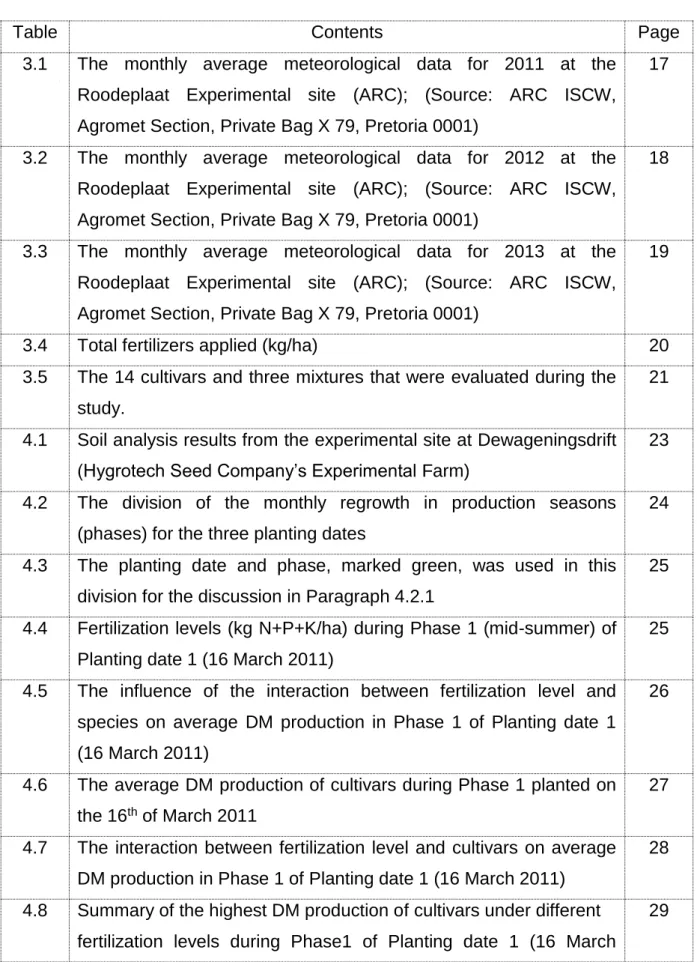
Table Contents Page
3.1 The monthly average meteorological data for 2011 at the Roodeplaat Experimental site (ARC); (Source: ARC ISCW, Agromet Section, Private Bag X 79, Pretoria 0001)
17
3.2 The monthly average meteorological data for 2012 at the Roodeplaat Experimental site (ARC); (Source: ARC ISCW, Agromet Section, Private Bag X 79, Pretoria 0001)
18
3.3 The monthly average meteorological data for 2013 at the Roodeplaat Experimental site (ARC); (Source: ARC ISCW, Agromet Section, Private Bag X 79, Pretoria 0001)
19
3.4 Total fertilizers applied (kg/ha) 20
3.5 The 14 cultivars and three mixtures that were evaluated during the study.
21 4.1 Soil analysis results from the experimental site at Dewageningsdrift
(Hygrotech Seed Company’s Experimental Farm)
23 4.2 The division of the monthly regrowth in production seasons
(phases) for the three planting dates
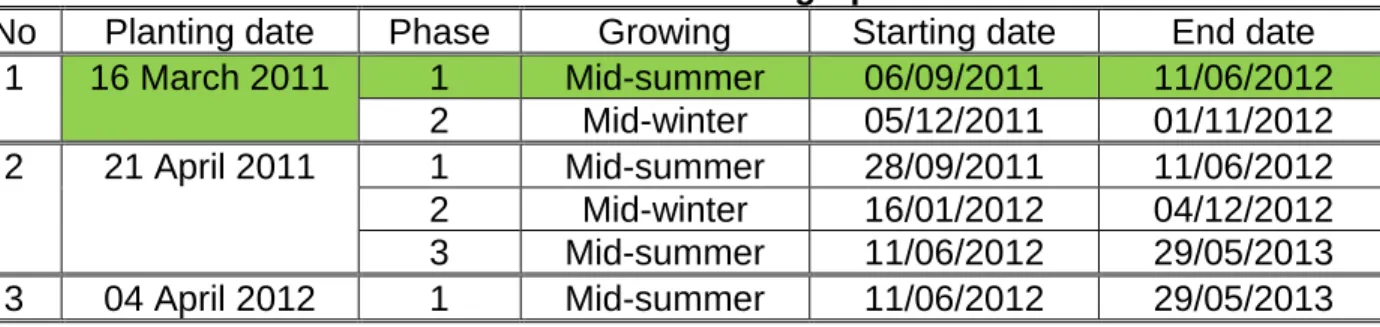
24 4.3 The planting date and phase, marked green, was used in this
division for the discussion in Paragraph 4.2.1
25 4.4 Fertilization levels (kg N+P+K/ha) during Phase 1 (mid-summer) of
Planting date 1 (16 March 2011)
25 4.5 The influence of the interaction between fertilization level and
species on average DM production in Phase 1 of Planting date 1 (16 March 2011)
26
4.6 The average DM production of cultivars during Phase 1 planted on the 16th of March 2011
27 4.7 The interaction between fertilization level and cultivars on average
DM production in Phase 1 of Planting date 1 (16 March 2011)
28 4.8 Summary of the highest DM production of cultivars under different
fertilization levels during Phase1 of Planting date 1 (16 March
29
x 2011)
4.9 The planting date and different phases, marked green, were used in this division for the discussion in Paragraph 4.2.2
31 4.10 The influence of the seasons and species on average DM
production in Planting date 2 (21 April 2011)
31 4.11 The DM production (t/ha) of cultivars during the three different
phases (seasons) planted in Planting date 2 (21 April 2011)
33 4.12 The different planting dates and different phases, marked green,
were used in this division for the discussion in Paragraph 4.2.3
38 4.13 The DM production (t/ha) of species as main effect during Phase 1
(mid-summer) of all three planting dates
38 4.14 The DM production (t/ha) of cultivars as main effect during Phase 1
(mid-summer) on three planting dates
39 4.15 The results from the planting dates and phases, marked green,
were used in this division (Paragraph 4.2.4)
43 4.16 The influence of the planting dates and species on average DM
production in Phase 2 (mid-winter)
43 4.17 The DM production (t/ha) of PD 1 (16 March 2011) and PD 2 (21
April 2011) of cultivars in Phase 2 (mid-winter)
44 4.18 Summary of the high, medium and low productions during the three
seasons of Planting date 2 (21 April 2011)
49
xi
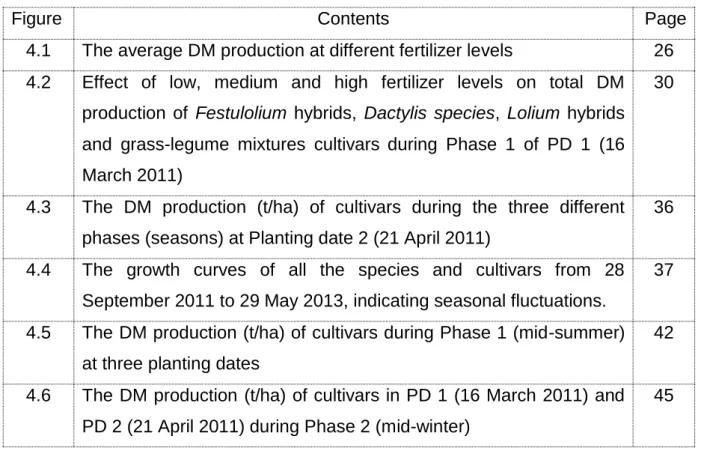
LIST OF FIGURES
Figure Contents Page
4.1 The average DM production at different fertilizer levels 26 4.2 Effect of low, medium and high fertilizer levels on total DM
production of Festulolium hybrids, Dactylis species, Lolium hybrids and grass-legume mixtures cultivars during Phase 1 of PD 1 (16 March 2011)
30
4.3 The DM production (t/ha) of cultivars during the three different phases (seasons) at Planting date 2 (21 April 2011)
36 4.4 The growth curves of all the species and cultivars from 28
September 2011 to 29 May 2013, indicating seasonal fluctuations.
37 4.5 The DM production (t/ha) of cultivars during Phase 1 (mid-summer)
at three planting dates
42 4.6 The DM production (t/ha) of cultivars in PD 1 (16 March 2011) and
PD 2 (21 April 2011) during Phase 2 (mid-winter)
45
xii
LIST OF ABBREVIATIONS Abbreviation Definition
ARC Agricultural Research Council NRF National Research Foundation
DM Dry Matter
LSD Least Significant Deference
RCBD Randomised Complete Block Design
SA South Africa
USDA United States Department of Agriculture
CP Crude protein
TNC Total Non-structural Carbohydrates DMI Dry Matter Intake
REML Restricted Maximum Likelihood GDP Gross Domestic Products
ISCW Institute for Soil, Climate and Water LTA Long Term Average
TDM Total Dry Matter
LAN Lime Ammonium Nitrate DoA Department of Agriculture
Kg Kilogram
mm millimeter
ha hectare
cm centimeter
P Phosphorus
Ca Calcium
Mg Magnesium
Na Sodium
C Carbon
K Potassium
N Nitrogen
t Tons
xiii cv. Cultivar
sp. Species
spp. Species
PD Planting date
FPL Festulolium pabulare loloid FPF Festulolium pabulare festucoid LAN Limestone ammonium nitrate Fert. Fertilizer
KCL Potassium chloride
1
CHAPTER 1:
GENERAL INTRODUCTION 1.1 Background information
Sown pastures are the base for profitable milk production in some regions of South Africa (Meeske et al., 2006). The temperate climate, availability of water for irrigation and the all-year-round rainfall in some areas are some of the most important factors contributing to the inclusion of various grass species in the fodder flow program to these areas (Botha, 2003). It has been shown by Miller et al. (2001) that the selection of grasses for higher levels of total non-structural carbohydrates (TNC) might increase palatability, intake and milk production. The studies of Taweel et al. (2005) and Tas et al. (2005), however, did not confirm this. High quality ryegrass often has a low dry matter (DM) content which may restrict the intake of grass by dairy cows (Bargo et al., 2003).There is however, limited data available on the production potential and forage quality of the most recent cultivars of temperate winter fodder species under irrigation in the warmer summer rainfall areas. The aim of the study was to evaluate and compare the production potential of different cultivars of temperate winter fodder species (Dactylis species, Festulolium hybrids and Lolium hybrids) and grass-legume mixtures to yield a higher dry matter (DM) content than existing cultivars in terms of DM production under irrigation in warmer summer rainfall areas of South Africa. A total of seventeen cultivars, three Dactylis species, five Lolium hybrids, six Festulolium hybrids and three grass-legume mixtures were evaluated and compared in terms of monthly, seasonal and annual DM production over a period of three years.
1.2 Problem Statement
South Africa is regarded as a semi-arid area; only 28 % of the country receives more than 600 mm rainfall annually (Schulze, 1997). As rainfall is the limiting environmental factor that determines agricultural production in the arid and semi-arid areas (Snyman, 1998), sustainable utilization of cool season fodder grasses in summer rainfall areas to produce winter animal feed remains a major problem. According to Coetzee (2012), the
2
number of dairy farmers in SA has decreased by 36 % from January 2007 to January 2012.
Farmers are affected by a shortage of adequate, good quality herbage for livestock during winter and dry periods on commercial farms (Fair, 1989). Animals lose weight in winter, which leads to low reproduction, low production of milk, mutton and meat production. The demand for high animal production in an alternative way to conventional rearing has increased globally in recent years (Nilze’n et al., 2001; Walshe et al., 2006, Shongwe et al., 2007). The impact of unsustainable beef and dairy production due to winter and dry periods often entices less GDP (Gross Domestic Products) for the country. This is due to high imports of meat especially due to scarce nutritional feeding systems (Anon, 2004).
1.3 Motivation of the study
Pasture form the basis for profitable and intensive meat and milk production in some regions of South Africa (Meeske et al., 2006). Reed (1996), Callow at al. (2003) and Nie et al. (2008) reported that Tall fescue (Lolium arundinaceum) and Cocksfoot (Dactylis glomerata) are alternative temperate perennial grasses that could improve the persistence and stress tolerance. The strategic utilization of different types of temperate grasses like annual rye grass (Lolium multiforum Lam.: Italian or Westerwolds rye grasses) and perennial rye grass (Lolium perenne L.) increase the seasonal DM production of the pastures offered to dairy cattle (Botha et al., 2007). With increasing human population, agriculture became the dominant source for survival. The most direct way of achieving this on land set aside for animal production, is to increase forage production, accompanied by an increase in livestock production (Tainton, 2000).
Consequently, farmers have to make decisions on species (annual or perennial) and type (Italian or Westerwolds) of ryegrass to use in their production system. These decisions may have a major impact on the profitability of farming. Unfortunately, limited information is available on newer winter growing species, their adaptability and utilization by grazing animals (Botha et al., 2007). One of the biggest challenges for the
3
animal industry is the selection of crops that will be able to produce in most areas of South Africa, with limited irrigation. It is further important to choose the correct cultivars, the correct planting date and the correct utilizing stage of the fodder grasses.
1.4 Purpose of the study
It was stated under the research problem that the production potential and forage quality of different perennial winter fodder species under irrigation in summer rainfall areas have never been evaluated and compared.
1.4.1 The aim
The aim of this study was to evaluate and compare the production potential of different temperate winter fodder species and mixtures to provide better understanding on their usage under irrigation for improved sustained pasture quantity and quality in the warmer summer rainfall areas of SA.
1.4.2 The objectives
The objectives of this study were as follows:
(i) To determine the effect of different fertilization levels on the DM production of Festulolium hybrids, Dactylis species, Lolium hybrids and grass-legume mixture species under irrigation in the warmer summer rainfall areas of SA.
(ii) To evaluate the DM production of Festulolium hybrids, Dactylis species, Lolium hybrids and grass-legume mixture species under irrigation in the warmer summer rainfall areas of SA.
(iii) To determine the effect of different planting dates on mid-summer DM production of Festulolium hybrids, Dactylis species, Lolium hybrids and grass- legume mixture cultivars under irrigation in the warmer summer rainfall areas of SA.
(iv) To determine the effect of planting dates on mid-winter DM production of Festulolium hybrids, Dactylis species, Lolium hybrids and grass-legume mixture cultivars under irrigation in the warmer summer rainfall areas of SA.
4
CHAPTER 2:
LITERATURE REVIEW
2.1 Impact of climate change on dairy cattle production in South Africa
There is growing evidence that climate changes will cause considerable damage to the agricultural sector worldwide. In Africa, the livestock sector will suffer the most from the adverse effects of climate change because the major proportion of agricultural production is from livestock. According to Seo and Mendelsohn (2006), environmental warming will be harmful to livestock owners, especially cattle owners. Currently the biggest concern for farmers is water scarcity, and it would remain a major concern in future.
A study conducted by the World Bank and the McKinsey Group, showed that South Africa could experience a water shortage of close to 2.7 million m3 by 2030 (2030 Water Resources Group, 2009). Economic losses from reduced animal performance as a result of adverse climate changes are likely to exceed those associated with death losses (Mader, 2003). Increased performance expected from livestock, coupled with sub-optimal environment conditions, will increase animal vulnerability and risk (Hahn, 1999). Klinedinst et al., (1993) observed that abnormally high temperatures may reduce milk production by up to 20 % and conception rates by as much as 35 % in dairy cattle.
Most of the work on the impact of climate change has focused on areas such as water resources, rangeland ecosystems and human health, while in agriculture studies have focused more on the impact on major crops such as grains. While these assessments are of importance, they have small contributions to the South African agricultural economy which is dominated by animal production, with dairy production accounting for about 20 % of the total number of cattle in South Africa (DoA, 2008). The dairy industry is one of the largest employers in the agricultural sector. Possible effects (both direct and indirect) of climate change on dairy cattle in SA have not been thoroughly investigated. The aim of this study was to evaluate the production potential of different
5
temperate winter fodder species in the warmer summer rainfall areas of SA. This will help to create more profitable dairy businesses, improve the competitiveness of the South African dairy sector, as well as contribute towards a reduction in climate change.
2.2 The need to improve animal production in South Africa.
2.2.1 Lack of winter feed
According to Dannhauser (1991), shortage of adequate good quality herbage during the winter months is one of the biggest problems confronting the stock farmer in the summer rainfall areas. The issue of low quality feed during winter and spring is common to many livestock farmers (Fair, 1989). Animal scientists agree that poor winter feed is responsible for the generally low animal production in SA. The impact of unsustainable beef and dairy production due to winter and dry periods often entices less GDP (Gross Domestic Products) for the country. This is due to high imports of meat due to scarce nutritional feeding systems (Anon, 2004). Previously disadvantaged communities are then unable to access quality meat due to higher meat prices and as a result, experience health problems (lack of iron in their diet) (Anon, 2004).
2.2.2 Alternative winter feeding strategies:
2.2.2.1 Hay
According to Engelbrecht et al. (2004) hay plays an important part in most fodder-flow programs. Hay production requires higher financial inputs than foggage and forage.
Because of the high running costs, hay should be used for high-producing animals or when no other grazing is available. Hay is usually fed in the late winter months, before the veld is ready for grazing. Hay can also be used as drought reserve. Good-quality hay may be used for any kind of animal. When hay is produced, the correct forage species must be used, it must be cut at the right time and correct fertilization must be practiced. The choice of species depends on the environment, availability of irrigation and type of animal.
6 2.2.2.2 Silage
Engelbrecht et al. (2004) mentioned that in regions where winters are cold and dry, it is a usual practice to conserve forages. Silage is made of seasonal surpluses (mainly of maize) that occur on most intensively farmed farms. The advantages of silage above that of hay, is that it is less dependent on the weather, has no fire hazard and quality is maintained for a longer period. The disadvantages include a poorer intake of dry matter, higher transport costs and lower acceptability to young animals. Silage is generally meant for high productive animals like dairy cattle and fat lambs and could be expensive on extensive beef cattle farms. When animals graze rested veld in winter, they do not adapt very well to being fed silage afterwards. Research indicated that cattle lost weight when they started feeding on silage after they had spent the winter on rested veld.
2.2.2.3 Crop residues
Crop residues offer great potential as a relatively cheap feed source for the livestock industry and is sometimes regarded as crucial for livestock survival in winter (Crichton et al., 1998 as cited by Van Zyl, 2006). However, farmers have tended to withdraw the more marginal soils from cash cropping due to the following limiting factors:
A price - cost squeeze in cash cropping.
Climatic risk like short, severe droughts especially in Limpopo.
Soil restrictions, like acidity build up and aluminum toxicity.
This has resulted in a reduction in the availability of crop residues for livestock.
Abandoned crop lands are often left to revert to secondary succession again or established with crops to compensate for the loss in crop residues. Minimum tillage cultivation practices on grain crop lands are gaining popularity. These practices inhabit the utilization of residues to a large extent, and this contributes further to the decrease in residues available for livestock (Van Zyl, 2006). Most parts of the semi-arid area, maize stalks make extremely important contribution to the forage requirements of the animals during winter, which is most difficult in Limpopo Province due to unpredictable low rainfall (Tainton, 2000).
7 2.3 Origin and cultivation of pasture species 2.3.1 Centre of diversity and domestication
Western Europe is the main centre of origin for the Poaceae (Festuceae) family (Wipff, 2002; Meyer and Watkins, 2003), which includes Festulolium, Dactylis and Lolium species. Annual rye grass, perennial rye grass and cocksfoot are native to Europe, temperate Asia and Northern Africa (Lamp et al., 2001). They were introduced to other temperate parts of the world, including North and South America, South Africa, New Zealand and Australia, because of their value as a pasture plant. They are defined as
‘cool season grasses’ because of their preferential adaptation to cool and moist environments (Romani et al., 2002). Perennial forage grasses are not domesticated in the strict sense as ‘wild’ collections are generally phenotypically indistinct from cultivated forms. The exception to this rule is annual ryegrass, which was selected from a continuum of Lolium spp. and now has species status as L. multiflorum (Casler and Duncan, 2003).
2.3.2 Fodder improvement
Factors which are considered when a pasture plant introduction is made include;
adaptation to the environment; for example climatic conditions and soil factors; higher yields than the resident species and increased winter/autumn production; higher nutritive value/herbage quality; seedling vigour, even spread of growth during the growing season; persistence and tolerance to grazing; ability to combine with other grasses and legumes; adequate seed production; pest and disease resistance; no adverse effects to animals; herbicide tolerance and lower endophyte toxicity and increased seed yield (Oram and Lodge, 2003).
Irrigated fodder
There are approximately 80 species of commercially available species and cultivars which are used in South Africa (Klug and Arnott, 2000). Lucerne (Medicago sativa) is the main purpose grown irrigated fodder in South Africa, and is grown under irrigation throughout the country. Ryegrass (Lolium multiflorum and L. perenne) is cultivated on a
8
large scale for pastures in the dairy industry. Many other species and numerous cultivars are available commercially and are provided in detail by Bartholomew (2000).
Imported fodder
In times of drought, the South African government traditionally assisted farmers in obtaining fodder by providing subsidies. According to the new drought policy (National Department of Agriculture, 1997), the fodder subsidies have been terminated in order to encourage farmers to build up their own forage reserves and to discourage them from retaining excessive stock numbers. Nonetheless, it is likely that some commercial farmers, and probably the government, will continue to import fodder in extreme drought conditions.
Constraints to pasture and fodder production and improvement
The principal constraints to pasture and fodder production in commercial areas are:
Low and uncertain rainfall.
Salinization of irrigable soils.
Declining water quality.
The principal constraints to pasture and fodder production in communal areas are:
Low and uncertain rainfall throughout most of the country
Concern about exotics becoming problematic, which limits the introduction and testing of hardy species considered suited to the environmental and utilization rigours of the communal areas
The availability and price of seeds for pasture/fodder improvement
Considerable portions of the savanna vegetation types in the freehold farms are severely encroached by bush, but the costs of thinning/clearing generally outweigh the benefits in terms of increased carrying capacity.
Conventionally, communal farmers do not retain exclusive use of their unfenced croplands after harvest for their own livestock, so limiting the opportunities and incentives for undersowing or alley cropping.
9 2.3.3 Beneficial attributes
The herbage yield and composition of Festulolium species and Lolium species are influenced by many environmental and climatic conditions, soil type, nutrients in the soil, fertilization and management, species and cultivars (Tas, 2006). Generally, pastures are most palatable, most easily digested and most nutritive earlier in the season when leaves are young (USDA, 2006b). Although the nutritive value of pasture declines with age, total yields increase, which results in a conflict between quality and yield. Taking this into consideration, early cutting of cool season grasses is probably the most cost- effective way of producing feed for both production and maintenance of stock, despite the sacrifices in total yield (Andrews, 1997).
2.4 Nutritive value of pasture species
Nutritive value relates to digestibility of herbage ingested by the animal, and the efficiency with which the digestion end products are used. The major determinants of the nutritive value of pastures are the botanical and morphological composition, the environment in which the pastures are grown, and the regrowth period or age of the herbage (Lambert et al., 2000).The stage of growth is the most important factor influencing composition and nutritive value of pasture herbage (McDonald et al., 2002).
As the plant mature the DM and CP content decreases, and the fibre content increases.
2.5 Dry matter production of pasture species
The dry matter production or yield of a pasture species is determined by genetic factors, such as grass species and variety, and environmental factors, such as climate, soil type, fertilization level, and grazing management (Marais, 2001). The production of a pasture species varies due to three main factors: (1) the site class, which is defined by rainfall or irrigation, soil type, and elevation; (2) the quality of sward and (3) the supply of nitrogen (Castle, 1985).
10 2.6 Temperate winter fodder grass species
Annual and perennial ryegrasses are temperate grass species. Their primary growth period is in winter, so they can play an important role in producing winter forage in some parts of South Africa. According to Thom and Prestidge (1996), annual ryegrass (Lolium multiflorum Lam.) is capable of winter/early spring growth than perennial rye grass allowing dairy farmers to overcome feed shortages in mid-July to September. Annual ryegrass varieties, such as Italian ryegrass (Lolium multiflorum var. italicum) and Westerwolds ryegrass (Lolium multiflorum var. westerwoldicum) are established in pure swards to provide high quality fodder for animals (Botha et al. 2008, Botha and Gerber 2008, Van der Colf, 2010), forming an important part of fodder-flow systems in the Southern Cape. Annual ryegrass grows more rapidly at low temperatures than perennial ryegrass and has a higher soluble carbohydrate content (Reed, 1994). Lowe et al., (1999) stated that irrigated annual ryegrass pastures are highly productive both in terms of herbage produced and milk production/cow/ha.
According to Tas et al. (2005), perennial ryegrass has a high DM production/ha and produces a high nutritive value feed to dairy cows at low cost. According to Taweel, (2004), because of its productivity, palatability, digestibility and nutritive value, perennial ryegrass is the most widely used forage for feeding dairy cattle in temperate environments. The relatively poor digestibility of perennial ryegrass pastures in summer leads to the use of feed supplements to maintain dairy production (Smith et al., 1998).
At an early stage of maturity, perennial ryegrass is highly digestible and has a high nutritive value in terms of energy and protein (Van Vuuren, 1993). However, despite its high nutritive value, perennial ryegrass has two main disadvantages: (1) it has an unbalanced energy/protein ratio and (2) its low DMI by high producing dairy cows (Bargo et al., 2003a).
11 2.6.1 Perennial ryegrass (Lolium perenne) Description
Perennial ryegrass (Lolium perenne) is a cool season tussock-forming perennial grass with a fibrous root system that grows up to 60 cm high. Leaf blades are dark green, hairless, the upper surface is evenly ribbed and the lower surface is smooth and shiny.
Length of leaf blade is up to 30 cm long and up to 7 mm wide. Young leaves are usually folded in the bud but occasionally rolled, particularly in young plants. Auricles are small and narrow. Ligules are white, translucent and short (Lamp et al., 2001).
Establishment
Perennial ryegrass will survive only in cool, wet conditions (750 mm +) in high altitude areas. It produces very well in the mountainous areas of KwaZulu-Natal and the Eastern Cape. The seeding rate, when planted in rows, is 10 - 15 kg/ha and when broadcasted with irrigation it is 20 - 25 kg/ha (Dannhauser, 1991). It can be planted in spring and early autumn.
Establishment limitations
Perennial ryegrass requires fertile soils, high levels of nitrogen fertilization, regular irrigation plus top management for it to establish better. It must get rain or frequent irrigation under hot and dry conditions (Fair, 1989).
Nutrient requirements
Perennial ryegrass grows best on fertile, well drained soils but has a wide range of soil adaptability, and tolerates both acidic and alkaline soils (pH range of 5.2 to 8.0) (Cool and Annaway, 2004). It responds well to applications of nitrogen (both as absolute N and N fixed by legumes) and phosphorus, and is moderately tolerant to acid soils although there is sensitivity to Al concentration when the soil pH is low (Waller and Sale, 2001). The P-content of the soil should be 25 mg/kg and the K-content 100 mg/kg.
Nitrogen content should be applied at a rate of 250 kg N/ha to 400 kg N/ha, depending on rainfall and irrigation (Dannhauser, 1991).
12 Temperature requirements and tolerances
Perennial ryegrass is less tolerant to heat although there is variation between cultivars (Razmjoo et al., 1993). It is best adapted to a cool, moist climate where winterkill is not a problem. It is tolerant to cold winters and can maintain growth down to 4˚C. Generally, cultivars with poor winter hardiness are very early heading, while those with better winter hardiness are later heading (Humphreys, 1989). Perennial ryegrass is sensitive to drought (Garwood et al., 1979), which leads to a reduction in herbage production under a mild moisture deficit, and dormancy or death under a severe drought. Studies in both temperate (Waller et al., 1999) and subtropical areas (Lowe et al., 1999b) indicated that perennial ryegrass survival hot dry conditions by dying back. When conditions have improved, the plants would produce new tillers in the centre of the crown.
Importance of Perennial ryegrass (Lolium perenne)
Perennial ryegrass is highly palatable, nutritious and has an excellent animal production potential. It will provide grazing for about 10 to 11 months of the year and will be dormant in the dry months (Dannhauser, 1991). Perennial ryegrass can withstand close continuous grazing and is ideally suited to intensive sheep and cattle grazing.
2.6.2 Annual ryegrass (Lolium multiflorum)
Annual ryegrass (Lolium multiflorum) is a high quality, cool season winter annual grass that is closely related to perennial ryegrass (Lolium perenne), the Lolium and Festuca genera are classified within the family Poaceae (Wheeler et al., 2002). Annual ryegrass is divided into two distinct cultivar groups: (1) Italian ryegrass, which requires an extended period of low temperatures to flower prolifically and (2) Westerwolds ryegrass, which has no cold inductive requirement for flowering and will go into a reproductive phase in warm areas.
Annual ryegrass is a cool season annual or biennial turf forming bunch grass, but cultivars that may persist for more than two years have been developed. Leaf blades are dark green, hairless and the upper surface is ribbed, while the lower surface is smooth and shiny. Leaf blades are up to 40 cm long and 5 -12 mm wide. Young leaves
13
are rolled in the bud. Auricles are small and narrow. Ligules are white, translucent and short. Leaf sheaths are hairless with fine longitudinal ribs, as in leaf blades (Lamp et al., 2001).
Establishment
Annual ryegrass is characterized by rapid germination under various environmental conditions. Annual rye grass is adaptable to a wide range of soil types and success can be achieved on very poor shallow soils provided the irrigation system and fertilization is highly effective (Fair, 1989). Ryegrass can be planted in autumn (February - April) and also in spring (August - Sep). The seeding rate is 10 - 20 kg/ha. It requires a high fertilization program (Dannhauser, 1991). The only problem with autumn planting is that seedlings suffer from “burn-off” in hot weather and can die if planted too early. Daily light irrigation can do a lot to overcome this problem (Fair, 1989).
Establishment limitations
Annual ryegrass is an expensive pasture which needs to be re-established each year.
According to Dannhauser (1991), it has a shallow root system and high moisture requirement.
Nutrient requirements
Annual ryegrass requires a highly fertile soil to perform well and responds well to applications of nitrogenous fertilizers (Lamp et al., 2001). It has a wide range of soil adaptability and is being tolerant to acidic and alkaline soils (pH 5.0 to 7.8). Below a pH of 5.0, aluminium toxicity may be a problem and higher pH can cause chlorosis due to iron and manganese deficiencies. The best growth occurs when soil pH is maintained between 5.5 and 7.5 (Hanaway et al., 1999). It performs poorly unless it is heavily fertilized with nitrogen (Fair, 1989).
Temperature requirements and tolerances
Its growing season is autumn, winter and spring. It is particularly valued for its winter growth which is higher than perennial ryegrass (Lamp et al., 2001). It was found to have the fastest primary (uncut) growth during establishment and a broader tolerance to
14
temperature than perennial ryegrass (Hill et al., 1985). It can be cultivated under dry land conditions, providing the rainfall exceeds 900 mm during the growing season (Dickinson et al., 1990). Annual rye grass is cultivated under irrigation in large parts of South Africa or as a winter and spring fodder. From results under irrigation at Potchefstroom, it appeared as if some cultivars stay vegetative for longer periods in spring and early summer than other cultivars (Dannhauser, 1991).
Importance of Annual ryegrass (Lolium multiflorum)
Italian ryegrass (annual or short-lived perennial), is used for forage and turf purposes throughout the temperate regions of the world, including North and South America, South Africa, Australia and New Zealand (Lamp et al., 2001). Due to its ability to establish quickly and grow rapidly in its first year, annual ryegrass is often included in permanent pasture mixtures to provide feed for the first winter after establishment. The grass is ideal for dairy or sheep farming in high rainfall or irrigation areas. Annual ryegrass, with its more upright and open growth habit is suited to grazing systems with lengthy intervals between grazing, or for silage production (Jung et al., 1996)
2.6.3 Cocksfoot (Dactylis glomerata)
Cocksfoot (Dactylis glomerata) is a cool season tussock-forming perennial grass which grows up to 1.5 m high, with strongly flattened vegetative shoots. It has a greyish-green to green foliage and the leaves are long (up to 80 cm) usually flat but may be folded lengthwise to give a shallow V-shaped cross-section. Translucent ligules are white with 2 - 10 mm long. Leaf sheaths are flattened and hairless (Lamp et al., 2001).
Establishment
Cocksfoot possesses a small, very light seed, averaging about 1.3 million/kg. It needs to be sown close to the soil surface at a depth of 10 mm or less. The suggested seeding rate is 10 - 15 kg/ha when sown in rows and when broadcasted with irrigation, 20 - 25 kg/ha. Cocksfoot is best sown in autumn. Early growth is slow, although it is generally more vigorous than tall fescue (Donaldson, 2001).
15 Establishment limitations
Early planting will pose a problem if seedbeds are not weed-free but late planting in weed problem situations will be more successful. Dry land cultivation is restricted to areas with a rainfall in excess of 750 mm (Fair, 1989).
Nutrient requirements
Cocksfoot responds to increasing soil fertility. New sowings require fertilizer to promote early root development and enhance seedling vigour. Mature stands should have major deficiencies corrected on the basis of soil analysis. Cocksfoot, like all grasses, responds to nitrogen either via a companion legume or fertilizer application (Fair, 1989).
Temperature requirements and tolerances
Cocksfoot prefers well drained loam and clay soils. It is essentially a cool climate grass and is suited best to winter rainfall conditions. It will also grow well in cool high summer rainfall areas (750 mm and more), where the soils are moist in winter or under irrigation.
It does not like very warm northern-western aspects or very cold low-lying areas (Donaldson, 2001).
Importance of Cocksfoot (Dactylis glomerata)
Cocksfoot is valued throughout the world for its better persistence, than perennial ryegrass on quick drying and moderately fertile soils. It is a palatable grass which is best adapted to cooler regions which have a good rainfall. In these regions it will grow well on a wide range of soils and have a good animal production potential. Cocksfoot does not contain any substances harmful to animals (Fair, 1989). Cocksfoot can be used as one of the alternative temperate perennial grasses that could improve the persistence and stress tolerance (Reed, 1996, Callow et al., 2003, Nie et al., 2008) of the temperate grass component within kikuyu systems. There is however, limited data available on the production potential and forage quality of the most recent cultivars of these species under irrigation in the summer rainfall areas of SA.
16 CHAPTER 3:
RESEARCH DESIGN AND METHODOLOGY 3.1 Experimental site
The study was carried out at the Hygrotech Seed Company’s Experimental farm. The farm is in Dewagensdrift, which is situated approximately 40 km south east of Pretoria, along the R573 route to the KwaMhlanga and Moloto villages. The GPS coordinates of the experimental farm are 25˚29” S and 28˚36.8” E. The climate is characterised by low temperatures in winter (± 2°C) and warm summer days (25 - 30°C) and the rainfall ranges from 550 to 660 mm/annum. The experiments were conducted during the 2011/2012 and 2012/2013 growing seasons. The soil in this area is sandy loam of the Clovelly form (Soil Classification Workgroup, 1991).
3.1.1 Meteorology
The Hygrotech Seed Company’s Experimental farm is characterized by cool winter and warm summer temperatures. The monthly average meteorological data for the 2011, 2012 and 2013 seasons of the area was taken from the Agricultural Research Council’s weather station at Roodeplaat, which is approximately 15 km from Dewagensdrift, and is given in Table 3.1, Table 3.2 and Table 3.3.
Legend:
Element Description Unit
Tx Daily Maximum Temperature °C
Tn Daily Minimum Temperature °C
Rain Total Rainfall mm
Rs Total Radiation MJ/m2
U2 Average Wind Speed ms
RHx Daily Maximum Relative Humidity % RHn Daily Minimum Relative Humidity % ET0 Total Relative Evapotranspiration mm
17
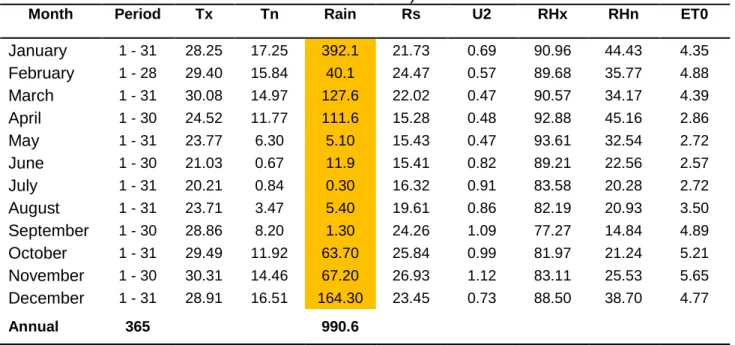
Table 3.1: The monthly average meteorological data for 2011 at the Roodeplaat Experimental site (ARC); (Source: ARC ISCW, Agromet Section, Private Bag X 79,
Pretoria 0001)
Month Period Tx Tn Rain Rs U2 RHx RHn ET0
January 1 - 31 28.25 17.25 392.1 21.73 0.69 90.96 44.43 4.35 February 1 - 28 29.40 15.84 40.1 24.47 0.57 89.68 35.77 4.88 March 1 - 31 30.08 14.97 127.6 22.02 0.47 90.57 34.17 4.39 April 1 - 30 24.52 11.77 111.6 15.28 0.48 92.88 45.16 2.86
May 1 - 31 23.77 6.30 5.10 15.43 0.47 93.61 32.54 2.72
June 1 - 30 21.03 0.67 11.9 15.41 0.82 89.21 22.56 2.57 July 1 - 31 20.21 0.84 0.30 16.32 0.91 83.58 20.28 2.72 August 1 - 31 23.71 3.47 5.40 19.61 0.86 82.19 20.93 3.50 September 1 - 30 28.86 8.20 1.30 24.26 1.09 77.27 14.84 4.89 October 1 - 31 29.49 11.92 63.70 25.84 0.99 81.97 21.24 5.21 November 1 - 30 30.31 14.46 67.20 26.93 1.12 83.11 25.53 5.65 December 1 - 31 28.91 16.51 164.30 23.45 0.73 88.50 38.70 4.77
Annual 365 990.6
According to meteorological data in Table 3.1, the total rainfall recorded from January to December 2011 was 990.6 mm. The highest rainfall of 392.1 mm was recorded in January while the lowest rainfall was recorded in July 2011. The good rainfall in March (127.6 mm) and April (111.6 mm) guaranteed rapid germination and early growth after establishment. The lowest rainfall during May to September could have influenced the total dry matter production, which will be discussed later in Chapter 4. The lowest temperatures were in June (0.67°C) and July (0.84°C) whereas the maximum temperatures were recorded in March (30.08°C) and November (30.31°C).
Legend:
Element Description Unit
Tx Daily Maximum Temperature °C
Tn Daily Minimum Temperature °C
Rain Total Rainfall mm
Rs Total Radiation MJ/m2
U2 Average Wind Speed ms
RHx Daily Maximum Relative Humidity % RHn Daily Minimum Relative Humidity % ET0 Total Relative Evapotranspiration mm
18
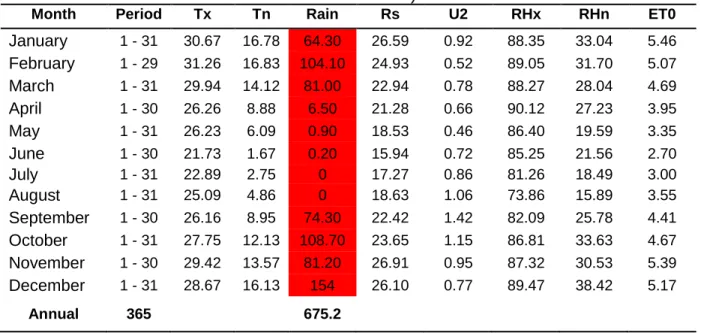
Table 3.2: The monthly average meteorological data for 2012 at the Roodeplaat Experimental site (ARC); (Source: ARC ISCW, Agromet Section, Private Bag X 79,
Pretoria 0001).
Month Period Tx Tn Rain Rs U2 RHx RHn ET0
January 1 - 31 30.67 16.78 64.30 26.59 0.92 88.35 33.04 5.46 February 1 - 29 31.26 16.83 104.10 24.93 0.52 89.05 31.70 5.07 March 1 - 31 29.94 14.12 81.00 22.94 0.78 88.27 28.04 4.69 April 1 - 30 26.26 8.88 6.50 21.28 0.66 90.12 27.23 3.95
May 1 - 31 26.23 6.09 0.90 18.53 0.46 86.40 19.59 3.35
June 1 - 30 21.73 1.67 0.20 15.94 0.72 85.25 21.56 2.70 July 1 - 31 22.89 2.75 0 17.27 0.86 81.26 18.49 3.00 August 1 - 31 25.09 4.86 0 18.63 1.06 73.86 15.89 3.55 September 1 - 30 26.16 8.95 74.30 22.42 1.42 82.09 25.78 4.41 October 1 - 31 27.75 12.13 108.70 23.65 1.15 86.81 33.63 4.67 November 1 - 30 29.42 13.57 81.20 26.91 0.95 87.32 30.53 5.39 December 1 - 31 28.67 16.13 154 26.10 0.77 89.47 38.42 5.17
Annual 365 675.2
According to Table 3.2, the total annual rainfall for 2012 was 675.2 mm. Good rainfall was recorded in February and October with 104.1 mm and 108.7 mm, respectively. The poor rainfall that occurred from April to August 2012 might be the reason for the low dry matter production recorded in the season, to be discussed in Chapter 4. High temperatures were recorded in January (30.67°C) and February (31.26°C) while low temperatures were recorded in June (1.67°C) and July (2.75°C).
Legend:
Element Description Unit
Tx Daily Maximum Temperature °C
Tn Daily Minimum Temperature °C
Rain Total Rainfall mm
Rs Total Radiation MJ/m2
U2 Average Wind Speed ms
RHx Daily Maximum Relative Humidity % RHn Daily Minimum Relative Humidity % ET0 Total Relative Evapotranspiration mm
19
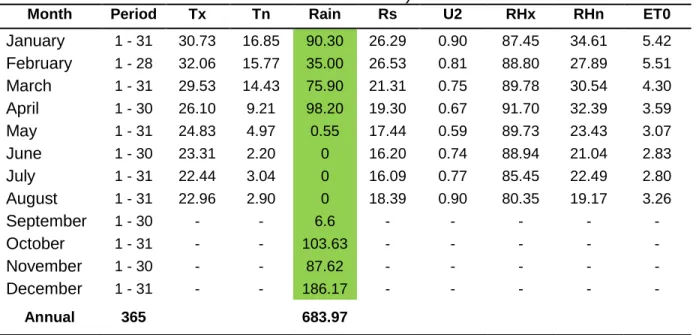
Table 3.3: The monthly average meteorological data for 2013 at the Roodeplaat Experimental site (ARC); (Source: ARC ISCW, Agromet Section, Private Bag X 79,
Pretoria 0001).
Month Period Tx Tn Rain Rs U2 RHx RHn ET0
January 1 - 31 30.73 16.85 90.30 26.29 0.90 87.45 34.61 5.42 February 1 - 28 32.06 15.77 35.00 26.53 0.81 88.80 27.89 5.51 March 1 - 31 29.53 14.43 75.90 21.31 0.75 89.78 30.54 4.30 April 1 - 30 26.10 9.21 98.20 19.30 0.67 91.70 32.39 3.59
May 1 - 31 24.83 4.97 0.55 17.44 0.59 89.73 23.43 3.07
June 1 - 30 23.31 2.20 0 16.20 0.74 88.94 21.04 2.83 July 1 - 31 22.44 3.04 0 16.09 0.77 85.45 22.49 2.80 August 1 - 31 22.96 2.90 0 18.39 0.90 80.35 19.17 3.26
September 1 - 30 - - 6.6 - - - - -
October 1 - 31 - - 103.63 - - - - -
November 1 - 30 - - 87.62 - - - - -
December 1 - 31 - - 186.17 - - - - -
Annual 365 683.97
Table 3.3 shows that the total rainfall recorded for 2013 was 683.97 mm, which was higher than the total rainfall obtained in 2012; however it was lower than the total rainfall recorded in 2011. The rainfall was poor in May (0.55 mm), whereas from June to August no rainfall that was recorded, this could be a reason why data was not collected every month, to be discussed further in chapter 4. The lowest temperatures were recorded in June (2.20°C) and August (2.90°C)
20 3.2 Materials and methods
3.2.1 Land/site preparation
The site/land was ploughed and then worked with a disc harrow or rotavator to control weeds and loosen the soil. The final preparation was done with the tiller for fine seedbeds and to mechanically eradicate weeds.
3.2.2 Fertilization and irrigation
Before planting soil samples were taken to a depth of 0 - 200 mm top soil and 210 - 300 mm sub soil to be analyzed. The fertilizers applied were:
Terra Nova (organic fertilizer made of chicken manure): 3.5% N; 1.35% P; 2.25%
K; 4% Ca; 0.5% S + micro elements (Zn, Mn, Cu, Fe & B)
MAP (11% N & 22%P)
Potash Nitrate [KNO3]: (13.5% N & 38.4% K)
NPK Mixture: 3:1:5 (26)
The total rate of application is specified in Table 3.4
Table 3.4: Total fertilizers applied (kg/ha).
Source Fertilization level (kg/ha)
Low Medium High
Terra Nova (before planting) 200 kg/ha 200 kg/ha 200 kg/ha Terra Nova (after planting) 600 kg/ha 600 kg/ha 600 kg/ha
Top dressings
MAP 250 kg/ha 250 kg/ha 250 kg/ha
KNO3 100 kg/ha 100 kg/ha 100 kg/ha
3:1:5 (26) 645 kg/ha 860 kg/ha
LAN (28%) 250 kg/ha 250 kg/ha 522 kg/ha)
The time of application was as follows:
Before planting: The equivalent of 200 kg/ha Terra Nova and disc in.
After germination: The equivalent of 620 kg/ha Terra Nova
Top dressings after cuts: Low application level: One application of MAP; KNO3 &
LAN. Medium level: One application of MAP and KNO3; two applications of 3:1:5
21
(26) and one of LAN. High level: One application: MAP; and KNO3 and two applications of 3:1:5 (26) andLAN
Seeds were planted in nine rows of 100 mm apart in the bigger plot of 1.5 m x 6.0 m (9 m2). An irrigation schedule of 20 - 25 mm/week was applied depending on the climatic conditions, for the full growing period.
3.2.3 Experimental design and treatment details
Three different planting dates were applied (16 March 2011, 21 April 2011 and 4 April 2012). For each planting date, 51 plots of 6.0 m x 1.5 m (9 m2) were arranged in a randomized complete block design, with three replications. Treatments involved were three planting dates with 17 cultivars. For all the cultivars that were planted, a seeding rate of 20 g per 9 m2 (20 kg/ha) and a raw spacing of 100 mm apart (nine rows/plot) was used. Three fertilizer levels (low, medium and high) were applied in three sub-plots (split plots), 1 m x 1 m in size, on each of the plots. A soil analysis was used as guideline for the medium fertilizer level. The low and high fertilizers were adapted to test low and high fertilizer level treatments.
Table 3.5: The 14 cultivars and three mixtures that were evaluated during the study
Festulolium hybrids: crosses between Festuca spp and Lolium multiflorum (annual ryegrass) or Lolium perenne (perennial ryegrass)
Cultivar Scientific name Festuca parent Lolium parent Type Achilles Festululium braunii F. prantesis L. multiflorum Italian Becva Festulolium pabulare F. arundinacea L. multiflorum Italian Fotjan Festulolium pabulare F. arundinacea L. multiflorum Tall fescue Lofa Festulolium pabulare F. arundinacea L. multiflorum Perennial Perseus Festululium braunii F. prantesis L. multiflorum Italian Perun Festululium braunii F. prantesis L. multiflorum Italian
Lolium hybrids: crosses between Lolium multiflorum (annual ryegrass) or Lolium perenne (perennial ryegrass)
Cultivar Species Type
Citeliac Perennial x Italian hybrid ryegrass Perennial Fotimo Perennial x Italian hybrid ryegrass Italian
Solid 4N Perennial x Italian hybrid ryegrass intermediate Storm Perennial x Italian hybrid ryegrass Perennial Tirna 4N Perennial x Italian hybrid ryegrass Italian
22 Grass-legume mixtures
Cultivar Contents
CutMax Alfa Protein Hot & Dry
40% alfalfa + 15% hybrid ryegrass + 15% cocksfoot + 15 % tall fescue + 15 % Bromus enermis
GrazeMax Hot & Dry 10% white clover + 70% tall fescue + 20% perennial ryegrass
VersaMax Hot & Dry 10% red clover + 5% white clover + 40% hybrid ryegrass + 20% cocksfoot + 25% tall fescue
Dactylis species
Cultivar Scientific name Common name
Aramis Dactylis glomerata Cocksfoot
Niva Dactylis glomerata Cocksfoot
Porthos Dactylis glomerata Cocksfoot 3.2.4 Species and Mixtures used
Six different cutivars of Festulolium hybrids, five cultivars of Lolium hybrids, three cultivars of Dactylis species and three grass/legume mixtures were used and specified in Table 3.5.
3.3 Data collection
Plots were harvested on a monthly basis. Thereafter the samples were placed in brown bags, weighed for fresh/wet weight and then dried in a drying oven at 60ºC until they reached a constant dry weight. Dried samples were removed from the oven and weighed to determine the monthly, seasonal and total annual dry matter production.
3.4 Statistical analysis
Growth and yield data of the seventeen cultivars generated from the three different planting dates was subjected to analysis of variance (ANOVA) to assess the treatment effects as well as their interaction at 5 % significance (P < 0.05) using the statistical program Genstat® (Payne et al., 2012). Linear Mixed Model Repeated Measurements Analysis, also known as REML (Restricted Maximum Likelihood), was applied to cumulative yields (Payne, Welham and Harding, 2012). The fixed effects were specified as fertilizers, species, cultivars, planting dates and their interaction. Fischer’s protected least significant difference (LSD) test was used to separate means at the 5 % level (Payne et al., 2012).