o
THE EVALUATION OF THE AIDS CARE PILOT PROJECT AT DURBAN'S CHILDRENS SOCIETY AS A MODEL OF CARE FOR HIV INFECTED ORPHANS IN DURBAN.
BY
JEEVANTHRI PILLAY
Submitted in partial fulfil/ment of the requirements for the degree in Masters of Social Science (Social Work) in the Department of Social Work, University of Natal, Durban.
April, 2003
ABSTRACT
The HIV/AIDS orphan crisis is one of the humanitarian and developmental challenges facing the global community. Providing a home, medical care, education, psychosocial support and basic needs for these children is part of the challenge that faces our generation. The purpose of this study was to explore whether an AIDS CARE pilot project implemented at DCS was able to successfully place ten HIV/AIDS infected orphans in fostercare.
The ecological perspective provided the theoretical framework within which the study was conducted. This perspective guided the selection of the study samples and the analysis of data. Sample one comprised ten foster parents who resided in various townships and suburbs in Durban. Sample two comprised of semi professional and professional staff that were involved in the daily care of the HIV infected orphans and well as ensuring their placement in fostercare.
The study found that recruitment, training and support were vital aspects in preparing foster parents to care for the HIV/AIDS infected child. The study also found that while residential child care institutions will continue to play a role in the care of children affected by HIV/AIDS, the magnitude and social impact of the disease renders it necessary that alternate models of care (this study proposes one model), within a community development paradigm be developed.
ACKNOWLEDGEMENTS
Sincere thanks to God and appreciation is extended to the following people who assisted in bringing this study to fruition:
Or. Vasantha Veeran and Or Barbara Simpson of the Department of Social Work, University of Natal, for your support encouragement and guidance.
My best friend Jeeva Govender for inspiring me and encouraging me to embark on this course of study.
My children Priyanka (6.5 yrs) and Prenushlin (4.6 yrs) Naidoo for their patience understanding and unfaltering support during my studies
My husband, the Deputy Mayor Councillor Logie Naidoo, mother, mother-in-law, domestic helper and Vimla and Preggie Moodley for assisting me in my most difficult times.
My good friends Shereen and Graham Fisher for assisting with the compilation of this thesis and repairing the computer glitches.
A special thank you to me for believing in my ability to complete this despite my many crisis.
This dissertation unless indicated to the contrary in the text, represents the original work of the candidate.
Jeevanthri Pillay April 2003 Durban
TABLE OF CONTENTS
CHAPTER 1:
INTRODUCTION TO THE STUDY / Statement of Problem ~
Context of the study Value of the study~
Research Approach
Research Aim /'
Objectives of the study ..-/
Theoretical Framework of the study""/
Definition of key concepts Presentation of the study
PAGE NO.
1 4 4 5 5 6 6 8 9
CHAPTER 2:
LITERATURE REVIEW /
Nature and extent of HIV/AIDS in South Africa 10
Mother to child transmission prevention 10
Non governmental response to the problem of orphans 12 Governmental response to the AIDS Pandemic 15 Durban Children's Society's response to the AIDS Pandemic 17
Models of Care 20
CHAPTER 3:
RESEARCH METHODOLOGY The Research,Design '-
Sampling v - / .- Data Collection L - - - / Ethical Considerations Limitation of the study CHAPTER 4:
FINDINGS AND DISCUSSIONS CHAPTER 5:
Conclusion and Recommendations References
Annexures
26 27 28 30 31
34
58 64 71
Table 1:
Table 2:
Table 3:
Table 4:
Table 5:
Table 6:
LIST OF TABLES
Profile of Foster parents
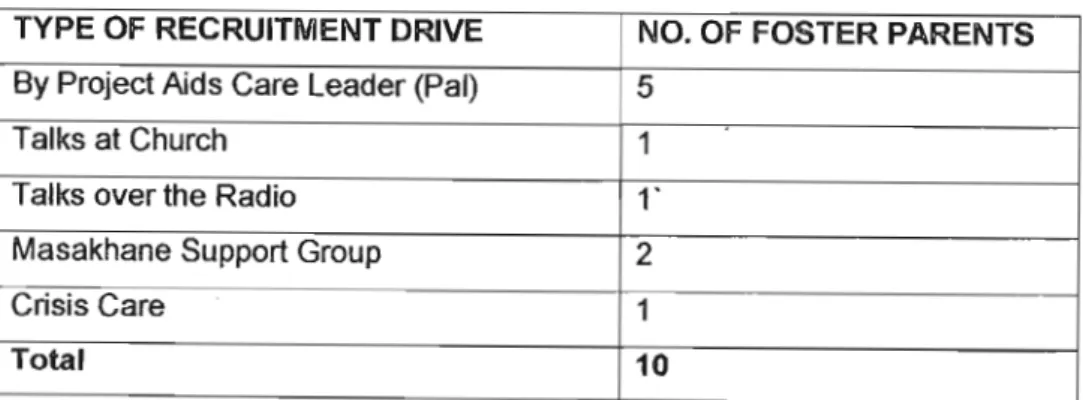
Type of Recruitment Drive
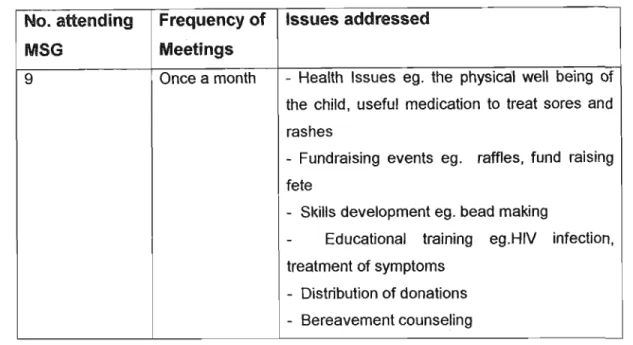
Attendance/Frequency of meetings, issues addressed
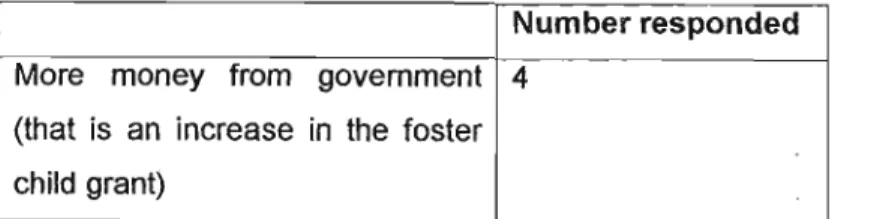
Other assistance you think should be provided by the government
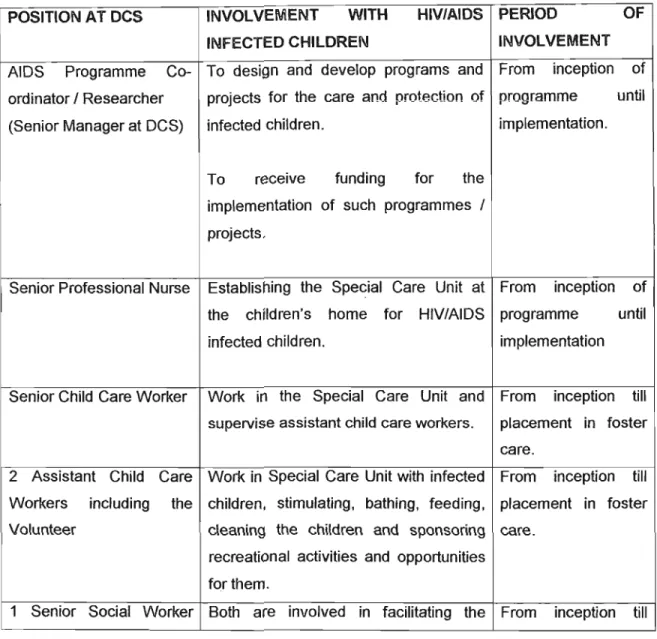
Position and involvement with the HIV/AIDS infected children
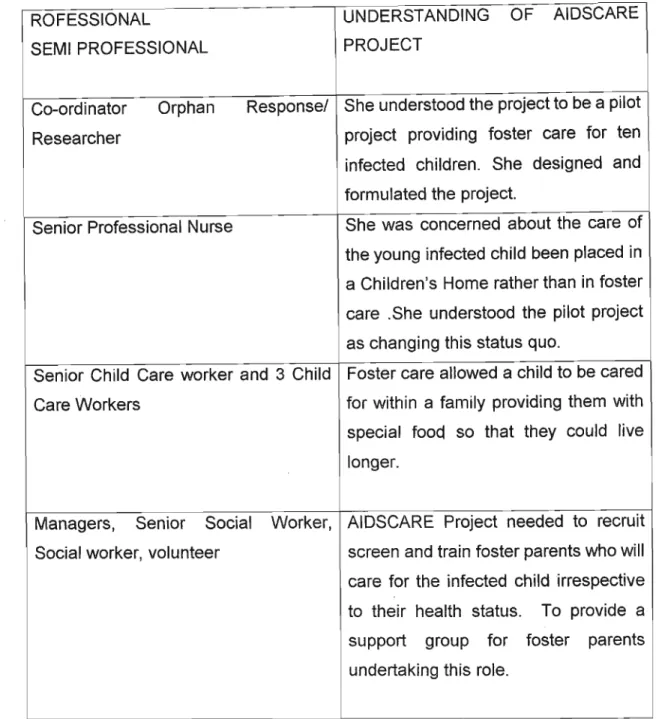
Understanding of the AIDSCARE project
CHAPTER ONE
INTRODUCTION TO THE STUDY
The devastating impact of the AIDS crisis on children in the developing world has yet to be fully understood. The number of orphans particularly in Africa constitutes nothing less than an emergency, requiring an emergency response. As already impoverished societies struggle with this massive onslaught their hard won gains in social development, including improvements in child health, nutrition and education will be negated. This study aimed at evaluating the AIDSCARE PILOT PROJECT at Durban Children's Society as a model of care for HIV infected orphans in Durban.
STATEMENT OF THE PROBLEM
The Joint United Nations Programme on HIV/AIDS (UNAIDS) estimates that, at the end of the twentieth century, nearly 19 million people died from AIDS around the world, leaving over 13 million orphans. Africa has been struck the hardest. About 70% of the world's 34 million HIV positive people live in the South of the Sahara desert and about 95% of the world's AIDS orphans are African] In the Ugandan context, orphans are children of less than eighteen years of age who have lost one or (commonly) both parents, initially due to civil strife but increasingly because of the burgeoning Acquired Immune Deficiency Syndrome (AIDS) that now affects the entire country. The 1.7 million estimate for the number of children orphaned by AIDS is expected to rise to 3.5 million by 2010, according to the United Nations Children's Fund (UNICEF). In seven Southern African countries, an extraordinary one in five adults (defined as those aged 15 to 49) is thought to be infected (G uest, 2001).
They're all in Southern Africa. In 1998, South Africa had an adult HIV prevalence of about 13%. By 2000, 20% were infected. That's over four million infected people, the largest number in any country. Unless sexual behaviour changes; between 6- 10 million South Africans, from a population of about 42 million, may die of AIDS in the next 10- 15 years. The figures are staggering, perhaps 19 million dead already and 12 million grieving children around the world. With 34 million currently infected and likely to die during the next decade, many more children face being orphaned.
The United States Agency for Intemational Development (USAID) estimated that 44 million children globally would have lost one or both parents by 2010, mostly to AIDS (Guest, 2001 :1). ./
AIDS (Acquired Immune Deficiency Syndrome) was first recognized as a syndrome of illness in 1981 (Berer and Sunanda ,1993:6). It is caused by the Human Immuniso Deficiency Virus (HIV), which is one of a group of viruses known as "retro viruses". Two major strands of HIV have been identified to date, though within these there are many different variations. HIV-1 is most prevalent in Western countries, Asia, Latin America and most of Africa. HIV-11 is found mainly in West Africa, although it has been reported in Mozambique and is thought to be present in Kwa- Zulu Natal. It is more difficult to detect than HIV 1 and may take longer to affect individuals post infection (Whiteside , 1995:4).
In order to develop, HIV has to enter the bloodstream, the main routes of transmission from one individual to another being through sexual contact, from contact with infected blood or from an infected mother to her unborn or newly born child (Whiteside ,1995:3) describes the progress of the disease. Immediately after infection individuals are highly infectious, although at this stage they do not show any symptoms and will not have produced sufficient anti-bodies for the virus to be detected through testing. This follows a "latent period" in which the individual still does not show symptoms but the virus can be detected by testing. During the next stage individuals begin to develop "opportunistic" infections and AIDS related illnesses, but HIV is a slow-acting virus and individuals can remain well or experience only minor symptoms for years. Initially bouts of illness may be of short duration and not particularly severe, but they become ever more debilitating as the disease develops.
AIDS is defined by Berer and Sunanda (1993) as a list of minor illnesses, which alone or in combination are most likely to indicate that a person has AIDS.
Manifestation of AIDS is similar throughout the world, but there is age, gender and regional differences in the presentation of the disease (Fleming, 1993). The length of time from HIV infection to the development of AIDS varies greatly, and is
dependent on an individual's general state of health, socio-economic condition, age and access to health care (Berer and Sunanda, 1993). The average time for orphans is estimated to be at 7-8 years Whiteside (1995), but this is generally higher in developed countries (Berer and Sunanda , 1993), and lower in the less developed countries. In South Africa the length of time from infection to the onset of AIDS is said to range between 3 and 8 years (McKerrow ,1995).
The length of time from the point of HIV-seropositivity to death is similarly varied, ranging from a few weeks to a possible 30 years, with a mean of 7-8 years (Whiteside, 1995:5). Although there has been some optimism about new drug treatments for AIDS patients, these are far too expensive to become widely available in less developed countries (Wood & Masson, 1997:6). As yet there is no cure or vaccine for AIDS, which is thought to be almost always fatal.
AIDS was first reported in South Africa in 1982. It emerged initially in the white homosexual population, but by 1985 heterosexually transmitted cases of HIV infection had been found in migrant labourers working in the mines (Patel, 1995:1).
The epidemic has spread most rapidly among African heterosexuals. Predictions by the World Bank suggest that by 2005 eight million South Africans will be infected and that 300 to 500 people will die from AIDS-related diseases every day.
A total of 4.7 million South Africans (Le approximately one in nine or twelve percent of the population) were estimated to be infected with HIV at the end of 2000, based on an official survey of woman attending public antenatal clinics. Some 2.5 million woman and 2.2 million men aged between 15 and 49 years and 106000 babies, were estimated to be HIV positive. According to Mark Heywood (2001) the lawyer for the Treatment Action Campaign (a non-governmental lobby group), 75000 babies or 30 percent of the babies born to HIV positive mothers were born HIV positive every year.
The estimated number of orphans in South Africa by 2010 will be around 2 million and of this number, 500 000 will be found in Kwa-Zulu Natal. This suggests that up to 1 in 5 children in school, or of school age, could be orphans. The impact of this suggestion is beyond the experience of anyone in the educational, social and welfare
field and certainly beyond the capacity of the limited counselling and support services available. The orphans will be another lost generation. growing up without family, without care, without love. compared to other children. they will be more likely to be malnourished, unhealthy and ill; more likely to drop out of school, more likely to join gangs and turn to illegal activity to survive (Launch of Aids Orphans Trust - ICC - 2/3/02 phamplet). /
CONTEXT OF THE STUDY
The Durban Children's Society was constituted in October 1999 as a result of three Child Welfare agencies in the Durban area merging, namely Child Family and Community care Centre founded in 1927; Durban Child and Family Welfare Society founded in 1918; Umlazi and District Child Welfare Society founded in 1936.
The area of operation of the Society is the Durban Metropole and North and South areas including Umlazi but excluding Chatsworth and Phoenix. The Society employs 73 Social Workers and four social auxiliary workers. The Society's core business is child protection, operating mainly in the poor and previously disadvantaged communities including informal settlements within Durban. Included in the work of the Society is a project which devotes specific attention to AIDS infected and affected children. The Society facilitates the development of informal educare centers. In addition the Society operates ten formal educare centers.
While the aim of the Society is to preserve the family unit, there are times when it is necessary to place children within children's homes. An increasing number of abandoned children are being placed in the children's home when it is not possible to find alternate family or community care.
VALUE OF STUDY
The goal of developmental social welfare is a humane, peaceful, just and caring society which will uphold welfare rights, facilitate the meeting of basic human needs, release people's creative energies, help them achieve their aspirations, build human
capacity and self reliance and participate fully in all spheres of social, economic and political life (White Paper for Social Welfare, 1996, Preamble).
The value of this study lies in its potential to uphold the rights of the child as espoused to in the United Nations Convention on the Rights of Child (1989) as well as the right to have quality of life. The value of the study is also enshrined in the Constitutional Mission Statement of DCS, which states that as a non discriminatory equal opportunity organization, the Society's objectives are to protect the rights and promote the quality of life of children, families and communities within its area of operation and to work for the course of social justice. The study acknowledges the need to change mindsets about people involved with children infected and affected by AIDS orphans with regards to fostering them. It aims to develop a programme to recruit and train prospective foster parents to care for the HIV infected child. The study acknowledges the need to develop a "best practice model" in providing services to orphans and to disseminate information if successful, encouraging communities to participate in the programme so that fostering HIV infected orphans becomes a norm.
Social workers and childcare workers are at the interface with the community, therefore they are in a position to influence the development and value of policy making.
RESEARCH APPROACH
A detailed description of the Research Methodology is outlined in Chapter Three. A programme evaluation research design was used. The researcher who is the facilitator of the AIDS Care pilot project chose the participants who attended the monthly Masakhane Support Group meetings, which the researcher facilitated. The researcher/facilitator's intention was to evaluate whether the pilot project was successful. The research approach used coheres with the ecological theoretical framework. The ecological theory was used throughout the study.
RESEARCH AIM
The aim of this research study was to evaluate the AIDSCARE Pilot Project at Durban Children's Society as a model of care for HIV infected orphans in Durban.
OBJECTIVES OF THE STUDY The study was guided by the following objectives:
1) To establish how effective the pilot project has been in recruiting, training and orientating foster parents to care for HIV infected orphans.
2) To evaluate the foster parent's experience of fostering HIV infected orphans.
3) To evaluate the service providers perceptions of the pilot project.
4) To establish whether the Masakhane Support Group has been successful in meeting the needs of foster parents.
5) To evaluate the HIV infected children's progress in fostercare.
THEORETICAL FRAMEWORK
The ecological perspective was viewed as an appropriate framework within which to contextualize this study. This approach emphasizes the multiple contextual influences on human behaviour and the concept of reciprocating between the individual and the environment (Hill & Madhere, 1996), (Whittaker, Schinke &
Gilchrist, 1986). McKendrick (1990) viewed the person in transaction with the environment stance as being the most useful and relevant approach for the South African social worker. One of the distinguishing characteristics of social work is its focus on the "wholeness and the totality of the person - in situation, gestalt", (Thackeray, Farley & Skidmore, 1994). The holistic, dynamic view of the reciprocal exchanges between people and environment moves away from simplistic linear cause - effect explanations (McKendrick, 1990). In fact, Brower (1988) maintained that the ecological model was one that grew directly out of the social work profession's dual commitment to the person and to the environment. The environment is defined as including "not only actual situations in which one finds oneself but also includes socio-cultural and socio-economic events that shape the psychosocial context within which one lives. These events include such things as the general political climate of the day, the socio-economic status of ones demographic characteristics" (Brower,1988:424). The author stressed that the
concepts "person" and "environment" were inseparable and that behaviours must be viewed within the person-environment interaction.
Similarly Whittaker et al (1986:482) viewed the environment as a set of "nested concentric structures", each influencing the other and ultimately the developing child and these structures may be viewed as contexts or systems that never function in isolation.
The ecological perspective accommodates a broad spectrum of problems and needs, it provides a suitable framework for understanding -:- the concepts illness and death and re-approval process between people and the environment.
Whittaker et al (1986) outlined the value of this paradigm in designing service programmes for children, youth and families, namely:
building more supportive, nutritional environments for people through various forms of environmental helping that are designed to increase social support.
Improving competence in dealing with proximate and distal environments through the teaching of specific life skills such as social skills for adolescents, conflict resolution skills and family living skills.
This study was based on the assumption that foster care is a preferable alternative to traditional residential care models for the HIV infected child.
Placement in a family can enhance the HIV infected child's well being and extend the lifespan of the infected child. USAID (2000:11)
"Adoption and fostercare mechanisms will be in need of special placement. This will involve strengthening and expanding government and non governmental fostercare and adoption programmes, supporting measures which ensure the rapid placement of abandoned infants ...
Institutional placement is at best, alast resort, to be used only on an interim basis until a more acceptable
placement can be arranged. Institutional care is not an acceptable solution to the growing problem of AIDS orphans, because it generally fails to meet children's developmental needs, including opportunities for attachment and normal socialization (and cultural norms).
The younger the child the more likely that placement in an institution will impair his/her psychological development. It is too expensive to provide on large scale and it tends to create more demand for children's placement by poor families who are struggling to care for orphans.
The UNICEF report (2000:18) states that programmes should be "promoting supportive and economically self sufficient community environments, promoting community based responses including identifying vulnerable children, finding innovative ways to support and strengthening family and community coping mechanisms, supporting the development of effective community based approaches to assist children and families affected by HIV/AIDS.
The ecological perspective is closely linked to the primary prevention perspective as both these approaches focus on people and their interaction with the environment.
The focus of the ecological perspective and primary prevention are on opportunities for positive social participation and skills to promote' building successful relationships (Fraser ,1996).
DEFINITION OF K~YCONCEPTS
Foster parentis - a single/couple who assume custodial responsibility for a non- related child through a court order.
AIDS - Acquired Immuno Deficiency Syndrome,
Orphan/s- child/ren who have lost both a natural mother and father and do not have a guardian
Vulnerable children - children who are at risk of abuse, neglect and abandonment.
Foster care- placement of a child in terms of Section 15(1)(b) of the Child Care Act with a related/non related family. The family gets temporary custody over the child.
The placement is supervised by a social worker.
Kinship care- caring for a child who is biologically related or a child where a relationship already exists
Adoption- refers to a permanent placement which gives guardianship to the adoptive parents which affords the child the same status has the biological child.
PRESENTATION OF THE STUDY
Chapter one provided an introduction to the research study. The statement of the problem, the objectives of the study, its theoretical framework as well as definition of key concepts were outlined. The Literature Review is presented in Chapter Two. In Chapter Three the research methodology, data collection and sampling guiding the study is highlighted. Chapter Four focuses on the analysis, interpretation and discussion of results. In Chapter Five, the conclusions and recommendations of the study are presented and some proposals are suggested.
CHAPTER TWO
LITERATURE REVIEW
This chapter deals with the review of literature concerning various aspects of AIDS and its social implications for infected orphans. An outline of paediatric AIDS, mother to child transmission prevention, the global response to orphans, the South African governments response to the pandemic outlines the extent of the problem. The Durban Children's Society response and the models of care are then discussed. The focus of this chapter will be on foster care of HIV/AIDS orphans.
Nature and extent ofHIVIAIDS in South Africa
Global statistics regarding the nature and extent of HIV/AIDS has already been outlined in Chapter One. The Child Health Policy Institute in Cape Town estimates that by the year 2005, South Africa will have over one million AIDS orphans, many of whom themselves will be HIV positive. Poor, under-resourced communities already carrying the burden of providing for the sick, the elderly and the orphaned will be unable to cope with caring for the escalating number of victims of the AIDS epidemic.
South Africa has only recently emerged from the tragedy of apartheid; the country is currently in the process of major socio-economic transformation that touches every aspect of life. Social Welfare needs have to compete with demands for more housing, better education, provision of water and electricity, improvement of roads in disadvantaged areas and crime prevention. Moreover, as South Africa struggles to shake off the legacy of apartheid and to create a more equitable and just society, it is faced with new problems created by a rapidly developing HIV/AIDS pandemic. The pandemic has raised immense social and economic problems in its wake, not the least of which is the impact of HIV/AIDS on children and their families.
Mother to Child Transmission Prevention
Most cases of pediatric AIDS is due to vertical transmission. Paediatric AIDS occurs in populations with limited access to healthcare and HIV related mortality would be a more serious problem where child mortality from other causes is low by developing
countries standards. Since women are the traditional providers of childcare, the high ratio of women infected has devastating consequences for children. Veeran (2000) stated that women's position in society is dictated by the various roles they play. In most if not all situations woman have the dual responsibility of maintaining a household and working, placing additional strain on the woman to take greater responsibility for her and her family's well being.
Although the availability of anti-retroviral drugs to reduce mother to child transmission has been promoted in KwaZulu Natal, children may become infected by their infected mother. The long-term impact will be the loss of mothers and fathers of young children and the subsequent increase in the number of orphans. On average babies who are infected will develop AIDS by the time they reach between 9 and 18 months. Their chances of survival thereafter vary between 3 months to 2 years.
Although a growing number of children as was evident in the current study are reported to be surviving beyond 5 years, these remain the exception. In Kwa-Zulu Natal most do not live to see their second birthday (McKerrow, 1995).
More than 150 children are born with HIV every day in South Africa. They live short and miserable lives, encountering respiratory infections, malnourishment, diarrhoea and fungal infection. Repeated regular visits to health facilities helps a little, but after a short life with much pain, these children die. Scientific research conducted by the Nelson Mandela School of Medicine (2001) shows that HlV transmission to half these children can be prevented if the government implements a mother-to-child transmission prevention (MTCTP) programme. The research further shows that MTCTP through the use of Nevirapine (a drug that has been registered for this purpose) is safe, effective, cheap and simple to administer. Despite Boeringer- Ingelheim's offer to the government of free Nevirapine for five years, it has refused to implement such a programme. TAC decided to launch the court case to pressurize government (which has been ignoring science, economics, morality, good planning, good governance and the law on this issue for more than five years) to make anti- retroviral drugs freely available to all sectors of the communities; this action occurred only after three years of meetings, petitions and protests went unheeded by the government. In September 2001, a court action was set in motion. Treatment Action Campaign's case was based on the premise that government was not implementing
a national programme, government was failing to recognize women's right to dignity, reproductive choice and health care and children's right to life. On 26 November the first hearing took place in the Pretoria High Court. On 14 December, the High Court ruled in TAC's favour, ordering the government to:
1. Develop a roll- out plan for a national MTCTP.
2. Make Nevirapine available to pregnant women with HIV who give birth in the public sector, to babies in public health facilities to which (government's) present programme for the prevention of MTCT of HIV has not been extended.
Government appealed this ruling and took the matter to the Constitutional Court.
The Constitutional Court heard both sides again on 2 May 2002 and is expected to make a final judgement either reinforcing the High Court order or leaving it up to the government to decide when, how, or whether to implement a national programme to prevent MTCT.
Non Governmental Response to the Problems of Orphans
The most critical challenge currently facing non governmental organizations seeking to assist AIDS- affected children is that of developing responses to problems on the same enormous scale that they are occurring. Millions of children have already been orphaned by HIV/AIDS; tens of millions more will lose one or both parents to the pandemic in the first decade of the 21stcentury. The World Bank estimates that under "normal" circumstances 5 percent of children in Africa are parentless and un-accommodated within the extended family structure.
This figure changes markedly when one introduces AIDS and its accompanying social consequences to the picture. Tens of millions more will suffer indirectly.
While it is reasonable to believe that the international community will make substantial resources available to assist these children than are currently allocated, resource levels will still be far lower than required. Each governmental/non governmental organization involved in programming must carefully consider how to use it's limited resources to ensure quality care is provided to the highest number of AIDS affected children/adolescents possible.
Programmes should be designed and developed to benefit as many children as
they can (scaling out) and effective approaches should be adopted and adapted by organizations in other areas (scaling out).
The problem of orphans is old as society itself, the only difference now is that the problem as now become more pronounced due to the AI DS pandemic. Thus there have always been care arrangements both formal and non formal. The responses to the problems of orphans include the use of the extended family system, foster care, adoption, institutional care and community based care as explained on pg.22.
South African child welfare agencies are faced with a huge task, not only must they find strategies to tackle poverty and redress inequalities created by apartheid, but in addition they must develop effective models of care to support children and families affected by the rapidly spreading HIV/AIDS pandemic.
HIV/AIDS is a global epidemic that is resulting in a vast number of children with dead or dying parents (Levine, 1992). When their parents die, these children need financial assistance, shelter, food and medical care. These psychosocial needs of the children would have once been available through the extended family (aunts, uncles, grandparents and cousins) support system. The increase in the number of orphans has increased the responsibility of the extended family system, which in the past used to accept the responsibilities of orphans. Since society has always had an orphan problem existing social structures provide care to orphans in traditional ways. The extended family (uncle's, aunt's, elder brothers and sisters and grandparents) is a source of physical, moral support.
Increasing impoverishment and numbers of orphans tend to breakdown some of these traditional structures. Furthermore socio-economic factors are undermining the effectiveness of the extended family system. These include the harsh economic environment, which makes it difficult for individuals to extend assistance to their needy relatives. Also, there has been a gradual weakening of kinship ties as a result of urbanization and industrialization. Those who take on the responsibility often do so with little or no support from the government. As a result the material needs of the orphans are often not met. The problem is often compounded by the fact that when parents die, they rarely leave any inheritance to their children, as they use all their resources to seek treatment for AIDS related
illnesses (Kaseke&Matshalaga, 1998). This impacts negatively on the welfare of orphaned children.
In developing countries orphaned children have traditionally been cared for by family members. Although the traditional arrangements for the care of orphaned children still exist, the magnitude of the problems of AIDS orphans has rendered the extended family system unable to cope. A significant feature of the AIDS pandemic has been the emergence of child-headed households and households headed by elderly persons. The existence of child-headed households in particular is a reflection of the growing incapacity of the extended family to provide care and protection to the orphaned children. Under such circumstances the eldest child assumes the responsibility for looking after the younger siblings, sometimes with the assistance of relatives or other members of the community. Unfortunately these children rarely have the resources and often find it difficult to access social safety nets because of their minor status. As a result they struggle to meet their basic needs (Kaseke&Gumbo, 2001).
In areas where an increase in the prevalence of AIDS has been noted, there are increasing stresses to the capacity of extended families and communities to provide care. Hence the option of a residential facility which is not an appropriate option is chosen. These residential facilities generally do not adequately meet key developmental needs such as consistency of care, especially for younger children.
In addition, when children grow up without family' and community connections, they are cut off from support networks they will need as adults, as well as the opportunities to learn the skills and culture that children learn in families in their communities. Their social integration in adulthood is a more difficult task as they are accustomed to been socialized in a group. They are usually ill-prepared for life after they leave the institution and this is exacerbated by the fact that they do not have marketable job skills when they leave the institution. The Inter-Ministerial Committee (IMC) on Young People at Risk (1996:26) stated that in terms of the continuum of care services to emotionally and/or behaviourally troubled children and youth (and their families), it is recognized that (a) there are presently more than 30 000 children in the child and youth care system and it will take years to develop and implement the full framework and transformation of the system, (b) HIV/AIDS is a factor whJch
Assist children, families, communities and provinces to identify the most vulnerable, to help prioritize resources and to preserve family life;
Strengthen families, children and communities in using their own strengths to help themselves through prevention, counselling and support to those who have been traumatized;
Support families, communities and other stakeholders to identify and implement strategies that promote the children's well being, for example medical care, substitute care, nutritional needs, educational needs and protection from abuse and exploitation;
Identify external supports for communities and enable communities to build support networks.
b) The implementation and further development of effective and affordable community based care and support models and targeted preventative interventions.
c) To ensure that the Comprehensive Childcare Legislation being developed by the SA Law Commission deals effectively with the needs of orphans and this includes the protection of children's inheritance.
d) Establishing and strengthening poverty alleviation I eradication programmes in affected areas.
e) Training programmes for professional community workers, child and youth care workers, community leaders, families, NGOs and CBOs.
f) To foster intersectoral collaboration at all levels and establish integrated institutional arrangements at provincial, regional and local levels for implementation and monitoring of the strategy.
g) To determine the financial implications ofimpl~m~ntingthe strategy.
Services to children infected and affected by HIV/AIDS would need to be contextualised within the framework and theproce~sof the transformed child and
youth care system, which has been established as a process and procedure.
The framework is underpinned by a developmental approach which focuses on strengths rather than pathology, understanding and responding appropriately to developmental tasks and needs, maximizing the potential of each individual, family and community to deal appropriately with challenges confronting them.
Durban Children's Society's Response to the AIDS Pandemic
Durban Child and Family Welfare Society, Child Family and Community Care Centre of Durban and Umlazi and District Child and Family Welfare Society merged in October 1999 to become Durban Children's Society and hereafter referred to as DCS. The Society became concerned about the increasing number of children in distress because of the death of their parents and primary caregiver due to HIV/AIDS. With the support and assistance of the AIDS Foundation of South Africa, an AIDS Co-ordinator (COR) was appointed. It seemed clear that the traditional strategies of alternative care for vulnerable children such as foster care; adoption and residential children's homes would not meet this increasing need. Fostercare is the placement of child through a court order in the temporary custody of a relative or a non related family where no written parental consent is required; adoption is the placement of a child through a court order into the permanent custody and guardianship of a new family with consent from the biological family; a children's home is the placement of a child through a court order into an institution which can be characterized by dormitory accommodation or a cottage system where children are socialized in a group setting (The Child Care Act74/1983)
An evaluation of statistics of DCS compiled for the period October 1999 to April 2002 of registered HIV/AIDS related cases from all geographical areas that is areas in the north of Durban to Umhlanga, south of Durban to Umlazi and west of Durban to Reservior Hills serviced by DCS indicated that over the 37 months, 98 parents were deceased leaving a total of 370 orphans who were referred to the society for services. These children were referred to DCS as a result of their parents dying from an AIDS related illness. (Neilson - Aids Co-ordinator, DCS April 2002). At the end of November 2001, DCS was monitoring the care of 2142 orphans in Kinship care ;:md a further 321 in non-related fostercare. Between 70 and a 100 new orphans are now
being registered each month. This has increased from between 30 to 50 orphans since December 2001.
The decision was made that the Society's services would have to be re-examined and modified andIor new care models developed, changes had to be made based on the following principles:-
all children have a right to family care and siblings should remain together where possible;
the family (nuclear and extended) is the primary care system and must be supported and empowered;
children who cannot live with their own family should preferably remain in their own community or in a similar environment and culture;
all children have a right to protection from abuse and exploitation.
These principles were and are compatible with the philosophical stance adopted in the South African White Paper on Social Welfare professional social work values and also DCS Mission and Aims. The above principles are also enshrined in the United Nations Convention on the Rights of the Child (UNCRC) 1989 . The UNCRC states that" children are born with fundamental freedoms and inherent rights of all human beings. This is the basic premise of the Convention on the Rights of the Child, an international human rights treaty that is transforming the lives of the children and their families around the globe. People in every country, in every culture and every religion are working to ensure that each of the two billion children in the world enjoy the rights to survival, health and education; to a caring family environment, play and culture; to protection from exploitation and abuse of all kinds; and to have his and her voice and opinions taken into account on significant issues.
According to DCS statistics for the period March to May 2000, 275 orphans needed alternative family care ie. Substitute care. The provision of substitute care is one of the most widespread remedial approaches, which is practiced in both developed and developing countries. In South Africa voluntary organisations including child welfare societies, have been instrumental in developing and administering a range of substitute care options for children in need of fostercare. DCS is committed to
developing strategies and implementing services which effectively mobilize, capacitate and involve children, families and communities in combating the impact if HIV/AIDS with particular emphasis on facilitating the care of children infected and affected by the pandemic. DCS has prioritized a range of services, which will ensure that orphans, children infected with HIV and other vulnerable children have access to adequate family or family type care. DCS with the support of the AIDS Foundation of South Africa launched its Co-ordinated Orphan Response (COR) aimed at developing a range of home or community- based care for children infected and affected by AIDS and other vulnerable children.
The general objectives of COR which forms the conceptual model of the programme are:
a) To establish the number of orphans and vulnerable children (OVC) within our area of operation and identify their needs and the needs of their caregivers.
b) To promote the early identification and rapid referral of vulnerable children.
c) To ensure the adequate care of OVC's already integrated into a family system.
d) To identify, promote and facilitate alternative family care for OVC's in need.
e) To develop and facilitate new community-based care and support systems for OVC's in need.
f) To design, develop and evaluate a "continuum of community care" for OVC's and evaluate the effectiveness of the range of options incorporated therein.
One of the strategies for achieving objective 4. was to implement the proposed
"AIDS Care" Project. This pilot project had been funded for three years, should the project be successful the funding will be continued.
The AIDS Care pilot project promotes, encourages, facilitates and supports the placement of HIV infected babies into foster family care as an alternative to institutional care. The project has recruited, orientated and assessed 10 special foster parents/families who are willing to offer a suitable and loving home to a HIV positive baby or young child who may have been orphaned or abandoned, who would benefit from being cared for within a family rather than in a children's home.
The Project AIDS Care Leader (PAL) who is the researcher processes the essential statutory procedures and monitoring the utilization of the child's "Aids-Care"
allowance and state provided foster child grant. More importantly. the project leader offers preparatory and ongoing individualised practical and emotional support, as well as facilitating support groups to foster parent. The project leader has initiated a Support Group for these foster parents. The Support Group is known as the Masakhane Support Group (MSG). It was formed in June 2001 with 6 foster parents. It presently comprises of 12 foster parents. The MSG meets once a month and the meeting is facilitated by the project leader. The Project includes the provision of grief and bereavement counseling for the foster parent. Nurses will provide special training and advice to help the caregivers to defer the onset of opportunistic infections, cope with the inevitable bouts of ill health and if possible, continue giving
"their" child personal love and emotional care during the terminal phase. Such assistance includes the use of vitamins and/or nutritional supplements. special care necessities, palliative care and/or respite care. A paediatrician is available to give essential advice. The initial Workplan (attached as Appendix A) provides an outline of the project.
Models of care
In South Africa voluntary organizations including child welfare societies, have been instrumental in developing and administering a range of substitute care options for children in need of foster care. In some countries like Britian and America foster care is seen strictly as a temporary arrangement, whereas in other countries like South Africa the norm is for long-term and quasi-adoption placements. Given these diversities Colton and Williams (1997:48) suggest the following inclusive, if rather cumbersome. definition of foster care.
a) Foster care
Foster care is care provided in the carers, home, on a temporary or permanent basis. through the mediation of a recognized authority, by specific
carers, who may be related or not, to a child who mayor may not be officially resident with the foster carer.
Pakati (1992) states that many children in South Africa live apart from their parents either temporarily or permanently, it is not uncommon that children are brought up by an aunt or uncle. Such family care is not re-imbursed and the parents can and do claim their children back whenever they feel like.
Kinship care is common, especially in the African population. These arrangements are generally informal, being agreed between individuals without recourse to formal rules and regulations. By contrast, formal foster care is defined by law and its practice is informed by regulations and procedures. Like adoption, the practice of formal fostering was introduced into South Africa and has been based on literature and practice drawn from Western countries.
b) Foster care by a group or community rather than an individual.
Here social, religious, sport or other cultural groups accept responsibility for the well being of the children, catering for basic needs. Individuals within the group may accept responsibility for specific needs of the children and the group as a whole undertakes with or without outside assistance, to raise the children (McKerrow, 1995).
c) Family structured models within "registered'homes".
This entails the creation of community households accommodating one or more families of orphans within an extended family setting. These households are under the supervision and management of paid, community appointed individuals and committees who provide for either specific needs of the children or for their total care (McKerrow, 1995).
d) Traditional institutional care
Children are cared for in a group in an institution. They reside in dormitory style accommodation or cottage systems. Their primary caregiver is a shared
child care worker. Economically, institutional care is not feasible for large numbers of children. A cost benefit analysis done by the Aids Co-ordinator at DCS in February 2000 estimated that the cost of retaining a child in a children's home totalled R1572,00 per month per child. In comparison a child placed in fostercare costs the state R41 0,00 per month per child. The resources needed to support institutional care for a single child can assist scores even hundreds of children if used effectively to support a community based initiative. In communities under economic stress, increasing the number of places available in institutions has often led to more children being pushed from family care to fill those places, where material standards are seen as being higher than what families can provide. This increases the scale of the problem and consumes resources that could do more if directed towards strengthening families and community capacity to care for vulnerable children. Institutional care can be helpful in some cases where there is no other option, as an interim solution whilst a fostering situation is arranged.
Children in this situation should be reintegrated into the community as soon as a reliable caregiver is identified.
According to the IMC document children needing residential care in the future are likely to be (1) those children who are orphaned / abandoned and who cannot be absorbed into communities, (2) those who have serious emotional and/or behavioural problems and cannot be best served within their families or in foster care, (3) those who are seriously disabled and who cannot be best served in their families and foster care.
The continuum of care refers to a range of alternative care interventions which offer differentiated programmes and which are compatible with the varying degrees of the young person's need for protection. The continuum logically ranges from adoption and foster care, which is least restrictive at one end through to various forms of secure care with youth correctional facilities at the other end being the most restrictive.
Recruitment of Foster Parents
The recruitment and training foster parents in linked to objective 1 of the study.
There is a continuing need for foster homes particularly for older and special needs children. A range of recruitment means are utilized including direct presentations by social workers or foster parents to select individuals or groups; newspaper advertisements and "word of mouth" among foster parents. Stone (1974) and Huntzeger (1974) concluded that recruitment methods are not successful, with the exception of referral by other foster parents. Although some studies report acceptable payment as a factor in attracting appropriate foster parent applications, Grow (1970) and Smith (1970) found that many agencies believe that there is no relationship between the foster care grant (boarding rate) and recruitment. Although various means are utilized agreement on effective methods is lacking. Other recommendations for recruiting include increasing the number of agency staff, utilizing foster parents and foster parent organizations and offering fees for service or reasonable payment.
Motivation of foster parents
Josselyn (1952:20,21) outlines the most common motivations expressed by potential foster parents as:
a) The family has learned through the newspaper and radio publications that there is a need for foster homes, they ha~e an extra room and feel that they should take a child.
b) Often coupled with the above is the statement that they like children and would enjoy having an additional child in the home.
c) The couple has one child and feel that their child shows signs of being spoilt and deprived of the experiences that a larger family seems to have. They therefore wish to enrich their child's own life by taking in the additional child.
d) The parents wished to have more than one child for medical or economic reasons it is not possible, they wish to augment their family by fostering a child whose stay is not permanent.
e) They have attempted to adopt, but the agency does not have a suitable child for them, the see a foster child as a substitute for an adopted child.
f) The have lost a child and have decided to fill the void by fostering a child.
g) One or the other of the couple was brought up in an orphanage or in an .unhappy childhood environment and wishes to give another child with a
similar background a satisfactory life experience in their home.
h) The couple's own children have reached an independent age where they are no longer emotionally dependent. Since the couple is too old to start their own family, they wish to substitute a foster child to meet their emotional needs.
i) The wife feels that she needs to substitute the family income but does not wish to work outside the home, she decides to augment the family income by fostering.
j) A sense of religious duty also motivates foster parents to foster a child.
Training of foster parents
George (1970) found in a study that he conducted that child care workers who viewed foster parents as professional colleagues were in agreement with the question that foster parents should attend short training courses in foster care principles and methods. Similarly, foster parents being consistent with their view that the fostering role is very similar to the parenting role, rejected the idea of training courses. One foster parent commented that such courses were necessary only for a few foster parents who cared for 'children in need of special care and treatment'. For the majority of foster children they were not necessary because 'normal children need love, understanding and being part of a family. Such things cannot be 'taught'.
An overview of research found that a majority of programmes emphasize the special roles and relationships· in foster care, a few focus on Mother/child interactions or child management techniques. Educational programmes involve a series of weekly meetings emphasizing child development, foster care roles and problem solving. A few programmes give certificates of completion or university credits, none specify any change in foster care payments as a result of program completion.
It is standard procedure in all South African child welfare agencies South African Council for Child Welfare (1987) that prospective altemate parents participate in a screening and training process. This practice benefits all parties involved:
a) It provides sufficient and accurate information to Court.
b) Pertinent knowledge of the applicants, their families and resources, facilitates the matching process, which ensures the child's needs are met.
c) During the screening process, the applicants' motivation, wishes and misperceptions are addressed. This gives the social worker a chance to provide the supportive and conselling services for all prospective carers involved.
Personality traits and characteristics of foster parents•
The personality traits and characteristics of foster parents is linked to objective 2 and 3.
Josselyn (1952) states that the emotional maturity of foster parents is very important with regard to the needs of a special child. The prospective carers should insight into children's feelings and child development.
A study done about caregivers of HIV positive children in Johannesburg, Soweto and Alexandra Township in South Africa found that only females responded to their study as woman were commonly recruited as foster parents (Levine, Michaels, Back,
1996).
This Chapter reviewed literature on aspects of AIDS, its social implications for orphans, paediatric AIDS, the global response to the AIDS pandemic, the South African Government's response and Durban Children's Society's response, lastly the models of care for infected children were outlined.
The next Chapter will outline the Methodology and will focus on the research design, sampling and data collection.
CHAPTER THREE
METHODOLOGY
Research Design
The value of a study is determined by the extent to which it is compatible with the research approach and the guiding theoretical framework (Patton, 1987(b).
Programme evaluation was the primary research method used in this study.
Babbie (1992) states that evaluation research sometimes called programme evaluation, refers to a research purpose rather than a specific research method. Its special purpose is to evaluate the impact of social interventions such as new teaching methods or as in this study, an intervention method. Evaluation research is a matter of finding out whether something is there or not there, whether something happened or did not happen.
Paton (1986:14) defined programme evaluation as "the systemic collection of information about the activities, characteristics and outcomes of programmes for use by specific people to reduce uncertainties, improve effectiveness and make decisions with regard to what those programmes are doing and affecting".
Patton (1986) highlighted differences between programme evaluation and evaluation research. He maintained that while programme evaluation used research methods to gather information, evaluation differed fundamentally from basic research in the purpose of data collection. Basic scientific research is undertaken to discover new knowledge, test theories, establish truth and generalize across time and space.
Programme evaluation is undertaken to inform decisions, clarify options, reduce uncertainties and provide information about programmes and policies within contextual boundaries of time, place, values and politics (Paton, 1986). In support of Paton (1986), Lincoln and Guba cited in Palumbo (1987) asserted that systematic differences in the purpose of the activities, signal differences in outcomes. Guba &
Lincoln (1989:8) state that evaluation outcomes are not descriptions of the "way things really are or really work" or of some true "state of affairs, but represent
meaningful constructions that individual actors or groups of actors form to make sense" of the situations in which they find themselves. The findings are not facts in some ultimate serve but are, instead literallycreatedthrough an interactive process that includes the evaluator. What emerges from this process is one or more constructions that are the realities of the case. In this study the participants interacted will the researcher in the monthly MSG meetings, therefore the researcher was able to "make sense" of their situation.
DCS decided that their services needed to be re-examined and modified and new care models developed in response to the growing AIDS pandemic. DCS is committed to developing strategies and implementing services, which effectively mobilize, capacitate and involve children, families and communities in combating the impact if HIV/AIDS with particular emphasis on facilitating the care of children infected and affected by the pandemic. DCS has prioritized a range of services, which will ensure that orphans, children infected with HIV and other vulnerable children have access to adequate family or family type care. Therefore the AIDS Care programme was developed as a pilot programme, hence programme evaluation will be the applicable approach for this study because DCS has implemented a new programme and it is important to have feedback and evaluate services. Furthermore participants were allowed to give inputs beyond the scope of the guiding questions.
Sampling
The type of sampling method used was non-probability purposive sampling. Marlow (1993) states that purposive sampling purposively includes in the sample those elements of interest to the researcher. Marlow (1993) elaborates on the fact that a purposive sample differs from an availability sample in that a purposive sample contains elements that possess the characteristics you are interested in studying.
An availability sample chooses the sample because of its ease of selection. The researcher chose the non-probability purposive sampling technique, as it was imperative to include only those participants who were selected and trained as foster parents.
Sample
A total of nineteen participants participated in the research study comprising the foster parents and service providers. Sample one comprised ten foster parents who participated in the AIDS Care project; they resided in the following suburbs/townships in Durban; Cato Crest, Bonella, Bluff, Hillary, Durban Central, Kwa Mashu and Wentworth. Some of these residential areas were occupied predominantly by white residents during the apartheid era in South Africa. Areas like Kwa Mashu continues to be occupied by African families and Wentworth is occupied by Coloured families. Five foster parents were married and five foster parents were single, only the foster mothers from the married couples were interviewed because they were the primary caregivers of the children.
Sample two comprised 9 service providers. There was one orphan response co- ordinator who is the senior manager at D.C.S (she designed and formulated the pilot project) , one manager, two residential social workers, one nursing sister from the William ClarklOthandweni Children's Home that comprised the professional sample.
There were four Child Care Workers from the said children's home who were part of the 9 service providers.
The researcher (PAL) of this study had to implement the pilot project as well as research it.
Data Collection
The data was collected by means of struct~red interviews using an interview schedule. The interview schedule was designed by using the researcher's experience as a social worker in' this field and guided by literature reviewed.
Different interview schedules were used for each sample. The data was collected by PAL who also the researcher. The strengths were that the researcher was able to clarify uncertainties and observe interactions amongst foster parents.
Inconsistencies that were observed yielded useful data.
Sample One
Annexure B: Interview Schedule for foster parents
This interview schedule was administered to the foster mothers on an individual basis and when necessary the social auxiliary worker was used to interpret the questions to them if they were Zulu speaking. The purpose of this questionnaire was to gain an understanding of foster parents motivation to foster, understanding of AIDS issues, training to be a foster parent and support opportunities available.
Sample 2
Annexure C:Interview Schedule for service providers
This schedule was administered to the Orphan Response Co-ordinator,Residential Manager, two Social Workers and the nursing sister from the children's home. In addition the schedule was administered to the two senior childcare workers (these child care workers supervised the two child care workers who were directly involved in the daily care of the infected children). The purpose of this schedule was to elicit their understanding of the AIDSCARE project and how they participated in this project.
Annexure D: Interview Schedule for service providers (child care workers)
This schedule was administered to the two childcare workers who supervised the children's growth and development on a daily basis in the children's home prior to their placement in fostercare. The data obtained from here will indicate what the children's physical, mental and developmental status whilst in the institution. The diagrammatic developmental assessment was compiled by the ex Principal Head of Pediatrics, Dr. Winship, Addington Hospital, 1980.
The researcher facilitated and conducted the interviews. Interviews with the staff from the children's home were held at the children's home, interviews with the COR and foster parents was held at DCS offices. Participants were allowed to make inputs beyond the scope of the guiding questions.
The study used both closed and open-ended questions. In devising close-ended questions, the researcher used her own knowledge of what the responses might be as a frame of reference for categorization. According to Bailey (1982) the disadvantage of close-ended questions was that a respondent could feel frustrated if her answer was not contained within any of the categories provided. In order to avoid such difficulties the researcher provided an "other" category. Data was analysed by drawing out relevant themes and categorizing them into sub themes.
ETHICAL CONSIDERATIONS
The use of human beings as respondents or otherwise in any research invokes the issue of ethics. Social work ethics serve to regulate the relationship between the client and the worker in the helping relationship and in research. According to Grinnell (1993) ethical considerations have to be made concerning the effects of the research process on the research participants, the social work profession and the larger society. The following ethical issues were taken into consideration throughout this study:
a) Confidentiality and anonymity: all participants in the study were assured of confidentiality. Data derived from the joint interaction was used strictly for the purpose of the study. Foster parents, childcare workers and service providers were not asked to disclose their names in an attempt to protect their identities. They were informed about their anonymity prior to their participatiem.
b) Informed consent: All the research participants were informed about the purpose of this study at the outset as well as notified of their right to decline participation if they did not wish to participate. According to Grinnell (1993) research participants must be competent to give consent and this requires that they must be provided with sufficient information to enable them to make an informed consent. All research participants were consulted and those that did not wish to participate in the study were free to decline. Interestingly enough, no foster parents declined.
c} Dissemination of research finding: the results of this study will be made available to all research participants, the AIDS Foundation of South Africa who are administering the funding of this project, other relevant authorities who are likely to benefit from the findings of this study.
Research data will also be made available by lodging copies at the University libraries and publications in scientific journals and newspapers.
LIMITATIONS OF THE STUDY
The researcher must be aware of the strengths and limitations of the method chosen in producing valid and reliable data and how this will affect the study and the generalizations that can and cannot be made from the findings. A discussion of the possible limitations in the design and methodology of this study follows.
Reliability and Validity
In choosing an evaluation methodology it was important to monitor the reliability and validity of evaluation instruments and designs. Reliability refers to the standardized nature of the measurement instrument (such as a test or questionnaire) which assumes that it will produce consistent information across different applications. If the questionnaire items are worded vaguely responses will be arbitrary and erratic, producing an instrument that is not reliable. On the other hand, validity refers to whether or not you are really measuring what you want to measure. It is possible that respondents will answer a given question consistently in a way that is different from what the evaluation intended and consequently the results will not be valid.
In this study the validity of the interview schedule was enhanced by the fact that the researcher conducted a literature review which guided the research, the interview schedule was also carefully studied by the COR to eliminate any subjectivity. The content validity was enhanced by pre-testing the instrument with the COR and a foster parent. The interview schedule was subsequently refined.
Reliability was enhanced by seeking the multiple perceptions of the sample groups to clarify meaning and repeatability of observation and interpretations.
SampleSize
The small sample size limits it's representatives of the population from which it is drawn (Marlow, 1993). This factor further limits the generalisability of the study. It must be noted that the sample was selected in order to obtain in-depth information. It has however been argued that qualitative research is more concerned with generating information rich data, and that the smaller the sample the more the likelihood that quality rather than quantity data will be generated. This study will therefore benefit from the small sample, which will enable that data be analysed in context.
Language Barrier
In this research the major shortcoming was language, as the researcher did not speak isiZulu. Some problems were encountered during the data collection as some research participants like the foster parents had limited English communication skills, making it difficult to probe without losing the context within which the question was asked. This was overcome by using the social auxiliary worker who normally assists in facilitating the support group meetings to translate the information, in order to minimize loss of contextual responses.
Researcher Bias
In view of the fact that the researcher was also the facilitator of the project it is impossible to totally eliminate researcher bias. Throughout the study, the researcher took cognizance of this and paid attention to ways in which she influenced the study, both in the data collection and data reporting. The researcher checked out the data collected with the COR who perused the data. The COR was present as an observer during the data collection process The researcher used the social auxiliary worker to assist in the data collection, the auxiliary worker was unable to prompt responses because she lacked knOWledge of the pilot project. The researcher also confirmed the data collected with the auxiliary worker to eliminate misinterpretation. In addition,
the researcher assured foster parents of confidentiality and that they needed to be honest with their responses.
Participant Bias
This refers to situations were participants attempt to preempt the researchers expectations and responds in a manner that s\he assumes meet the expectations of the researcher. In this study this was offset by further probing and cross checking with the social auxiliary worker who is not familiar with the work plan of the pilot project.
This Chapter has reviewed the research design, sampling, data collection, ethical considerations and limitations of the study. The next chapter will interpret the findings and analyse the data collected.
CHAPTER 4
FINDINGS AND DISCUSSION
In this chapter the results of the study are discussed. The results are presented, analyzed and interpreted using literature reviewed in Chapter 2 of this study.
The study comprised two sample groups namely 10 foster parents and 9 service providers - 6 of whom were professional and three of whom were semi professional staff. Deductions were made on the basis of the results obtained. Themes were identified from the responses and categorized. In the discussion that follows these samples will be referred to as the foster parents' sample and service providers' sample.
Presentation of the findings in this Chapter will be illustrated by tables/figures where necessary.
FOSTER PARENTS: WHO THEY ARE AND THEIR EXPERIENCES
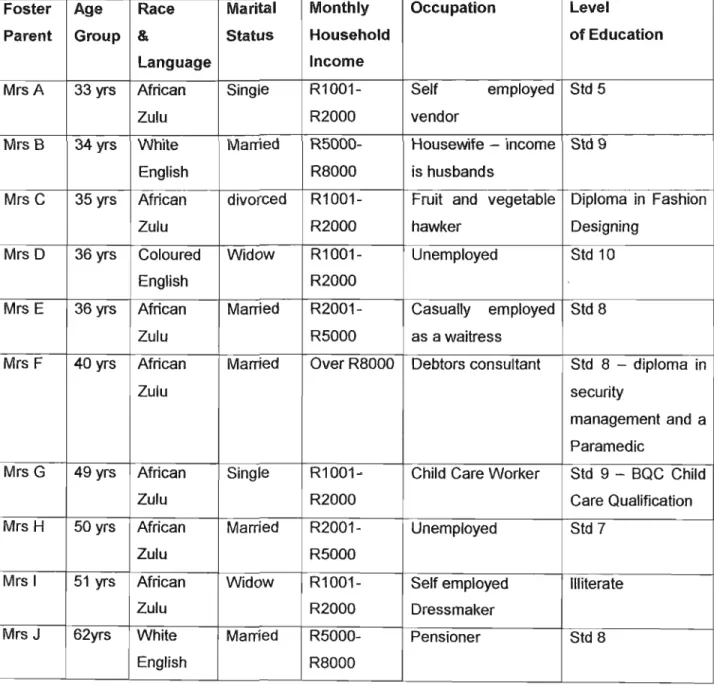
The following table illustrates the profile of foster parents.
TABLE1:PROFILE OF FOSTER PARENTS
Foster Age Race Marital Monthly Occupation Level
Parent Group & Status Household of Education
Language Income
MrsA 33 yrs African Single R1001- Self employed Std 5
Zulu R2000 vendor
Mrs B 34 yrs White Married R5000- Housewife - income Std 9
English R8000 is husbands
Mrs C 35 yrs African divorced R1001- Fruit and vegetable Diploma in Fashion
Zulu R2000 hawker Designing
Mrs D 36 yrs Coloured Widow R1001- Unemployed Std 10
English R2000
Mrs E 36 yrs African Married R2001- Casually employed Std 8
Zulu R5000 as a waitress
Mrs F 40 yrs African Married Over R8000 Debtors consultant Std 8 - diploma in
Zulu security
management and a Paramedic
Mrs G 49 yrs African Single R1001~ Child Care Worker Std 9 - BQC Child
Zulu R2000 Care Qualification
Mrs H 50 yrs African Married R2001- Unemployed Std 7
Zulu R5000
Mrs I 51 yrs African Widow R1001- Self employed Illiterate
Zulu R2000 Dressmaker
MrsJ 62yrs White Married R5000- Pensioner Std 8
English R8000