An
evaluation of the Russell High School's library collection in meeting the curricula needs of learners
By
Favour Ogochukwu Atagana
Submitted in partial fulfilment of the academic requirements for the degree of Master of Information Studies in the School of Human and Social
Studies, Information Studies Programme, University of Natal, Pietermaritzburg
March, 2001.
Declaration
The author hereby declares that the contents of this dissertation, unless specifically indicated to the contrary, are her own work, and that the dissertation has not been submitted simultaneously or, at any other time, for another degree.
Favour Ogochukwu Atagana
Dedication
This thesis is dedicated to my husband Harrison Ifeanyichukwu Atagana, who initiated the idea.
Abstract
The purpose of the dissertation was to evaluate the Russell High School library collection in meeting the curricula needs of learners.
A study population consisting of 150 learners, 13 teachers, the librarian and Principal was surveyed by means of questionnaire and interview.Jrhree types of questionnaires were used, one each for the learners, the teachers and the librarian . The Principal's interview was based on a
~
--- - -
checklist.
Results were discussed in terms of frequencies and cross-tabulations of responses were made.
Results are graphically displayed in the form of tables, pie charts and bar charts.
The present situation of the library and its problems are discussed with regard to resources, the availability and suitability ofthe present collection, types of materials used, and satisfaction with the library by users as well as encouragement from teachers and the librarian to learners in the use of the library. The discussion was situated within the current requirements of Outcomes-Based Education as guided by Curriculum 2005 and 21.
The study findings indicated that learners and teachers were satisfied with the library stock although a need for books, especially new titles, was identified. Learners and teachers felt that more books and better infrastructure for example, computers, television sets, and more space were needed. Itwas also revealed, however, that the budget was severely limited. These findings are discussed within the framework provided by a review of international, African and local schOQI libraries.
Recommendations for possible future services are made in the light of this discussion.
Acknowledgments
I would like to record my gratitude to the following people:
Professor A. M. Kaniki and the academic staff of the Information Studies Programme who contributed to the MIS 2 programme, especially to my supervisor Professor Christine Stilwell without whose help this would not have been possible, and Patrick Ngulube for his assistance and advice;
The Principal, librarian, teachers and learners of the school at which this study took place;
My husband, who encouraged me morally and financially; and my children for their understanding through this period.
Contents
Abstract i
Acknowledgments .ii
List oftables xii
List offigures xiii
List ofacronyms and abbreviations xiv
Chapter 1: Introduction
1
1.1 Brief introduction to Russell High SchooL 2
1.2 Status of the School. 2
1.3 The research problem 3
1.4 Purpose ofthe study 7
1.5 Objectives ofthe study 7
1.6 Research questions 8
1.7 Justification for the study 9
1.8 Definition ofterms 10
1.9 Summary 12
Chapter 2: Literature
review 13
2.1 International perspectives on the role of schoollibraries 13
2.2 School libraries in the United States 15
2.2.1 Provision of libraries 15
2.2.2 Funding of libraries 16
2.2.3 Evaluation 16
2.3 School libraries in the United Kingdom .l7
2.3.1 Provision of libraries 18
2.3.2 Funding of libraries 18
2.3.3 Evaluation 18
2.4 School libraries in Australia 20
2.4.1 Provision of libraries 20
2.4.2 Funding of libraries 21
2.4.3 Evaluation 21
2.5 Sub-Saharan African perspectives on the role ofthe schoollibraries 21
2.5.1 Provision of libraries 23
2.5.2 Funding of libraries 23
2.5.3 Evaluation 23
2.6 The development of school libraries in South Africa 27 2.6.1 School libraries in South Africa prior
to the 1994 election 27
2.6.2 School libraries in South Africa since 1994 29 2.6.3 The introduction ofOutcomes-Based Education 35
2.6.4 Critical outcome for information skills 37
2.7 Approaches in the literature to collection evaluation .38
2.7.1 Effectiveness 39
2.7.1.1 Cost-effectiveness 39
2.7.1.2 Cost-benefit. 39
2.7.2 Macro-evaluation 40
2.7.3 Micro-evaluation 40
2.8 Summaries of methodologies used in other studies .40
2.9 Summary 42
Chapter 3 :
Methodology 43
3.1 Methods used 43
3.1.1 Literature search and review 43
3.2 Descriptive survey 44
3.3 Population 45
3.3.1 The size and characteristics ofthe populations .45
3.3.2 Sampling 45
3.4 Instrumentation 46
3.5 Questions 47
3.5.1 Forms of question 48
3.5.1.1 Closed questions 48
3.5.1.2 Open questions 49
3.5.2 Categories ofinformation .49
3.5.2.1 The learners' questionnaire 50
3.5.2.3 The teachers' questionnaire 50
3.5.2.4 The librarian's questionnaire 51
3.5.2.5 The Principal's interview checklist.. 51
3.6 Procedures 51
3.6.1 Pretest. 51
3.6.2 Distribution of instruments 52
3.7 Data coding 53
3.8 Data analysis 53
3.8.1 Dataoutput. 53
3.9 Evaluation ofthe research methodology 54
Chapter 4: Results ofthe study 55
4.1 Responses from learners at Russell High 56
4.1.1 Background data on learners 56
4.1.2 Library visits and frequency of visits by learners 57
4.1.3 Reasons for library visits by learners 59
4.1.4 Availability of materials and types of
materials used by learners 61
4.2 Extent to which materials met the requirements oflearners' assignments 63
4.3 Library staff assistance to learners 64
4.4 Use of other libraries 65
4.5 Learners' views of the role of the library and ways in which it could be
improved 67
4.6 Summary of findings on learners 69
4.3 Responses from teachers 72
4.3.1 Background information on teachers 72
4.3.1.1 Subjects and levels taught.. 72
4.3.1.2 Teachers' levels of seniority 73
4.3.1.3 Teachers' years of teaching
and service at Russell High 74
4.3.2. Library visits and frequency of visits by teachers 76
4.3.3 Reasons for library visits by teachers 78
4.3.4 Extent to which teachers were satisfied with library materials and the
extent of teachers participation in materials selection 79
4.3.5 Directing learners to library resources 80
4.3.6 Degree of use oflibrary for assignments 80
4.3.7 Views on the role ofthe library 81
4.3.8 Teachers satisfaction with the library and suggestions for
. . , 81
ImprovIng It. .
4.3.9 Summary of findings on teachers 82
4.4 Response from the librarian 84
4.4.1 The librarian's view of the role of the schoollibrary 84
4.4.2 Selection policy 85
4.4.3 Criteria used to select materials 85
4.4.4 The library collection 85
4.4.5 Use of the library 86
4.4.6 Access to other resources 86
4.4.7 Required improvements 87
4.4.8 Summary of findings on librarian 87
4.5 Response from the Principal ofRussell High School.. 88
4.5.1 Library support structures 89
4.5.2 Library infrastructure and budget 89
4.5.3 Library selection policy 89
4.5.4 Library collection 90
4.5.5 Cost-benefit analysis of the
library collection 90
4.5.6 Summary ofthe Principal's response 91
Chapter 5 : Discussion
of results 92
5.1 Learners and teachers' perceptions of the role
of the school library 93
5.2 The curricula needs oflearners and teachers 94
5.3 The appropriateness of the collection to the curriculum 94
5.4 The criteria used by the school to acquire its collection 95
5.5 The use and non-use of the library materials
by learners and teachers 96
5.6 The role of teachers and the librarian in encouraging learners
to use the library collection 96
5.7 The problem learners face with regard to the
school library services 97
5.8 Use by learners of other libraries 97
5.9 Co-operation between the school and other libraries, and
use of Internet resources by teachers and learners 98
5.10 Summary 99
Chapter 6: Conclusions and
recommendations 1006.1 Revisiting the objectives ofthe study 100
6.2 Conclusions 101
6.3 Recommendations 102
6.3.1 Library collection 102
6 3 2 C -. . 0 operatIon WIt ot er I ranes. . h h l'b . l 02 6.3.3 Library budget, cost-effectiveness and the need for policy
. I .
Imp ementatlon l 03
6.4 Recommendations for further research 104
References
105
Appendices 114
Appendix A Learners' questionnaire
114Appendix B Teachers' questionnaire .118
Appendix C Librarian's questionnaire 122
Appendix D Principal's interview checklist .127
List of tables
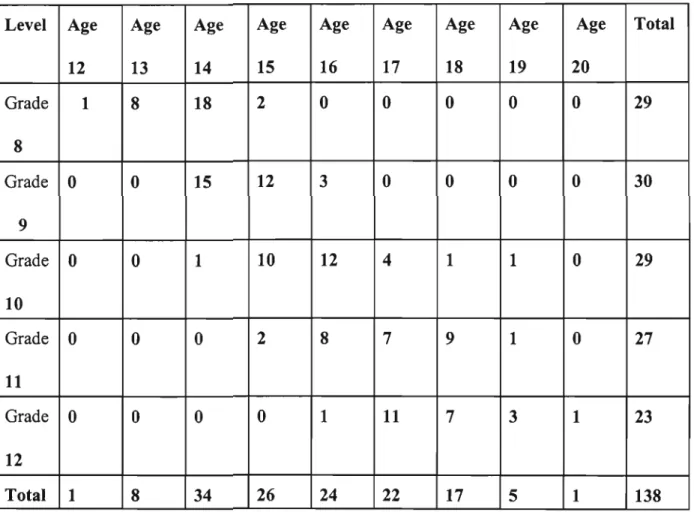
1. Age and level of study oflearners 57
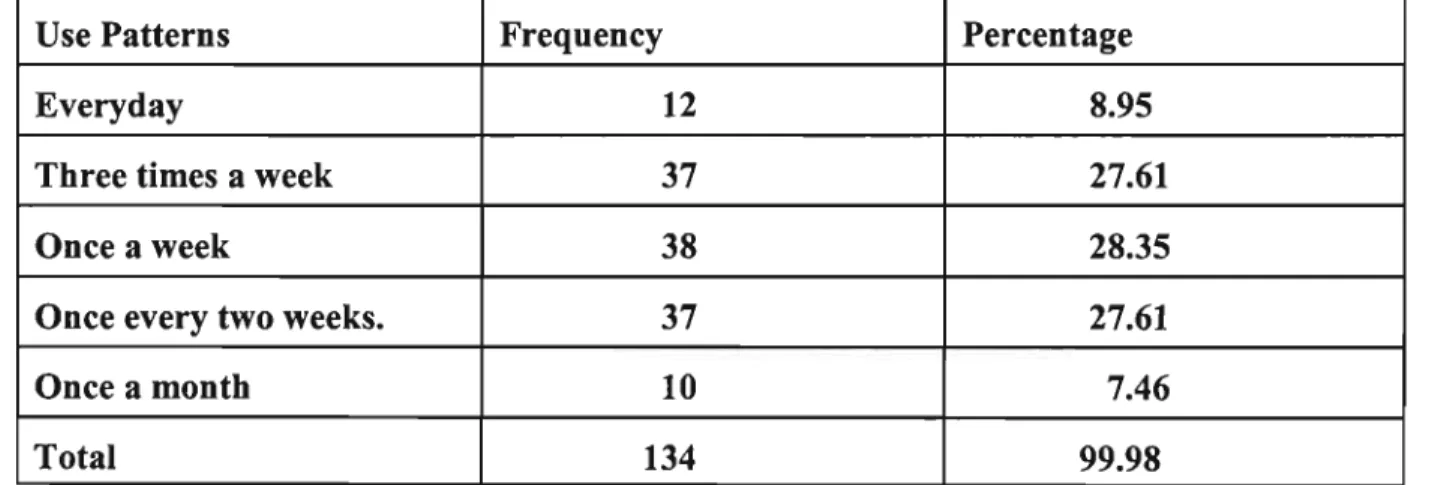
2. Frequency of visits to the library by learners 59
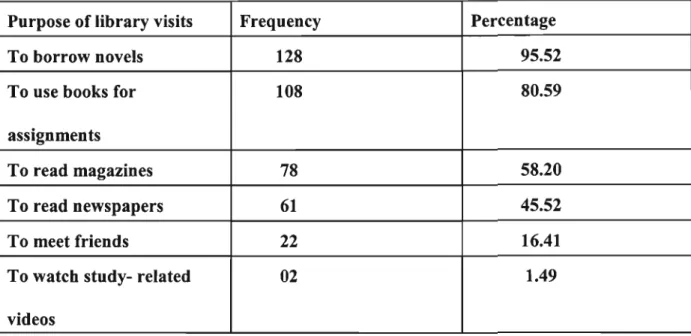
3. Purpose oflibrary visits by learners 60
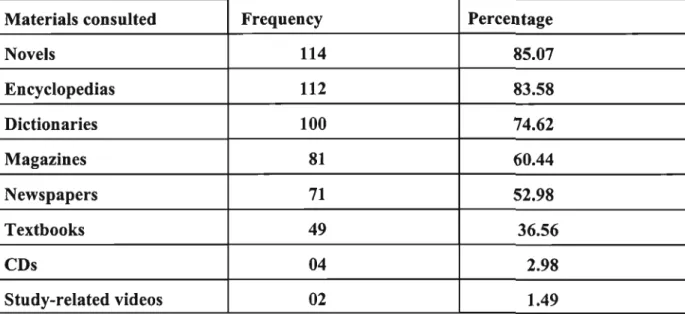
4. Materials consulted by learners visiting the library 62 5. Learners satisfaction with the library materials for assignments 63
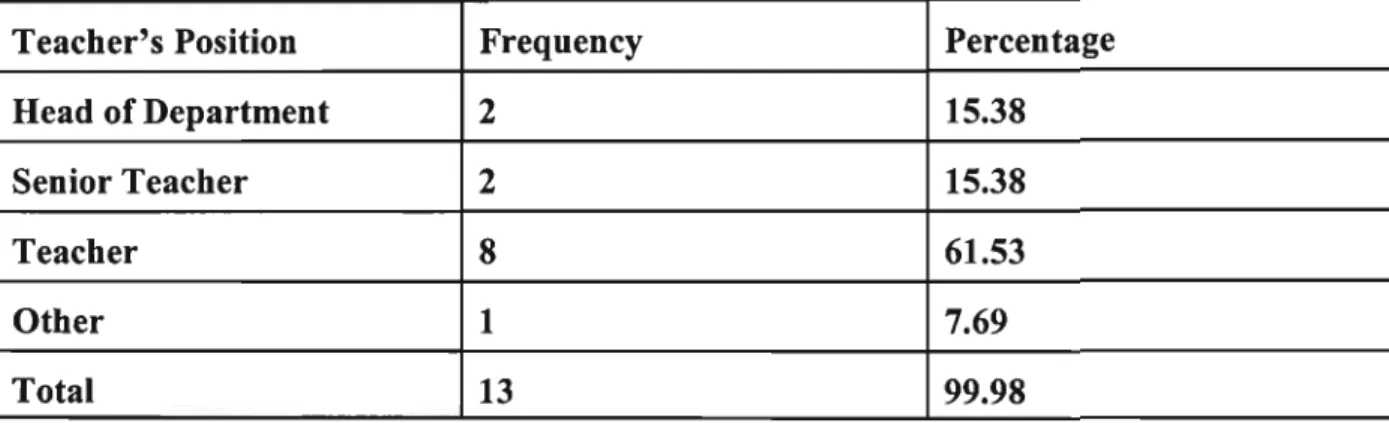
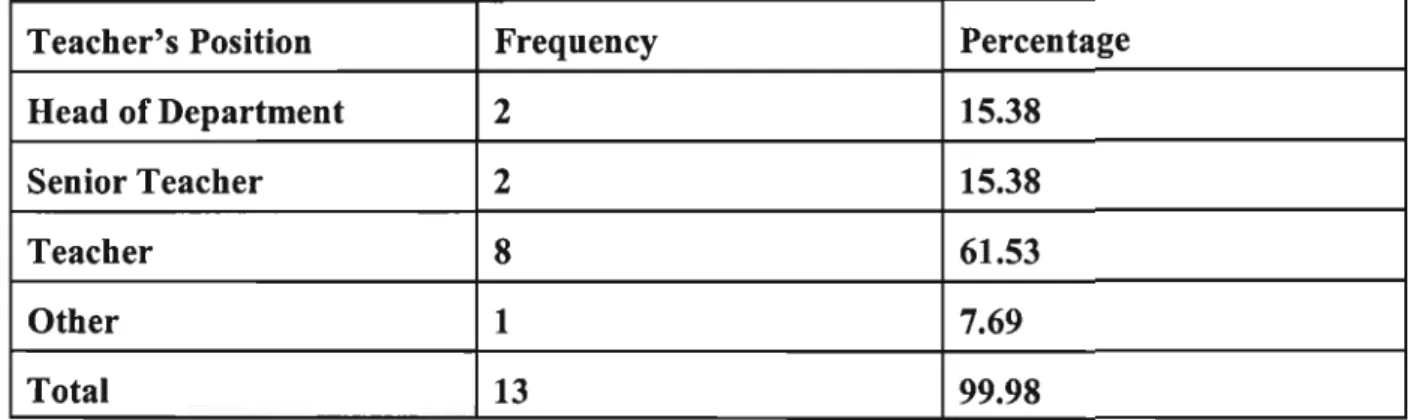
6. Subjects and levels taught. 73
7. Positionatwork 74
8. Number of years ofteaching 75
9. Number of years at Russell High 76
10. Frequency oflibrary visits by teachers 78
11. Purpose of library visits by teachers 79
List of figures
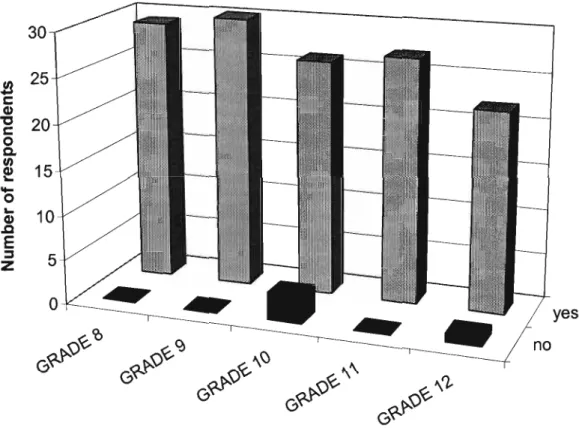
1. Visits to the school's library by grade 58
2. Availability ofmaterials 61
3. Librarian's assistance to learners 65
4. Use ofother libraries 67
5. Library visits by teachers 77
List of acronyms and abbreviations
ANC African National Congress
CD Compact Disk
CD-ROM Compact Disk with Read Only Memory CJSS Community Junior Secondary School DET Department of Education and Training DOE Department of Education
ELITS Education Library Information and Technology Services ESEA Elementary-Secondary Education Act
GCSE General Certificate of Secondary Education HOA House of Assembly
HOD House of Delegates HOR House of Representatives ISP Internet Service Provider
NEPI National Education Policy Investigation NSL Natal Society Library
OBE Outcomes-Based Education
TV Television
UK United Kingdom
USA United States of America
Chapter 1 Introduction
The library is an intrinsic part of the school system (Osei-Bonsu 1990:102; Pain 1987:3). Smith and Pike (1991:329) and Naidoo (1997:6) argue that a school library is the heart ofthe school, as curriculum design, implementation and support is facilitated by the school library. The role ofthe school library is mainly to support instruction with its collection which is comprised of books, Internet sources and non-book materials. Such a collection should be evaluated in terms of cost- effectiveness and the extent to which it satisfies the demands placed on it by users.
Itis important to note that in the post apartheid era, the new South African government introduced a system of education which is student centred and at the same time resource centred, focusing on outcomes-based education (Kruger 1998). The aim ofthis system was to give all those who were disadvantaged (and advantaged) under the previous system, the opportunity to go through a life long system oflearning. To make resource-based education a reality, the school library has to move with the times and its collection has to be updated.
The term "school library", according to Herring (1988:5), is used to cover all types oflibrary or collection of materials in schools, whether staffing of any kind is provided or not. De Klerk (1995:93) points out that "school libraries imply those organised collections of books and other resources inside the schools that have the primary aim not only to support day to day teaching, but also to introduce learners to the world of information without which they will be much poorer and less fulfilled."
School libraries not only house, but also create resources that supplement the curricular and extra- curricular needs of the schools they serve. Some schools have continued to use the term school library, while others started to use terms such as media centre, media resource centre, library resource centre and multi-media centre. In response to these changes, the terms "school library"
and "media centre" are interchangeably used to refer to multi-media collection and resource base in the school context.
1.1 Brief introduction to Russell High School
Russell High School is a school for girls in Pietermaritzburg, KwaZulu-Natal; which has been in existence since 1879 and was predominantly a white school until 1991 when it opened its doors to other races (black, coloured and Indian). Russell High School has five levels of classes, that is, grades eight to twelve. There is a school library which was established in 1970, which supports the learners and teachers with instructional materials. The current population ofthe school is 453 learners, 18 teachers and a full time teacher-librarian (A'Bear 2000).
1.2 Status of the school
Russell High since 1994 has been classed as a Model B school which in actual fact did not collect much in the way of school fees and has never been wealthy. Model B schools remain state- funded, but admit non-white children up to a proportion of 49% of the total number(Financial Mail 1993:18-19).
There have been no funds allocated to the school library from the government since 1996 and the school has continued to generate funds through school fees and fund-raising activities (A' Bear 2000).
The school library is allocated an annual budget depending on what the school is able to afford. The most that has been given to the library is R12,000 and for this academic year 2000, the sum of R6,000 has been given to the librarian for the purchase of materials (A'Bear 2000).
1.3 The research problem
Some secondary schools in South Africa are provided with libraries. Overduin and de Wit (1986 :265), in their study on the evaluation ofsecondary school libraries in the country, pointed out that, in 1969, the Education Department responsible for white schools realised the importance ofschool libraries and accepted full responsibility for them and the former agreement to leave secondary school libraries under the Provincial Library Services ceased to operate.InApril 1970, the Director ofEducation recommended that adequate libraries, a full-time teacher-librarian, a well-chosen and adequate book stock and a central collection ofmodem audiovisual apparatus was to be established in secondary schools and the Administrator-in-Executive agreed to implement these improvements.
From Overduin and de Wit's (1986) study, it is clear that school library services were not given equal treatment on racial lines because of the apartheid regime. There were many different education ministries in charge of the day to day running of the schools. The allocation of responsibility to ministries was constituted according to race, with each service having its own education media services. This has resulted in an uneven development of school media services
(Stilwell1991:33; Le Roux 1992: 43; Bawa 1996:41-61). These disparities in provision will be discussed in detail in Chapter 2 of this study. With the dawn of a new South Africa, one would have expected that more attention would be paid to the schools and the disparities in their provlslOmng.
Until recently, the provision of school libraries in the KwaZulu-Natal Province, and South Africa generally, appeared to occur in a laissez-faire fashion without any co-ordinated national, provincial or departmental policy to guide the process of provision (Karlsson, Nassimbeni and Karelse 1996:5-24; Bawa 1996:51). According to Vermeulen (1992: 114), this lack ofco-ordinated policy, and the subsequent lack ofuniform standards with regard to provision, have prevented any serious evaluation of the system.
Bawa (1996), in her study on implementation plans for school library provision in the context of a scarcity of resources and an increase in the competition for these resources in the post-apartheid era, presents the status ofschool libraries in the Province ofKwaZulu-Natal in South Africa for the period of 1990-1996. She examines the status quo in order to provide a backdrop to the development ofan implementation plan for resource provision in this region. This is because access to resources at secondary school level is important for the enrichment of the learning experience and the development of skills needed to access information effectively. Radebe (1998:45) points out the lack of understanding of the relevance of learning resources in libraries, with huge disparities in budgetary allocations between the different former departments. These disparities resulted in widespread absence offacilities; inadequate provision ofmaterials, inadequate physical
accommodation and lack oftrained personnel, in African schools. This under-provision accorded with the plan ofthe Christian National Government to train Africans to be subservient (Stilwell 1991). A lack of understanding of the role of information resources in teaching and learning resulted in the marginalization of school libraries in the education sphere, and poor co-ordination between school libraries and other sectors. In 1999, a survey of the South African school library sector was carried out by the Department of Education which said in its draft report that what the environment needs is an improved capacity in the Department of Education to systematically take stock ofits school library resources in terms oftheir quality, quantity and spatial distribution (South Africa. Department of Education. Draft report 1999:4).
Recently, the Department ofEducation (DoE), came out with a four year implementation plan and policy framework for school library standards (South Africa. Department ofEducation. Draft report 2000:2). The policy framework now recognises that the provincial Departments of Education are responsible for the provision of learning resources in public schools in partnership with other stakeholders and players such as public libraries, non-governmental organisations and the wider community (South Africa. Department ofEducation. Draft report 2000:2). From this recent report it appears that the Education Department, including both the national and provincial departments, has not been totally committed to libraries in secondary schools as to the provision of adequate materials. This observation is supported by discussions with A'Bear (the librarian at Russell High since 1994), who has been weeding stock and has reduced the collection to 9,000 volumes but still intends to weed further as the majority of the books are very old (A'Bear 2000). According to A'Bear, the Education Library Information and Technology Services (ELITS) has given the school
5
books on three occasions since 1994 to date. For this year, as mentioned, the school has given her the sum of R6,000 for the purchase of materials but the school library still needs more books.
From discussion concerning the use of public library by secondary school learners with Arlene Pilkington, a reference librarian at the Natal Society Library, it was confirmed that many of secondary school learners use the Natal Society Library for their school projet and assignments (Pilkington 2000). Felicity Balcomb, a media teacher from ELITS, also confirmed that ELITS assists schools with materials; and about six teachers from Russell High School are members of the ELITS library and come in regularly to use the library. ELITS however, do not allow secondary school learners to use their library (Balcomb 2000). Itis important to note that ELITS provides services to mainly teachers in the Pietermaritzburg Region (Cooper 2001). Lar (1998) has pointed out that learners generally do use the Natal Society Library or other libraries for their curricula needs because ofperceived inadequacies in their school bookstock. The researcher wanted to probe the views of learners from Russell High School concerning the library collection at Russell High and its role in supporting teaching and learning.
The problem to be researched, therefore, was to
}> identify the curriculum needs of the learners;
}> determine whether the existing library in the school took care of them;
}> determine the appropriateness of the library's collection;
}>ascertain the library's response to changes in the school programme (for example, the resource-
based learning system); and
}> assess the library's support of the curricula and instructional needs of the library staff.
1.4 Purpose of the study
The purpose ofthis study was to evaluate Russell High School's library collection in meeting the curriculum needs of the learners. The study sought to establish the patterns of use by learners and teachers, and suggest modifications where necessary to the collection development policy. It identified the less frequently used items so that they could be considered for either weeding or moving to a storage area.
1.5 Objectives of the study
The objectives of the study were:
1. To investigate learners' and teachers' perception of the role of the school library . 2. To identify the curricula needs of the learners and teachers.
3. To determine the appropriateness of the collection for the school's curriculum.
4. To identify the criteria used by the school to acquire its library collection.
5. To determine the use and non-use of the library by teachers for curricula needs.
6. To determine the use and non-use of the library materials by learners.
7. To determine the role ofteachers and the librarian in encouraging learners to use the school library collection.
8. To identify the problems learners faced with regard to the school library services.
9. To find out iflearners used other libraries.
10. To determine ifthere was any form ofco-operation between the school and any other library
and to find out if Internet resources were used by teachers and learners in the library.
11. To make recommendations about the current and future provisioning of the library.
1.6 Research questions
The research questions were:
1. What are the learners' and teachers' perceptions of the role of the school library?
2. What are the curricula needs of the students and teachers?
3. Is the collection appropriate to the curriculum?
4. What criteria does the school use for its library acquisitions?
5. How often do teachers use the school library materials for their curricula needs?
6. How often do students use the school library materials for their curricula needs?
7. What role do the teachers and librarian play in encouraging learners to use the school library?
8. Is there any problem faced by learners with regard to services in the school library?
9. Do learners use other libraries?
10. Is there any co-operation between the school and other libraries and do teachers and learners use resources such as the Internet?
11. What recommendations can be made?
1.7 Justification for the study
This study undertook an evaluative assessment of the school library collection within a school system where Outcomes-Based Education (OBE) is in place. In other words the emphasis in this system is~udent cent~~(that is, learners have to work independently but not without the teacher's guidance), and resource based. This type ofstudy could be of importance to the school, in that it is likely to make a contribution to informing staff about the need for the collection to be current and responsive to user needs. If the findings of this study are implemented it could also help the librarian to identify ways to demonstrate the value oflibrary collections to users. Mancall (1982:185) points out that
" evaluation permits us to describe what exists in relation to what is needed, and thus sheds light on the effectiveness of current collection management policies. We can test whether collection policy is in line with curricular programs, and target limited monetary resources to areas that need attention".
The study was carried out at Russell High School in Pietermaritzburg, a school which gives a broad picture ofthe diversity ofthe South African population, comprised ofblack, colo.ured, Indian
--- --- ----"- - ..---, . . _.- ,-_.. ---....
_- --
--.-- -agdw:bit~J~£lfIle~.Although the study was conducted in Pietermaritzburg, it could be of benefit to the Kwazulu-Natal Province more widely because it could assist the Education Department in redefining policy regarding the curriculum needs of high school learners in the Province particularly with reference to this type of school. The study could help the school authorities (principal! librarian! teachers) to provide for the relevant curriculum needs of the learners in its
-- -._---
----_.--....collection, funding permitting.
1.8 Definition of terms
The terms used in the study are defined in this section:
Adequacy: The term according to Clapp and Jordan (1989:161) is proportionate to need, and relevant in terms of user satisfaction and curricula offered. In this study adequacy ofthe collection will refer to the collection that answers the users' needs by providing relevant books in terms of the curricula and other information needs relating to teaching and learning at Russell High.
Collection evaluation: According to Lancaster (1988:13), the term collection evaluation is the assessment ofthe utility ofa library's collection in relation to the users' needs (both expressed and potential) . The objective of an evaluative study is to identify strengths and weakness in the collection.
Curriculaneeds: This refers to information relevant to the structure and teaching of school subjects.
Effectiveness: This term is used to mean the degree to which a school library system achieves its objectives.
Learner: Any person, ranging from early childhood development to the adult education phases, who is involved in any kind offormal or non-formal education and training activity; and any person who receives or is obliged to receive education.
The term 'learner' refers to persons studying in ordinary, public schools and replaces the terms 'pupil' and 'student' (Mothata 2000: 94). For this study this term will be used to mean pupils or students.
Pertinence of the collection: This refers to an item that is useful to the user in that it contributes to the satisfaction of his or her information need (Lancaster 1988: 129).
Principal: The principal is the head of the school.
School library: The term is used by Herring (1988:5) to mean a place where primarily learners and educators have access to information which may occur in a variety of different forms, including a range of printed publications (for example, books, periodicals, newspapers, posters and so on), non-book materials (for example, audio taped materials, video and so on), as well as information that can be sourced through information technologies such as CD-Rom and the Internet, and staffing and other services made available to schools by the education authorities, non- governmental organizations and other stakeholders to support the provision of libraries in the school.
Teacher-librarian: A teacher librarian is a person who combines the dual roles ofteaching library skills and running the school library.
Timetablin~: This is the practice whereby use of the library is slotted into the school time-table as a period.
User: The term, user, and variations of it in this study refer to person entering a library and engaging in activities for the purpose of locating and obtaining materials (Aitchison 1998: 142).
Here it refers to a person who is actively using the school library facility to get information on curricular or extra-curricular needs or information.
1.9 Summary
This study investigates the current situation of the Russell High School library and its collection in meeting the curricula needs of the learners. This chapter provided the background to the thesis exploring the need for the study and the intentions ofthe study, that is, its purpose and objectives.
Russell High School library was established in 1970. Itwas assumed that this collection may no longer meet the curricula needs of learners for the Outcomes-Based-Education system currently in place. Therefore, evaluations were made to determine whether or not the collection met the curricula needs of learners. In addition, frequently used terms were defined.
Chapter 2
Literature review
This section highlights the literature on the role of the school library in meeting the curricula needs of secondary school learners. It gives international perspectives on the role of school libraries, Sub-Sahara African perspectives on the role of school libraries, and others on the development of school libraries in South Africa. Approaches in the literature to collection evaluation and techniques used for collection evaluation are discussed. The majority of books and journals on the subject relate to the countries of Europe and North America; nevertheless, there are some that have treated this topic in Africa and South Africa.
2.1 International perspectives on the role of school libraries
Emphasis is increasingly being placed on the need for information skills (Fourie 1996:205;
Behrens, Olen and Machet 1997; Thomas 1999) . By information skills is meant the ability of the learners to access knowledge and facts as well as to apply these to the real world. This ability also requires research skills and the use of a wide range of sources and technology to access information (Naidoo 1997:5). Skrzeczynski (1995:11 ) as quoted by Jacobs (2000:24) portrays information literacy skills as receptive skills which involve the whole range of location, reading, looking (observation), and listening skills; reflective skills necessary for internal processing, resulting in the coordination of isolated bits of information into meaningful relationships and expressive skills enabling learners to recoganise and communicate knowledge gained through the receptive and reflective skills. School librarians have to provide
learners with the opportunities to acquire skills that will enable them to find the sources of information they need.
The library should be central in the educational planning of the school (Gsei-Bonsu 1990; Pike and Smith 1991; Glen and Kruger 1995 ). According to the American Association of School Librarians and Association for Educational Communications and Technology (in Glen and Kruger 1995), the aim ofthe school media programme/library is to ensure that pupils and staff are effective users of ideas and information. This aim may be achieved by a number of specific objectives as reported by Glen and Kruger (1995:52-53):
• to provide intellectual access to information;
• to provide physical access to information;
• to provide learning experiences that encourage users to
become discriminating consumers and skilled creators of information;
• to provide resources and activities that contribute to lifelong learning;
• to provide leadership, instruction and consulting assistance in the use of instructional and informational technology;
• to provide a facility that functions as the information centre of the school; and
• to provide resources and learning activities that represent a diversity of experiences, opinions, social and cultural perspectives, supporting the concept that intellectual freedom and access to information are prerequisite to effective and responsible citizenship in a democracy.
These objectives fonn a useful framework against which the success of a country's school library service can be measured. International approaches to school library provision follow in the next section in which the situations of the United States of America (USA), United Kingdom (UK), and Australia are examined.
2.2 School libraries in the United States of America
In the USA, the promotion of school librarianship began in the late 1800s. During the 1890s high school principals and directors ofpublic libraries in widely scattered communities began to develop school libraries at the secondary school level (Miller 1991 :357). School libraries have undergone many stages of development from cutting back on both library staff and acquisitions and replacing trained professionals with clerks and volunteers (le Roux 1992 :39), to a situation where school libraries now enjoy electronic access to collections, and school library media specialists have library lessons and skills development sessions integrated into the curriculum (Woolls 1999:23). Unfortunately, in many schools in South Africa the reduction or cutting back on provision is in contrast to other schools which never have enjoyed library provision at all (Bawa 1996).
2.2.1 Provision of libraries
The provision of libraries in secondary schools in the USA is a major concern of the government. The Elementary-Secondary Education Act of 1965 (ESEA) fostered the development of school library media programmes in the public schools (Miller 1991 :356). The government made sure these public school libraries were staffed with certificated personnel and
they were catered for financially.
2.2.2 Funding of libraries
The funding of secondary school libraries in the USA is done jointly by the local and state governments (Miller 1991).
2.2.3. Evaluation
Small (1998a :175), in his Colorado study, which was a significant attempt to isolate and assess the impact of school libraries on students' achievement, found that libraries were a major contributory factor in countering social factors (such as low literacy levels). He also found that students with high levels of investment in the school library performed better in norms-referenced standardised tests and acquired more reading skills. The most significant aspect, however, is that the study provides firm evidence that the school library does have a direct and significant effect on academic achievement; especially on reading and literacy levels (Small 1998a: 185).
Inanother recent study on a school library collection in a Library Power schools project (USA), Hopkins (1999) investigated the currentness and quantity of the collections of high schools using a questionnaire to collect data. According to Hopkins (1999:1), the library collection is seen as the primary information base through which the library media specialist makes ideas and information available to students and teachers. She also pointed out that collection mapping (that is, a clear picture ofthe collection acquisitions in response to specific curricular emphases),
helped the librarian and teachers to focus in similar ways on the library and the curriculum and to see clearly the magnitude ofthe role of the school library where resource-based learning and teaching was in place.
2.3 School libraries in the United Kingdom
Until the late 1980s, two percent of the schools in the United Kingdom had no library at all, and a further four percent had no adult in charge. Over seventy-five percent of the school libraries were staffed by teachers with no professional qualifications in librarianship and the book stock was poor because of financial stringency. This situation changed with the introduction of the new "General Certificate of Secondary Education" (GCSE) in the UK in 1987 (Kinnell 1994), which aimed at improving the quality of secondary education through a change in the system of public examination and assessment. This gave rise to high expectations about the potential role of the school library (le Roux 1992: 41). LeRoux argues that the emphasis in GCSE on what pupils "know", "understand", "can do" and the balance between skills, concepts and content ought to make the school media centre indispensable.
Similarly, the introduction of OBE in South Africa should bring about greater awareness ofthe need for well-resourced school libraries. However, the Library Association was well aware of the potential role of libraries in this new curriculum structure and therefore took the initiative to produce the publication GCSE: guidance notes on the role oflibraries and librarians. This publication emphasises the links between the national assessment criteria, the use of libraries and the need for information skills on the part of both pupils and teachers (le Roux 1992:42).
2.3.1 Provision of libraries
Provision for school libraries in the UK is made by the local education authorities, the majority of them through the public library service on an agency basis (Fea 1991: 102).
2.3.2 Funding of libraries
Funds are provided by each local education authority's education committee to finance a school library service. The level of this provision varies enormously from one authority to another;
while some are highly developed to include an imaginative range ofmedia, others are restricted by lack of funds to inadequate book-only loan services (Fea 1991: 103).
2.3.3 Evaluation
Small (l998b), in a study on "Secondary school libraries in the UK", reported that many schools were achieving minimum standards in service provision. There was, however, considerable variation with many schools failing to reach standards. There are no governmental standards as such for school library provision other than area guidelines (SmallI998b:62).
With regard to the use of the Internet by learners, in June and July 1997, the University of Manchester Faculty ofEducation undertook a survey oflnternet use in secondary schools in the UK. This survey, according to Small(I998b:64), found that eighty-three percent of secondary schools had some kind of Internet connections with only three percent having no plans to connect. Seventy-one percent of the connected schools supervised students' access; only six percent of schools allowed unrestricted access. Access to 'unsuitable' materials was governed
by the Internet Service Provider (ISP) in forty-four percent of cases and by the use of filtering software in eighteen percent. Small (1998b) also stated that most of these Internet connection sites were within the' staff only' areas and about thirty percent ofthe Internet connections were in the library.
In another UK study, Rogers and Needham (1999) in their report on the Bookflood Project, investigated the effect of 'flooding' a group of school children with a range of exciting, stimulating and creative texts for free choice recreational reading. However, this type of material is not a priority in most school budgets. Rogers and Needham (1999) measured the impact ofthis provision on attitudes to reading among pupils, teachers and parents and possible improvements in pupils' reading ability.
In the final analysis, each school noticed different benefits from the availability ofthe books but overall the findings included:
•
•
•
•
•
•
•
•
improvement in behaviour and attitudes to reading;
pupils talking more about themselves as readers and writers;
greater awareness of different kinds of text;
pupils carrying out independent research;
changed reading habits, and pupils making more use of the public libraries;
pupils discovering that reading can be enjoyable and not a threat;
use of the school library was given a boost;
increased involvement of parents with the reading process;
• improvement in pupils' spelling (Rogers and Needham 1999:182-183).
This project was a huge success and actually led the Schools Library Service to offer a Bookflood loan, with practical suggestions for creative use, as part of their service options.
2.4 School libraries in Australia
The widespread provision of school libraries in Australia is relatively recent (Hallein 1991 :302).
Although there have been school libraries in Australia since the 19th century, the Munn-Pitt Report of 1935 stated that while there were library facilities in some schools, " no secondary school was found, even in the largest cities, in which all of the elements of satisfactory service exists" (Hallein 1991 :303).
2.4.1 Provision of libraries
Until the early 1980s school libraries provided in secondary schools were without the elements of satisfactory services . According to Biskup and Goodman (1982:94), these persistent shortcomings of school libraries in Australia were due to lack of financial support on the part of the controlling bodies both in the government and the private sectors. As the discussion in section 2.4.3 suggests, provision has improved vastly with a growing emphasis on information skills. School library provision has taken an interesting form in South Australia where the concept of school- community libraries has been implemented on a statewide basis and forty-six such libraries existed in 1989 in the state.InSouth Australia the rural school-community library model is one in which the public library collection is integrated with the school library collection and is located in the school building. This model of utilising a network of school community
libraries to bring library services to the vast rural reaches of South Australia has been in operation since 1979.
2.4.2 Funding of libraries
The year 1969 saw the commencement of the Commonwealth Secondary Schools Libraries Programme with the funding from January 1969-1986 of the secondary school library (Hallein
1991 :304). The state governments then took over from the late 1980s.
2.4.3 Evaluation
According to Kirk's (1987:84) evaluative study, growing interest in the teaching of information skills in Australia reflects that in other parts ofthe world.Ina guideline document published by a central education authority in New South Wales, the teaching of information skills is seen as a whole- school programme involving principal, teacher and teacher-librarian. Each member of the partnership has a specific contribution to make to the co-operative planning and teaching of information skills (Kirk 1987:85-86).
2.5 Sub-Saharan African perspectives on the role of school libraries
There are many studies on school libraries in Africa but few deal with their evaluation. Among the problems relating to library provision in Africa are linguistic problems and also the lack of a reading culture, the high rate of illiteracy and lack of significant publishing industries which
results in a general lack of information awareness and neglect of libraries (Sturges and Neill 1998:24). Itis accepted that "the library and information profession is one of the legacies to Africa from the long historical and cultural links with Great Britain and the West"(BellI998 :41).
It is also significant that the libraries were introduced as part of a "culture of a literate society with a long established book and reading tradition that had been nurtured over centuries" (Bell 1998:41). Libraries were transplanted into African societies, which were largely illiterate and which had, and still have, an oral culture. The consequences of this are still very much part of African librarianship today (Bell 1998:41). Libraries in Africa, according to Ogundipe (1998 :154), seem to be bedeviled by the problems of image and status. According to Suttie (1997:278) some African authors also point to the incompatibility of Western culture with African culture and needs. They refer to the Western rituals of information associated with silence rather than with "robust orality, music and gesture". Moreover, the architecture of libraries inhibits public acceptance of these institutions, because it displays an authoritarian notion about written knowledge which is conveyed in the rows oftables, books and audiovisual material that alienate unschooled Africans (Suttie 1997:278).
Iwuji (1991) in Suttie (1997:279) believes that libraries in Africa can reinevent themselves to propagate traditional culture and become the custodians ofartifacts that document African rituals, legends, myths and poems.Inthis way, they are transformed into African instruments of social education within the community, thus shedding their alien and sometimes threatening Western garb. Africanisation in this context is simply a reflexive response to a different operating climate which calls for "new information philosophies and service strategies to cater to the changing user
demands of a generally non-literate continent" (Suttie 1997: 279). These factors contribute to a situation in which there is an extremely low use, and impact, of library services in Africa.
2.5.1 Provision of school libraries
In most cases libraries in general are not seen as an important part of the school in Africa, and school libraries are not always included in the plans of a school building. According to Ogundipe (1998:154) the Government and local authorities in general all pay lip service to the idea of library provision in secondary schools. Otike (1989:80) argues that "the school library is not considered central to the school programme and the establishment of school libraries is more a concern of individual schools".
2.5.2 Funding of school libraries
In schools where libraries are provided the government's response to funding is often discouraging because these school libraries are usually stocked with old and obsolete books from international donors (Ogundipe 1998).Ithas been indicated by authors like Adelusi (1998), Osei- Bonsu (1990), and Kakoma (1999) that school libraries in Africa are grossly inadequate in meeting the growing needs of education because of lack of funds.
2.5.3 Evaluation
Ina study entitled "secondary school libraries in Ghana: an evaluative study" Moses Osei-Bonsu (1990), focused on secondary school libraries in Ghana, using the survey method with a view
to evaluating them in terms of their infrastructure, bookstock, financial resources, organisation and use of facilities, and their contribution to the teaching-learning process. This study showed that the performance of secondary school libraries in Ghana was grossly inadequate in meeting the growing needs of education. Some reasons were given for this; firstly, because of lack of money for the development of secondary school libraries and, secondly, through the poor management and lack of organisation of these libraries. Thirdly, there were restrictions on the use ofthe books in order to avoid losses or theft; and lastly there was no clearly defined national policy on the development of secondary school libraries in the country. Osei-Bonsu (1990:102), indicates that secondary school libraries should be conceived as an integral part of the educational programme and they must be concerned with providing a full range ofbookstock and information services to both students and teachers in order to broaden their intellectual horizons and improve the quality of instruction students receive, as well as facilitate learning.
Ina study of school libraries in Botswana using the survey method, Batlang Comma Serema (1999: 183), pointed out the importance of school libraries and argues that "it is through them (school libraries) that children begin to learn independently, to think on their own, to ask questions about the world, make their own decisions and take responsibility for their future".
Serema (1999) argues that this is particularly true in Botswana where there is an apparent lack of reading skills, and where school libraries must be established to address this problem.
He suggests that the community junior secondary school (CJSS) in Botswana seems not to be aware ofthe importance and the role the library plays in a school or society. He further points out that where there is a library, a teacher librarian is assigned to manage it, together with his/her
nonnal duties as a full-time teacher making hislher work load too much, and in most cases teachers do not have time to work in the school library.
On behalf of the teacher-librarian, he argues for their contributions being recognised in tenns of remuneration. They are paid only for teaching; so they prefer giving all their time and effort to teaching at the expense ofthe library. Given that there is no incentive for the teacher-librarian, most teachers do not see the advantages of working in the library even though they recognise its importance (Serema 1999:183).
It is very clear from this literature that CJSS libraries have problems of shortage of rooms/buildings, lack of qualified librarians, and lack of government's commitment to defining a good environment in which teacher-librarians may operate. All of these problems make it extremely difficult for head teachers who are aware of the importance of libraries to reduce the teacher-librarian's teaching work load, allowing them to develop the library into a better place (Serema 1999:183).
Kakoma (1999), in his study of school libraries in Lesotho, also using the survey method, points out that majority of secondary and high schools in Lesotho do not have libraries. According to Kakoma (1999 :120) there are 201 Secondary / High schools in Lesotho and only 82 have libraries and in schools where libraries do exist, there is no evidence to suggest that the library is treated as an important component of the school curriculum in spite of the new developments in education which make a school library an imperative facility (Kakoma 1999:120). Kakoma
(1999) looked into four main areas of school librarianship and his findings show, firstly, that the school libraries are managed by two categories of staff: teachers without library qualifications, and full-time staff with qualifications in neither teaching nor librarianship. Staff in charge do receive some basic training from the School Library Service section of the Lesotho National Library Service.
Secondly, some schools have purpose-built library buildings, but a good number of school libraries are housed in converted rooms which can barely accommodate forty students. This seems to be one of the common problems affecting school libraries in Africa (Radebe 1997:218-226;
Adelusi 1998:39). Thirdly, school libraries in Lesotho are starved of adequate financial support.
This has resulted in their being poorly stocked, with the bulk oftheir collections being donations.
This is a result of inadequate budgets, although the manual for Heads of Secondary and High Schools in Lesotho stipulates that five percent of the school budget should be used for running the library. Itis obvious that this is merely a statement of intent, and not a reflection of the actual situation on the ground otherwise the funds meant for running the school libraries would have been sufficient or adequate. Lastly, there are no guidelines on how the school libraries should be run. Every school has leeway to run its library as it sees fit (Kakoma 1999:121).
Ina recent study of ' library resources in secondary schools in Nigeria,' using the survey method, Adelusi (1998:39) argues that the school libraries are in a deplorable condition due to problems of qualified personnel, finance, accommodation and resources. According to Adelusi (1998 ), collections in some of these secondary schools surveyed fall far short of the basic standard
recommended for every secondary school library in the Manual for Nigerian School Libraries.
There are no full-time professional librarians, and in all, only two schools were staffed by teacher- librarians, and they are supported by library assistants who have not even received any in-service training in librarianship (Adelusi 1998:42). Regarding infrastructure and finance all ten schools used for the study declared that they had libraries, but only two had fairly large libraries and all others lacked appropriate accommodation and backup support. Financially, all the schools indicated that they had no separate annual budget, and the funds they received came as grants from the government and philanthropic organisations (Adelusi 1998 :43).
2.6 The development of school libraries in South Africa
This section discusses school libraries in South Africa before the 1994 election, school libraries since 1994, and the introduction of Outcomes-Based Education.
2.6.1 School libraries in South Africa prior to the 1994 election
Prior to South Africa's first democratic elections in 1994 and the resulting establishment of a single Ministry of Education, there were 15 Ministries of Education in South Africa. These Ministries and their departments were differentiated along racial and ethnic lines, in accordance with the apartheid system and philosophy of Christian National Education (StilwellI991; Bawa 1996; Karlsson 1996).
According to Karlsson (1996 :6), educational resources were allocated unequally, reflecting the racially-based values and preferential treatment of whites by the apartheid state. This impacted on the quality of education offered through the various administrative departments. The administrative departments ofthese Ministries each developed their own character, underpinned by separate parliamentary Acts. The departments designed and built their own schools, trained and employed their own staffand developed their own permutation ofschool models, governance structures and curricula.
They were different in the way they handled library and media studies policy ( Le Roux 1992;
Karlsson 1996:7). Only a few departments, namely, those that fell under the House of Delegates (HOD) for Indians, the House of Assembly (HOA) for whites and the House ofRepresentatives (HOR) for coloureds formulated school specific library policies. According to the Education Act of 1983, blacks in the self-governing territories 'outside' the borders of South Africa ran their own education systems under 'own affairs'. The HOD issued a document which promoted an integrated approach making the school library central to classroom teaching, and stressed the importance of audiovisual materials and software. Likewise, the HOA developed their own particular approach. In the self-governing territories for blacks, the supportive role of the school library was also recognised by the Education Ministry and the Education Ministry was committed to its provision (Karlsson 1996).
In 1992 the National Education Policy Investigation (NEPI) Library and Information Services Research Group found that the existence of a policy was directly related to the provision of
school libraries and media centres. This was the case in the schools administered by HOA and HOD Education Departments which had libraries with consistently good collections and equipment, and were also supported by subject advisors (National Education Policy Investigation Report 1992). The Department of Education and Training (DET), which was the single largest provider of schools for African learners outside of the self governing territories, only officially acknowledged the role of school libraries in teaching and learning in 1983. Prior to this development, there was no legal imperative to provide school libraries or train teacher librarians for African schools. This led to an enormous backlog and accounts partly for generations of African learners who reached adulthood without having had the experience of a library (Karlsson 1996 :7).
2.6.2 School libraries in South Africa since 1994
Since 1994, the new constitutional dispensation regarding the South African Education Policy Framework has shifted dramatically in terms of affirming the rights of individuals to education and in terms of the need for redress. The generation of policy has touched virtually all aspects of educational construction but has given particular attention to the challenges of generating equitable access to education and integrating education and training (South Africa. Education Department... Draft report 1999:3). Central to these challenges has been the development of a range of policy documents including: the South African Schools Act (1995), the National Education Policy Act (1996), the Education White Paper No 2 on the Organisation and Governance of Schooling (1996), the Education White Paper No 4 on the transformation of the Further Education and Training sector (1998), and the National Norms and Standards for School
Funding (1999) which deals with the procedures to be adopted by provincial Education Departments in detennining the allocation of resources to schools (South Africa. Department of Education... Draft report 1999). The aim ofgenerating this equitable access to education resources and opportunities includes providing critical facilities such as school libraries for all.
According to this report (South Africa. Department ofEducation... Draft report 1999), generating full access to such facilities for children of school going age in South Africa is essential. Firstly, the school library represents the primary organisational unit through which learners will interact with various infonnation and communication technologies. Secondly, it has to be emphasised that South Africa's curriculum policy ofOutcomes Based Education can only be fully expressed with sufficient access to a range ofleaming resources of which the school library is a key provider.
Overduin and De Wit (1986 :813-814) in their evaluation ofschool libraries in South Africa claim that a balanced school library collection, consisting of books and audio-visual materials, which complies with educationally sound qualitative and quantitative standards, is essential for school library services to be rendered. They argue that the collection should provide for all the curricular and extra-curricular media needs of the school; and should also be regularly weeded and supplemented to ensure that the material is relevant to the curriculum and the needs of the learners. However, in their research, they found that most collections in the schools included a considerable number of outdated and inappropriate books (Overduin and De Wit 1986:815).
Fourie and Kruger in 1994 also carried out a study on "Secondary-School pupils as public library
users". A cross-sectional survey method was used for this study. This method involved 500 secondary school pupils from the Pretoria-Verwoerdburg area. Fourie and Kruger (1994) stated their concern about the ability of the public libraries to cope with the demands being placed on their resources by pupils. This has been expressed by several South African authors, but few studies have thus far been conducted into the curricular information usage of pupils in public libraries. Two reasons were given in this study as to why pupils use the public libraries and were divided into two broad categories: one related to school work (curricular) and the other related to non-school work (extra curricular) situations. Therefore, these categories reflect pupils' recreational and information needs. The curricular reasons given were:
• to find information for any school task.
• to borrow books for any school task.
• to make photocopies from public library books for any school task.
For the extra curricular reasons, the following were given:
• to read, return or borrow recreational reading materials.
• to find information for a hobby or own interest.
Fourie and Kruger (1994), in their study showed the implications ofusing public library services for school-going youth and from the above findings it is clear that apart from its recreational function the public library also fulfils a formal educational role. As pupils undertake more independent study and the teaching ofinformation skills becomes integrated into the curriculum, increased needs for information will follow. Ifschool collections cannot meet these demands the public library will have to attempt to develop effective pupil-oriented collections, facilities and services (Fourie and Kruger 1994).
Karlsson (1996: 19) in her study on the problems in the provision ofresources for school learners, identified the need for Internet resources to be provided in secondary schools as was proposed by the African National Congress (ANC) Government. According to Karlsson, Internet's interactive and multimedia approach is rapidly becoming a norm in Australia and Iceland.
Secondary schools are provided with computers and are connected to the Internet to enable students to use their skills and the available information storage and retrieval technologies as tools (Clyde 1989:195).
Radebe's 1997 investigation revealed a bleak picture even at the schools with qualified teacher- librarians. She noted that school libraries were marginalised and this was manifested in various ways:
• The inferior status accorded to teacher-librarians and librarians in general was responsible for much of the marginalisation. Libraries were viewed as peripheral to school functioning. She argued that some teacher-librarians were blameworthy for failing to be pro-active.
• The under-utilisation of libraries and ignorance regarding their use meant that school libraries were currently an abused resource. At some schools they were used as classrooms, staff rooms or meeting rooms for teachers.
• The principals' attitudes played an important role. A relationship existed between the active support by the school principal of individualised learning, and the successful development of the school library. In South Africa, principals in general undervalued
school libraries and did not support their establishment.
• Subject teachers' attitudes and perceptions exhibited ignorance and
• Inaccurate perceptions of the role of the school library. These were among the major reasons for the under-utilisation of school libraries.
In South Africa, the lack of co-ordinated policy, and the subsequent lack of uniform standards with regard to the provision of school libraries, has been noted by some authors (StilwellI991;
Vermeulen 1992; Karlsson, Nassimbeni and Karelse 1995; Bawa 1996). A four year Implementation Plan of the Policy Framework for School Library Standards has been drafted by the Department of Education to enable the government to use one standard for all secondary schools and where there are lapses like in Russell High where the library has insufficient materials, they will be catered for (South Africa. Department ofEducation. Draft report: January 2000), but it is yet to be implemented.
Itis important to note that the total number of South African schools with a library or a library collectionlbox service is 9537 out of 22556 schools, which represents 42.28% of all schools in the country (South Africa. Department of Education... Draft report 1999:14 ). When levels of access are disagregated KwaZulu-Natal schools, has 41.7% of schools have a libraries service of some sort (including box collection).
The provision ofschool libraries according to the South African Department ofEducation... draft report (1999: 10), reveals that the proportion of schools with on-site libraries is relatively low. In
some provinces, the proportion of schools with on-site library facilities is much higher than in other provinces. The provinces that are most disadvantaged in terms of school library access are the Eastern Cape and the Northern Province, where only 12.2% and 16.00% of schools respectively have on site library facilities. This implies that in these two provinces fewer than two in ten learners have access to a library on their school premises. Given that both provinces have significant rural heartlands, there are unlikely to be other public, municipal or provincial libraries available.Itshould also be noted that the biggest provinces with reference to numbers ofschools, the Eastern Cape (5741) and KwaZulu-Natal (4874), have low proportions of libraries as opposed to book boxes at 12.2% and 24.1 % respectively. This implies that a campaign to increase library access in these provinces will be a financially onerous task (South Africa. Department of Education... Draft report 1999: 11).
Vosloo (1999) in a paper titled" Services to schools", looks at library services to schools in the Western Cape Province of South Africa; and states very clearly that in respect oflibrary services to schools in the Western Cape Province, the most frequently heard complaints are of staff shortages, limited space, few suitable resources and lack of cooperation by the schools. This observation and these areas were areas of investigation in the current study.
Thus it is clear that the school library is an important area that needs attention in any society. It is important that learners get appropriate materials to meet their curricula needs.
2.6.3 The introduction of Outcomes-Based Education
The introduction ofOutcomes-Based Education (OBE) or Curriculum 2005, now Curriculum 21, emphasises resource-based learning. This curriculum was introduced in 1995 by the then Minister of Education, Professor S. Bengu, who stressed the importance of information skills in this new approach:
We are poised to introduce a new curriculum next, which will expose learners to a wide range of information and resources to meet the demands of the next century.
If learners are to have an ability to collect, organise and anlayse information it means that they would have to engage with resources so that they know how to access information and facts (Kruger 1998:8-9).
In March 1997, the Department of Education launched Curriculum 2005 or Outcomes-Based Education (OBE), to be implemented from 1998, starting with grade 1.InOBE, statements are made about what knowledge, skills, values and attitudes learners should acquire as a result of their learning. These statements are called outcomes. All learning, whether at school, university or work, should be organised to help learners achieve these outcomes (Outcomes-Based Education and curriculum 2005, 2000:1).
Curriculum 2005, now known as Curriculum 21, and a local version ofresource-based, outcomes directed learning, has been developed for South African schools. The main aspects of the curriculum are prescribed by the National Department of Education, and must be adhered to in all the provinces. Curriculum 21 is organised around eight "learning areas" which have replaced the traditional school subjects. These learning areas are (Outcomes-Based Education and
curriculum 2005, 2000: 1) :
• arts and culture;
• communication, literacy and language learning;
• economic and management sciences;
• human and social sciences;
• life orientation;
• natural sciences;
• numeracy and maths; and
• technology.
Significantly, the content of OBE has been spelt out and this enables school libraries to focus on these areas as regards their collection and services to learners. Itis important to note that this curriculum cannot succeed without the library. According to Kruger (1998 :10) the availability of learning resource materials will play an important role in achieving the prescribed critical cross-field outcomes. These critical outcomes are designed by the South African Qualifications Authority (SAQA) and apply to all the learning areas. Learners should be able to successfully demonsrtate their ability to:
}> communicate effectively using visual, mathematical and language skills in the modes of
oral and written presentation;
}> identify and solve problems by using creative and critical thinking;
}> organise and manage themselves and their activities responsibly and effectively;
}> work with others effectively in a team, group, organisation and community;
»
collect, analyse, organise and critically evaluate information;»
use science and technology effectively and critically, showing responsibility towards the environment and the health of others;understand that the world is a set of related systems. This means that problem solving contexts do not exist in isolation;
show awareness ofthe importance ofeffective learning strategies, responsible citizenship, cultural sensitivity, education and career opportunities and entrepreneurial abilities.
(South Africa. Department of Education. 1997).
2.6.4 Critical outcome for information skills
This is the outcome that deals with information skills. Learners are expected to be able to collect information, analyze, organize and evaluate it critically. Inother words, learners should have the ability to gather information, study it closely or systematically and then assemble or put into operation, for their school project.
The new curriculum makes it quite clear that an Outcomes-Based Education system moves educators and learners away from total reliance on prescribed textbooks. Learning support materials that should be used by learners to collect, analyze, organize and critically evaluate information should include what are traditionally regarded as library books and materials. A school library has three corner stones, namely collection, facilities, and the teacher-librarian. Only one ofthese cornerstones is alive: the teacher-librarian who can make things happen. The teacher- librarian is therefore the most important of all three. The availability of a collection of library
books and materials without someone who takes responsibility for it is, to a large extent, useless.
That is to say,