University of KwaZulu-Natal
An Evaluation of Transnet’s Engineer in Training Programme:
A Systems Thinking Approach
Ashneil Premraj 208 504 258
A dissertation submitted in partial fulfillment of the requirements for the degree of
Master of Commerce in Leadership Studies
College of Law and Management Studies Graduate School of Business & Leadership
Supervisor: Professor Paul Green
2016
i
DECLARATION
I, Ashneil Premraj, declare that:
The research completed for the fulfillment of this dissertation is my original work, unless otherwise stated.
This dissertation has not been presented for any degree or examination at any other university.
This dissertation does not include any other persons’ research, images, graphics or information, unless explicitly cited as being sourced from that persons.
This dissertation does not include any other persons’ writing, unless explicitly cited as being sourced from other researchers. Where other written sources have been referenced:
Their words have been rephrased but the overall information credited to them has been referenced;
Where their exact words have been presented, these words have been properly quoted, and referenced.
Where my own work has been reproduced or presented this has been specifically referenced back to myself and the body of work from which it was extracted.
This dissertation does not contain images, tables or graphs copied from other sources, unless explicitly cited.
All references have been listed under References at the end of the dissertation.
Signed:
ii
ACKNOWLEDGEMENTS
I would like to convey my utmost gratitude and appreciation to the following people without whom the completion of this dissertation and this programme would not have been possible:
To my fiancé and wife to be, Nicole, who has supported me and inspired me, not only throughout this programme, but every day, in everything that I have done, since the day that I met her.
To my parents, Ray and Nisha, who have propelled me to where I am today through hard work and sacrifice.
To my Supervisor, Professor Paul Green, for his guidance and insight empowering me to reach this milestone.
iii
ABSTRACT
The South African government is looking towards Transnet to grow the economy through its capital investment programme. In order to achieve this, the company needs to have within its ranks a highly competent workforce who possess the necessary skills. The Engineer in Training programme at Transnet is critical in ensuring that the current and future employees of Transnet are competent and have the necessary skills to perform at a level which is required of them and successfully deliver on projects. This study examines the Engineer in Training Programme at Transnet to determine how the programme is perceived by senior staff, if the programme is achieving its purpose and the ways in which the programme can be improved.
The aim of the study was to identify how the graduate programme currently offered by Transnet Group Capital can be improved. This was done by benchmarking the activities and outcomes of the program against the Engineering Council of South Africa’s requirements for a professional engineer. A qualitative approach was adopted for this study. This was conducted in the form of a semi-structured focus group platform using predefined prompts to direct the discussions. The focus group session followed a soft systems methodology (SSM) approach, hence, SSM tools and techniques were employed during the session to gain a clearer understanding of the problem situation. This included the development of rich pictures, root definitions and conceptual models, which were carried out in three consecutive phases during the course of the session.
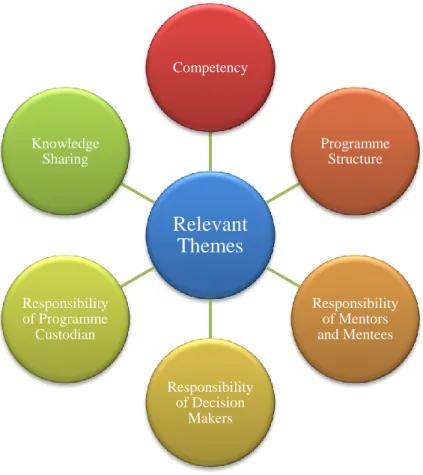
The data was analysed using thematic analysis, with the aid of NVivo 10.0 software. The presented themes were then used to compliment the findings of the SSM tools that were utilised during the data collection phase. The main themes which emerged were Competency, Programme Structure, Responsibility of Mentors and Mentees, Responsibility of Decision Makers, Responsibility of Programme Custodian and Knowledge Sharing.
There were a total of 31 change measures suggested. It will obviously not be feasible to implement all of these changes at once. It is therefore recommended that a phased approach is adopted by prioritizing the most critical change requirements as well as the most easily attainable changes first.
It is also recommended that a committee be tasked to oversee the change measure implementation
iv
and that, within that committee, a dedicated champion is assigned to each theme or category of change.
This study has been successful in revealing a deeper understanding of the Engineer in Training programme at Transnet and its deficiencies as well as the means to begin to address the identified problems. This will in turn have a positive effect on the quality of trainees being produced, thereby the quality of work being done by the company and ultimately the economic strength of the country.
The study has thus been valid and useful, giving a number of recommendations for the improvement of the programme. Recommendations for further study have also been suggested and it is thought that if these studies are taken further, significant advancement of the programme can be achieved.
v
TABLE OF CONTENTS
DECLARATION ... i
ACKNOWLEDGEMENTS ... ii
ABSTRACT ... iii
TABLE OF CONTENTS ... v
LIST OF FIGURES ... ix
LIST OF TABLES ... x
LIST OF ABBREVIATIONS AND SYNONYMS ... xi
CHAPTER 1: INTRODUCTION ... 1
Introduction ... 1
Background ... 1
Problem Statement ... 5
Significance of Study ... 6
Aim and Objectives ... 6
Research Questions ... 7
Chapter Breakdown ... 7
Conclusion ... 9
CHAPTER 2: LITERATURE REVIEW ... 10
Introduction ... 10
A Global Perspective ... 10
Pedagogy versus Andragogy ... 12
Mentoring ... 15
Transfer of Knowledge... 19
Competency ... 22
vi
Systems Thinking Definition ... 28
Systems Thinking Concepts ... 29
Systems Thinking Tools ... 31
The Principle of Leverage ... 31
The Iceberg Model ... 33
Soft Systems Methodology ... 35
Conclusion ... 39
CHAPTER 3: RESEARCH METHODOLOGY ... 41
Introduction ... 41
Participants and Location of the Study ... 41
Research Design ... 42
Population and Sample ... 43
Sampling Method ... 43
Probability Sampling ... 44
Non-Probability Sampling ... 44
Data Collection ... 45
Data Collection Instruments ... 46
Focus Group ... 46
Semi-Structured Group Discussion... 47
Focus Group Prompts ... 47
Administration of Focus Group ... 48
Data Capture ... 49
Data Analysis ... 50
Data Display ... 51
Measures for Ensuring Trustworthiness ... 51
vii
Credibility ... 51
Dependability ... 52
Confirmability ... 53
Transferability ... 53
Authenticity... 54
Ethical Matters ... 55
Ensuring permission is obtained ... 56
Ensuring Participants are given informed consent ... 56
Ensuring no harm comes to participants ... 56
Ensuring confidentiality and anonymity ... 57
Conclusion ... 57
CHAPTER FOUR: RESULTS AND DISCUSSION ... 59
Introduction ... 59
Presentation of Data ... 59
Phase 1: Rich Picture... 63
Competency ... 64
Responsibility of Mentors and Mentees ... 70
Responsibility of Decision Makers ... 74
Phase 2: Root Definitions ... 75
Competency ... 77
Programme Structure ... 79
Responsibility of Mentors and Mentees ... 82
Responsibility of Decision Makers ... 83
Responsibility of Programme Custodian ... 87
Knowledge Sharing ... 93
viii
Conceptual Model ... 97
Competency ... 98
Programme Structure ... 101
Responsibility of Mentors and Mentees ... 103
Responsibility of Decision Makers ... 105
Responsibility of Programme Custodian ... 108
Knowledge Sharing ... 110
Conclusion ... 115
CHAPTER FIVE: CONCLUSION AND RECOMMENDATIONS ... 116
Introduction ... 116
Key Findings ... 116
Objective 1: Level of competency of TGC trainees ... 117
Objective 2: The structure and training outcomes of the programme ... 118
Objective 3: Ways in which to improve the TGC graduate programme ... 119
Systems Thinking as a Theoretical Framework Revisited ... 121
Recommendations ... 122
Limitations of the Study ... 122
Recommendations for further study ... 123
Conclusion ... 124
REFERENCES ... 126
ANNEXURE A: Gatekeepers Letter ... 141
ANNEXURE B: Ethical Clearance Form ... 144
ANNEXURE C: Informed Consent for Focus Group Participation ... 145
ANNEXURE D: Focus Group Schedule ... 148
ANNEXURE E: Turn It In Report ... 150
ix
LIST OF FIGURES
Figure 1.1: Transnet Organisational Structure ... 3
Figure 2.1: Relationship between Knowledge, Information and Data ... 19
Figure 2.2: Explicit Knowledge versus Tacit Knowledge ... 20
Figure 2.3: Continuum of Personal Attributes and Competencies ... 23
Figure 2.4: Integrated model of competence ... 24
Figure 2.5: Tiered diagram of the model ... 26
Figure 2.6: Habits of a Systems Thinker ... 32
Figure 2.7: The Iceberg Model ... 35
Figure 2.8: Soft Systems Methodology Steps ... 37
Figure 2.9: Example of a Rich Picture ... 38
Figure 4.1: Summary of Relevant Themes ... 60
Figure 4.2: Rich Picture Developed by Participants ... 63
Figure 4.3: Competency Subthemes from Phase 1 ... 64
Figure 4.4: Responsibility of Mentors and Mentees Subthemes from Phase 1 ... 70
Figure 4.5: Responsibility of Decision Makers Subthemes from Phase 1 ... 74
Figure 4.6: Competency Subthemes from Phase 2 ... 77
Figure 4.7: Programme Structure Subthemes from Phase 2 ... 79
Figure 4.8: Responsibility of Mentors and Mentees Subthemes from Phase 2 ... 82
Figure 4.9: Responsibility of Decision Makers Subthemes from Phase 2 ... 84
Figure 4.10: Responsibility of Programme Custodian Subthemes from Phase 2 ... 87
Figure 4.11: Knowledge Sharing Subthemes from Phase 2 ... 93
Figure 4.12: Conceptual Model Developed by Participants ... 98
Figure 4.13: Suggested Change Items against Competency Theme ... 101
Figure 4.14: Suggested Change Items against Programme Structure Theme ... 103
Figure 4.15: Suggested Change Items against Responsibility of Mentors and Mentees Theme 105 Figure 4.16: Suggested Change Items against Responsibility of Decision Makers Theme ... 108
Figure 4.17: Suggested Change Items against Responsibility of Programme Custodian Theme110 Figure 4.18: Suggested Change Items against Knowledge Sharing Theme ... 114
Figure 5.1: Summary of Suggested Action Items ... 120
x
LIST OF TABLES
Table 2.1: Pedagogy vs Andragogy ... 14 Table 2.2: Mentor and Mentee Criteria for Success List ... 16 Table 2.3: Hard Systems vs Soft Systems Approaches ... 36
xi
LIST OF ABBREVIATIONS AND SYNONYMS
CPD - Continuous professional development
EBITDA - Earnings before interest, tax depreciation and amortization ECSA - Engineering Council of South Africa
EIT - Engineer in Training GDP - Gross domestic product MDS - Market Demand Strategy PR - Professional Registration SSM - Soft systems methodology TFR - Transnet Freight Rail TGC - Transnet Group Capital
TNPA - Transnet National Ports Authority TPL - Transnet Pipelines
TPT - Transnet Port Terminals TRE - Transnet Rail Engineering
1
CHAPTER 1: INTRODUCTION
Introduction
The growth of the South African economy is dependent on the capability of its workforce.
According to Goyal and Chhabra (2016), employment in a developing economy is characterized by an increasing demand for more highly-skilled workers. Perhaps the most important of these skills are technical skills in the form of engineers and technicians. One of the key drivers of the South African economy is the import and export of commodities through the countries rail, port and pipeline infrastructure, which is operated by Transnet, a state owned enterprise (Morris et al., 2012). The development of young engineers through Transnet’s Engineer in Training Programme is a vital tool to aid in the development of a competent workforce. It is therefore critical that this programme functions at an optimal level and serves its purpose of producing capable engineers.
This study examines the Engineer in Training Programme at Transnet to determine how the programme is perceived by senior staff, if the programme is achieving its purpose and the ways in which the programme can be improved.
This chapter introduces the study by first describing the background to the topic and thereafter offering a problem statement that will be further investigated throughout the study. The significance of conducting this study and how it will be beneficial will then be outlined. The aim and objectives of the study are then presented from which research questions are drawn. The limitations of the study will be provided and finally the chapter will conclude with a breakdown of the proceeding chapters.
Background
The events of unrest which took place during the Apartheid era in South Africa greatly destabilized the nation in many ways, including economically, politically and socially (Marais, 2011). Since the fall of apartheid the country has begun to recover in this new social amalgamation which looks to provide equal opportunity to all citizens. South Africa, now a young democratic nation, has the
2 potential for vast growth and expansion. The country has embarked on an ambitious growth strategy, termed the National Infrastructure Plan, to drive the economy by investing in its infrastructure. This strategy came into effect in 2012 and will give rise to considerable investment in key new and existing infrastructure. The bulk of this money was administered to South African state owned enterprises (Gordhan, 2013).
Transnet is a multimodal logistics service provider that deals with the import, export and distribution of commodities in South Africa (Nethathe et al., 2011). The parastatal is solely owned by the South African government and is managed by the Department of Public Enterprises. The responsibility of Transnet is to manage and operate the rail, port and pipeline network infrastructure of the country. This makes Transnet a key driver of the South African economy, contributing to gross domestic product (GDP), employment and other key socioeconomic drivers within the country (Maharaj, 2013).
The organisation is self-funded through its own operations and does not receive any government grants. Much of the capital in which it invests is gained through a combination of profits earned and money borrowed from international lenders (Maharaj, 2013). It is thus important that business operations are efficient in order to maximize on profits earned as well as to install confidence in lenders. Transnet looks to accomplish this through the operation of its five core operating divisions supported by its two specialist units.
Figure 1.1 outlines the organisational structure of Transnet which comprises of three core areas of operations; rail, ports and pipeline, as well as two specialist units.
Transnet Freight Rail (TFR), dedicated to managing rail logistic operations;
Transnet Rail Engineering (TRE), dedicated to the acquisition and maintenance of rail assets;
Transnet National Ports Authority (TNPA), operates in a landlord capacity for South African ports;
Transnet Port Terminals (TPT), dedicated to managing operations within the ports;
Transnet Pipelines (TPL), dedicated to the operation of a network of pipelines leading from the ports to major inland hubs;
3
Transnet Properties, manages all Transnet owned properties including the acquisition of new properties; and
Transnet Group Capital, dedicated to the execution of capital investment projects across all operating divisions.
Figure 1.1: Transnet Organisational Structure Source: Adapted from Transnet (2012)
Transnet Group Capital (TGC), previously known as Transnet Capital Projects, was established in 2004 as a subsidiary company of Transnet Limited. TGC is viewed as the project execution arm of the parastatal and houses the bulk of Transnet’s practicing engineers. The mission of TGC is to deliver major capital infrastructure projects by providing specialist technical services in the form of Engineering and Project Management. The specialist unit is made of technical departments including architecture, electrical, structural, civil, rail, signaling, mechanical, and project management.
TRANSNET LTD.
RAIL
Freight Rail
Rail Engineering
PORTS
National Ports Authority
Port Terminals
PIPELINE
Pipelines
SPECIALIST UNITS Transnet Property Transnet Group Capital OPERATING DIVISIONS
4 The South African government is looking towards Transnet to grow the economy through its capital investment programme, the Market Demand Strategy (MDS). This strategy consists of projects aimed at developing the countries ports, railway and pipeline infrastructure. The capital investment programme is an ambitious ten year strategy which forecasts investment of greater than 300 billion rand (Transnet, 2012). The key drivers of the MDS according to Transnet (2012) are:
Expand rail, port and pipeline infrastructure;
Increase capacity to meet market demands;
Maintain financial stability and strength;
Provide productivity and operational efficiency improvements;
To enabling economic growth; and
To provide job creation, skills development, localisation, and empowerment opportunities.
Transnet has a social responsibility to deliver on the MDS by executing projects on time, within budget and of a good quality. In order to achieve this, the company needs to have within its ranks a highly competent workforce who possess the necessary skills. In addition to the MDS, Transnet also has a commitment to create employment as well as to skills development (Cawe, 2015). They have for this purpose developed a graduate programme, known as the Engineer in Training (EIT) programme.
The purpose of the EIT programme is to develop young employees through direct and indirect training and mentoring. This training should equip these employees with the skills to operate at a level that will be expected of them as they progress in their careers (Liebenberg and Mathews, 2012). It is equally important to ensure that the skills and knowledge possessed by senior employees are transferred and retained within the organisation before these experts retire (Liebenberg and Mathews, 2012). This programme is critical in ensuring that the current and future employees of Transnet are competent and have the necessary skills to perform at a level which is required of them and successfully deliver on the MDS.
5 Problem Statement
The age profile of the current TGC engineering staff is typically young recently graduated individuals as well as seasoned veterans approaching retirement. There is a large gap apparent in the middle age bracket. This middle aged group of employees are especially important and should constitute a significant portion of a company’s workforce. These employees are generally more stable, have higher efficiencies, and are more accountable and reliable (Muehlbauer et al., 2012).
According to Black and Gerwel (2014), it is the middle aged bracket that needs to be populated with competent professionals.
There is an identifiable skills gap that exists within TGC especially within the middle aged group.
The ultimate goal of the EIT programme is to enable young employees to eventually fill these gaps.
There is, however, a number of vacancies on offer that should have been potentially filled by programme graduates. There are also no programme graduates who have progressed to a middle or senior management position within the organisation. There is a need to identify what it is that is undermining this progression by evaluating the structure and content of the programme and ascertaining the perceptions of senior employees of the programme and its participants.
The Engineering Council of South Africa (ECSA) defines specific competency standards and training areas that are expected of an engineer before they are deemed to be Professionals by an ECSA committee. A professional engineer, as compared to a candidate engineer, is able to sign off drawings and approve designs, thus assuming a higher degree of responsibility and accountability, and consequently are more valuable to any organisation (Machimane, 2014).
Currently only a small number of programme graduates have gone on to obtain an ECSA professional status within TGC.
The problem involving the EIT programme at Transnet is one that involves a substantial number of variables. These variables are all connected such that a multitude of interactions exist between them, whereby, a slight change in one can result in a significant change in one or more of the other variables. It is consequently noted that this vast system of loosely defined, interacting variables, and the relationships which exist between them, is one which is complex in nature (Simon and
6 Schiemer, 2015). In order to better understand these relationships there is a need to identify the inputs of the system, the outputs, as well as the processes of exchange which occur or the throughputs. A means to examine complex situations such as the EIT programme is through the use of systems thinking. The approach of this study was systems thinking based.
Significance of Study
The responsibility of Transnet, and of TGC in particular, is immense for South Africa in the context of developing infrastructure, raising the economy, creating employment and ultimately improving the lives of South African citizens (Maroun and Garnett, 2014). This same level of responsibility is thereby shouldered by the employees of Transnet, especially those who are in critical positions such as engineers, senior managers and executives. Hence, it is highly important to ensure that employees who occupy these roles presently, and in the future, have a solid experiential foundation and are competent enough to purposefully complete their jobs.
The study will benefit graduates entering the programme and those currently in the programme through the evaluation of the activities and outcomes of the programme. The greater engineering staff of TGC will benefit in the long run as the calibre of young engineers coming through the programme will be at a higher level. TGC as a business and Transnet as a whole will also benefit as the competency and efficiency of its staff improves. Ultimately, the South African economy, and the South African public, will benefit as national infrastructure projects will be delivered on time, within budget and of a good quality.
Aim and Objectives
The aim of the study was to identify how the graduate programme currently offered by TGC can be improved. This was done by benchmarking the activities and outcomes of the programme against ECSA’s requirements for a professional engineer.
7 The following objectives were established for the study in order to achieve this aim:
To determine the level of competency of TGC trainees and programme graduates benchmarked against ECSA competency standards;
To evaluate the structure and training outcomes of the programme; and
To recommend ways in which to improve the TGC graduate programme.
Research Questions
The following research questions were investigated:
1. What are the competency levels of those employees who have graduated from the training programme and how is the programme perceived by current senior employees?
2. Is the structure and design of the programme achieving its intended outcomes?
3. What are the changes that can be implemented to positively affect the TGC graduate programme?
Chapter Breakdown
Chapter 1 – Introduction
Chapter 1 of this dissertation is the introductory chapter. This consists of an introduction, followed by the background to the research. A problem statement was then defined. The chapter proceeded to highlight the significance of the study and how it will be a beneficial body of knowledge. The
8 chapter also outlined the aim and objectives of the study as well as the research questions that were posed.
Chapter 2 – Literature review
This chapter contains a critical review of the relevant literature pertaining to the topic. The current trend in global and local employment was first discussed as well as the various concepts of learning and their benefits. Literature pertaining to mentoring, knowledge sharing and competency were then investigated and discussed. The approach of the study was to use systems thinking, therefore, a significant portion of the literature reviewed focused on systems thinking theories and concepts, including the concept of leverage and soft systems methodology tools, which were utilised during the data collection stage of the study.
Chapter 3 – Research Methodology
This chapter focused on the methodology applied in the study. It begins by outlining the research design and research methodology adopted for the study. The data collection strategy used for the study is then introduced. The population and sample and the sampling strategy was also detailed.
Furthermore, the collection of data is discussed including the instrument used to collect data, the capturing of data and the manner in which data was analysed and displayed. The chapter goes on to review the validation and reliability of data as well as the elimination of bias before concluding with the ethical considerations that were taken into account.
Chapter 4 – Results and Discussion
This chapter presents the findings of the study conducted and discusses the data obtained. The presentation of results was illuminated by grouping the data into themes that emerged from the analysis. These themes were further expounded by linking them to the research questions that were drawn at the start of the study as well as the literature that was reviewed. The themes were broken down further into subthemes which encapsulated the problems experienced with the programme, and each of the subthemes were addressed by suggesting possible change items that could be
9 implemented in order to positively influence the system. The data was presented in three phases, dictated by the soft systems approach that was employed for data collection purposes. These three phases include the rich picture, root definition and conceptual model phase. The chapter concludes with a discussions of all the results presented.
Chapter 5 – Conclusions and Recommendations
The final chapter of the dissertation presents the conclusions and key findings of the study, which directly address the objectives set for the study. Recommendations are given based on these key findings and conclusions are drawn. The implications and benefits of the study have also been deliberated. The limitations of the study post data collection were then reviewed. Finally, the chapter is concluded by providing recommendations of important areas for future research that may further benefit the EIT programme.
Conclusion
The study undertook to investigate the ways in which the graduate EIT programme at Transnet may be improved. Transnet has a social responsibility to deliver on the MDS by executing projects on time, within budget and of a good quality. In order to achieve this, the company needs to have within its ranks a highly competent workforce who possess the necessary skills. The ultimate goal of the EIT programme is to enable young employees to eventually fill skilled and accountable positions in the company. There is a need to identify what is undermining this progression by evaluating the structure and content of the programme. Given the problem being faced by Transnet, it was valuable to see what literature stated on the topic. The next chapter presents a review of several sources of literature relevant to the study.
10
CHAPTER 2: LITERATURE REVIEW
Introduction
This chapter examines literature that will support the study and aid in explaining concepts and theories that will elucidate the proceeding results and discussion. The literature review first explores the global trends in employment and skills availability. Concepts pertaining to how individuals learn are then investigated, followed by the practice of mentoring and how mentoring may be carried out in a work environment. The methods in which knowledge may be shared is investigated. Competency in the professional context is also considered to determine how the trainees themselves should be evaluated. Systems thinking, which forms the basis of the approach taken to gather data for the study, is then examined in detail, including the concept of leverage and softs systems methodology.
A Global Perspective
The first section of this review will look at the environment in which the engineering industry and Transnet are operating from a worldwide view and within a South African context. In the past century there has been a global change in marriage trends; where, historically people were getting married at a young age, people in current times are waiting, and as a result, are having children at a later age (Hayford, 2013). According to Harper (2014), people are currently also having fewer children due to the economic and social implications. Women in general are now more career driven and delay having children to focus on their careers or sometimes opt to not have children at all (Jesiek et al., 2014). There is, for this reason, an inherent age gap that exists which has had an effect on industry.
The Apartheid era saw the disadvantaged majority being restricted from progressing to an educational level that would enable them to enter professional careers (Chisholm, 2012).
Following the fall of apartheid, opportunities became equal for all and education was a priority, especially for previously disadvantaged race groups (Horwitz, 2013). The influx of graduates in
11 all industries significantly increased, as previously disadvantaged youth were given the opportunity to educate themselves at a secondary and tertiary level. This again created an imbalance in the demographics when considering young employees versus senior employees (Branson et al., 2013).
In South Africa the age profile of the working class is typically young recently graduated individuals as well as seasoned veterans approaching retirement (Young and Muller, 2014). There is a large gap apparent in the middle age bracket. According to Black and Gerwel (2014), it is this area that needs to be populated with competent professionals. This can only be achieved by ensuring that young graduates entering the working world are well trained and are equipped with the skills to operate at a level that will be expected of them as they enter the middle aged bracket (Liebenberg and Mathews, 2012). It is even more important to ensure that the skills and knowledge possessed by senior employees are transferred and retained within an industry before these experts retire (Cappelli, 2012).
Technological advancement, globalization and economic integration has affected the engineering profession as well. According to Levonisova et al. (2014), it is important that these aspects are taken into consideration when we benchmark the competencies required for a modern engineer. In our current environment, however, technical skills are insufficient. An engineer also requires good communication skills, the ability to operate well within a team and a global awareness in terms of economic, social and environmental trends, to be technologically savvy (Levonisova et al., 2014).
The certification of an engineer to the status of ‘professional’ is a tool to regulate and develop the engineering profession (Chuchalin and Gasheva, 2015). The competencies, in terms of level and skill set, differ from a graduate to a professional according to the requirements of the Washington Accord. The idea of ‘continuous professional development’ (CPD), a term that refers to on the job practice and coaching, is given a lot of attention through mentorship and training programmes (Chuchalin and Gasheva, 2015). Every engineer should choose the route to their professional registration based on the requirements of the local authority, which in South Africa is the Engineering Council of South Africa (Streiner et al., 2014).
12 Pedagogy versus Andragogy
The following discussion relates to pedagogy and andragogy which considers the learning habits of children and how this transforms as they grow into adults. This is of particular interest as graduates must adapt from being in a situation where they were being taught formally in a classroom environment, to trying to learn in the working world where the circumstances are different and your colleagues and superiors are not always going to try or even want to teach you (Bowen et al., 2013).
According to Finn (2011), pedagogy is literally translated to mean the science of teaching children.
This is based on the origin of the word which is derived from two Greek words. The first word is
“paid”, which translates to mean "child", and the second word is “agogus”, which means "leader of” (Finn, 2011). As stated by Ozuah (2016), pedagogy has origins in early 7th century Europe where monks taught children in the monasteries. The monks began to notice patterns when teaching children basic skills and thus began to make certain assumptions as they continued to teach future generations. These assumptions became commonplace amongst teachers as the schooling systems evolved especially in Europe (Ozuah, 2016).
The study of learning progressed, focusing on how children responded to systematic instruction (Kali et al., 2011). Pedagogy is now commonly understood to be an authority-focused, systematic approach, but does not exclusively relate to the teaching of children, but teaching in general (Taylor and Kroth, 2012). The ultimate goal of a pedagogical approach is to transmit foundational knowledge (Turner, 2013). It regularly employs a grading system of some kind, such as those found in schools, and is considered formal in nature (Taylor and Kroth, 2012).
In the early 20th century the teaching of adults took a similar design, methodical in nature, to the pedagogic approach employed to teach children (Ivey, 2014). This approach was found to not be as successful. Knowles et al. (2014), claim that the major reason for this was that pedagogy operated on the principle that the reason for education was transfer of knowledge and skills, and adults at the time did not see merit in this reasoning. They did not respond well to typical pedagogic methods such as classes, assessments and homework (Knowles et al., 2014). It became clear that
13 the same assumptions about learners used in a pedagogic approach, could not be applied to adult learners.
The term andragogy became regularly used during the middle of the 20th century in a number of European countries (Ivey, 2014). It was developed to contrast the now well-known term of pedagogy. The word andragogy is derived from the Greek words “aner”, which translates to mean
“man, not boy”, and again “agogus” (Ivey, 2014). The direct definition was taken to mean “the science of helping adults learn”. Ozuah (2016), states that andragogy took on a parallel approach to pedagogy, steering clear of authority driven teaching and moving towards a self-directed approach. Learning through one’s own experience and attempting to solve problems at an individual level was promoted in this regard (Ozuah, 2016).
According to Chinnasamy (2013), andragogy promotes a goal of reaching self-actualization, requiring adult learners to strive to find their own purpose and fulfillment. The learning is very much in the hands of the adult requiring them to operate within their own schedules and commit to study through their own motivations (Fornaciari and Dean, 2014). The teacher is thus a facilitator who directs adults towards taking responsibility for their learning (Knowles et al., 2014).
As stated by Mac Callum et al. (2015), in most andragogic situations, learning is informal, and does not usually employ a grading system. A summary of the main differences between pedagogic and andragogic training are summarized in Table 2.1.
14 Table 2.1: Pedagogy vs Andragogy
Pedagogy vs. Andragogy
Pedagogic Andragogic
The Learner The learner is dependent upon the instructor for all learning
The teacher/instructor assumes full responsibility for what is taught and how it is learned
The teacher/instructor evaluates learning
The learner is self-directed
The learner is responsible for his/her own learning
Self-evaluation is characteristic of this approach
Role of the Learner’s Experience
The learner comes to the activity with little experience that could be tapped as a resource for learning
The experience of the instructor is most influential
The learner brings a greater volume and quality of experience
Adults are a rich resource for one another
Different experiences assure diversity in groups of adults
Experience becomes the source of self- identity
Readiness to Learn
Students are told what they have to learn in order to advance to the next level of mastery
Any change is likely to trigger a readiness to learn
The need to know in order to perform more effectively in some aspect of one’s life is important
Ability to assess gaps between where one is now and where one wants and needs to be Orientation
to Learning
Learning is a process of acquiring prescribed subject matter
Content units are sequenced according to the logic of the subject matter
Learners want to perform a task, solve a problem, live in a more satisfying way
Learner must have relevance to real-life tasks
Learning is organised around life/work situations rather than subject matter units Motivation
for Learning
Primarily motivated by external
pressures, competition for grades and the consequences of failure
Internal motivators are self-esteem, recognition, better quality of life, self- confidence and self-actualization
Source: Adapted from floridatechnet (2013:1)
15 Mentoring
This section will examine literature related to mentoring concepts, the role of a mentor and the intricacies of the relationships that exist between mentors and mentees. Doerwald et al. (2015), define mentoring as an act of offering advice and guidance by an experienced individual to a less knowledgeable and less experienced individual. This process is built on communication and a strong relationship between the mentor, who guides, and the mentee, who receives guidance (Doerwald et al., 2015). Schunk and Mullen (2013:362), offer a more detailed definition of mentoring, “Mentoring is a process for the informal transmission of knowledge, social capital, and the psychosocial support perceived by the recipient as relevant to work, career, or professional development”.
The mentor is someone who possesses a degree of expertise and need not necessarily be older than the mentee, although this is regularly the case (Schunk and Mullen, 2013). The success of mentoring is hugely influenced by the dynamics of the relationship between the two parties as well as the competency of the mentor in being able to fulfill the role (Masalimova et al., 2016).
According to Masalimova et al. (2016), it is also important that the mentee is receptive to the guidance being offered and they are genuinely interested in learning and their development.
Table 2.2 lists the criteria suggested by Cohen et al. (2012) for the basic requirements of a competent mentor and a competent mentee:
16 Table 2.2: Mentor and Mentee Criteria for Success List
MENTOR MENTEE
Helps mentee settle in organisation Establishes goals which are *SMART Is available to assist in tough situations Is honest and transparent
Boosts self-confidence of mentee Utilizes mentoring time effectively Maintains proper communication channels Is aware of mentors expectations Encourages creativity and independence Maintains confidentiality
Maintains confidentiality
*SMART – Specific, Measurable, Achievable, Realistic and Time Constrained
Source: Cohen et al. (2012:10)
Similarly, Ilesanmi (2011) claims that mentoring in the workplace can have far reaching benefits for an organisation. Ilesanmi (2011), describes workplace mentoring as a learning partnership that exists between colleagues. In this partnership a bulk of information can be shared including technical nous, experiential recounts as well as personal insights and opinions (Roche, 2013).
Pryce et al. (2015), goes on to state that mentoring can be effectively expressed as a developmental process; a process that differs from person to person.
Eller et al. (2014), lists the following qualities of a good mentor:
Takes a vested interest in mentorship and the development of others
Is mindful of others aspirations and career needs
Is a good listener
Is committed to the task
Keeps private matters private
Provides feedback and lessons learnt
Similarly, Eller et al. (2014) puts forward the following qualities of a good mentee:
Is motivated and driven to develop in their career
Is keen to acquire new skills
Takes positive and negative feedback well
Is able to think outside the box and discover new methods of learning
17
Is clear on career goals and path
Mentoring relationships may spontaneously begin in an informal sense as senior employees develop a bond with a junior and look to take that individual under their wing. More commonly, however, these relationships form as a result of a predefined arrangement in companies (Straus et al., 2013). The establishment of a formal mentoring programme within an organisation can be a huge draw card to attract graduates of the highest calibre (Brown, 2015). According to Brown (2015), this provides a level of comfort to young employees entering the company as it ensures that all juniors are matched with an experienced professional.
As suggested by Silva and Yarlagadda (2014), establishing a formal mentoring programme in an organisation can be hugely beneficial for both the company, in terms of performance, and the employees, in terms of career development. Silva and Yarlagadda (2014), substantiate this by stating that it enables the transfer of skills and knowledge from senior to junior employees in a predefined, structured manner. It also ensures that senior employees are obliged to make time to mentor, while affording junior employees the care that is required in these early developmental stages. Clinton and Hokanson (2012), claim that the ultimate purpose of these programmes is to enable young employees to reach a level where they can assume a higher degree of responsibility within the organisation, as quickly as possible.
According to Wankat and Oreovicz (2015), a formal mentoring programme can lead to improved employee satisfaction as the professional aspirations of employees are acknowledged by the organisation and a path to reach these goals is defined in line with the company’s goals. People are often more content in their jobs if they have a feeling of achievement and progression. This may consequentially result in enhanced employee performance as well as better employee retention (Wankat and Oreovicz, 2015).
As defined by Klasen and Clutterbuck (2012), other benefits of a structured mentoring programme in an organisation can be summarized as follows:
The transfer of knowledge in a meaningful and planned manner
18
Job specific training including technical expertise and soft skills
Improved employee satisfaction and a positive work environment
Training and development of a staff compliment in line with company objectives
Increased assumption of responsibility and improved outputs from staff
Identifying talent and potential future leadership/management
Ralph and Walker (2014), believe that the latest generation of graduates entering the working world require even more attention than previous generations when it comes to mentoring. Ralph and Walker (2014), state that society’s perception of this latest generation, which they refer to as
“millennials”, is very negative in that they are seen as lazy, immature and having a sense of entitlement. Marcinkus Murphy (2012), are in agreement, however believe that, through nurture and attention, the potential of these millennials, who are in fact quite intelligent, can be unlocked.
In this technological age, children have grown up constantly seeking the advice and approval of others on social media platforms (Adams et al., 2011). For this reason, the current generation innately seek a mentor figure in all aspects of life, including social and professional. It is further put forward by May and Tekkaya (2014), that mentoring in a professional environment has evolved over the years to become a reciprocal relationship. Nowadays the mentor can also learn a certain degree from the juniors as well, especially in a technological sense (Streiner et al., 2014). This reverse mentoring is necessary to some degree on the part of the mentor in order to enable young employees to feel that their ideas and thoughts are valued (Levonisova et al., 2014).
Further to that, and in line with the statements of Pryce et al. (2015), a requirement of this generation of young employees is that they need a significant amount of feedback at more regular intervals than was the case in the past. They also are generally not content with only a single mentor, but rather a mentor for different demands and time periods. These requirements if met will aid in the mentees overall understanding of the direction in which they need to move in terms of their career (Silva and Yarlagadda, 2014).
19 Transfer of Knowledge
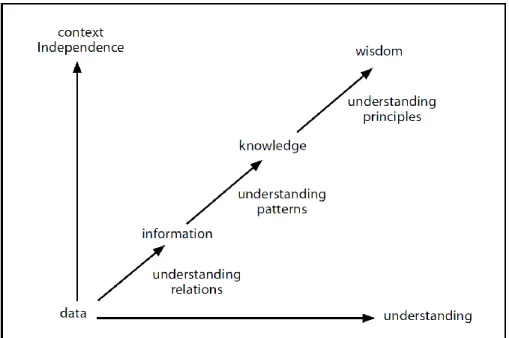
As mentioned in the previous section, the transfer of knowledge is an important activity that must occur in a mentoring relationship. This section will investigate what knowledge is, the types of knowledge that exist as well as how it may be transferred. According to Liew (2013), knowledge is the most valuable resource to any organisation. As demonstrated in Figure 2.1, there is inherent difference between data, information and knowledge. Data is purely objective facts which require context or interpretation in order to have meaning, such as the price of petrol currently being R11/litre (Mousavizadeh et al., 2015). Information is data that has been interpreted and has context, such as the price of petrol has risen by R3.50 over the last 2 years. Knowledge is information in context, which is interpreted and applied thereby influencing ones perceptions. It is generally based on experience and the understanding of patterns. For example, knowledge is recognizing that as the petrol price rises, the price of other commodities rises too, such as the price of food.
Figure 2.1: Relationship between Knowledge, Information and Data Source: Adapted from Liew (2013:60)
Knowledge can be viewed as either explicit or tacit (Becerra-Fernandez and Sabherwal, 2014). As defined by Nissen et al. (2014), explicit knowledge is tangible, visible and public knowledge
20 commonly written in a formal manner. It is usually categorised and arranged within libraries or archives of some form. Explicit knowledge can be captured in a document or a database or expert system. It can also be expressed in rules or guidelines (Nissen et al., 2014). This makes it easy to access and share with others often using a structured, technical approach (Becerra-Fernandez and Sabherwal, 2014). Examples of explicit knowledge include equations or specifications.
Tacit knowledge is private and intangible knowledge. It is what people know within themselves through their own studies and experiences (Nissen et al., 2014). Venkitachalam and Busch (2012), go further stating that tacit knowledge consists of paradigms, viewpoints, beliefs, and concrete know-how such as crafts and skills. It is instinctive and subjective, making it difficult to express to others and to capture. Montcalm (2013), states that tacit knowledge is invisible, and cannot be stored in archives or databases, but rather carried in people’s minds, which makes it difficult to access. Often people are not aware of the knowledge they possess or how it can be valuable to others. Tacit knowledge is considered more valuable than explicit knowledge as it is richer in nature and provides context to people and ideas (Montcalm, 2013). Figure 2.2 summarizes the differences between explicit and tacit knowledge.
Figure 2.2: Explicit Knowledge versus Tacit Knowledge Source: Montcalm (2013:1)
21 The effective transfer of tacit knowledge generally requires extensive personal contact. It is often relationship dependent and is built on trust and reciprocity (Hau et al., 2013). Reciprocity in the sense that both parties should gain from the transfer. The culture of an organisation, therefore, plays a huge part in influencing the sharing of knowledge within the organisation (Nakhchian and Bemani, 2013). Culture influences the way in which employees interact and treat each other.
Nakhchian and Bemani (2013), describe two types of organisational cultures pertaining to knowledge sharing; individualistic and collective. In an individualistic organisation, people prefer to be rewarded individually for their sharing of knowledge. In the collective culture, and if there is a collective team spirit, people are happier if everyone is rewarded and people are not possessive about their knowledge and experience (Nakhchian and Bemani, 2013). Culture also dictates the methods and procedures to be followed when effecting knowledge to particular situations. This is reverberated by Huang et al. (2014), who claims that if people are afraid to express themselves, they may be stifled and be reluctant to speak out and share knowledge.
The sharing of knowledge in an organisation can be encouraged by establishing platforms in which employees, especially those with significant experience, are given the opportunity to share stories and practical nous (Dong et al., 2016). In smaller segments or departments this may take place in small groups around a table or in a presentation format (Lamberts and Shanks, 2013). According to Dong et al. (2016), it is also important to try and encourage people to not only share their successes but also stories where they have made errors as you often learn more from these types of recounts.
Lamberts and Shanks (2013), suggests that on the job mentoring need not be the sole responsibility of senior managers and experienced employees, who are often heavily involved in the business and its operations. According to Paulin and Suneson (2015), retirees or staff approaching retirement should be engaged to mentor young employees. These individuals usually have a wealth of knowledge to share and often are not very keen on becoming too involved in the pressures and stresses involved with the business operations (Paulin and Suneson, 2015). Once these individuals do retire the organisation loses a resource with key knowledge and experience. It is important to try and retain as much of that knowledge in the organisation as possible (Lamberts and Shanks, 2013).
22 Competency
The ultimate goal of the EIT programme is to produce competent engineers who are able to deliver on projects. This section will look at the definition of competency, the various types of competency and a model for competency and how it can be developed. Competency is directly related to the success of an organisation. A competent workforce is generally a collection of individually competent employees as a majority (Rath, 2015). According to Rath (2015), competency is, however, relative and varies from person to person depending on the role and the function which they are expected to fulfill.
Brightwell and Grant (2013:1), define competency as “the ability to utilize knowledge, skills, and abilities to successfully perform functions or tasks in a defined work setting”. Dato’R (2014), goes further and states that competency is an inherent quality of an individual, enabling them to persevere and perform at a level that is equal to or greater than what is expected of them in a work capacity. It is argued further by Bral and Cunningham (2016), that competency stems from ones personality and is built upon to perform depending on the task being set. Competency often sets the benchmark for what is the minimum requirement for skills or ability in a given role (Bral and Cunningham, 2016). If you are performing below this benchmark you are usually considered incompetent in that role.
We are able to distinguish between two types of competencies, namely; behavioural competencies and functional competencies (Omar and Fayek, 2016). Functional competencies are commonly referred to as technical skills and abilities (Omar and Fayek, 2016). These are more functional activities that enable one to achieve a set task. Examples of functional competencies are driving a forklift, designing a bridge or repairing a motor vehicle engine. Often the mentoring or training of young employees largely focuses on functional competencies (Parts et al., 2013).
Behavioural competencies are commonly referred to as soft skills, and relates to the way in which one goes about completing a task (Ahadzie et al., 2014). Behavioural competencies often refer to doing things in relation to people, usually when acting in a position of leadership (Ahadzie et al., 2014). An example of a behavioural competency would be remaining calm in a pressure situation
23 or being charming or seductive when dealing with people. It should be noted that behavioural competencies are generally more difficult to teach than other functional competencies (Parts et al., 2013). According to Omar and Fayek (2016), it is these competencies that require particular attention in terms of mentoring.
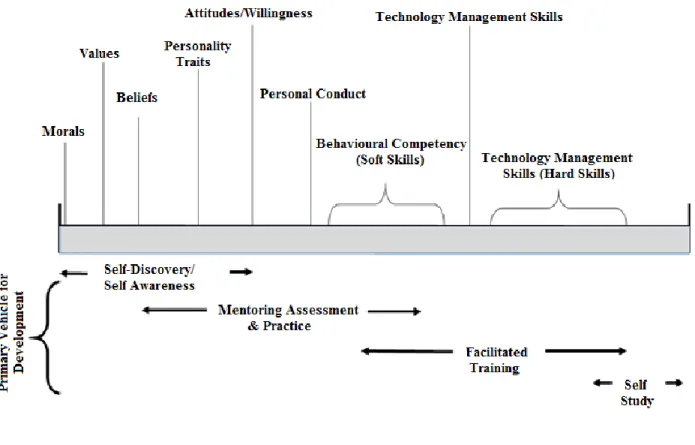
As depicted in Figure 2.3, Khapova and Jansen (2014) describes the competencies that one can develop and their primary vehicle for development. Things such as morals, values and beliefs are said to be developed through self-awareness and discovery. Personal conduct and soft skills are best taught through mentoring in practice. Technology management and hard skills are often best gained though facilitated training, and anything beyond this, moving into expert technical knowledge is achieved through self-study. It is clear from the figure that the vehicles for development can overlap in terms of competencies.
Figure 2.3: Continuum of Personal Attributes and Competencies Source: Adapted from (Khapova and Jansen, 2014:709)
24 The level of competency of an individual can be determined through the utilization of a competency model (Mayhew et al., 2014). A competency model can be defined as a set of proficiencies that collectively must be applied by an individual in order for them to be considered a success within their work capacity (Stevens, 2013). It is often utilised as a tool for human resource functions including performance management, training and development and recruitment (Coetzee et al., 2014).
Crawford (2013), developed a general competence model that may be idealistically applied to any work position or function. As detailed in Figure 2.4, Crawford’s model states overall competence is obtained through a combination of personal attributes and on the job performance. Personal attributes are broken down into input competencies, constituting personal knowledge and skills, and personal competencies which refers to one’s core personality traits. Demonstrable performance is considered an output competency, which is the ability to use the attribute based competencies to perform within an occupational area. Crawford’s integrated model for competency can be applied generally.
Figure 2.4: Integrated model of competence Source: Adapted from Crawford (2013:3)
25 A more detailed competency model can be developed specific to a role requirement of any organisation. Competency models can take a variety of forms but the premise upon which they are constructed is largely the same (Baran and Klos, 2014). The following elements are typical inclusions when developing a competency model for a specific role as described by Baran and Klos (2014):
Competency titles and comprehensive definitions.
E.g. Competency Title – Teamwork
Defined as: Working as a functional member of a group, good interpersonal skills to build strong relationships, taking decisions to the benefit of the group and able to mediate disagreements while working to maintain collaborative accord.
Descriptions of associated actions and behaviours for each competency title.
E.g. Teamwork
Behaviours: Recognising strengths and weaknesses of team members and utilizing this to your advantages. Motivating members within your team to contribute and perform.
Leading from the front to achieve group goals.
A diagram of the model.
E.g. Figure 2.5 below is an example of a diagram of the model.
A graphical representation of the model enables users and prospective employees to gain a better understanding of the requirements of the role.
26 Figure 2.5: Tiered diagram of the model
Source: Kirk et al. (2016:1)
A competency model can be developed for all job profiles in any industry. As detailed by Mirzazadeh et al. (2014), the following steps can be followed as a guideline on how to go about developing a role specific competency model:
Step 1. Gather background information
The building of role specific competency model needs to be based upon something. This requires a degree of research and analysis pertaining to current industry standards set by national and local bodies and authorities (Mirzazadeh et al., 2014). Investigating the technical curriculum and certifications required within the industry is also necessary. It is often prudent during this stage to consult with industry experts who are familiar with the demands of the field, and what skills and
27 knowledge is required of an employee in the industry (Baran and Klos, 2014). This initial step requires a lot of ground-work upfront, including the arrangement and classification of resources and the analysis of the research to identify similarities that can be outlined as a benchmark competency (Mirzazadeh et al., 2014).
Step 2. Develop a draft competency model framework
It is possible to draft a framework by building on the current industry models that have already been developed. This will ensure that there is a solid foundation to build upon and that the draft will be comprehensive going forward. This step can be achieved by identifying patterns from the existing industry models, grouping this to form themes, relating it to the role profile and competency titles and using this information to develop a draft competency model (Mayhew et al., 2014).
Step 3. Acquire subject matter expert review and comments
This can be done via individual contact or through focus group sessions encouraging engagement and the sharing of ideas. These individuals should be based on their experience in the field and their familiarity with the requirements of what it takes to succeed in the industry (Mirzazadeh et al., 2014). It can be beneficial to consult with a host of experts from various localities and professions within the industry in order to obtain a range of perspectives regarding the draft model.
This step can be achieved by first consolidating the purpose of the competency model with the experts. The model should then be reviewed by looking at each proposed competency individually and ensuring that the major competency themes have been addressed and that there are no missing competencies that should be included (Stevens, 2013). It should also check that all terminology used in the titles and definitions is unambiguous and that the requirements are clear.
Step 4. Refine the competency model framework
The development of a competency model is an iterative process (Adams et al., 2011). It requires review and amendment before refining and finalisation. The information gathered through Step 3
28 should be consolidated. Amendments to titles, definitions and behaviours can be made and additions or deletions to competencies can be completed. The process of Step 3 and Step 4 can be repeated until the subject matter experts and the developer is satisfied that the competency model is comprehensive and clear on what the requirements are in terms of skills, knowledge and proficiencies for that specific role or occupation (Mirzazadeh et al., 2014).
Step 5. Validate the competency model framework
The final step of validation is especially important in order to make sure it is fit for purpose and the model will achieve its intended outcome. It involves a sort of pilot study issued to potential users of the model to gather feedback and comments. Once the feedback has been consolidated and processed, consensus should be reached that the model is now complete and the competency model can subsequently be put to use.
Systems Thinking Definition
Systems thinking is the primary approach method used to gather data for the qualitative research of this study. The definition of systems thinking, concepts of systems thinking as well as the tools that can be utilised are all discussed to supplement and justify the choice of method adopted. This also includes a discussion on the concept of leverage, linked to the Iceberg Model and soft systems methodology.
To define systems thinking, it is necessary to first define the meaning of a system. Oickle et al.
(2014), defines a system as a collection of interdependent variables that are connected directly or indirectly, and that interact to form a complex and integrated whole that serves a definite purpose.
The requirement is then a minimum of two interrelated variables or components. Haines (2016), goes further stating the components of the system impacts the overall state and the value of the system. Ultimately systems have a purpose that holds the parts together. For example, an automobile is system which has a purpose to get you from one place to another.
29 A system is not necessarily equal to the sum of its parts. Rather, the properties of a system are essentially defined by the interactions which exist between the parts, and not the properties of the components themselves (Senge, 2014). The parts can, therefore, not assume the defining properties of the whole on their own. Systems thinking is being able to see beyond the individual parts and start looking at the system as a whole (Senge, 2014). Systems thinking is for this reason holistic thinking.
Shaked and Schechter (2013), state that systems thinking puts the system in the context of the larger environment of which it is a part and studies its role in the larger whole. Similarly, Caldwell (2012b), describes systems thinking as processes that are open to change through internal dynamics of self-regulation or interactive feedback with its environment. Taking a systems approach means that all parts of the system have to be addressed in concert, and acknowledging that adding one component to a system disturbs other parts of the system (Levin and Schrum, 2013).
This idea of holistic thinking is the fundamental principle of systems thinking, which is one of five disciplines of the ‘learning organisation’ theorized by Senge (Caldwell, 2012b). Systems theory, a discipline for seeing wholes, is the conceptual cornerstone of the learning organisation and integrates the other four disciplines (Caldwell, 2012b). Social systems involving people are almost always considered complex in nature. These systems usually comprise of purposive actors possessing a multiplicity of goals.
Systems Thinking Concepts
Systems thinking revolves around viewing situations as a whole. This is achieved by emphasizing the interrelationships among the components involved rather than the components themselves (Shaked and Schechter, 2013). “The whole takes a form that is unrecognizable from looking at its parts in isolation. These parts have meaning only as a result of the whole” (Shaked and Schechter, 2013:776). Systems thinking; a means for facing real world, richly interconnected problem situations, helps us to understanding complex situations (Flanagan et al., 2012).
30 Levy et al. (2014), claim that every systems approach is based on the view that every system in the universe is part of a hierarchy of systems. Levy et al. (2014), goes further in saying that every organism is part of systems and subsystems which act together to attain goals. All parts of the system have to be addressed in concert as adding or altering one component disturbs other parts of the system (Levin and Schrum, 2013). Levin and Schrum (2013), also state that a system is more than the sum of its component parts or practices and that these practices are more about interaction than action.
Neumann (2013), developed the concept of “Know Why” thinking, a systemic approach which he claims can be used to reflect on all kinds of complex situations. It is based on the idea that
“everything in the world needs to adapt and develop in order to be successful” (Neumann, 2013:81).
Most people shy away from trying to analyse complex situations. They tend to reuse old solutions that may have worked in the past but was in a different context (Graham et al., 2013).
Nguyen et al. (2012), claims that many people try to solve complex problems with simplistic arguments. This is seldom effective and never affects the system for a sustained period of time (Nguyen et al., 2012). Richardson (2016), states that if the same recipes always worked for a similar problem situation in any context, everything would always be successful. Neumann (2013), encourages one to ask the question, “Why are things the way they are?” And the answer put forward is that a system exists there for a reason; a reason to adapt and develop in order to be successful (Neumann, 2013:86).
Caldwell (2012a), discusses the concept of distributed leadership, which is a process of systems learning that could be shared by many people. He states that “Leadership of the many is far greater than leadership by the few” (Caldwell, 2012a:40). The idea put forward strongly in the article is that learning should be led by leaders throughout the system. Complex system issues cannot be met by isolated heroic leaders. It requires a mix of different people in different positons (Caldwell, 2012a).