The study will also make recommendations on how to address some of the issues that arise. The study also found that the majority of students involved in the study were operating at the visual and analysis levels of the Van Hiele levels of geometric thinking, while a few students were able to reason at the informal deduction level.
Rationale and motivation of the study
However, in my own teaching experience, I have noticed that learners dread geometry and prefer to spend most of their time on the algebra and statistics sections of mathematics. Therefore, there is a need to find out more about the specific areas of geometry that pose challenges to the learners and why these areas pose problems.
Focus of the study
The report recommended that learners should spend a lot of time solving geometry problems in order to improve their skills in this area. It is therefore important that teachers and researchers learn more about geometric concepts that current learners struggle with.
Outline of the study
The first chapter of this study provides an overview of the study, rationale and motivation for the study. Chapter six of this study will summarize the main findings of the study and discuss how the research questions of the study were answered.
Introduction
Mathematics Curriculum in South Africa
In the next section I will provide a definition of geometry before looking at some of the misconceptions commonly found in geometry.
Geometry
The first point gives the familiar definition of a square with its properties, and the second statement gives the characteristics of a window as one of the figures defined in the first statement. Some of the issues involving misconceptions and mistakes will be discussed in the next section.
Misconceptions and Errors
Misconceptions
In the modern sense, geometry includes any mathematical system developed from a set of statements called axioms or postulates. Teachers usually present evidence by presenting routine examples on the board or electronic equivalent while students simultaneously take notes while also trying to make sense of what the teacher is teaching.
Errors
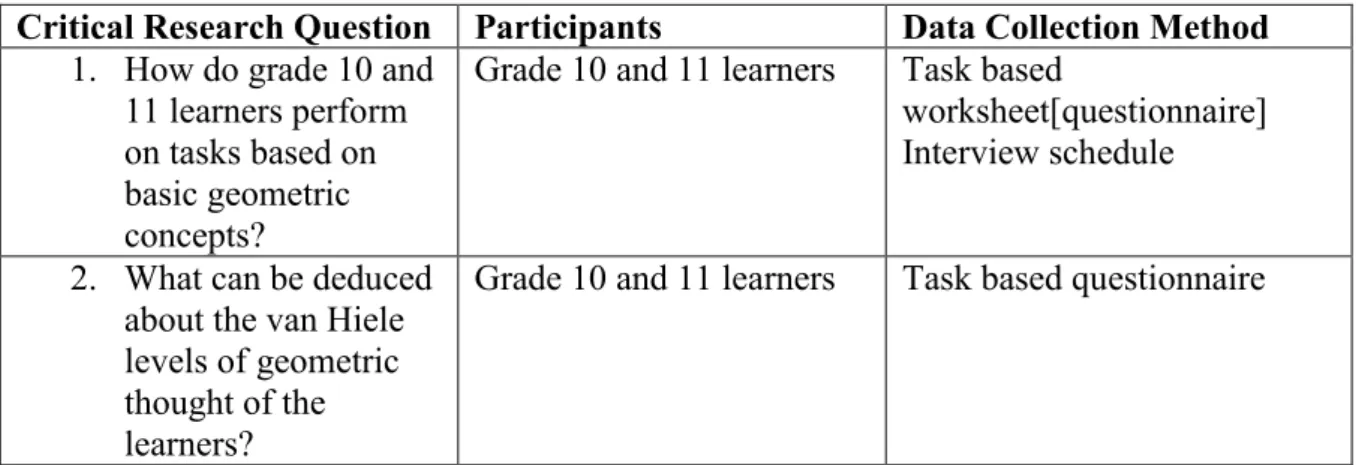
What can be concluded about students' van Hiele levels of geometric thought. This section will discuss the students' van Hiele levels as revealed by the analysis.
Some misconceptions and errors from other research studies
Conceptual Understanding and Procedural Fluency
Schneider and Stern (2010) defined conceptual knowledge as the link between information or knowledge within a particular domain and procedural. Faulkenberry (2003) considered conceptual knowledge as one that relates to the principles that refine the understanding of mathematics.
The duty of the teacher in developing understanding
Although the concept of conceptual understanding seems to have attracted the attention of most researchers in the field of mathematics education, some researchers have emphasized the role of procedural fluency in acquiring competence in mathematics. According to Eisenhart, Borko, Brown, Jones & Agard (1993), procedural knowledge allows teachers and students to justify their solutions to problems, but with little or no knowledge about why a particular method, operation, or formula is used to achieve the solution to find the problems. issues.
Introduction
Constructivism
Social Constructivism
In contrast to Piaget's view of child development, Vygotsky believed that social learning precedes development. Students should be given the opportunity to think about their correct and incorrect solutions.
Cognitive Constructivism: Piaget’s learning types
According to Vygotsky (1978), learning is a social interaction that plays an elementary role in the process of cognitive development. Vygotsky viewed development as dependent on social interaction and theorized that social learning leads to cognitive development, which he called the Zone of Proximal Development (ZPD).
Social constructivism and learning mathematics
Social constructivism and the study
The main ideas of social constructivism are described and furthermore the approaches of Piaget and Vygotsky in teaching mathematics are also explained in this chapter.
The van Hiele model of geometric thought
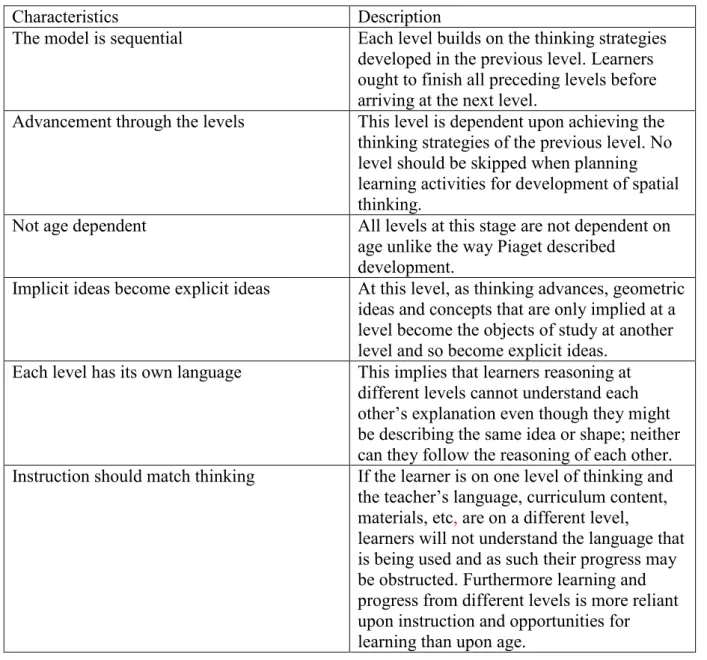
The next section now discusses the Van Hiele theory of geometric thinking as one of the theories underlying this study. Van Hiele's theory suggested that a possible cause for students' school geometry failure was that the curriculum was taught at a level higher than that of students' level of understanding.
Introduction
Research Paradigm
Research Design
Context of Study
Data collection Instruments and Procedures
Task-based worksheet (Questionnaire)
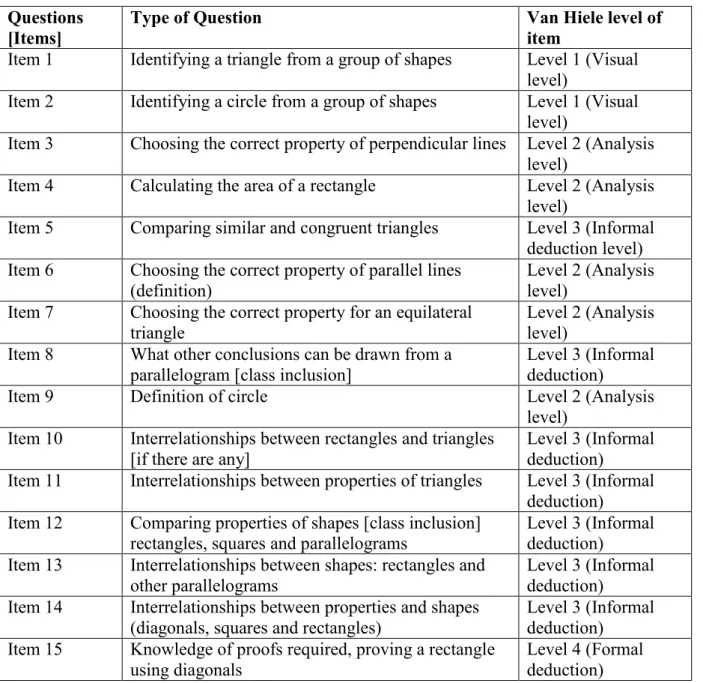
Question Paper A consists of multiple-choice questions that require knowledge of different aspects of geometry using the required reasoning at different van Hiele levels. Each item was analyzed according to the van Hiele levels to which it could be matched.
The semi-structured interview
The individual interviews were conducted on a one-to-one basis with only the participant and the interviewer. Individual interviews offer the participant the freedom to speak freely without fear of being ridiculed or judged by their peers.
Pilot Study
The results of the pilot study showed that the questionnaire was too long, consisting of 25 multiple-choice questions in questionnaire A and 12 questions in questionnaire B. The number of items in questionnaire A was reduced from 25 items to 15 items, while the number of items in questionnaire A was reduced from 25 items to 15 items. items in questionnaire B have been reduced from 12 to 6 items.
Data analysis procedure
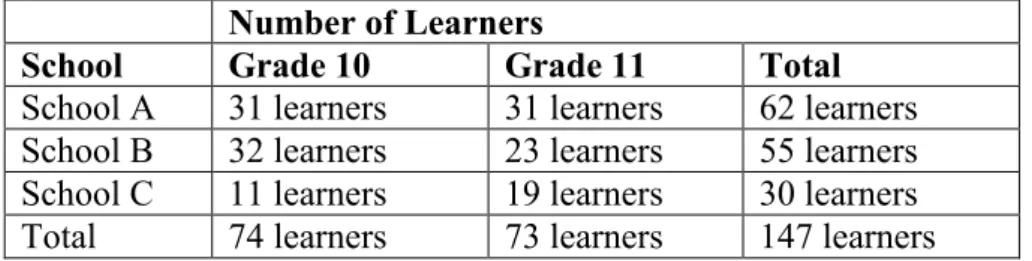
Twenty-three grade 10 students and nineteen grade 11 students were asked to complete the task-based worksheet. The majority of students could not finish the task as they complained that there are too many questions in both Questionnaire A and Questionnaire B.
Validity Issues
Ethical Issues
Limitations
Conclusion
Introduction
Results by item for Questionnaire A
- Item 1 and 2
- Item 3
- Item 4
- Item 5
- Item 6
- Item 7
- Item 7
- Item 8
- Item 9
- Item 10
- Item 11
- Item 12
- Item 13
- Item 14
- Item 15
- Performance in Questionnaire A according to van Hiele levels
- Classification of learners into van Hiele levels
- Comparisons of the van Hiele levels of learners between grade 10 and 11 learners…
- Comparison of learners’ performances in Questionnaire A
- Progression from one van Hiele level to the next
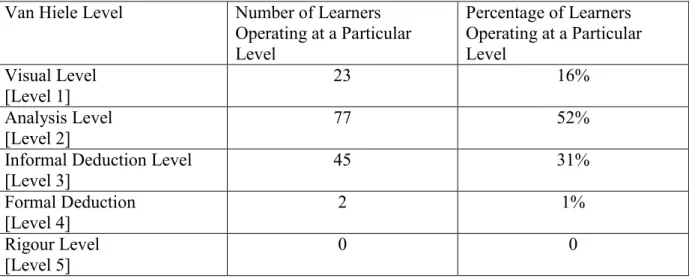
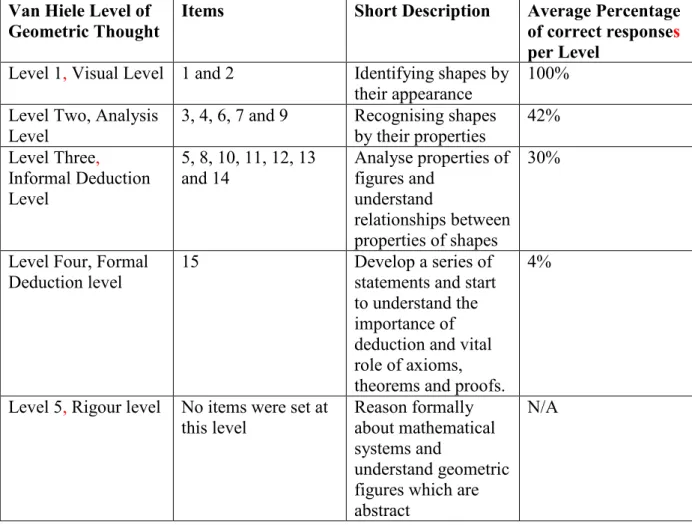
The table also shows that 31% of FET students operated at the informal deduction level of the van Hiele levels of geometric thinking. No questions were set at the difficulty level of van Hiele's levels of geometric thinking.
Results for Questionnaire B
Question 1 analysis
Comment Most of the learners responded correctly to this item which was set at the Analysis level of. Most of the learners involved in the study could identify two other angles that were equal to x and y.
Question 2 analysis
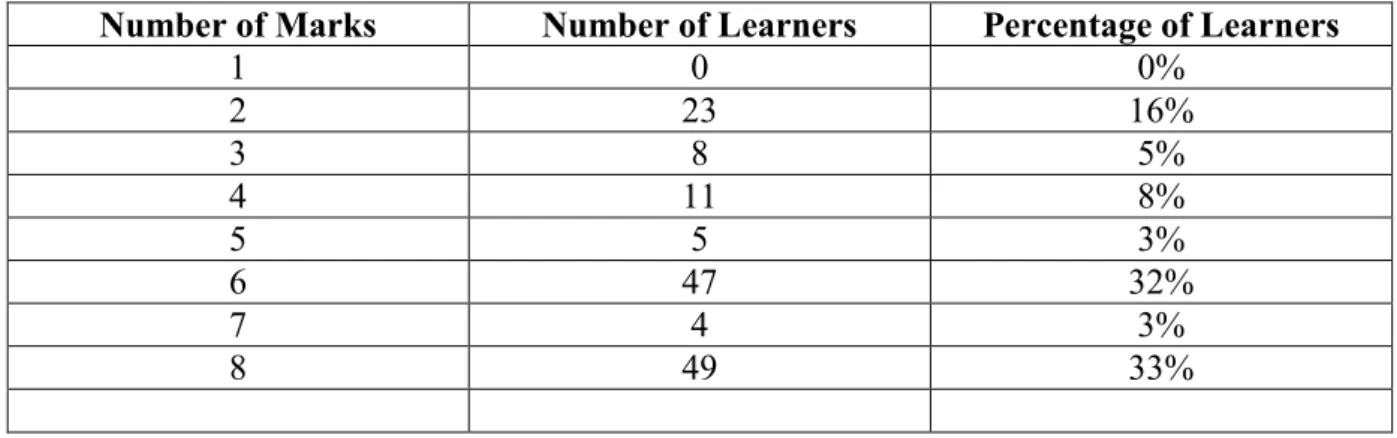
The results show that 68% of the students included in the study were able to score 6 or more points on the first question. There were 77 students who failed to score a point in question 2 and this corresponds to 52% of the students included in the study.
Question 3 analysis
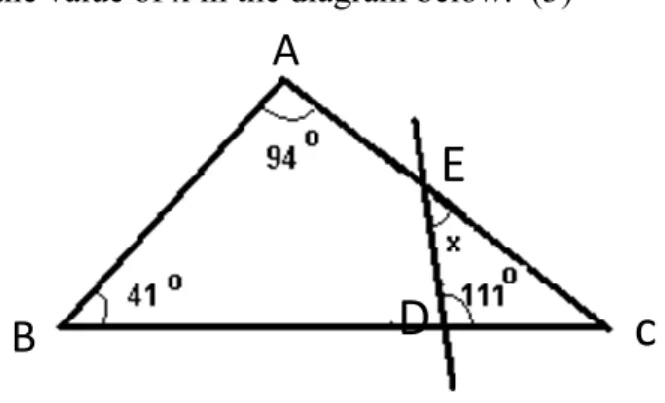
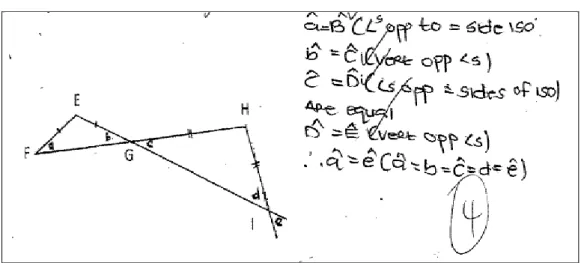
The question was asked at the level of informal deduction of Van Hiele's level of geometric thinking. Thus, this revealed that the student was working at the formal deduction level of van Hiele's levels of geometric thinking.
Analysis of question 4
Question 5 analysis
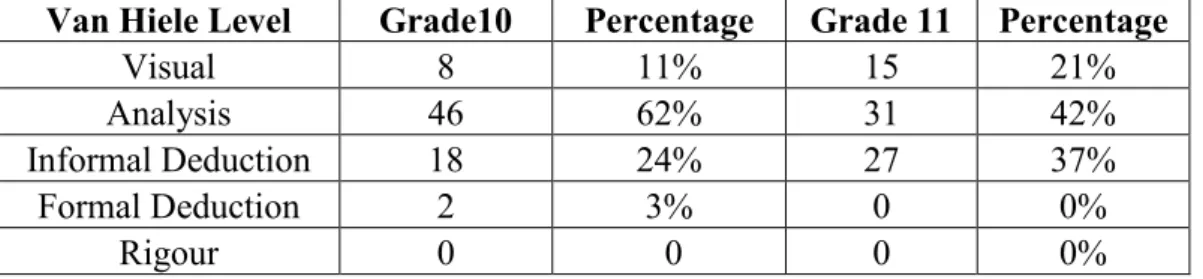
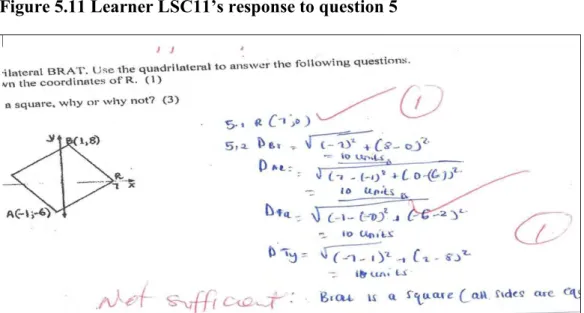
The table below shows a summary of the van Hiele levels of all 10th and 11th grade students. Thus, the analysis of the results in the previous chapter showed that most students worked at the level of analysis.
Analysis of question 6
Van Hiele levels for learners using Questionnaire B
Overall van Hiele levels for the FET learners
Conclusion
Introduction
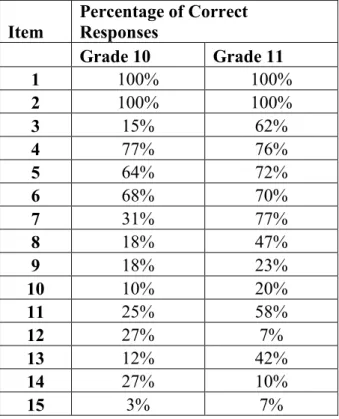
Some of the reasons why Van Hiele levels are important are discussed in the next section. In general, this shows that the grade 11 learners performed better than the grade 10 learners in terms of the van Hiele levels.
Answer to Research Question 1: How do FET learners perform on tasks based on basic
Results of Questionnaire A
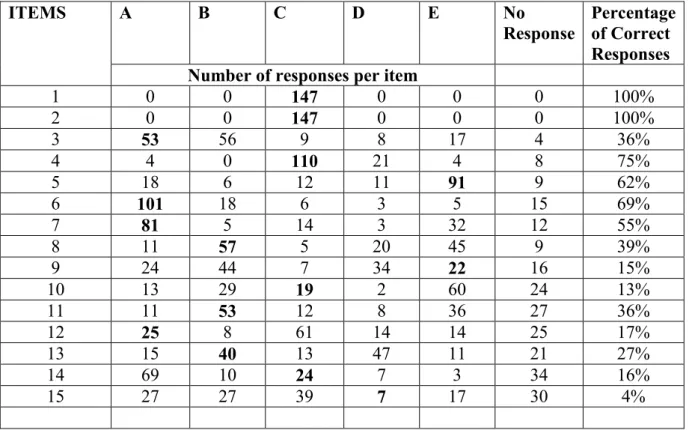
Items 4, 6, and 7 required knowledge of properties of shapes and definitions of various geometric shapes such as rectangles, parallel lines, and equilateral triangles. There were also a fair number of correct answers in item 5 of Questionnaire A, which required knowledge of comparable and congruent numbers (62% of correct answers).
Results of Questionnaire B
Similarly, Senk (1989) and Usiskin (1982) indicated that many high school students are at the visual or analysis level of the van Hiele levels. There was also evidence of a lack of logic and coherence in most of the students' responses.
Comparing performance for grade 10 and grade 11 learners
Answer to Research Question 2: What can be deduced about the van Hiele levels of
Van Hiele levels according to Questionnaire A and Questionnaire B
The table shows that the majority of students were operating at the first three van Hiele levels, with only 1% of students operating at the formal descent level. The study also found that students' ability to work with problems at van Hiele levels 3 and 4 is still a challenge as only a few were able to demonstrate competence at these levels.
Differences in van Hiele levels according to Questionnaire A and Questionnaire B
This shows that reasoning at a van Hiele level is not static but constantly evolving; so a learner may show some competence at one level, but still struggle with other aspects at the same level. It should be noted that the van Hiele levels are not there to make judgments, but are there to help diagnose barriers to progress that teachers need to address to their learners in order to improve.
Comparison between grade 11 and grade 10 learners according to the van Hiele
The authors attributed the differences in placement to the mathematical process involved, for example, some students did better when asked to draw shapes than when asked to identify shapes where orientation and shape changed.
Emergence of Pertinent Issues
Conceptual Issues Identified
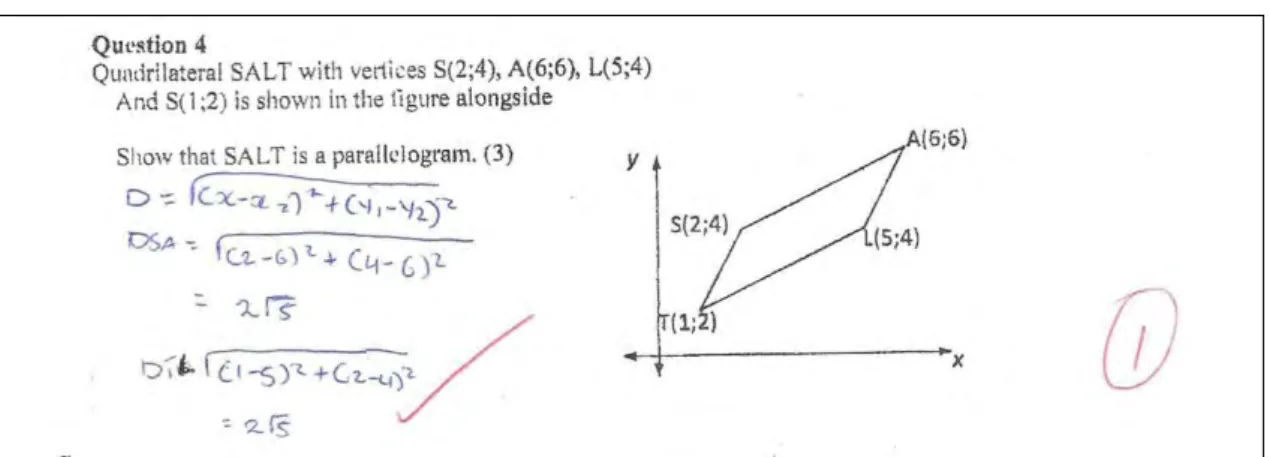
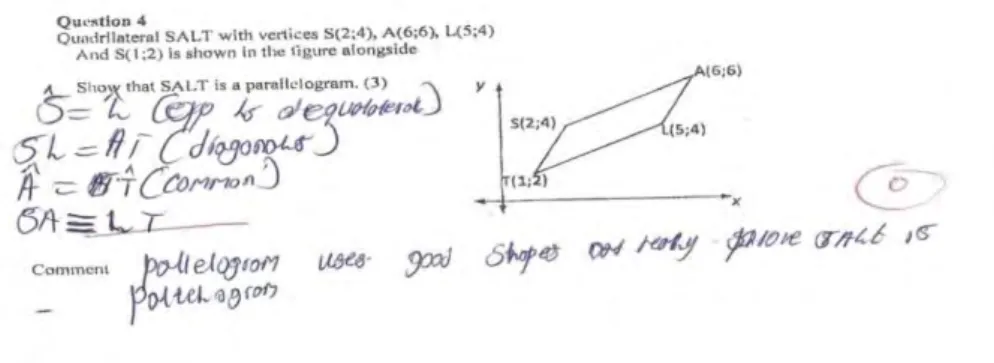
This answer shows that the student has confused facts about the properties of shapes and does not know the connection between the shapes, that is, he does not know the inclusion in the class. This was observed in the responses to Question 2 of Questionnaire B, as shown in the figure below.
Language Barriers
The purpose of this study is to explore students' understanding of geometry, and also to identify the van Hiele level at which FET students are operating and the causes of progression from one van Hiele level to another. The purpose of this study is to explore students' understanding of geometry, as well as to identify the van Hiele level at which FET students are operating and the causes of progression from one Van Hiele level to another.
Real Life Context Issues
The implications of the Van Hiele theory in teaching and learning of geometry
Recommendations of the study
An understanding of geometric terms will help students understand the requirements of the questions, which will make it easier for students to cope with the requirements of the question. Educators must allow students to work with a variety of registers of semiotic representation in geometry to increase conceptual understanding of geometric terms.
Limitations
Exposing students to experiences involving proof should help students perfect the art of answering proof-type questions.
Concluding Remarks
Classification of raw data into van Hiele levels from questionnaire B. Informed consent letter for Principals whose students are participating in the research project. I am a lecturer currently studying towards a Masters Degree in Education in the field of Mathematics Education at the University of KwaZulu Natal.
![Table 4.4: Van Hiele levels of questions in Questionnaire B Question [Item] Van Hiele level Explanation Question 1 Level 2](https://thumb-ap.123doks.com/thumbv2/pubpdfnet/10643042.0/37.892.98.768.146.526/table-hiele-levels-questions-questionnaire-question-explanation-question.webp)