1
learners when learning angles associated with parallel lines in geometry
Xoliswa Dlamini
(209504923)
In fulfillment of the requirement for the DEGREE OF MASTER OF EDUCATION
In the School of Education (Mathematics Education)
College of Humanities University of KwaZulu-Natal
Supervisor: Prof Jayaluxmi Naidoo
2021
2
This research study explored challenges experienced by Grade 8 learners when learning angles associated with parallel lines in geometry. This research study was conducted in a school situated in the city of Pietermaritzburg, KwaZulu-Natal, South Africa to understand factors that shape learner’s experiences towards learning angles associated with parallel lines in geometry. This research study was framed within the social constructivist theory which guided and examined the systematic explanation of the experiences of Grade 8 learners when learning angles associated with parallel lines in geometry, by following certain principles outlined by the social constructivist theory. This research study was situated within the interpretivist paradigm and focused on an explanatory qualitative case study to, explore learners’ experiences and get an in- depth understanding of the challenges they are experiencing when learning angles associated with parallel lines in geometry.
This research study used inductive data analysis and evaluation process to sort data generated from the 36 purposely selected Grade 8 learners. The process of data analysis and evaluation was done through the use of Curriculum Assessment Policy Statements (CAPS document), questionnaire, worksheet and the semi-structured interview schedule. The findings of this research study confirmed that there are challenges experienced by 8 learners when learning angles associated with parallel lines in geometry. It was recommended that this research study be conducted at a larger number of diverse schools across the country, to explore more challenges experienced by Grade 8 learners when learning angles associated with parallel lines in geometry.
3
The work described in this research study was conducted under the School Education at the University of KwaZulu-Natal from February 2018 to January 2021, through the supervision of Professor Jayaluxmi Naidoo. The original work presented by the author of this research study has not otherwise been submitted in any other form for any degree or diploma to any tertiary institution and where there was a use of the work of other scholars, it was duly acknowledged within the text.
Xoliswa Dlamini Date
--- Professor J. Naidoo
05 July 2021 Date ---
02 July 2021
4
I just want to thank God for loving me, it has been a very difficult journey. I lost my father
“TIDDO” who always pushed me to be the best of the best. After my father, we then lost our grandfather while we were still mourning and again, we lost our only uncle who was always there for us from day one when our father passed on. Just like everyone, I experienced lot of challenges in everywhere of my life including coming from my death bed due to Covid-19.
Through it all, God has never left me and was using everyone to push me and believing in me. This journey was driven by the book of Romans 8:28 from the Bible which reads: “And we know that God causes everything to work together for the good of those who love God and are called according to his purpose for them”. This book reminded me that everything that was happening and will still be happening, works together for my good. I would like to further extend words of gratitude to the following people for playing a very important role in this research study:
o My Supervisor Professor J. Naidoo who gave me unconditional proper professional support holistically. If it were not for her commitment and support in supervising me, I would have not completed this research study. Professor, developed a scholar in me and unlocked the potential within me.
o My Sister, Mbali Mlambo for everything you have done, words cannot express how grateful I am for your endless, unconditional love and support.
o My Family, thank you for always believing in me and understanding my absentia at times.
o My Church Family, thank you for all the prayers and declarations upon my life especially to Pastor S.E. Ndlovu and his loving wife Mrs. N. Ndlovu.
o My Daughter Asinothe, thank you for being my biggest supporter and for always understanding that mommy is studying.
o My Friends, thank you so much for always being there and patient for me.
o My Linpark Family (colleagues) thank you for encouraging me and providing necessary documents and ideas in writing this thesis.
o My Learners who gave up their time and participated in this research study and made it possible. Without you this was not going to be a success.
5
every day I write at least one sentence or read one article when I was not well. Thank you so much for believing in me.
6
ABSTRACT 2
DECLARATION 3
ACKNOWLEDGEMENT 4
CHAPTER 1 INTRODUCTION
1.1 Introduction 11
1.2 Background and the problem statement 11
1.3 Location of the study 12
1.4 Rationale for the study 12
1.5 Purpose of the study 14
1.6 Objectives of the study 15
1.7 Research questions 15
1.8 Research methods 16
1.9 Definition of the concepts used in this research study 18
1.10 Structure of the thesis 19
1.11 Conclusion 21
CHAPTER 2
LITERATURE REVIEW 22
2.1 Introduction 22
2.2 The learning of mathematics at the school level 23
2.3 Geometry within the grade 8 curriculum 26
2.4 Exploring learners’ misconceptions when learning geometry 28
2.5 The levels of geometric thinking 30
2.6 Learners’ perception of concepts in geometry 31
2.7 Language as a learning barrier when learning geometry in mathematics 32 2.8 Exploring the basic knowledge and skills in geometry 33 2.9 The use of visualisation to understand concepts in geometry 36
2.10 Conclusion 39
7
THEORETICAL FRAMEWORK 41
3.1 Introduction 41
3.2. Identification of the suitable theory-social constructivist theory 43 3.3.Exploring the social constructivist theory and the learning of angles associated with
parallel lines in mathematics 49
3.4. The guiding principles and concepts of the social constructivist theory 50 3.5. Conflicts and controversies regarding social constructivist theory from other
scholars 52
3.6. How the identified or chosen theory connected this research study? 53 3.7. The element of social constructivist theory in relation to learning in geometry 54
3.8. Conclusion 56
CHAPTER 4
RESEARCH METHODOLOGY 57
4.1. Introduction 57
4.2. Research design 57
4.3. Geographic location 64
4.4. Research sampling 64
4.5. Data collection 66
4.6. Research instruments 67
4.7. Data organisation 69
4.8. Data analysis 69
4.9. Ethical considerations 71
4.10. Validity (piloting of instruments) 73
4.11. Trustworthiness 74
4.12. Credibility 74
4.13. Dependability 75
4.14. Confirmability 75
4.15. Limitations 75
4.16. Conclusion 75
8
DATA PRESENTATION AND ANALYSIS 76
5.1. Introduction 76
5.2. Data presentation. 76
5.3. Analysis of data 84
5.4. Conclusion 93
CHAPTER 6
FINDINGS, DISCUSSIONS, CONCLUSION, LIMITATIONS AND
RECOMMENDATIONS 94
6.1. Introduction 94
6.2. Summary of main findings of research questions 95
6.3. Discussion of significance of the research findings 105
6.4. Limitations 107
6.5. Recommendations 108
6.6. Conclusion 110
REFERENCES 112
APPENDICES
A Permission to conduct research study to Principal 119
B Permission to conduct research study to Parent 122
C Permission to conduct research study to Learner 125
D Approval to conduct research 128
9
F Questionnaire 130
G Individual worksheet 133
H Group worksheet 135
I Interview schedule 138
J Interview transcripts 140
K Editor's Language and Editing Certificate 144
L Turnitin Certificate 145
LIST OF FIGURES
Figure 2.1 Hexagon shape 29
Figure 2.2 Corresponding, Co-interior and Alternate Angles 32
Figure 2.3 Parallel lines 35
Figure 2.4 Parallel lines 37
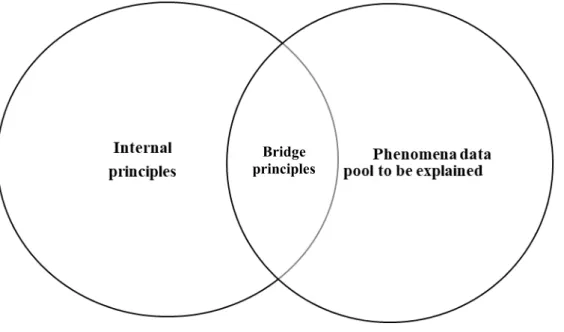
Figure 3.1 Schematic relationship between internal principle, bridge principles and
phenomena to be explained 40
Figure 3.2 Parallel lines 45
Figure 3.3 Geometry in real life situation 46
Figure 4.1 The 6 stages case study processes 60
Figure 5.1 The response of L20 to question 1.2a 88
Figure 5.2 The response of L4 to question 1.2a 89
Figure 6.1 Relating real life situation to geometric concepts 101 Figure 6.2 Grade 12 Mathematics 2020 test and examination scope/guidelines 105 Figure 6.3 Grade 12 Mathematics 2020 test and examination scope/guidelines 106
LIST OF TABLES
Table 1.1 Overall achievement rate in mathematics 12
Table 2.1 The gradual movement of geometry content from Grade 7 to Grade 9 27
Table 2.2 Levels of the van Hiele geometric thinking 30
Table 3.1 Gradual movement of geometry from Grade 7 to Grade 8 54 Table 4.1 Qualities and components of a case study research style 62
10
Table 4.3 Data evaluation process 69
Table 5.1 Summary of learners’ responses to the individual worksheet
question 1.2a 77
Table 5.2 Summary of learners’ responses to the individual worksheet
question 1.2b 78
Table 5.3 Summary of each group’s response to each group worksheet questions 79 Table 5.4 The percentage of question 2 group worksheet matching column 1 and 2
results 80
Table 5.5 Summary of learners’ response within each group 81 Table 5.6 Summary of each learners’ response within each group 82
11 INTRODUCTION
1.1 INTRODUCTION
This research study sought to explore challenges experienced by Grade 8 learners when learning angles associated with parallel lines in geometry. Furthermore, this research study was conducted to respond to the research questions that motivated carrying out this research study. This chapter aims to discuss the purpose, provides a full description of the background of this research study and the objectives of this research study. It further presents the problem statement, rationale and the definition of the necessary concepts of this research study. This chapter concludes with a summary of the overview of the thesis.
1.2 BACKGROUND AND THE PROBLEM STATEMENT
This research study was motivated by the continuous declaration of poor mathematics performance in South Africa and the label of being among the worst mathematics performance in the world (Jojo, 2019). According to Malatji (2019), the high failure rate attained by South Africa is of great concern as learners of South Africa are regarded to be incompetent in mathematics. This regard limits opportunities for learners to access and complete University and weakens the labour force of the country (Nogozo, 2019).
This research study then looked at one of the topics within mathematics that is leading to a high failure rate, which is geometry (Yudianto, 2018). This research study explored the challenges experienced by Grade 8 learners when learning angles associated with parallel lines in geometry because, learners experience so many challenges and have poor understanding of geometric concepts which leads to poor performance (Bot, 2018).
Furthermore, geometry is considered to be the most challenging and difficult concept in mathematics (Naidoo, 2020). According to the Further Education and Training Annual Teaching Plans, geometry contributes 66,6% of the mathematics examination paper 2. This acknowledged that learners can improve their overall mathematics performance if they have better meaning and understanding of their geometric concepts.
12
8 learners when learning angles associated with parallel lines in order to find solutions in understanding how and why learners are experiencing these challenges.
1.3 LOCATION OF THE STUDY
This research study was situated in one of the schools in the Umgungundlovu district situated in Pietermaritzburg, KwaZulu-Natal, South Africa.
1.4 RATIONALE FOR THE STUDY
The Report from the National Senior Certificate Diagnostic Report Part 1 of 2019 outlined that, there is a decline of performance in mathematics. This was noted when the achievement of the first two entry levels of passing mathematics which are Level 2 and Level 3 declined in the year 2019. This decline indicated that, there are challenges in learning of mathematics.
This is evident from Table 1.1 which shows the decline in comparison from previous years.
Table 1.1: Overall achievement rate in Mathematics adapted from the report on the National Senior Certificate Diagnosis Part 1 of 2019, Department of Basic Education (2019, p. 177)
YEAR No. Wrote No. Achieved at 30% & above
% Achieved at 30% & above
No. Achieved at 40% & above
% Achieved at 40% & above
2015 263 903 129 481 49,1 84 297 31,9
2016 265 912 136 011 51,1 89 119 33,5
2017 245 103 127 197 51,9 86 096 35,1
2018 233 858 135 638 58,0 86 874 37,1
2019 222 034 121 179 54,6 77 751 35,0
13
performance was 58% in 2018 and declined to 54, 6% in 2019. The pass percentage of 40%
achieved by learners also declined from 37, 1% in 2018 to 35% in 2019.
The National Diagnostic Report stated that, some of the reason behind the decline in learner performance in mathematic according to the Department of Basic Education (2019, p. 177) are:
1. A lack of understanding of basic concepts across some topics in the curriculum.
2. Learners are not exposed to the complex and problem solving questions across all topics from the curriculum of the earlier grades.
The report further outlined that in geometry, learners are experiencing the following challenges (Department of Basic Education 2019, p. 200-201):
1. There is less time allocated on the teaching of Euclidean geometry in all grades.
2. Teachers are not covering the basic work thoroughly.
3. Learners are not accompanying statements with reasons.
4. Learners are incorrectly writing or giving incomplete reasons or naming angles incorrectly.
5. Learner’s show poor understanding of angles associated with parallel lines where they fail to mention that corresponding angles are equal, alternate angles are equal and the sum of the co-interior angles is 1800.
6. Learners cannot differentiate between alternate and corresponding angles.
These findings were used as the basis to further study challenges experienced by Grade 8 learners when learning angles associated with parallel lines in geometry. When you study the national diagnostic report, it indicates that most of the challenges learners experience when writing their final National Senior Certificate examinations are as a result of the challenges that were not dealt with in the earlier grades (Department of Basic Education, 2019). Since this research study is exploring challenges experienced by learners when learning angles associated with parallel lines in geometry, it was important for the researcher to outline what is expected from the teacher and the learner during the process of teaching and learning. This research study is supported by Good and Lavigne (2017) when they stated that for a successful process of learning in a classroom situation, a teacher must be fully aware that in a
14 levels of capabilities in terms of learning abilities.
According to the Guidelines to diversity by Department of Basic Education (2011, p. 2), when teaching and learning is taking place:
There must be an understanding of diversity within the classroom.
There must be an understanding that people are unique in their own way.
There must be an observation that learners come from different socio-economic, language, cultural, religious, ethnic, racial, gender, sexual orientation, ability groups etc. All these learners come to school with different experiences and one purpose, to learn.
Curriculum differentiation delivery must be ensured in order to enable access to learning for all.
There must be a variation of approaches used for the delivery of content to accommodate all learners.
This is why this research study was framed within the social constructivist theory as supported by Piaget (1967) and Bruner (1996). Vygotsky (1978) also mentioned that there are three categories of problem solving abilities which emphasised the notion of the possibility of different kinds of learners that are found in the classroom situation. In order to understand how learners are learning angles associated with parallel lines in geometry and how they are experiencing challenges when learning angles associated with parallel lines in geometry, this research study was supported by the theory of social constructivist theory because one of the successful aspects of learning is through social interactions within the classroom and outside the classroom (Engelbrecht, 2015). A teacher is expected to be fully aware that every learner in a classroom context is unique and possesses his or her own level of capacity in terms of learning abilities (Good, 2017). This means that, there must be learner-teacher and learner to learner interaction in a classroom situation.
1.5 PURPOSE OF THE STUDY
The results found from this research study are expected to help all stakeholders to recognise the challenges experienced by Grade 8 learners when learning angles associated with parallel lines in geometry. The purpose of this research study is three fold. The first part is to explore
15
lines in geometry. The second part is to explore how Grade 8 learners experience challenges when learning angles associated with parallel lines in geometry. The third part is to understand the reasons resulting in Grade 8 learners experiencing challenges when learning angles associated with parallel lines in geometry.
In this research study the importance of prior knowledge, socio interactions, anxiety and attitude towards mathematics was included as an underlying factor that influences learners to experience challenges when learning angles associated with parallel lines in geometry.
This research study aspires to provide an in-depth insight into the experiences of Grade 8 learners and the challenges they experience when learning angles associated with parallel lines in geometry. Furthermore, this research study aims to respond to the challenges experienced by Grade 8 learners when learning angles associated with parallel lines in geometry.
1.6 OBJECTIVES OF THE STUDY The objectives of this research study are:
a) To explore challenges experienced by Grade 8 learners when learning angles associated with parallel lines in geometry.
b) To examine how Grade 8 learners experience challenges when learning angles associated with parallel lines in geometry.
c) To understand why Grade 8 learners experience challenges when learning angles associated with parallel lines in geometry.
1.7 RESEARCH QUESTIONS
Research questions addressed by this research study are twofold:
1. What challenges do Grade 8 learners experience when learning angles associated with parallel lines in geometry?
2. How and why do Grade 8 learners experience challenges when learning angles associated with parallel lines in geometry?
16
This research study intended to explore challenges experienced by Grade 8 learners when learning angles associated with parallel lines.
1.8.1. Research Paradigm
This research study was situated within the interpretivist paradigm in order to consider multiple viewpoints and experiences of different individuals from different social backgrounds (Paul Victor, 2016). This research study was framed within the ambits of the social constructivist theory in order to understand learner’s challenges through their social experiences and their social interactions(Bull, 2013).
1.8.2. Research Approach
A qualitative research approach was used in this research study because, the researcher wanted to understand the experiences of learners and uncover their reality during the process of teaching and learning (Chen, 2016). This qualitative research approach employed a case study methodology in order to generate data and used Yin’s (2009) 6 stages of the processes for a case study research methodology.
Research Sampling
This research study used a purposive sampling method so as not to generalise the findings to a wider population (Barratt, 2015). A reviewed research traditions table (Gentles, 2015) was used to guide the selection process for the sampling.
Data Collection
Data collected in this research study was qualitative in nature and was collected from learners’ experience through 4 data collection instruments.
Curriculum Assessment Policy Statement Document (CAPS Document)
The curriculum Assessment Policy Statement document was used to check what learners need to know for the current grade, their existing knowledge and what is expected to be covered for the gradual movement as they learn about the angles associated with parallel lines in geometry.
17
A Questionnaire was used to obtain the profile of learners and information concerning their prior knowledge (see appendix F).
Worksheets
All participants were assessed in order to ascertain their level of understanding of angles associated with parallel lines in geometry. These worksheets were used to identify the challenges learners were experiencing when learning angles associated with parallel lines in geometry individually and amongst other learners in a form of group work (see appendix G &
H).
Semi-structured interview
A semi- structured interview was used in order to attain a flexible two way communication between the researcher and the participant (Pathak, 2016) (see appendix I). Participants were given an opportunity to explain their responses, experiences and perceptions freely.
Interviews were recorded by the use of a voice recorder and all participants provided permission to be recorded (see appendix C).
Data Analysis
An inductive data analysis process was used in this research study through the guiding procedures of a data evaluation process table method as outlined by Naidoo (2018).
Ethical Consideration
Ethical Consideration is briefly discussed in Chapter 4 and the following were outlined:
Gate keeper’s permission was granted (see appendix D).
Approval from the University of KwaZulu-Natal to conduct this research study was obtained and a protocol reference number was given (see appendix E).
Informed consent was provided to both learners and parents/guardians (see appendix B
& C).
18 through the use of pseudonyms.
Right to withdraw without fear of academic exclusion was explained to the participants.
Assessing risk of harm was implemented to ensure non-maleficence.
Deception in this research study was avoided.
Debriefing was done prior to the implementation of the study and throughout the research study.
Worksheet and Interview questions were piloted.
Honesty and Integrity in this research study were maintained.
1.9 DEFINITION OF THE CONCEPTS USED IN THIS RESEARCH STUDY In this study, there was use of various terms that could have different contextual meanings, or could be written differently. For these reasons, the researcher provided explanation of the meanings of these terms within the context of this research study.
Geometry
According to Naidoo and Kapofu (2020, p. 2), geometry involves learning about the geometric properties (points, lines, planes, angles, different shapes and dimensions) of a figure that do not change when the figure is revolved or transformed.
Learning in mathematics
This research study was framed within the ambits of the social constructivist’s theory which defines learning as the process of mental construction whereby learners construct their new knowledge, meaning and understanding onto an existing constructed knowledge, meaning and understanding (Bozkurt, 2017). Learning mathematics is a process where learners are placed in a problem solving situation to solve and create solutions that are not immediately obvious to deepen their own meaning and understanding (Permatasari, 2016).
19
This research study aimed to explore the level of learners’ geometric thinking based on van Hiele’s theory. The van Hiele’s theory of the levels of geometric thinking suggest that learners experience geometric learning progress through numerous levels (Recognition/
Visualisation, Analysis, Abstraction, Deduction and Rigor) of geometric thinking in order to understand why many learners experience challenges in geometry.
Basic knowledge and skills
Geometry equips learners with certain abilities of knowledge and basic skills that play an important role in mathematics’ learning and performance (Hawes, 2019). This basic knowledge and skills involves critical thinking skills and problem solving skills which are an essential part of learning geometry in mathematics.
Misconceptions
Ay (2017), defines misconceptions as a kind of misunderstanding and misinterpretation which is derived from inaccurate meanings. Misconceptions can emerge from any incorrect existing knowledge to newly introduced knowledge, hence it is important to assess leaners’
prior knowledge before introducing new concepts.
Language Barrier
In this research study the language barrier is the inability to understand the language used by the teacher which causes learners to experience confusion and misconceptions when learning (Cheok, 2017). In most cases, the language used in a classroom situation is not the learners’
mother tongue language but is according to the stipulations by the Department of Education.
This is an additional factor that could lead to the language of instruction being a barrier to successful teaching and learning.
Visualisation
According to Thohirudin, Maryati and Dwirahayu (2017), visualisation gives learners opportunities to observe different transformations of diagrams and enhance their geometric abilities. Learning of geometric concepts must incorporate technology (Sfiso, 2017) which
20
what is learnt on their own abilities (Thohirudin, 2017).
1.10 STRUCTURE OF THE THESIS
This research study is organised according to the following 6 chapters:
Chapter 1 – Introduction: Chapter 1 introduces the reader to the background of this research study and highlights the significance of understanding Grade 8 learners’ challenges when learning angles associated with parallel lines in geometry.
This chapter also presents the significance of learners deriving knowledge and understanding on their own through social interactions. The rationale for conducting this study, the purpose, specific objectives, research questions and relevant definitions for this study are outlined in this chapter.
Chapter 2 – Literature Review: Chapter 2 presents writings that address challenges learners’ experienced and explores the necessary skills and strategies for learning angles associated with parallel lines in geometry. The literature associated with the history of geometry and its concepts is also presented in this chapter. This research study also focused on the learning of mathematics, the geometry curriculum for Grade 8 learners and angles associated with parallel lines in geometry and the importance of the gradual movement, levels of geometric thinking, basic knowledge and skills, misconceptions, language barriers and the importance of visualisation when learning angles associated with parallel lines in geometry.
Chapter 3 –Theoretical Framework: This chapter looked at the theory that was related to the exploration of the challenges experienced by Grade 8 learners when learning angles associated with parallel lines in geometry. The social constructivist theory was discussed in detail which included how this framework framed this research study.
Chapter 4 –Research Methodology: This chapter presented in detail the empirical processes for this research study. The selected research methodology for this research study was
21
collection instruments, data processing, data analysis procedures, ethical considerations and issues of validity and trustworthiness. In addition, the limitations of this study are also included in this chapter.
Chapter 5 –Data presentation, analysis and discussion of the findings: This chapter introduces raw data collected and analysed data by the use of tables, the reviewed literature and the selected framework for this research study.
Chapter 6 – Findings, discussions, conclusion, limitations and recommendations: This chapter summarises the purpose of this research study, methodology used for this research study and presents the summary of the main findings which respond to the research questions. A discussion of significant research findings, limitations, recommendations and the conclusion is included in this chapter.
1.11 CONCLUSION
In this chapter, introduction, background and the problem statement of this research study is presented. Furthermore, this chapter outline the location of the study, rationale, purpose, objectives, research questions, research methods, definitions of the concepts used that guided this research study. In addition, this chapter briefly highlighted the structure of this thesis.
The next chapter focusses on the literature review that guided this research study.
22 LITERATURE REVIEW
2.1 INTRODUCTION
In Chapter 1, the researcher presented the purpose of the study, provided a full description of the background of the study and the objectives of the study. Furthermore, Chapter 1 presented the problem statement, rationale, definition necessary concepts of this research study and concluded with a summary of the overview of the thesis. Chapter 2 seeks to present the review of the literature done by other scholars on learners’ challenges in the learning of angles associated with parallel lines in geometry. South Africa has been labelled as one of the countries that has the worst education system in comparison with other developing countries, particularly in Africa (Cloete, 2016).
The Department of Basic Education has been revising and implementing policies to improve the education system in South Africa. In 2005, the National Curriculum Statement was revised and implemented in order to improve the education system in South Africa (Spaull, 2015). In 2012, Curriculum Assessment Policy Statements (CAPS) was implemented subsequent to the Annual National Assessments (ANA) which was implemented in 2011 to standardise assessments in schools (Kallaway, 2012). In addition to all these implementations and revisions of policies, South Africa has been also participating in various international tests such as the Trends in International Mathematics and Sciences Study (TIMSS) (Moodley, 2013). According to researchers in the field ( Alex, 2017; Moodley 2013; Spaull, 2013), the findings from the Annual National Assessments (ANA) and the Trends in International Mathematics and Sciences Study (TIMSS) indicated that South Africa has the lowest performance in both Mathematics and Science and thus reveals that South African learners are not competent with respect to the level of testing.
It is for these above-mentioned reasons that the conducting of this research study was to discover the challenges that learners experience when learning mathematics specifically angles associated with parallel lines in geometry. The focus of this study is on the challenges learners experience when learning angles associated with parallel lines in geometry.
23
There are numerous research studies done on geometry focusing on different content to improve teaching and learning of geometry (Bokosmaty, Sweller & Kalyuga, 2015; Casa, Fermender, Gavin & Carroll 2017; In’am & Hajar, 2017; Moss, Hawes, Naqvi & Caswell 2015; Mulligan, 2015; Sinclair & Bruce, 2015).
Other studies have focused on mathematics where researchers focus on the language of learning mathematics (O’Halloran, 2015), teaching and learning mathematics (Bryant, 2016, Furner, 2017, & Goos, Vale, & Stillman, 2017), improving the pass rate in mathematics (Bakri, 2017).
However, limited studies have been done around the challenges Grade 8 learners experience when learning angles associated with parallel lines in geometry. Hence, this research study closes the gap by engaging in critical arguments by other scholars in relation to the literature on learning of mathematics at school level, geometry within the Grade 8 curriculum, learners’
misconceptions on geometry, the levels of geometric thinking, learners’ perception of concepts in geometry, language as a learning barrier when learning geometry in mathematics, exploring basic knowledge and skills in geometry and visualisation used to promote the understanding of concepts in geometry.
2.2 THE LEARNING OF MATHEMATICS AT THE SCHOOL LEVEL
According to Qvortrup, Wiberg, Christensen and Hansbol (2016), a learner is someone who can learn individually and from others in different ways in order to acquire knowledge and understanding of certain things and the world at large. In addition, learning involves transformation of knowledge, beliefs and how one sees things in order to behave differently than before (Kalule, 2016). Furthermore, learning depends on the knowledge learners possess with the help of a more knowledgeable other teacher or any other (Τσώνη, 2020).
The effectiveness of learning can be achieved when learners integrate their prior knowledge and experiences to new experiences including the concepts and ideas into the existing knowledge (Fiorella, 2016).
The teacher is expected to be fully aware that every learner in a classroom context is unique and possesses his or her own level of capacity in terms of learning abilities (Good, 2017).
This means that there must be learner-teacher interaction.
24
The absence of such classroom interaction results in a teaching and learning environment that does not support learner-centeredness, as recommended in schools by the Department of Education (Engelbrecht, 2015).
Numerous theorists theorised the learning of mathematics in mathematics education. It is significant to recognise mathematics learning discovered by such theorists in this research study since they encompass aspects to be known and understood about mathematics learning.
In Vygotsky’s (1978) discovery of mathematics learning, thinking and problem-solving ability fall into three categories. Firstly, there are learners who can handle problem-solving independently; secondly, those that handle with assistance and lastly, those who cannot handle even with assistance (Vygotsky, 1978). This possibly means that mathematics classrooms could belong into any of these categories since learners respond differently to tests or examinations assigned to them. A second aspect Vygotsky (1978) explained is the Zone of Proximal Development (ZPD) whereby the term ‘zone’ refers to the area of exploration for which the student is cognitively prepared but requires help and social interaction to fully develop (Vygotsky, 1978). A more experienced peer (Vygotsky, 1978) is able scaffold for support in understanding of knowledge. The collaborative learning and the scaffolding strategy is supporting intellectual knowledge and skills of learners (Vygotsky, 1978).
Considering that this research study focuses on the challenges experienced by learners when learning angles associated with parallel lines in geometry and how and why Grade 8 mathematics learners learn angles associated with parallel lines in geometry, some learners require social interaction with peers to gain more insight of aspects being learnt. Similarly, (Bin-Tahir, 2020) mentioned that, learners need to verbally interact with others on learning tasks, exchange opinions, explain concepts, teach others and present their own understanding and meaning. The theory by Bruner insisted on the significance of a child’s environment, the social environment in particular. This aspect is very important in teaching and learning of geometry in mathematics.
According to Bruner (1960) what is learnt earlier must clearly provide a general picture of what is learnt in the later stage. This provides the distinction between Bruner and Vygotsky’s theory. Important areas of teaching and learning should not be compromised nor be postponed (Bruner, 1960).
25
Furthermore, any content can be taught effectively to any learner at any stage of development. This attests to Bruner’s (1960, p. 13) idea of the spiral curriculum which states;
“A curriculum as it develops, should revisit the basic ideas repeatedly, building upon them until the learner has grasped the formal apparatus that goes with them”. The significance of Bruner’s theory of spiral curriculum in this study is that algebraic skills learnt in previous grades must be revisited to understand functions. In other words, when Grade 7 mathematics learners learn geometry, they should always consider concepts in geometry learnt in Grade 7.
The same aspects of learning are to be applied in the process of learning mathematics, which also requires that learners understand and integrate what they already know with new knowledge (Pennbrant, 2017).
There are countless theorists that have theorised about the process of learning in mathematics especially when learners are actively engaged (Freeman et al., 2014; Othman, Shahrill, Mundia, Tan, & Huda, 2016; Siemens, 2014; Fraser, 2015). These theorists propose that learning mathematics requires learners to acquire skills and abilities that can be applied academically and in any area of their everyday lives. This was also emphasised by Aizikovitsh-Udi and Cheng (2015) when they demonstrated that these skills and abilities can be used in analysing, understanding, identifying applicable mathematical concepts and procedures, reasoning, generating solutions and expressing mathematical results properly.
The South African Curriculum Assessment Policy and Statement (CAPS) Department of Basic Education (2011) outlined that, it is important that a learner develop these skills in order to be competent and be able to make sound judgement when solving problems. The CAPS document recommends developing these skills if learners are to be able to apply them to physical, social and mathematical problems.
I have realised and concluded that, in most schools in South Africa mathematics has been wrongfully labelled as a difficult subject. In my teaching experience, I have witnessed learners coming to my class fearing and hating mathematics. Larkin and Jorgensen (2016) concluded that it is not an easy thing to get positive feelings and attitudes of learners towards mathematics. If learners have mathematics anxiety it is likely for them to encounter problems and difficulties when learning mathematics (Vitasari, 2010).
Hence Vitasari (2010) concluded that in most cases in a classroom situation, the learners who fear mathematics will always be in the list of learners who do not complete their given tasks.
26
(Ismajli, 2018) suggested that in one classroom, learners are not at the same level of development. This means that teachers must play a role of motivating learners by unlocking the potential within them to be able to learn independently with meaning and understanding.
This is also supported by Huang and Hew (2016, p. 759) who demonstrated that learning behaviour is stimulated and can be sustained by a motivation. It is of paramount importance to discover the ability each learner has including the fears and stigma he or she has to support their learning (Rahman, 2016).
2.3 GEOMETRY WITHIN THE GRADE 8 CURRICULUM
The South African Curriculum and Assessment Policy Statement (CAPS) document Department of Basic Education (2011) emphasised that, during the process of learning there must be critical and active learning. It further states that, there must be an encouragement of an active and critical approach to learning rather than rote and uncritical learning of given truth (Department of Basic Education, 2011b).
The Curriculum and Assessment Policy Statement (CAPS) document emphasises that when the process of teaching and learning is taking place, traditional teaching and learning must not be practised (Department of Basic Education, 2011b). It further encourages learners to be responsible for constructing their own knowledge, meaning and understanding. This can be achieved when there is an implementation of interactive approaches and when learners are actively involved.
Mathematics is moving gradually from a grade to a grade, which is also supported by Miyazaki, Nagata, Fujita, Ichikawa, Shimizu and Iwanaga (2016) when they stated that within the geometry curriculum there must be a corresponding progression from the junior level to the senior level. In South Africa, geometry is learnt from the foundation phase until the senior phase (Department of Basic Education, 2011c). According to the Curriculum and Assessment Policy Statement (CAPS) document of the General Education and Training (GET), there are three concepts that are covered under the topic of Space and Shapes in mathematics namely construction of Geometric Figures, Geometry of 2-D shapes and Geometry of Straight Lines (Department of Basic Education, 2011a). In the construction of geometric figures learners are expected to construct objects using all mathematics construction sets like compass, ruler and protractor in order to construct angles (300, 450 and 600).
27
In the geometry of 2-D shapes, learners are required to identify and distinguish between 2-D shapes and to work with the similarities and congruency of 2-D shapes (Department of Basic Education, 2011a). In the geometry of straight lines, learners are required to know the relationships within pairs of angles and parallel lines. In this section, Grade 8 geometry will be discussed in relation to angles associated with parallel lines according to the Curriculum and Assessment Policy Statement (CAPS) document.
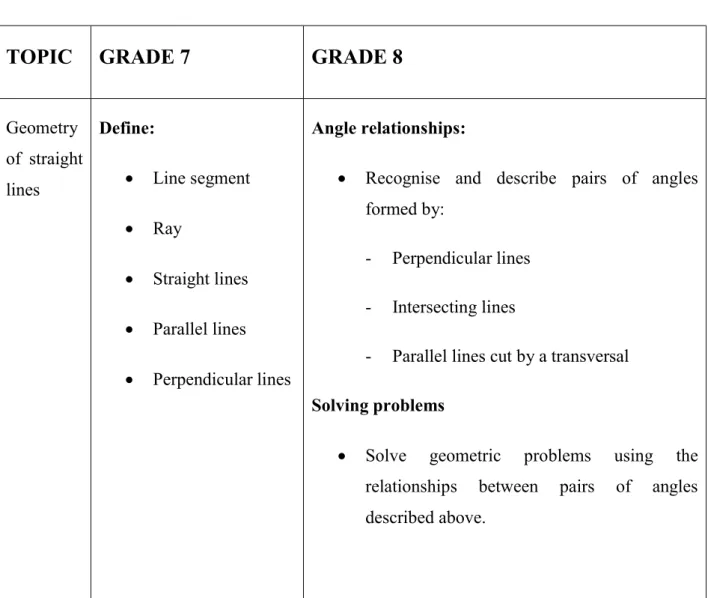
Table 2.1 exhibits the gradual movement of the geometry content from Grade 7 to Grade 9 in the General Education and Training (GET) phase, as outlined in the Curriculum Assessment Policy and Statement (CAPS) document (Department of Basic Education, 2011a). The gradual movement of the content in geometry is what helps the teacher to obtain the prior knowledge of the learners.
Table 2.1:The gradual movement of geometry content from Grade 7 to 9 adapted from the Mathematics Curriculum Assessment Policy and Statement (CAPS) Department of Basic Education (2011, p. 28)
TOPIC GRADE 7 GRADE 8 GRADE 9
Geometry of straight lines
Define:
Line segment
Ray
Straight lines
Parallel lines
Perpendicular lines 2
Angle relationships:
Recognise and describe pairs of angles formed by:
- Perpendicular lines
- Intersecting lines
- Parallel lines
cut by a
transversal
Angle relationships:
Revise and write clear descriptions of the relationship between angles formed by:
- Perpendicular lines
- Intersecting lines
- Parallel lines
cut by a
28
Solving problems
Solve geometric problems using the relationships between pairs of angles described above.
transversal Solving problems
Solve geometric problems using the relationships between pairs of angles described above.
When geometry in relation to angles associated with parallel lines is being introduced to Grade 8 learners, teachers must take into consideration that learners’ prior knowledge from Grade 7 does exist. Learners must know and fully understand the significance and methodology of the three main rules (Fujita, 2014). According to Tindall- Ford, Agostinho, Bokosmaty, Paas and Chandler (2015, p. 94-94), learners are expected to be able to identify the positions of the angles and solve problems involving the three main rules which state that:
1. Corresponding angles are always equal.
2. Angles on a straight line and co-interior angles add up to 1800. 3. Alternate angles are equal.
This is also evident in the Curriculum Assessment Policy and Statement (CAPS) document Department of Basic Education (2011, p. 98) whereby there are clear guidelines on the content coverage.
2.4 EXPLORING LEARNERS’ MISCONCEPTIONS WHEN LEARNING GEOMETRY
Learners in all grades have misconceptions when learning various concepts in mathematics.
They have tendencies of deriving their own notion of certain mathematical concepts when learning mathematics (Ojose, 2015b). I support Ojose’s (2015b) argument when he alluded to the fact that a teacher needs to have the necessary skills and knowledge to detect misconceptions in mathematics. The reason behind my view is that once a teacher has
29
assumptions that the learners are on par with him or her, learners may fail assessments due to their misconceptions.
A gradual process that occurs when learners integrate new knowledge into their own existing knowledge is called a conceptual change (Durkin, 2015). For example, when you ask Grade 8 learners what shape is depicted by Figure 2.1:
Figure 2.1: Hexagon shape adapted from NCS Classroom Mathematics Grade 10 learner book, p. 63
The normal response from many learners will be that, the shape is a diamond instead of hexagon because according to their existing knowledge that shape is a diamond shape.
Durkin and Rittle-Johnson (2015) emphasise that, recognising learners’ prior knowledge assists in diagnosing misconceptions.
Geometry is regarded as one of the basic elements of mathematics that learners must understand and master. Geometric concepts go beyond the development of skills required to manipulate geometric shapes and angles (Luneta, 2015) and Poon and Leung (2016) discovered that teachers are unaware of their learners’ difficulties in learning geometry.
Teachers are unable to identify learners’ missing knowledge with respect to angles in parallel lines (Zuya, 2015). Hence it is of importance for teachers to be life- long learners of their subjects and its content in order to identify the types of misconceptions. Learners’
misconceptions of geometry may be categorised into 5 categories according to Poon and Leung (2016, p. 3) namely;
1. An inability to understand the real- world applications of geometric concepts.
2. Errors in using basic geometric concepts to solve complex problems.
3. An inability to recognise different forms of the same geometric concepts (symbolic, visual, etc.).
30
4. A lack of concrete understanding of the geometric concepts underlying particular models.
5. An inability to recall major geometric principles when using nested geometric concepts.
This is also supported by Hock (2015) who encourages the application of the van Hiele levels of geometry thinking, Hock (2015) believes that when using the van Hiele theory when teaching geometry, it will be easy to identify misconceptions by following the levels of geometric thinking.
2.5. THE LEVELS OF GEOMETRIC THINKING
One of the challenges that learners experience when learning geometry is when the instructions are at higher level than the level of the learner (George, 2017). There is a need for understanding the geometric thinking level of learners to understand where and how challenges are occurring. There are 5 levels of Geometric Thinking and each level tells you what kind of instructions learners can understand (Van Hiele, 1999). In a classroom situation there is a diversity of learners with dissimilarity degrees of academic ability and level of geometric thinking (Donohue, 2015).
It is therefore important to study the geometry curriculum in line with each geometric concept within the van Hiele geometric levels of thinking.
Table 2.2: Levels of the van Hiele Geometric Thinking adapted from Ma, Lee and Wu (2015, p. 3)
LEVEL GEOMETRIC THINKING
1. Visualisation- Learners must be able to identify any geometric figure by its appearance, the learners can recognise any form of shape. For example the learner can identify a square from a rectangle, horizontal line from the vertical line, etc.
based on its appearance.
2. Analysis At this level the learners must be able to examine things
31
in full detail to discover meaning and understanding.
They must identify geometric figures using their properties. For example, the learner may know that this kind of shape is a rectangle by looking at the two opposite sides shown that they are equal and the diagonals are equal or the shape has four right angles.
3. Abstraction At this level learners recognise relationships between geometric figures and are able to reason or perceive the relationships between properties and different geometric figures. This can only be obtained if learners are able to filter concepts from the main content by only deriving aspects.
4. Deduction At this level learners begin to understand and write proofs by themselves.
5. Rigor At this level learners can reason formally about mathematical systems without experiencing any difficulties.
These above-mentioned levels of geometric thinking are important in each geometry lesson.
According to Alex and Mammen (2016, p. 4), the levels of geometric thinking were created to develop a solid geometric understanding. It is vital for learners to pass through the 5 levels without skipping any level (Hock, 2015). The other critical facet that needs to be considered is making sure that, learners are taught at their level to avoid frustrations (George, 2017).
2.6. LEARNERS’ PERCEPTION OF CONCEPTS IN GEOMETRY
Learner’s perception of concepts in geometry depends on the learners’ ability to construct geometrical conceptual understanding (Sutiarso, 2018). In order for the learner to be able to construct understanding, he or she must discover what is learnt through the existing knowledge. In this way, it will be easy for the learners to remember and know the concepts
32
(Linn, 1987). Learners may show understanding while the teacher is teaching and respond correctly when asked questions based on the learnt questions but, this does not mean the learners have gained knowledge and understanding.
The findings of Jojo (2016) indicated that learners can respond to questions based on a word or diagram that they associated with a particular concept but still fail given assessment.
Learners first need to understand the basic concepts in geometry and when they lack the basic conceptual knowledge they hardly respond to assessment questions (Luneta, 2015).
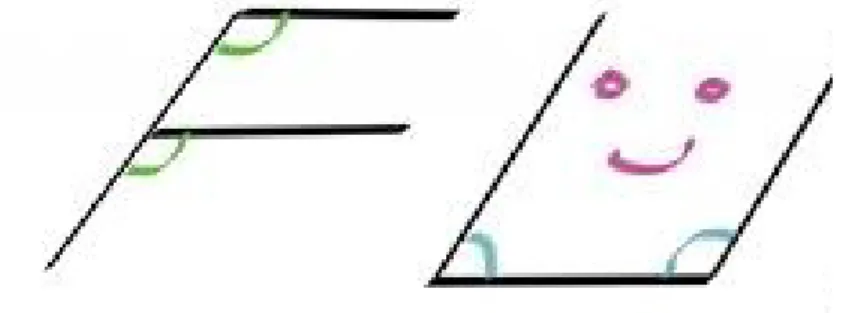
For example, if the learner does not know that in parallel lines the “F” shape represents corresponding angles, U or “C” shape represents co-interior angles and the “Z” or “N” shape represents the alternate angles, that learner cannot to solve given problems.
Figure 2.2: Corresponding, Co-interior and Alternate angles adapted from http://www.greatmathsteachingideas.com/2014/03/09/angles-in-parallel-lines-fun/
(Emeny, 2014)
Luneta (2015) also asserted that knowledge of geometric concepts goes beyond the development of skills required to work and solve geometry and what is more important is understanding the concepts and how to apply required geometric skills which will be discussed later in this chapter.
2.7. LANGUAGE AS A LEARNING BARRIER WHEN LEARNING GEOMETRY IN MATHEMATICS
The other challenge that occurs when learning geometry, is the language used to teach and learn mathematics. Mathematics uses symbols and notations to describe numerical, geometric and graphical relationships (Department of Basic Education, 2011b).
Therefore, it is of importance for the learner and the teacher to integrate the spoken language and the mathematics language. According to O’Halloran (2015, p. 63-74), the spoken
33
language is considered as one of the resources that creates meaning when learning mathematics. In mathematics, there are terminologies or certain vocabulary used that requires learners to know them. Smith, Hughes and Fries (2015) have demonstrated that, understanding of the mathematics vocabulary used when learning geometry contributes to the competency of the learner.
In most cases, learners prefer to be taught in their home language and prefer to be instructed and express themselves in their own home language (Wu, 2015). However, it is the responsibility of both the learner and the teacher to communicate any language barrier that occurs during the process of teaching and learning.
Children at an early age may display some understanding of geometrical concepts as they are used to seeing different types of shapes and playing with them (George, 2017) . This tells us that, learners have prior knowledge of what is being taught; it is just that sometimes they cannot relate this knowledge within a scientific context (Siemens, 2014). Learners experience challenges in learning geometry by failing to understand the relationship between the theorem and the definitions of angles focusing on parallel lines. If a learner does not know what a straight line is, the learner is not likely to know the theorem around the straight line (Ding, 2015). For example, a learner must integrate the definition of a straight line with the theorem of the straight-line which states that straight line angles are supplementary.
Learners find it so hard to convert word language to symbolic language which geometry uses.
There are learners who can achieve great expertise in speaking any language but cannot read with understanding (Yule, 2016). Unfortunately, this language barrier may contribute to the learners’ challenge of understanding what it is that they are required to prove thus , making it difficult for them to attempt solving any given riders because of the geometric terminology that has been used (Clements, 1992). Hence it is important for learners to know and understand the basic knowledge and have the basic skills when learning geometry starting from the terminology and properties of geometry (Ding, 2015).
2.8. EXPLORING THE BASIC KNOWLEDGE AND SKILLS IN GEOMETRY
The process of learning is something that can happen naturally to anyone, anywhere, planned or unplanned. When learning is taking place in a classroom situation, Ding, Jones and Zhang
34
(2015) emphasised that in order for the learners to learn anything firstly, they must be taught the basics which are the basic knowledge and the basic skills.
There are many reports about the challenges that are experienced by the learners when learning geometry. Geometry is an essential part of mathematics and most learners are afraid of it and hence are failing it (Alex, 2016).The reasons behind the challenges are that learners lack the basic knowledge and basic skills. Jojo (2016) states that the intention of teaching geometry in schools is to equip learners with certain abilities of knowledge or basic skills like critical thinking skills, problem solving skills including the high levels of geometric thinking skills which were discussed earlier on in this chapter. This basic knowledge and skills may be present in the early development of a learner (Bonny, 2015). These skills and knowledge will help learners to understand all geometric concepts and be able to know how each geometric concept can be applied in order to conduct correct proof or sound reasoning.
One of these basic skills is critical thinking skill as reflective thinking, whereby a learner develops the ability to think correctly when working with concepts in assessment (McPeck, 2016). This is done by relating or integrating prior knowledge to new knowledge whereby learners think in an abstract and conceptual way, in order to apply specific correct strategies to construct solutions. Critical thinking skills are essential to a learner because once a learner has critical thinking skills this implies that, he or she has good reasoning and can accurately interpret problems and understand what is required from him or her (Hitchcock, 2017).
When learners apply critical thinking skills, they will be able to develop capacity and capability to think, argue and find ways to solve problems apart from classwork given problems (Noddings, 2016).
In geometry, critical thinking skills compel learners to use their critical eye to check all possible solutions to solve riders and assure that each solution is accompanied by a correct reason stating why the learners decided to solve the riders in a certain way. After solving, the learners need to think about and also revise their work before submitting and this requires the application of critical thinking skills (Su, 2016).
Another skill that is important in learning geometry is problem solving skills. According to Schoenfeld (2016, p. 17) learners need to have problem solving skills in order to know which tool and strategy to apply when solving problems (Schoenfeld, 2016).Teaching problem solving skills encourages learners to be active on solving problems on their own. This will
35
empower learners to be able to conduct research, integrate theory, practice and apply knowledge to develop practical solutions to all defined problems (Savery, 2015).
Recent research suggests that having problem solving skills plays a crucial role because problem solving skills involve several cognitive (paying attention, ability to retrieve memory and understanding of the mathematical language) and metacognitive processes (self- questioning, self-monitoring, self- evaluation). Weisz and Kazdin (2017) substantiated that, learners with problem solving skills will not only manage their academics but will also be able to handle their social life.
Problem solving skills do not only mean that a learner must be able to get answers at the end of the problem. In mathematics, learners are able to represent the nature of the problem correctly and have strategic plan to solve problems by using correct mathematical procedures and verify if the attained solution is indeed correct (Jitendra, 2015). In geometry if the lines are not parallel by specifications or indication, rules for corresponding, alternating and co- interior angles should not be applied anyhow. If a learner does not have skills to discover that lines are not parallel, it will be impossible for the learner to solve problems correctly (Jojo, 2016).
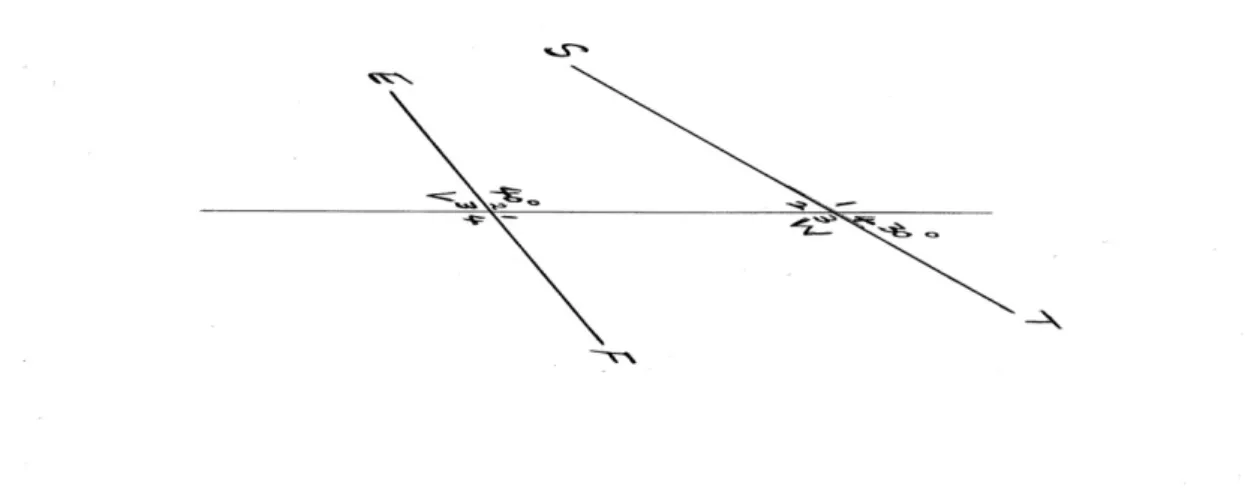
Figure 2.3: Parallel lines adapted from the CAPS Classroom Mathematics Grade 10 learner book, Pg 198 exercise 9.1 no. 3a
In Figure 2.3, the lines are not parallel to each other because when you extend them they will meet and cross each other. This means that the FUN connotation cannot be applied to the angles lying within the lines. A learner who is equipped with geometric skills will be able to identify this without wasting so much time trying to solve the angles by using FUN.
36
Bokosmaty (2014) argued that learners who are given worked examples of geometry consisting of problems along with their worked-out solutions perform better than learners who are given problems to solve by themselves. This suggests that learners develop problem solving skills when they are giving solutions to solve problems.
I contradict Bokosmaty (2014) because, giving learners worked out problems is the same as spoon feeding them by telling them to memorise the working outs, which will affect learners when they are being assessed with different problems from those they have been given. In a classroom situation there must be interaction between learners and the teacher. Koole (2015) emphases the importance of interaction whereby there will be a process of teaching, asking, explaining, clarifying misconceptions or assessing.
Giving learners worked problems can only accommodate a certain number of learners and will deprive learners of an opportunity to be active and learn from one another. Chen, Kalyuga and Sweller (2015) regards worked examples as guidance to problem solving, which elucidates that a teacher may not give the learners the worked examples but teaches them how to solve problems by demonstrating not giving the learners the solutions. Mudaly and Naidoo (2015) considered that the use of concrete representational abstract makes teaching and learning effective. They further explained that this strategy develops learners to understand mathematical concepts through the use of symbols and visualisations which will be discussed later on. This process can only be effective if the learners have problem solving skills. For these reasons this research study proposes that, learners need to be taught problem solving skills through modeling rather than being given solutions to memorise to make connections, meaning and understanding from what they already know.
Learners will be associated with competence once they are able to correctly apply mathematical skills and understand the mathematical language in order to represent mathematical expressions, processes and results using words, drawings, symbols, numbers and materials (Díaz, 2017).
2.9. THE USE OF VISUALISATION TO UNDERSTAND CONCEPTS IN GEOMETRY
Visualisation encourages communication of knowledge through the use of interactive visual interface (Manovich, 2011). The word visualisation can be broken down for better understanding whereby visualise means making visible and making mental images.
37
Manovich (2011) further elucidated that one cannot have a visual form until he or she visualises something. In mathematics, using and applying visualisation can be useful for problem solving (Carden, 2015). For example, teachers in the early childhood schools use visuals to assists learners in problems solving. Kashefi (2015) stated that learning is divided into three levels namely; Enactive learning, Iconic learning and Symbolic learning.
These levels of learning were also elaborated by MacBlain (2018) where he quoted the theory by Bruner which explains that the enactive level is when learners are learning by doing or experiencing, at an iconic level, learners learn through diagrams or images and the symbolic is through words and symbols. According to Kashefi (2015) the enactive level is the connection between the practices and formal level of understanding. This enactive level of learning supports the constructivism theory where learners are active and involved in the process of learning through visualisation.
Geometry consists of concepts derived from diagrams and in the classroom situation learners use diagrams to understand the geometric concepts hence visualisation is essential. Cannon (2017) has demonstrated that visualisation in geometry promotes a deeper conceptual understanding. For example, when looking at the angles associated with parallel lines, a learner needs to form images in his or her mind or even on the given problem to apply the FUN principles.
38
Figure 2.4: Parallel lines adapted from the CAPS Platinum Mathematics Grade 8 learner book, Pg. 142 exercise 12.3 no. 2
In Figure 2.4, a learner needs to first check if the lines are parallel by looking at the qualities of parallel lines. This can be stipulated or demonstrated by the use of arrows in the diagram and if the lines do not meet. A learner then needs to form images of each FUN property for example taken from the above figure;
Angle a = 700 reason is, angle a and 700 are corresponding. This is concluded by line CD which is parallel to EF and the F-shape is formed by the transversal line cutting through line EF.
Angle b = 700 reason is, angle a and 700 are alternating angles. This is shown by line AB which is parallel to EF and the transversal line forming the Z-shape.
Angle c + d = 1800 reason is , co-interior angles add up to 1800 provided that they lie within two parallel lines which form a C-shape. In this figure line AB and EF are parallel and form a C-shape with the transversal joining the two lines.
39
There is a national need for the integration of technology during the process of teaching and learning because, technology creates and promotes a constructivists’ learning environment (Worthington, 2008). Technology plays a very important role in involving the learners in their learning. Benjamin Franklin as cited by (Sharma, 2014) stated that if you tell me I will forget, if you teach me I may remember but, involve me and I will learn. This tells you that once a learner is involved in his or her learning he or she will learn and understand what is being taught. Regarding the use of visualisation during teaching and learning, the use of technology is relevant to be introduced for the interest of the technologically advanced generation we are currently grooming. Stols, Ferreira, Pelser, Olivier, Van Der Merwe, De Villiers and Venter (2015) were concerned about the South African teachers having internet access but refraining from using online materials to improve teaching and learning to these technology inclined learners. This may be the results of not being trained by the institutions they come from or the department is not providing enough resources or introducing workshops to train teachers to use visualisation in teaching and learning.
Many studies (Skinner, 2016, Venkatesh, Croteau, & Raba, 2014; Henderson, Selwyn, &
Aston, 2017; Kirkwood & Price, 2014; Ertmer, Ottenbreit- Leftwich, & Tondeur, 2014) have emphasised the use and the importance of technology during the process of teaching and learning to engage with students and enrich their learning experience in a meaningful and effective way. This suggests that technology must be part of teaching and learning to encourage and support construction of own understanding and knowledge of the world through experiences and reflection (Bull, 2013).
According to Johnston- Wilder, Lee and Pimm (2016) the use of digital technology is an important aspect in visualisation because digital technology scaffolds and motivates learning by observing patterns, seeing connections and working with dynamic images in geometry.
The use of technology makes it easier for learners to see what is being taught and will enable them to keep the concepts for a long time (Visser, 2015).
2.10. CONCLUSION
Having reviewed the above literature from different scholars, I have realised that this research study has commonality with them in terms of what is expected from learners when learning angles associated with parallel lines in geometry. For successful learning, learners are expected to integrate their prior knowledge and experiences to new concepts.