The aim of this study was to explore the use of instructional strategies by foundation stage teachers to teach data handling. Data on the instructional strategies used by foundation stage teachers to teach data manipulation were obtained using the case study approach.
Overview of this chapter
Introduction
Therefore, it is a necessity to explore teaching strategies that teachers use in the foundation phase when teaching data management, because the researcher has not come across such research. This is an area of concern in mathematics, more so because of the Department of Basic Education (DBE) Annual National Assessment Report (ANA) which reveals that students in the foundation stage are not doing well in data management.
Background to the study
The purpose of the study
Therefore, the inclusion of a data processing section in the foundation phase is beneficial for learners. The focus of the study was to investigate how pre-service teachers use instructional strategies to teach data management.
The rationale of the study
Addressing the gap in mathematics education
In addition, Motiswe (2012) focused on the instructional and learning strategies used in inclusive classrooms in the primary phase. While these studies focused on the instructional strategies used in the foundation phase, they did not focus on the teaching of data management.
The contribution of this study to mathematics education
It appears that the body of research in the foundation phase with reference to teaching and learning of data handling is limited. Through data handling in the foundation phase, statistical principles are thus learned and statistical reasoning is also developed.
Exploring mathematics in general
The statistics component of the data processing section of Curriculum 2005 (C2005) was originally developed by DBE. Therefore, a problem-solving approach (North & Zewotir, 2006) is used throughout the data processing section.
The teaching and learning of data handling
When it comes to understanding the role math plays in students' lives, these studies are important, but they are silent when it comes to data handling and learning at the foundation stage. It is therefore the aim of this study to investigate what instructional strategies teachers use to teach data processing at the foundation stage in selected schools in South Africa.
Introducing the critical research questions
The researcher's concern in this study was to understand the instructional strategies that foundation stage teachers use to teach data handling. All participants used different instructional strategies during the teaching and learning process related to data processing.
The scope of the study
Overview of this study
This chapter presents relevant literature that will strengthen the theoretical basis of the study. This chapter also discusses the recommendations and limitations of the study.
Conclusion
Scaffolding is also one of the instructional strategies that teachers can use to teach data handling. It was also observed that all foundation stage teachers used colors when teaching data handling.
Introduction
Mathematics in SA
According to research conducted in SA, students perform poorly in mathematics in most public schools (Mkhize & Nduna, 2010). There is a shortage of artisans and technicians in SA due to low achievement in mathematics (Vithal, 2012; Siyepu, 2013).
Teaching mathematics within the South African context
Mathematics in the foundation phase
The mathematics curriculum in the foundation phase is divided into five sections known as content areas (DBO, 2011): Few mathematical studies were done in the foundation phase in SA (Machaba . & Lenyai, 2014).
Data handling in the foundation phase
Therefore, it is essential to investigate how elementary teachers use instructional strategies to teach data processing. Therefore, this study aims to understand how teachers learn data handling at the foundation stage.
Teaching and learning of data handling internationally
Therefore, the introduction of data processing at the foundation stage and low performance in mathematics requires serious concern about how students are taught (Makina & Wessels, 2009). Teaching data handling using information that students have generated or are familiar with is effective.
Mathematics teachers in SA
The above are some of the research studies that the researcher has come across, but none focused on the instructional strategies used to teach data management at the foundation stage. The above types of scaffolding are some of the instructional strategies that elementary teachers can use to teach data management.
Different instructional strategies
Scaffolding in the classroom
Murphy and Messer (2000) conducted a study of the effects of scaffolding on the performance of 5-7 year old students. The findings were that students who received scaffolding advanced in their performance level more than those who worked without scaffolding.
Think, pair, share strategies
Group work
Using questioning as an instructional strategy
Issues of social justice and mathematics in SA
According to McMillan and Schumacher (2006, p. 324), validity refers to "the degree of congruence between the explanations of the world's phenomena and realities". The purpose of the interview was to clarify what was observed in the classrooms and to explore the instructional strategies participants used to teach data management.
The implication of literature reviewed
Conclusion
All participants used the question and answer method more often than other learning strategies. Most of the participants used the question-answer learning strategy more often during the data handling lessons.
Introduction
Social constructivism
Vygotsky’s theory of social constructivism
Vygotsky (1978) argued that students are social people who grow and learn through their interactions with teachers and parents. Furthermore, Vygotsky (1978) stated that the social and cultural context has a strong influence on the way students learn.
The role of language in the social construction of knowledge
The main implication of Vygotsky's theory is that students seek opportunities to learn with their teacher and peers (Turuk, 2008). This theory supports the notion that foundation-level teachers should use instructional strategies that improve students' understanding of data manipulation.
Social interaction and collaborative opportunities for learning
This suggests that social interaction plays an important role in the development of the learner's mind. Therefore, foundation teachers must consider students' abilities when using instructional strategies to accommodate all students in the classroom.
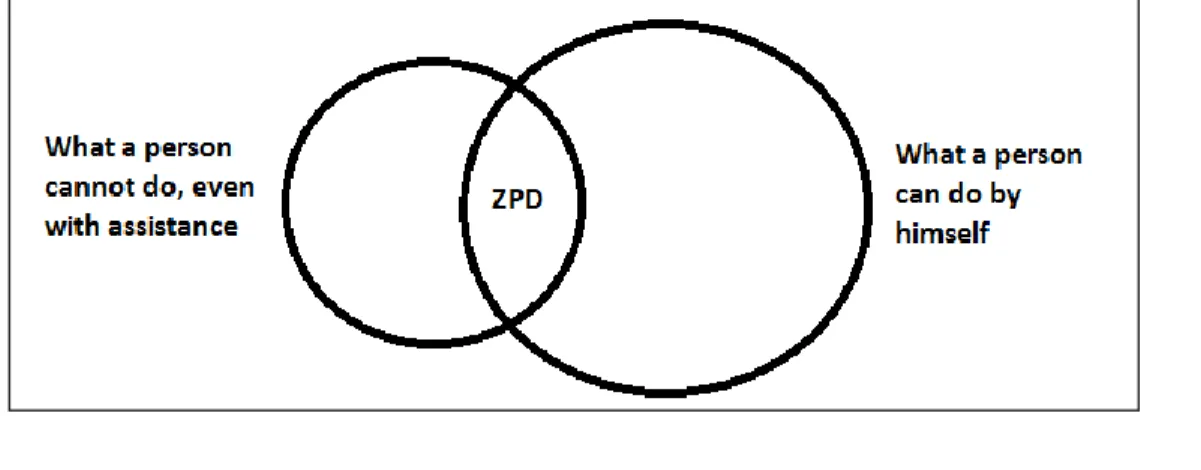
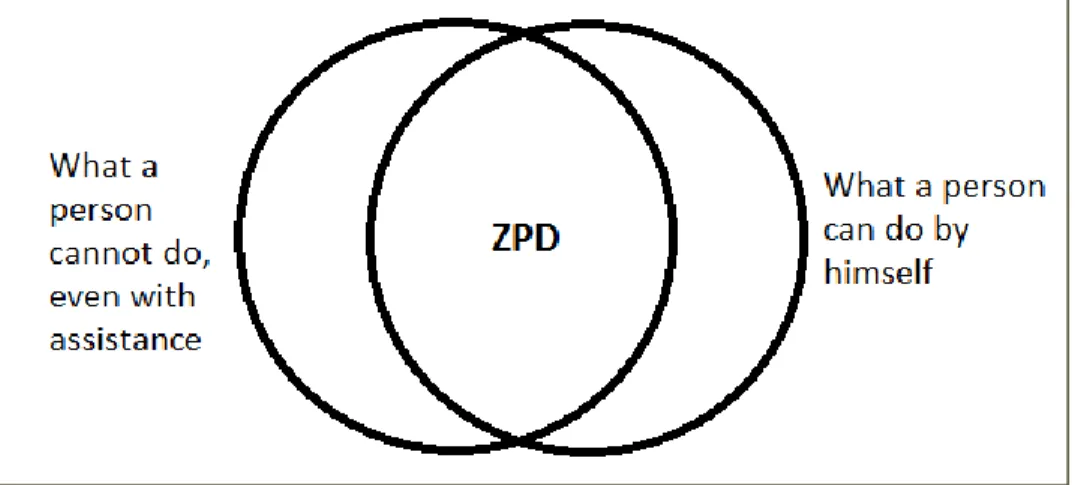
The zone of proximal development
Then, from the above description of the teacher's responsibility, we can define teaching as the support of the individual by the teacher or a more competent person through ZPD (Tharp & Gallimore, 1988). If school districts provide curriculum materials that include constructivist assignments, teachers may find it appropriate to incorporate them into their instruction (Beck, Czerniak, & Lumpe, 2000).
Scaffolding the instruction
Scaffolding in the learning of data handling
The foundation teachers in this study used a variety of instructional strategies to teach data handling. Based on the lesson observations and teacher interviews, the results showed that as teachers use different instructional strategies, they also used scaffolding strategies to guide their students' data processing progress.
The different levels of scaffolding
- Level 1: Exploring the teacher-learner interaction
- Level 2: Exploring the teacher-learner interaction
- Level 3: Using representational tools
Progression and timing relate to the way in which the teacher progresses from one idea to the next during the data handling lesson. In the restructuring of tasks, the teacher reformulates the learners' comments, to negotiate meanings and create more understanding.

Conclusion
Most of the participants used question and answer, talk and chalk, resources and demonstration when teaching data handling. The majority of participants mentioned demonstration as the most effective teaching strategy to teach data handling.
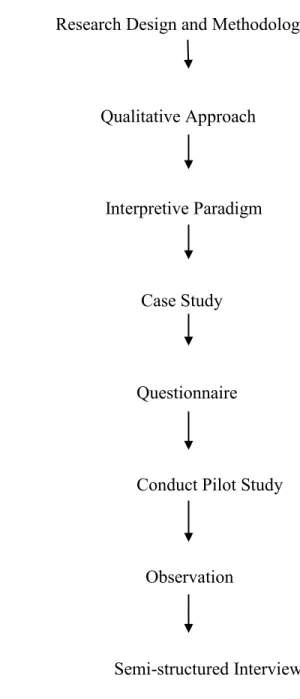
Introduction
Qualitative approach
Using a qualitative research design, the researcher was able to investigate the use of teaching strategies by primary stage teachers in teaching data management. A qualitative research approach allows the researcher to examine, understand, and draw conclusions based on participants' responses to the phenomenon under consideration in a given normal setting, such as a mathematics science classroom (Denzin & Lincoln, 2005).
Working within the interpretive paradigm
After lesson observations, the researcher interviewed the participants to find out why they used specific teaching strategies to learn data handling. The findings of this study will therefore provide knowledge of the teaching strategies used in the foundation phase to teach data handling and how these teaching strategies are used.
The case study
The exploratory case study was chosen because this study wanted to understand how foundation phase teachers use teaching strategies when teaching data handling. The case study approach was used in this study, supported by questionnaires, observations and interviews to explore in depth the foundation phase teachers' use of teaching strategies in teaching data handling.
The ethical issues addressed
Using the case study approach allows a researcher to get very close to the research participants through observations and interviews, and to build an intensive, in-depth analysis of a case under study (Cohen et al ., 2007 and McMillan & Schumacher, 2010). Letters were also written to the principals of the schools requesting permission to conduct research in their schools (Appendix A iii).
Obtaining consent for the study
To address these issues, consent letters were obtained and permission was also obtained to observe and interview participants, with a commitment to destroy the audio tapes after data collection to protect the participants. To protect the participants' rights to privacy, the researcher had to promise them the confidentiality of the information they would provide (Cohen et al., 2007) so that the public would not know who provided the information.
Sampling
This selection was therefore based on the accessibility of the school, and the availability of the teachers and their answers to the teacher survey. The participants were all women, because at all participating schools all foundation phase teachers were women.
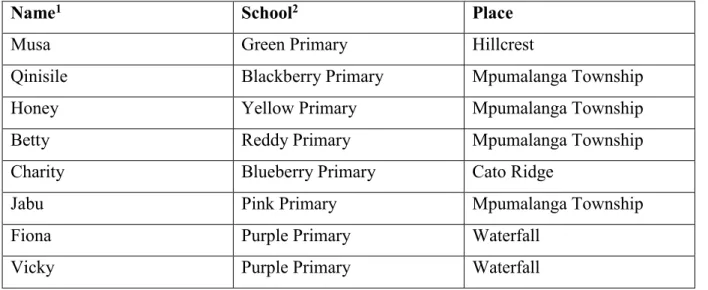
Data collection methods
Questionnaire
As this study explored the instructional strategies used by primary teachers to teach data management, the second section focused on school infrastructure. The researcher ensured that the questionnaire covered all the domains it was intended to cover (see Appendix B i).
The observations
The semi-structured interviews
The first question focused on instructional strategies that are effective in teaching data handling by foundation stage teachers. The second question focused on the concepts covered using the learning strategies they mentioned.
Validity and reliability
Participants were allowed to delete or add text to clarify their responses in the transcripts. The researcher used different sources of data (questionnaires, interviews and observations) which will increase the validity of the study.
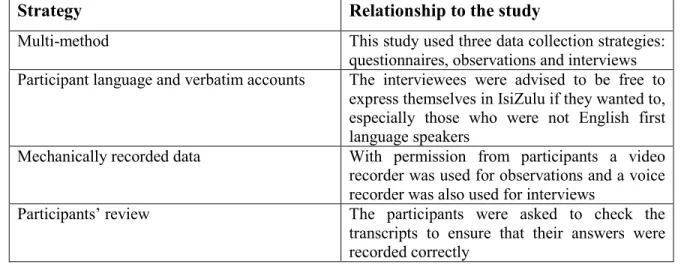
The pilot study
Limitations of the study
Conclusion
The majority of the participants mentioned the question-and-answer instructional strategy, demonstration and group work as effective teaching strategies in teaching data handling. In addition, the majority of participants indicated that they had not attended data handling workshops.
Introduction
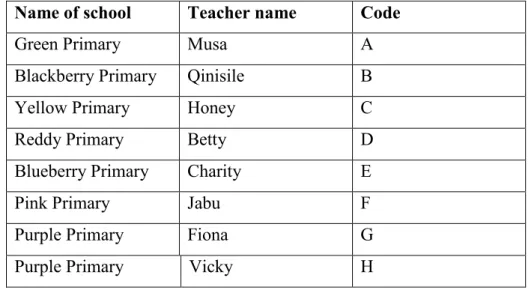
Coding of the teacher questionnaire
School profile
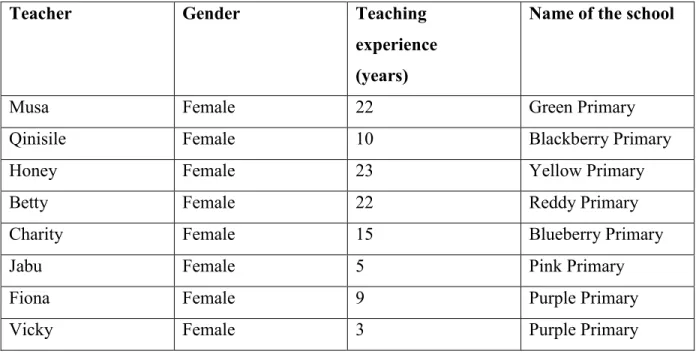
What was noticeable in most schools was that the classes were large. Participant responses to school profile questions are also coded and provided in Table 6.
School resources
The participants’ profiles
The participants’ stories
- Fiona (G)
- Honey (C)
- Musa (A)
- Betty (D)
- Charity (E)
- Vicky (H)
- Qinisile (B)
- Jabu (F)
In the foundation phase, the vernacular is used when teaching and even the students' workbooks are written in isiZulu. Viki is a young teacher and has been teaching in the foundation phase for 3 years.
An analysis of the lesson observations
Teacher-learner interaction
As previously mentioned, the majority of teachers used the whole-class teaching strategy, and students responded individually or as a whole class to the questions posed by the teacher. The students repeated what the teacher had said or what a student had said in response to the teacher's question.
Learner to learner interaction
The teachers used the teaching strategy of questions and answers to actively involve the students during the teaching and learning process. Therefore, the interaction between the teacher and the child took place using some learning strategies, including question and answer and repetition.
Teaching and learning resources
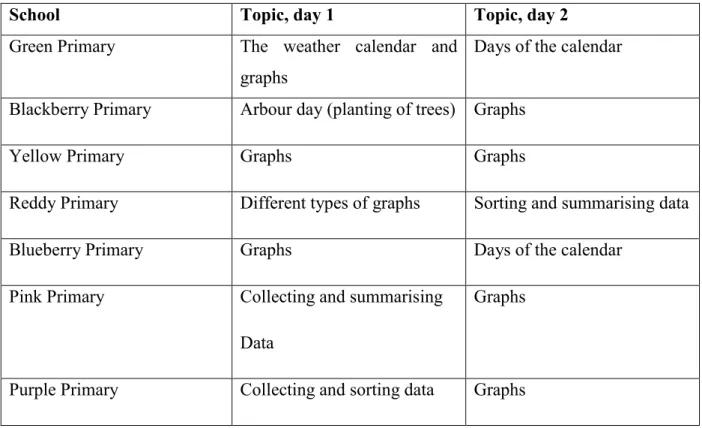
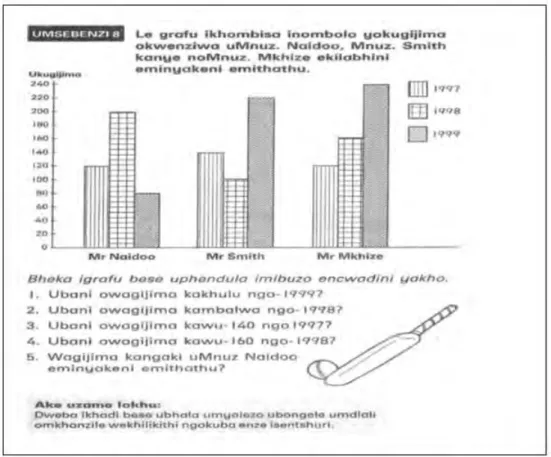
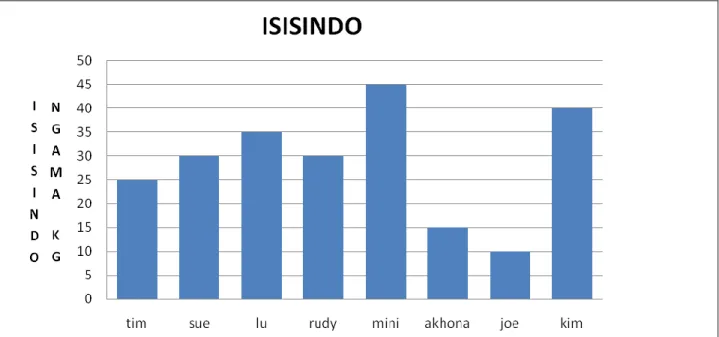
When the teacher asked the students the weight of the first baby, the students gave wrong answers. Students were given an exercise based on the pictograph, bar chart and pie chart (chart).
Analysis of the semi-structured interviews
The participants emphasized that the learning strategies they used helped the students to understand the concepts more easily. Most of the participants indicated group work as the best strategy to help students understand as they help each other.
Conclusion
During the analysis, the following themes emerged: theme 1 – the use of visual material; theme 2 – the use of resources; theme 3 – the use of group work in the classroom; theme 4 – the use of the question-and-answer method in the classroom; theme 5 – the use of demonstration in the classroom; theme 6 – repetition as a teaching strategy; and theme 7 – recitation as a teaching strategy. It emerged in the study that the participants used different teaching strategies to learn data handling for different purposes.
Introduction
Theme 1: The use of manipulatives as an instructional strategy
The use of visuals
The visual aid used by the majority of participants was the use of different colors. The participants also emphasized that the use of different colors made the data processing lessons interesting for students.
The use of resources
Some of the teachers used worksheets when giving students an activity to do in the classroom. Vicky used a real-life situation when teaching students about the hours of the day.
Theme 2: Using social constructivist instructional strategies
The use of demonstration in the classroom
For example, when Fiona asked the learners to write the number sentences on the board for. The demonstration method of teaching is effective in increasing the learners' achievements (Adekoya & Olatoye, 2011; Ekeyi, 2013).
The use of group work in the classroom
Discussions enhance student learning and can also motivate them (National Council of Teachers of Mathematics (NCTM), 2013). Thus, allowing students to work in groups can help them benefit from each other.
Using the question and answer method in the classroom
She also asked the students to write the answers on the board while they used the learning strategy of questions and answers. She used a question-and-answer teaching strategy and persistently encouraged her students to read the instructions.
Theme 3: Using memorisation as an instructional strategy
In other words, she was of the opinion that coaching students is the effective way of teaching and helps students understand what is being taught. Most participants (6 out of 8) required students to memorize facts rather than understand them or allow students to find ways to understand data handling concepts on their own.
Conclusion
This study began with the exploration of foundation phase teachers' use of teaching strategies to teach data handling. The study investigated the use of teaching strategies used by foundation phase teachers to teach data handling.
Concluding remarks, recommendations and limitations
Introduction
The researcher’s thoughts
Although data management is considered easy, students do not perform well in this section. Data management is one of the sections of mathematics that links to the real world, unlike other mathematical concepts such as algebra and trigonometry.
Responding to the critical questions
- Which instructional strategies do foundation phase teachers use to teach
- How do foundation phase teachers use these instructional strategies to teach
- Why do foundation phase teachers use these instructional strategies to teach
- Effective instructional strategies when teaching data handling
- Concepts covered in data handling using specific instructional strategies
- Learners’ benefit from the instructional strategies used to teach data
- The response of learners to the instructional strategies used
The participants used different learning strategies, depending on the learning goal they wanted to achieve. Using different instructional strategies, participants accommodated students with different levels of learning abilities (Gangi, 2011; Tulbure, 2011; Arnold-Garza, 2014).
The significance and contribution of this study
The participants indicated that learners respond with interest and excitement when using different teaching strategies, and seem to understand data handling. For example, a concern of the participants was that learners seem to understand when they are being taught, but have a problem when they are given individual work to complete.
Recommendations
The researcher did not come across literature focusing on teaching strategies used to teach data handling in the foundation phase. Therefore, this study investigated the teaching strategies used by foundation phase teachers to teach data handling as this section is part of the mathematics curriculum.
Limitations of the study
Since resources make teaching and learning easier and more enjoyable, it is recommended that rural and town schools be provided with sufficient resources for teaching by the Ministry of Education. It is recommended that the Ministry of Education provide professional development workshops in the field of data processing, to equip teachers with effective instructional strategies for teaching this subject.
Conclusion
Paper presented at the Proceedings of the Sixth Annual Meeting of the Southern African Association for Research in Mathematics and Science Education. I want your child to be part of the research project that will be developed in it.