i
Exploring learners’ understanding of
mathematical concepts necessary in the learning of grade 11 algebraic functions: the case of three
schools in uMgungundlovu District
Nkosinathi Ndlovu
(211507215)
Supervisor: Ms Busisiwe Goba
SUBMITTED IN FULFILMENT OF THE ACADEMIC REQUIREMENTS FOR THE DEGREE OF MASTER OF
EDUCATION BY RESEARCH REPORT
School of Education, Mathematics & Computer Science Education Cluster, University of KwaZulu-Natal, South Africa
November 2019
i
ABSTRACT
The purpose of this study was to explore learners’ understanding of mathematical concepts in the learning of grade 11 algebraic functions in uMgungundlovu district, KwaZulu-Natal.
In order to gain insights into learners’ understanding of mathematical concepts in learning grade 11 algebraic functions, APOS theory was used as a theoretical lens to explore learners’ level of understanding of functions. This study describes the mathematical concepts that are important in the learning of grade 11 algebraic functions. The CAPS document was used to analyse the mathematical concepts for functions to be learnt in grade 11. The data was gathered through written tasks and interviews of grade 11 learners in three schools in one district in KwaZulu-Natal. The research approach used for this study was the mixed method. Sixty grade 11 learners (twenty in each school) were purposively selected; however, this sample selection was conveniently done since learners were able to participate in the study after school. This study employed the interpretive paradigm and nine learners (three from each school) were interviewed during data collection.
Multiple methods were employed for data collection in this study. Qualitative data was organised using interview transcripts and quantitative data was organised using the APOS analytical framework. The findings of this study confirm that learners’ level of understanding of algebraic functions at an object level is extremely poor.
ii
PREFACE
The work described in this thesis was carried out in the School of Science, Mathematics and Technology Education, University of KwaZulu-Natal, from February 2018 to November 2019 under the supervision of Ms Busisiwe Goba. This study represents original work by the author and has not otherwise been submitted in any form for any degree or diploma to any tertiary institution. Where use has been made of the work of others, it is duly acknowledged in the text.
Nkosinathi Ndlovu Date
November 2019
--- --- Supervisor Date
--- ---
November 2019
iii
TABLE OF CONTENTS
ABSTRACT I
PREFACE II
TABLE OF CONTENTS III
LIST OF TABLES VI
LIST OF FIGURES VI
ACKNOWLEDGEMENTS VIII
CHAPTER 1
COMPREHENDING MATHEMATICS ISSUES AND LEARNERS’ PERCEPTION OF FUNCTIONS
Introduction 1
1.1
Background and the problem statement 1
1.2
Rationale for the study 3
1.3
Purpose of the study 4
1.4
Objectives of the study 5
1.5
Research questions 5
1.6
Definition of the concepts used in the study 5
1.7
1.7.1 Function 6
1.7.2 Learning in mathematics 6
1.7.3 Mathematical concept 6
Structure of the thesis 6
1.8
Conclusion 7
1.9
CHAPTER 2
THE ALGEBRAIC FUNCTIONS AND LEARNERS’ EXPERIENCES: A REVIEW OF THE LITERATURE
Introduction 8
2.1
The history of defining the function concept 8
2.2
Learners’ understanding mathematical concepts 10
2.3
Challenges faced by learners in learning mathematics 13 2.5
Linear Function 16
2.5.1
iv
Quadratic Function 16
2.5.2
Hyperbolic Function 19
2.5.3
2.5.4 Exponential and Logarithmic Function 19
Functions in the South African Curriculum 20
2.6
Algebraic knowledge necessary for the learning of functions 21 2.7
2.8 Conclusion 22
CHAPTER 3
RECONCEPTUALISING MATHEMATICAL CONCEPTS IN FUNCTIONS: THE REVIEW OF LITERATURE
Introduction 24
3.1
Researcher’s theoretical understanding of learning mathematics 24 3.2
The APOS theoretical model 27
3.3
3.3.1 Action 28
3.3.2 Process 28
3.3.3 Object 28
3.3.4 Schema 29
The genetic decomposition for functions 30
3.4
Conclusion 33
3.5
CHAPTER 4
AN EXCURSION TO THE FIELD: THE RESEARCH DESIGN
4.1 Introduction 34
4.2 Research design 34
4.2.1 Research paradigm 36
4.2.2 Research approach 38
4.3 Research sampling 38
4.4 The distinctive characteristics of three schools 40
4.5 Research instruments 44
4.6 Data organisation and analysis 45
4.7 Ethical considerations 47
4.7.1 Piloting of instruments 48
4.8 Ensuring quality of the findings: trustworthiness 48
4.8.1 Credibility 49
v
4.8.2 Dependability 50
4.9 Conclusion 50
CHAPTER 5
DATA PRESENTATION, ANALYSIS AND DISCUSSION OF THE FINDINGS
5.1 Introduction 52
5.2 Presentation and analysis of learners’ mental constructions 53 5.2.1 The CAPS document presentation and analysis 53 5.2.2 Presentation and Analysis of the task and interviews 56 5.2.2.1 The action level presentation and analysis 58 5.2.2.2 The process level presentation and analysis 67
5.2.2.3 Object level presentation and analysis 73
5.2.2.4 The schema of understanding algebraic functions 78
5.3 Conclusion 78
CHAPTER 6
CONCLUSION AND RECOMMENDATIONS
6.1 Introduction 81
6.2 Summary of the main findings 82
6.3 Significance and implications of the study 83
6.4 Limitations of the study 83
6.5 Recommendations for future research 84
REFERENCES
REFERENCES 86
LIST OF TABLES
Table 5.1 Learners’ responses to sub-questions related to action level. 61 Table 5.2 Learners’ responses to sub-questions related to process level. 69 Table 5.3 Learners’ responses to sub-questions related to object level. 75
LIST OF FIGURES
Figure 2.1 Representation of a parabola 17
Figure 3.1 Illustration of mental structures of APOS theory 30
vi Figure 3.2 A proposed genetic decomposition for functions 32
Figure 4.1 Lanfield Secondary School 42
Figure 4.2 Lulove high school 43
Figure 4.3 Maxiz high school 44
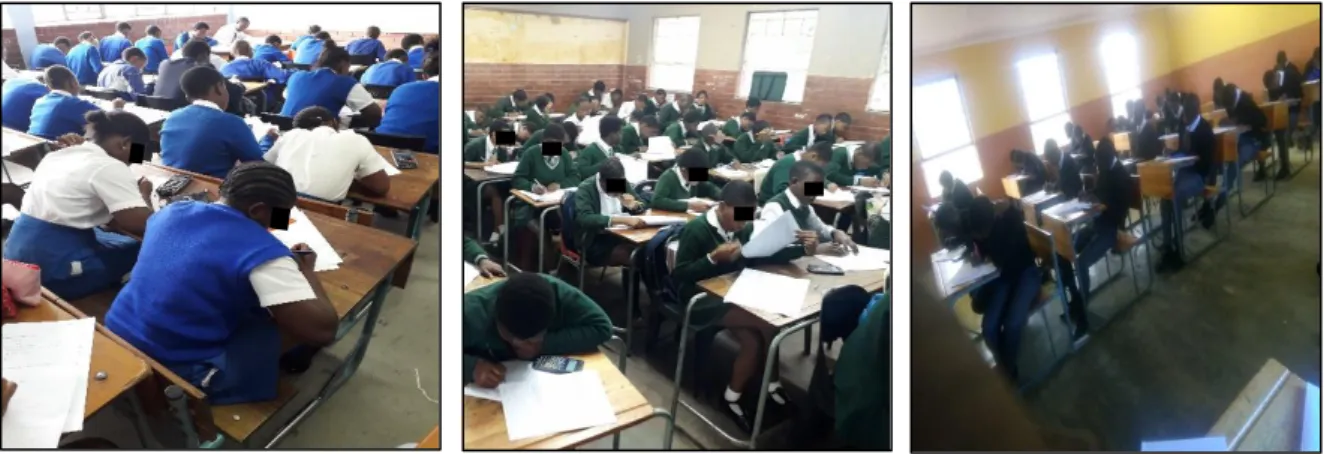
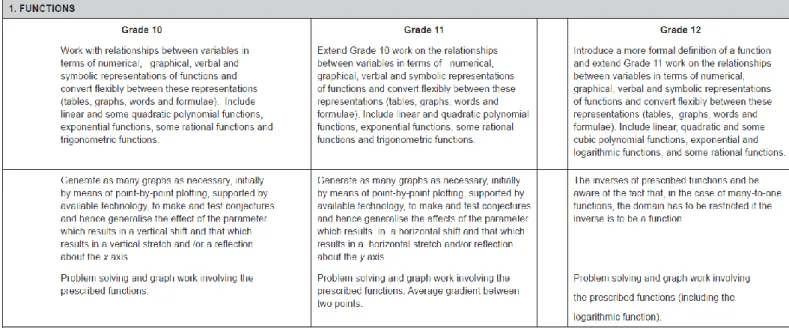
Figure 4.4 Illustration of data collection and analysis 46 Figure 4.5 Learners of three participating schools writing a task 47 Figure 5.1 Illustration of functions in FET phase mathematics 54 Figure 5.2 Concepts taught at Senior Phase mathematics necessary for learning
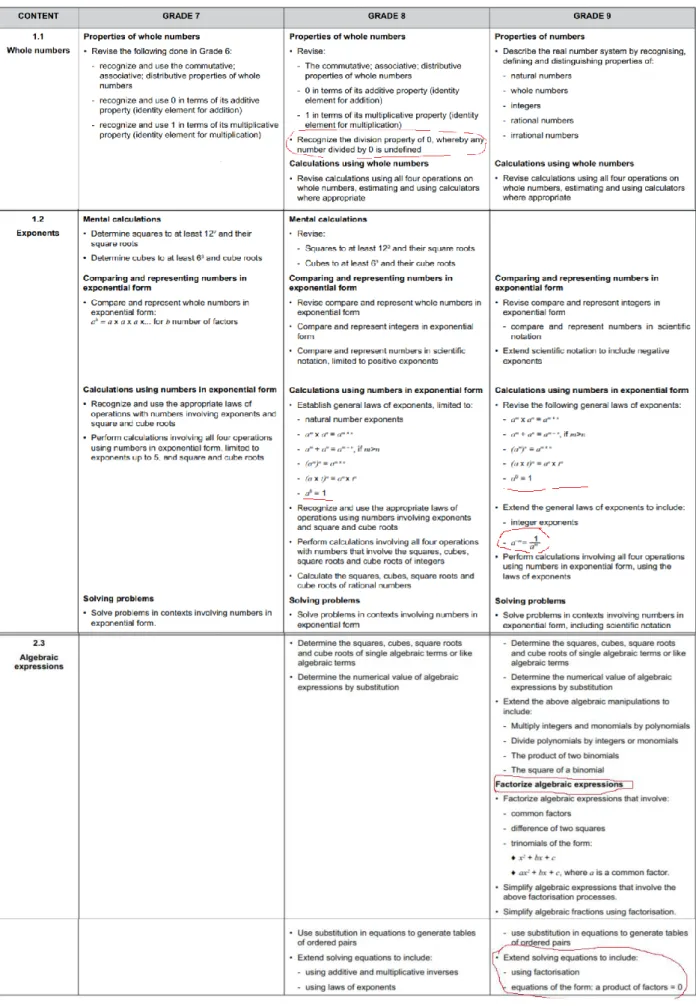
functions 55
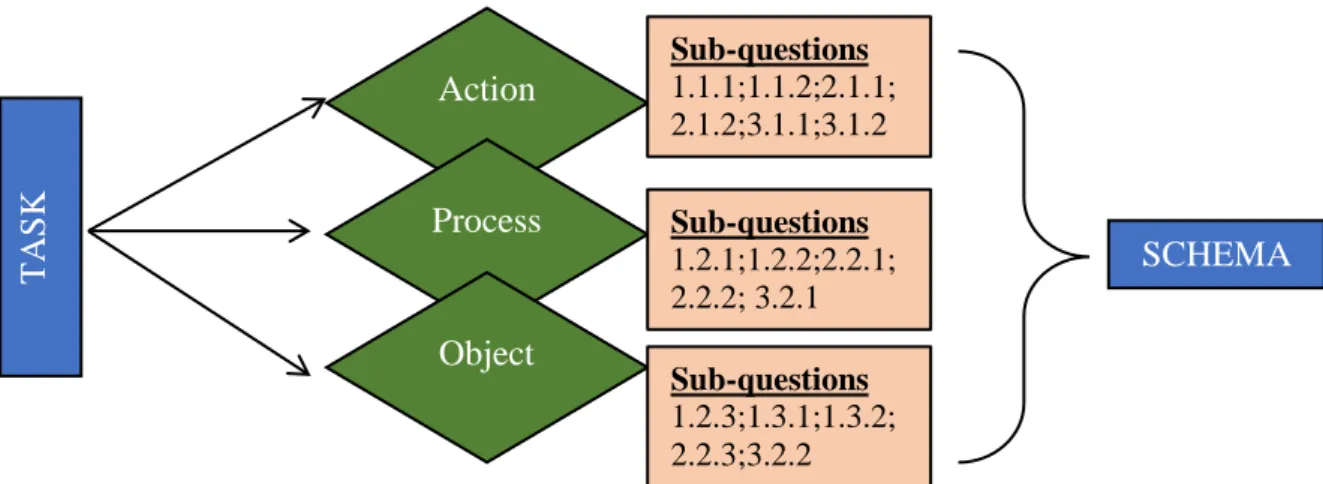
Figure 5.3 Representation of APOS on questions items of the task 57 Figure 5.4 Bar graph illustrating learners’ responses at action level 59 Figure 5.5 Learner (L43) response to Question 1.1.1 and Question 1.1.2 60 Figure 5.6 Learner 6 (L6) responses to question 1.1.1, 1.1.2 and 1.2.1 and 1.2.2 62 Figure 5.7 Illustration of learners’ answers in solving exponential equations 63 Figure 5.8 Illustration of learner’s (L6) understanding of exponential equations
at process level 65
Figure 5.9 A sketched graph of an exponential 65
Figure 5.10 Learners’ responses on solving quadratic equations 66 Figure 5.11 Bar graph illustrating learners’ responses on process level questions 68 Figure 5.12 Learners’ responses to question 1.2.1 and 1.2.2 69 Figure 5.13 Illustration of the incorrect x-intercepts found 72 Figure 5.14 Bar graph showing learners’ responses on object level questions 74 Figure 5.15 Illustration of incorrect hyperbolic function in 1.2.3 74 Figure 5.16Learners’ incorrect sketched graph of a quadratic function 77
vii
ABBREVIATIONS
APOS- Action-Process-Object-Schema
CAPS - Curriculum and Assessment Policy Statement MKO- More Knowledgeable Other
NDR- National Diagnostic Report NSC- National Senior Certificate
viii
ACKNOWLEDGEMENTS
I feel highly favoured from the Lord almighty who has been with me throughout the entire journey. Even though this was not an easy journey, my passion was driven by the word of God from the book of Proverbs 3:5 which reads: “Trust in the Lord with all your heart and do not learn on your own understanding. In all your ways acknowledge him and He will make your paths straight”. I would then like to thank God for his presence in this journey and the strength He provided which made me not give-up. I would also like to extend my sincere words of gratitude to the following people for their massive role in this study:
o My Supervisor Ms Busisiwe Goba who gave me proper and professional support in writing this thesis. If it was not for her commitment and extra support in supervising me, I would have ended up not completing this qualification. You developed the interest of research in me.
o My family, I thank you all for the words of encouragement in ensuring that I complete this degree qualifications.
o My girlfriend Lerato Makhabane, thank you for the support you gave me during this hard time and being able to be patient when I was absent in our relationship. Thank you for prioritising education and for not giving up on us.
o To my colleague and inspiration Ms Lungile Majola, thank you so much for the provision of necessary documents which aided me in writing this master’s thesis, may God bless you.
o To my colleague and a mother, Mrs CNN Shezi, thank you so much for encouraging me regularly and giving me hope which strengthened me all the times.
o To my cousin Sphelele Duma who supported all the times by preparing delicious meals during study time, thank you so much for helping me in that manner.
o To the learners who gave up their time in participating in this study knowing that there are no benefits, thank you so much for making this study possible.
1
CHAPTER 1
COMPREHENDING MATHEMATICS ISSUES AND LEARNERS’
PERCEPTION OF FUNCTIONS
Introduction 1.1
This chapter aims at discussing the research purpose. Firstly, a full description of the background and the objectives of the study are given. The problem statement, rationale and the definition of the concepts necessary for this study follow thereafter. Furthermore, this study was done in such a manner as to answer the research questions stated below. This chapter concludes with a summary of the overview of the thesis.
Background and the problem statement 1.2
Generally, South African Grade 12 learners perform poorly in mathematics. It is well known that learners struggle in mathematics paper 2. Therefore, if the learners’
performance in mathematics could be improved then the learners could be expected to get better marks in mathematics paper 1. However, the National Diagnostic Report (NDR)1 of learner performance in 2016, 2017 and 2018 acknowledges that learners can improve in their performance if they have a better understanding of functions. Functions make up 35%
of paper 1 and in paper 2 they take the form of trigonometric graphs. In other words, if learners can improve on the understanding of functions, then the overall mathematics learner performance can be improved. Also, the diagnostic report points to learners not being able to respond to items on functions in exams because they lack basic mathematical concepts, which relate to functions. The Department of Basic Education (2017) succinctly summarises this point:
The algebraic skills of the candidates are poor. Most candidates lacked fundamental mathematical competencies, which could have been acquired in lower grades. Whilst
1 In this document, there is information aimed at assisting teachers and department officials about how learners perform in National Senior Certificate (NSC) examinations in selected subjects including mathematics.
2 calculations and performing well-known routine procedures form the basis of answering Mathematics questions, an in-depth understanding of definitions and concepts cannot be overlooked (Department of Basic Education, 2017, p153).
The above extract refers to the poor algebraic skills that candidates displayed in the 2017 National Senior Certificate (NSC) examinations and the lack of mathematical understanding of concepts. Since the study is exploring learners’ understanding of mathematical concepts necessary for learning functions, thus their algebraic thinking and concept definitions are vital to their understanding of functions in mathematics.
Contemporary researchers argue that there is little evidence of learner experiences of functions and how they represent their understanding of the concepts in functions. Some researchers have explored learners’ development and understanding of function concepts;
however, these studies varied in focus in terms of the level of learners’ schooling and the theoretical perspective used. According to Ayalon, Watson and Lerman (2017) learners possessing prior knowledge of the word “function” have a strong insight of functions as an object compared to learners without such prior knowledge. The use of the word “function”
is not the only way to improve understanding of the concept, however, through visualization of diagrams displayed by educators in the classroom can improve the understanding of functions (Mudaly & Rampersad, 2010). Contrary to the use of the word and visualization of a function, learners’ use of procedural knowledge to explain simple concepts showed that they had a weak understanding of functions (Mudaly & Rampersad, 2010). The studies done on learners’ conception of functions that resulted in improved understanding of functions due to the use of both word and visual representation were reviewed. However, none of these studies investigated grade 11 learners’ insight into mathematical concepts necessary for learning algebraic functions. Therefore, there is a need for this study in which learners’ understanding of mathematical concepts to learn functions is explored. From the above-mentioned background, it is evident that there is still the need for mathematics educators to improve their skills when teaching mathematics (Rowland & Rutvhen, 2011). Even though educators can be more knowledgeable in the subject, however, it is significant for them to possess skills necessary in conveying such knowledge to learners. This implies that the presentation of mathematical concepts should be in the manner that learners can make a connection of such concepts with function types.
3 Rationale for the study
1.3
In three years of mathematics teaching experience, the researcher has realised that learners fail to respond correctly to questions involving assessing algebraic functions. What is not clear is a deep understanding of the main cause of this problem that students have with functions. The interest in gaining insight into learners’ experiences with the learning of algebraic functions emanates from informal conversations held with grade 10 and 11 mathematics learners about their mathematics learning and performance. From these conversations with learners, it has become clear that there is a huge need for teaching functions in mathematics.
The learners’ understanding of mathematical concepts necessary for learning grade 11 algebraic function is the main focus of this study. Also, a discussion is done on the learners’ difficulties observed during each problem-solving activity. The need for conducting this study is due to a huge contribution made by “functions” throughout the entire mathematics curriculum (Gcasamba, 2014). In this curriculum, the ability to sketch and interpret graphs is one of the requirements in understanding the chapter of functions.
The study by Ayalon, Watson and Lerman (2017) emphasised functions as crucial in mathematics, and the assortment of its interpretations and representations is also spreading on both pure and applied mathematics. While this is the case, the National Diagnostic Report (NDR) learners’ poor answering of questions relating to functions due to numerous reasons:
Most candidates could not state the range of the hyperbola. Candidates were unable to differentiate between 𝑦𝜖𝑅 , 𝑦 ≠ −1. Some gave the answers in terms of x; however, these candidates confused the domain and range. Few candidates were able to determine the equation of the axis of symmetry. Some of those who were able to determine the equation of the axis of symmetry did not realise that the x-intercept of the axis of symmetry passes through B (Department of Basic Education, 2017, p. 159).
Concerning these above-mentioned quotations, there is a huge role that teachers must play in teaching learners such that they interpret functions conveniently. In addition, the characteristics and features of the graphs in functions are also significant for understanding
4 the concepts that are involved with functions. In mathematics (paper 1)2 the chances of learners passing the examination rely precisely on their knowledge and understanding of functions and algebra, thus these two sections are connected. For instance, we use algebraic skills in functions, such as interpreting the point of intersections, domain and range on the graphs. In paper 1, approximately 35% of the questions assess or are related to functions. This suggests that learners’ performance in mathematics will be better if they master the function concept. Mathematics educators should insist on teaching algebraic skills and functions in previous grades so that learners can respond correctly and accurately in their matric exam papers.
Therefore, it is important to explore learners’ experiences with functions to gain insight into how they interpret and conceptualise functions to find ways to improve their level of understanding of functions. Such learners’ experiences about learning functions can help educators to formulate strategies for teaching functions in earlier grades so that learners become experts on functions in secondary education. The culture of learning functions in mathematics should be the one that promotes a clear understanding by learners. This should reduce the number of comments from the National Diagnostic Report about errors evident in mathematics paper 1. Even though numerous studies have explored the teaching and learning of functions, this study specifically explores learners’
understanding of mathematical concepts necessary in learning functions. This includes how the learners interpret functions in connection with the prior knowledge necessary for learning functions. Thus, it is necessary for the conduction of this study that the numerous aspects that hinder a learner’s ability to conceptualise functions are determined.
Purpose of the study 1.4
The purpose of this study is threefold. Firstly, to describe the mathematical concepts learners need in the learning of functions in mathematics. Secondly, to explore the manner in which learners use these mathematical concepts while learning functions in mathematics. Thirdly, to understand the reasons for learners using mathematical concepts
2 This paper assesses functions and graphs at various cognitive levels with the attention on process skills, critical thinking and scientific reasoning. In the National Senior Certificate examination, the entire paper is out of 150 marks and entails approximately 25% assessment on algebraic function.
5 while learning functions in the manner in which they do. In this study, algebraic reasoning is included as the underlying factor that influences the learning of functions. Concerning functions in mathematics, it appears that there is a great deal of literature reported on students’ experiences of functions (Nielsen, 2015). However, there is a dearth in research about learners’ interpretation of mathematics concepts while learning functions, therefore, this study aspires to provide insight into the learners’ use of concepts in functions. In addition, it addresses key solutions that can help learners have an improved understanding of functions in mathematics.
Objectives of the study 1.5
The objectives of this study are:
i) To identify the mathematical concepts necessary for learning algebraic functions.
ii) To examine learners’ understanding of mathematical concepts necessary for learning algebraic functions.
iii) To understand why learners understand these mathematical concepts for learning algebraic functions in the way they do.
Research questions 1.6
The research questions addressed by this study are threefold:
i) What are the mathematical concepts that are necessary for learning grade 11 algebraic functions?
ii) How are learners understanding these mathematical concepts when learning grade 11 algebraic functions?
iii) Why are learners understanding these mathematical concepts necessary for learning grade 11 algebraic functions in the way they do?
Definition of the concepts used in the study 1.7
In this study, the researcher has used various terms that could have different contextual meanings, or could be written differently. Consequently, the researcher elucidates the meanings that these terms have to convey in this thesis.
6 1.7.1 Function
Clements and Sarama (2008) defined a function as the correspondence that associates each element of a domain with each element of a range. Similarly, a function can be defined as the relationship consisting of one element of the range being associated with one element of the domain (Vinner, 1992). The introduction of algebraic and graphical representations of functions (Leinhardt, Zaslavsky, & Stein, 1990) is significant in mathematics learning.
This concept ‘function’ is significant in this study since it draws the reader’s attention to what functions in mathematics education are all about.
1.7.2 Learning in mathematics
Learning is the transformation brought by advancing a new skill, understanding scientific law and developing new attitude (Sequeira, 2012). According to Tabach and Nachlieli (2015), learning in mathematics education includes the ability to use mathematical keywords as accepted by mathematicians. Learning mathematics requires a learner to become more proficient in mathematics communication (Tabach & Nachlieli, 2015).
1.7.3 Mathematical concept
The learning and comprehending mathematical definitions are crucial for learning mathematical concepts; the power of definition of concepts is captured in the roles and features of the definitions (Thomson, 2015).
Structure of the thesis 1.8
This thesis is organised into the following six chapters:
Chapter 1 – Introduction: This chapter introduces the reader to the background of the study and highlights the significance of understanding learners’ use of mathematical concepts in learning functions. This chapter also presents debates about learners’
knowledge and understanding of the concepts embraced in functions. The rationale for conducting this study, the purpose, specific objectives, research questions, and relevant definitions for this study are provided.
7 Chapter 2 – Literature Review: This chapter presents literature that addresses learners’
experiences in learning algebraic functions. The literature associated with the history of the function concept is also presented in this chapter. While this study focuses on learners’
use of mathematical concepts in the learning of grade 11 functions; literature on learners’
understanding of mathematical concepts is also provided. In addition, acknowledgement is made of the challenges faced by learners in the learning of mathematics which can have an impact on learners’ understanding of the function concept. Furthermore, the literature that is discussed also presents the algebraic skills necessary for the learning of algebraic functions in mathematics.
Chapter 3 –Theoretical Framework: This chapter looks at the theory that is related to an exploration of learners’ use of mathematical concepts in the learning of functions. To do this, the researcher discusses in detail the APOS theory and highlights how the framework is used in this current study.
Chapter 4 –Research Methodology: This chapter presents in detail the empirical process of this study. The selected research methodology for this study is also provided. In this chapter the researcher outlines the research design, population, sampling procedure, data collection instruments, data processing and analysis procedure, ethical considerations and issues of validity and trustworthiness. In addition, the limitations of this study are also included in this chapter.
Chapter 5 –Data presentation, Analysis and Discussion of the Findings: This chapter presents the raw data and analyses using tables. The reviewed literature and the suggested framework for the study are also discussed in this chapter.
Chapter 6 – Summary of the Findings, Conclusion and Recommendations: The chapter summarises the purpose of the study, and the methodology used, and presents the main findings, the conclusion and recommendations.
Conclusion 1.9
This chapter presents the introduction and background of the study. It outlines the rationale, purpose, objectives, research questions, and definitions of the concepts that guide this study. In addition, this chapter briefly highlights the structure of this thesis.
8
CHAPTER 2
THE ALGEBRAIC FUNCTIONS AND LEARNERS’ EXPERIENCES:
A REVIEW OF THE LITERATURE
Introduction 2.1
Recent debates for research in South African mathematics education are predominantly concerned with the teaching and learning standards of mathematics (Spaull, 2013). This study focuses on learners’ understanding of mathematical concepts in learning grade 11 algebraic functions in uMgundundlovu District, KwaZulu-Natal. The ‘function’ definition and concepts involved around it are explored by numerous scholars in mathematics education (Bardini, Pierce, Vincent, & King, 2014; Chitsike, 2013; Breen, Larson, O'Shea,
& Petterson, 2015). This chapter commences with a discussion of seminal contributions that have been made in understanding the history of the function concept. This is followed by a discussion of the learners’ understanding of mathematical concepts and learners’
understanding of the function concept. Also, the researcher then presented a comprehensive review of the challenges faced by learners in learning mathematical concepts. Furthermore, the researcher explored the outline of functions as given in the South African curriculum of mathematics education to construe how these functions are connected across all grades. I also realised the significance of understanding the algebraic thinking skills necessary for the learning of algebraic functions in this chapter.
The history of defining the function concept 2.2
In mathematics education, numerous branches of mathematics deal with functions directly or indirectly. Most of the mathematics curricular consider it important to study the properties of functions of one, two or n variables. Other fields of mathematics deal with concepts that constitute generalizations or outgrowths of the notions of functions, for example, algebra contemplates operations and relations. According to Kleiner (1989), functions should constitute a fundamental concept in secondary school mathematics. The South African mathematics curriculum still clearly emphasises the significance of
9 functions (Denbel, 2015). Depending on the dominant mathematical viewpoint, there are many ways to consider the notion of functions (Kleiner, 1989). This section reviews some of the more prominent features of the history of the concept of function. The researcher examines the relation of functions to other sciences and discusses functions used in the study of real-world situations. In addition, the researcher considers the problems of certain pedagogical approaches with special attention given to the nature of the function concept underlying the activities of learners.
The current definition of a function and the teaching of its concepts are based on the great advancements in algebra and geometry that took place over centuries. The developments on function concepts began during Leibnitz’s first introduction of the word function in a geometric context in 1673. In 1718, Bernoulli followed by proposing definitions of algebraic equations as formulae. One of the definitions reads; “a function is a quantity composed in any manner of a variable and including any constants (Kleiner, 1989)”. Thereafter, Euler (1748) proposed a function in terms of an analytical expression:
“A function of a variable quantity is an analytical expression composed in any manner from that variable quantity and numbers or constants quantities (Kleiner, 1989, p.283)”.
The dependence between the variables in equations or formulae as representations was the tactic to functions that were considered at that time (Kleiner, 1989). The development of lasted for more than two centuries and represented a tug of war between the geometric and algebraic approaches (Kleiner, 1989). The developments of the function concept last for more than two centuries and represented a tug of war between the geometric and algebraic approaches (Kleiner, 1989). During the introduction of the new version of the definition of a function, it was discovered that the geometric definition falls short of expectations when it comes to the algebraic definition, thus that definition was rejected and a new version was formulated. Definitions of functions, therefore, evolved with each extending on the existing version until Bourbaki’s (1970) set theory and abstract algebra that resulted in a set-theoretic definition. The definition reads:
Let E and F be two sets, which may or may not be distinct. A relation between a variable element x of E and a variable element y of F is called a functional relation in y if, for all x (element) E, if there exists a unique y (element) F which is in the given relation with x. A function is given by an operation that associates every element x (element E) with the
10 element y (element F) given in relation with x; y. This function is said to be the value of the function at the element x, and is said to be determined by the given functional relation.
Two equivalent functional relations determine the same function (Kleiner, 1989, p.299).
From the above discussion, it has been understood that the ‘function concept’
development has been cyclical and continuing over centuries. The psychological development of algebraic concepts in learners emanates from the historical development of the function. Thus, Nachlieli and Tabach (2012) pointed no reason that those who presently learn functions will struggle in similar to those mathematicians in the past. It is evident in mathematics education research that learners experienced difficulties predominantly when learning functions. These difficulties will be part of the discussion later in this chapter. For this study, South African learners are not immune to difficulties experienced by other learners elsewhere, and as discussed in chapter one, this is evident from the National Diagnostic Report (Department of Basic Education, 2017).
Learners’ understanding mathematical concepts 2.3
The definition of concepts in mathematics is essential for reaching an agreement about the nature and properties of mathematical objects. The attainment of educational goals in mathematics relies on learners’ understanding of mathematical concepts. The learning of mathematics should also embrace the ability to use acceptable mathematical keywords for each aspect of mathematics. Mathematics education comprises concepts that are numerical, algebraic, statistical, probabilistic, and analytical. The possession of these key concepts is paramount in the teaching and learning of mathematics (Watson, Jones, & Pratt, 2013), most especially in the early stages of development. Failure in teaching the concepts necessary for functions in prior grade results in learners failing to understand functions at the high school and tertiary level (Veloo, Krishnasamy, & Abdullah, 2015). In addition, besides the possession of the key mathematical concepts, reasoning about key concepts in mathematics is paramount since it promotes a better understanding of the concepts.
Previous studies have shown that learners often display reluctance in helping themselves with definitions while categorising mathematical concepts (Nachlieli &
Tabach, 2012). Such reluctance can lead to learners failing to understand chapters of mathematics or even mathematics as a whole since many of these concepts are connected
11 with information in other chapters. Learners’ reluctance in using mathematical concepts to learn mathematics depends solely on the context in which they use these concepts (Mukono, 2015). For instance, it is pointless to teach mathematics using examples that are irrelevant to a learner’s context. Instead, the commendable teaching strategy is the one that introduces mathematical concepts in terms of learners’ exposure to the context. This can lead to learners’ convenience in understanding the connections of prior learned concepts with newly learned mathematical concepts.
In mathematics learning, learners comprise numerous learning capabilities that can help in their successful understanding of mathematical concepts. For instance, some visual learners are mostly dominant in mathematics classrooms (Nel, N & Nel, M, 2013). Their preference is that of portraying information using diagrams, graphs and other illustrative methods (Fleming, 2015). This possibly justifies that most teachers should teach mathematical concepts using diagrams and graphs. A typical mathematics classroom also includes auditory learners whose preference is to listen to spoken information, and their best learning criteria is through group discussions and lesson presentations (Fleming, 2015;
Juskeviciene & Kurilovas, 2014). The promotion of group discussion in mathematics classroom should accommodate these learners and help them in understanding mathematical concepts better. Some learners learn most effectively through reading and writing. Their preference is that of displaying mathematical instructions in words (Fleming, 2015; Juskeviciene & Kurilovas, 2014). From this discussion, it is evident that the presentation of mathematical concepts should not be limited to just one strategy.
Making mathematical concepts understandable requires teachers to take steps to accommodate different learners’ routines in which they understand such concepts best.
Learners should not simply learn about mathematical concepts but also think about the concepts. This is important since reasoning about such concepts is also significant in promoting a better understanding of mathematics. For example, the study by Welder (2012) posits that learners often omit to reason about an overall goal or the concept entailed in a problem. Instead, they look for an implied procedure inherent in the equations and directly apply it when trying to solve a problem (Welder, 2012). For instance, algebraic equations expressed in letter form are seen as representing a range of unspecified values and a systematic relationship is seen to occur between two sets of values (Welder,
12 2012). These equations are what often results in great confusion for learners (Welder, 2012). For learners to have a deeper understanding of these concepts in terms of content and application, practical work, and the use of manipulatives are extremely important in their learning.
The study by Thomson (2015) revealed learners’ adversities in relating functional representation with its definition. For instance, their responses in explaining the domain and range were sketchy, meaning they could not express these concepts orally and in writing (Thomson, 2015). Similarly, Mpofu and Pournara (2016) found that learners’
description of a hyperbola to be only visual and not by using literal words. Most learners portray hyperbolic graphs displaying asymptotes but talk as if there are no asymptotes (Mpofu & Pournara, 2016). These learners’ perception of a hyperbola yields to the reasoning that function with a fraction displays a hyperbola whilst the one not expressed in standard form does not represent a hyperbola. For example, it can be convenient for learners to see that a particular graph is a hyperbola if they see the function with a fraction, but they cannot identify it as a hyperbola if the function is expressed in a different form.
Therefore, teachers must adopt diverse pedagogies in enabling learners to present concepts of functions in different ways, as this will result in better mathematical reasoning.
This section attempts to provide a comprehensive review of learners’ understanding of mathematical concepts. However, there is limited literature describing the relationship between a learner’s understanding of the formal definitions in mathematics and their capability to classify mathematical objects to an extent that is consistent with these definitions (Nachlieli & Tabach, 2012). Thus, it is beyond the scope and primary purpose of this section to attempt to provide a comprehensive review of learners’ understanding of definitions and their capability to classify mathematical objects.
Learners’ understanding of the function concept 2.4
Several factors affect learners’ learning and performance in mathematics. One of these factors includes learners’ attitudes towards the subject, teachers’ pedagogical practices and school environment (Mazana, Montero, & Casmir, 2019). In mathematics, learners can portray a positive or negative attitude while learning concepts for each topic. In a study by Mazana, Montero and Casmir (2019), initially learners displayed a positive attitude
13 towards mathematics; however, such attitude faded as they shifted towards higher levels of education. This occurs due to teacher-related factors such as difficulties in teaching the subject, which have a negative influence on their teaching (Ajai & Iyekekpolor, 2016;
Kravitz, 2013). Thus, having a negative attitude in mathematics learning can be one of the reasons for failure in using correct concepts for learning mathematics.
The learning context for learners’ interaction with mathematics becomes more significant in emphasising learners’ experiences (Mata, Monteiro, & Piexoto, 2012). In the study by Fraser and Kahle (2007), learners’ learning at home, school and with a peer group is accounted for a significant amount of variance. Learners’ exposure to the context corresponds with their attitude in learning the subject. In other words, the exposure of the context where learners interact contributes to the understanding of mathematical concepts.
It is, therefore, the role of teachers to influence learning such that learners’ exposure to the context contributes to having a positive attitude in mathematics learning (Ajai &
Iyekekpolor, 2016).
There are many challenges learners face in mathematics learning. One of these challenges includes making connections with concepts, manipulating information, stating mathematical sentences and determining applicable formulae (Tambychik, 2010). The lack of these information skills in mathematics learning results in difficulties with problem- solving. From the researcher’s personal experience in teaching functions, it has become clear that learners fail to solve problems in functions, and cannot apply suitable formulae correctly. For instance, factorising quadratic functions is a huge difficulty for many learners. Even though they can use the quadratic formula to determine the factors, they cannot substitute into a correct formula.
Challenges faced by learners in learning mathematical concepts 2.5
The curriculum in mathematics education views the ‘function concept’ as a unifying theme (Steele, Hillen, & Smith, 2013) consisting of tables, symbolic equations and verbatim as multiple representations of the function concept (Chitsike, 2013). It entails using distinct representations where each concept representation offers information about a specific aspect of the concept without its complete description (Gagatsi & Shiakalli, 2004). The understanding of the function concept in mathematics education is paramount for learners and
14 is a major goal secondary curriculum together with a collegiate curriculum (Lin & Cooney, 2016). It enables learners to use various representations and to translate important features from one form to another (Lin & Cooney, 2016).
Numerous scholars have recognised the role that connections of representations play in functions and problem-solving (Gagatsi & Shiakalli, 2004; Monoyiou & Gagatsis, 2008).
Connecting representations of functions with problem-solving promote learners’ problem- solving abilities (Gagatsi & Shiakalli, 2004). This means that learners with a more powerful understanding of relationships between various kinds of representations are more successful in problem-solving than other learners. However, this depends on the learners’ insight in defining the function concept since it is crucial in the mathematics curriculum.
Clements and Sarama (2008) defined a function as a correspondence associating each element of x with each element of y. In addition, the symbolic representation y = f(x) characterises a function comprising a single variable x that produces a mapping from x-values to y-values (Clements & Sarama, 2008). Similarly, Chitsike (2013) defined a function as a relationship consisting of one element of the domain being associated with one unique element of the range. This definition refers to a domain as a set of x-values and the ranges refer to a set of y-values (Chitsike, 2013). The definitions mentioned cannot be the only ones to consider in defining a function concept and a function can also be a many-to-one relationship.
In mathematics education, the ability of learners to define and make sense of a function is significant. Defining and making sense of a function entails the possession of ideas, covariation reasoning3, and mapping (Breen, Larson, O'Shea, & Petterson, 2015). Knowing the change and variation of quantities are also important for the functional thinking ability of learners (Wilkie, 2016). In the study by Thompson and Carlson (2016), it is suggested that learners should gain covariation and quantitative reasoning in their mathematics lessons.
These reasoning types are significant for their real lives and advanced mathematical understanding (Thompson & Carlson, 2016).
3 Saldanha and Thompson described covariation understanding of a function as “holding in mind a sustained image of two quantities’ values (magnitude) simultaneously” (Saldanha & Thompson, 1998).
15 Concerning the above definitions of functions, this study explores learners’
understanding of mathematical concepts necessary for learning grade 11 algebraic functions.
Therefore, learners understand the function concept in numerous perspectives including algebraic and geometric concept images of a function (Breen, Larson, O'Shea, & Petterson, 2015).
However, research on the function concept has revealed instructional difficulties related to the learning of functions in mathematics (Viirman, 2014). In other words, learners’
conception of the function concept displayed inconsistencies both within and between the conceptions and definitions (Viirman, 2014). The most occurrence of these difficulties is through the use of textual, algebraic and graphic representations involving daily life situations in problem-solving (Okur, 2013). Learners struggle with the multivariable function concept, including identifying domain and range (Kabael, 2011; Martinez-Planell & Trigueros, 2012), drawing correct graphs (Dorko, 2016) and working with free variables (Dorko, 2017). These difficulties may hinder learners from reasoning correctly about multivariable functions in other settings such as physics, statistics, and engineering (Dorko, 2017). Thus, research regarding learners’ thinking about the definition and representations of functions can assist in informing instruction at the secondary and college education levels.
Currently, studies persist in identifying learners’ challenges in defining a function and solving function problems (Panaourna, Michael-Chrysanthou, & Philippou, 2016). Research also indicates representational obstacles learners experience when dealing with functions (Bardini, Pierce, Vincent, & King, 2014). They cannot appropriately define or recognise if a graph displays a function or rule that done a function (Bardini, Pierce, Vincent, & King, 2014). In addition, they could not relate between function graphs and a table of values (Bardini, Pierce, Vincent, & King, 2014). Thus, it is paramount to familiarise learners with defining the ‘function concept’ with its application in solving function problems. There is a huge role that teachers need to play in understanding the image created in learners’ minds about the specific concept as internal representations of the concept (Panaoura, Michael- Chrysanthou, Gagatsis, Elia, & Philippou, 2017).
There are numerous types of functions and their concepts included in the South African schools’ mathematics curriculum. The learning of some of these functions starts at the primary school level, while others start at the high school level. As mentioned above, these
16 functions include the linear, quadratic, exponential, hyperbolic and trigonometric functions (Department of Basic Education, 2011). It is, therefore, paramount to give the reader a precise understanding of these function types and how learners perceive them.
2.5.1 Linear Function
The learners’ initial experiences with functions typically embrace the study of linear relationships, before constructing more advanced functional relationships (Nagle & Moore- Russo, 2013). These linear relationships involve linear functions and comprise variables appearing in the first degree only (Webster, 2016). Linear functions are commonly sighted with a rule, y =mx+c and require that learners cannot only develop an understanding of the variables x and y, but also understand the meaning of m and c. The learning of linear functions in the mathematics curriculum requires learners to perceive the role played by parameters m and c in the graph of the function (Pierce, Stacey, & Bardini, 2010). The value of m denotes the gradient or the slope of a function and c denotes the y-intercept of a function.
Numerous scholars have noted that learners’ understanding of the parameters of linear functions is a problem. For instance, according to Pierce, Stacey and Bardini (2010), learners often neglect the parameter c from verbal and symbolic descriptions and treat it as if it is not an essential part of the linear function. In addition, even college undergraduate students lack the insight of the slope and equations of linear functions (Mielicki & Wisely, 2016) which are essential for advanced algebraic thinking. This lack of knowledge began during learners’ earliest experiences with graphing linear functions. It has been discovered that most learners perceive the connection from the equation to the graph (Soots & Shafer, 2018), however, they fail to construct equations from a given graph (Knuth, 2000). This inability of learners to recognise algebraic and graphical representations hinders their ability to truly understand mathematics (Bayazit & Aksoy, 2010). Therefore, the introduction of linear functional relationships in earlier grades should not only focus on learners’ ability to sketch or plot linear graphs. A deep understanding of the standard form y = mx +c together with its parameters is crucial.
17 2.5.2 Quadratic Function
A quadratic function is one of the basic polynomial functions consisting of a degree greater than one (Burns-Childers & Vidakovic, 2018). It describes the connection between amongst two variables, where an independent variable has exactly one dependent variable (Bansilal & Ubah, 2018). This function type is one of the most significant ideas for learners to learn about in school mathematics (Nielsen, 2015; Parent, 2015; Benning &
Agyei, 2016) since it plays an important role in calculus courses (Burns-Childers &
Vidakovic, 2018). In addition, the concepts of quadratic functions are extremely significant in higher mathematics, especially when dealing with higher polynomial functions (Suzame, 2015).
A good understanding of quadratic functions enables learners to explore numerous function types including cubic, trigonometric, exponential and logarithmic functions, leading to real-life uses of this concept (Bansilal & Ubah, 2018). In the South African curriculum, quadratic functions form a part of the grade 10 mathematics introduction and are explained further in grade 11 (Department of Basic Education, 2011). The standard form of the quadratic function 𝑓(𝑥) = 𝑎𝑥2+ 𝑏𝑥 + 𝑐 is where a, b, and c are numbers that are not equal to zero (Nielsen, 2015). The graph of a quadratic function 𝑓(𝑥) = 𝑎𝑥2+ 𝑏𝑥 + 𝑐 is called a parabola (Yeo, Seng, Ye, & Chew, 2013) and can either concave up or down as shown in figure 2.1 below.
There are numerous forms of expressing quadratic functions in the South African curriculum. Firstly, the grade 10 curriculum only introduces quadratic functions in the form f(x) = ax2 + q. Secondly, the grade 11 curriculum further displays quadratic functions in factorised or intercept form and vertex form. The factorised or intercept representation of a quadratic function is given by the equation f (x) = a (x- x1) (x- x2). The values x1 and x2
in this equation denotes the roots of the corresponding quadratic function (Bansilal &
Ubah, 2018). There is also a quadratic function written in a standard form given by f(x) = ax2 + bx + c, where the value of c represents the y-intercept of the equation (Bansilal &
Ubah, 2018). In grade 11, learners are introduced to the quadratic function f(x) = a (x – p)2 + q that is written in vertex form with p and q representing the coordinates of the turning point (Parent, 2015). The following figure represents the shape of a quadratic function:
x y
f(x) = x2
x y
g(x) = - x2
18 Since quadratic functions can be represented in different forms, numerous scholars in mathematics education (Parent, 2015; Nielsen, 2015; Endang, Nanang, Sufyani, & Ruli, 2018) have explored learners’ challenges in learning quadratic functions. For a complete understanding of quadratic functions, learners need to relate quadratic equations with functions. While this should be the case, learners are inept when solving quadratic equations for quadratic functions (Didis, Bas, & Erbas, 2011). The conception of solving quadratic equations is paramount in learning quadratic equations. However, learners’
concept image of quadratic equations is limited and dominated by ideas concerning factorising (Kabar, 2018). In other words, learners lack prerequisite knowledge such as knowing the degree of a polynomial, variable, and equal sign (Kabar, 2018). Thus, this reduces learners’ competences in learning quadratic functions and other polynomials with a degree greater than two.
As mentioned above, quadratic functions can be represented in three forms. However, amongst these forms research suggested that the learners’ preferences of learning quadratic functions lie in standard4 form rather than vertex5 form or factored6 form (Nielsen, 2015). The interpretation of the vertex form and factored form of quadratic functions are assessed in the National Senior Certificate examinations, and thus it is paramount that learners know these forms. In summary, the focus on pedagogy for teaching quadratic functions is necessary to
4 The standard form of a quadratic function is written as 𝑓(𝑥) = 𝑎𝑥2+ 𝑏𝑥 + 𝑐
5 The vertex form of a quadratic function is written as 𝑓(𝑥) = 𝑎(𝑥 − 𝑝)2+ 𝑞, where (p; q) represents the coordinates of the stationary points of a function.
6 The factored form is written as𝑓(𝑥) = (𝑥 − 𝑥1)(𝑥 − 𝑥2), with x1 and x2 denoting the x-intercepts of the function.
19 address issues concerning learners’ thinking and difficulties in mathematics (Celik & Guzel, 2017).
2.5.3 Hyperbolic Function
In South African mathematics curriculum, hyperbolic function is considered as the only rational functions present in the National Senior Certificate examination among all other function types (Department of Basic Education, 2018). While this is the case, the National Diagnostic Report displayed challenges faced by learners in interpreting this function type (Department of Basic Education, 2018). This challenge resulted in a 27%
national average score on questions involving the hyperbola (Department of Basic Education, 2018). Therefore, the exploration of learners’ understanding of mathematical concepts necessary for learning function is essential.
The study by Mpofu and Pournara (2016) focused on three ways that learners displayed the representation of the hyperbola, namely: formula (equation), graph, and table. It was found that the majority of learners sketched the graph of a hyperbola displaying a vertical asymptote yet talked as if there was no vertical asymptote (Mpofu &
Pournara, 2016). Similarly, Mpofu and Pournara (2018), elucidated on a learners’ tendency of sketching graphs showing two asymptotes whilst talking as if there were only one asymptote. In other words, it is a huge challenge for learners to see the axes of the Cartesian plane as asymptotes (Mpofu & Pournara, 2018). In addition, these learners failed to display asymptotic behaviour on the table of values yet they drew graphs with asymptotes (Mpofu & Pournara, 2018). This demonstrates that a teacher’s pedagogy in introducing the hyperbola should be done to enable learners to display hyperbolic function in numerous transformations (tables, graphs and equations). In most cases, the point-by- point plotting is the most commonly used strategy for introducing the concept of function (Mpofu & Pournara, 2018). However, the selection of the points emphasising the horizontal and vertical asymptotes is vital in the case of hyperbolic function (Mpofu &
Pournara, 2018).
20 2.5.4 Exponential and Logarithmic Function
The function type consisting of the relationship between variables represented by f(x) = a.bx + q is an exponential function (Mousel, 2006; Webber, 2002). It is also included in the grade 11 mathematics curriculum and requires a basic understanding of exponential laws.
The exponential functions are connected to logarithmic functions, and therefore should not be taught in isolation (Makgakga & Sepeng, 2013). However, looking at the South African mathematics curriculum shows that exponential functions are first introduced in grade 10 and then later dealt with deeply in grade 11, yet these concepts are taught separately from logarithmic functions. The logarithmic function as the inverse of an exponential function is only introduced in grade 12 whilst there is the need for learners to study and interpret the relationship between these function types in earlier grades (Makgakga & Sepeng, 2013).
The current literature on learners’ understanding of exponential functions is extremely scant. It has been previously explored that learners appear to encounter adversities in understanding exponential functions and they struggle to express the exponential equations as 𝑦 = 𝑎𝑥 (Makgakga & Sepeng, 2013). This is supported by the study of Webber (2002) which demonstrated that even college undergraduate students struggled to explain what a function such as f(x) = ax meant, and the reason for a function such as f(x) = (12)𝑥to be considered as a decreasing function. The lack of understanding exponential functions contributes to learners’ challenges with interpreting this function type, more especially in grade 12. The learners’ difficulties in understanding exponential functions are due to teachers’ difficulty with using covariation as a tool for building an understanding of these functions (Strom, 2007). Hence, the designed pedagogy for teaching exponential functions in grade 10 should outline the relations of exponential and logarithmic functions. This will result in learners being able to reason why a logarithmic function is an inverse of an exponential function.
Functions in the South African curriculum 2.6
The mathematics curriculum in South Africa comprises functions as the central topic, which contributes about 50% of the marks in the National Senior Certificate (NSC) examinations. The learning of functions includes transformations on points in the Cartesian
21 plane, intersections, algebraic operations on numbers and combinations of pairs of sets (Denbel, 2015). While this is the case, the South African curriculum encourages a shift from traditional ways of teaching and learning to the use of more interactive approaches (Department of Basic Education, 2011). Thus, learners must be encouraged to take the study of functions seriously and to know and understand its connection with other chapters in mathematics. In addition, their knowledge construction in learning functions should be a priority, and teaching should reconstruct meaning, where learners interpret what they see based on what they already know (Department of Basic Education, 2011).
The mathematics curriculum for secondary schools in South Africa entails function topics from grades 8 to 12. However, the curriculum does not introduce all the function types across all grades. For instance, grades 8 and 9 explores only the concepts involved around the linear function, and grades 10 and 11 entails quadratic, hyperbolic, and exponential functions.
In grade 12, logarithmic and cubic functions are additional function types that are examined.
This section discusses the outline of functions in the Curriculum Assessment and Policy Statement (CAPS), which indicates four learning outcomes that learners need to achieve in learning functions in grades 10 to 12. In mathematics, functions are also included in trigonometry; however, the researcher’s focus in this study is precisely limited to algebraic functions and their characteristics. Most importantly how grade 11 learners use mathematical concepts to learn these functions. This study focuses precisely on learners’ understanding of mathematical concepts necessary in learning grade 11 algebraic functions. There are four types of algebraic functions in the grade 11 mathematics curriculum namely, linear functions, quadratic functions, hyperbolic functions, and exponential functions.
With these function types mentioned above, grade 11 learners are anticipated to explore the concepts involved around them as stipulated in the curriculum (Department of Basic Education, 2011). The curriculum also emphasises the pointwise approach, such as performing operations like sketching graphs and manipulating algebraic expressions (Department of Basic Education, 2011). The interpretation of global features of representations, for example, investigating the properties of graphs, is another emphasis of the curriculum. While analysing the mathematics curriculum document (Department of Basic Education, 2011), I have realised that it is only in grade 12 that the formal definition of a function is explored.
22 Algebraic knowledge necessary for the learning of functions
2.7
In mathematics, the learning of numerous types of functions requires the use of algebraic thinking skills. These thinking skills include reasoning, using notations, and calculations of unknown variables and numbers (Radford, 2014). The possession of algebraic thinking results in an ability to think and solve problems logically (Baltaci & Yildiz, 2015). The focus of this study is on learners’ use of mathematical concepts in learning grade 11 algebraic functions. The algebraic thinking revolves around functions, and it is thus paramount to foster it through primary and secondary education (Chimoni & Pitta-Pantazi, 2015). Engaging elementary learners in rich, age-appropriate tasks can improve their foundational understanding of core mathematical concepts, including variables and functions (Blanton, et al., 2015).
Conclusion 2.8
This chapter explored the literature related to function concepts and learners’ learning of algebraic functions. The chapter commenced by exploring the historical developments of the function concept. There were inferences made by numerous scholars that functions should constitute a fundamental concept in secondary school mathematics (Kleiner, 1989) since most recent curricula clearly emphasise the significance of functions. The researcher also explored the literature about learners’ understanding of mathematical concepts. From the reviewed literature, it seems that learners’ understanding of mathematical concepts strongly depends on their ability to use simpler terms in defining the concept as well as their use of representations.
To comprehend the nature of learners’ learning of algebraic functions in South Africa, more attention was paid to the type of research that South African mathematics researchers conducted. It appears that there is very little literature about learners’ learning of algebraic functions in South Africa, particularly in rural areas. Therefore, this study contributes to the knowledge about learners’ perceptions of algebraic functions in rural mathematics education research. This can help researchers to understand what rural learners experience about the learning of algebraic functions. The literature in this study also points out that the meaning of the function concept requires the relevant experience of earlier concepts (Ayalon, Watson, & Lerman, 2017). Besides that, the visualisation of diagrams displaying the concept “function” and its representations play a huge role in
23 mathematics classrooms (Mudaly & Rampersad, 2010). This chapter has illustrated the great need for mathematics research more especially in a rural context where there is a dearth of existing literature pertaining to learners’ understanding of functions.
24
CHAPTER 3
RECONCEPTUALISING MATHEMATICAL CONCEPTS IN FUNCTIONS: THE THEORETICAL FRAMEWORK
Introduction 3.1
The learners’ understanding of mathematical concepts necessary in learning grade 11 algebraic functions is what this study intends to explore. In the previous chapter, the researcher introduced the literature informing this study. Therefore, this chapter discussed in detail a theoretical framework within which this study is located. The beginning of this chapter is that of the researcher’s beliefs about learning mathematics education which emanates from several theories that intersect with the theory underpinning this study.
Subsequently, the researcher elucidates the significance of the APOS theory that this study used. According to (Eisenberg, 1992), a theoretical framework guides the researcher with a formal theory constructed with the use of a recognised, clear explanation of certain phenomena and relationships. This formally constructed theory shapes the thinking about the nature of the study and planning of the study process. Thus, a researcher cannot begin what he or she intends to do without a theoretical framework as it is a lens through which the study is viewed. Before relating the APOS theory with functions in this study, there is the need to provide the reader with an outline of the researcher’s theoretical understanding of mathematics learning.
Researcher’s theoretical understanding of learning mathematics 3.2
In this study, the researcher used the APOS theory. Further, the researcher explained the concepts this framework comprises to the study. Before engaging the reader in understanding the framework for this study, the researcher will first elucidate his theoretical understanding of learning mathematics. These theories about mathematics learning inform the researcher’s engagement in this study.
25 In the learning process, the constructivist theory guides knowledge construction. This theory emanates from the arguments of the scientists Piaget, Dewey and Vygotsky and has an important influence on mathematics learning theories and reasoning (Hanna & Jahnke, 1996). In addition, the constructivist theory is also significant and relevant to the current South African curriculum (Department