Page | i
FACTORS DRIVING PAY CHANGES AND THEIR IMPACT ON CORPORATE PERFORMANCE: NAMIBIAN PORTS
AUTHORITY CASE STUDY
By Andreas Kanime
203516985
A dissertation submitted in partial fulfilment of the requirements for the degree of Master of Business Administration
Graduate School of Business Faculty of Management Studies
Supervisor: Mr. L. N. Govender
28 February 2011
Page | i
DECLARATION
I, Andreas Kanime, declare that
(i) The research reported in this dissertation/thesis, except where otherwise indicated, is my original research.
(ii) This dissertation/thesis has not been submitted for any degree or examination at any other university.
(iii) This dissertation/thesis does not contain other persons‟ data, pictures, graphs or other information, unless specifically acknowledged as being sourced from other persons.
(iv) This dissertation/thesis does not contain other persons‟ writing, unless specifically acknowledged as being sourced from other researchers. Where other written sources have been quoted, then:
a) their words have been re-written but the general information attributed to them has been referenced:
b) where their exact words have been used, their writing has been placed inside quotation marks, and referenced.
(v) This dissertation/thesis does not contain text, graphics or tables copied and pasted from the Internet, unless specifically acknowledged, and the source being detailed in the dissertation/thesis and in the References sections.
Signature
Page | ii
ACKNOWLEDGEMENTS
I wish to express my sincere appreciation and gratitude to my supervisor Mr. Loganathan N. Govender for his constant support, guidance and feedback.
I am especially indebted to my wife Aini, for all the moral support, encouragement and love despite not having been able to make time for her, whilst busy with this dissertation.
Finally I wish to acknowledge the following persons who contributed significantly to this study:
To the respondents, the Namport employees, without whom this study would not have been possible;
To my employer, for understanding and allowing me to take time off to work on this project;
To my family members who have always been there for me and
To my friends for the constant support and encouragement
Page | iii
ABSTRACT
Remuneration levels in Namibia‟s State Owned Enterprises (SOEs) have trended upwards over the last couple of years. It is believed that these increases happened at a faster rate and without being necessarily accompanied by commensurate growth in corporate perfor- mance. As a result, remuneration levels in SOEs have predominantly been attributed to fat- cat self-enrichment schemes.
The objective of this study was to establish the topmost remuneration drivers in Namport and the extent to which a relationship existed between these drivers and corporate perfor- mance over a period of three years. A case-study approach was adopted, focusing on the Namibian Ports Authority. A triangulated quantitative approach was applied, split into a primary study and a secondary study, in order to find answers to the research questions. A survey questionnaire constituted the basis for the primary study and was designed based on remuneration drivers and components discerned from the literature. The secondary study was informed by a rigorous financial analysis of Namport‟s financial statements and pay- roll data.
The outcome of the primary study confirmed that a relationship existed between Namport‟s remuneration drivers and corporate performance. The study further found that perfor- mance-related pay drivers had a significant positive impact on corporate performance rela- tive to other pay drivers. These outcomes were corroborated by findings from the second- ary study.
The study findings support the literature conclusions that a positive correlation exists be- tween company performance and remuneration policy especially where performance- related pay has been adopted as a significant component of remuneration policy.
In addition, the findings disproved the current discernment that remuneration drivers with- in Namibia‟s SOEs are driven by self-enrichment schemes and are not aligned to corporate performance, at least within the context of Namport.
Page | iv The study provides practical discernments with respect to the factors and the remuneration components that ordinarily have the uppermost positive impact on corporate performance.
Against the background that SOEs have different mandates and operate under varying op- erating and economic conditions, the study concludes that a one-size-fits-all remuneration framework is not appropriate for SOEs and point to the need to have customised remunera- tion policies for each SOE, crafted within the broader remuneration framework set by the State Owned Enterprises Governance Council (SOEGC), which integrate performance- related and non-performance related pay drivers which are informed by each SOEs own unique mandate and circumstances.
Namibia has about 52 SOEs which have been categorised into economic and productive enterprises, regulatory enterprises and service rendering enterprises, depended on their rea- son mandate and the marker under which they operate. Although the findings offer instruc- tive insights and are useful to other SOEs, generalisation to other SOEs is limited. It is thus recommended that future studies should look at a heterogeneous sample comprising a number of SOEs from different categories and sectors or on the basis of classification.
Additionally, as the study was limited to exploring the impact of pay drivers on corporate performance and did not venture to look into impacts of remuneration strategy on variables such as staff attraction, retention and motivation at an individual level or other non- remuneration variables, it would be useful to carry out a study focusing on understanding other drivers which could positively impact on organisational performance.
Page | v
TABLE OF CONTENTS
DECLARATION ... i
ACKNOWLEDGEMENTS ... ii
ABSTRACT ... iii
TABLE OF CONTENTS ... v
LIST OF FIGURES ... xi
LIST OF TABLES ... xii
CHAPTER 1: INTRODUCTION ... 1
1.1 Introduction ... 1
1.2 Background to the Study ... 1
1.3 Focus of the Study ... 3
1.4 Research Objectives and Research Questions ... 5
1.5 Motivation for the Study ... 6
1.6 Limitations of the Study ... 8
1.7 Chapter Layout ... 8
1.8 Chapter Summary ... 9
CHAPTER 2: THEORETICAL AND CONCEPTUAL FRAMEWORK ... 10
2.1 Introduction ... 10
2.2 Theoretical Framework for Remuneration Management ... 11
2.2.1 Economic-inclined Remuneration Theories ... 11
2.2.1.1 Classical Labour Market Theory ... 12
2.2.1.2 Institutional Labour Market Theory ... 12
2.2.1.3 Human Capital Theory ... 12
2.2.1.4 Exchange Theory ... 13
2.2.1.5 Efficiency Wage Theory ... 13
2.2.1.6 Principal-Agent Theory ... 14
2.2.1.7 Internal Labour Markets ... 15
2.2.1.8 Wage-gap Theory ... 16
2.2.1.9 Synopsis: Economic-inclined Remuneration Theories ... 16
2.2.2 Psychological Motivation Remuneration Theories ... 17
Page | vi
2.2.2.1 Frederick Taylor‟s Theory of Scientific Management... 17
2.2.2.2 Elton Mayo‟s Hawthorne Study ... 18
2.2.2.3 Abraham Maslow‟s Need Hierarchy Theory ... 18
2.2.2.4 Douglas McGregor‟s Theory X and Theory Y ... 19
2.2.2.5 Frederick Herzberg‟s Two-Factor / Hygiene Theory ... 20
2.2.2.6 Victor Vroom‟s Expectancy Theory of Motivation ... 21
2.2.2.7 The Porter and Lawler Model ... 22
2.2.2.8 Stacey J Adams‟ Equity Theory ... 23
2.2.2.9 Clayton Alderfer‟s Existence, Relatedness and Growth Theory ... 23
2.2.2.10 David McClelland‟s Theory of Needs ... 23
2.2.2.11 Reinforcement Theory ... 24
2.2.2.12 Goal Setting Theory of Edwin Locke ... 25
2.2.2.13 Synopsis: Psychological Motivation Remuneration Theories ... 25
2.3 Remuneration Strategy and Policy Framework ... 26
2.3.1 Pay-For-The-Job Strategy (Job Evaluation) ... 27
2.3.2 Pay-For-The-Market Strategy... 28
2.3.3 The Pay-For-The-Person Strategy ... 30
2.3.4 Pay-For-Performance Strategy ... 31
2.4 Constituent Elements of Remuneration ... 33
2.4.1 Fixed / Guaranteed Remuneration ... 33
2.4.1.1 Basic Salary ... 33
2.4.1.2 Fringe Benefits ... 34
2.4.1.3 Total Package Approach ... 35
2.4.1.4 Fixed Pay Analysis ... 35
2.4.2 Performance-Based Pay ... 37
2.4.2.1 Short Term Incentive Schemes ... 38
2.4.2.2 Long Term Incentives ... 40
2.4.2.3 Performance-Based Remuneration Examination ... 41
2.5 Remuneration Drivers ... 45
2.5.1 Performance-related Pay Drivers... 46
2.5.1.1 Company Performance ... 46
2.5.1.2 Merit Pay (i.e. performance-based fixed pay increment) ... 46
2.5.1.3 Commission Schemes ... 47
Page | vii
2.5.1.4 Productivity-Based Pay ... 48
2.5.1.5 Share Options ... 48
2.5.2 Non-performance-related Drivers... 49
2.5.2.1 Market-Based Pay ... 49
2.5.2.2 Talent Attraction and Retention Policy ... 50
2.5.2.3 Skills Scarcity ... 51
2.5.2.4 Technological Changes ... 52
2.5.2.5 Inflationary Pressures ... 53
2.5.2.6 Competitors ... 53
2.5.2.7 Long Service/Seniority-Based Pay Systems ... 53
2.5.2.8 Competency-Based Pay ... 54
2.5.2.9 Qualifications-Based Pay ... 55
2.5.2.10 Time-Based Pay ... 55
2.5.2.11 Trade Unions ... 56
2.5.2.12 Promotions ... 56
2.5.2.13 Progression within Career Path Ladders ... 57
2.5.2.14 Job Re-evaluation ... 57
2.5.2.15 Term Contracts ... 58
2.5.2.16 Legal Compliance (i.e. Affirmative Action Act, Labour Act etc.). ... 58
2.5.2.17 Regulator / Government ... 59
2.6 Remuneration and the Performance Management System ... 60
2.6.1 Managing Employees Performance ... 61
2.6.2 Performance Management Systems... 61
2.6.2.1 Traditional Performance Appraisal System ... 61
2.6.2.2 Multisource Feedback System (360 Degree Feedback)... 62
2.6.2.3 Outcomes Based Performance Management System ... 62
2.6.2.4 Balanced Scorecard ... 62
2.6.3 Fundamentals of an Effective Performance Management System ... 64
2.6.3.1 Performance Planning ... 64
2.6.3.2 Performance Contracting ... 65
2.6.3.3 Performance Measurement and Review ... 66
2.6.3.4 Performance Rating ... 67
2.6.3.5 Performance Audit / Moderation ... 68
Page | viii
2.6.3.6 Linking Performance to Remuneration ... 69
2.6.4 Corporate Performance Determination and Measurement ... 70
2.6.4.1 Profitability ratios ... 72
2.6.4.2 Liquidity Ratios ... 74
2.6.4.3 Solvency Ratios ... 75
2.6.4.4 Operational Efficiency (Activity) Ratios ... 76
2.6.4.5 Growth Ratios ... 76
2.7 Chapter Summary ... 77
CHAPTER 3: RESEARCH DESIGN ... 78
3.1 Introduction ... 78
3.2 Focus of the Study ... 78
3.3 Research Objectives and Research Questions ... 80
3.4 Research Methodology ... 81
3.4.1 Part 1: Primary Data Study ... 83
3.4.2 Part 2: Secondary Data Study ... 83
3.5 Population and Sampling Approach ... 84
3.5.1 Part 1: Primary Data Study ... 85
3.5.2 Part 2: Secondary Data Study ... 85
3.6 Data Collection Methods ... 86
3.6.1 Primary Data Study ... 86
3.6.1.1 Identification of Key Pay Increase Drivers and Remuneration Components ... 86
3.6.1.2 Questionnaire Design ... 86
3.6.1.3 Administering of the Questionnaire ... 87
3.6.2 Secondary Data Study ... 88
3.7 Data Analysis ... 88
3.7.1 Part 1 – Primary Data Study ... 88
3.7.1.1 Descriptive statistics ... 89
3.7.1.2 Pearson Correlation Coefficient ... 89
3.7.1.3 Cronbach Alpha (α) Coefficient ... 89
3.7.1.4 Factor Analysis ... 89
3.7.1.5 Multiple Regression ... 91
Page | ix
3.7.2 Part 2 – Secondary Data Study ... 92
3.7.2.1 Profitability ratios ... 93
3.7.2.2 Liquidity Ratios ... 94
3.7.2.3 Solvency Ratios ... 94
3.7.2.4 Operational Efficiency (Activity) Ratios ... 94
3.7.2.5 Growth Ratios ... 94
3.8 Issues of validity ... 95
3.8.1 Triangulation ... 95
3.8.2 Research Ethics... 95
3.8.3 Reliability and validity of the research results ... 96
3.8.4 Limitation of the research ... 97
3.9 Chapter Summary ... 98
CHAPTER 4: RESEARCH RESULTS ... 99
4.1 Introduction ... 99
4.2 Part 1: Primary Study - Survey Results ... 100
4.2.1 Characteristics of Data... 100
4.2.1.1 Age Profile ... 100
4.2.1.2 Job Grade Distribution ... 101
4.2.1.3 Uninterrupted years of service ... 102
4.2.1.4 Satisfaction with Remuneration Level ... 102
4.2.1.5 Satisfaction with Pay Increases ... 103
4.2.2 Factors Driving Pay Increases ... 103
4.2.2.1 Recorded Frequencies ... 104
4.2.2.2 Factor Analysis ... 110
4.2.3 Pay Components Increased ... 122
4.2.4 Perceived Impact of Pay Changes on Company Performance ... 125
4.2.4.1 Recorded Frequencies ... 125
4.2.5 Correlation ... 128
4.2.6 Multiple Regression ... 129
4.3 Part 2: Secondary Study – Company Data Analysis Results ... 131
4.3.1 Company Performance ... 131
4.3.1.1 Revenue ... 131
Page | x
4.3.1.2 Profitability Ratios ... 133
4.3.1.3 Liquidity Ratios ... 138
4.3.1.4 Solvency Ratios ... 138
4.3.1.5 Operational Efficiency (Activity) Ratios ... 141
4.3.1.6 Growth Ratios (Sustainable Growth Rate and Retention Rate) ... 141
4.3.2 Remuneration Increases ... 144
4.3.2.1 Short Term Incentive Scheme ... 144
4.3.2.2 Guaranteed Remuneration ... 146
4.3.3 Long-term Incentive Scheme ... 147
4.4 Chapter Summary ... 148
CHAPTER 5: DISCUSSION AND INTERPRETATION OF RESULTS ... 149
5.1 Introduction ... 149
5.2 Key Empirical Findings Drawn from the Literature ... 149
5.3 Factors Driving Pay Increases ... 153
5.4 Remuneration Components‟ Extent of Increase and their Impact on Corporate Performance ... 155
5.5 Namport‟s Actual Corporate Performance ... 158
5.6 Namport‟s Actual Remuneration Increase ... 158
5.7 Chapter Summary ... 159
CHAPTER 6: CONCLUSIONS AND RECOMMENDATIONS ... 160
6.1 Introduction ... 160
6.2 Motivation for the Study ... 160
6.3 Implications of this Research ... 162
6.4 Limitations and Recommendations for Future Studies ... 164
6.5 Conclusion ... 165
REFERENCES ... 166
APPENDIX A - RESEARCH QUESTIONNAIRE ... 172
APPENDIX B – RESPONDENTS COVER LETTER ... 178
APPENDIX C – ETHICAL CLEARANCE ... 180
Page | xi
LIST OF FIGURES
1 Figure 1.1 Research proposition ... 6
2 Figure 2.1: Porter & Lawler Model ... 22
3 Figure 2.2: Balanced Scorecard Framework ... 63
4 Figure 4.1: Respondents Job Grade Distribution ... 101
5 Figure 4.2: Top Five Pay Drivers ... 109
6 Figure 4.3: Bottom Five Pay Drivers... 110
7 Figure 4.4: Scree Plot ... 115
8 Figure 4.5: Pay Components Increased - Mean Ratings ... 124
9 Figure 4.6: Perceived Increase on Short-term Incentive ... 124
10 Figure 4.7: Perceived Impact of Pay on Company Performance ... 127
11 Figure 4.8: Pay driver impact on corporate performance (short-term incentive) ... 127
12 Figure 4.9: Namport Turnover... 132
13 Figure 4.10: Namport Operating Profit Margin... 133
14 Figure 4.11: Profit Before Tax ... 134
15 Figure 4.12: Return on Investment ... 135
16 Figure 4.13: Return on Equity ... 136
17 Figure 4.14: Return on Total Assets ... 136
18 Figure 4.15: Return on Capital ... 137
19 Figure 4.16: Current ratio ... 138
20 Figure 4.17: Debt ratio ... 139
21 Figure 4.18: Debt Equity ratio ... 140
22 Figure 4.19: Interest coverage ... 140
23 Figure 4.20: Activity ratios ... 141
24 Figure 4.21: Dividends declared ... 143
25 Figure 4.22: Growth rates ... 143
26 Figure 4.23: Short-term incentive distributed to Namport staff ... 146
27 Figure 4.24: Average increases granted on guaranteed remuneration... 147
28 Figure 5.1: Research propositions ... 149
Page | xii
LIST OF TABLES
1 Table 4.1: Age Profile of Respondents... 100
2 Table 4.2: Job Grade Distribution of Respondents ... 101
3 Table 4.3: Years of Uninterrupted Service ... 102
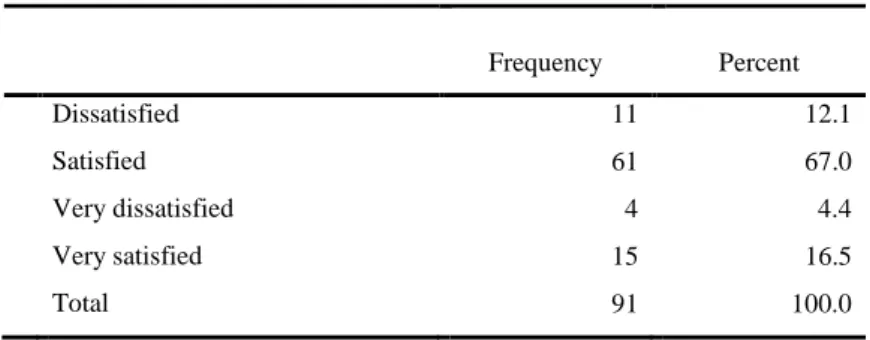
4 Table 4.4: Satisfaction with Salary ... 102
5 Table 4.5: Satisfaction with Pay Increases ... 103
6 Table 4.6: Response Frequencies for Section B, Question 6... 105
7 Table 4.7: Correlation Matrix ... 111
8 Table 4.8: KMO and Bartlett's Test ... 113
9 Table 4.9: Initial eigenvalues on First-Order Factor Analysis ... 114
10 Table 4.10: First-Order Factor Analysis: Factor Matrix (correlation) (a) ... 116
11 Table 4.11: Eigenvalues on Second-Order Factor Analysis ... 117
12 Table 4.12: Pattern/structure for coefficients (Rotated Component Matrix (a)) ... 118
13 Table 4.13: Underlying Pay Drivers ... 119
14 Table 4.14: Reliability Statistics: Factor 1 ... 120
15 Table 4.15: Item Statistics: Factor 1 - Non-performance Related Pay ... 120
16 Table 4.16: Reliability Statistics: Factor 2 ... 121
17 Table 4.17: Item Statistics: Factor 2 - Performance Related Pay ... 121
18 Table 4.18: Response Frequencies for Section C, Question 7 ... 123
19 Table 4.19: Response Frequencies for Section C, Question 8 ... 126
20 Table 4.20: Reliability Statistics... 128
21 Table 4.21: Correlation between primary pay driver extent of increase and impact of increase... 128
22 Table 4.22: Model Summary (b) ... 129
23 Table 4.23: ANOVA (b) ... 130
24 Table 4.24: Coefficients (a) ... 130
25 Table 4.25: Cargo handled (tonnage) ... 132
26 table 4.26: Containers Handled (TEUs) ... 133
27 table 4.27: Vessels visits (Number) ... 133
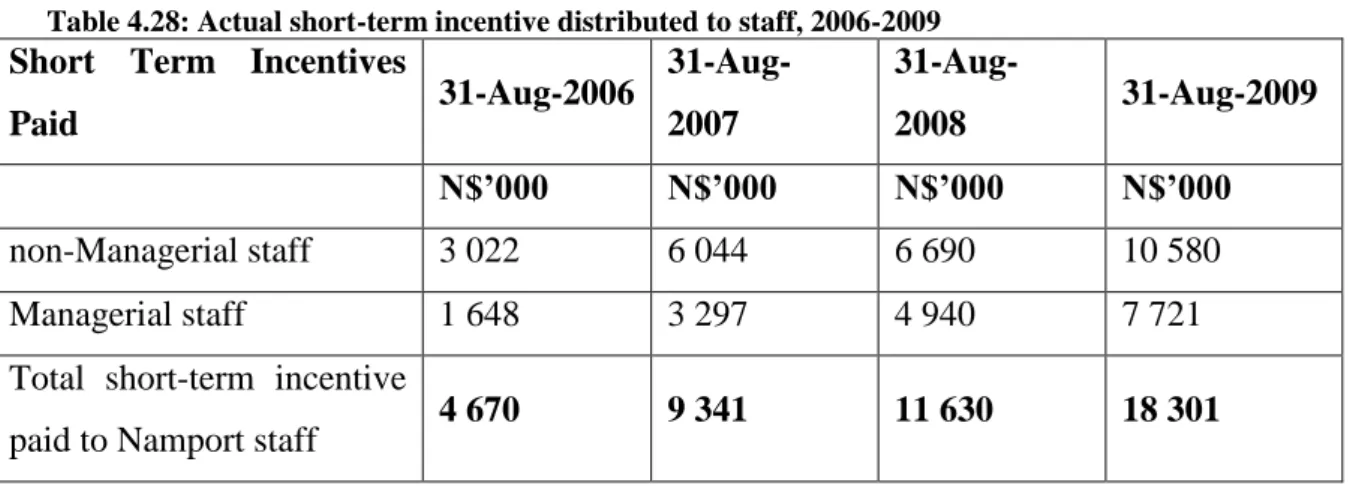
28 Table 4.28: Actual short-term incentive distributed to staff, 2006-2009 ... 145
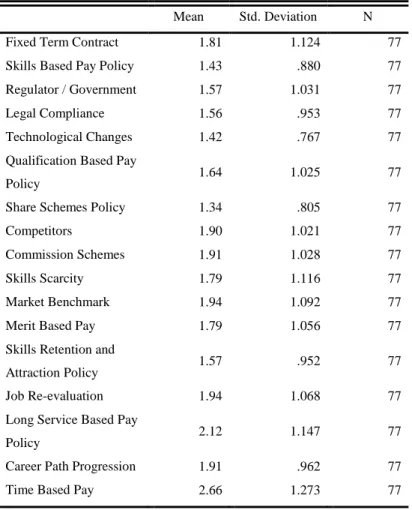
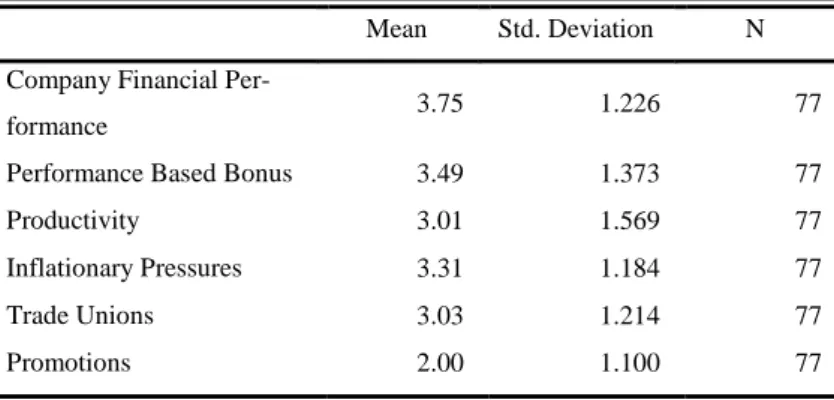
29 Table 5.1: Factors Driving Pay Increases Rank ordered by mean rating ... 154
30 Table: 5.2: Mean rating extent of increase of remuneration component and impact on Namport performance ... 156
Page | 1
CHAPTER 1: INTRODUCTION
1.1 Introduction
Namibia‟s State Owned Enterprises (SOEs) are perceived to be characterized by persistent poor corporate performances and soaring remuneration levels, ostensibly justified by the need to pay remuneration levels that are competitive enough to attract, motivate and retain talent. Concerns have specifically been raised over these excessive remuneration levels, which are believed to have reached unprecedented levels, despite the fact that some of the- se SOEs have had to continuously receive financial bail-outs from the government in the form of subsidies and guarantees.
This study seeks to establish factors that drove these pay increases, determine remunera- tion components that were increased and the extent thereof as well as determine which re- muneration components greatly contributed to a high positive impact on corporate perfor- mance (i.e. determine relationship between remuneration and corporate performance). The secondary research questions include the need to determine actual remuneration increases granted during the last three years as well as actual corporate performance over the same period.
The purpose of this chapter is to outline background to the research problem and to intro- duce the research objectives and questions. The chapter concludes with the rationale for the study as well as the limitations encountered.
1.2 Background to the Study
Remuneration levels in Namibia‟s SOEs have trended upwards over the last couple of years. It is believed that these increases happened at a faster rate and without being neces- sarily accompanied by commensurate growth in corporate performance (Staff Reporter, 2009). It is contended that organisational performance in many of these enterprises has been on a descending trend. Consequently, increases in remuneration have primarily been attributed to self-enrichment schemes even in cases where increases were perhaps justified (Maletsky, 2005).
Page | 2 The trend has generally caused a stir amongst the shareholder, general public and other stakeholders. The concerns about the scale and extent of remuneration levels in SOEs are exasperated by the following:
SOEs earning tremendous remuneration include those that are providing negative re- turns to the shareholders as well as receiving government support in the form of tax- payer funded bailouts
Remuneration structures in SOEs are generally perceived to be rewarding failure and encouraging complacency due to the conspicuous link between remuneration and per- formance
the remuneration levels are seen to be beyond what is warranted given the poor corpo- rate performances
the remuneration levels are perceived to have become increasingly out of line with av- erage wages, widening the gap between executives and other employees (Amupadhi, 2008).
In light of the above, the shareholder (i.e. Namibian government) has specifically been un- der pressure to respond and address the professed excessive pay in SOEs which it is be- lieved have not been accompanied by commensurate corporate performances. In an effort to address the situation, the shareholder legislated for the establishment of a centralised State Owned Enterprises Governance Council (SOEGC) to regulate executive remunera- tion in SOEs in order to ensure that remuneration packages are contained and that remu- neration practices do not reward failure nor are they misaligned to public expectations (State-owned Enterprises Governance Act No 2 of 2006).
As a result, the SOEGC issued a directive requiring remuneration and conditions of service of senior staff in SOEs to be pegged and equated to what is applied in the public / civil ser- vice (Katjiuanjo, 2007). This is despite the current perception that any attempt to standard- ize levels of pay would be difficult to enforce across SOEs. The directive is, in the words of SOEGC, meant to ensure a consistent, transparent and oversight governance framework to remuneration practices across all SOEs (Katjiuanjo, 2007).
Page | 3 On the other hand, there are those that maintain that current levels of remuneration in SOEs are justified and that the directive from the state is ill placed and has the potential to further dampen performance in SOEs especially those that have been performing. It is con- tended that for SOEs to be competitive (i.e. self-funding, generating profits from own rev- enue operations, raising own loans for capital expenditure and paying dividends to the State) and able to achieve their mandates, their remuneration levels need to be competitive to be able to attract and retain talent with the required expertise and experience, to be able to generate required performance (Muadinohamba, 2008).
Consequently, State Owned Enterprises have been placed in an uncertain position as to what remuneration decisions they should be making in the remuneration space. The need for organisations‟ ability to understand the factors that will help them overcome this diffi- dence is therefore critical in order for them to come up with remuneration policies that en- able them to get value from their ever mounting wage bills.
There has been no scientific study conducted in Namibian SOEs to comprehensively inves- tigate pay drivers and the empirical relationship between organisational performance and remuneration levels. The actual levels and drivers of pay in Namibia‟s SOEs as well as their impact on corporate performance have not yet been quantified. This makes it difficult to determine the extent to which pay levels in SOEs have actually been justified.
In light of the above, there is not enough Namibian empirical evidence to assist with deci- sion making in terms of how this paradox of soaring remuneration levels coupled to poor corporate performance can be overcome. Therefore, the lack of empirical data on pay driv- ers and the extent of their impact on corporate performance warrant a closer examination in order to close some of the knowledge gaps in this regard. It is against this background that this study was initiated.
1.3 Focus of the Study
Given the sensitivity of the topic as well as the difficulty to obtain necessary information, this study shall only focus on examining pay practices for a single SOE, the Namibian Ports Authority.
Page | 4 The Namibian Ports Authority (Namport) is a commercialised State Owned Enterprise es- tablished by the Namibian Ports Authority Act, 1994 (Act No 2 of 1994). The Authority is governed in terms of the above Act as well as the State-owned Enterprises Governance Act, 2006 (Act No 2 of 2006), which makes provision for efficient governance and moni- toring of the performance of state-owned enterprises in Namibia.
The Authority is 100% owned by the Government of the Republic of Namibia. The Au- thority manages and controls the ports, lighthouses and other navigational aids in Namibia and its territorial waters and provides facilities and services normally related to the func- tioning of a port. The Authority operates in the same manner as any privately owned com- pany and has so far not received any bailouts from its shareholder (Namport Annual Re- port, 2009).
The company is well regarded in Namibia as it is one of the top performing SOEs in Na- mibia. Since commercialisation in 1994 Namport has significantly been profitable and has spent large amounts of money on upgrading its infrastructure in order to ensure a reliable and modern port infrastructure.
The Authority has a staff compliment of more than 500 employees and is managed by a Board of Directors appointed by its sole shareholder, the State. The Board has overall re- sponsibility and accountability for the affairs and performance of the Authority. The board gives strategic direction and monitors executive management closely in implementing board strategies and plans (Namport Annual Report, 2009).
The Board has established a Remuneration Committee which is responsible for making recommendations to the board regarding the determination of the remuneration of direc- tors, executive and senior management. The remuneration committee comprises three non- executive directors and the chairperson of the committee is an independent non-executive director (Namport Annual Report, 2009).
Page | 5 1.4 Research Objectives and Research Questions
The primary objective of the study is to empirically establish and determine pay increase drivers in Namport and to establish the extent to which current remuneration structure and levels have contributed to increased corporate performance and returns for the sharehold- ers. The finding would help confirm or refute the current opposition and concerns round the perceived excessive compensation levels amongst SOEs.
The fundamental questions requiring answers are as follows:
What factors drove pay increases and to what extent did they drive such increases in Namport over the last 3 years?
Which components of the remuneration package were increased and to what extent were they increased?
What impact did the pay increases have on Namport‟s corporate performance and what is the extent of such impact on Namport‟s corporate performance?
In addition the following secondary questions shall be answered through a secondary study:
Did Namport remuneration levels increase and to what extent did they actually increase in over the past 3 years?
Was the increase in Namport‟s remuneration levels accompanied by commensurate in- crease in corporate performance? In other words, to what extent has there been a rela- tionship between extent of change in pay and corporate performance.
Page | 6 Four main constructs have been identified and are depicted in Figure 1.1
Proposition 1 Proposition 2 Proposition 3 Proposition 4
1 Figure 1.1 Research proposition
1.5 Motivation for the Study
Research on the topic has generally confirmed that organisations that have implemented performance-based remuneration are best placed to attract and retain best talent as well as generates higher productivity or performance (Martocchio, 1998; Greenhill, 1988; Rynes and Gerhart, 2000). However, Namibia‟s State Owned Enterprises are arguably able to at- tract and retain best talent due to high levels of remuneration paid, but are not necessarily able to generate high levels of productivity and performance due to the conspicuous link between remuneration and performance.
Whilst there is empirical confirmation from the literature that the performance-related pay approach is critical to organisational success and maximised investment returns, the ap- proach does not seem to have been fully implemented in Namibia‟s SOEs. Therefore the public‟s current perception of “self-enrichment” scheme in SOEs may be justified given that there appears to be a lack of alignment between organisational performance and remu- neration levels in SOEs.
It was envisaged that the study will contribute to the current debate in the country on the merits and de-merits of pay levels in Namibia‟s SOEs and will help shape and inform deci- sions on remuneration levels for SOEs. In particular the following contributions were en- visaged:
Economically-inclined remuneration theories
Psychological motivation remuneration theories
Influence Remuneration
Strategy / Drivers Determine Remuneration
components Impacts Corporate perfor- mance
Page | 7
provide a deeper understanding of the relationship between pay drivers, remuneration components and organisational performance within an SOE environment, enabling an enhanced insight on the impact of various remuneration components on organisational performance
provide empirical results and insights indicating which pay drivers and remuneration components have the greatest impact on company performance. This will positively in- form the formulation of remuneration policy and will assist the following stakeholders:
o Shareholder: will aid the shareholder (i.e. SOEGC) to revisit its recently is- sued generic remuneration framework for SOEs in order to implement a rather broad remuneration framework that best ensures alignment between pay and en- terprise performance, upon which SOEs can build their own remuneration poli- cies. framework
o SOEs Board of Directors: will empower Boards with necessary empirical in- formation to enable them to formulate remuneration strategies and policies that are strategically positioned to enable the SOEs to respond to the challenges of attracting, retaining and motivating required talent without being accused of overpaying staff or compromising the principles of corporate governance and organisational performance.
o SOEs Management: The sole objective for paying competitive remuneration levels to employees in any organisation is to create value for both the company and its shareholders. Thus finding an acceptable and consistent criteria for ad- justing remuneration levels is not only a matter of concern to Management, but increasingly also important to shareholders and all other stakeholders. Attract- ing and retaining high-performing employees is critical but will be useless if not directly linked to creation of shareholder value. SOEs will be well-placed to come up with defensible and transparent remuneration policies and structures that have public confidence and blessing given the sought-after alignment be- tween pay and organisational performance.
Page | 8 o General Public: The study is of particular importance to the general public and
other stakeholders. It is expected to help the general public understand circum- stances under which specific compensation levels (i.e. enterprise performance and success) would be acceptable and stop perceiving remuneration levels as outrageous where these are justified. The general public will thus be empow- ered to appreciate organisational conditions under which specific remuneration levels are justified and not perceived to be outrageous.
1.6 Limitations of the Study
This study focused specifically on Namport. The study was constrained by the non- availability of related studies conducted in Namport and other Namibian SOEs.
The study was also constrained by the limited availability of information due to the confi- dential nature of remuneration information and the possible reluctance of the respondents to share information. This contributed to major delays in completing the study due to com- prehensive and continuous follow-ups which had to be made with participants to get the information.
Although the study focuses on one SOE out of a total of fifty two (52) SOEs in Namibia, it is believed that the recommendations emanating out of this study would generally be ap- plicable and useful for the rest of the SOEs.
1.7 Chapter Layout
The study is structured as follows
Chapter One introduces the study, while Chapter Two contains the literature review.
Chapter Three defines the quantitative research design and methodology followed in col- lecting the empirical data to address the research questions.
Page | 9 Chapter Four describes the results of the empirical study and provides a statistical analy- sis of the quantitative data collected in relation to the variables. Preliminary findings are also noted.
Chapter Five provides an interpretation of the results of the quantitative research. The re- sults are contextualised in terms of the primary and secondary research questions.
Chapter Six is a summary of the study, with concluding remarks on the research findings and the research limitations. It also contains suggestions regarding future fields of study which could be embarked on as a result of this research.
1.8 Chapter Summary
This chapter provided an outline of the research problem as well as a high level summary of the rationale for the study. The study is warranted by a lack of empirical evidence on pay drivers, remuneration components and their relative impact on corporate performance.
It is envisaged that the findings of the study would provide useful insights that are compel- ling enough to change the current widespread perception that SOEs personnel are being paid “excessive remuneration levels” as well as to influence a review of the recently adopt- ed remuneration framework in Namibia‟s SOEs, which has been found to be ill-placed and inappropriate.
The next chapter provides a review of the literature in order to establish what is currently known with respect to the research objectives.
Page | 10
CHAPTER 2: THEORETICAL AND CONCEPTUAL FRAMEWORK
2.1 Introduction
Remuneration is about how employees in organisations are paid. Although there are differ- ent pay practices for employees stretching across industries and enterprises, remuneration structures typically fall into two forms: fixed / guaranteed remuneration and variable re- muneration. A broadly defined remuneration package of an employee would therefore be usually constituted by a combination of the following remuneration elements: a basic sala- ry, employment fringe benefits (i.e. medical aid benefits, retirement benefit, life insurance etc.), a meaningful and challenging short-term performance based incentive scheme and also a longer term incentive (Armstrong and Murlis, 2007).
Armstrong and Murlis (2007) further contends that remuneration structures can be de- signed in an unlimited number of ways and a single employer typically will use a combina- tion of several ways to design remuneration packages appropriate to their organizations and industry.
Economic and sensational issues surrounding remuneration levels especially for executive staff have received considerable global attention in both academic literature and the media over many years. However, there is no consensus about what is just and reasonable remu- neration and what the key drivers of remuneration are, relative to their respective impact on corporate performance (Cyert, Kang and Kumar, 2002). In Namibia like in many other countries, some people condone the practice of Executives receiving millions of Namibian dollars for their work and others strike down such practice, saying it is not justifiable that one person receive millions of dollars as a salary.
This chapter presents a conceptual framework to compensation and will seek to: (1) suc- cinctly examine remuneration strategy and policy framework, (2) outline the constituent elements of remuneration, (3) delineate the key compensation drivers (4) explore the rela- tionship between compensation drivers and corporate performance and (5) illustrate a theo- retical framework for the corporate performance indicators.
Page | 11 2.2 Theoretical Framework for Remuneration Management
In order to undertake systematic consideration of remuneration drivers, an understanding of a range of theories that underpin and inform remuneration practices is a prerequisite.
Perkins and White (2008: 60) opine that analytical models and prescriptions addressing the propensity of individuals and groups to make their labour available and to accept direction and commitment to managerial aspirations are available in abundance.
As has been affirmed in the literature, several schools of thought exist on the complex sub- ject of drivers for remuneration levels within an employment context. Perkins and White (2008: 60) classify the theoretical models into economic-inclined remuneration theories and the psychological motivation remuneration theories.
Economic-inclined remuneration theories assume that employment relationships, expecta- tions among parties and the regulation of remuneration systems should primarily be mod- elled along the factors associated with economic exchange, whilst the psychological moti- vation remuneration theories place greater emphasis on behavioural and biological factors, articulating roles for active managerial initiatives and alternating between efforts intended to modify employee behaviours or to create the environmental conditions in which em- ployees may direct their own efforts to act in ways that may satisfy managerial goal- directed aspirations (Perkins and White, 2008).
These, being the theoretical foundations that inform and influence remuneration policies and practices, are expounded upon in the next section.
2.2.1 Economic-inclined Remuneration Theories
The principle of economic-inclined remuneration theories is that there is competition for labour in the same way that goods and services are traded within a capitalist society. In this regard, employers seek to purchase labour at the best price and employees seek to sell their labour within this market at the best price (Perkins and White, 2008). Next we consider the main economic theories concerning remuneration.
Page | 12 2.2.1.1 Classical Labour Market Theory
The assumption of this theory is that pay will be fixed in the labour market where the de- mand for employees equates exactly to the supply, known as market clearing (Perkins and White (2008: 34). So when the supply of labour meets employers‟ demands, employers will have to offer work at that price and employees will have to accept work at that price.
This theory suggest that there is little point in employers attempting to differentiate them- selves from their competitors by paying different salaries as in the final analysis everyone has to pay the same as everyone else.
The theory is however criticised for being too simplistic and its glaring ignorance of the realities on the ground such as the effects of market distortions resulting from potential po- litical interventions or trade union actions (Perkins and White, 2008: 34).
2.2.1.2 Institutional Labour Market Theory
This is an alternative economic theory to the classical economic theory and redefines the market clearing model in order to explain differentials between wage levels, contingent on institutional factors (Perkins and White, 2008: 38). Whilst the institutional labour market theory is predominantly based on the suppositions of the classical labour market theory, the differentiation is brought in whereby scope is introduced to cater and compensate for mar- ket imperfections. Factors as arising from the environmental and organisational context are introduced that may be associated with differential employee remuneration levels across the labour market.
2.2.1.3 Human Capital Theory
The human capital theory is another economic theory relevant to remuneration based on the assumption that individuals accumulate human capital by investing time and money in education, training, experience and other qualities that increase theory productive capacity and thus worth to an employer. While all employees bring some skill and experience to their job, additional qualifications and experience give rise to differentiation in the level of reward necessary to secure and retain certain people (Perkins and White, 2008: 40).
Page | 13 The human capital theory hinges therefore on the need for organisations to cost-effectively secure, develop, motivate and hang on to those special skills that are mission critical if an institution is to achieve its organisational objectives.
2.2.1.4 Exchange Theory
The exchange theory is premised on the notion that, under capitalist relations of produc- tion, employers and employees enter into an agreement whereby they employer contracts to pay wages or other extrinsic rewards to the employee in return for willingness on the part of employees to give up their right to leisure and accept the direction of the employer over their labour services. The labour then has to convert rented labour power into that which created economic value. Issues round the relative value of different skills and the transaction costs in harnessing them partly explain the segmentation of the workforce into core and peripheral skills (Perkins and White, 2008: 40). As a matter of principle employ- ers will generally invest more in the core skills than the peripheral skills that can be dis- pensed with when times are tough.
2.2.1.5 Efficiency Wage Theory
The efficiency wage theory is based on the premise that if employers assume that employ- ees will use their human capital to secure alternative work at enhanced pay rates, but their loss to the employer would incur transaction costs greater than paying above market rates, paying higher reward levels is a rational employer response to sustain an on-going rela- tionship. Efficiency wages are thus an investment into specific skills and knowledge to maximise loyalty and minimise opportunistic employee behaviour (Perkins and White, 2008: 41).
The theory is also based on the premise that if the job is more complex higher levels of re- ward are offered to employees in the expectation that employees will see it as an incentive to perform better than the external market norm. In other words, if employees feel better paid, they will not only be inclined to work harder but also their performance will be con- ditioned by a fear of losing employment with above-market pay rate. Similarly, organisa-
Page | 14 tions whose operating strategies require highly skilled employees may find it more effi- cient to use above-market pay rates to signal their wish to attract above-average quality employees.
2.2.1.6 Principal-Agent Theory
The agency theory emerged from the seminal papers of Alchian, Demsetz, Jensen and Meckling (1976), seeking to find solutions to the universal challenging agency relation- ship, whereby the shareholder (principal) delegates his business to the manager (the agent) to manage it on his behalf. The theory advocates that all directed behaviours are designed to achieve outcomes and that generally speaking people who have agreed to make their time available will not be induced to try harder unless one indicates what is in it for them.
This in essence means that behaviours need to be directed toward organisational goals through the offering of incentive rewards on a meaningful scale (Hall and Murphy, 2002).
The fundamental problem, in terms of this theory, is the separation between ownership and control, which vests the manager (the agent) with significant discretion to influence share- holder (the principal) value. However, if the manager‟s interests are not fully aligned with shareholder interest, the manager will make decisions that benefit him at the expense of the owners. At the heart of the principal–agent problem is the reality that managers might nat- urally be inclined to exert less effort or perhaps focus on business strategies that fit their risk preferences, rather than on those that would maximize shareholder value over the long-run.
According to Perkins and White (2008), Agency theorists reason that alignment of interests between employed agents and shareholders will require employees to share the risks asso- ciated with the organisation. This can be achieved by implementation of the following, amongst others:
Deferred payments - making a significant amount of employees‟ potential total earn- ings dependent on their own contributions to the organisation‟s financial success. Out- come-based differed remuneration such as profit sharing, gain-sharing and long-term share-ownership-based incentive plans may be used in this regard
Page | 15
Pay-at-Risk – whereby pay rates may be set below market-guaranteed levels and em- ployees are offered the opportunity to earn above average total remuneration, contin- gent on higher performance.
Pay Progression – associated with notions of incremental pay progression as employees ascend internal job ladders, reasoning that the expectation of a full return on their hu- man capital investment only over a lengthy employment career will encourage people to stay beyond the below market paid phase in early period of employment.
Seniority-based increases - an investment in seniority-building increases the individu- al‟s economic worth to the employer while acting to mitigate divergence in the inter- ests of employees and other stakeholders over the longer term (Perkins and White, 2008).
The principle behind the theory is that a proportion of employees‟ remuneration should be linked to corporate and individual performance in order to bring into line their interests with those of shareholders and to give them incentives to perform at the highest levels. In this regard, there is general consensus in the literature that to guarantee the longevity and success of a company, it is important to ensure that a suitable compensation structure is in place that seeks to ensure that the goals of employees are aligned to those of the organisa- tion. Shleifer and Vishny, 1997 and many others are of the same mind that variable remu- neration is one of the most proficient ways of aligning employees and shareholders‟ inter- ests by tying employees‟ remuneration to company performance.
The drawback, however is that measures introduced to address the principal-agent prob- lems have contributed to excessive remuneration levels.
2.2.1.7 Internal Labour Markets
The internal labour market (ILM) approach is based on the premise that a structured inter- nal labour market must be created and maintained to shield the organisation‟s employees from the whims of external market forces impacting on an organisation‟s ability to retain its employees. Certain positions are thus reserved for internal recruitment only or automat-
Page | 16 ic promotion on internal employees into such positions. This preservation of skills within the business serves as a basis for sustainable competitive advantage and has an incentive and retention effect on employees (Gerhardt and Rynes, 2003).
In terms of this theory pay progression is offered over the course of a career to motivate employees to remain within an organisation. Wage rates are attached to jobs and employ- ees are rewarded by clear long-term and guaranteed career trajectories rather than purely financial incentives. Labour pricing and allocation are governed by corporately determined rules and procedures whereby jobs are arranged hierarchically and reward rates are at- tached to jobs rather than to individuals (Gerhardt and Rynes, 2003).
The downside of this theory is of course sacrificing access to a wider talent pool.
2.2.1.8 Wage-gap Theory
The wage-gap theory also known as the union mark-up theory arose out of the industrial relations writers seeking explanations for the differences in wage levels between unionised and non-unionised workplaces (Gerhardt and Rynes, 2003). The key driver behind this theory is the capacity of employees with scarce skills in a labour market characterised by shortage of skills to use the opportunity to bargain for higher remuneration levels as well as the capacity of organised labour to halt production through the use of measures such as strike to demand higher remuneration levels in the face of rising inflation and cost of liv- ing.
Additionally, Perkins and White, 2008 attributes the wage-gap theory to agreement by em- ployers to increase remuneration levels in the face of a strike or to share part of the profits with the workforce in return for agreement by employee representatives for continuity of operations, the outcome of which is a trade union mark-up over competitive market rates.
2.2.1.9 Synopsis: Economic-inclined Remuneration Theories
Evident from the afore-discussed economic theories is the fact that the basic questions of how much an employer should pay and what employees may realistically expect to be paid
Page | 17 for their skills and competencies may be addressed in a variety of ways. The exclusive market regulating approaches can clearly not be the sole determinant of remuneration lev- els given their imperfections and given the need for employers to leverage on their balloon- ing wage bills as well as the need for employee to leverage on their skills which in some instances may be scarce. It is thus clear from the range of approaches discussed that there can be no generally accepted “one-size-fits-all solution to remuneration challenges.
2.2.2 Psychological Motivation Remuneration Theories
According to Perkins and White, 2008: 49, it may appear self-evident that to be effective, remuneration systems need to be based on a sound understanding of how people at work are motivated. This is particularly based on the premise that there is a need to understand how remuneration systems affect employee behaviour and the role of remuneration as a managerial lever for employee performance.
Thus, in the next section we consider theories associated in particular with psychological motivation to perform in work situations.
2.2.2.1 Frederick Taylor’s Theory of Scientific Management
Fredrick Taylor regarded employees as rational and economic in their approach but essen- tially lazy and requiring to be encouraged and inspired by management through the remu- neration system. The core of the theory is that employees are motivated primarily by mon- ey. It was thus deemed important to ensure that jobs are structured in such a way that they were capable of maximising earnings. This implies that reward is to be tied to task/output attainment, provided this is exactly in accordance with managerial specifications (Perkins and White, 2008). This approach emphasised the role of the outcome-based incentives as a motivational financial reward which combined with a paternalistic management style is believed would sustain labour productivity levels and discourage workforce unionisation.
This theory has however been widely criticised for its tendency to equate people with ma- chines, its assumption that there was only one universal best method and that the individu- al‟s inventive to earn money is the primary motivating factor at work (Rose, 1978: 62).
Page | 18 Nonetheless the impact of this theory on remuneration practices has been remarkably dura- ble and evidence exists to suggest that individuals believe others are motivated by money even as they know that they themselves are less so (Pfeffer, 2001).
2.2.2.2 Elton Mayo’s Hawthorne Study
This theory is based on the research results of Elton Mayo, legendarily known as the
“Hawthorne Experiments.” He carried out behavioural trials at the Hawthorne Works of the American Western Electric Company in Chicago. He carried out experiments, intro- duced rest periods amid work performance and also introduced snacks during the breaks.
Based on the research results Elton Mayo concluded that employee motivation was an in- tricate matter. He concluded that it was not only about remuneration, employment condi- tions and morale but also included psycho-social dynamics (Marchington and Wilkinson, 2008).
This study has been critiqued from many angles. However, the fundamental learning points emanating from the study are that: human beings are motivated by more than just remuner- ation; the need for acknowledgement and appreciation as well as the need to belong are imperative drivers and employees‟ approach with respect to work are meaningfully influ- enced by the team. Marchington and Wilkinson (2008) advocate that the implications for this approach for remuneration strategy are not that payments are irrelevant, but that re- wards must be seen in a broader context, one in which employee objectives, other than the simple maximisation of earnings are important. New remuneration schemes may thus be warranted in order to increase productivity.
2.2.2.3 Abraham Maslow’s Need Hierarchy Theory
Maslow categorised people‟s needs into a hierarchy, consisting of physiological needs, safety and security needs, social needs, esteem needs and self-actualisation needs, which intensifies from the bottommost to the uppermost in the above-stated order. He drew con- clusions that as soon as a particular group of needs is gratified, it no longer serves as a mo- tivator, and the next need within the hierarchy comes to the fore. According to Maslow, (cited in Bratton and Gold, 2007), these are the needs that motivate employees at work de-
Page | 19 pendent on each individual employee‟s positioning within the hierarchy. The supposition of the theory is that physiological needs required to sustain human life must be fulfilled before the next need within the hierarchy (i.e. safety and security) becomes a motivator.
This iteration process is followed until the uppermost need (i.e. self-actualisation need) is fulfilled.
Marchington and Wilkinson (2008) opine that one implication of this theory is that for em- ployees on low wages and consequently operating at the lower end of the hierarch, money may loom more important than for those earning considerably more. The latter have satis- fied their basic needs, and may move on to higher level needs.
Whilst this theory is extensively acknowledged and utilised by many Managers, there is little research evidence supporting the notion of a universal hierarchy of needs. It is also apparent that employees may at the same time demand not only money but also more satis- fying work and are thus operating at more than one level of hierarchy at one time. The the- ory is further contradicted by widespread controversies round executive remuneration (Marchington and Wilkinson, 2008).
2.2.2.4 Douglas McGregor’s Theory X and Theory Y
The McGregor theory advocates that there are at least two techniques that can be used to lead and manage employees, namely Theory X which is negatively inclined and Theory Y which is positively inclined. McGregor researched and studied how supervisors interacted and managed employees. He drew the conclusion that Managers‟ style of supervising and managing staff was greatly depended on the assumptions and beliefs they held about the nature of people (McGregor, 1960).
The supposition of theory X is that employees are by nature slothful, indifferent in their work and required to be strictly managed and induced with rewards in order to get them to put in extra effort and go the extra mile. Contrastingly, the assumption of theory Y is that employees are by nature enthused and inspired by the need for self-esteem and the wish to excel in their job. Hence, management‟s role is to facilitate this positively inclined ap- proach to work (Marchington and Wilkinson, 2008).
Page | 20 It is evident from the above suppositions that McGregor‟s theory is built upon Maslow‟s theory, given that theory X assumes that employees are motivated by physiological, safety and security needs while theory Y assumes that employees are motivated by self-esteem and self-actualisation needs. Although this theory is discredited for generalising workplace dynamics and human conduct, it nonetheless solidifies the notion of money and incentives being key driving or motivating factors amongst employees (Marchington and Wilkinson, 2008).
2.2.2.5 Frederick Herzberg’s Two-Factor / Hygiene Theory
In his theory, Frederick concluded that there exist “satisfiers” and “dissatisfiers” for em- ployees at the workplace. His research (1966) found that satisfaction and dissatisfaction were not necessarily related. According to this theory, the fact that an employee may not be satisfied about a specific facet of their work does not necessarily imply that they were dissatisfied. Equally if employees did not feel dissatisfied, this did not imply automatic sat- isfaction (Wood et al 2005).
The theory associated satisfaction with good emotions and intrinsic factors such as achievement, accountability, appreciation, progression and the job itself. Extrinsic factors, also known as hygiene factors were linked with dissatisfaction or bad emotions and include variables such as HR policy, conditions of service, working environment, management and remuneration. In concluding his research he opines that the reverse of satisfaction is not dissatisfaction and that eliminating dissatisfying elements from the work does not neces- sarily lead to a situation where the job becomes satisfying. He further advocates that the existence of specific variables in the workplace is standard and the existence of these very variables does not lead to satisfaction. Contrastingly, their non-existence leads to demoti- vation. Correspondingly, there are certain variables, the absence of which causes no dissat- isfaction, but their being there has motivational impact (Wood et al 2005).
The key tenet of this theory is that unless the hygiene factors e.g. pay are satisfied, motiva- tors are of little use. Based on this theory, Marchington and Wilkinson, 2008: 458 argues that remuneration is a substantial “hygiene” factor and that a fitting level must be found
Page | 21 which satisfies employees‟ anticipations and hopes. Conversely, there may not necessarily be a motivating effect by paying above this level.
2.2.2.6 Victor Vroom’s Expectancy Theory of Motivation
Vroom‟s expectancy theory is one of the commonly accepted explanations of motivation.
The theory advocates that the extent to which a person acts in a particular manner is con- tingent upon the extent to which the probability exists that such an act will be followed by an assumed result and on the appeal of that outcome to the person (Vroom, 1964). The the- ory assumes that an individual can be enthused to improve performance when there is a conviction that improved performance will lead to recognition and reward.
The key tenet of this theory is that Motivation = Expectancy x Valence. There are three principles that underpin this theory, namely: effort-performance association; performance- reward expectancy and the concept of valence. This implies that if a person realises that jerking up his performance will return a recognition incentive which he or she appreciates, then, in all likelihood such an individual shall increase his performance relative to a situa- tion where the outcome of increased performance is not rewarded. It is evident from the suppositions of this theory that Valence x Expectancy lead to motivation, which lead to action, which in turn lead to improved performance and then satisfaction in the form of re- wards (Vroom, 1964).
Additionally, the theory is widely credited for recognising that there is no universal princi- ple for explaining everyone‟s motivation which means that successful link between per- formance and pay is difficult to accomplish in practice. This is in contrast to the content theories of motivation, which are based on the assumption that all employees are alike, mo- tivated by money, recognition or whatever, and all situations are alike (Marchington and Wilkinson, 2008).
Flowing from this theory is the fact that Management need to demonstrate to employees that effort will be recognised and rewarded in both financial and non-financial terms. The importance of this theory is that the onus is on management to establish schemes to reward behaviour it wants, given that remuneration should motivate behaviour.
Page | 22 2.2.2.7 The Porter and Lawler Model
Lyman W. Porter and Edward E. Lawler (1968), cited in Perkins and White (2008) refined the expectancy theory to include the motivational influence of active self-reflection on the individual‟s abilities and other traits, the perceived nature of the role to be performed and the degree of equity attributed to both extrinsic and intrinsic reward likely to result from the endeavour.
This means that while performance is a function of the effort exerted, it is also affected by other factors such as the employee‟s capacity to do the work as well as by the employee‟s view of what is expected from him/her. It is hence the deduction of this theory that perfor- mance is the variable that brings about both intrinsic and intrinsic rewards.
This is encapsulated in Figure 2.1.
2 Figure 2.1: Porter & Lawler Model
Adapted from Lyman W. Porter and Edward E. Lawler (1968), cited in Perkins, SJ and White, G (2008). Employee Reward: Alternatives, Consequences and Contexts. Chartered Institute of Personnel and Development.
Page | 23 2.2.2.8 Stacey J Adams’ Equity Theory
The equity theory (Adams, 1963), suggests that the extent to which employees are moti- vated is influenced by how they perceive the remuneration structure i.e. whether they per- ceive the remuneration structure to be fair or not in relation to their efforts and inputs. This means employees weigh up their inputs (effort, performance) against outcomes (rewards) in comparison with other co-workers or peers elsewhere. If they feel that the employer owes them, then employees may seek to restore the balance. Accordingly, if employees feel that they are not fairly recognised and remunerated for their work they may resign or even go slow. However, if employees believe that they are commensurately remunerated for their work, they may increase performance levels. It is thus the deduction of this theory that human beings make personal conclusions to take a view of the nature of the relation- ship between inputs and outputs to determine whether equilibrium exists in order to appro- priately shape their actions within the workplace (Gerhardt, 2008).
2.2.2.9 Clayton Alderfer’s Existence, Relatedness and Growth Theory
This theory is premised on Maslow‟s needs theory. Its supposition is that there are three categories of fundamental needs, namely: existence, relatedness and growth. The existence category is apprehensive of human sustenance while the relatedness category pertains to the person‟s desire to have a communal relationship with other people in the community.
The third category is the inherent need for an individual to grow and develop (Gerhardt, 2008).
Gerhardt (2008) summed up the foremost deductions of this theory such that a human be- ing has several needs all of which require satisfaction. In instances where a primary need has not been contented, then the need to fulfil a secondary need increases.
2.2.2.10 David McClelland’s Theory of Needs
According to Perkins and White (2008), McClelland‟s theory is based on three types of motivating needs, namely: the need for power; the need for affiliation and the need for
Page | 24 achievement. The theory categorises human beings into these groups and concludes that individual motivation is dependent upon which group an individual belong to.
It is presumed that individuals with a great need for power are motivated by their being able to exert influence and control. They can be inspired to excel at what they do if they are empowered and occupy influential positions where they are allowed to exert authority.
Individuals with the need to affiliation constitute the second group. These are the individu- als who are generally outgoing, extroverted and thrive on being part of a team. They can be inspired to excel at what they do if they are recognised in social settings and maintain rela- tionships with others. The third group is constituted by individuals who are ambitious and motivated by success and the anxiety of not making it. They are inspired to excel at what they do if they perceive that chances of success exist (Perkins and White, 2008).
It can be concluded form the supposition of this theory that individuals are complex human beings whose motivational drivers are a function of many variables.
2.2.2.11 Reinforcement Theory
The reinforcement theory was propagated by Skinner (1953) cited in Perkins and White (2008) and advocates that employee motivation is a function of how their working envi- ronment is structured (Skinner, 1953). It is presumed that individuals are motivated by what is happening in their working environment and not so much by emotions and/or cog- nitive behaviours. According to Skinner (1953) employees seek positive reinforcement for the performance and hence the work setting should be designed in a way that will secure reinforcement for employees‟ performance. It thus flows from these assumptions that Managers should constantly positively shape the working environment in order to maintain high levels of motivation amongst staff.
Although the reinforcement theory may be viewed as less a motivational theory and more concerned with subjects‟ responses to social encounters, the assumption of this theory is that people seek positive reinforcement for their actions. Under this theory, differentiating between employees‟ individual performance outcomes will reinforce the learned connec- tion between actions and reward (Perkins and White, 2008: 52).