FAMILIES IN TRAUMA
The Experiences and Perceptions of the Maternal Caregivers of Children affected by
Extrafamilial Child Sexual Abuse
- Sarah Margaret Burton -
RA.Hons (University of Stellenbosch)
Submitted in partial fulfillment of the requirements for the Degree of Master of Arts (Clinical Psychology)
in the School of Psychology, University of Kwazulu-Natal,-
Pietermaritzburg Campus
November 2005
Declaration
I, the undersigned, hereby declare that the work contained in this thesis, unless specifically indicated to the contrary, is my own original work, and that I have not previously submitted it in
its entirety or in part at any university for a degree.
Sarah M. Burton
I
Noliefl1l3E/C. ~00S.Date
Thesis Supervisor's Approval for Submission
As the supervisor of this thesis, I have approved this thesis for submission.
BJ. Killian (Ph. D.) Date
Acknowledgements
To the following people, [ would like to express my sincere gratitude and appreciation for their support and contribution to this study:
• Dr. Bev Killian, my supervisor, for your professional guidance, encouragement and calm support throughout the process of this study.
• The participants for so willingly volunteering to share your experiences and those of your families. Itwas a significant privilege and honour to bear witness to your stories.
• Dominique Mamet, of the Vulnerable Children's Programme, for your helpfulness and professionalism, and for placing me in contact with potential role players and participants.
• Ntombenhle (Pretty) Zondi, of the Vulnerable Children's Programme, for your time, patience and calm presence in assisting with translation for the Zulu-speaking
respondents. Your manner was a most significant asset to the process of interviewing.
• Linda Naidoo and the team at Childline, Durban, for granting me permission to access participants through your organization, and for your general helpfulness during my times with you.
• My family and friends. Your love, support and belief in me have kept me strong and focussed during the past challenging months.
• Ed, for your love, quiet understanding and untiring patience.
Abstract
Child sexual abuse and its potentially traumatizing consequences, over both the short- and longer term, has been increasingly recognized in the literature as a possible pathway to the development of intra- and interpersonal maladjustment, affecting the mental well-being of those affected.
There is a paucity of local research investigating the systemic impact of a child's sexual abuse upon the caregiving and family systems in which the child is integrally embedded. The current research was conducted primarily in response to this, with the intention of illuminating the experiences of caregivers and families managing their child's experience of sexual abuse.
More specifically, the research was interested in the experiences and perceptions of caregivers of children who had been sexually abused by an extrafamilial person. The phenomenological approach informed the planning, implementation, analysis and interpretation phases of the research. The sample included six mothers/ female caregivers who had discovered their child's sexual abuse no less than three months and no longer than twelve months prior to the research being conducted. Maternal caregivers were the primary source of information regarding their own experiences, as well as spokespersons for the caregiving family unit and its members. Two semi- structured interviews were planned for each respondent, the first interview aimed at eliciting their experiences and perceptions, and the second interview aimed primarily at providing debriefing and feedback. In view of the highly sensitive nature of the interview topic, the second interview was structured primarily out of ethical concerns for the respondent's well-being as a consequence of the interviewing.
Results of the interviews suggest that these caregivers were faced with a host of complex experiences related to three broad thematic areas, namely: their involvement with the criminal justice system; managing the child's and family's distress; and themes around coping and support. A number of sub-themes were identified within and across these three broad thematic areas, representing a complex interaction between dominant experiences. Caregivers were typically faced with a series of dilemmas and decisions in their interactions with their child, family, and the criminal justice system. Based upon the findings, a number of suggestions have been made in terms of policy and protocol development for intervening with such families and their children.
Table of Contents
Title page 1
Declaration 11
Acknowledgements .. , III
Abstract .IV
Table of contents V
List of tables and figures XI
Preliminary comments '" XII
CHAPTER ONE - INTRODUCTION 1
1.1 Child sexual abuse in context l
1.2 Child sexual abuse, caregiving and family systems 1
1.3 Parameters ofthe present research 3
1.4 Overview of the present research .4
CHAPTER TWO - LITERATURE REVIEW 5
2.1 Introduction to CSA in South Africa 5
2.1.1 The cultural construction ofsexual relations 5
2.1.2 The context and profile of
cs
A 62.1.3 The constitutionalframework and legislative background 10
2.2 Definition of Terms 12
2.2.1 Non-legislative definitions: Child abuse and CSA 12
2.2.1.1 "Child abuse" 12
2.2.1.2"Child sexual abuse" 13
2.2.1.3 Contact and non-contactforms of
cs
A 142.2.1.4Specijication and objectijication in CSA 16 2.2.1.5Contemporary developments in definition 16
2.2.2 "Family" 17
2.2.3 "Extrafamilial" 18
2.2.4 "Secondary traumatization" 19
2.3 Parental, caregiver and family responses 20
2.3.1 Risk and protective factors - Intrafamilial and extrafamilial CSA 20
2.3.1.1 Family risk variables for CSA 20
2.3.1.2 Family protective factors in CSA 23
2.3.2 Caregiver andfamily secondary trauma reactions 24
2.3.3 Effects ofparental or caregiver reactions 25
2.3.4 Common caregiver reactions 26
2.3.5 Differential caregiver reactions -Acute and chronic 28
2.3.5.1 Maternal reactions 28
2.3.5.2 Paternal reactions 33
2.3.5.3 Reactions ofnon-abused siblings 34
2.4 Theoretical orientations 34
2.4.1 The etiology and impact of
cs
A , 352.4.1.1 Thefamily systems tradition 35
2.4.1.2 Thefour pre-conditions model ofsexual abuse 37 2.4.1.3 The impact of
cs
A -A conceptualframework 39 2.4.2 Theoretical frameworks pertaining to the familial effects ofECSA .412.4.2.1 The loss model 41
2.4.2.2 The post-traumatic stress disorder model 44
2.4.2.3 Other theoretical advances 44
2.4.3 The family myth model 46
2.4.3.1 Definition of "family myth" .46
2.4.3.2 Common parental issues and themes .47
2.4.3.3 Common parental andfamily myths and beliefs 48
2.4.3.4 Towards a theoretical framework 49
CHAPTER THREE - RESEARCH DESIGN AND METHODOLOGy 51
3.1 Research questions 51
3.2 Research design 53
3.3 Design validity and coherence 55
3.4 Ethical considerations and integrity of the research 57
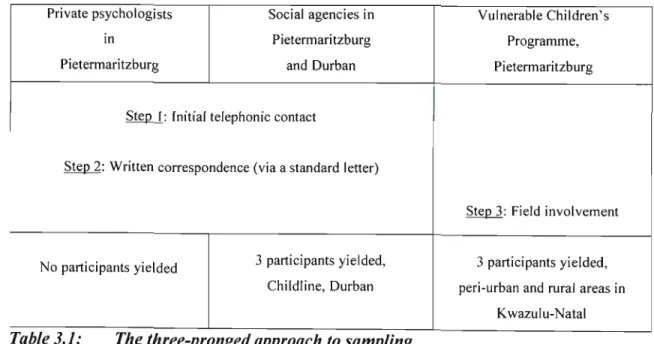
3.5 Sampling 60
3.5.1 Criteria for inclusion 63
3.5.1.1Entry level ofresearch 63
3.5.1.2Householdfamity member participation 63
3.5.1.3Non-participation criteria, age and temporal limits 64
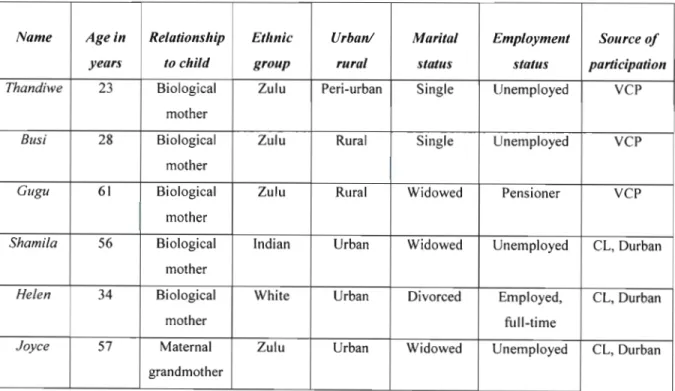
3.5.2 Description ofthe research participants 65
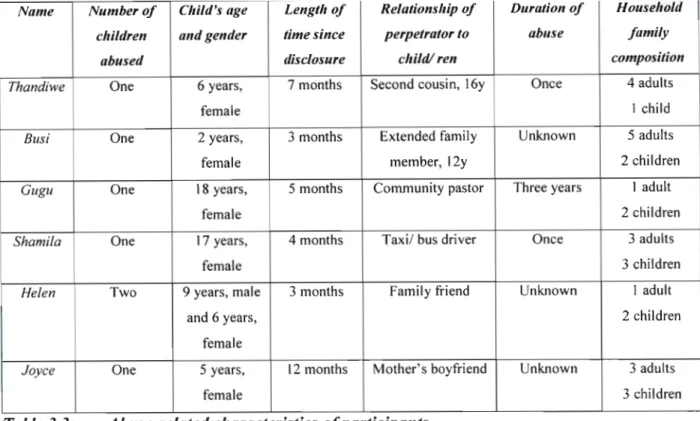
3.6 Interviews 68
3.6.1 Development ofthe interview schedules 70
3.6.2 Setting up the interviews 70
3.6.3 The first interview 71
3.6.4 The second interview 71
3.7 Data analysis 73
3. 7.1 Transcribing the interviews 73
3.7.2 The process ofdata analysis 74
3.8 Reliability and validity 78
3.8.1 Definitional issues within qualitative research 78
3.8.2 Safeguarding reliability 78
3.8.3 Upholding validity 79
CHAPTER FOUR - RESULTS AND DISCUSSION 81
4.1 The process of finding out and discovery 83
4.1.1 The aftermath ofdisclosures 83
4.1.2 Initial emotional responses 83
4.1.3 Entry into the "system" 85
4.1.4 Managing the chitd's distress 86
4.1.5 "Not knowing" and the questfor truth 87
4.2 Disillusionment and frustration with the system 89
4.2.1 Insensitivity ofthe system 89
4 2 2. . "JI4'olce essness Witl " . h'Int e systemh 90
4.2.3 Abandonment and neglect by the system 90
4.2.4 Helplessness and powerlessness in the face ofsystem apathy 90
4.2.5 Waiting for justice '" '" 90
4.2.6 Ambivalent hope '" 93
4.2. 7 Feeling failed by the system 94
4.2.8 Prac~icalconsequences ofsystem involvement 94
4.3 Living with fear and loss of hope 94
4.3.1 Ongoing threats to safety 95
4.3.2 Changed perceptions ofbeing in the world 96
4.3.3 Fearsfor thefuture 97
4.3.4 "Being a virgin" and the concept ofhope 98
4.3.5 Living in limbo 99
4.3.6 Release and relieffrom perpetualfear 99
4.3.7 Current solutions to threatened safety 99
4.4 Culpability ofthe maternal caregiver 100
4.4.1 Maternalfailure to protect 100
4.4.2 Caregiver isolation and burden ofresponsibility 101
4.4.3 Culturally and socially defined gender roles 102
4.4.4 The conflicted positioning ofblame and guilt 103
4.5 The centrality of shame 104
4.5.1 Maternal shame within thefamily 105
4.5.2 Community isolation and stigmatization 106
4.5.3 Maintaining the silence 107
4.6 Consequences to the child and family 108
4.6.1 Initial sequelae 108
4.6.2 The meaning ofthe abusefor thefamily 109
4.6.3 Differentialfamily response 109
4.6.3.1 Maternal response 109
4.6.3.2 Paternal response 112
4.6.3.3 Sibling responses I 12
4.6.4 Dynamic and relational effects 113
4.6.4.1 Conflicts in relation to the self '" 113
4.6.4.2 Conflicts in relation to the child I 14
4.6.4.3 Conflicts in relation to the broader, extendedfamily_ 116 4.6.4.4 Conflicts in relation to the perpetrator I 16 4.6.4.5 Conflicts in relation to the paternal caregiver I 16 4.6.4.6 Conflicts in relation to the broader community 117
4.6.5 Intra-family isolation and polarization 118
4.7 Coping with loss 118
4. 7.1 Social support 118
4.7.1.1 Perceived loss ofanticipated support 119
4.7.1.2 Valuable sources ofsocial support 120
4.7.1.3 Social support and resilience 121
4.7.1.4 Needs for professional support 121
4.7.2 Faith in a higher power 122
4.7.2.1 "Managing through God" 123
4.7.2.2 Faith in the "system" 123
4.7.3 Coping strategies 124
4.7.3.1 Wishful thinking 124
4.7.3.2 Finding "evidence" retrospectively 125
4. 7.3.3 Denial and thought avoidance 125
4.7.3.4 Justification and rationalization oflosses 126 4.7.3.5 Normalization and minimization oflosses 126
4.7.3.6 Isolation and withdrawal 126
4.7.3.7 The cycle ofhope versus despair 126
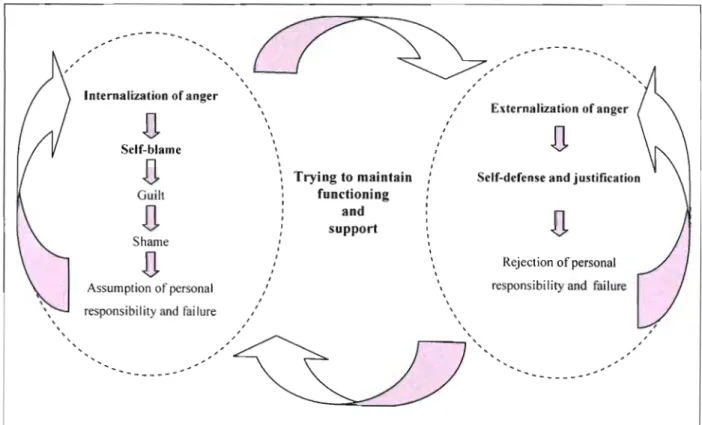
4.7.3.8 The conflict ofself-blame versus self-justification and defense 127
4.8 Experience of the interviews 127
4.8.1 Thepain ofrecollection 127
4.8.2 The value offeeling heard 128
4.9 Conclusions 129
CHAPTER FIVE - RECOMMENDATIONS AND CRITIQUE 131
5.1 Implications of the findings of this research 132
5.1.1 Caregiver-childfunctioning and well-being 132
5.1.2 Guidelines for protocol development 133
5.1.3 Recommendations for intervention 134
5.2 Limitations of the research 136
5.3 Recommendations for future research 138
CHAPTER SIX - CONCLUSIONS 139
REFERENCES 143
APPENDIX A:
APPENDIXB:
APPENDIXC:
APPENDIXD:
APPENDIXE:
APPENDIXF:
APPENDIXG:
APPENDIXH:
APPENDIX I:
APPENDIXJ:
APPENDIXK:
APPENDIXL:
APPENDIX M:
APPENDIXN:
APPENDIX 0:
Diagnostic criteria for post-traumatic
stress disorder (PTSD) 153
Diagnostic criteria for Acute Stress Disorder 155 Introductory pre-amble to interview schedules 156
Translator's pledge of confidentiality 157
Participant form of informed consent 158
Child assent form 159
Standard questionnaire: Participant demographics 160 Interview schedule: The first interview 161 Interview schedule: The second interview 163
Data analysis: Thandiwe* 164
Data analysis: Busi* 168
Data analysis: Shamila* 173
Data analysis: Joyce* 178
Data analysis: Gugu* 188
Data analysis: Helen* 195
*
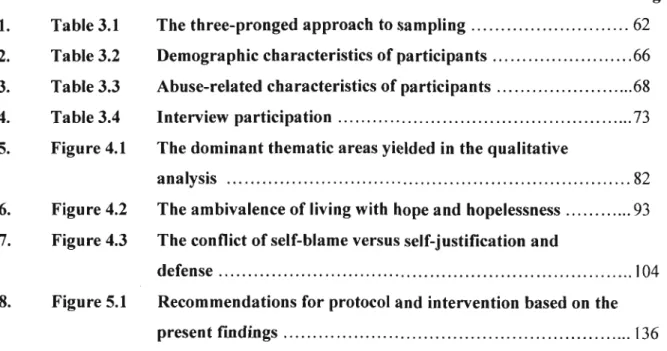
Pseudonyms have been used throughout this thesis to protect the identities and anonymity of the participants.1. Table 3.1 2. Table 3.2 3. Table 3.3 4. Table 3.4 5. Figure 4.1
6. Figure 4.2 7. Figure 4.3
8.
Figure 5.1List of Tables and Figures
Page
The three-pronged approach to sampling 62
Demographic characteristics of participants 66 Abuse-related characteristics of participants 68
Interview participation 73
The dominant thematic areas yielded in the qualitative
analysis 82
The ambivalence of living with hope and hopelessness 93 The conflict of self-blame versus self-justification and
defense 104
Recommendations for protocol and intervention based on the
present findings 136
Preliminary Comments
1. Frequently used abbreviations and acronyms
Throughout the text of this study the following abbreviations and acronyms have been used for the sake of brevity:
CSA Child sexual abuse
ICSA Intrafamilial child sexual abuse
ECSA Extrafamilial child sexual abuse
CJS Criminal justice system
2. Use of pseudonyms
Pseudonyms have been used throughout the body of this thesis when referring to the identities of participants. While thepseudo~ymshave been used primarily to protect personal identities, they have also been chosen so as to reflect the cultural and race groupings of the participant
individuals.
3. US style of spelling
The researcher has used the US style of spelling throughout this document for ease of reading.
4. Transcripts of the interviews
Page and line references have been made within this document to the interview transcripts. While not attached, these are available upon request.
CHAPTER ONE INTRODUCTION
1.1 Child sexual abuse in context
Despite recent increases in public, media and research concern with the phenomenon of child sexual assault, social-systemic interventions aimed at preventing and managing the intra- and interpersonal consequences, and possible longer-term implications of such trauma within our communities, are proving difficult to implement and slow to follow suit. Against the background of poverty and high rates of unemployment, the rapid proliferation of HIV/AIDS, together with the increasing incidence of child sexual assault, creates a unique set of challenges for South African public health strategies. A great number of our children, families and communities are suffering from multiple sources of hardship and trauma, often with few accessible resources for coping. Furthermore, while a great number of our children are predicted to be orphaned as a consequence of HIV/AIDS over coming years, many, too, will be living with the disease as a direct result of sexual assault (Jewkes, 2004). The physical and mental well-being of our children and families is, thus, a pertinent and socially relevant area for ongoing research endeavours.
1.2 Child sexual abuse, caregiving and family systems
While there is an increasing body of research documenting the host of potential, and variable, negative consequences of sexual abuse (both immediate and long term) at the level of the individual child's development (Killian & Brakarsh, 2004), the likely impact on caregivers, family systems and broader community functioning has been somewhat overlooked (Banyard, Englund& Rozelle, 200 I). Furthermore, it has also been recognized in the literature that the ramifications of child sexual assault, whether incestuous (intrafamilial) or non-incestuous (extrafamilial) in nature, typically extend beyond the individual to the systems of which they are a part, most notably, the family system (Asen, George, Piper& Stevens, 1989; Browne&
Finkelhor, 1986; Davies, 1995; Figley, 1989; Finkelhor& Berliner, 1995; Finkelhor& Browne, 1985; Grosz, Kempe& Kelly, 2000; Kelley, 1990; Regehr, 1990).
Despite the paucity of research into caregiver and family responses to their child's sexual abuse, much of the literature on coping, risk and resilience has recognized the significance of parental, caregiver and family support as an important mitigating factor for negative child outcomes
following child sexual assault (Berliner, 1995; Gomes-Schwartz, Horowitz& Cardarelli, 1990;
Kiser, Pugh, McColgan, Pruitt& Edwards, 1991; Rosenthal, Feiring& Taska, 2003; Shochet&
Dadds, 1997). Caregiver support and higher parental functioning have been identified as protective factors to the sexually abused child, with caregiver distress being a risk factor for negative child outcomes. The larger family context in which children live and the amount of caregiver and family support received following sexual trauma, can be a powerful mediating factor between the sexual trauma and negative outcomes, with positive caregiver support serving as a protective factor (Banyard et al., 2001). Given these findings in the research, it would seem that efforts to better understand caregiver and family responses to their child's sexual abuse by a non-family member, as well as efforts towards optimizing caregiver's emotional well-being and their emotional availability to the child, would yield positive outcomes at the level of the broader family system.
While individual child counselling or therapy currently presents as one possible mode of intervention following sexual assault, it is the researcher's impression that so often, family members are denied involvement in their child's process, or, are unwilling to participate due to their own feelings of shame and stigma surrounding the abuse. As a result, the needs of such families and their members are commonly disregarded or inadequately addressed. Given the important role that caregivers can play in enhancing the recovery of the sexually abuse child, it is important to examine how the child's trauma can impact on non-offending caregivers and place them at risk for high levels of distress and decreased efficacy in their caregiving functions
(Banyard et al., 2001). Using trauma theory as a basis for understanding, some of the research has suggested a process of secondary or vicarious traumatization in caregivers and family members affected by their child's sexual abuse, where their own empathic responses to the traumatized child predispose them to experience similar post-traumatic effects (Figley, 1995, in Banyard et al., 2001; Saakvitne& Pearl man, 1996, in Banyard et al., 2001). Research efforts towards better understanding the experiences of caregivers and family members dealing with their child's sexual assault, and interventions aimed at providing emotional and practical support as well as
promoting caregiver and family coping, would go a long way towards appreciating the
interpersonal and systemic consequences that are a common consequence following child sexual abuse (Killian & Brakarsh, 2004).
1.3 Parameters of the present research
While the dynamics and repercussions of incestuous, intrafamilial child sexual abuse (lCSA) are complex and profound, it is the phenomenon of non-incestuous, extrafamilial child sexual abuse (ECSA) with which the present study is concerned. More specifically, the present research was interested in elucidating the subjective experiences and perceptions of the caregivers and parents of children sexually abused by non-family members, with a view to exploring possible secondary trauma effects (for a comprehensive description of the research design, methodology and aims, see Chapter Three). The four primary research objectives for the present research included the following:
I.To gain greater understanding of the caregivers' and families' experiences post-disclosure a) To explore the meaning of the experience for caregivers and family members
b) To explore the meaning of the experience for the family system (e.g. in relation to the extended family system; in relation to the community; in relation to prior beliefs and assumptions held by the family)
2. To gauge the traumatic impact and effects of the sexual abuse experience on caregivers and the family system
c) To explore whether and how the experience has affected caregivers and individual family members
d) To explore whether and how the experience has affected the functioning of the family system (e.g. in relation to pre-disclosure functioning; in relation to extended family and the community)
e) To explore whether the caregivers and family system display symptoms of secondary traumatization
3. To explore risk and coping variables
f) To explore how the caregivers and family have coped since the disclosure
g) To explore what factors have helped to protect the caregivers and the family system from secondary traumatization
h) To explore what factors have increased the caregivers' and family's vulnerability to secondary traumatization
4. To describe the implications for families, service-providers and policy-makers
i) To describe how such caregivers and families may be optimally assisted to survive the experience with minimal traumatization
j) To describe how such caregivers and families may be optimally assisted to provide the necessary support to their abused child
1.4 Overview of the present research
This thesis will commence with an outline of the relevant literature pertaining to child sexual abuse, starting with the current situation within the South African context. Definitional issues related to sexual abuse, as well as factors pertaining to ECSA and the traumatic impact upon the caregiving family system will then be addressed in the context of previous research (Chapter Two). Thereafter, the research design and methodology will be explicated, with particular emphasis on the ethical issues related to investigating sensitive research topics (Chapter Three).
Chapter Four will present the results of the present study, incorporating a discussion in terms of relevant literature. Chapter Five will present a critique of the present research, as well as the implications of the findings for policy development and service-providers. Finally, conclusions will be drawn in Chapter Six.
CHAPTER TWO LITERATURE REVIEW
Child sexual abuse (CSA), and its potentially traumatizing consequences at both the individual and societal level, has increasingly become a matter of publ ic and research concern. Despite increased attention, however, the development of adequate theoretical and conceptual
frameworks for understanding the complex socio-cultural and socio-political phenomenon that is
"sexual abuse" has proved difficult. The impact upon the individual, family and broader society needs to be anticipated in the development of resources and services to assist those both directly and indirectly affected. The following review of both international and local research into the fields ofECSA (or non-incestuous CSA) and ICSA (or incestuous CSA) will begin with an introductory overview of child abuse within the South African context. This will be followed by a definition of terms relevant to the current research. Thereafter, a more detailed discussion will follow regarding the impact of ECSA upon the family system. Finally, various theoretical and conceptual frameworks will be presented as a means of understanding the possible secondary traumatic effects of ECSA upon the family system.
2.1 Introduction to CSA in South Africa
2.1.1 The cultural construction ofsexual relations
A most significant issue in the context of and in relation to child abuse and, more specifically, CSA is the cu Itural construction of gender relations and ch i1dren' s sexual ity. Sexual ity and sexual abuse are profoundly cultural matters whereby norms for sexual relations and for their violation are created within specific cultural communities. Korbin (1990, as cited in Dawes, Richter&
Higson-Smith, 2004a, p.3) states that "virtually all societies have proscriptions ... on sexual behaviour among related indiviquals". Adult behaviour towards children is, as such, deeply ingrained in local beliefs about what is good, what is bad, and what is necessary for children. The collection of beliefs and behaviours associated with child sexuality and abuse are entrenched within cultural practices, and while there are a number of similarities, the meaning of sexual abuse is variable across cultures (Dawes et al., 2004a).
Cultural practices also include normative understandings of the power dynamics and relations between men and women. The term "abuse" is fundamentally Iinked to the notion of power - those with less power have the potential to be abused, whereas those with more power have the potential to abuse it. In patriarchal societies such as our own, where abusive power is frequently sanctioned within culturally defined male rights, abusive relationships between men and women may become so enmeshed with the exercise of power that those wielding it cease to recognize their acts as abusive (Dawes et al., 2004a). When it comes to sexuality, regardless of culture, the defining power of patriarchy and the necessarily subordinate position of women and children are evident. Campbell (1992, as cited in Dawes et al., 2004a) notes that in spite of legislation and norms that denounce sexual acts with children, it is men, with or without the involvement of women, who have the structural and physical power to define sexual relations. In cultures where the masculine identity is constructed and defined in terms of the exercise of power over women and children, the risk of abuse (whether sexual or otherwise) is likely to increase. More
specifically it is in contexts such as our own, where the patriarchal ideology of masculinity is so deeply embedded in notions of the inextricable link between sexuality and power, that the subjugation of and discrimination against women and children is likely to be perpetuated.
2.1.2 The context and profile of
cs
ACSA needs to be seen within the context of violence against children. Leventhal (1990, as cited in Dawes et al., 2004a) reports that CSA constitutes a limited proportion of all types of child abuse.
Under-reporting aside, evidence suggests that significantly more young children experience other forms of neglect and violence than those who are subjected to sexual abuse by more powerful adults and other children. For example, many more children in the southern African region are faced with the chronic hardships caused by poverty. Despite the recent increase in media attention and public awareness campaigns concerning CSA, it is the abandonment, physical abuse, emotional abuse, prostitution, and participation in child labour and armed conflict that continues to place a vast majority of our children at risk (Dawes et al., 2004a; Guma & Henda, 2004).
In May 2002, the following statistics were reported in Parliament for the period of January to September 200 I: 15650 cases of child rape were reported to the South African Police Services (SAPS); of these, 5859 (37.4%) children were under twelve years of age and the rest (62.6%)
were twelve to seventeen years of age. Such figures are likely to under-represent the incidence of CSA for reasons of under-reporting and lack of administrative efficiency in the SAPS (resulting in reported cases not being recorded) (van Niekerk, 2004).
In an overview of statistics of reported child abuse over the past ten years, Childline has noted the following trends (Childline, 1991-2002,2001,2002 in van Niekerk, 2004):
• A four hundred percent increase in the number of cases of CSA presenting at Childline centers nationally over the past eight to nine years.
• A decrease in the average age of the sexual assault victim. In 1991 the average age of the sexually assaulted child was between ten and twelve years of age. Presently, fifty percent of all children attending Kwazulu-Natal's therapy services after sexual abuse are under the age of seven years. In the Pietermaritzburg center, this percentage rose even further in the first third of2003 to sixty-three percent.
• A decrease in the average age of the sexual offender. In 2003, forty-three percent of all cases of sexual assault reported to Childline nationally were committed by children under the age of eighteen years.
• An escalation of brute force. Many of the sexually abused children attending Childline therapy centers nationally are also severely beaten and physically intimidated by the person who has sexually assaulted them.
• An increase in the reported incidence of gang rape.
• An increase in the number of children who present with HIV infection after a history of sexual assault, seen across the Childline centers.
In both the international and local literature, the majority of children are reported to be sexually abused by familiar adults - those adults known to and often trusted by the child. These include parents, lodgers, neighbours and other adults responsible for the care of children. Children are sexually abused most frequently in the home and their neighbourhood by people known to them, with caregivers sometimes forming the direct link between the child and the abusing adult or adolescent (Richter& Higson-Smith, 2004).
In a police docket analysis of sexual crimes committed against children between the years 1996- 1997 in the region of Gauteng (SAPS, 2001 in Dawes, Borel-Saladin & Parker, 2004b), it was found that:
• Fourteen percent of the time the crime occurred at the child victim's home. Fifty-two
percent of the time the crime occurred at the offender's house or that of a person known to the child.
• The majority of offenders were found to be young (between twelve and twenty-five years of age), and ninety percent of all offenders were known to the victim.
• Fourteen percent of the offenders were classified as "parents", although it is unknown whether these included non-biological parents. Twelve percent were other family members.
The intrafamilial total is therefore twenty-six percent.
• Thirty-eight percent of the offenders were unemployed. Twenty percent of offenders were school pupils or students in a higher institution.
• Most of the sexual crimes happened over the weekends. Other vulnerable times included during the week after school.
• Alcohol abuse by the perpetrator was commonly associated with the incident.
Thus, data from the docket analysis suggest that people who live near the child, who are acquainted with the child or the child's family, and who have time on their hands pose a particular risk. While the statistics for ICSA are alarmingly high, seventy-four percent of the offenders were not family, although they may have lived in the same household (Dawes et al., 2004b).
Finkelhor (1994a, as cited in Dawes et al., 2004b) notes that international research conducted on retrospective accounts of CSA in non-clinical adult populations places the prevalence of CSA in a wide range. Such diversity regarding prevalence rates also appears to exist within the local South African context. For example, Levett (1989, as cited in Dawes et al., 2004b) found that forty-four percent (44%) of mostly white female psychology students reported childhood sexual abuse. Collings (1991) found that nearly twenty-nine percent (28.9%) of a sample of two hundred and eighty four mainly white male university students reported childhood sexual abuse
experiences. Both of the aforementioned studies used a broader definition of CSA that included
both contact and non-contact forms of abuse (see 2.2.1.3). Madu (2001), using a narrower
definition of CSA to include only contact forms of sexual abuse (see 2.2.1.3), found a prevalence rate of nearly twenty six percent (25.6%) in a sample of six hundred and forty nine mainly black university students. Of these, nearly twenty-two percent (21.7%) were males and nearly twenty- four percent (23.7%) were females.
In the US, the figures from nationally representative samples of men and women are sixteen and twenty-seven percent respectively. In Britain, the figures for men and women are eight and twelve percent respectively (Finkelhor, 1994a in Dawes et al., 2004b). The question is, however, whether these are real cross-national differences, or a reflection of differing research instruments and research populations. Unless the research instruments are standardized and the research populations equivalent, it is not possible to make accurate comparisons. One such instrument includes the definition of what constitutes an act of child abuse and, more specifically, what constitutes an act of CSA. South Africa still only has a draft policy framework on child abuse and work needs to be done on emerging definitions included in policy documents. The matter is further complicated by the fact that different provinces and agencies use different approaches (Dawes et al., 2004b).
Typically, definitions of child abuse and CSA are overly inclusive and too unwieldy to be of practical use. Furthermore, there also appears to be a trend within definitions of CSA towards emphasis on physical acts, hence undermining the impact of non-contact forms of sexual abuse.
Finally, the basis of many definitions is to be found in crime categories (such as rape and
indecent assault) - such crime categories are not necessarily the most suitable for defining sexual abuse, and emphasis on serious crimes (such as rape) is likely to reduce sensitivity to less violent forms of sexual abuse. Finkelhor (l994b, as cited in Dawes et al., 2004b) supports this point, noting that comparisons across research studies and social service reporting agencies are problematic when definitions are neither standardized, nor sufficiently precise. Such confusion results in different estimates of the incidence and prevalence of CSA and, consequently, affects service planning. In light of the scope of CSA, it is the pertinent issue of definition that will be further explored in the following section.
2.1.3 The constitutional framework and legislative background
Whilst crime categories are not necessarily the most useful bases for developing comprehensive and practically useful definitions of CSA, the constitutional framework does provide the
legislative foundation for ongoing policy development and, hence, more refined definitions of what constitutes an act of sexual abuse. The following section will outline the South African constitutional framework as it pertains to the protection of children and those affected by sexual abuse. Thereafter, various definitions of child abuse and CSA emerging from the non-legislative literature will be presented and discussed.
The South African Constitution affords special protection to children in terms of Sections 28, which constitutes a mini children's charter.Itis stated that children have the right to be protected from maltreatment, neglect, abuse or degradation. Further, it is stated that a child's best interests are of paramount importance in every matter concerning the child and that a child means a person under the age of 18 years. In the context of sexual abuse, it is the child's rights to dignity, privacy and security of the person that need to be upheld and protected within laws and policies. In addition, every person is afforded general protections through the Constitution - every person has the right to freedom and security of the person, including the right to be free from all forms of violence from either public or private sources. Furthermore, every person is afforded the right to bodily and psychological integrity. The Constitution as a whole is, thus, geared to protect children, both as subjects of all the rights outlined in the Constitution and as a vulnerable group in need of specific care (Gallinetti, 2004).
In 1995 South Africa ratified the 1989 United Nations Convention on the Rights of the Child (CRC) and in 2000, the African Charter on the Rights and Welfare of the Child (1994). In so doing, South Africa undertakes to incorporate the provisions of these international instruments into domestic laws and to comply with monitoring requirements. Of particular importance in the CRC, is the State obligation to protect the child from all forms of sexual exploitation, sexual abuse and all other forms of exploitation detrimental to any aspects of the child's welfare. More than simply enacting laws to protect children from sexual and other kinds of abuse, the State must also ensure that a holistic, substantive and procedural system is in place to effectively prevent forms of child abuse and, when this is not possible, to support and assist children who are victims of abuse. Although not as specific, the South African Constitution echoes the sentiment contained
in the CRC and has, as such, committed itself to the protection of children who are the victims of sexual abuse (Gallinetti, 2004).
The African Charter broadly obliges State parties to take measures to protect children against all forms of torture, injury, neglect, and maltreatment, including sexual abuse, while in the care of a parent, legal guardian, school authority or any person who has responsibility for the care of the child. The addition of the school authority emphasizes the responsibility placed on schools to care for children in a manner similar to that of a parent or caregiver. In light of the sexual abuse reported to occur at schools, this is a most necessary addition. Like the CRC, The Charter thus places obligation on the State to prevent the sexual exploitation of children (Gallinetti, 2004).
By incorporating the provisions and obligations of the CRC and The Charter into the South African Constitution, domestic legislation will necessarily need to be addressed and efforts made towards ongoing review. The Common Law crimes of importance to CSA include the categories of rape, indecent assault, incest and crimen injuria. As previously noted, there are many
restrictions in the legal definitions of such categories, most of which are under review. The Child Care Act No. 74 of 1983 is a piece of welfare legislation to provide for procedures to care for children who are neglected, abused, and in need of adoption or institutional care. Of importance is the section dealing with those circumstances that would result in a children's court (a civil and not criminal court) making a finding that a child is in need of care. Some of the relevant
situations include the exposure of the child to circumstances that would result in the physical, sexual or mental abuse of a child, or where the child has been physically, mentally or sexually abused. Such a finding may result in the child being placed in foster or institutional care or, where appropriate, placed back with his of her parents. In addition, the Act prohibits and
criminalizes the commercial sexual exploitation of children. However, this piece of legislation is very outdated and, in the context of children, is the one piece of legislation that has frequently been declared unconstitutional. In response, the South African Law Commission undertook a review of the Child Care Act. The resulting report and draft of The Children's Bill in January 2003 is essentially a codification of child law in South Africa. Itcovers areas such as child protection, children's courts and early childhood development, and deals with the situation of children in need of care. The law reform proposals contained in the draft are currently under review (Gallinetti, 2004).
The purpose of The Sexual Offences Act (No 23 of 1957) is to "consolidate and amend the laws relating to brothels and unlawful carnal intercourse and other acts in relation thereto" (Gallinetti, 2004, p.215). Some of the offences of particular importance to CSA include: procuration (any act by which a woman, usually a young woman or girl, is obtained to become a prostitute or have unlawful carnal intercourse with a third person) (Snyman, 1991 in Gallinetti, 2004); and, sexual offences with youth (often referred to as statutory rape) whereby perpetrators who have sexual intercourse with female children under the age of 16 years, even when the child has consented, are prosecuted. The problem with this section is that the perpetrator is not adequately identified.
Furthermore, different ages are set for heterosexual and same sex relationships, resulting in much confusion and inconsistency regarding the ages of children and homosexual and heterosexual acts. Such shortcomings have been addressed in the draft Bill (Gallinetti, 2004).
2.2 Definitionof terms
2.2.1 Non-legislative definitions: Child abuse and CSA
2.2.1.1 "Child abuse"
Svevo (1998, as cited in Guma& Henda, 2004) notes the continuing inconsistency and
complexity in the definition of what child abuse entails, both within and between countries and in their different regions. As we consider the multitude of ways in which a child may become vulnerable it becomes evident that, despite prohibitions of cruelty and abuse as stated in the CRC, there is considerable cross-national and cross-cultural variation in standards of child rearing and approaches to what constitutes child abuse or maltreatment. Finkelhor and Korbin (1988, as cited in Guma& Henda, 2004) comment that there have been many attempts over the past ten years to set universal standards so as to prevent the various forms of child abuse.
Garbarino and Ebata (1983, as cited in Guma& Henda, 2004) acknowledge that efforts to determine the relationship between what is universal and local in human experience depend mainly on culturally validated definitions of child abuse. Knowing about the variation in
interpersonal and family dynamics within and between different socio-cultural contexts may lead to a variety of different solutions to an act defined as "child abuse" - as discussed earlier, the
pattern of socio-cultural beliefs and behaviours considered to be "normal" and "traditional" may perpetuate violence and abuse in a way that is perceived to be customary.
Further, Finkelhor and Korbin (1988, as cited in Guma& Henda, 2004) draw attention to the notion of "personhood" when grappling with the complexities involved in defining child abuse in the international context. Differing norms regarding when and how a child should be endowed with personhood will, no doubt, affect that child's treatment by others in the community. Notions of child abuse thus depend upon culturally validated ideologies and definitions of what
constitutes such an act and, hence, the cross-cultural variation in perceptions which we have come to observe (Garbarino& Ebata, 1983 in Guma& Henda, 2004).
Despite cross-cultural variation concerning the defining nature of and responses to child abuse, that we need to protect our children and respond to such reprehensible acts as CSA would seem to be acknowledged by most cultures.
2.2.1.2 "Child sexual abuse"
Although CSA has received increasing awareness from professionals, there is still a lack of agreement regarding its definition (Milner, 1998 in Townsend & Dawes, 2004). Furthermore, Calder (1999, as cited in Townsend& Dawes, 2004) comments that CSA tends to be thought of as a blanket term that covers a range of vaguely defined acts. We commonly think and speak about sexual abuse as if it were one thing, as if all episodes of CSA followed the same pattern, were prompted by the same motivations, and led to the same consequences. Rather, there are several distinct kinds of sexual abuse perpetrated against children. CSA varies by factors such as the features of the event, experiences of the child, duration of the abuse, age of the child,
circumstances under which the abuse took place and effects of the abuse on the child and family.
Aside from rape, other forms of the sexual abuse of children can involve the full range of human sexuality involving all the senses and various degrees of contact, force, and compliance (Richter
& Higson-Smith, 2004). Haynesseman and Krugman (1989, as cited in Richter& Higson-Smith,
2004) note that sexualized attention, or playful sexuality, may be psychologically abusive for children. There is, thus, no one defining act or motivation for CSA.
A number of useful operational definitions of CSA have, however, been constructed in recent years. One such definition is that offered by Finkelhor& Korbin (1988, as cited in Guma&
Henda., 2004, p.99) who define sexual abuse as:
... any sexual contact between an adult [as socially and physically defined] and a sexually immature child for purposes of the adult's sexual gratification; or any sexual contact to a child made by the use of force, threat, or deceit to secure the child's participation; or sexual contact to which a child is incapable of consenting by virtue of age or power differentials and the nature of the relationship with the adult.
Korbin (1990, as cited in Dawes et aI., 2004a) notes that where the purpose of the act is the sexual stimulation of the initiator, then one is speaking of a sexual act. When a child is the object of such attention and the act is deemed as culturally inappropriate, then it is appropriate to speak of the act as sexual abuse. Korbin (1990, as cited in Dawes et aI., 2004a, p.4) goes on to say that
"child sexual abuse is best conceptualized as the disruption of expected roles, relationships and behaviors".
2.2.1.3 Contact and non-contact forms ofCSA
Another widely used definition in the literature is that of Finkelhor, who acknowledges that CSA has two basic elements: "I. sexual activities involving a child, and 2. abusive conditions such as coercion or a large gap between the participants, indicating a lack of consensuality" (Finkelhor,
1994b in Dawes et aI., 2004b, p.179). An important element of this definition is that the sexual activities referred to, as in Korbin's definition above, are intended primarily for the sexual stimulation ofthe perpetrator, even if it involves the sexual stimulation of the child. Because the precise intention of the perpetrator is not always clear, the meaning of the act is always open to interpretation. As mentioned elsewhere, cultural guidelines not only provide rules regarding who may touch whom, how and when, but also assist in distinguishing between behaviour involving a child's sexual organs that has a sexual meaning, and that which does not (Dawes et aI., 2004a).
Another important aspect of the definition is that the sexual activities mentioned include both contact (in which the child has some form of physical contact with the perpetrator) and non- contact abuse, within abusive conditions.
Finkelhor (1994b, as cited in Dawes et aI., 2004b, p.179) describes contact abuse as being of two types: penetration and non-penetration. "Penetration ... includes penile, digital and object
penetration of the vagina, mouth or anus, and non-penetration ... includes fondling of sexual portions of the child's body, sexual kissing, or the child touching sexual parts of a partner's body". Contact sexual abuse, thus, involves any form ofphysical contact during the perpetration of a sexually abusive act, and ranges from non-genital and genital touching to vaginal or anal sexual intercourse (Townsend&Dawes, 2004).
Non-contact abuse "usually includes exhibitionism, voyeurism, and the involvement of the child in making pornography. Sometimes verbal sexual propositions are included as well" (Finkelhor, I994b in Dawes et aI., 2004b, p.179). Due to the lack of actual sexual contact between abuser and child in non-contact CSA, Richter and Higson-Smith (2004) note that these are perhaps the most underreported types of abuse. Seldom reported to child protection services, non-contact forms of CSA may serve as a precipitant to other forms of abuse, whereby the perpetrator may be
grooming the child for other sexual acts.
According to Finkelhor (1994b in Dawes et aI., 2004b), abusive conditions are said to exist when:
... the child's partner has a large age or maturational advantage over the child; or the child's partner is in a position of authority or is in a caretaking relationship with the child;
or the activities are carried out against the child using force or trickery. (p.179)
Calder (1999, as cited in Townsend& Dawes, 2004) comments that there appears to be emerging consensus, both amongst professionals and laypersons, at the more severe end of the contact abuse continuum. The further one moves away from this extreme however, the more contentious the issue of definition becomes. Calder suggests that one school of thought argues for excluding all forms of non-contact behaviours in the definition of CSA, whilst others advocate the inclusion of the ostensibly benign act of surreptitiously watching a child in private personal situations.
In a comparison of South African studies investigating CSA, Townsend and Dawes (2004) report the variety of definitions of sexual abuse and associated prevalence figures. Two noticeable findings to emerge from this comparison included the lack of consensus around contact forms of sexual abuse, and the greater emphasis placed on contact sexual abuse rather than non-contact
forms. Calder (1999, as cited in Townsend & Dawes, 2004, p.59) comments that whether the behaviour in question includes contact and/ or non-contact acts, a generally accepted definition of CSA includes "any form of non-consenting interpersonal sexual behaviour that poses some risk of harm to the non-consenting individual".
2.2.1.4 Specification and objectification in CSA
Another possible categorization of CSA is between acts or events in which the child's nature, circumstances and features are critical to the selection of the child for sexual expression of the perpetrator, and sexual abuse in which they play little or any role in the sexual act. In the former it is the specific characteristics of the child that influences the perpetrator's selection of that child to sexually abuse. In the latter kind of sexual abuse the child is abused primarily because s/he cannot offer effective resistance to the will and strength of the perpetrator. The difference between what may be termed "specification" and "objectification" in CSA may be illustrated by the paedophile's choice of a psychologically significant child - a child of a particular gender or age, or with a particular shape or dress, at one extreme, and the rape of a baby by a drunk stranger who uses the child as a sexual object or prop at the other extreme. In between are forms of sexual abuse which may appear be based on either specification or objectification, but which mislead us because we have so few descriptive and conceptual tools with which to understand what has happened, or why (Richter&Higson-Smith, 2004).
2.2.1.5 Contemporary developments in definition
As research in the field of CSA continues and authors continue in their efforts to better conceptualize and understand the phenomenon, definitions are becoming more refined and inclusive. According to Tomison (1995, as cited in Townsend & Dawes, 2004, p.59) one definition of CSA that has been widely used is that of Kempe and Kempe (1983). They define CSA as "the involvement of dependent, developmentally immature children and adolescents in sexual activities which they do not fully comprehend, are unable to give informed consent to and that violate social taboos offamily roles".
Tomison (1995, as cited in Townsend& Oawes, 2004, p.60) goes on to cite the Australian Institute of Health and Welfare's national definition: "Sexual abuse is any act which exposes a
child to, or involves a child in, sexual processes beyond his or her understanding or contrary to accepted community standards".
Another, even more inclusive definition offered by Sgroi, in Calder (1999, as cited in Townsend
& Dawes, 2004, p.61) is the following:
Child sexual abuse is a sexual act imposed on a child who lacks emotional, maturational, and cognitive development. The ability to lure a child into a sexual relationship is based upon the all-powerful and dominant position of the adult or older adolescent perpetrator, which is in sharp contrast to the child's age, dependency and subordinate position.
Authority and power enable the perpetrator, implicitly or directly, to coerce the child into sexual compliance.
Each of the definitions described above progressively attempts to confront difficult issues, such as that of consent. The more inclusive definitions acknowledge that should a child consent, at some ages the child may not have the capacity to understand the implications of consenting to participate in sexual acts. This is more likely below the age of twelve years. There is also
emerging recognition of social and community standards within some of the definitions. Finally, Sgroi's definition above addresses the issues of power relations between perpetrator and child (Townsend& Dawes, 2004).
2.2.2 "Family"
When one considers our South African context and what is implied by the term "family" within and across cultural groupings, one realizes that complexity exists with regards definition.
Traditional conceptions of the normal, ideal "nuclear family unit" (with biological mother, father and blood-related siblings) are implicitly critical of deviations from this norm, and unhelpful in terms of understanding contemporary variations in family group structures. It is also well known that family relatedness can imply very close as well as rather distant relationships. For various socio-political, health and economic reasons the majority of South African families do not fit neatly into a "nuclear" conception of kinship. Furthermore, traditional distinctions between the
"nuclear" and "extended" family have little relevance in light of how the family operates
functionally in reality. Rather, it would appear that there exist a variety of possible constellations
that fulfill the role of "family" in terms of providing basic needs, economic support, nurturance, attachment relations, security and relations of trust.
Gittins (1985, as cited in Steyn, 1994, p.3) suggests that the following ideas, phenomena and definitions are common to many families: "co-residence; marriage; power relations between men and women; power relations between adults and children; domestic labour; sexuality and sexual relations; procreation; motherhood and mothering; fatherhood; sibling relationships; definitions of kinship; gender; authority, dependence, service; economic relations".
While this definition would appear to capture some of the roles and meanings associated with
"family" a more comprehensive and flexible description offered by Reiss (1965, as cited in Steyn, 1994, p.5) states that the family is " ... a small kinship-structured group with the key function of nurturing socialization". Steyn (1994) further highlights the significance of concepts such as "structure", "household" and "co-residence" when considering variations in family structure. It would seem noteworthy that none of the definitions consulted thus far include the concept of "love" in their descriptions of what the family structure provides.
Guma (2000, as cited in Guma & Henda, 2004) notes that from an African perspective, the notion of "family" is understood as an inclusive concept whereby parenthood is understood as a shared social responsibility. Parents are, thus, not just ones biological predecessors but also anyone who is related to one's biological parents and those of their age group and older. As such, all these authorities have rights to command age- and gender-appropriate obedience from child kin.
The proposition by Yorburg (1975, as cited in Steyn, 1994) of a continuum offamily structures within the kinship network, ranging from "nuclear" to "extended", is a useful typology allowing for understanding of the variation and dynamic nature offamily systems.
2.2.3 "Extra[amilial"
The fact that there is no narrow definition of the concept "family" in terms of biological or non- genetic affiliation has implications for our understanding of the terms "intrafamilial" and
"extrafamilial". With regards sexual abuse, "intrafamilial" is typically synonymous with
incestuous abuse, implying a biological or genetic affiliation between the perpetrator and victim.
"Extrafamilial" is typically synonymous with non-incestuous abuse, implying no biological or genetic affiliation between perpetrator and victim. The fact that biological relatedness is no longer the singular criterion for kinship or membership to a "family" has implications for understandings of "intrafamilial" and "extrafamilial" based on narrow biological conceptions.
Beyond genetic affiliation it is the nature of the relationship between the child and the perpetrator that will determine whether the abuse be termed "incestuous" or "extrafamilial". In terms of the present study, a definition of "extrafamilial" based on a non-incestuous understanding of sexual abuse was adhered to. According to such a definition, the perpetrator is not in a kinship role in relation to the abused child, is not a member of the immediate caregiving family unit, or, is a distant member of the extended family who does not reside in the abused child's home.
2.2.4 "Secondary traumatization"
Traditionally, the term "secondary traumatization" has been used synonymously with "vicarious traumatization" and "compassion fatigue" in literature describing the experiences of mental health workers involved in trauma work. In the literature on sexual abuse, the term has been used to describe the potentially negative and traumatic consequences for the sexually abused child post-disclosure. As Shochet and Dadds (1997) note, systemic factors have been described as possibly providing secondary trauma to the primary trauma. The sources of such secondary trauma have typically been linked to the reactions of the family or broader systems (such as the child's movement through the criminal justice system [CJS]), which exacerbate the child's difficulties (Sadan, 2004; Shochet& Dadds, 1997). Regarding the responses of the child's caregivers or family, Shochet and Dadds (1997) draw attention to the "underresponsiveness cycle" versus the "unresolved grief" response which constitute the polarity of secondary trauma for the child, and which is influenced by and influences treatment decisions. Sedan (2004) cites a definition of secondary trauma as anything that re-evokes the initial trauma in an uncontained way, or an uncaring or unprotected way. It is mostly the child's parents, caregivers or family system that are called upon to minimize such effects by providing the necessary support at the time of disclosure.
The application of this term to understanding the experiences of families affected by a trauma to one of its members has received much support in recent research (Figley, 1989). Particularly relevant is the application of the term "secondary traumatization" to understanding the reactions
offamily members affected by the sexual abuse of their child. Research findings of post-
traumatic stress symptoms in family members of abused children would lend support for the use of the term in this context (Kelley, 1990; Manion et aI., 1996; Manion et aI., 1998; Newberger, Gremy, Waternaux&Newberger, 1993; Regehr, 1990; Timmons-Mitchell, Chandler-Holtz&
Semple, 1996).
According to Horowitz et al. (1980, as cited in Kelley, 1990), posttraumatic stress disorder occurs in reaction to a major traumatic event and is characterized by intrusive ideas and feelings,
ideational denial, and emotional numbing, as well as recurrent or prolonged episodes of depression, anxiety, guilt, shame, and hostility. For the purposes of this study, the term
"secondary traumatization" will be used to describe the full range of potential stress and trauma reactions experienced by the family members of children victimized by extrafamilial sexual abuse.
2.3 Parental, caregiver and family responses
2.3.1 Risk and protective factors - Intrafamilial and extrafamilial CSA
It would seem that the more recent awareness of the effects of CSA upon the family system originated in two broad streams of research aimed at determining those factors affecting the short- and long-term impact of sexual victimization on the child. Firstly, in research investigating the risk variables (including family risk variables) that increase a child's vulnerability to sexual abuse and secondly, in research investigating resilience and the protective factors that promote the adaptive coping of the sexually abused child.
2.3.1.1 Familv risk variables for CSA
There appears to be consensus in the research that the sequelae of sexual victimization do not form a consistent and identifiable behavioural syndrome, that there is a heterogeneity of possible consequences, and that the short- and long-term effects of sexual victimization on the child vary according to a number of factors (Bal, De Bourdeaudhuij, Crombez& Van Oost, 2004; Shochet
& Dadds, 1997; Sesan, Freeark& Murphy, 1986). Some of these factors include the child's age and developmental level, the nature of the sexual abuse, the use of force or violence, and the duration of the abuse. Two further factors significant to this research study include the identity of
the offender and his/ her relationship to the child, and parental or significant other response to disclosure (Bal et aI., 2004; Killian & Brakarsh, 2004; Sesan et aI., 1986). Some research has shown that those children who are abused by a person external to the family are likely to have greater emotional distance from the offender and, thus, respond with less emotional trauma to a nonviolent assault (Burgess et aI., 1978 and Sgroi, 1982b, in Sesan et aI., 1986).
Despite the apparent consensus concerning the variable traumatic effects on the sexually abused child, and the broad risk factors identified for the development of severe emotional trauma following sexual abuse, there appears to be some controversy regarding family risk variables.
Based upon the studies of Burgess et al. (1978) and Sgroi(I982b), Sesan et al. (1986) conclude that there appear to be differences in the family functioning of intrafamilial and extrafamilial victims ofCSA. They state that those families experiencing CSA by an extrafamilial offender are found to be better functioning, less chaotic, and more motivated for treatment. Furthermore, they do not often show a blurring of generational boundaries, seem more able to express affect around the abuse, and are less isolated and more open to outside intervention than incestuous families.
Moreover, the issue of divided loyalties is often absent from these families and, thus, there is less threat to family integrity following the process of disclosure. Such observations imply not only . that incestuous families are more inherently and premorbidly dysfunctional in nature, but that children and families of ECSA may have different treatment needs from those of the incestuous family.
In their review of three studies aimed at describing the family characteristics associated with ECSA, Gregory-Bills and Rhodeback (1995) reach similar, yet more specific, conclusions.
Marital conflicts, disruptions of the family unit, poor maternal relations, and the absence of a parent were characteristics found to be strongly related to ECSA. The absence of the mother was found to be a significant risk factor. In their review of a number of studies investigating the family characteristics associated with ICSA, social isolation, secrecy, and blurred generational and role boundaries are frequently reported. Furthermore, it is noted that children growing up in this type offamily environment frequently witness female powerlessness and male dominance and control. These children often take on parenting roles, resulting in problems with their own emotional and social development.
Other research, however, has found the family environments of victims of ICSA and ECSA to be less different than previously thought. In a study aimed at determining whether the characteristics of incestuous families that appear to place children at risk for abuse can also be viewed as risk factors for ECSA, Chandler Ray, Jackson and Townsley (1991) found no statistically significant differences to exist between incestuous and ECSA families along the dimensions of the Family Environment Scale (FES). Both types of families were found to be equally and significantly poorly functioning in comparison to nonvictim control families in which there had been no experience of CSA whatsoever. It was foundt~atthose family characteristics associated with sexual abuse appear to reflect a lack of involvement of family members with each other in terms of emotional support, closeness, and activities that would promote children's growth and
development. Such a lack of involvement, cohesion and organization could be associated with increased risk of sexual abuse, whether incestuous or extrafamilial. In line with a risk factor perspective on CSA, it is the presence of such factors and characteristics within families that may predispose children towards increased risk for sexual abuse, whether incestuous or extrafamilial.
There appears to be an increasing body of research supporting the theory that some of the long- term impacts of CSA are related more to the child's family relationships than the nature and characteristics of the abuse itself (Hooper& Humphreys, 1998).
Similarly, Long and Jackson (1994, as cited in Bal et aI., 2004) found that adult victims who had been sexually abused as children, compared to a group of randomly selected non-victims,
reported more disorganized and less support-oriented family functioning. Compared to non- clinical groups who did not report abuse, specific types offamily dysfunction - such as higher familial disorganization, less cohesion, poor delineation offamily roles, lower expressiveness, more conflict, and rigid control - are more frequently reported by both intra- or extra-familial sexually abused victims.
Bal et al. (2004) state that it is not only the relationship of the abuser to the child but also the functioning of the family that can contribute to symptom variety. Considerable evidence now indicates that a cohesive, supportive family environment may not only protect against initial CSA, whether intrafamilial or extrafamilial, but may also serve as a buffer against the negative effect of sexual abuse when it does occur. Bal et al. (2004) acknowledge that while it is often taken for granted that the effect of sexual abuse on the child is more severe when the perpetrator
is a close family member, the severe effects of ECSA reported in the research cannot be
discounted. Because abuse-related symptoms cannot unequivocally be related to the perpetrator's relationship with the victim, demographic family variables and the functioning of the family can further clarify the severity of child symptoms. Living with a single parent (which often causes stress due to a single income) or having a stepfather or an absent mother (as a result of work, depression, or drug abuse) are known to be potential risk factors that make families more vulnerable to abuse.
The adoption of an approach towards identifying risk and resilience factors in CSA becomes far more meaningful than any arbitrary and purely descriptive distinction between the terms
"incestuous" and "extrafamilial" as indicators of the severity of abuse, likelihood of negative consequences or degree of family functioning.
2.3.1.2 Family protective factors in CSA
The second main stream of research regarding CSA has been aimed at identifying the protective and resiliency factors that aid in the adjustment of sexually abused children post-disclosure. As noted above, while many who have been sexually abused are at increased risk for the
development of a number of psychosocial problems (including depressive symptoms, post- traumatic stress disorder, poor self-esteem, inappropriate sexual behaviour and substance abuse) there are variations in the presentation and duration of such symptoms, and many are resilient to the chronic negative effects of such abuse. The concept of resilience is understood as the process whereby .individuals who experience traumatic events cope or adjust in ways that are better than expected (Masten, 2001; Rosenthal et aI., 2003; Rutter, 1999). Much of the research investigating the variations in children's and adolescents' adjustment post-disclosure has focussed on the characteristics of the social support network as a significant mediating variable, as well as the child's perception of social support and its availability. As with the potential risk factors discussed above, there is a range of potential factors that might contribute to resilience.
Nonetheless, as Kiser et al. (1991) note, the literature on CSA suggests that family functioning and support may be intervening variables that may serve to ameliorate the long-term effects of such abuse.