However, it also has the highest rate of HIV infection of all the Districts in Sierra Leone during the 2005 HIV/AIDS seroprevalence survey. DFP District HIV/AIDS Focal Person DHS Demographic and Health Survey DMO District Medical Officer.
Background
Impact of HIV/AIDS on farming households in Koinadugu District in Sierra
In this study, I will look at HIV/AIDS and its gendered impact on both the infected and affected household members. HIV/AIDS can be contracted through unprotected sex with an infected person, through blood transfusions, and through sharing skin piercings or cutting instruments.
Problem statement
Of particular interest in this study is the gendered impact of HIV/AIDS on farm households and livelihoods. The objective of this study is therefore to explore the social and economic impact of HIV/AIDS on male and female members of agricultural households in a selected community in Koinadugu District.
Motivation for this study
Hence the need for the government of Sierra Leone to have an HIV/AIDS focal person in all line ministries and institutions. As such, I am the HIV/AIDS focal person for the Sierra Leone Agricultural Research Institute.
Objectives of the study
Chapter Outline
In Chapter 5, I present empirical findings from my research with both PLWHAs and service providers, focusing on the kinds of questions and concerns they raised regarding the impact of HIV/AIDS on farm households and society. I also focus on the HIV-positive members of farm households whom I will interview about the impact of HIV/AIDS on farm households as understood and experienced by them.
Limitations
I wanted to share with them the impact of HIV/AIDS on the livelihood of PLWHA and. The land and property rights of women and orphans in the context of HIV/AIDS: Case studies from Zimbabwe.
Global perspective of HIV/AIDS and agriculture/livelihood/food security
HIV/AIDS and agriculture/livelihood/food security in Africa
The involvement of agricultural stakeholders should focus on ensuring that they address the needs of HIV/AIDS agricultural households. A combination of interventions such as food aid, agricultural inputs, subsidies and technical support is required to help households affected by HIV/AIDS.
Rural – urban dimension of HIV/AIDS
A study conducted in sub-Saharan Africa in five villages in Malawi concluded that rural households affected by HIV/AIDS lose a large proportion of their assets (e.g. land, vehicles, televisions, stocks in the market) has lost or lost, largely due to the impact of HIV/AIDS.31 Further evidence also indicates that the sale of an asset for financial, social or political goals is higher among households with an HIV/AIDS -related death than for other households.32. The cooperation between various interest groups; (eg the government, civil society and the private sector) the approach to HIV/AIDS does not make strong use of the advantages in agricultural production.
HIV/AIDS impact on rural livelihoods
To gain a broader understanding of the dynamics between HIV/AIDS and rural livelihoods, some writers have examined the impact that HIV/AIDS has on the livelihoods of rural populations.38 They have analyzed how the disease affects human, financial, social and physical capabilities so far. as it robs individuals, households, networks and communities of assets.39 Comparative case study research also found that members of household groups respond differently to the additional costs of HIV/AIDS-related illness and death based on their assets or resources, these groups may it makes the family more vulnerable and even impoverished or even more vulnerable among household members. Because of their increased vulnerability, household members may resort to dangerous response strategies that may further threaten the future survival of HIV/AIDS-infected and affected households;41 such as selling distressed productive resources, withdrawing children from school, and switching from commercial to subsistence. farming, growing crops for household consumption only.
HIV/AIDS impact at rural household level
The global mirror of gender and HIV/AIDS
Women's economic dependence also increases their vulnerability to HIV, as it can lead to transactional sex for money or goods.61 This power imbalance between men and women curtails women's sexual autonomy and expands men's sexual freedom, thereby increasing both sexes' risk and vulnerability to HIV. 62.
Social stigma and HIV/AIDS
Therefore, HIV/AIDS organizations must intervene to educate men and women from areas where HIV and AIDS are highly prevalent about the dangers of stigmatization and support infected and affected people who may be stigmatized by HIV/AIDS. We have learned from HIV/AIDS that community participation is crucial for successful interventions,65 at all levels: household, community, national and international66.
The gendered impact of HIV/AIDS on farming households in Africa
Some of the most reported gender dimensions of HIV/AIDS include: access to land and other productive resources as the epidemic amplifies the problems women face regarding property and inheritance rights. This is so because of the cultural rules and norms that regulate sexual relations between men and women. 94.
Orphaning due to HIV/AIDS
Looking at the bigger picture, however, little is known about the effects of the increased number of orphans on gender, both for the orphans themselves and for the households caring for the orphans. This is partly the result of a traditional coping mechanism where those with better resources take in orphans.132
Gender inequalities in Sierra Leone
The status quo of agriculture in Sierra Leone…
To achieve this, various agencies including the Sierra Leone Agricultural Research Institute (SLARI) started training farmers on how to prepare more food recipes from the food crops they grow in their communities and was also able to teach farmers the skills needed to grow yam with minisett technologies. Farmers are also trained on how to apply what they have learned in an entrepreneurial and profitable way.
Secondary information on the agricultural situation in Koinadugu District… …
This is relevant to this study as it will also determine the impact of HIV/AIDS on farmers. Many crops, including the staple food (rice), of Sierra Leoneans are grown in the region's valleys and other remote parts of the country, but most crops, including rice, are lost every year due to post-harvest. losses and factors such as poor roads and storage problems.153 This chapter has considered the global perspectives of HIV/AIDS and agriculture/livelihood/food security, HIV/AIDS and agriculture/livelihood/food security in Africa, the impact of HIV/AIDS on the productivity, HIV/AIDS in Sierra Leone, the rural-urban dimension of HIV/AIDS, HIV/AIDS on rural livelihoods, HIV/AIDS at the rural household level, the global mirror of gender and HIV/AIDS , Gender and HIV/AIDS in Africa, orphans due to HIV/AIDS, gender issues in Sierra Leone, the status quo of agriculture in Sierra Leone and secondary information on the agricultural situation in the district.
Introduction
Functionalist perspective of the sick role
Studies have shown that Sub-Saharan Africa remains one of the regions in the world that is predominantly rural, and agricultural food production remains a major source of household and national food security.”162 And if farmers are infected with HIV/AIDS, this will have serious consequences for rural food production, productivity and security.163 This can result in the disintegration of the family, community and nation as food is a political commodity. This can result in the disintegration of the family, community and nation as food is a political commodity in Sierra Leone, and its absence will lead to the disintegration of the 'whole' which the vicar says is necessary for the functioning of the human being. as well as family and society.
The livelihood perspective
It further explains how HIV/AIDS affects the contribution of the infected and affected to their families and community nutrition. Building on this perspective, this research investigates the social and economic impact of certain family members contracting HIV/AIDS in the family.
The socialist feminist perspective…
While functionalists, such as Parsons, present these gender roles as complementary feminists such as Hanrahan argue that these are exploitative, mainly because women's role is unpaid, which in effect makes their contribution to the economy and family dynamics of invisible as well as undermining their status in How does this affect family dynamics and the roles men and women play.
Introduction
In the desire to create a positive impact in dealing with some of the stresses caused by HIV/AIDS. What are the impacts of HIV/AIDS on agriculture/livelihood information among members of your household?
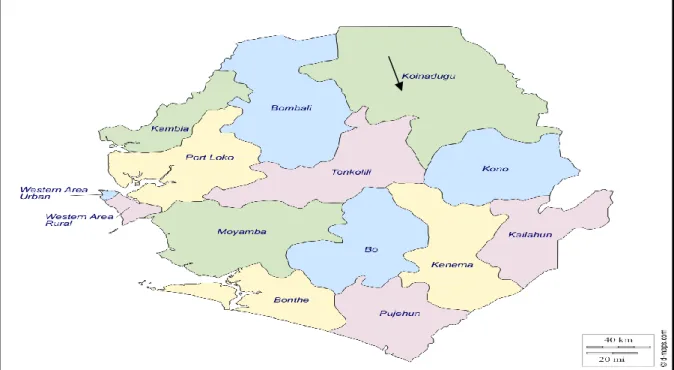
Description of study location
HIV/AIDS prevalence and impact in Koinadugu District, Sierra Leone
There is no denying that the causes of HIV/AIDS have a rural-urban divide. A survey conducted in 2009214 identified the following as most sought after by families who have HIV/AIDS-infected members: emotional support, psychological support, education, treatment and other training needs for individuals and support groups.
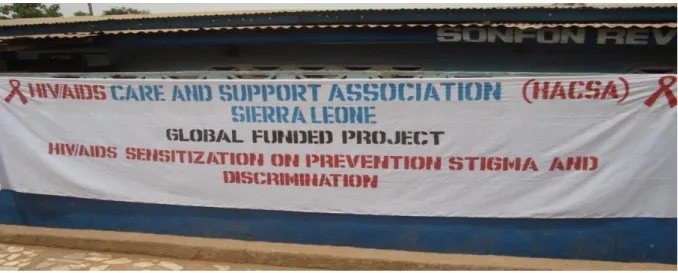
HIV/AIDS sensitization programmes in Koinadugu District
These wishes were partly taken into account when a support group was established in the district capital Kabala.
Agricultural activities in Koinadugu District
Agricultural trainings and knowledge transfer in Koinadugu District
People living with HIV were encouraged to use a local method of pest control on their farms by killing the pests in a container of water and spraying it on areas of the farm infested with insects, which drives others away. But in the surrounding area, most children go to evening classes after school.
Description of research participants
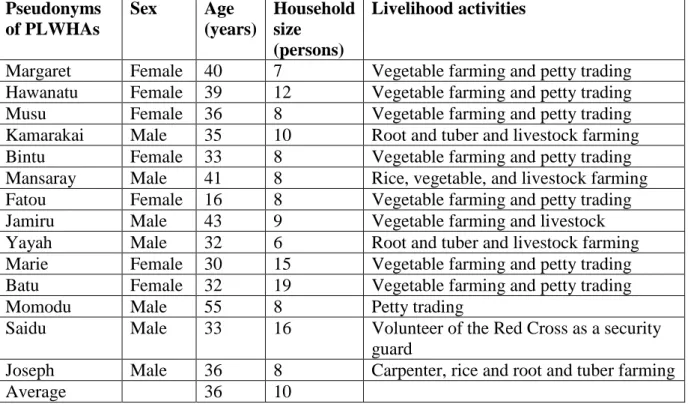
People living with HIV/AIDS who were interviewed
I am conducting a research on the gendered impact of HIV/AIDS on livelihoods among affected farming households in your community. What are the effects of HIV/AIDS on the livelihoods/agricultural activities of households affected by HIV/AIDS in this community.
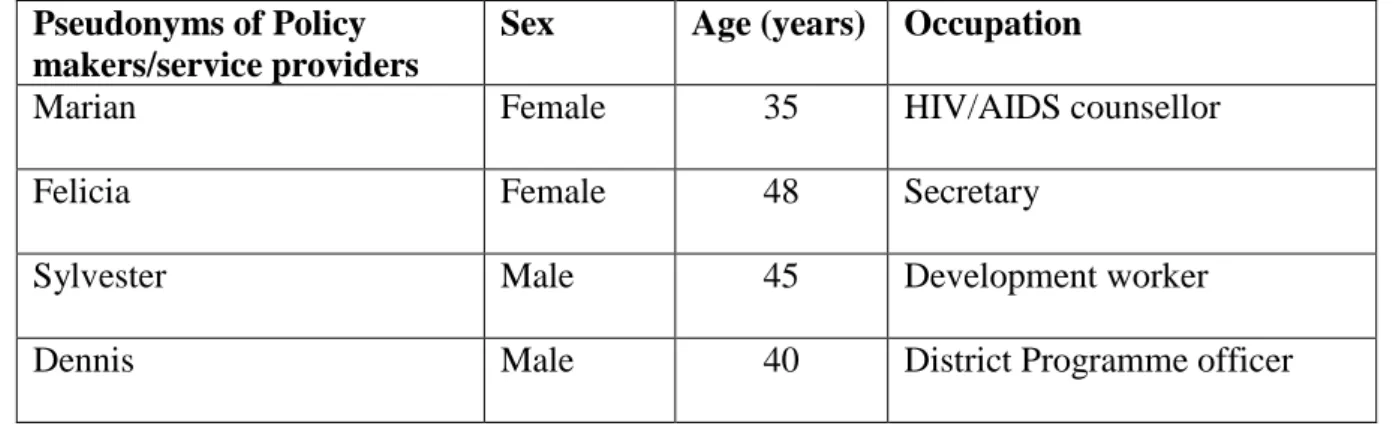
Policy makers/service providers who were interviewed
Data collection and analysis
Data collection
Although there were certain themes that I wanted to address in the 'semi-structured interviews and focus group discussions'227 that I conducted with them, I was keen to encourage my research participants to raise and explore concerns and issues that I had not necessarily expected. Another was developing a relationship with my research participants in which they felt free and able to talk about being HIV-positive in a context where HIV can be highly stigmatized.229 For both of these reasons, I chose to semi- to conduct structured individual interviews (Appendix 1 and 7) and focus group discussions (Appendix 2), with those who were willing to participate in the group discussion.
Data analysis
Respondents were given pseudonyms, and their opinions were summarized and classified under relevant topics in the research according to the theories.
Themes and questions in the semi-structured interview schedules and focus
I am conducting a research on the gendered impact of HIV/AIDS on livelihoods among affected agricultural households in your community. What are the effects of HIV/AIDS on agricultural knowledge-based systems in households affected by HIV/AIDS in this community.
Other complementary methods employed
Discussing the proposal and interview guides with authorities in Sierra Leone… 58
Ethical issues which emerged when conducting interviews with PLWHAs
Introduction
In this chapter, I identify and discuss key themes that emerged from interviews with people living with HIV, policy makers and service providers in relation to the broad objectives outlined in the first chapter on the gendered impact of HIV/AIDS on farm households in Koinadugu District.
Main concerns and issues raised by policy makers/service providers
- The prevalence of petty trading among women and their social and economic
- The economic vulnerability of PLWHAs involved in agricultural production…
- The consequences for households when men or women become infected with
- The marginalization of women through lack of access to productive resources…. 66
- Stigma, gender and HIV/AIDS status disclosure
- Gender power relations as manifested in marriages between young girls and much
- Children offering support for their HIV positive mothers and fathers
- Problems of inadequate support and care services in HIVAIDS affected farming
This was illustrated by the differential impact on women and men affected or infected by HIV/AIDS in households. What are the impacts of HIV/AIDS on agriculture/livelihood information among household members affected by HIV/AIDS?
The main concerns and issues raised by PLWHAs
The debilitating effects of HIV/AIDS in relation to farming
It is mainly the poorest households, as in the case of the participants in my study, who are usually delayed in their agricultural activities, while the better-off employ laborers for their agricultural activity during peak seasonal work demands.244 This was expressed by Joseph ' who mentioned that he was involved in the cultivation of crops, money from which he used to finance his farm.' But for many affected families, some family members turned to work within the community for wages, especially providing hired labor as a livelihood option to meet the family's livelihood needs. With fewer first-age adults in the household, non-farm income is likely to fall, as it is largely gender specific.”245.
Agricultural knowledge transfer and adoption
At an early age, parents introduce their children to agriculture, although it is not the case as it was in the past, because of great awareness, as some parents do not even want their children to go into agriculture because it is associated with poverty . Those involved in cattle rearing are the wealthiest here and they don't even bother to send their children to school as they have to take care of the animals (Hawanatu PLWHA).
Some technologies identified as easily accepted by HIV positive farmers
Some of them acknowledged that with the provision of compulsory primary school, which they welcomed as giving their children the opportunity to improve, there could be a conflict between adults' expectations that their children should take over their family farms and their children's interests. As it is, people prefer to buy from the few farmers available and sell on market days rather than planting." I don't want my children to be poor like me, that's why I encourage them to go to school or at least learn other subjects.
Providing help to farming households affected by HIV/AIDS to adopt alternative
HIV/AIDS exacerbates the gender and age division of labor in an "affected farm family"246, as some tasks are gender and age specific. Several agencies providing funds to PLWHA who were farmers had to give up due to ill health.” However, these funds were not intended to help them continue farming, but to give them the skills and resources needed to engage in other income-generating initiatives such as petty trading or soap making or dyeing tie etc.
The double standards which operate in households when women and men become
In exploring the impact of HIV/AIDS on livelihoods and families in rural areas, I found that this was highly gendered. Enforcing inheritance laws can be a good step in combating the impact of HIV/AIDS.
The consequences for boys and girls in households when men and women become
The gendering of HIV/AIDS and its impact on farming households in Koinadugu
The vulnerability of women in such households is particularly evident and acute, as I found in my study, in the context of HIV/AIDS. My research findings highlighted the (gendered) impact of HIV/AIDS on farm households and livelihoods and how such households operate with the subordination of women and girls in the context of HIV/AIDS.
Participants’ (Policy makers/service providers and PLWHAs) reflections about being
A consideration that was raised and which had implications for my research with members of agricultural 'households affected by HIV/AIDS'249 concerned children and their experiences in such households. They expressed hope that the questions they raised about the social and economic effects of being infected with HIV/AIDS on their households would be taken up by policy makers and other organizations interested in helping them.
Introduction
The shared social expectation that women, not men, be caregivers makes them particularly vulnerable and open to exploitation in agricultural households "infected and affected"250 by HIV/AIDS. Therefore, gender issues should be a serious concern in prevention and mitigation efforts to address the impact of HIV/AIDS.
Recommendations
This intervention will go a long way in alleviating some of the problems faced by HIV/AIDS "infected and affected agricultural households"257 and this will lead to sustainable livelihoods. Livestock, Livelihoods and Managing Food Insecurity in the Context of Drought and HIV/AIDS in Rural Zimbabwe.
Individual semi-structured interview questions for PLWHAs
Because of your illness, you have access to any form of support outside the home. How has the HIV/AIDS status of your family member affected you and other members of your household in accessing markets.
Checklist for focus group discussion for PLWHAs
What would you say are the main limitations and challenges that have arisen, if any, because of your illness for a) you and b) your family members. Would you say that you personally have changed in terms of your views, outlook or behavior as a result of your illness?
Individual semi-structured interview questions for Policy makers/
Potential participants will have time to read, understand and question the information provided before giving their consent. This will include a time limit on the investigator's presence and time to consult with friends and/family.
Informed consent form for focus group discussion for PLWHAs
After entering and analyzing the collected data, all printed copies will be removed within 3 months or 5 years after submitting the dissertation.
Acceptance to participate form
Participant's full name) hereby confirm that I understand the contents of this document and the nature of the research project, and agree to participate in the project. This includes time out of the researcher's presence and time to consult with friends and/or family.
Informed consent form for Policy makers/service providers
Potential participants should be given time to read, understand and question the information provided before giving consent. Note: Potential participants will be given time to read, understand and question the information provided before consenting.
Interview guide for Policy makers /service providers
What support, if any, do various other community members provide to people living with HIV. How do you think relevant institutions and community members should respond to them?
Open letter to gate keepers
This district was chosen by me for this project because the results of the 2005 seroprevalence survey in Sierra Leone revealed that it has the highest prevalence of HIV/AIDS. It is against this background that I want to undertake this research to investigate the gender impact of.
Permission to conduct research from District Medical Officer
Permission to conduct research from Chairman, Koinadugu District
Permission to conduct research from Paramount Chief of Sengbeh
Ethical permission from UKZN
Livelihood options of PLWHAs