Heritage-making at the Wildebeest Kuil Rock Art Tourism Centre, Northern Cape: an exploration.
By
Shanade Bianca Barnabas
November 2014 and March 2015
Submitted in fulfilment of the requirements for the degree of Doctor of Philosophy at the Centre for Communication, Media and Society, University of KwaZulu-Natal, Durban
i
Declaration
Submitted in fulfilment of the requirements for the degree of a PhD at the Centre for Communication, Media and Society, University of KwaZulu-Natal, South Africa.
I, Shanade Bianca Barnabas, declare that:
1. The research reported in this thesis, except where otherwise indicated, is my original research.
2. This thesis has not been submitted for any degree or examination at any other university.
3. This thesis does not contain other persons’ data, pictures, graphs or other information, unless specifically acknowledged as being sourced from other persons.
4. This thesis does not contain other persons’ writing, unless specifically acknowledged as being sourced from other researchers. Where other written sources have been quoted, then:
a. Their words have been re-written but the general information attributed to them has been referenced
b. Where their exact words have been used, then their writing has been placed in italics and inside quotation marks, and referenced.
5. This thesis does not contain text, graphics or tables copied and pasted from the Internet, unless specifically acknowledged, and the source being detailed in the thesis and in the References sections.
Student: Shanade Bianca Barnabas Student number: 204515456
____________________ ____________________
Signature Date
ii
Abstract
This study explores practices of heritage-making at the Wildebeest Kuil Rock Art Tourism Centre in South Africa’s Northern Cape. The research is informed by an African cultural studies perspective, employing ethical reflexivity to populate the work with research participants rather than research objects. The !Xun and Khwe San groups are the hosts at Wildebeest Kuil. Historically, San peoples have been violently subdued while recent history has seen them incorporated into rhetoric of national unity, simultaneously placating competing nationalisms and legitimising a dominant ideology. Negotiations of representation, heritage valuation, challenges to community participation and custodial failings are explored in regard to the hosts’ engagement with the heritage resource at Wildebeest Kuil. The thesis responds to a call for critical thought into the uses of rock art sites within heritage and the dearth of research into heritage tourism in the developing world, knowledge of which is decidedly vital for heritage preservation and sustainable tourism.
The qualitative study, conducted between 2010 and 2014 via regularised field trips, was indebted to relationships built over time with various stakeholders. Data collection included desktop research, interviews and participant observation within the ambit of an interpretive case study. Multivocality is widely endorsed as a panacea to complexities of identity and heritage politics. The thesis pursues principles for thinking about multivocality from a cultural studies perspective, through which critical questions are raised about heritage construction, mutability, democratic responsibility and counter-hegemonic responses.
Challenges at Wildebeest Kuil were found to be indicative of socio-political concerns in the South African heritage sector. The thesis does not dismiss attempts at reformation in the
iii
sector; instead it engages with a pervading disquiet that necessitates continued criticism.
Heritage is not autochthonous, nor is it harmonious, originally present, and outside of human constructedness. Findings of the study reiterate that heritage is made by social processes and historic developments. It is invented, assembled, mutable, emotionally and politically charged. When viewed as such, heritage narratives valorising national and elite agendas become open for critique.
Key Words: African cultural studies, heritage narratives, heritage resource, heritage tourism,
San, ethical reflexivity, museology, interpretation, rock art, multivocality.
iv
Dedication
This thesis is dedicated to the generations on whose shoulders I have stood and from whose hard work I have prospered and to all those who instilled in me a love of learning, particularly Samuel M. Barnabas who at 92 years old remains the sprightliest student I know.
***
Blessed is the one who finds wisdom and the one who gains understanding, for the gain from her is better than gain from silver and her profit better than gold—Proverbs 3:13–14.
v
Acknowledgements
The research for this study was conducted under the auspices of Professor Keyan Tomaselli’s National Research Foundation (NRF) funded Rethinking Indigeneity project and was made possible through scholarships provided by the University of KwaZulu-Natal and the NRF.
The opinions expressed, however, and conclusions reached are my own and not necessarily those of the Foundation or the University. A special thanks to my supervisor, Keyan Tomaselli, for his support and encouragement. I am grateful to colleagues from the Centre for Communication, Media and Society (CCMS) who peer-reviewed chapters. Special thanks to Julie Grant and Varona Sathiyah for their meticulous reading of drafts.
I thank other colleagues who read chapters, offered insights, suggestions and encouragement.
Thanks go to the !Xun and Khwe of Platfontein, particularly community leaders Mario Mahongo and Zeka Shiwarra, for access to the community and support offered. I especially thank David Morris, Bafana Ndebele and Petrus Wilson of Wildebeest Kuil, for their time, patience and willingness to participate in the study. Additional thanks go to personnel at the South African San Institute (SASI), the McGregor Museum, and numerous others who acquiesced to an interview. While it is not possible to list everyone by name, I am sincerely grateful to those whose assistance helped to further this thesis. A heartfelt thank you to Johann and Elsabé for their hospitality during my many stays in Kimberley. Their warm hearth made bearing the Northern Cape winters considerably easier. I am indebted to my family for their enduring support and to my friends for encouragement along the way. My greatest gratitude is unto God, for every accomplishment is only by grace.
*** Soli deo gloria ***
vi
Table of Contents
Declaration ... i
Abstract ... ii
Dedication ... iv
Acknowledgements ... v
Table of Contents ... vi
Acronyms ... x
A note on pronunciation... xiii
The Fieldwork Site ... xiv
List of Figures ... xv
Chapter One ... 1
The context of the study ... 1
Parameters of the study and contribution to the field ... 1
Research tracks and access to the community ... 5
The fieldwork site ... 6
A background to the hosts at Wildebeest Kuil... 8
Synopsis of the study ... 15
A note on indigenous naming practices ... 17
Chapter Two... 20
Research Methods in Context ... 20
Location of the study, participants and framing ... 20
Paradigms and approaches framing the study ... 22
The cultural studies paradigm ... 23
Research design and methods of data collection ... 27
The interpretive case study design ... 28
Interviews ... 29
Participant observation... 36
vii
Data analysis ... 39
A reflexive disclosure of subjectivity ... 40
Challenges: relationship building and ethical concerns ... 42
Summary ... 45
Chapter Three... 47
The South African heritage landscape with a focus on rock art and San peoples ... 47
Heritage conceptualised ... 47
Politics of Indigeneity ... 53
On heritage management, preservation and legislation ... 54
Heritage and museums ... 60
Interpretation and presentation of heritage ... 67
Shifting perceptions of rock art and interpretation ... 71
Heritage as mutable... 75
(Ig)nobility of the Savage ... 75
Historic presentations of San peoples ... 78
Museological presentations ... 81
The Miscast Exhibition ... 85
After Miscast ... 92
Rock art heritage sites in South Africa ... 97
Didima Rock Art Centre ... 97
Game Pass Shelter... 100
Giant’s Castle, Main Caves... 102
Summary ... 103
Chapter Four ... 104
Interpretation, presentation, custodianship and preservation: challenges at Wildebeest Kuil ... 104
Interpretation and presentation at Wildebeest Kuil ... 104
The display room and outdoor stations ... 105
Filmic presentation at Wildebeest Kuil ... 108
viii
The 31 Battalion Military Exhibition ... 112
Wildebeest Kuil: broader challenges ... 118
The Wildebeest Kuil steering committee ... 119
Community engagement: ownership, site usage and participation ... 123
Development failures and managerial differences ... 136
Summary ... 144
Chapter Five ... 146
Heritage in Tourism ... 146
Definitions and conceptualisations ... 146
The tourism-development dilemma ... 150
Impacts of tourism ... 151
Tourism in the South African context ... 157
On responsible and sustainable tourism development ... 162
Concerns and problematics ... 164
The Northern Cape branding strategy ... 170
Wildebeest Kuil: tourism projections ... 174
The N//aoh Djao craft shop and site employees ... 176
Factors contributing to low visitor numbers ... 177
Crime and perceptions of risk ... 177
Unclean surroundings ... 180
Site identification, signage and marketing ... 182
Wildebeest Kuil: possible site improvements ... 187
Summary ... 189
Chapter Six... 191
Heritage-making and multivocality ... 191
What is heritage and who benefits from it? ... 191
On multivocality ... 199
A multiplicity critique ... 203
ix
Toward a decolonising multivocality... 212
Summary ... 218
Chapter Seven ... 220
Conclusion ... 220
Principal themes revisited ... 220
Significance of the research ... 224
Study limitations and further areas of scholarship ... 225
References ... 229
Primary sources ... 229
Fieldnotes ... 229
Interviews and personal communications ... 229
Emails ... 229
Filmography ... 230
Unpublished theses, dissertations, papers and reviews ... 230
Published Sources ... 233
Government and NGO documents, reports, speeches, brochures, exhibitions ... 267
Acts ... 269
URLs ... 270
Appendix A: Photo-documentation and Wildebeest Kuil floor plan ... 271
Appendix B: Sample of Interview Questions ... 275
x
Acronyms
AIDS – Acquired Immune Deficiency Syndrome ANC – African National Congress
CCMS – Centre for Communication, Media and Society COP17 – 17th Conference of the Parties
CPA – Communal Property Association
CPAMC – Communal Property Association Management Committee CMS – Cultural and Media Studies
DEAT – Department of Economic Affairs and Tourism DEDT – Department of Economic Development and Tourism DG – Director General
DIA – Department of Indigenous Affairs DLA – Department of Land Affairs
DVD – Digital Video Disc/Digital Versatile Disc EIA – Environmental Impact Assessment
FBDM – Francis Baard District Municipality
FIFA – Fédération Internationale de Football Association GNP – Gross National Product
HIV – Human Immunodeficiency Virus
ICOMOS – International Charter for the Conservation and Restoration of Monuments and Sites
ID – Identity Document
xi
IDP – Integrated Development Plan IOL – Independent Online
ISS – Institute for Security Studies KZN – KwaZulu-Natal
KZNDAC – KwaZulu-Natal Department of Arts and Culture LDC – Least Developed Country
LSA – Later Stone Age
MEC – Member of the Executive Council NDT – National Department of Tourism NGO – Non-Governmental Organisation
NHCTS – National Heritage and Cultural Tourism Strategy NHRA – National Heritage Resources Act
NTSS – National Tourism Sector Strategy
RDP – Reconstruction and Development Programme RSA – Republic of South Africa
SABC – South African Broadcasting Corporation SADF – South African Defence Force
SAHRA – South African Heritage Resources Agency SAM – South African Museum
SAMORA – South African Museum of Rock Art SANParks – South African National Parks SASI – South African San Institute
xii
SWAPO – South West African People’s Organisation TRC – Truth and Reconciliation Commission
UNCTAD – United Nations Conference on Trade and Development
UNESCO – United Nations Educational, Scientific and Cultural Organisation UNFCCC – United Nations Framework Convention on Climate Change
US/ICOMOS – United States International Charter for the Conservation and Restoration of Monuments and Sites
Wits – University of the Witwatersrand
WIMSA – Working Group of Indigenous Minorities in Southern Africa WHC – World Heritage Committee
xiii
A note on pronunciation
The descriptions below are to assist in the pronunciation of vernacular terms used in the thesis:
The ‘!’ is a cerebral click.
“An alveopalatal or palatal stop, produced by pulling the tip of the tongue sharply away from the front hard palate. When made with lips rounded, it sounds rather like a cork popping from a wine bottle”.
The ‘≠’ is an alveolar click.
“An alveolar stop, produced by pulling the blade of the tongue sharply away from the alveolar ridge, immediately behind the teeth”.
The ‘//’ is a lateral affricate.
“Produced by placing the tip of the tongue on the roof of the mouth…and releasing air on one side of the mouth between the side of the tongue and the cheek. More simply, the clicking sound film cowboys use…to make their horses go”.
Adapted from Barnard (1992:xix).
xiv
The Fieldwork Site
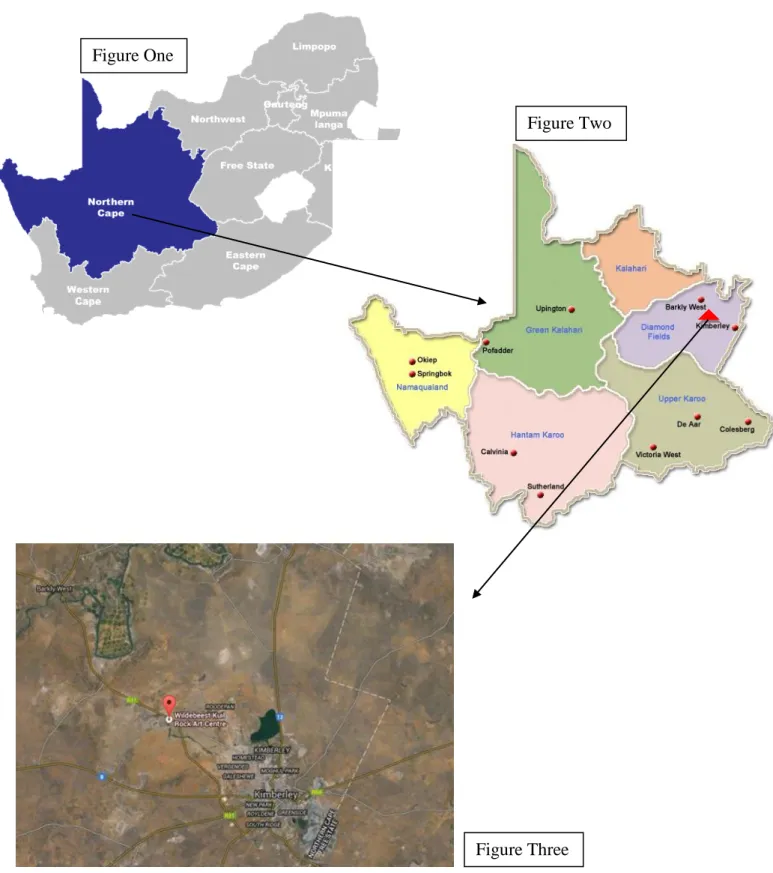
Figure One
Figure Two
Figure Three
xv
List of Figures
Figure 1: Map of South Africa, adapted from:
http://www.platinumweekly.co.za/images/SA_Main%20Map_NorthernCape.png Accessed: 01/11/14
Figure 2: Map of the Northern Cape Province, adapted from:
http://www.scielo.org.za/img/revistas/sajae/v41n1//05f01.jpg Accessed: 01/11/14
Figure 3: Map of the R31 showing Wildebeest Kuil, adapted from:
https://www.google.co.za/maps/place/Wildebeest+Kuil+Rock+Art+Centre/@-
28.66719,24.65055,53527m/data=!3m1!1e3!4m2!3m1!1s0x1e9b0ef6eb407107:0x8fc9db08c c98996b
Accessed: 01/11/14
1
Chapter One
The context of the study
What is heritage and who benefits from it? This is a question underlying the study. Is heritage a construct, a discursive practice, a resource for politicking, economic growth, shaping identity, claiming rights, fashioning inclusivity or its counterpart? The study is an effort to engage these issues with particular attention to complex negotiations in regard to heritage- making and multi-vocal practices at the Wildebeest Kuil1 Rock Art Tourism Centre located approximately 12 kilometres outside the Northern Cape city of Kimberley. This is particularly relevant to a South African context where crucial debates unfold concerning heritage-making. The chapter outlines the parameters of the study, including reasons for the choice of topic; it describes the fieldwork site; problematises the key ideas and offers a synopsis of the chapters to come followed by a proviso on indigenous naming practices.
Parameters of the study and contribution to the field
22014 marked South Africa’s 20th anniversary of democratic governance. Commemorations included increased promotion of indigenous heritage in the public sphere. The indigenous perspective has been globally popularised since the rise of indigenous rights in the early 1990s, and this has been paralleled by transformations in museology. Processes of democratisation, however, particularly in South Africa, are still underway and there remains much to be achieved. Nevertheless, that these processes were begun at all is an indication of progress. The thesis does not seek to dismiss attempts at reformation in the South African heritage sector; certainly a great deal of democratisation has taken place. The aim here is to engage with a pervading disquiet in the sector that necessitates continued criticism. Roshi Naidoo (2005:37) describes this engagement as such:
1 ‘Wildebeest Kuil’ is an Afrikaans appellation. The wildebeest (literally ‘wild beast’) is a large antelope described in English as a gnu. The kuil or ‘water pit’ near the hill on which the engravings lie could hold water for months after plentiful rains, making for a surrounding veldt rich in plant food and wildlife. This abundance in an otherwise arid landscape could have made the place one of importance for hunter-gatherers who lived there (cf. Morris & Blundell, 2004).
2 Parts of this section are adapted from “Biesje Poort as a Rock Art Resource: Conservation and Tourism”
(Barnabas, 2013).
2
Rather than simply letting out a sigh of relief because museums are now sensitive to those they have historically trammelled, we need to examine more closely and critically how ‘ethnicity’ and ‘race’ are mobilised, how communities are engaged with, and how a world view in tune with the neo-liberal nation can be shored up rather than undermined in these new, more ‘sensitive’ approaches.
A question fundamental to the study is ‘what is heritage and who benefits from it?’ To this we may add ‘whose heritage?’ (cf. Graham, Ashworth & Tunbridge, 2000). Through investigating practices of heritage-making at Wildebeest Kuil the study illuminates politics, culture, tourism and museology as key sites of heritage-making out of which answers to the above questions may proliferate. The thesis deals with these sites as they relate to Wildebeest Kuil and the larger South African context.
The country’s colonial and apartheid past has played a significant role in shaping its heritage identity, one fraught with contesting narratives (cf. Herwitz 2012; Marschall 2010; Tomaselli
& Mpofu 1997; Shepperson & Tomaselli 1997; Coombes 2004). The thesis responds to controversial issues of heritage in a postcolonial, post-apartheid, developing world context at a time when heritage is most topical in terms of the country’s official commemorations and discussions in the public domain. Developing countries are often described as lacking the monetary and skills resources to best care for their heritage. Where there is a rich array of heritage, a lack of human resources and economic constrains disallow a large sum of that heritage to be conserved (Timothy & Nyaupane, 2009b). Coupled to this is a lack of cooperation between government departments in the coordination and administration of projects which have an impact on heritage; this has been a concern in South Africa. Further challenges include environmental pressures, uncontrolled urban development as well as urban decay, communal conflicts, warfare, poverty, lack of political will, lack of awareness of heritage value, trafficking, and inadequate funding (Eboreime, 2009). Top-down legislation or isolationist conservation practices, where local communities are side-lined from the running of sites, often result in neglect, looting and vandalism (ibid). South Africa’s past of displacement and marginalisation has fostered a lack of concern for heritage sites in groups that once shared a rich history with such locales. Vandalism and theft, for instance, have been a concern at Wildebeest Kuil, positioning the site within a costly state of perpetual repair (cf.
3
Chapter Four). Further, Eurocentric heritage management on the continent has disempowered local communities (Eboreime 2009; Hall 2009; Munjeri 2009).
The thesis contributes to research on the !Xun and Khwe of the Northern Cape who unlike their regional neighbours, the ≠Khomani San, have not been subject to extensive research.3 Essentially interlopers in the scramble for land rights, the !Xun and Khwe occupy a unique place in the country’s heritage discourse. Originating in Angola and Namibia respectively and having made their home in South Africa for over two decades the ways in which they negotiate their place as hosts at Wildebeest Kuil and their affinity to the rock engravings exclusive of direct descendancy from the engravers is a point of interest unique to the case study. (Wildebeest Kuil is one of three rock art tourism centres in South Africa and is the only one that boasts a host community). These negotiations of identity and representation are especially pertinent in a country in which San peoples have been violently subdued yet valorised as First People and incorporated into rhetoric of national unity as a pervading symbol of South African origins, simultaneously placating competing nationalisms and legitimising a dominant ideology.
The !Xun and Khwe enjoy an indigenous status in South Africa due to the state’s recognition of them as ‘San’. Nevertheless, they are “tolerated” as are other marginalised indigenous groups, and considered an “inconvenience” in their dependency on government and aid resources (Coates, 2004:15). As marginalised indigenous, they are “[r]educed in the minds of most to caricatures, stereotypes, and museum exhibits… find[ing] themselves fighting for acceptance and survival in a rapidly changing world that shows little respect for their rights or unique histories” (2004:16; Saugestad 2001a, 2001b). Community-based museums and interpretive centres, such as Wildebeest Kuil, could possibly urge autochthonous participation and encourage communities to voice their stories in public fora. These spaces could potentially develop into platforms that foster inclusion, acknowledgment and respect described above as lacking. Studies of this nature thus prove imperative to understanding the dynamics at play at such sites.
3 Research conducted among the !Xun and Khwe of Platfontein has included topics relating to resettlement, art, health communication, self-imaging in participatory video production, the politics of cultural distinction, community radio and development (Den Hertog 2013; Tyali 2012; Dicks 2011; Dockney 2011; Hart 2011;
Barnabas 2010, 2009; Mhlanga 2010, 2009, 2006; Robbins 2007, c. 2004; Soskolne 2007; Van de Weg 2007;
Stephenson 2006; Uys 1993; Douglas 1996). Nevertheless, this research is minimal in comparison to collated research conducted among the ≠Khomani San.
4
Previously the preserve of specialists, enthusiasts and the heritage sector, “some of the agendas and narratives concerning rock art sites are now… set by the tourism industry…
education authorities, or those determining policy on the uses of heritage sites” (Morris, 2012:232). David Morris, head archaeologist at the McGregor Museum and the director/curator of the interpretive centre at Wildebeest Kuil, warns that care and critical thought must go into “the ways in which rock art sites are understood and incorporated in these spheres” (ibid; Weiss 2007; West & Carrier 2004). The study is a contribution to this necessary ‘critical thought’. It engages with prior research conducted at Wildebeest Kuil having analysed the site as significant for heritage conservation and tourism, with a focus on archaeology (cf. Morris 2012; Weiss 2012; Morris, Ndebele & Wilson 2009; Smith 2006), and heritage-making—although Lindsay Weiss’ (2007) application in this regard is centred on archaeological remnants of an era subsequent to the rock engravings.
A large corpus of work exists on heritage management while heritage in tourism “occupies so far only a minor position in the growing academic literature on tourism both in South Africa and the wider region of [s]outhern Africa” (Van der Merwe & Rogerson, 2013:156; cf.
Rogerson & Rogerson 2011; Rogerson & Visser 2011; Visser & Hoogendoorn 2011). The knowledge gained from such research in the developing world is arguably vital for heritage preservation and sustainable tourism in those destinations (Timothy & Nyaupane, 2009b).
The thesis responds to the scarcity of research and seeks to contribute to the growing body of knowledge in its focus on a site of cultural heritage tourism, specific to the heritage of San peoples both past and present, fraught with tensions and challenges.
In response to the shortage of empirical data and subsequent conjecture on the topic, Linda Richter asserts that “[c]ase studies are needed to probe who gains and loses from heritage tourism” (2005:269). While outcomes in practice may not be as Manichean as Richter’s comment implies, nuances of gains and losses are relevant to a South African context where heritage is increasingly politicised and used as a resource for redress. Indeed, Weiss describes rock art sites as “restitutional” (2012:218). The particulars of this restitution are made evident in Chapter Three where shifting modes of interpretation and presentation of San peoples (their culture and heritage) and the historical precedent are explored.
5
Restitution and reconciliation are themes pervading all sectors of the South African example.
Coupled to this has been an interdisciplinary valorisation of multivocality as opposed to a single heritage narrative. Multivocality is simply to be ‘many-voiced’. Born out of postmodern relativism and the post-structural deferral to a multiplicity of meaning in the text and change of meaning over time, multivocality promotes the co-existence of diverse perspectives and provisions a place to provoke thinking, learning and emotional connection to heritage (cf. Fawcett, Habu & Matsunaga 2008; Silberman 2008; Tilden 1977). In the heritage sector multivocality may be used as a tool to “…challenge dominant interpretive narratives and to create spaces and structures at heritage sites that will promote the co- existence of potentially conflicting approaches and perceptions of the site’s significance”
(Silberman, 2008:141). This definition compliments processes of democratisation underway in the South African heritage landscape. The thesis concludes by building on this definition in pursuing principles for thinking about multivocality from a cultural studies perspective in terms of heritage narratives in the South African context (cf. Chapter Six).
Research tracks and access to the community
Access to various sources and informants, notably the South African San Institute (SASI) in Kimberley, the management and staff of Wildebeest Kuil and Platfontein community members, was obtained during previous research conducted with the !Xun and Khwe at Platfontein since 2008 (cf. Van de Weg & Barnabas 2011; Barnabas 2010, 2009).
Engagement with the above sources included participation in the “Heritage in Tourism Week” seminars held in Kimberley in September of 2009 and 2010. The seminars were a cooperative initiative between the Partnerships and Industry Development Business Unit of the Department of Economic Affairs and Tourism (DEAT), the Department of Sport, Arts and Culture, the McGregor Museum and the University of KwaZulu-Natal’s Centre for Communication, Media and Society (CCMS). The seminars functioned as a critical space for interdisciplinary and intercultural dialogue relating to tourism, heritage and culture.
Further insight into the discourses surrounding cultural heritage tourism developed through participation as a research assistant in drafting the book Cultural Tourism and Identity:
Rethinking Indigeneity (Tomaselli, 2012). This, in part, resulted in my co-authorship of chapters in that compilation and others (cf. Finlay & Barnabas 2012a, 2012b; McLennan-
6
Dodd & Barnabas 2012). Participation in the multi-disciplinary, inter-institutional “Biesje Poort: KhoiSan Rock Art Recording Project” further established a heritage tourism background to the study (cf. Lange, Magongo & Barnabas 2013). Funded by the National Heritage Council, the project focussed on the recording of previously undocumented rock engravings and multiple interpretations of the art, associated artefacts and landscape. This later developed into the book Engraved Landscape: Biesje Poort, Many Voices (2013) in which I contributed a chapter relating to Biesje Poort as a heritage resource (cf. Barnabas, 2013). The current study was conducted over a period of four years (2010–2014). The location, participants and framing are discussed at length in Chapter Two.
The fieldwork site
Situated in the Northern Cape’s semi-arid region bounded by the Vaal and Orange Rivers, Wildebeest Kuil was developed and opened for public access as the Wildebeest Kuil Rock Art Tourism Centre in 2001 and is a declared Provincial Heritage Site. The servitude is a little over 23 hectares in size and is located along the R31 auxiliary road between Kimberley and Barkley West. Dominated by farm lands, the area is close to the Platfontein and Galeshewe peri-urban settlements west of Kimberley. Kimberley’s McGregor Museum had plans to develop the site for public access in the mid-1990s. These plans were shared with the
!Xun and Khwe Communal Property Association4 (CPA) when they took ownership of the farm (Morris, 2012). While the !Xun and Khwe own the farm, the rock engravings form part of the national estate. In 2000, due to efforts of the Rock Art Research Institute,5 funding became available from DEAT for public rock-art site development. Stakeholders in the project included the McGregor Museum, the Rock Art Research Institute, members of the
!Xun and Khwe, and other Khoe-San organisations. The Northern Cape Rock Art Trust6 grew out of this committee; the museum manages Wildebeest Kuil on behalf of the trust and provides a monthly subsidy towards guide salaries (Morris 2014, 2012, 2004).
4 The CPA is an internal body which manages land owned by the !Xun and Khwe.
5 “[D]edicated to developing an understanding of rock art”, the Rock Art Research Institute is “active in rock art conservation and in the development and management of rock art tourism in South Africa” (www.sarada.co.za).
6 The trust was originally intended as a resource for the development of multiple sites in the region. These were to be incorporated into an archaeological tourism route yet to be developed (Morris, interview, March 2011).
7
On opening, the tourism centre included a craft shop (a retail outlet for contemporary !Xun and Khwe arts and crafts), a modest exhibition room of Stone Age tools and other archaeological finds on the site, and a small auditorium in which visitors view an introductory film on the history of the site and its hosts. A second exhibition room was constructed in 2012, to house military paraphernalia and to interpret the story of !Xun and Khwe soldiers in the South African armed forces. Beyond the tourism centre the site boasts over 230 engravings7 and more than 400 human markings (Morris, 2012). Subject matter of the engravings includes animals such as the eland (a popular image in South African rock art), hartebeest, rhinoceros, elephant and ostrich (cf. Lange 2011, 2006; Low 2009; Lewis- Williams & Pearce 2004; and Marshall 1962 on the significance of these animals in San cosmology and folklore). Engravings are particularly concentrated in this region (Parkington, Morris & Rusch 2008; Fock & Fock 1989). Radiocarbon dating suggests that some of the engravings at Wildebeest Kuil were made by LSA [Later Stone Age] occupants over a thousand years ago (Morris, 2012). The /Xam speaking San of this region are known as the last of the engravers:
…caught up in the vicious advance of the frontier across the karoo. Many were killed in the relentless conflict, most were incorporated as farm labourers or domestic servants, a tiny few were able to leave their imprint on the historic record. The descendants of these residual hunters and gatherers live on today as the impoverished shepherds, labourers, servants and unemployed township dwellers on the vast karoo farms and in dusty karoo towns. Culturally extinct, but genetically extant, they no longer speak /Xam and no longer have access to their story telling traditions.
(Parkington et al. 2008:55)
While the engravings at Wildebeest Kuil were considered insignificant according to early nineteenth-century perceptions of rock art (Wilman, 1933), the site became a place of interest to historians for its other points of archaeological richness from the colonial era (Morris 2012; Beaumont & Vogel 1989). Today, the site beyond the interpretive centre is divided into 10 stations marked by information boards. Engravings are concentrated on the central rise at
7 The engravings at Wildebeest Kuil and others in the region have been created using the ‘pecked’ technique which involves the use of a hard stone to penetrate the outer crust of the rock thereby exposing the usually lighter coloured rock beneath (Parkington et al. 2008).
8
station eight. Incorporating multi-layered histories, these stations provide visitors with general knowledge of the site and its various inhabitants.
A background to the hosts at Wildebeest Kuil
The ‘Sanness’ of the hosts at Wildebeest Kuil is noteworthy in terms of the genocide of San peoples in South Africa’s past and their related museological representations (cf. Chapter Three). The !Xun are part of the Northern !Kung,8 a large group broadly distributed in a forested area of southeast Angola and known as Vasequela—the ‘Forest San’ (Robbins 2007;
Barnard 1992). They speak !Xûntali, “a linguistic sub-dialectic of the !Kung family of languages” (Hart, 2011:17; Robbins 2007). Many of the Khwe, from the Eastern Caprivi Strip, were identified as Baraquena (Water Bushmen) (Robbins 2007; Uys 1993). They are taller and darker in complexion than the !Xun and other San groups and have been referred to as ‘black Bushmen’ (Robbins, c. 2004:6). The Khwe speak a Tshu-Khwe linguistic dialect known as Khwedam. Like the !Xun, they speak Afrikaans and (little) English along with a variety of other languages indigenous to Namibia, Botswana and Angola. By the 1900s, due to contact with European, Afrikaner and Bantu-speaking groups, the !Xun and Khwe had become subsistence farmers (Robbins 2007; Sharp & Douglas 1996).
In Angola the San were victimised and displaced by migrating Bantu-speakers (Robbins 2007; Sharp & Douglas 1996). In response to this, during the Angolan War for independence, the San aligned themselves with the Portuguese whose influence in Angola stretched back to the 1480s. By the late 1960s !Xun men were serving as trackers for the Portuguese military.
Known as Flechas (Portuguese for ‘arrows’), these soldiers became a formidable tactical arm of the Portuguese military. Matoka Matheus, a San recruit, observed that they would be sent into the bush to flush out the enemy. He noted further that they were given no radios and had no command structure (in Uys, 1993). They were told only “to go kill blacks” (1993:5).
Moreover, the soldiers were told by the Portuguese that these “…were bad blacks who used pangas, knobkieries and grenades, and that they wanted to use them against these people”
8 Alan Barnard (1992) distinguished between the Southern, Central and Northern !Kung. The Southern !Kung are those who in the 1950s had captured the imagination of Laurens van der Post, and who occupied the arid Kalahari regions of central Botswana. The Central !Kung live to the west of the Okavango Delta in a swathe of desert astride the Namibia/Botswana border. The Northern !Kung are discussed above. Nevertheless, others note disharmony between the !Xun and !Kung (cf. Marschall & Ritchie, 1984).
9
(Uys, 1993:3). After Portugal’s coup d’etat in April 1974, it was decided that forces would be withdrawn from Angola and the country handed over to the liberation leaders (ibid). During Angola’s liberation struggle “[o]ver 130 Bushmen were shot in a bloodbath at Mavinga and it was estimated that fully 25% of all Angolan Bushmen were killed during this period” (Uys, 1993:11). Fearing discrimination and possible death, those who had previously assisted the Portuguese fled the country. !Xun soldiers, together with their families, sought asylum in South West Africa (now Namibia) and Botswana (Robbins 2007, c. 2004).
The soldiers who had crossed the border into South West Africa were recruited by the South African Defence Force (SADF) in South Africa’s incursion into Angola. The Khwe, situated in Eastern Caprivi, found their region embroiled as a major zone in the Namibian War of Independence (Robbins, c. 2004). Finding themselves in an increasingly hostile and dangerous position, the Khwe were likewise recruited by the SADF. In September 1976, 31 Battalion also known as the ‘Bushman Battalion’ was officially recognised (Uys, 1993). The
!Xun and Khwe were segregated because they did not live harmoniously together and both were separated from their white counterparts. With the large civilian population under the military’s bureaucratic administration, prevailing circumstances produced a condition of extreme dependency (Felton & Becker, 2001).
There has been some debate regarding the recruitment of San soldiers by the SADF. In 1980, anthropologist Richard Lee, who had worked with the !Kung for 17 years, stated that the San were “being ground to death by the South African war machine” (cited in Uys, 1993:101).
Lee argued that South Africa was using the San much like the United States had used the ‘hill tribes’ in Vietnam, “to fight a white man’s battle at the expense of their culture” (ibid). In contrast, the famed writer/explorer Laurens van der Post observed that life in the army would complement the ‘hunter-gatherer’ lifestyle, possibly saving the San from annihilation and providing a sense of protection and belonging (Uys, 1993). David Robbins notes that “…the
!Xun soldiers and their dependents from Angola were indeed saved from an uncertain future (to say the least) by an SADF keen to do three things: to use the San skills; to display the army’s humanitarian qualities; and to show that South Africans (the racist pariahs of the world) harboured no real racist tendencies” (c. 2004:11). This notwithstanding, the admittance of non-whites into the SADF was primarily to do with the apartheid state’s
10
(paradoxical) attempts to prevail against what it considered the twofold threat of Communism and African nationalism (Harmann, 2006).
In the process of South West Africa becoming an independent Namibia, the !Xun and Khwe found themselves in a similar predicament to the one they had been in when the Portuguese withdrew from Angola. During the negotiated withdrawal, the SADF attempted to facilitate the San soldiers’ re-alignment with other San groups in Namibia, primarily undertaking to persuade the soldiers and their families to stay in that country. The South West African People’s Organisation (SWAPO)9 leader and president-elect, Sam Nujoma, assured the soldiers of their safety in Namibia; nevertheless, they were given the option to relocate to South Africa. Approximately 50 per cent took up this offer (Robbins 2007; Douglas 1996;
Uys 1993). According to John Sharp and Stuart Douglas (1996), motives behind their move to South Africa remain unclear. Further, Sharp and Douglas (1996) question whether or not their decision to move was voluntary. In discussions with !Xun and Khwe participating in an art project, artist Katharina Meyer observed that, “[t]he army had told them that Swapo [sic]
would have killed them had they stayed in Namibia” (in Robbins, c. 2004:26). Anna Maria Mahongo, the wife of Mario Mahongo, similarly noted, “[t]he army told the minister to move because SWAPO were going to kill us… [w]e were shown videos and books on how SWAPO killed people” (cited in Uys, 1993:250).
The soldiers’ reasons for their decision to resettle in South Africa included: their trust in the SADF, dependence on the army for salaries, their fear of retribution from ex-SWAPO fighters and the fact that their land in the Caprivi was not guaranteed (Uys 1993; Robbins 2007, c. 2004). Those who decided not to relocate to South Africa could remain in Omega, relocate to Botswana, East Caprivi or return to Angola. The social security offered by the SADF was no small factor. Moreover, having relied on the SADF for their livelihood for so many years the prospect of losing that support would have been daunting. According to Robert Gordon (1992) the refugee-status of the San soldiers precludes an argument for their having ‘volunteered’ as recruits for the SADF. Put simply, they had little choice but to volunteer. Their decision to move to South Africa may be seen in a similar light.
9 SWAPO was a guerrilla force fighting for the liberation of South West Africa (now Namibia). For more on the involvement of San soldiers in this war, see Uys (1993) and Robbins (2007, c. 2004).
11
The San were promised housing after the initial move to a tented camp at Schmidtsdrift.
Within the first year of relocation talks towards a housing project had begun. These plans were soon overshadowed by an uncertain political climate. In February 1990 then state President, F.W. de Klerk, announced the unbanning of all liberation movements and began a programme marking the abolition of apartheid. Nelson Mandela was released from prison in that same year and as Robbins observes, it was a time when:
[v]iolence rocked the country; crime dramatically increased; and political nerves were stretched taut across an uncertain future. A few thousand San sitting in tents in the blistering heat and intense cold of the Northern Cape seasons hardly mattered in the national scheme of things. (c. 2004:22)
Political negotiations led to the disbanding of various military units, including 31 Battalion.
Some of the soldiers were transferred to units in different parts of the country leaving their families at Schmidtsdrift. This was cause for an increased sense of instability and alienation.
The disbanding of the unit ended plans towards a housing project and with the military gone and an increase in political debate about their presence in South Africa the !Xun and Khwe found themselves once again on the brink of upheaval. Proposals were made by politicians to send them back to Namibia and they were viewed by many as “refugees who had fought…
against democracy” (Swart cited in Robbins, c. 2004:25).
In their time at Schmidtsdrift, the !Xun and Khwe experienced a pervading sense of temporality which in combination with the acuity of being unwelcome in South Africa created “serious dimensions of anger and mistrust, both towards the military and the South African government” (Robbins, 2006: 25). These destructive emotions were turned inward in a time that, for many others, was a period of celebration of democratic freedom:
[t]he period immediately after the 1994 elections was one of a collapse of personal and communal vision. Uncertainty had turned to paranoia and depression. The incidents of rape, attempted suicide, extreme domestic violence, and alcohol and substance abuse increased dramatically, leading to more and more social negativity. (Robbins, 2006:
25)
12
There was an increase in poverty, disease, illiteracy, and unemployment together with a sharp increase in teenage pregnancy and alcohol abuse during pregnancy (Robbins, 2006). Alcohol abuse is said to have promulgated in the military camps (Uys, 1993). Alcohol was smuggled into the camp by drivers and on occasion the San soldiers would “drink and dance through the night, then be useless for duties the following day” (Uys, 1993:61). Andre Gerber, an officer at Omega, recognised the army’s role in this, saying, “[m]any mistakes were made, for example, they wanted to brew their low-potency beer… and were forbidden to... [i]nstead they learned to drink our more alcoholic beer” (cited in Uys, 1993:68). Alcohol abuse remains a concern in the community today (Fieldnotes, June 2011; September 2012).
In her observations of the community in the sixteen months in which she lived in Schmidtsdrift, Meyer recalled “an atmosphere of ruthless self-destruction, the picking to pieces of each other” (in Robbins, 2006:26). Incidents of aggression between the !Xun and Khwe increased as the anger felt concerning elements out of their control was turned inwards.
This ‘picking to pieces’ is evident in the treatment of women by the !Xun and Khwe men. In the tented camp, the women were regularly beaten by their husbands (cf. Felton & Becker, 2001). The division was widened by economic opportunities. While unemployment was rife, what job opportunities there were went to the men, while no such opportunities existed for the women. Gender-based violence and negative gender attitudes remain prevalent among the
!Xun and Khwe today (Becker, 2003).
Reappropriation of the Schmidtsdrift territory resulted in the !Xun and Khwe’s forced relocation.10 In 1997 the farms11 Platfontein, Wildebeest Kuil and Droogfontein were purchased by the then Department of Land Affairs in the name of the !Xun and Khwe Trust (Robins, Madzudzo & Brenzinger, 2001). Due to delays and stalled negotiation the title deeds were handed over two years later. Further complication included “opposition from certain ANC [African National Congress] provincial leaders who were against former apartheid soldiers being given preferential treatment” (Robins et al. 2001, cited in Robbins, c.
2004:31). Construction of the settlement at Platfontein began in late 2002 with 805
10 Schmidtsdrift was named a ‘native’ area in terms of the Native Land Act of 1913. In 1968, the Batlhaping, known to have settled there since the 1880’s, were removed from that land and relocated north of Kuruman. In 1992 they successfully lodged a land claim for the reinstatement of Schmidtsdrift (Gontle, 2006).
11 The community itself is not involved in large-scale farming; what farming there is occurs infrequently on small plots in individual yards. Some revenue is received from land leased to outside farmers (Shiwarra, interview, September 2012).
13
rudimentary Reconstruction and Development Programme (RDP) pattern houses and 120 privately-owned houses with external pit-style lavatories and a single tap in each yard (Robbins 2007; Sharp & Douglas 1996). In some instances families of more than ten live in these three-roomed houses (Dicks, 2011). Platfontein is an Afrikaans name which translates to ‘Flat Fountain’. The settlement is indeed flat, however, in contrast to the second half of its name the area is dry with sparse vegetation. In the dry season, red dust from the dirt roads whirls around the settlement while in the wet season these roads are often water logged. In 2012, for the first time, Platfontein acquired road signs. Many of these new signs had been vandalised by June of that year. I was told by Piet Jonas, a young man from the community, that this was the work of drunken, and often jobless, youth (Fieldnotes, June 2012).
The entire Platfontein community is serviced by two outsider-owned supply stores along the main road, as well as smaller, resident-owned tuck shops within the community. Between them, the stores on the main road sell items of clothing, a small selection of canned foods, bread and package-sealed items like biscuits and sweets. For household groceries community members travel to a franchised grocery supplier on the edge of Kimberley while some residents walk to the city’s nearby landfill in search of food (Fieldnotes, September 2012;
Dicks 2011; Soskolne 2007). According to Platfontein community member, Billies Pamo, no minibus taxis or buses operate between Platfontein and Kimberley (Email, 9 April 2013).
Private vehicle owners from Platfontein charge a R20.00 fee to drive people to and from the Spar on the outskirts of Kimberley, approximately two kilometres away (ibid). The lack of public transport greatly impacts the community’s access to employment opportunities within the greater Kimberley area.
There exist tensions within the community which manifest in a variety of ways. Currently, there are approximately 4000 !Xun and only 2500 to 3000 Khwe living in Platfontein (Windschut, interview, June 2011; Pamo, email, 9 April 2013). When occasions arise which necessitate the division of goods there is often an argument from the !Xun that they should be given more than the Khwe. This leads to conflict between the two groups. Diana Shiwarra, a young woman from Platfontein, revealed that many of the group conflicts often begin with an argument between individuals in a drunken state (Field notes, June 2010). When others join in, these road-side brawls escalate into quarrels between the two groups (ibid).
14
According to community leader, Zeka Shiwarra, tensions between the leadership from the different sides of the community generally arise from arguments between inter-married couples (!Xun and Khwe inter-marriage) (Interview, July 2012). These familial conflicts often escalate into community disputes. Leadership of the !Xun and Khwe is divided into two constituents, these are traditional and community elected. While traditional leadership is hereditary (each chief chooses his successor from within the family), community leadership is determined by democratic vote with re-elections taking place every four years. Ten leaders are chosen from each of the !Xun and Khwe groups and from those ten a chairman, deputy and secretary are chosen. In addition, each traditional house chooses three of its members to serve in the community leadership. The combined !Xun and Khwe community leadership, also known as the community development committee leadership, consists of twenty-six members (ibid).
The role of the traditional leadership is to address internal community affairs while the leadership ascribed by the community are tasked with community development concerns and meeting with government and other parties (Shiwarra, interview, July 2012). The chairman, deputy and secretary of each side of the community leadership, six in all, together form the CPA. The CPA manages community-owned land; receiving an income from land hired out to farmers, as well as a monthly payment for the telecommunications tower erected on Platfontein. The CPA financially supports the two development committees (one !Xun and one Khwe) which in turn support the traditional houses. There are constituents calling for a democratic vote of the traditional leaders citing the fact that the community now lives in a democratic nation. Shiwarra expressed his concern that these individuals want to seize control of both the traditional and development committee leadership for personal gain (ibid).
Describing the !Xun as deeply disturbed and the Khwe as reclusive, Robbins (c. 2004) asks if Platfontein could ever atone for the sense of dislocation and homelessness that pervades the San soldiers and their families. Many people were happy with the move and were proud of their houses (ibid). Nevertheless, the impact of the move to South Africa “…coming on the heels of centuries of gradual loss, of the shocks and brutalities of the death throes of Portuguese colonialism, and of the decade and a half of relative stability at Omega—was a frightening burden for the !Xun and Khwe to shoulder” (c. 2004:20). Community members have been known to lament the loss of space and freedom of movement. Batista Salvadore, a
15
Platfontein community member and onetime Wildebeest Kuil member of staff, was noted as having described the environment at Platfontein as a kind of prison (Ludman, 2003:np). In comparison, at Schmidtsdrift men would walk to the nearby river to fish; they would construct a make-shift hut near the river bank in which they lodged during their fishing expeditions (ibid). The limitation of the landscape at Platfontein remains a source of anguish for many community members (cf. Soskolne 2007; Robbins c. 2004; Uys 1993). Today these San are South African citizens, having received South African Identity Documents as part of their relocation. It has been a hard-won citizenship of particular interest to the study.
Synopsis of the study
The thesis consists of eight chapters. Chapter One has described the research focus, outlined the main tenets, and provided a background and rationale for the study. Chapter Two describes the methodological approach framing the research. The procedures, methods and techniques used in the data collection process are explicated and the reliability and breadth of the data collection techniques are examined. Various limitations and challenges faced in the field are discussed and complex relations between researcher and researched are explicated.
Chapter Three constitutes a critical exposition of the South African heritage landscape as specifically related to interpretation and presentation of San peoples and rock art. Heritage is conceptualised, debates in the field considered, and the constructedness and mutability of the concept brought to the fore. Impacts of the socio-political contexts of colonialism and institutionalised apartheid on the conceptualisation of heritage and its valuation are explored in terms of historic shifts in perception in the broad fields of rock art and San studies (with a focus on valuations of Wildebeest Kuil). Democratisation of the museum space is explored along with the country’s progressive legislation and contemporary commitment to heritage management. Critical themes explored in this chapter include: heritage as constructed within museology and popular culture and as relationally bound together with legitimising efforts, cultural capital and dominant ideology (cf. Graham et al. 2000).
Chapter Four offers an examination of the challenges and concerns at Wildebeest Kuil as they relate to heritage-making, preservation, interpretation and presentation. Strategies of presentation and interpretation at Wildebeest Kuil are explored in terms of the Wildebeest
16
Kuil introductory film and the Angola to Platfontein: !Xun and Khwe and 31 Bn [Battalion]
military exhibition. Further areas of discussion include vandalism, theft, the host community’s seeming apathy and processes of decision-making which may have widened the gap between community ownership and partnership at the site. Present-day heritage-making at Wildebeest Kuil is shown to vacillate between progressive and historically static.
Challenges at the site highlight that community-based museology, if genuinely sought, is a practice of constant striving. The chapter illustrates that policy and representation alone do not constitute heritage, but that events unfolding “…behind the scenes at an institution [are]
also crucial to the way meaning is created, change occurs and ideologies are produced”
(Littler, 2005:13).
Chapter Five builds on the previous chapters with a focus on heritage in tourism. National tourism trends, the provincial branding strategy and national tourism strategies are examined and their intersection or divergence from on-the-ground activities at Wildebeest Kuil explored. A number of on-site challenges are interwoven with prevailing concerns of the hosts. Dispossession, displacement, poverty, unemployment and substance abuse are factors that plague this community and confirm these groups as under duress. Exceedingly low visitor numbers, on-going vandalism, host community concerns and an overall lack of government support concerning infrastructure for tourism and heritage preservation are critically analysed and possible site improvements described. An argument is made for tourism as dependent on the efficiency of other sectors and the relationship between policy and praxis (as it relates to heritage) is problematised.
Chapter Six explores the question posed in the Introduction: What is heritage and who benefits from it? Key issues of culture, tourism, politics and museology (expounded upon in the previous chapters) are discussed in relation to ways in which they intersect in the process of heritage formation. Discussion of the country’s national heritage narrative is consolidated and issues of inclusivity and exclusivity are explored. The concept of multivocality, propagated in academic and popular spheres, is critically examined and a decolonising multivocality is presented as a step further in progressive heritage-making. A critical reflexive space is encouraged where heritage makers and consumers are forced to ask pivotal questions about heritage construction, mutability, democratic responsibility and counter-
17
hegemonic responses. The theoretical outcomes are considered applicable to broader implications in the South African heritage sector.
Finally, Chapter Seven draws together the main themes explored in the thesis, reiterates the significance of the research, describes limitations of the study, and includes recommendations for further areas of scholarship.
A note on indigenous naming practices
12In recent decades, culture and identity politics have become highly contested and problematised “[w]ithin these debates the names of indigenous peoples are particularly protested” (Hall & Fenelon, 2009:14–15). Contestation over the naming of indigenous groups do not belong wholly to academics; such debates are articulated within indigenous groups themselves and vehement responses are offered to researchers as manifestations of historic researcher-researched relations. Interviews reveal contending opinions among the !Xun and Khwe pertaining to group designation (Barnabas 2010, 2009; Taplin 2006). /Thaalu Bernardo Rumao noted, “[t]he people say they are not Bushmen anymore. They do not wear skins and they do not live in the bush. They say they are now the San” (cited in Winberg, 2001:128). In contrast is Freciano Ndala’s emotive response: “I’m already a Bushman, I will not change…
other people thought we were baboons, that’s why they called us Bushmen, I’m a real Bushman, I’m not a baboon” (cited in Barnabas, 2009:10). ‘San’ and ‘Bushman’ now represent “ethnic self-designations” and “pan-ethnic identities” (Taplin, 2006:15). The above speaks to the complex meaning behind names and their historical contexts.
Having derived from the Dutch Boesjesman, ‘Bushman’ is said to imply the “deplorable practice of cunningly concealing themselves in the bushes before springing out on the unwary traveller” (Lewis-Williams, 1983:13). The term is also expressively masculine. Commonly employed as a benign alternative, ‘San’ is believed to be derived from the Khoe Sonqua and translated as ‘forager’ (cf. Barnard, 1992). There is evidence, however, to suggest that ‘San’
may be interpreted as ‘bandit’ (Gordon, 1992). Both ‘San’ and ‘Bushman’ are terms open to criticism; firstly as homogenising designations of groups with divergent mythologies and cultural practices, and secondly as externally-ascribed colonial constructs “created to control
12 This section is adapted from Barnabas (2009).
18
subjugated peoples in manageable, depoliticised, arbitrarily bounded enclaves of homogeneity” (Wilmsen, 1996:188). There are those, however, who are re-claiming and re- defining these allotted names while rejecting the previously ascribed bestial connotation (Barnabas 2009; Francis 2007; Bregin & Kruiper 2004; Dyll 2004; McLennan-Dodd 2003b).
This is possibly attributed to a “new sense of empowerment” (Hitchcock, 1998:303).
Capitalisation and the use of single quotation marks in the thesis are reminders that names and categories are constructed, ephemeral, prone to change and subject to stereotype and myth (cf. Errington, 1998). The surnames of many respondents are used in-text and during a more informal interview with a group of youth from Platfontein, first names were used.
Where respondents offered particularly sensitive information anonymity was preferred.
Specific group names are utilised but where there is need for an all-encompassing term, for conciliation (a respected traditional leader from the subject community has expressed his offence at the term ‘Bushman’) and the sake of expediency, ‘San’ is preferred unless otherwise quoted. The ‘Platfontein community’ is another term used here to describe dissimilar constituents, geographically indistinct and brought together by daily struggles against on-going challenges.
There are multiple spellings and variations of the term ‘Khoe-San’, for example: Khoisan, KhoiSan, Khoesaan, and Khoesan. Unless otherwise quoted the variant used in the study is
‘Khoe-San’ as recommended by WIMSA with reference to “the common gene type of the indigenous peoples or to the language stock” (www.sanculture.org.za). The terms
‘autochthonous’ and ‘indigenous’ are used when discussing First Nation groups that face similar challenges and share common experiences (see Tallbear 2001 and Francis 2007 for more on the accessibility of the term ‘indigene’). A challenge arising is that there is little consensus over meaning (Coates, 2004) and these terms (including ‘San’ and ‘Bushman’) suggest a conflation of varied groups of people with dissimilar cultures and histories (Kincheloe & Steinberg, 2008). Nevertheless, there are a number of key characteristics and historical circumstances shared by numerous groups described as ‘indigenous’ (cf. Coates, 2004). Indigenous groups have been dispossessed and marginalised under institutionalised forms of control and have had violence perpetrated against them. They have also been the perpetrators of violence, dispossession and subjugation. The term ‘indigenous’ has been ascribed to groups from the outside often in legalistic and patriarchal ways. There is little in
19
terms of self-identification in this process (ibid). The use of ‘indigenous’ in this study is applied not as essentialist rhetoric but rather in accord with the South African government’s valorisation of San peoples as First People.13
13 Dyll-Myklebust (2011) describes the ≠Khomani San in similar terms.
20
Chapter Two
Research Methods in Context
The study analyses interactions between the management and hosts at Wildebeest Kuil in the process of heritage-making and multi-vocal practices. This chapter is an account of the methodology employed in the investigation. The approach is qualitative, interpretative and derived from cultural studies. Methods of data collection included face-to-face interviews and participant observation written in an interpretive case study design. Methods of documentation comprised of fieldnotes and audio recordings of interviews that were later transcribed. The above were supplemented with sustained email contact with certain key informants. Procedures, method and technique used in the data collection process are detailed at length in this chapter. Concerns central to the research (epistemic, phenomenological and ethical) are contextualised within the field and challenges, limitations and outcomes of the research design are discussed.
Location of the study, participants and framing
The fieldwork was conducted over a period of four years (2010–2014) at the Wildebeest Kuil Rock Art Tourism Centre in South Africa’s Northern Cape Province, and with research participants from site management, employees and the host community. Since Wildebeest Kuil is a satellite of the larger McGregor Museum, site management includes David Morris (Wildebeest Kuil curator/head archaeologist at the McGregor Museum), Colin Fortune (then manager/director of the McGregor) and the Wildebeest Kuil Steering Committee (discussed later in the chapter; cf. Chapter Four). The !Xun and Khwe San communities are attributed as the hosts at Wildebeest Kuil (expressed as such in the Wildebeest Kuil introductory film).
They own the farm on which the engravings lie and have been identified by the McGregor as the San peoples to which the site (and interpretive centre) is linked. !Xun and Khwe art and craftworks are displayed for sale at the centre’s craft shop and in the past community members were trained as site guides and shop attendants. Members of the !Xun and Khwe thus once hosted tourists at Wildebeest Kuil, however, they are currently infrequently
21
employed on-site. The Platfontein community’s role as ‘hosts’ at Wildebeest Kuil is strongly founded on their capacity as custodians of the site.
Morris, Bafana Ndebele and Petrus Wilson were key informants as were Platfontein community leaders Zeka Shiwarra (Khwe leadership) and Reverend Mario Mahongo (!Xun leadership). Originating as an ethnographic research method and now widely used in other social science research, the key informant technique depicts the use of qualitative, in-depth interviews conducted with informants who are expert sources of information (Marshall 1996;
Burgess 1989). Otherwise described as ‘strategic informants’, key informants have first-hand knowledge of a topic/area of study and “as a result of their personal skills, or position within a society, are able to provide more information and a deeper insight into what is going on around them” (1996:92).
As the curator at the site, having worked in the South African museum sphere for a number of years and having published on the topic of rock art in terms of heritage and on Wildebeest Kuil in particular, Morris was a valuable source of information. Ndebele and Wilson’s years as employees at Wildebeest Kuil meant that they possessed an acute understanding of the everyday functioning and goings-on of the site. Community leaders Shiwarra and Mahongo are members of the Wildebeest Kuil Steering Committee as well as the !Xun and Khwe Communal Property Association. Their involvement in multiple areas of leadership meant that they had access to much community-related information. At important note is that the research differs from pure ethnogr