RETURN MIGRATION 152
MIGRANTS AND CITIZENSHIP IN SOUTH AFRICA .l Places of Origin and Entering the Country
DISCUSSION OF HYPOTHESES
CHANGING NATURE OF MIGRATION 8.4 IMPLICATIONS FOR CITIZENSHIP
CHAPTER ONE
AFRICAN CONTINENTAL MIGRANTS IN THE CITY
INTRODUCTION
2 In the 19th century there was no state known as the Republic of South Africa with its current borders. The significant changes in South Africa as experienced in the last decade of the 20th century did not mean that migration suddenly ended.
THE CORE ISSUES
Some Malawians have left this contested spatial terrain to live and work on the outskirts of the city, namely Mariannhill. This does not mean that part of the eThekwini Municipality's economic development policy, which tends to lead to a struggle between targeting prosperous international consumption, such as the International Conference Centre, tourism, and the northern pier and waterfront developments, and various .
THE RESEARCH PROBLEM
This is not to deny that links or networks of links bind them to their places of origin. Although this view implies inclusion, there are certain ambiguities that need to be highlighted and further explored in relation to the productive role and contribution of migrants to the city.
HYPOTHESES
It reduces the idea of the 'victim' - temporary immigrant, refugee, asylum seeker, laid-off worker or landless peasant - to the actual practices of migrants and the evolution of their particular strategies in response to overcoming constraints and constraints in an environment urban for the advancement of their livelihood strategies and their claims to citizenship. The study therefore focuses very narrowly on how migrants from Malawi experience the movement from their countries of origin in the cities and villages of Malawi to the streets of Durban and the suburbs of Thekwini, and the implications this has for concepts such as citizenship.
OUTLINE OF THE CHAPTERS
The research shows some of the differentiation that takes place among Malawian migrants themselves, and the degree of identification with their place of origin, and Durban as a city, and South Africa in general. Chapter eight addresses the issue of citizenship through Malawians' participation in the local economy of eThekwini and interest groups of which they are a part.
LIMITATIONS
The chapter describes the current legal and constitutional position of citizenship in South Africa, and identifies ambiguities regarding citizenship and the law of rights, and explores the tension between state-based, territory-based citizenship rights and migrant citizenship rights earned through participation. sense of belonging and protection (or lack thereof) of their localized interests. His contribution to the study of migration in Southern Africa, and South Africa and Durban in particular, aims to advance the debate on understanding African continental migration in an era of global transformation as it affects and is affected by developments in Southern Africa and The African continent as a whole.
INTRODUCTION
THE CONTEXT OF THE RESEARCH
In the case of Malawian migrants, the assurance of my bona fides was facilitated by the fact that a colleague of Malawian descent from the University of Durban-Westville introduced me to the Malawian community among whom he lived. His confirmation of my credibility and the fact that I was Muslim and had personal relationships with one or two local Islamic scholars greatly facilitated my entry into the world of Malawian migrants.
COLLECTING THE DATA: A TRIANGULATION OF METHODS, USING MULTIPLE RESEARCH METHODS
- Qualitative and Quantitative Research: Triangulation
- The Social Survey
This period also allowed for many informal conversations and interviews based on initial observations. All these observations, conversations and informal interviews formed the basis of more formal semi-structured and structured interviews.
ANALYSIS OF THE DATA
This was so despite the fact that one of the interviewers was a Malawian, and that many respondents had agreed in advance to be interviewed. It therefore took a considerable amount of time and effort to complete the second phase of the social survey, particularly in the inner city and Overport areas.
PROBLEMS ENCOUNTERED
CONCLUSION
INTRODUCTION
The central part of the chapter discusses the literature on migration and citizenship. Ravenstein's migration laws were first published in the last quarter of the 19th century.
MACRO LEVEL APPROACHES: STRUCTURAL APPROACHES
It was in the interest of the state to maintain the agricultural base of migrants through the reserve and 'homeland' systems. For others in the developing world, the move was to the shantytowns, bidonvilles and Javellas of the urban centers.
MESO-LEVEL PERSPECTIVES: BEYOND STRUCTURAL ANALYSIS
It was originally posed as a question of 'descent' or how much of the tribal culture was imported into the urban environment. Or to put it another way, how many of the new ideas learned and encountered in the colonial situation replaced tribal customs and ideas3•.
MICRO-LEVEL PERSPECTIVES: BETWEEN STRUCTURE AND DECISION MAKING
Ultimately, such ethnic identities are perceived as positive assets that help assimilate migrants/immigrants as citizens into the dominant values of the host society. A crucial aspect of migration is the actions and policies of states, especially their regimes for the incorporation of migrants and immigrants (Soysal Freeman, 2003).
CITIZENSIDP AND PARTICIPATION
First, the way the state subjugates ethnic minorities and/or natives of a country in the construction of citizenship. It is precisely this participation in the process of who exercises power and how it is exercised that promotes the identity of citizenship.
CONCLUSION
The implications of such perspectives for the migrant and citizenship debate are explored through the actions, forms of living practices and sense of belonging that Malawian migrants construct in the city of Durban. Initially, world systems approaches conceived of migration as a movement from one country to another, and migrants as nothing more than labor units in the service of global capitalism.
INTRODUCTION
I do point out that the only reliable figures on foreigners in South Africa are those collected at the various points of entry - border posts and airports. Thirdly, I review and analyze a number of studies of foreign migrants and refugees in South Africa, to show what problems they experience in South Africa (such as xenophobia and limitations to pursue their livelihood strategies), what such people actually do to to make a living, and whether this is a real or perceived drain on the resources and job prospects of local South Africans.
DEFINING IMMIGRANTS, MIGRANTS, FOREIGNERS, ALIENS AND ILLEGALS
Adding to the notion of being inundated with 'illegals' was perhaps the worst estimate of the number of foreigners and illegals in the country. This is evidenced by the greater scrutiny given to Home Affairs officials over the Aliens Control Act and the greater effort made to deport "illegals" (and arguably with less parliamentary accountability and oversight).
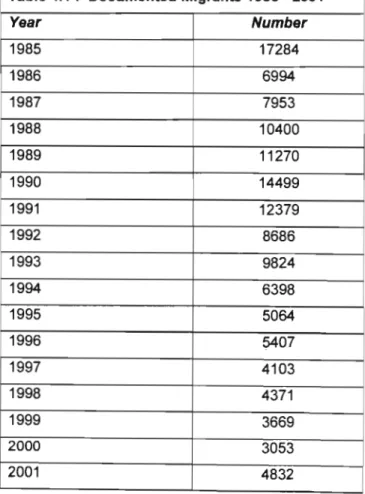
STATISTICS ON LEGAL IMMIGRANTS
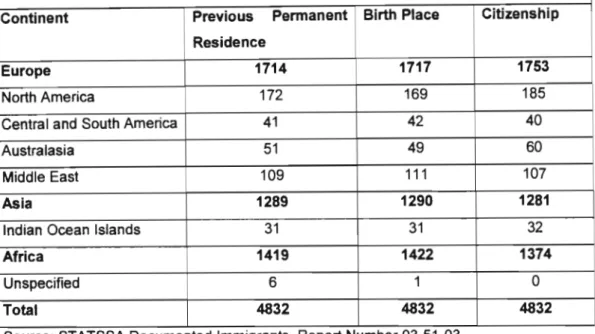
It is interesting to note the influx of immigrants from the Asian continent that began in the mid-1980s (STATSSA Documented Immigrants, Report Number 03-51-03, iv) which, from the point of view of apartheid policy, was something to be avoided at all costs. avoid. However, Africa and Asia together account for 55% of total immigration for 2001, representing a significant shift away from receiving most immigrants from Europe.
REFUGEES AND ASYLUM SEEKERS
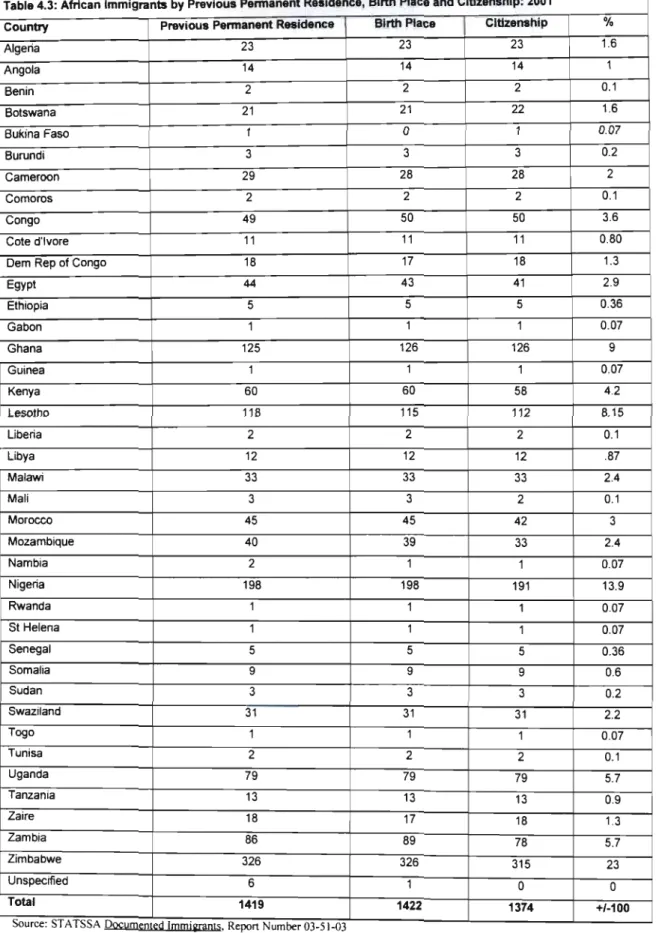
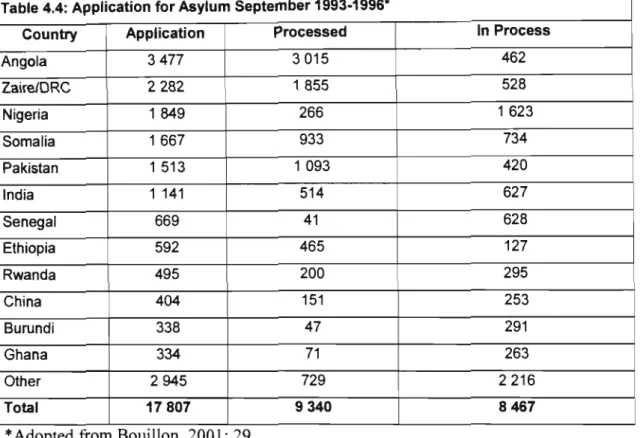
One can note that the number of documented Malawians is only 33 or 2.4% of the total. Clearly, official documented data on immigrants do not adequately reflect the changes taking place in tens of the number of foreign Africans in the country.
AFRICAN CONTINENTAL IMMIGRATION INTO SOUTH AFRICA, WITH SPECIFIC REFERENCE TO FRANCOPHONES IN JOHANNESBURG
Kadima argues that in the case of the waves of Congolese immigrants arriving in South Africa, they can be divided into five periods. In the case of Nigerians, three main reasons are given for coming to South Africa.
FOREIGN MIGRANTS AND FORMAL WORK
This indicates a longer historical and significant cross-border migration in the North-West Province, mainly due to the mines employing foreign migrants. The sample of respondents is also dominated by foreign migrant workers from SADC countries.
CONCLUSION
The majority of migrants are within the age group of 15 to 35 years and are (or wish to be) economically active. They are mostly not found in the construction industry and very few trade visibly on the streets as informal traders.
INTRODUCTION
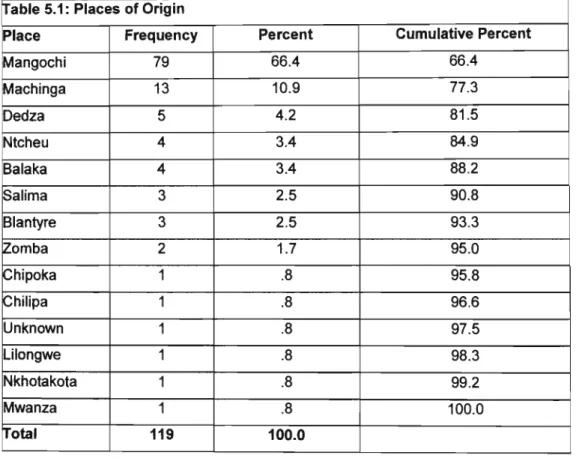
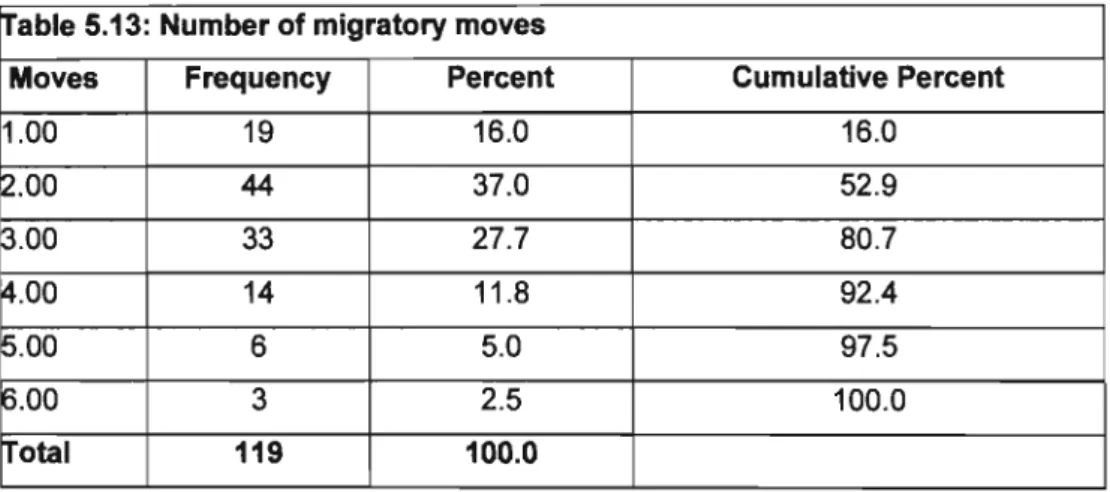
The chapter also gives some indications of the problems they face, and their perspectives on continued contact with and possibilities of returning to Malawi. The next section continues to examine their migration movements from Malawi to Durban, illustrating the number of migration movements prior to arrival in Durban in terms of the reasons for each move, and the employment and residence practices at each destination en route to Durban.
THE SOCIAL PROFILE OF MALAWIANS
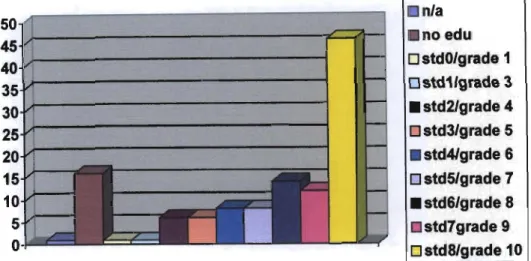
- Educational Levels
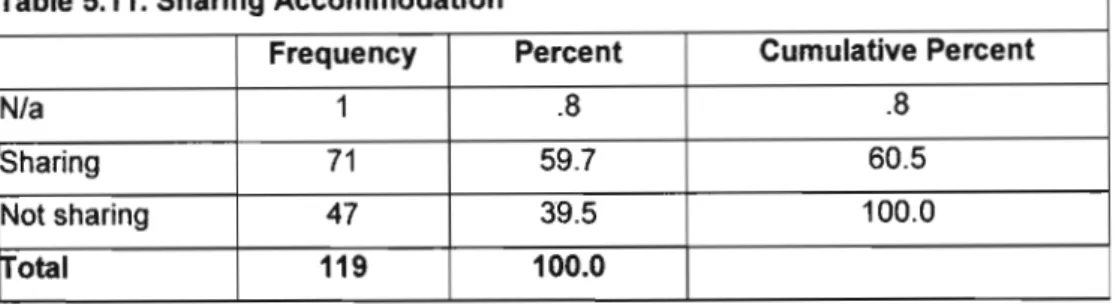
It is not certain how widespread this incident was in the consciousness of the Malawians interviewed here. But in Table 5.9 below, the figures suggest that accommodation with friends and relatives was only slightly less than 50% (47%) of the total sample.
MIGRATORY MOVEMENTS FROM MALAWI TO DURBAN
- The number of migratory movements
In Table 5.20, 66% of the respondents lived with parents or some other member of the family (family is defined very broadly to include parents, siblings, uncles, aunts, cousins). Fifth, the majority of migrants are employed by other people (44%), although 28% are self-employed.
CONCLUSION
In the first move, most migrants were self-employed, but with the move, more of them seek and accept employment than employees. Female migrants are not a significant part of the migration pattern, but those who do migrate are usually married first and therefore migrate to join their families.
INTRODUCTION
FORMAL EMPLOYMENT
Overport and Morningside are closer to Durban's city center than any other northern suburbs.). The interpretation of these figures should be cautious, but should be seen in the context of the length of previous employment.

RETURN MIGRATION
This range provides an indication of the time and commitment of Malawians to the jobs they have taken or accepted. Implicit in this duration of employment is the fact that, as foreign migrant workers, they are willing to work for less than the local population, with all the vulnerability that entails: vulnerable to the threat of exposure to the authorities, vulnerable to the threat of xenophobic attacks on their person. , and to continue earning lower wages than their South African counterparts.
INFORMAL TRADING
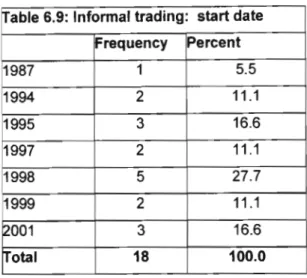
Most traders in Malawia denied employing anyone, much less employing a local South African, or 'Zulu' as they would call it (see Table 6.15). But at least 10 of 22 Malawian traders say they employ someone more or less permanently, but most declined to elaborate beyond simply acknowledging that some people do have jobs.
INCOME AND REMITTANCES
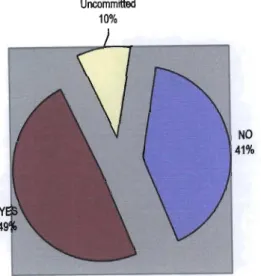
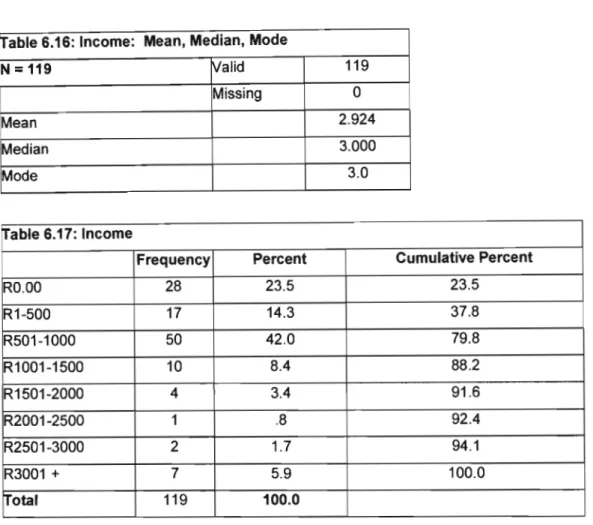
In contrast to the table above which indicates that 50% of the population send money back to Malawi, Table 6.20 below shows that the actual number is only about 48%. In Table 6.20 above, it can be seen that the amounts transferred vary enormously from hundreds to thousands of rands per month.
CONCLUSION
Surprisingly fewer than this researcher expected are self-employed entrepreneurs in the informal sector. These issues are further explored in the context of individual biographies in chapter seven, and as part of the debate on citizenship and migration in chapter eight.
INTRODUCTION
We will explore this question of identity again in the next chapter through the prism of citizenship. In the following section, I outline some of the main characteristics that distinguish the different groups of mainland African migrants in the city of Durban.
COMPARING CONTINENTAL AFRICAN MIGRATION STRATEGIES
Malawians, because of the longer ties they have with South Africa, tend to be able to connect with a well-established network of their own nationals. To identify their own countrymen, as in the case of francophones - French-speaking immigrants, such as the Congolese.
REVIEWING THEORETICAL INSIGHTS
In part, the decision to migrate depends on imperfect information about the place of destination (Sjaastad, cited in Boyle, Halfacree and Robinson), which is different from their knowledge of the place of origin. However, it lies at the level of the individual, family or household. that a decision to migrate is made.
MIGRANTS: MARGINALISATION AND OPPORTUNITIES
It is based on 13 in-depth interviews, as well as a sub-sample from the statistical survey of the previous two chapters. Some of the data obtained through the survey will be analyzed to provide a context for the more qualitative data analysis.
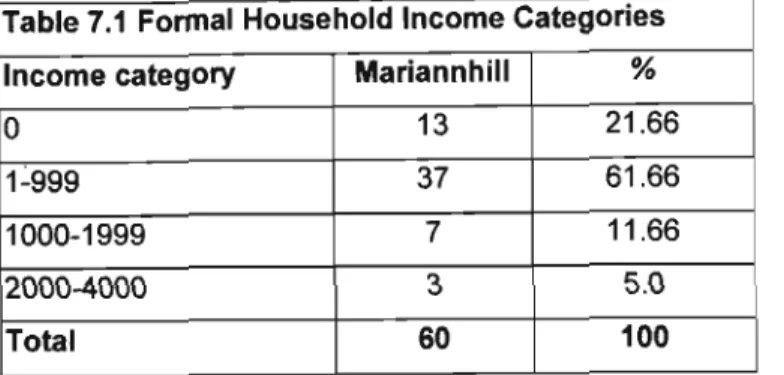
MARlANNHILL AND MALAWIAN STRATEGIES: LIVING AND WORKING ON A URBAN PERIPHERY
- Use of networks
Mosal: I worked in the Eastern Transvaal first in one of the sugar mills for about 20 years. Imperfect knowledge of the actual conditions in Durban is thus not a fundamental deterrent to migration.
NETWORKS AND EARNING A LMNG
Rather, it is indicative of deferring immediate income with a long-term view that at some point in the future they will find work or some form of economic sustenance. It is also possible that at some point in the future, depending on the circumstances of their hosts, friends and family, they may exhaust the patience and generosity.